I've been a fan of Japanese popular music for 40 years, and have managed to collect a lot of material during that time. So I decided I wanted to talk about Showa Era music with like-minded fans. My particular era is the 70s and 80s (thus the "kayo kyoku"). The plus part includes a number of songs and artists from the last 30 years and also the early kayo. So, let's talk about New Music, aidoru, City Pop and enka.
Credits
I would like to give credit where credit is due. Videos are from YouTube and other sources such as NicoNico while Oricon rankings and other information are translated from the Japanese Wikipedia unless noted.
Showing posts with label Tomomi Nishimura. Show all posts
Showing posts with label Tomomi Nishimura. Show all posts
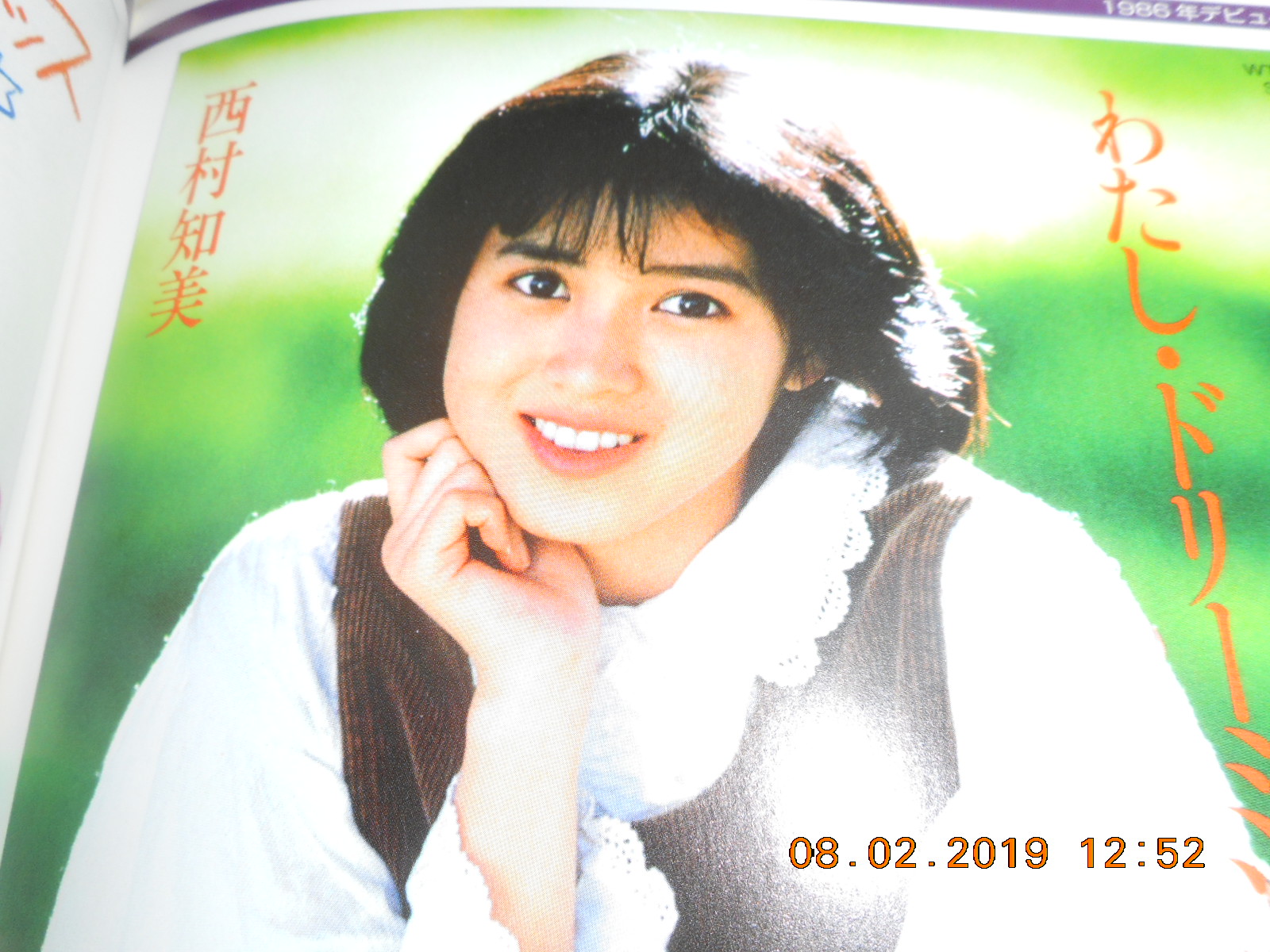
Well, call me gobsmacked! Here we are...over a decade into this wonderful world known as "Kayo Kyoku Plus", and I have found out that the only mention of 80s aidoru Tomomi Nishimura(西村知美)up to tonight was via Marcos V.'s list of Eurobeat kayo...all the way back in December 2013! Considering that I've known Nishimura not only for her aidoru tunes but also for her frequent presence on television over the years as a tarento, I feel like that I have to Gibbs slap myself upside the head for this shocking neglect.
Fortunately, I can add Nishimura's 2nd entry to "Kayo Kyoku Plus" in October 2022 with a pretty slick aidoru number called "Mizutama no Gorilla" (Polka-Dot Gorilla). At first blush, I had assumed that a song with that title would be a B-side on one of her singles, but actually, it's a track on her July 1989 album"Mezzo Piano". It's a cheerful song about a zoo gorilla, a bunch of young folks and a polka-dot handkerchief which would make for a nice anime or really silly but heartful comedy on Japanese TV. Give thanks to lyricist and Onyanko Club/AKB48 maestroYasushi Akimoto(秋元康).
As I said the melody and arrangement are pretty cool. It's almost like an aidoru tune overlaid on top of some City Pop beats, and that is due to Etsuko Yamakawa(山川恵津子), someone that I've known for providing darn kakkoii music to aidoru and singers of the City Pop persuasion such as Junko Yagami(八神純子). When I read who it was behind the melody, I went "Ah, naruhodo".
Between 1986 and 1994, Nishimura released 22 singles and 8 albums. For some reason, I had thought that Nishimura was part of the aforementioned Onyanko Club(おニャン子クラブ), but such was not the case. I do know that the lass had married a famous chef Takumi Nishio(西尾拓美)in the late 1990s. He had been an actor and a singer but once he left the entertainment business behind, he went fully into cooking and has opened up a number of his own restaurants.
Hi everyone. It’s my time to contribute with a
list of some personal favorite Japanese songs from the 80s. I don’t pretend to
waste many lines in the introduction, but some important characteristics of my
list must be told before starting with the proper songs.
First, my main theme, eurobeat, is one of the key music
genres of mainstream Japanese music during the mid-to-late 80s as it
contributed with new musical and fashion aesthetics to the Japanese pop
landscape. Based on that, my method in most of the entries is to introduce one
special song and kinda tell a story related to the particular style of eurobeat
of the song and, also, related to the performer. It’s an interesting exercise
I’ve been developing in the blog since I started contributing earlier this
year. This practice also helped me organize my ideas and conclusions, and I’m
very grateful to JTM, nikala, Jari and especially J-Canuck for letting me write
my confuse thoughts in this very special space.
Second, an important, and maybe secondary,
characteristic of my list is that it’s only comprised of aidoru singers, with
no single exception. Some of them might be perceived as being more aidoru than
others, but, in the end, they’re all aidoru singers. This particular feature is
secondary because, in no moment, I had the intention of doing an aidoru list.
To be honest, most of the aidoru singers I chose to be part of my list would be
out of any serious aidoru-focused list. That’s why I put emphasis on the eurobeat
theme and not in the aidoru one. Summarizing, I see my list as a compilation of
interesting fusion moments between aidoru and the eurobeat sound. Also,
this post isn’t just about the songs. Sometimes I’m going to talk more about
other things, like fashion or the transformation suffered by the aidoru world,
than of the songs themselves. But the writing is ALWAYS based on the song, so
try to understand what I’m talking about with the song and the video (when it’s
available) in mind.
Third, I must warn that although my list is
MAINLY based on eurobeat, some songs are not in this category. They are kinda
shuffled with the others, but it’s not that difficult to identify them.
Last but not least, the reader must pay
attention to one important thing. This list is, by no means, absolute. My main
intention while selecting the songs was to construct a nice balance between
singles (some of them hit singles, some of them not) and album tracks. This
choice was very arbitrary, as I wanted to highlight some hidden gems over the
well known singles and hit songs. With other acts, I simply chose to talk about
famous singles.
Well, I ended wasting everyone’s patience with
the introduction. Let’s just start this list and have a great time.
I always found very interesting how trends come
and go. As the aidoru days were slowly coming to an end, some accomplished
aidoru singers just decided to change their styles and adapt themselves to new
trends, like the eurobeat trend that emerged after the mid-80s.
The beautiful and tanned Hidemi Ishikawa, owner
of one of the cutest cheeks of the aidoru world, started releasing synthpop
inspired songs around 1986 with a cover of the Pet Shop Boys sophomore single
“Love Comes Quickly”. But “Everynight” is, for me, the best example of her
eurobeat ambitions before retiring from the music scene in 1990 after a scandal
involving pregnancy and rushed marriage. Typical unfortunate aidoru story. Released in 1988, “Everynight” is different in sound from the "Stock Aitken Waterman" brand of eurobeat that became very popular in Japan one year after, in 1989, with Chisato Moritaka’s (森高千里) “17-sai” (17才), Wink’s “Ai ga Tomaranai ~Turn it Into Love~” (愛が止まらない), Minako Tanaka’s (田中美奈子) “Namida no Taiyou” (涙の太陽) and Eriko Tamura’s (田村英里子) “Shinken (Honki)” (真剣). That said, it was an early type of eurobeat more comparable with the Italo Disco sound that was starting to fade away in Europe in favor of House music. About this subject, it’s interesting to note that while Italo Disco and eurobeat were decreasing in popularity in Europe, it was, at the same time, becoming even more popular in Japan (and in Soviet Union, but that’s not the point here). This process resulted in a natural change of focus as Japan virtually became the only Italo Disco importer during the late 80s and early 90s. Basically, Japan became the main cash cow to Italy’s disco producers, a phenomenon that constituted what I call Japan’s “first dance craze”. This phenomenon faded around 1992 and 1993 to resurge even more powerful in 1995 as the “second dance craze”, when Namie Amuro (安室奈美恵) conquered the charts with her eurobeat covers of Lolita’s “Try Me”, Veronica Sale’s “Season” and Sophie’s “Stop the Music”. Back to the “first dance craze”, Italo Disco also faced competition from the English brand of eurobeat masterminded by Stock Aitken Waterman (SAW). Their main “product”, the cute little Australian singer Kylie Minogue, hit really big in Japan around 1988 and 1989. This instant popularity led to many Japanese covers of her hits, like the aforementioned Chisato Moritaka, which covered Kylie’s version of “The Locomotion” in her “Mite Special Live Concert” (見て ~スペシャル~ライヴ in 汐留PITII 4.15.'89), and Wink, which covered many songs of the teen star, with “Ai ga Tomaranai ~Turn It Into Love~” being the most representative of them. In the end, both Italo Disco and SAW’s artists
were popular in Japan, while Italo Disco experienced a much more important role
in the advance of eurobeat with the “Super Eurobeat” compilation series that
started in 1990 and… well, it’s still going on in 2013. In the case of Hidemi’s “Everynight”, its charm
consists of the aggressive synths and the edginess portrayed by Hidemi’s vocals.
Aidoru singers who started recording eurobeat songs during the “first dance
craze” period had two options. First, the fluffy and sugary vocals combined
with playful eurobeat melodies and, second, a more serious and clubby approach.
Hidemi went with the second option here on “Every Night”, and it was a nice
idea as she was kind of leaving the cute aidoru days behind. All in all, I enjoy Hidemi’s “Everynight” a lot.
It represents very well this transition from mildly successful aidoru singer
into a more “dance diva” kind of singer that happened quite frequently during
the late 80s.
Eriko Tamura is not a common artist in any list,
but I had to include her beautiful “Tsumetaku Shinaide” in my list for one
specific reason: the melodramatic melody combined with the orchestral synthpop
arrangement offers a nice example of majestic pop sensibility that was common
during the 80s. Of course Eriko’s voice (and pin-up beauty) was a nice treat
too. I always think that she should have been a more successful aidoru based on
her vocals, but some lackluster songs didn’t help her achieve the deserved
fame. We must remember that the late 80s also represents the end of the aidoru
era, and Eriko’s image was more suitable for the early-to-mid 80s than for the
end of the decade. Despite that, her debut album, “May Be Dream” (released in July 1989), is a nice and
polished selection of late 80s dance-pop/eurobeat songs. Based on that, the
inclusion of “Tsumetaku Shinaide” in this list is my tribute to this great
phase of her career.
Being honest, though, Eriko’s material is not the
best example of 80s dance-pop, neither is “Tsumetaku Shinaide” an outstanding
song that stood the test of time. At the same time, although her production
team was clearly emulating a trendy sound in order to sell more records, the
melodic pop sensibility that I talked earlier is very noticeable in this little
romantic piece. In fact, Eriko sings it like a Cinderella. A beautiful song,
indeed.
This song is probably the most out of place of the bunch, but I like it so much that I needed to include it in this list. On the other hand, it would not be so off in JTM’s list that was posted earlier.
Not an eurobeat or synthpop song, “Shadow Hunter” (released in February 1987) could be better placed in the early-to-mid 80s, during the start of the burikko aidoru era inaugurated by Seiko Matsuda (松田 聖子). It reminds me vaguely of some Kyoko Koizumi’s (小泉 今日子) hits around 1984/85. Also, the song has quite a dynamic with all the horns and the bouncy bass line. Its overall sound makes me think of some spy movie or series. In reality, it was a “Sukeban Deka III” (スケバン刑事III) related song, which may explain its live action sound and adventurous feeling.
Yuka Onishi was never the best aidoru singer, nor the most famous one, but the "Sukeban Deka III" exposure had quite a positive impact on her career (she was one of Yui Asaka’s [浅香 唯] sisters in the series). Around 1989, though, instead of switching to an eurobeat sound like many of her contemporaries, she invested in a rock sound with an aidoru approach. She was quite daring trying to compete with PRINCESS PRINCESS and other all-female rock bands. Even the talented Minako Honda (本田 美奈子) failed to be successful with a similar strategy. Back to Onishi, she slowly retired from the
music career, and eventually got nude in a photo shoot (1999). I must confess
that it wasn’t nice to see a former 80s aidoru getting naked in exchange of
some bucks. I felt bad for her, and seeing the photos I can almost assure she
wasn’t happy at all. Or maybe I’m being too sentimental about my 80s aidoru. Nonetheless, the young and cheery Yuka Onishi
will always be in my memory singing “Shadow Hunter”. I bought an old Yuka
Onishi CD just because of this song (I ended liking the whole CD, though).
07) Megumi Hayashibara (林原めぐみ) -- Yoake no Shooting Star (夜明けのShooting Star)
Megumi Hayashibara is not a 80s singer. Although some rare and not memorable late 80s songs can be found in her discography, her major label debut as a singer was only in early 1991. On the other hand, she recorded one solid pop song in the 80s, “Yoake no Shooting Star”, an image song for the character Christina “Chris” MacKenzie (クリスチーナ・マッケンジー) from the anime OVA “Mobile Suit Gundam 0080: War in My Pocket” (機動戦士ガンダム0080 ポケットの中の戦争). “Yoake no Shooting Star” is a nice song, but nothing spectacular. The arrangement is just straightforward pop with a loud and cool synth melody that tastes like 80s right from the beginning. But what make it stand out is Megumi’s vocals, which are strong, full of cheerfulness and charisma. Based on that, it’s interesting to notice that “Yoake no Shooting Star” was also Megumi’s first recording ever. According to her autobiography manga series, she had to sing the song at an event in place of Megumi Shiina (椎名恵). Firstly, though, she had to have her vocal range tested, and in that specific day, she was sick with a high fever, which resulted in horrible vocals. But a man from the King Records (キングレコード株式会社) label listened to her and, somehow, liked what Hayashibara delivered. Finally, it was decided afterwards that “our” Megumi was going to officially record the song, which she did (for the source of this story, click here). And that’s the story behind Megumi Hayashibara’s first recording in early 1989. “Yoake no Shooting Star” got a spot in Megumi’s
sophomore album “WHATEVER” (1992), and in two of her compilations, “VINTAGE A”
(2000) and “VINTAGE WHITE” (2011). Also, Megumi seems to like the song very
much because she often includes it in her concerts, like in the 2002 concert
that is featured above. The arrangement is the original 1989 one (Megumi rarely
sings with a live band in her concerts), but with Megumi’s live vocals.
06) Aya Sugimoto (杉本彩) -- 13-Nichi no Runa (13日のルナ)
The late 80s/early 90s were a very curious moment of Japanese mainstream pop music. Some strange characters, like Chisato Moritaka and Minako Tanaka, were artistically created in this period, and with a sexy appeal that was buried since the late 70s. We all know that, overall, the 80s aidoru era was a time where the virgin and naïve aesthetics were an essential factor in the construction of female stars. Of course a very specific type of sexuality was present in this discourse, but it was different from what aidoru acts during a pre-Seiko Matsuda period, like Pink Lady (ピンク・レディー) and Momoe Yamaguchi (山口百恵), represented. Although the aforementioned Chisato Moritaka
and Minako Tanaka were sexy aidoru singers, Aya Sugimoto was more explicit and
wild if compared to them. Her stage persona, directly influenced by Italian
eurobeat singer Sabrina Salerno, was famous for some raunchy and over-the-top
performances. For instance, Aya’s debut single, “Boys”, was a cover of
Sabrina’s hit that became famous around Europe because of the explicit music
video where she happily reveals her large breasts in a swimming pool (check
this AMAZING video here. Unfortunatly you need to have a YouTube account because of some age restriction). And although Aya couldn’t go that far in Japan, her
bouncy breasts were also a highlight of her dance-oriented performances.
As for “13-Nichi no Runa”, which was released in December 1988, I don’t quite
remember when I discovered it, but I do remember that I became quickly addicted
to its catchiness. And yes, I know Aya Sugimoto was a very bad live singer, but
I just tend to ignore her lack of singing talent in favor of nice disco songs
and some sexy appeal. Back to the song, like most of her other wannabe hits,
it’s a nice example of the eurobeat/Hi-NRG sound of the late 80s. Her
energetic performances were nice to watch too.
After reading a 2008 interview with Aya Sugimoto
(for the interview, click here), I concluded that she acts like a self aware
woman who was defending feminine empowerment back in the late 80s. In her
words, “it would be difficult to wear clothes like that if it were not
accompanied by a new kind of spirit”. Also, “when I [Aya Sugimoto] wore sexy
clothes in the ’80s and the ’90s, it caused a stir”. These phrases induces the
reader to believe that Aya Sugimoto was almost revolutionary at the time, which
is kind of ambiguous as she was more like a sex toy teasing a male fan base
than a female empowerment icon. Besides that, she really devoted her entire
career in maintaining the status of a sexy symbol that defends sexual freedom.
Aya’s concrete and apparent sexiness, like the
tamer sexiness portrayed by Chisato Moritaka and Minako Tanaka, was one example
of the transformations experienced by the aidoru category during the late
80s/early 90s. That strange transition of pure/virgin aidoru into a more
sexualized type of aidoru is one of my favorite subjects and one that it’s not
very discussed in the English speaking world. I, for example, consider singers
like Aya, Chisato and Minako to be kind of ahead their time, just because sexy
divas like Namie Amuro and MAX were yet to rule the J-Pop world. These three
young ladies were not actual aidoru artists, but not out of this particular
landscape either. And I just find kind of strange how everyone actually ignores
the blatant sex appeal of these artists when constructing the J-Pop history. It
gives the impression that the kawaii and virgin aidoru ideal model of the 80s
gave space to the energetic and sexualized image of Namie Amuro in the mid-90s
while nothing else was created between these two extremes. Based on that, I
believe that Aya Sugimoto, for example, can be seen as a transition artist, or
something like that. I’m also aware that this type of sexualized aidoru singer
was not very successful, with the exception of Chisato Moritaka. The lack of
success is probably a reason for their constant absence in the J-Pop history,
and that’s understandable. It’s also important to remember that the fall of the
aidoru category from the top of the entertainment world represented a niche
division where different types of aidoru singers with a specific fan base in
mind were created, and the sexy aidoru type was one of many new types that were
trying to survive with a limited fan base.
Well, I’m not advancing in this territory now, but some other artists of
this specific list are going to be used to talk a little more about this
subject.
Strange theories aside, Aya Sugimoto is one of
my many guilty pleasures. I just have a thing for cheap dance-pop music of the
80s and not so talented performers. As for “13-Nichi no Runa”, it’s not a
groundbreaking song, but I remember how much I liked to study while listening
to it and other Aya Sugimoto’s songs during my graduation years. She was
probably the first “forgotten aidoru” I became a fan.
I was in serious doubt if Tomomi Nishimura’s “Nemurihime” was the right song for my eurobeat list. This song was in a serious battle with Noriko “Nori-P” Sakai’s (酒井法子) “Wagamama Syndrome” (ワガママ・シンドローム) (you can listen to it here, if you want), but I ended up with “Nemurihime”. Basically, I chose it because of a more complex arrangement if compared to Nori-P’s “Wagamama Syndrome”. I like both, but I don’t think Nori-P’s song would add something new to this list. Besides being a catchy and straightforward pop song, “Wagamama Syndrome” didn’t offer significant twists and innovations.
Back to “Nemurihime”, it’s a 1989 eurobeat song
with some interesting elements. Although I’ never been a true fan of Tomomi
Nishimura, mostly because of her weak vocals, I liked her delivery in “Nemurihime”,
especially when the ballad introduction gives place to the full synth
arrangement. One of the main characteristic of “Nemurihime”,
and of Nori-P’s “Wagamama Syndrome” as well, was the mixture of a mildly cutesy
style with a mysterious synth arrangement. In fact, it wouldn’t be out of place
in a Wink album of the late 80s. In the “Yoru no Hit Studio” live version
presented above, a lot of the synths are not audible. Like in many “Yoru no Hit
Studio” performances, the horns are actually taking the place of the synths. I
only decided to post this performance because the song is played almost in its
entirety, and, well… 80s, for me, is almost synonym of “Yoru no Hit Studio”. But
trust me, “Nemurihime” is a cool eurobeat song, and not a full orchestra disco.
04) Minako Tanaka (田中美奈子) -- Namida no Taiyou (涙の太陽)
Maybe I’m just a fool, but I like Minako Tanaka
very much. I like her image, her beauty, her sound and her vocals a lot. No
deeper reasons. Just like it. And do I know her entire discography? No, it’s
rare. I only know her singles and some of her album songs, nothing more. But I
consider myself a fan.
The first time I saw Minako Tanaka on YouTube
singing “Namida no Taiyou” I just couldn’t stop thinking of Chisato Moritaka.
It was the same style of music and a very similar image (Chisato’s image became
a lot more extravagant and campy, though). But besides being a “copy”, I liked
Minako’s vocals and beauty very much, which was a plus for her. Like I said
above, I’m a fan, and I started considering myself one right after the moment I
just described. It was around May or June 2011. “Namida no Taiyou” was Minako’s debut single in 1989. Let’s just call it the eurobeat rendition of “Namida no Taiyou”, as the song was covered by a lot (and I really mean a lot) of different artists since it was originally recorded in English as “Crying in a Storm” (1965) by “Japanese-born-but-raised-in-England” singer Emy Jackson (エミー・ジャクソン) (for Emy's original version, click here). About that, I think Japanese eurobeat singers had a thing for turning non eurobeat songs into eurobeat. Chisato Moritaka did that with the classic “17-sai”, while Wink… well, Wink did that with so many songs that it’s hard to make a proper account. In fact, Minako Tanaka’s second single, “Be My Baby”, was also an eurobeat cover of an old classic. Back to Minako’s version of “Namida no Taiyou”,
I find it very energetic. The arrangement is not made of classy or laidback
electronic sounds, but of loud, memorable and sharp synths. And combined with
Minako’s girly vocals, the result was an interesting listening experience. The
bridge is also something to keep an eye for (or ear, in this case) as the
keyboard sounds are mixed with a robust bass that features a lot of slapping. Minako’s version of “Namida no Taiyou” was not
a big hit, reaching only #18 on the Oricon charts. To be honest, none of her
songs would conquer the status of hits. She was just a sexy female pop singer
that could hardly be labeled as an aidoru. Nevertheless, I thought she deserved
a spot on my personal list.
BONUS TRACK) Sophie -- SOFT TIME (RED MONSTER MIX)
“SOFT TIME” is just a bonus I decided to
include in my “eurobeat” list before my top three songs. As it’s a classic 1989
eurobeat song which was included in the first volume of the “Super Eurobeat”
series, the only thing that makes it an outsider is the fact that it isn’t a
Japanese song, but the original Italian recording sung by Sophie (Elena
Ferretti).
I first discovered this song in early 2011 when
my Wink fanboyism was bigger than the stratosphere. Although I had had contact
with eurobeat before in two different times, in special when I discovered
Chisato Moritaka a year before, in 2010, I just didn’t became a fan of the genre before 2011. As I recall, Chisato got me into the overall aidoru world, and
eurobeat was just a secondary factor for me at the time. It was really with
Wink and their “Stock Aitken Waterman” brand of dance-pop (which was somehow
called eurobeat) that I started listening to eurobeat more seriously, and “SOFT
TIME”, a song I found listening to this first “Super Eurobeat” volume, still is
my favorite song of the genre (I soon discovered that almost nothing really
sounds like it, but that’s another story).
As for “SOFT TIME”, well…, the song is just
amazing, and this “RED MONSTER MIX” I decided to include just take things to
another level (it’s an official remix. I have it on CD). It’s not very
different from the original in structure, but the slight changes are just
amazing, just like when the synths in 6:13 mark are apparently going into a
higher register, and then Sophie comes back with the chorus before the ending.
What I also like is the common eurobeat practice of intercalating vocals with
the arrangement, just like after the 4:53 mark. Finally, the vocals, just like
the title, are very soft and beautiful, which contributes to the overall
melancholic vibe of the song. In the end, it’s a killer song, for sure.
Nothing better than a song starting with very sharp
80s synths and a groovy bass line.
“Mermaid” is my favorite song by classy aidoru
singer Miho Nakayama. Released in 1988, this summer gem is a funk/synthpop
masterpiece. I just can’t get enough of the raw and sharp synths used in this
song. As for Miho, her vocals became very mature around late 1987/early 1988,
and that’s visible in “Mermaid”. She really did a good job with this one. It’s
a pity she couldn’t deliver a high-level performance of it in live TV shows,
although she nailed it in her 1991 concert (you can watch it here). Besides being a very pretty young lady and a decent singer, I never found Miho very charismatic on stage. Her songs, on the other hand, were very nice during the 80s. Just like Wink’s “Samishii Nettagiyo” (淋しい熱帯魚), “Mermaid” is a very synth rich song, which is an important characteristic of the 80s. Unlike today’s American mainstream electronic music, which relies heavily in one or two synth hooks, mainstream electronic music in the 80s was, overall, more sophisticated (although raw and rudimentary in its sound). As synthesizers were one of the main new musical technologies of the decade, experimentation (and exaggeration) was at its peak. Nowadays, on the other hand, synthesizers are not used in a very creative way. Maybe the overall musical aesthetics changed a lot in the last thirty or twenty five years. Of course that’s just a personal feeling, but I thought it was nice to share my view. Back to “Mermaid”, it earned Miho’s third #1
single on the Oricon charts. Also, it was released in the same day of her
seventh album “Mind Game”. Although it wasn’t featured in the album, “Mermaid”
is a nice start to the overall feeling and sound of this album, as both relies
in a summery funk/synthpop sound. In that way, it works like an appetizer
before the main dish. Some songs from the album, like “Strange Parade” (my
favorite from the album. Check it here right after the 5:40 mark) and “Mind Game” (listen to it here), are even kind of
similar to “Mermaid” in structure and arrangement, which is not a bad thing at
all. All in all, I deeply recommend this one Miho album, “Mind Game”. It’s my
favorite from her career.
Her name has appeared many times before in this list, but her real time was yet to come. She's the main artist now, and she holds the second position in my ranking.
First of all, I must confess that I have the
bad, very bad habit of including this song in most of my “favorite songs” lists.
And the poor Moritaka, a singer with an overall great catalogue, ends up being
represented with this song, one she probably isn’t proud of nowadays. Cheap
talk aside, I love this song very much. It represents Moritaka’s extravaganza
at its best, both sonically and visually. We can really tell that after
“17-sai’s” success, she went even far into the campy style.
With typical late 80s synths, “Korekkiri Bye
Bye” is a very cheesy and horribly outdated song, or, in a more positive view,
a straightforward shameless bubblegum dance-pop song from the late 80s (“Stock
Aitken Waterman”, I’m looking right at you). The girl surely had guts to
perform a song like "Korekkiri Bye Bye" dressed like… well, I don’t know how to describe THIS "fashion style", but it looks like a heroine from a cartoon, at least (and this was
before “Sailor Moon”, for god’s sake). I’d really like to know what Moritaka
and her fashion staff were thinking when they came up with this look. “Korekkiri Bye Bye” can be found in Moritaka’s fouth studio album “Hijitsuryokuha Sengen” (非実力派宣言), which was released in July 1989. This particular album represents the start of Moritaka’s peak as an aidoru singer. To be honest, though, there’s quite a discussion about Moritaka’s status of an aidoru. As pointed out by Ian Martin, “she [Chisato Moritaka] existed in a strange sort of limbo between the end of the kayokyoku in the late 80s and the birth of J-Pop in the early 90s” (click here to read the full article). Also, Patrick St. Michel wrote that “the peak of her career happened after the golden-age of ’80s J-Pop, and just before acts like Namie Amuro and Ayumi Hamasaki became powerhouses across all of Asia” (click here to read the full article). As I agree with both of them, I understand that it’s difficult to call Moritaka an aidoru strictus sensus, but I can’t help thinking of her as such. That’s a tough dilemma.
Wink’s “Samishii Nettaigyo” could not stay out
of my list. Although “Ai ga Tomaranai ~Turn It Into Love~” is a personal
favorite, “Samishii Nettaigyo”, which was released in 1989, is not very far. Also, the plus of this song, or
the reason why I chose to reserve a spot for it in my list, is that it’s a very
influential pop song. Besides being a classic on its own, “Samishii Nettaigyo”
has been covered by a lot of artists, like actress Nana Katase (listen to it here), 90s eurobeat
girl group MAX (listen to it here), Hello! Project aidoru
duo W (listen to it here), and also by Anglo-Irish girl group from the 70s The Nolans, which Wink
also covered some of their songs like “Sexy Music” and “I’m in the Mood for
Dancing” (by the way, The Nolan’s english version of “Samishii Nettaigyo” is
called “Tidal Wave”. Listen to it here).
For me, personally, “Samishii Nettaigyo” also
marks the real birth of Wink as a musical act on its own. I’m saying that
because most of their earlier hits were Japanese covers of European pop/disco
songs, while with “Samishii Nettaigyo” the duo started to make their successful
path as a true act, and not a cover based act (they continued relying heavily
in cover songs, but they also released a bunch of successful original tracks).
Their songwriting team did that emulating the overall trendy synthpop/eurobeat
sound of their time, and also combining it with Wink’s emotionless and
vulnerable stage personas. The result was the great “Samishii Nettaigyo”, an
upbeat but sad dance-pop song about an unrequited love and some water
metaphors. Also, worthy of note are some specific parts of the song like the
main synth melody, the instrumental breakdown with the melancholic synth notes
and, of course, the catchy chorus. Overall, this song offers an amazing synth
arrangement full of details and spacey sounds in the background (my favorite
performance of this song is from "Yoru no Hit Studio" where three keyboard
players were reproducing all the electronic sounds live. It was a dream to see
a band with so much live synthesizers being played and just one guitar player.
Something like the revenge of the synthesizers. You can check it here after the
5:40 mark). Making it even better, like a cherry at the top of the cake, the
bass line is monstrously groovy. In the end, “Samishii Nettaigyo” surely
deserved to be the smash hit it was and, also, the top song of my list.
As a funny story, one of my best friends says
he can’t like Wink, especially this “fish” song (that’s how he calls it). The
raw synthesizers are probably too much for him, and Wink’s lifeless stage
personas don’t help at all. One day, after a discussion involving Wink, I put a
Perfume concert, and he instantly said it was a lot better than Wink. But he’s
a nice guy who watched the whole Wink concert in DVD with me some years ago
simply because we’re friends.
Well guys,
that’s it for today. Thanks a lot for taking some time to read this long post.
I just hope this selection introduces some nice songs and a couple of ideas I chose to develop as well. It was a very
difficult, but pleasurable exercise. Of course I could change this list almost
every day, but that’s just one bad consequence of “best of lists”: in the end,
we are never truly satisfied with them. But I think it’s ok for now.