I've been a fan of Japanese popular music for 40 years, and have managed to collect a lot of material during that time. So I decided I wanted to talk about Showa Era music with like-minded fans. My particular era is the 70s and 80s (thus the "kayo kyoku"). The plus part includes a number of songs and artists from the last 30 years and also the early kayo. So, let's talk about New Music, aidoru, City Pop and enka.
Credits
I would like to give credit where credit is due. Videos are from YouTube and other sources such as NicoNico while Oricon rankings and other information are translated from the Japanese Wikipedia unless noted.
Not sure if any of the KKP viewers have also been viewers of the current Olympics happening in Italy but I've been catching my fair share of the action including snowboard, ski, hockey and speed skating.
Having posted back number's"Doushite mo Doushite mo"(どうしてもどうしても)which is serving as NHK's official theme song for the 2026 Winter Olympics in Milan-Cortina (or perhaps for copyright purposes, I should say NHK's "winter sports" theme song), I decided to see what other past tunes have been used as Japanese television network themes for the Olympic games. Well, I found out that TBS' first-ever Olympic theme was introduced for the 1992 Barcelona Games and it's the coupling song to Hikaru Nishida's(西田ひかる)July 1992 13th single"Ikiterutte Subarashii"(生きてるって素晴らしい...To Be Alive is Wonderful).
"Truth" is a song that was written and composed by Hiromasa Ijichi(伊秩弘将)and it's got that jumpy and jaunty arrangement that reminds me of much of the discography of Misato Watanabe(渡辺美里). And that shouldn't be a surprise since Ijichi also whipped up tunes for Watanabe as well. Following "Truth", TBS wouldn't punch in another Olympic theme for its coverage until the Nagano Winter Games in 1998 and that turned out to be the hit "UNITE! THE NIGHT!". As for "Ikiterutte Subarashii", it reached No. 24 on Oricon.
Well, welcome to February 2026. It's hard to believe that one-twelfth of the year has already sped by but for those sports fans, there will be a delicious glut of events to look forward to. The one around the corner (as in the end of this business week) is the 2026 Winter Olympics in Milan and Cortina d'Ampezzo, Italy.
Interestingly enough, Italy also held the Winter Olympics twenty years ago in 2006 in Turin/Torino. Of course, all Japanese broadcasters for the Games had to have some sort of theme song. I actually wrote about the one for the upcoming Games in Milan-Cortina, back number's"Doushite mo Doushite mo"(どうしてもどうしても)on behalf of NHK's coverage, early last month.
For the 2006 Games, TBS brought in Kazumasa Oda's(小田和正)February 2004 22nd single,"Masshiro" (Pure White) as the station's official theme song. It's not one of those supremely rousing firebrand sort of Olympic tune but it's a relatively quiet and reassuring number for all involved in a "Hey, everything will be alright. It's all in the hips" sort of way. Plus, as usual with Oda's voice, there is that lovely creamy texture to it so I often think of hot chocolate with that big white marshmallow in the middle.
Now, some viewers might be thinking that TBS was just a little too early with the Olympic themes since "Masshiro" was released a full two years before the Torino Games. Well, that was because it hadn't meant to be an Olympic theme initially. It was actually released as a single to commemorate its status as the theme to a TBS drama which was broadcast during that time titled "Sore wa Totsuzen Arashi no you ni"(それは、突然、嵐のように…Suddenly, It Was Like a Storm) starring Makiko Esumi(江角マキコ). It peaked at No. 4 on Oricon.
Well, in less than a month, the Winter Olympics will begin anew through the joint organization by the Italian venues of Milan and Cortina. It feels as if it were only several months ago that I was writing something for the Paris Games in 2024.
Of course, with the Olympics being just around the corner, NHK will have its own coverage which means their own theme song for these Games. As well, the national network has been careful to categorize it blandly as "winter sports theme song", probably not to get the IOC's feathers all ruffled about copyright, official recognition and that sort of stuff.
This time, it's the pop-rock band back number that has gotten the gig, and although their "Doushite mo Doushite mo" (No Matter How, No Matter How) was only released as their 13th digital download single on December 27th, NHK viewers have already been hearing it for some weeks, and in fact, back number performed it on the 76th edition of the Kohaku Utagassen during their 2nd time on the New Year's Eve special. A suitably inspiring and optimistic number about basking in the glow of ultimate achievement after working one's tail off, it will hopefully get some or a lot of Team Japan onto the podium. Of course, I've got my own nation to root for as well.
Although I've heard about the band from southern Gunma Prefecture for some time, this is the first time for them to get onto KKP, and I was wondering about how they got their name. Well, apparently, the way it's been described on both their J-Wiki and Wikipedia pages, there was enough sturm und drang behind the naming to fill an entire cour of J-Drama. One big surprise to me that I discovered while looking up the band was that back number has been around since 2004 so it's already celebrated its 20th anniversary. Anyways back in the old days, vocalist, guitarist and songwriter Iori Shimizu(清水依与吏)had an ex-girlfriend who ended up as the girlfriend of a rival band member so he self-flagellated himself as a "back number" (maybe something like a "used tissue") and resolved to make his newly-named band, back number, better than the other band so perhaps his ex would return. Not surprisingly, that didn't quite happen and there were various disagreements and stuff on the odyssey to create a stable successful group over the next few years. Hey, maybe "Doushite mo Doushite mo" could also be the official song for back number's own journey. In any case, the current lineup also has bassist Kazuya Kojima(小島和也)and drummer Hisashi Kurihara(栗原寿).
I've given my translation of the title above but the official English title for "Doushite mo Doushite mo" is "Want Want Want". Unfortunately, I couldn't find the footage but that really avaricious English title reminded me of one Japanese Olympic swimmer who had just earned a silver medal but in the ensuing interview, she cheerfully admitted to some disappointment in her results and yelled out "I want gold!".
Over the past few days, I've been watching some of the Paris Olympics events including judo which truly had the thrill of victory and the agony of defeat. In the last hour, I saw Yuto Horigome win his second Gold medal in Men's Street Skateboarding; I was chuckling somewhat at the CBC announcers who apparently decided to act more like standup comedians during that event. Meanwhile, one of them was mangling Horigome's name by continuing to call him "Yuto Origami". But unlike that popular paper craft, the Tokyo athlete didn't fold and won it all once again.
Anyways, to start off this July/August 2024 week of "Kayo Kyoku Plus", I've decided to bring folks to the AI Gallery with an Olympics theme in mind.
I have to admit that the photo of Mr. Calico and Kayo is cuter than it is hot-bloodedly passionate but the AI generator kept pushing me to adjust my request. Oh, well...enjoy Ohguro's classic which is definitely fiery.
I did something unusual yesterday in that I actually ended up watching all 4 1/2 hours of Opening Ceremonies coverage of the Paris Olympics. Things did diverge from the norm with the Athletes' Parade taking place on the Seine rather than on an arena track. Plus, there was the entertainment including Lady Gaga putting on her usual flamboyant show with "Mon Truc en Plumes". Later in the broadcast, there was a whole lot of techno club music pumping away which cut into our dinner time; I don't think I've ever eaten hamburgers to hard dance music...digestion was interesting to say the least. But I have to admit that the showstopper was seeing Celine Dion, despite all of her medical troubles recently, sing "Hymne A L'Amour"; I actually got a bit verklempt.
The Games are now under way. I've seen a few of the events including judo and beach volleyball and hope to catch some of the swimming competition later on today. No problems with the Canadian broadcast but unfortunately Jme informed us subscribers that due to the usual broadcasting rights and zones, we won't be getting any Olympic coverage from NHK, although my family might get lucky with some YouTube footage.
NHK has been featuring this for the past few weeks but their "sports theme song" for these Games is YOASOBI's latest single"Butai ni Tatte" (Standing on Stage) which was released yesterday. I think for the last number of years, Japan's national broadcaster has been using "sports theme song" instead of "official Olympics theme song". I'm only speculating here but perhaps NHK got in trouble with the IOC regarding Japanese pop songs being recognized as official Olympics tunes or the network didn't want to pay any hefty fees for recognition.
Well, regardless of what "Butai ni Tatte" is labeled, we've been hearing the song alongside what news on the Olympics on NHK is provided. With its jangly high-tempo pop/rock arrangement, this could easily have been used as a theme song for any anime and maybe somewhere out there...for example, on a side of a government building...there is some anime footage with a whole bunch of characters possessing their gumption to get at sports. I've also got a feeling that YOASOBI will be making their way onto the Kohaku Utagassen at the end of the year to showcase the song.
Tomorrow is the official opening day of the Paris Olympics although there has already been some action today, and I figure that it's time to put up some Olympic fare for Reminiscings of Youth this week.
A reviewer from "Rolling Stone" once described Canadian record producer and composer David Foster as a "master of . . . bombastic pop kitsch". Like ouch! And nope, it wasn't even a tongue-in-cheek backhanded compliment. However, with all of his contributions to Canadian, American and Japanese pop music, I'd like to state that he is MY master of bombastic pop kitsch. There are songs that he helped craft for other singers that I still like to hear after so many decades.
One of them has even been mentioned before when I did an Author's Pick on the man himself back in early 2019, and that was "Winter Games" for the Calgary Olympics in February 1988. I'd already been aware of his works as an 80s pop song enthusiast but this one landed a 10 on the mat when it premiered because it sounded so epic, friendly, wintry and downright Canadian for some reason. That main piano melody has always reminded me of shushing down the ski slopes without a care in the world, and I believe that it probably hit the Japanese in a nice way, too, because over the years, my impression has been that they have always appreciated nimble-fingered piano pop from musicians like Foster and Richard Clayderman outside of Japan and their own Midori Karashima(辛島美登里)and Hiroko Kokubu(国府弘子).
So, let's see what else was being released in Japan during the Calgary Games, according to the CD/record sales calendar for 1988.
As mentioned in the previous Reminiscings of Youth article regarding Earth Wind & Fire's"Boogie Wonderland", this is a ROY twofer because not only of the passing of EWF percussionist Fred White on New Year's Day but also of the passing of Anita Pointer of The Pointer Sisters on New Year's Eve.
Now, I first heard of The Pointer Sisters back in the 1970s through their television appearances on various talk and/or music shows. Back in those days, I think that they were doing quite a lot of boogie jazz and even some country music. If I'm not mistaken, Anita, Bonnie and June even showed up on "Sesame Street" with some of their golden harmonies.
However, going into the 1980s, I remember that The Pointer Sisters also discovered the novelty and power of the music video, and one song and video that really had them soaring up on the charts was their April 1984 single"Jump (For My Love)". This video was on such heavy rotation on the local shows that I assumed that it would apply for permanent resident's status.
Created by Stephen Mitchell, Marti Sharron and Gary Skardina, listening to that beat again after so long had me swooning over how the pop music of the 1980s were. Also, The Pointer Sisters were already being seen as chart-topping superstars during the decade. Its release just before the Los Angeles Olympics was timely, especially with that title, so excerpts of athletes doing their amazing thing were included in the video. "Jump" jumped to No. 8 on Canada's RPM singles (while hitting No. 1 on the Adult Contemporary charts) and it got up to No. 3 on America's Billboard.
My condolences to the family, friends and fans for Anita Pointer.
So, what was scoring on Oricon in April 1984? I have Nos. 1, 3 and 5.
Well, this does take the proverbial cake. Almost ten years to the day after I'd put up my first Maki Ohguro(大黒摩季)song onto "Kayo Kyoku Plus", "Atsukunare"(熱くなれ), I'm finally writing up its coupling song. I hadn't even been aware of the significance of the date (July 22nd 2012) until merely a few minutes ago.
"Atsukunare" was the hit single for rock and pop singer Ohguro that was used for NHK's coverage of the Atlanta Olympic Games in 1996. For me, it still stands as the most blood-pumping J-Olympics tune that I ever heard and it could almost have me running a few laps around the block whenever I hear it. Almost.
What I had completely forgotten was that the coupling song "Soshite"(And Then), written/composed by Ohguro and arranged by Takeshi Hayama(葉山たけし)who had both contributed to "Atsukunare", was also utilized by the national television network in the 1996 Olympic broadcasts. As I remember, it was usually used as the song to end the program since the lyrics rather showed the coda of folks having joined together for a mighty effort and were now celebrating that effort through trying and triumph. "Soshite" has quite the happy and upbeat melody including one epic trumpet solo, and I can imagine young folks racing toward the shoreline to cavort about in joy and satisfaction.
Well, I only heard the news late last night right after I had finished the usual Thursday ROY article for Kim Carnes' "Bette Davis Eyes", but unfortunately Greek musician and composer Vangelis (Evángelos Odysséas Papathanassíou) passed away a few days ago on May 17th at the age of 79. He actually already has some representation on "Kayo Kyoku Plus" since I wrote about his moving contribution to the 2002 World Cup by Japan and South Korea through the tournament's official "Anthem".
And as much as he has been lauded for his work on "Blade Runner", I think that when the news came out on his death, most folks remembered the 1981 sports historical film "Chariots of Fire" starring Ben Cross and John Gielgud.
Pretty much everyone who saw "Chariots of Fire" and even those who never did will most likely remember the theme song by Vangelis and the footage of British Olympic athletes running barefoot along the sea. From what I read on Wikipedia, Vangelis didn't want to go full historical, musically speaking, but he also didn't want to go full electronic either, and so the end result was "Titles" according to the movie soundtrack list. However, for all those listeners and radio DJs out there, the song was known simply as "Chariots of Fire".
Just my opinion, but what Vangelis did in his contribution to the movie was akin to what John Williams had done with "Star Wars" a few years earlier. No one would have imagined Williams to come up with a swashbuckling score worthy of Errol Flynn to support a sci-fi movie, and so I think that it was pretty brave for Vangelis to bring in a Yamaha CS-80 among other electronic instruments to help score a movie about the 1924 Olympics in Paris, France. And yet in an age when the synthesizer was beginning to excite musicians and music lovers alike through pop music in general, "Titles" knocked the socks off of everyone as the theme for a serious movie with its combination of anthemic electronics and elegant piano illustrating something joyous, inspiring and proud.
Released as a single in March 1981, it reached No. 1 on America's Billboard chart and No. 4 in Canada. The movie itself won a couple of Oscars: Best Movie and Best Original Score. I remember it getting plenty of airplay on the radio for months. I offer my condolences to Vangelis' family, friends and fans.
Since Carnes' "Bette Davis Eyes" was also released in the same month and I've scoured through the Oricon chart there, I'll go with what won at the Japan Record Awards in 1981 to show what the big hits were.
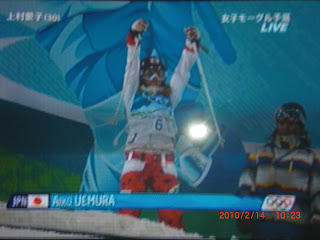
Now that the Beijing Olympics are in full swing currently, it's been nice to hear that both Canada and Japan have already been earning some medals of various colours. My mind then goes back a dozen years to the Vancouver Games in 2010...and doesn't remember very much at all. In fact, I had to go to some of those impromptu shots by my ancient Casio that I took of some of the televised footage, including the above photo showing off Aiko Uemura(上村愛子)on the moguls.
Singer-songwriter Ai Otsuka(大塚愛)is someone that I've known for her 21st-century bubblegum pop through songs such as "SMILY". I must have then focused solely on the NHK coverage of the Vancouver Olympics since I had no knowledge that the happy-go-lucky Osakan was also behind Fuji-TV's official theme for their Games broadcast in 2010. Indeed, she came up with "LUCKY☆STAR" which was a part of her 20th single"Zokkondition/LUCKY☆STAR"(ゾッ婚ディション/LUCKY☆STAR) as released in April of that year.
"LUCKY☆STAR" has got quite the mixture of spacey dance beats and jangly guitar and it doesn't really sound like the usual inspirational Olympic J-Pop song, but it is indeed catchy. I would have thought it was a tune created by Denki Groove(電気グルーヴ)but it's actually all by Otsuka. The official music video has a goodly dollop of computer graphics to the extent that I wondered if the Pet Shop Boys' 90s videos had been any inspiration. The entire single hit No. 6 on Oricon. "LUCKY☆STAR" would also be included in Otsuka's 6th original album"Love Fantastic" from July 2014. The video below has the instrumental version which is in itself pretty cool to listen to.
A little over a year ago, I covered a milet song for the first time via her "inside you" which she'd also performed on the special COVID-influenced 2020 Kohaku Utagassen. She does have a distinctive voice which makes her one that can be easily recognizable in pop music. It also sounded rather familiar when compared to other singers and I was wondering which singers. I finally thought milet's vocals rather blended the timbre of Alanis Morissette and the soar of Adele, but that's just my opinion.
Near the end of the year, milet showed up on comedian Sanma Akashiya's(明石家さんま)year-end special where she basically broke down in adorable embarrassment and hilarity after boasting that she could peel a hard-boiled egg lickety-split on an Olympic level and then failing miserably. Apparently, the egg never got the memo.
However, that's OK since her day job as a singer-songwriter is serving her much better. Strangely enough, since I've mentioned the Olympics, her "Fly High" (written and composed by her with TomoLow also helping out with the melody) has been selected as NHK's official song for the upcoming Winter Games in Beijing starting next week, although for some reason, it's been labeled as "The Winter Sports Theme Song" for the first time instead.
For me, it doesn't quite reach the levels of the truly blood-pumping "Atsukunare"(熱くなれ)by Maki Ohguro(大黒摩季)for the 1996 Games in Atlanta, but "Fly High" has that appropriately Olympic-level inspiration within milet's vocals and arrangement. Also, I think that there is also a bit of "Lion King" flowing through its veins. Indeed, milet not only sang this on the Akashiya special but this was her contribution on her 2nd appearance on the Kohaku almost a month ago. It will be a track on her 2nd full album"visions" which will be released on February 2nd next week.
Ah, I did find her folly with the egg peeling. According to the poor lass, she'd actually practiced with six eggs beforehand.
Last Saturday, there was a special on NHK via TV Japan called "Live Yell" which I'd assumed was yet another retrospective on that popular morning serial "Yell" which had aired for a good chunk of last year on the national broadcaster. I kinda rolled my eyes since though I knew how much folks loved the program but I felt that it was time to let it go and move on.
But actually I was mistaken. "Live Yell" is the second annual music-based special that was first aired last year as a means to cheer up the nation during this pandemic. Basically it's the summer version of the New Year's Eve Kohaku Utagassen which itself had been established decades ago to also lift people's spirits up during the first uncertain years of Japan's recovery from World War II. Even the hosts, comedian Teruyoshi Uchimura(内村光良)and NHK announcer Maho Kuwako(桑子真帆), were straight from the Kohaku. This year's edition may have been even more needed perhaps since it isn't just about COVID, as really bad as it is now, but also about the torrential rains and floods that have been damaging parts of Japan.
The first up to bat was the marvelous Misia who had not only performed Japan's national anthem at the Opening Ceremonies of the Tokyo Olympics a few weeks ago but also what I gather was the welcoming song for everyone in the stadium. Misia indeed performed that latter song, "Welcome One", which is her 50th single released in April this year.
"Welcome One" isn't Misia's first Olympic-related contribution. Back in 2002, she provided NHK's official theme song for its coverage of the 2002 Olympic Games in Salt Lake City, the epic power ballad "Hatenaku Tsuzuku Story"(果てなく続くストーリー). With "Welcome One", though, it is more of her earlier disco music mixed with some Disney cheer.
Written by Misia & Kelli Smith and composed by Minoru Komorita(小森田実)& Liantian, "Welcome One" doesn't have quite the affecting impact for me as "Hatenaku Tsuzuku Story" did, but it's still a fun and positive Misia number that would have been very welcoming for the tourists and athletes alike if they'd been able to tour through the megalopolis of Tokyo. I'm hoping that they will come back soon enough. One last point of trivia is that "Welcome One" hadn't started out as the Olympic welcome song; it was actually the campaign tune for the Japan Racing Association.
It's Simcoe Day in Toronto so a good chunk of the population if not everyone is having a day off, and I'm just relaxing from my usual translation duties. The Tokyo Olympics are now a little over half way done with both Japan and Canada enjoying a nice variety of medals despite the typically hellfire that is summer in the city and COVID.
Speaking of the Olympics, I'd thought that Mari Hamada's(浜田麻里)"Heart and Soul" was the first time that a Japanese pop song was used as a theme for an Olympic TV broadcast, and indeed it was NHK's inaugural Olympic song for the 1988 Seoul Games. Apparently, it shares that distinction with Hound Dog's"Only Love" which was adopted by NTV for its Olympic broadcast that year. I found this out through a webpage put up by Entamedata which lists the various Olympic themes used by the Japanese TV networks over the decades.
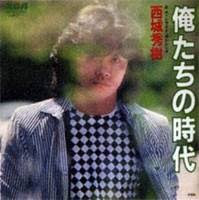
Well, I was a tad surprised to find out from that particular list that yet another kayo from several years in the past before "Heart and Soul" had been given the attempt to become an Olympic theme, and it was recorded by none other than Hideki Saijo(西城秀樹). The song was "Ore-tachi no Jidai" (Our Times), Saijo's 33rd single.
Released in June 1980, the original cover of "Ore-tachi no Jidai" had Saijo on the track ready to fly through the 100-metre dash as the song, written by Takashi Taka(たかたかし)based on the original lyrics by Masato or Masahito Kumano(熊野昌人), composed by Kimio Mizutani(水谷公生)and arranged by Jun Sato(佐藤準), begins with a rock riff followed by an upbeat funky and marching melody led by a beefy bass, tinkly synthesizers and a horn section and then ends with a strangely jazzy twist. Incidentally, this is just my theory, but I'm wondering whether the use of that synthesizer heralded what a lot of sports show themes would sound like in the years to come on Japanese TV. When I listen to Saijo singing "Ore-tachi no Jidai", I really feel like that he's putting some extra Saijo in his vocals for some reason.
As I said off the top, this was to have been an official Olympic song and according to that Entamedata list and J-Wiki, it was used by TV Asahi for one particular Olympic-themed special, but the real client was the Japanese Olympic Committee itself which was going to use "Ore-tachi no Jidai" as a cheer song for the 1980 Olympics in Moscow. Unfortunately, due to an international crisis looming over Afghanistan at the time which had the United States and the Soviet Union enter another one of their global fights in the Cold War, America and its allies, which included Canada and Japan, boycotted the Moscow Games. As a result, according to the J-Wiki article for "Ore-tachi no Jidai", that meant changing the cover for the single mid-sale to something more sober as you can see at the bottom.
Still, the single did pretty well by breaking into the Top 10 at No. 6 and finishing 1980 as the 99th-ranked single. I like the B-side "Moonlight Dancing"(ムーンライト・ダンシング)even more and you can read my personal recollection of that song there.
Well, for better or worse, the Tokyo Olympics are under way, and it appears that Japan has already gotten onto the medal list with a Gold and a Silver at least in judo. Canada came close in the Men's individual road race with Michael Woods coming in 5th. COVID hasn't taken it easy on the Olympic Village and now Tokyo has to contend with a typhoon potentially crashing the party in the middle of next week.
Of course, when we have Japan + Olympics, the result will be official theme songs and for the national broadcaster NHK, that has been the case since 1988 when Mari Hamada(浜田麻里)sang "Heart and Soul" for the Seoul Games. The commercial TV networks have also followed suit. For example, Misato Watanabe(渡辺美里)sang "My Love, Your Love" which was used as the Olympic theme by NTV for the 1996 Games in Atlanta while Anri(杏里)contributed her own "Ano Natsu ni Modoritai"(あの夏に戻りたい)for TV Asahi for the same competition.
Speaking of Anri, when the Winter Games arrived in Nagano, Japan in 1998, her 31st single,"SHARE Hitomi no Naka no Hero" (The Hero in My Eyes), had originally been released in November 1994 as this love ballad that the singer wrote and composed, but it was then selected to be the official Nagano Olympics song by the Japan Olympic Committee. In comparison with the pleasantly light and summery "Ano Natsu ni Modoritai" for the NTV coverage, "SHARE Hitomi no Naka no Hero" has a bit more gravitas and an inspirational mood which probably caught the JOC's eyes and ears.
"SHARE" was then given its own separate release in January 1998 as an Olympic single. The original peaked at No. 47 and can also be found as a track on "Anri The Best", her 9th BEST compilation released in May 2000. Meanwhile, the Olympic single, which also has an English version, only got as high as No. 78. Supposedly, both versions have different arrangements.
For me, the Nagano Olympics meant those Ski Jump Golds earned by Takanobu Okabe, Hiroya Saito, Masahiko Harada and Kazuyoshi Funaki. I was happy to see that victory live on TV in Ichikawa, but that was only because I was stuck at home with a busted ankle.😧
Whatever the fate of the Tokyo Olympics scheduled for late July to early August, the torch ceremony did take place earlier today at ancient Olympia, and so the torch run has begun.
One of the other scenes that I remember from last year's Kohaku Utagassen was Arashi(嵐)performing right in the middle of the newly-built Olympic stadium in Tokyo. It was a good opportunity to show off the new building and also for the aidoru quintet to show off their latest song, which has yet to be released as their latest single despite the New Year's Eve showcase.
"Kite", and indeed it is the English noun for that kid's piece of fabric in the sky, was written and composed by singer-songwriter Kenshi Yonezu(米津玄師)who had his own debut for the 2018 Kohaku. Compared to other Olympic theme songs, it looks like Yonezu and NHK went for something more elegiac to befit the majesty behind an Olympics, and it's the official song for the national network's broadcast of the 2020 Games.
To be honest, it hasn't quite moved me like Misia's"Hatenaku Tsuzuku Story"(果てなく続くストーリー) for the 2002 Winter Games or got my blood pumping like Maki Ohguro's(大黒摩季)"Atsukunare"(熱くなれ)at the 1996 Summer Games, so I will treat "Kite" as an Olympic song that could grow on me as we near the time. Let's hope that the health condition of humanity will improve by show time.
I don't think this floral logo for the Tokyo 2020 Games exists anymore, officially anyways. This was a poster that I saw in West Shinjuku in the hotel district when I was over there in late 2014, and I think this was something that has since been replaced by the more abstract logos. It's going to be another three years since my last visit to my old stomping grounds in 2017 but I won't be heading over during the craziness of the Olympics since I don't think that there was any way I was going to grab tickets for any of the events and frankly I have no desire to cook at an even hotter temperature than is usually the case during a typical Japanese summer. If anything, it'll most likely be much later in the year.
Speaking of the Olympics, I found another song that was used as the theme for NHK coverage of the Barcelona Games in 1992, "PARADISE WIND", as recorded by Keiko Terada(寺田恵子), at the time formerly of the rock band SHOW-YA.
As I mentioned in the first article for the band, the SHOW-YA vocalist left the group in 1991, and "PARADISE WIND" was her debut solo single released in July 1992. Written by Yoshihiko Ando(安藤芳彦)and composed by Koji Makaino(馬飼野康二)under a pseudonym, Jimmy Johnson, the song has plenty of spunk to get folks excited about all those athletes pulling off medal-winning feats, and it became Terada's biggest hit, peaking at No. 28 on Oricon. The song was also on her debut album"Body & Soul" from August 1992 which broke into the Top 10 at No. 7.
Personally though, I'm still a bigger fan of Maki Ohguro's(大黒摩季)"Atsukunare"(熱くなれ), the NHK theme song for the 1996 Olympics in Atlanta.
Yes, folks, we've now passed the 1-year mark in the countdown toward the Tokyo Olympics, something that NHK has not failed to inform us about. I figure that there will be features on the athletes and venues every day on the national network from now til late July 2020.
To be honest, when it comes to my benchmarks for Olympic theme songs, and all of the Japanese TV networks have loved coming up with such tunes for the past couple of decades, I have to go with Maki Ohguro's(大黒摩季)blood-pumping "Atsukunare"(熱くなれ)for the Summer Games in Atlanta 1996 for the uptempo stuff, and the epic ballad "Hatenaku Tsuzuku Story"(果てなく続くストーリー)by Misia for the 2002 Winter Games in Salt Lake City, both from NHK.
Now, it seems as if when it came to the 2000 Olympics in Sydney, hitomi's"LOVE 2000" became the popular tune associated with those Games due to marathon runner Naoko Takahashi's(高橋尚子)love for it. But that wasn't the official NHK theme. Actually, it was "Get U're Dream" by ZARD that was her 32nd single released in September 2000.
I'm not sure but perhaps "Get U're Dream" may have gotten overshadowed by "LOVE 2000". Still, ZARD's contribution to the Olympic theme songs isn't too bad. With lyrics by the singer under her name of Izumi Sakai(坂井泉水), and music by singer-songwriter Aika Ohno(大野愛果), "Get U're Dream" won't get listeners wanting to run the 100-metre dash or do a clean-and-jerk like "Atsukunare", but it's a fun enough song to get folks in the mood for some sports viewing. The single managed to peak at No. 4 on Oricon and was also placed as a track on ZARD's 9th album"Toki no Tsubasa"(時間の翼...Wings of Time) from February 2001. It went Platinum and hit the top spot on the charts.
On Xmas Day 2013, Ohno released her own 3rd album"Silent Passage" which contained a cover version of "Get U're Dream" (the entire album consists of covers of songs that Ohno had composed for other artists including ZARD). When it comes to her Ohno's own presence on "Kayo Kyoku Plus", she's just been listed as being the songwriter for Mai Kuraki's(倉木麻衣)tunes including that singer's debut "Love, Day After Tomorrow", so it's nice that I can have Ohno show up here again this time as a singer herself.
Ohno's "Get U're Dream" has got the same level of cheer but with its synth orchestral arrangement, it sounds like something more attuned as a theme for a story of gothic intrigue. "Silent Passage" went as high as No. 110.
I was living in Japan for a good smattering of Olympics coverage and also the World Cup with Japan and South Korea as hosts in 2002. For the 2000 Olympics in Sydney, I was just waking up one Sunday morning when I turned on the TV and had the good luck to see the ending of the Women's Marathon when Japanese runner Naoko "Q-chan" Takahashi(高橋尚子)crossed the finish line to get the Gold medal.
It was later found out that Takahashi got psyched up during training while listening to "LOVE 2000" by hitomi, and so not surprisingly, that certainly helped boost sales of the singer-songwriter's 17th single from June 2000.
hitomi had already been around for some years since arriving under the Tetsuya Komuro(小室哲哉)umbrella, and at the time, I hadn't really thought of her as being the strongest singer around. However, with "LOVE 2000", there was that good fit between her vocals and the uplifting song.
I think one reason is that she and her lyrics seemed more comfortable with Masato Kamata's(鎌田雅人)melody as if she had crafted the music herself. My image of hitomi has always been as that of a rock-loving biker type, and whether or not that's actually true, "LOVE 2000" has become the tune that I will always recognize for. It did become one of her bigger hits by reaching No. 5 on Oricon and ending up as the 78th-ranked single of the year. The song was also her first invitation to the Kohaku Utagassen that year with her only other appearance a couple of years later for "Samurai Drive".
As far as I know, "LOVE 2000" wasn't an Olympics theme song in any official capacity but considering that it may have helped Q-chan get that Gold for Japan, I'll be happy to bestow honourary status in Labels.
Some sad news today regarding the Olympic effort for 2020. When I woke up this morning, I found out through NHK's "News Watch 9" that a very energetic fellow who had been spreading his brand of Japanese joy for the Games for decades passed away at the age of 92 back on March 9th.
Naotoshi Yamada(山田直稔), aka Olympic Ojisan(オリンピックおじさん...Uncle Olympics), was someone that I often saw during any Olympics coverage whenever NHK or any of the private TV stations focused their cameras onto the audience no matter where the Games for that year were staged. Decked out in a getup which was half Uncle Sam and half ultimate Japanese superfan, Olympic Ojisan could have also been seen as an Olympian version of Santa Claus for all of the happiness that he liked to bring out in everyone, whether Japanese or not.
What I found out through the NHK tribute to Yamada was that like a lot of longtime traditions, Olympic Ojisan was born from a happy accident. Yamada had been at the Opening Ceremonies at the Mexico City Olympics in 1968 (the Summer Games right after Tokyo 1964) and with his mighty chutzpah, he had thought that he was cheering on the Japanese team when in fact, he was cheering on the Mexican team (both teams were apparently wearing blazers of the same colour...red). I don't know whether the fellow was embarrassed by his supposed faux pas but Mexicans were impressed and charmed by Yamada kindly roaring in support of the home country, and from then on, Olympic Ojisan became a fixture at future games, including the boycotted 1980 Games in Moscow.
I think that he had a great life and Yamada was even bestowed the Medal of Dark Blue Ribbon in 1984 by the government of Japan. Such recipients, according to Wikipedia, are given this particular award for having "...made exceptionally generous financial contributions for the well-being of the public." Not quite sure how the financial component played in with Yamada, although perhaps he did make some generous donations for the Olympics effort. But that didn't show up on the NHK tribute; I think his biggest gift was his overt excitement for the Games. It's just sad though that he wasn't able to live long enough to see the 2020 Games in Tokyo next year.
As my own personal tribute to Olympic Ojisan, I've decided to go with this article for Mariko Takahashi's(高橋真梨子)"Haruka na Hito e" (To The Faraway People) which was NHK's official theme song for the 1994 Winter Games in Lillehammer, Norway. Her 22nd single released in February 1994, it was written by Takahashi and composed by Ryo Matsuda(松田良).
To be perfectly frank, this probably won't get up into my Top 5 list of beloved Mariko songs, but it does have that feeling of hope and optimism as Takahashi sings about people still doing great things although time and distance may have separated them. Moreover, it is indeed Takahashi singing this so it's always a solidly delivered tune. "Haruka na Hito e" was her 3rd single to break into the Oricon Top 10 (peaking at No. 6), after "Momo Iro Toiki"(桃色吐息)in 1984 and "Hagayui Kuchibiru"(はがゆい唇)in 1992, selling north of 500,000 copies. In terms of her most successful singles, it also ranks in at No. 3, behind "Gomen ne..."(ごめんね…)from 1996, and the aforementioned "Hagayui Kuchibiru". On the annual rankings, the song was No. 64.
Since its debut as an Olympic song, "Haruka na Hito e" has become cherished even as a graduation song due to its lyrics. Here's hoping that Olympic Ojisan, despite his own graduation to a better place, has bequeathed his energy to a lot of the folks left behind when July 2020 finally arrives.
As is usually the case with TV Japan during an Olympics, due to copyright issues and the like, any NHK Olympics coverage in North America is heavily curtailed and limited to 2~3 5-minute reports a day. Now, it's not so bad with the Winter Olympics since it seems the Canadian, American and Japanese media generally focus on the same events together as opposed to the Summer Olympics. So, I was able to find out live this morning on CBC that Japan's Sara Takanashi(高梨沙羅)got a Bronze medal in the ski jump. Happy about that and of course, Canada has been hauling in the medals early as they currently occupy 2nd place behind Norway in the medal count.
Of course, with Olympics coverage in Japan, that automatically means campaign songs for each of the networks covering the Games in Pyeongchang. And for NHK, the Olympics song is "Sazanka" (Camellia sasanqua) by SEKAI NO OWARI. It is also the band's 12th single that has yet to be released (February 28th is the date).
Written and composed by members Fukase, Saori and Takajin, the brief excerpts of "Sazanka" that I've heard on the NHK highlight broadcasts and the first half of the song from the video had me thinking that this was a pretty subtle ballad for something as grand as the Games but of course watching the video of the older brother supporting his younger brother (through the simple acts of cooking) as he struggles to become a successful artist finally did send the message along with the rise in the music halfway through. Yes, inspiration and encouragement through food.
This was such a heartwarming video that I think it could be chopped into separate segments to create commercials selling the separate dishes. It was also heartbreaking to see such good tonkatsu go to waste like that but the artist was going through some major angst, so understandable (to a certain extent). Still, it was nice of him to apologize through that final art piece.
Well, Canada has a big early morning tomorrow with the Mixed Doubles Curling Gold Medal match between us and Switzerland.