I've been a fan of Japanese popular music for 40 years, and have managed to collect a lot of material during that time. So I decided I wanted to talk about Showa Era music with like-minded fans. My particular era is the 70s and 80s (thus the "kayo kyoku"). The plus part includes a number of songs and artists from the last 30 years and also the early kayo. So, let's talk about New Music, aidoru, City Pop and enka.
Credits
I would like to give credit where credit is due. Videos are from YouTube and other sources such as NicoNico while Oricon rankings and other information are translated from the Japanese Wikipedia unless noted.
Just to echo my friend, fellow KKP administrator/contributor and occasional lunch/dinner buddy, Larry Chan,Happy 61st Birthday to Akina Nakamori(中森明菜). As I mentioned in my comments to him following his article on "Gomen to, Suki to"「ごめんと、好きと」, it used to be the tradition on the blog whenever we celebrated July 13th that we gave our greetings in the form of nervously hoping that Nakamori was doing OK wherever she was. Well, in the last couple of years, it looks like she is feeling fine and so I'm ready to retire the tradition and know that she's in pretty good spirits.✌
Reading the previous article, I was more than happy to have our annual July 13th Akina article written by Larry with my blessing since it's been another tradition to alternate our contributions, year by year. But then I thought why not have the two of us providing articles on this hot summery day? Mind you, both of us gave our Favourites lists a dozen years ago: "Larry's Akina Top 6 Picks (post-1991 era)" and "J-Canuck's Favourite Six Akina Songs"...man, time flies quickly!
Since a lot of us on the blog put up a lot of Akina tunes from early on in KKP's history, it's been a little difficult as of late to find something "new", but I was able to once again scour the early B-sides of the lass' singles. As a result, I was able to find this one titled "Ame no Requiem"(Rainy Requiem) which was the flip side to her September 1983 single"Kinku"(禁区). That song, coincidentally enough, was the very first Akina song I heard and it was the song that she sang during her first appearance on NHK's Kohaku Utagassen at the end of that year.
"Kinku" was that rather dramatic technopop hit composed by Yellow Magic Orchestra's Haruomi Hosono(細野晴臣), and so I figured that knowing that, "Ame no Requiem" would most likely be a much softer ballad vocalized by Akina in that high and feathery love song style that she used to do in her earliest years to contrast with the deeper voice that powered songs like "Kinku",
Well...yeah..."Ame no Requiem" was definitely a different kettle of fish. It came off as being so French that while I was listening to it, the taste of garlic and butter escargots popped into my mouth along with a glass of Bourgogne Aligoté. The surprising thing was that the composer was none other than Koji Tamaki(玉木浩二), lead singer of Anzen Chitai(安全地帯); never realized that he had that much of the City of Lights in him. He definitely brought in the Fashion Music for Akina! Rui Serizawa(芹沢類)was the lyricist while Mitsuo Hagita(萩田光雄)took care of the arrangement (he probably helped out with the French flavourings, too).
If you have any B-sides of Akina that you've enjoyed, please let us know!
I realize that I should have done this yesterday when the Lunar New Year began but it was getting late into the night and I was just too tired. Anyways, perhaps it's just as well that I'm doing this today on Hump Day when I need to get some energy expended especially on a dreary stormy day. So, allow me to give my Happy Lunar New Year greetings to everyone who's celebrating it this week and they include some of my friends and some of my brother's in-laws. Hopefully, you have eaten very well so far.
To be frank, I'm kinda surprised that I hadn't done an Author's Picks based on the Lunar New Year before but that simply means that I get to do it today when folks are celebrating the Year of the Horse. My picks here don't have any significantly deep meaning aside from the fact that they include song titles connected to areas whose populations would celebrate the holiday. Among the five I'm listing here, three of them already have their own articles on KKP, while the last two are newbies, so I guess this article is a hybridization of an Author's Picks and a regular posting.
The entries above and below are the newbies as I mentioned at the top and they're being included now since I had been looking for these songs on YouTube for years (and giving up) before they finally popped up. I actually borrowed Naoko Kawai's (河合奈保子)March 1985 11th studio album"Stardust Garden ~ Sennen Teien"(STARDUST GARDEN -千・年・庭・園-...Millennium Garden) from a friend back in my university days but never got my own copy, and the one song that I remember from it is "Chinatown Rhapsody" which also has the English subtitle of "Missin' Girl" which hints at some sort of neighbourhood intrigue. Written by Masao Urino(売野雅勇), composed by Kyohei Tsutsumi(筒美京平)and arranged by Hiroshi Shinkawa(新川博), the song goes at a good clip with a certain mysterious aura imbued throughout. I do like that twanging instrument in the intro.
(1987) Koji Tamaki -- Hong Kong
Honestly speaking, I hadn't gotten a great impression of Koji Tamaki's(玉木浩二) "Hong Kong" in the intro which sounded like a combination of a soundtrack from an episode of "Doctor Who" deep into the 1980s when the show was frankly going downhill and a little smidgen of a Pet Shop Boys tune. Now that I've gotten to hear it for the first time in many years, "Hong Kong" still won't enter my Top 5 Tamaki songs but it's a pretty tight and sexy song thanks to his considerable vocals and the simmering arrangement by Chris Cameron. Tamaki was responsible for melody while Goro Matsui(松井五郎)provided the lyrics.
I'd never seen the music video for "Hong Kong" before and it appears that the director was going for a Neo-Noir look in the titular city with Tamaki cutting quite the figure as someone reminiscent of the late actor Yusaku Matsuda(松田優作). Tamaki's naturally saturnine looks can have viewers wondering about which side he's working for. "Hong Kong" is a part of his debut solo album"All I Do" which was released in August 1987 and peaked at No. 2 on Oricon.
Y'know...I should have posted this one up right on New Year's Day almost a month ago, but then again, I was rather busy with family stuff on January 1st. But I digress. This year is once again the Year of the Horse; people who were born in that year are supposedly responsible, confident and agreeable.
As such, I'm not sure whether I can find any kayo kyoku that are responsible, confident and agreeable, but at least I can find some songs that have some sort of relationship to horses.
I realize that this last one may not have anything directly to do with horses, but dang it, the rhythms here just remind me so much of taking a running ride on a steed through the countryside!
An old friend of mine was once the liaison via the JET Programme between Kariya City in Aichi Prefecture and the city of Mississauga next to my hometown of Toronto which had me thinking about any sister-city relationships involving Toronto itself, notably with any Japanese cities. Well, strangely enough, Toronto does have such a relationship with Sagamihara City in Kanagawa Prefecture, not too far away from Tokyo.
One of my most notable students during my seventeen years living and working in the capital city area actually hails from Sagamihara, although I didn't know about the sister-city relationship at that time. She was definitely an Arashi-loving character who I met every Wednesday night at school; a lab technician in a hospital, she analyzed urine and fecal samples and we had a ball putting pet names such as "apple juice" and "fudge" on her targets, and joked about the fact that some patients were a little overzealous in their donations.
For the purposes of this blog though, I wanted to find out if there were any singers who came from Sagamihara, and I discovered that Seri Ishikawa(石川セリ)was one such person. It was just a little over a week ago that I had included her in The Works of Koji Tamaki(玉置浩二)Author's Picks article in which the Anzen Chitai(安全地帯)vocalist composed "Ai no Bunryo"(愛の分量)as a track on her 1985 album"Rakuen"(楽園...Paradise).
Well, Tamaki came up with the music for another track on "Rakuen" which was "Mukashi Italia de"(Once Upon a Time in Italy). With lyrics by Masato Tomobe(友部正人), this is a light technopop number arranged in a style of a 50/60s girl pop tune or even as a song from Italy at about the same time. Realizing that this is a Tamaki creation, it still makes me feel as if it were a Taeko Ohnuki(大貫妙子) number just from the whimsical nature and the synths involved.
Once again, we've reached Hump Day or the doldrums of a weekly Wednesday, so as such, I wanted to something a little different. I haven't done a Creator article since "The Works of Ayumi Date"(伊達歩)back last November, so I decided to go with that today. And today's Creator contribution will be on the works of singer-songwriter Koji Tamaki.
Of course, everyone has known him for decades as the vocalist of successful pop-rock group Anzen Chitai(安全地帯) and as a wonderful solo singer who has the ability to make granite weep. However, he has also provided many songs for other singers over the years as well. His band had developed a certain recognizable sound in their music in the early days but I've found that Tamaki the composer was more wide-ranging in the melodies that he has concocted for others.
The second track from Mariko Takahashi's(高橋真梨子)"Garland" album, "Gokai"(Misunderstandings) wasn't a song that was a hit with me initially. I was still in my early phases of appreciating music from all over, and this mix of playfully sultry pop strut and light reggae was perhaps a little much for me at the time, but fortunately, time and experience have proven fruitful. I could easily imagine Tamaki handling this solo but he can still be heard backing Takahashi.
To be honest, if you had told me in the old days that Tamaki had been responsible in creating the melody for one of Akina's(中森明菜)biggest early hits, I would have just scoffed. Perhaps it was due to the arrangement and of course the singer's then-high vocals, but it sounded like a typically dramatic aidoru tune and nothing related at all to Anzen Chitai. However, I've learned that being able to go beyond the sound that a singer has been recognized for and provide something that fits the other singer's style is an asset.
I would have said the same thing that I did for the above Akina tune for one of Yuki Saito's(斉藤由貴)most famous songs, "Kanashimi yo Konnichiwa", and it also happens to be one of the most famous anison for one of the more beloved anime "Maison Ikkoku"(めぞん一刻). Mind you, the first few measures of the song has reminded me a bit of the old Anzen Chitai sound but the rest of it is pure breezy melodic optimism.
The technopop aside, there is something rather Tamaki-esque in the melody for Seri Ishikawa's(石川セリ)"Ai no Bunryo" (Amount of Love). In some of those Anzen Chitai songs and Tamaki's own solo discography, there have been signs of secrecy or sneakiness, and in fact, Tamaki's own countenance has had those certain saturnine qualities. I think "Ai no Bunryo" has a dollop of that as well as some of that racing guitar which reminds me of him, too.
(1993) Kaori Kozai -- Mugonzaka(無言坂)
Now, the whole impetus behind me putting up a Creator article for Tamaki is this song right here. When I was watching "Uta Con"(うたコン)yesterday, the show devoted some of its minutes on the Japanese utahime who included enka singer Kaori Kozai(香西かおり). Ironically, although the Kozai file on KKP is quite healthy, I realized that I had yet to include what is arguably one of her greatest hits, so here it is.
"Mugonzaka"(The Silent Hills) was indeed composed by Tamaki, so he can provide music for enka as well. And the melody is sweeping and earthy (perfect for a go-touchi song) as it envelops the lyrics of Mitsuhiko Kuze(久世光彦) (although he went by the pen name of Mutsuki Ichikawa「市川睦月」 for "Mugonzaka") who came up with them based on the hills within his hometown of Toyama City in Toyama Prefecture. Kuze's lyrics talk of a local romance that has gone so far off the rails that one can no longer go home again in all meanings of the phrase.
Released as Kozai's 6th single in March 1993, "Mugonzaka" won the Grand Prize at the Japan Record Awards that year as it hit No. 10 on Oricon. It would end up being performed five times at the Kohaku Utagassen between 1993 and 2007, and as the biggest tribute, "Mugonzaka" has been covered by a number of artists including Tamaki himself in his 2012 "Offer Music Box".
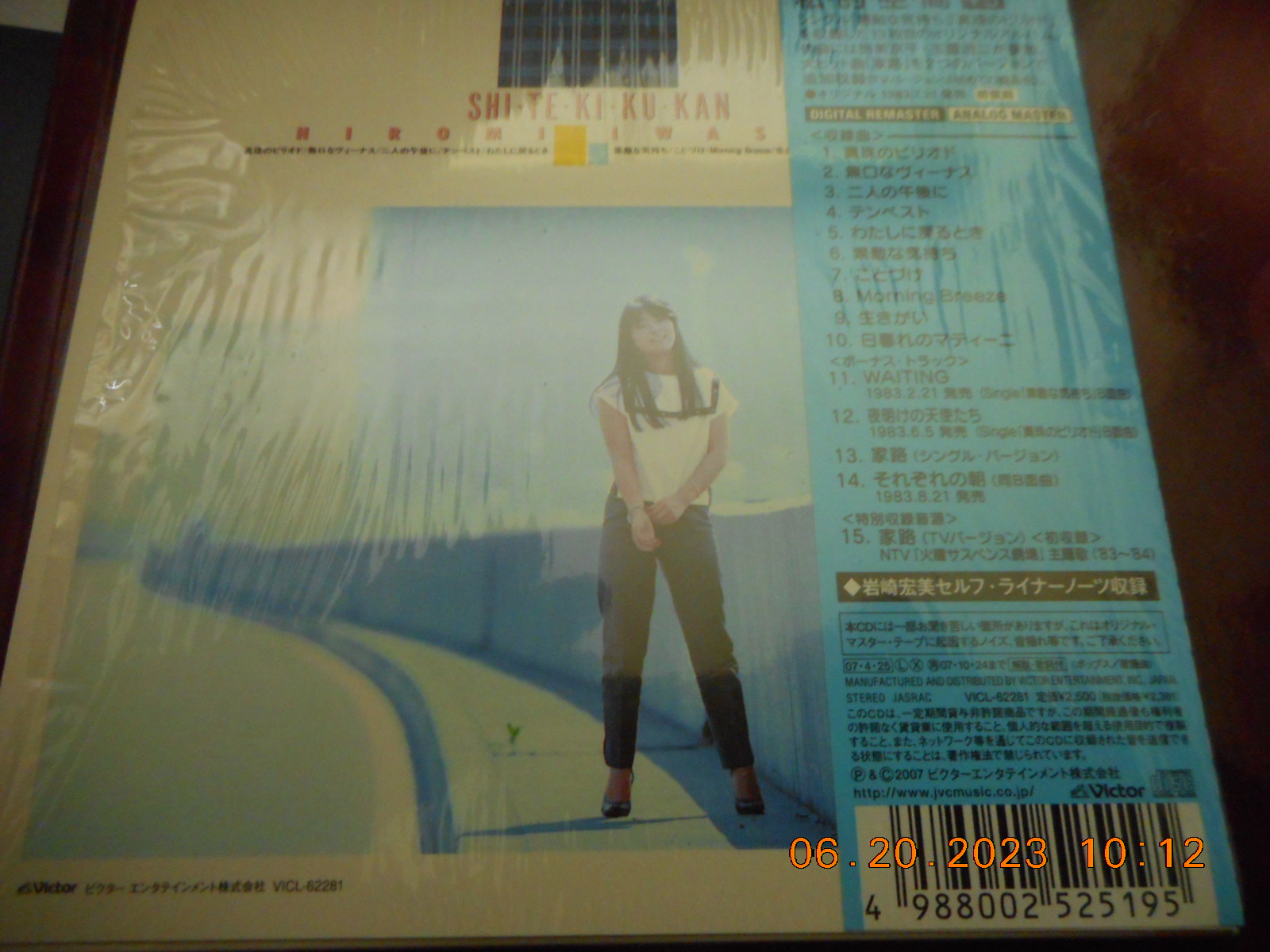
Well, in another case of "Ach, my memory's going!", I completely forgot that I'd promised to have Part 2 of Hiromi Iwasaki's(岩崎宏美)"Shi-Teki-Kuu-Kan" (Personal Space) up by a few nights ago on Monday following Part 1 the previous Monday. I would have done it last night but Tom Cruise and Hayley Atwell kept me busy at their movie. Allow to make amends by taking care of things now.
Part 2 will logically go into Side B of the original LP although I'm basing this article on the 2007 issue of "Shi-Teki-Kuu-Kan" with its extra tracks. To start off, here is "Kotozuke" (ことづけ...Sending Word) which is a gently rolling pop ballad of a remembrance over a past romance. Although there doesn't seem to be any direct mention of sending messages to the old flame, Hiromi is singing that all's well with her and she hopes that the same is true of her former paramour. Mieko Arima(有馬三恵子)was the lyricist with Koji Tamaki(玉置浩二)composing and Mitsuo Hagita(萩田光雄)arranging.
Just seeing the title "Morning Breeze" had me assuming City Pop and/or J-AOR or a Febreeze spray scent. It's once again Tamaki and Hagita on composition and arrangement duties but the interesting thing is that the City Pop feeling tends to undulate throughout the song; at one point, it feels like a straight pop tune but then the chorus kinda kicks things into City Pop mode, and then the coda suddenly shifts into a different key, perhaps showing a bit of uncertainty in the romance department. This time, it's Yasushi Akimoto(秋元康)providing the lyrics of a couple enjoying the early hours rising from bed and then having breakfast.
"Ikigai"(生きがい...Raison D'etre) has that undercurrent rhythm which reminds me of "Joanna" by Kool & The Gang, but otherwise, it's a wholly different animal. The rotation of songwriters continues here with lyricist Arima back with arranger Hagita but this time it's prolific Kyohei Tsutsumi(筒美京平)handling the melody. There's something of the Douglas Sirk melodrama imbued in "Ikigai" but if I've understood Arima's lyrics correctly, it may deal with a man and a woman...perhaps colleagues in the same company...who are sharing some secret personal time after hours but cannot afford to reveal their tryst.
The final track on the original Side B is "Higure no Martini"(日暮れのマティーニ...Martinis at Sunset) has Arima and Tsutsumi working together again but the arranger is Keiichi Oku(奥慶一). Sounding like an elegant ballad from the 1970s powered by a piano, the heroine here is sharing that titular martini with a new friend and she suddenly has this deja vu. Maybe love has come around once again?
As I mentioned in Part 1, there are five bonus tracks on the 2007 issue of "Shi-Teki-Kuu-Kan". I covered one of them already there. Another one that I will talk about here is "Waiting" which was the B-side to "Suteki na Kimochi"(素敵な気持ち), Iwasaki's 30th single that I covered some years ago (and you can find the link to that article in the third paragraph from the top of Part 1. It's another grand contemporary pop ballad that the singer could do in her sleep with Machiko Ryu(竜真知子)behind the lyrics and Shinji Kawahara(川原伸司)as the composer under his pseudonym of Natsumi Hirai(平井夏美).
The other bonus track is "Yoake no Tenshi-tachi"(夜明けの天使たち...Sunrise Angels) and it's another B-side, this time for Iwasaki's 31st single"Shinjuu no Period"(真珠のピリオド...Pearl Period) that was actually described as the first track of "Shi-Teki-Kuu-Kan" in Part 1. Only two minutes and forty-nine seconds long, it ends rather abruptly but it's still pretty sweet and snazzy with some of that disco/City Pop and I'll always love those horns. Tsutsumi was behind the melody with Takashi Matsumoto(松本隆)handling the lyrics. For both bonus tracks here, Hagita took care of the arrangement.
Well, again, sorry for the delayed article and hope you enjoy both parts.
I admit that I may have quickly scrolled down the Hiromi Iwasaki(岩崎宏美)file on "Kayo Kyoku Plus", but I was surprised to realize that it's almost been eight years since I actually covered one of her albums. Certainly, I've covered plenty of her individual songs in the last number of years, but the most recent album by her that I took a look at as a whole was her 1985 "Diamant"(ぎやまん)back in October 2015.
Well, allow me then to cover at least a part of her July 1983 album"Shi-Teki-Kuu-Kan" (Personal Space) tonight. I bought this one by Iwasaki several years ago and there is personal testimony from the singer herself in the liner notes. The one thing I remember the most by far from those notes is her hilariously embarrassed apologies in the second paragraph for her looking so "fat" in the photos. She took particular aim at her saggy arms and those bushy eyebrows before reassuring fans that she at least was able to upgrade herself in the years hence. Personally, she looks hot and has always looked so. End of story.
Incidentally, I'm covering the 2007 issue of "Shi-Teki-Kuu-Kan" so there are five bonus tracks including two versions of one of my favourite Hiromi songs of all time, "Ieji" (家路)which I actually profiled years ago. I'll cover those as well but among the original tracks, the truly relaxing "Suteki na Kimochi"(素敵な気持ち)is another song that I handled back in 2015.
There's a lot to see and hear so let's begin with the first track "Shinjuu no Period"(真珠のピリオド...Pearl Period) which was Iwasaki's 31st single from June 1983. It did decently on Oricon by peaking at No. 31 and I like it because it has that snazziness as it straddles the line between pop and City Pop. I love the old-fashioned "dabba dabba" chorus as well as the sharp strings and the horns coming in. Not surprised at all then that the master songwriters behind this one were lyricist Takashi Matsumoto(松本隆), composer Kyohei Tsutsumi(筒美京平)and arranger Mitsuo Hagita(萩田光雄). Considering how this one sounds, I had assumed that "Shinjuu no Period" was yet another Iwasaki contribution to the Tuesday Night Suspense Drama on NTV like "Ieji" was. But that wasn't the case here and Matsumoto's lyrics merely relate the bittersweet late summer story of a tryst at a beach house that is to end soon, and the lovers are trying to make the best out of what little time they have left with each other.
Track 2 is the sunny 70s soulful "Mukuchi na Venus"(無口なヴィーナス...Silent Venus). Once again, Tsutsumi provides his composing prowess here as he does for two more tracks on Side A of the original LP with Keiichi Oku(奥慶一)as the arranger. The late Rei Nakanishi(なかにし礼)was the lyricist here as Iwasaki sweetly and slyly assures a paramour that all's fine and dandy in Romance City and that nothing needs to be said at all.
There is a bit more brio in Iwasaki's vocals for Track 3, "Futari no Gogo ni"(二人の午後に...A Couple's Afternoon) with Mieko Arima(有馬三恵子)as the lyricist here while Hagita is back as arranger. We're definitely in the City Pop here. I like the layering of urban contemporary rhythm and keyboard underneath strings which paint a more romantically fantastical picture although the story is more negative as a couple go through the motions poolside even though the love dissipated a while back. Well, that's how the cake crumbles.
Not surprisingly for a title like "Tempest"(テンペスト), there's more melodic drama and rock guitar in this track which has Nakanishi, Tsutsumi and Oku working together. My mind pegs this one as a theme song for a detective show although once again such was not the case. Still, the tempest isn't only occurring outside but inside a hotel where a woman is anticipating an affair is about to turn a critical corner into permanent changes.
The final track on Side A is "Watashi ni Modoru Toki"(わたしに戻るとき...Getting Back to Me) has me getting some 80s Steve Winwood vibes. And this time, I also feel some West Coast AOR with the electric guitar thrown in there. Hagita is back but for this one, Kazuko Katagiri(片桐和子)was responsible for the lyrics for this jaunty love song. One other thing is that instead of Tsutsumi composing the tune, it was Anzen Chitai's(安全地帯)Koji Tamaki(玉置浩二)coming up with the melody. Iwasaki noted Tamaki's assistance in the liner notes and that he also composed a couple of other tracks on Side B. The singer noted that Tamaki's three contributions to "Shi-Teki-Kuu-Kan" were just before his band made it big with "Wine-Red no Kokoro"(ワインレッドの心)in that same year. Additionally, she remarked that Tamaki was dressed to the nines a la Humphrey Bogart right down to the fedora (usually apparently most songwriters would come over as casual as possible); he even sported an attaché case. Maybe he was trying to impress her; I have no idea.
To finish off Part 1 (Part 2 will be next week), I'm leaving the article with one of the bonus tracks "Sorezore no Asa"(それぞれの朝...Each Morning) which was the B-side to "Ieji". I actually first heard this song on an episode of that old CHIN-FM radio program "Sounds of Japan" and it sounded so beautiful despite all of the hissing and spitting of bad reception that I searched for years for the title of the tune. Kaoru Ito(伊藤薫)was both the lyricist and composer for this ballad that sounds like a lullaby for children. In point of fact though, it is a melancholy ballad about the end of a relationship signalled openly with phrases like "the end of love" and more tacitly with one line stating the coming of fall. To hammer the final nail in, there is a very morose harp playing there along with some splendid strings playing in the bridge. "Sorezore no Asa" will never get anywhere near a wedding reception but it's still a wonderful song.
These next two paragraphs are a bit of a reminder from "Den'en"(田園)but bear with me here. During those Anzen Chitai(安全地帯)heydays, I had that impression of amazing vocalist and songwriter Koji Tamaki(玉置浩二)as Japanese pop's answer to Mr. Spock: fairly tall, handsome, brooding and stoic. I wouldn't have been surprised if even the most ardent Anzen Chitai fans were a little afraid to approach Tamaki for an autograph due to the risk of being frozen or incinerated to death with those eyes.
But through the years of watching him and Anzen Chitai appearing on television for interviews a number of years from late in the 1980s, it turns out that Tamaki was quite the opposite. He was quite the gregarious and smiling fellow, always up for conversation and even acting a bit goofy. For a while going into the 1990s, he was also quite in demand as an actor. I only saw him in one Japanese drama during my life in the Kanto area and that was the 1996 Fuji-TV show "Coach"(コーチ)as the good-hearted if somewhat zany factory employee Mikuni who drove Atsuko Asano's(浅野温子)embittered and doesn't-suffer-fools-gladly executive Kubota when she had to come on down and straighten out a failing cannery in the wilds of Chiba Prefecture.
Well, the cannery, the show and the theme song, the aforementioned "Den'en" by Tamaki himself, were hits for everybody involved.
And it appears that Tamaki's goofiness may have gone a ways back in terms of television. He had a co-starring role in an early 1989 TBS show titled "Kitsui Yatsura"(キツイ奴ら...Trouble Guys) with actor Kaoru Kobayashi(小林薫)as they played perhaps a couple of good-time wise guys with money troubles. Just from the above video, Tamaki (and his fellow castmates) had plenty of opportunities to show off that incredible vocal talent, to boot.
The opening theme for "Kitsui Yatsura" was "Ki-tsu-i" (Trouble) which was also Tamaki's 2nd single as a solo artist, released in January 1989. "Den'en" may have been Tamaki's biggest hit but I think "Ki-tsu-i" as a slow bluesy rocker was one of many examples of how the singer-songwriter liked to do things sexy and slinky, this time with backing chorus AMAZONS, and the lyrics seem to intimate that a real intimate courtship is taking place on the dance floor (with whipping sounds?). As was the case with Anzen Chitai, "Ki-tsu-i" was created under the aegis of the tandem Goro Matsui(松井五郎)on lyrics and Tamaki on music, although for some reason for this particular single, Matsui was also given the nickname of O-Tsuki-sama(お月様...Lord Moon) while Tamaki got Nagareboshi(流れ星...Shooting Star).
From 3:21 of the video above is the coupling song "Hen" which has nothing to do with a chicken but the fact that it's the romaji version of the Japanese word for strange. Yep, indeed it is strange, but I also recall that Tamaki sometimes liked to do a pretty melodic form of avant-pop, gathering all of the forces of his voice, musical instruments and the backup chorus.
"Ki-tsu-i" made it to No. 7 on Oricon and finished the year as the 64th-ranked single for 1989. It would actually make its album debut several years later on the compilation "Anzen Chitai/Tamaki Koji Best"(安全地帯/玉置浩二 ベスト)from August 1994.
The late Ken Ogata(緒形拳)was an actor that I first got to know in the biopic "Mishima" and since then I've envisioned him as someone who would play rough-and-tumble salt-of-the-earth characters such as Showa Era fathers and samurai warriors. But I also remember him doing all those Kirin beer commercials to "One" from "A Chorus Line".
In 1983, he played one of those terse characters in the film "Gyoei no Mure"(魚影の群れ...The Catch) as a grizzled veteran fisherman looking for that huge tuna catch to rake in the yen while having to deal with his daughter's city boy fiancé played by Koichi Sato(佐藤浩市). Not that it will ever happen, but I figure that if I ever were put in the situation of meeting a potential father-in-law like Ogata, I would most likely do something that I haven't done since I was three.
How I got to know about "Gyoei no Mure" in the first place was through music, of course. In this case, it was the ending theme for the movie, "Bright light, in the sea", which was a duet between actor/singerYoshio Harada(原田芳雄)and jazz singerAnli Sugano(アンリ菅野). I introduced Sugano last summer through her "Akujo Street"(悪女ストリート), a track from her debut album whose cover still gives me the heebie-jeebies.
I knew about Harada's acting career and I thought that he was in the movie since my impression was that he could also play the tough guys although he would have been pretty young back then. However, Harada, along with Sugano, only provided "Bright light, in the sea" which was a B-side to his 1983 single, "New York Hyouryuu"(ニューヨーク漂流...New York Drift). For a movie about fighting the rough seas, "Bright light, in the sea" is a surprisingly romantic pop ballad along the line of similar ballads that I heard back on the radio here in Toronto such as "The Next Time I Fall" with Peter Cetera and Amy Grant or the Grammy award-winning "Up Where We Belong" by Joe Cocker and Jennifer Warnes.
Harada's singing is something that I've heard on New J Channel and he's got the chops for rock and blues, and I think he had some of that Cocker feeling in his vocals here. The music was by Koji Tamaki(玉置浩二)from Anzen Chitai(安全地帯)which was on its way to fame, and Tamaki can come up with the heart-on-your-sleeve balladry just like that. Meanwhile, lyricist Ryo Shoji(東海林良)was responsible for the words; he was also behind Machiko Watanabe's(渡辺真知子)bouncy "Kuchibiru yo, Atsuku Kimi wo Katare" (唇よ、熱く君を語れ). Kazuo Shiina(椎名和夫)took care of the arrangements.
"But what I really want to do is sing down-home pop/rock".
After many years on the shelf, I took out Koji Tamaki's(玉置浩二)4th solo album"Love Song Blue" from December 1994 and popped it into the stereo last night. My reaction was "Geez, why haven't I played this some more?"
It's a fine album to be sure with not only Tamaki's proven amazing voice but also a variety of genres among the tracks. By the way, that quote above is simply something that I made up thinking that it could be what the Hokkaido-born lead vocalist for 80s rock band Anzen Chitai(安全地帯)would have said when comparing his band output of moody music in the early 1980s to the songs that he has crafted as a soloist since then...songs that I see and hear as material that I would love while Tamaki is entertaining a close group of friends around a campfire or in front of a cottage in a snowy hinterland.
"Love Song Blue" had Tamaki writing and composing all of the songs with some help by Ko Tanaka(田村コウ)on some of the tracks while Akira Sudo(須藤晃)and Katsu Hoshi(星勝)co-produced along with the singer. I already have one track from the album represented which is the romantic "Futari nara"(ふたりなら).
The album begins with "Seigi no Hero"(正義の味方...Hero of Justice) which is pretty much as it says on the title: an inspiring start to the album with Tamaki singing and encouraging folks to do their best at the right thing. It's got the brassy synths pushing the way and the arrangement reminds me a little of the first track from Anzen Chitai's"VI" album, "I Love You Kara Hajimeyou"(I Love Youからはじめよう...Let's Begin With I Love You) . This was actually the coupling song to Tamaki's 9th single from June 1995, "STAR", but I think this would have made a nice theme tune for any J-Drama or even a tokusatsu series.
Track 2 is "Ii Kao de"(いい顔で...Put on a Good Face), another encouraging track although this time, it's all about the game of love, and somewhat differently from what I was describing some paragraphs above about Tamaki going for that down-home approach, the setting is more downtown with some real horns as the singer exhorts folks not to sweat any temporary setbacks and just go for it and have some fun while at it. It was with "Ii Kao de" that I started comparing "Love Song Blue" as the solo Tamaki equivalent of what Anzen Chitai was doing with their "V" album...pushing through the envelope away from that distinctive sound that they had broken through with in their earlier albums.
Seeing Tamaki perform in the video above is probably how he really likes to let loose at a concert when compared to his Anzen Chitai performances on the music ranking shows at least when being stoic as possible was the usual performance stance. And I mean, he would have to let loose for this good ol' rock-n-roll"Aishiteru yo"(愛してるよ...Love Ya) which seems to be depicting one of the most passive-aggressive courtships that I've ever heard.
(karaoke version)
"ROOTS" is Tamaki at his charismatic down-and-sultry as I think his lyrics are describing some major boot-knockin' that was going on back in the day. However, the surrounding music also puts in hints of peril...sounds like the plot of a 1980s romance-thriller.
"Saikou desho?"(最高でしょ?...Isn't it the Best?)is an interesting mesh of bluesy jazz and rock as Tamaki sings about a fellow's week of making up and making out with his beloved. Along with "Ii Kao de", this extravaganza brought thoughts of comparisons between "Love Song Blue" and Anzen Chitai's"V" as I was listening to the melodic odyssey taking things out of the intimate jazz supper club in New York City and into the craziness of the Manhattan streets and back again. Tamaki is one artist who's not content giving a straight-ahead delivery; he loves to play around with his voice and the surrounding musicians in a jam session style. There's probably no difference between him in the recording booth or on a stadium stage.
One more track that I will provide here is "Aishitenjanai"(愛してんじゃない...You Still Love Her, Don't You?)which I was left thinking about wondering about how to categorize it. There is some of that jazz in there but it isn't Big Band or even Cool Jazz. Then I thought it was more in the old-fashioned pop standard genre involving folks like Bobby Darin and Michael Buble who've loved to put their hearts right on their sleeves when performing. As for the story in the lyrics, some poor schlep gets thrown out of the house after a fight with the significant other and would love to forget the whole wreck of a relationship except that he's haunted by the title itself. Just another night in the city.
There are a few more tracks on "Love Song Blue" including two that were a single and its coupling song but I will leave that to separate articles. The album peaked at No. 18 on Oricon, and as I mentioned off the top, Tamaki has provided some of that down-home music but with "Love Song Blue", he's also shown himself to be as much of a showman in a nightclub as he has in front of a campfire with buddies. Nice to make its acquaintance again.
Referring back to yesterday's article on the passing of composer Kyohei Tsutsumi(筒美京平), I also have to let you know of another loss but this time, it's in the form of a shop that I used to frequent often when I was living and working in the Kanto years ago. A good friend of mine informed me last night that RECOfan, a longtime seller of used albums and singles of all stripes (J-Pop, jazz, R&B, etc.) located in the BEAM Building in Shibuya closed its doors for the last time a couple of days ago due to the pandemic. He got his information from a "Japan Times" article so you can take a look at that, and then also you can take a gander at my own article for RECOfan in the Sites category. My biggest fear now is whether a number of other Tokyo music stores may follow suit and that may even include the big ones such as Tower Records.
Anyways, enough of the long faces. Let me start off Tuesday, and for those in Canada, the beginning of a shortened work week, with someone we haven't seen in a while, singer Seri Ishikawa(石川セリ). Not having known her as long as I have known her husband, Yosui Inoue(井上陽水), I have been accustomed to her kayo and City Pop fare from the 1970s, but of course, she also sang well into the 1980s, too.
This time, though, Ishikawa provided the track "Ai no Bunryo" (Amount of Love) from her September 1985 release, "Rakuen"(楽園...Paradise), and this is more of a light synthpop number thanks to Anzen Chitai(安全地帯)vocalist Koji Tamaki(玉置浩二). Masato Tomobe(友部正人)wrote the lyrics which somewhat depict a sad scene of a woman getting ready to meet her husband or a longtime boyfriend although the feeling is that the relationship has gotten rather stale of late (certainly the arrangement hints at some uncertainty). Still, she seems to be willing to go through the motions. Not totally sure if I got the gist of the words right so click on the link and correct me if I'm off-base here.
"Rakuen" peaked at No. 57 on Oricon. "Ai no Bunryo" is also available on Ishikawa's April 2008"Re:SEXY 〜Seri's Selection OLD & NEW〜", an album of self-covers.
This week, while updating some of my 80s aidoru files, and doing some research on the internet, I discovered that aidoru Miwa Kawagoe (川越美和) died in 2008, but it wasn’t until 2017 that it became public. Well, I’ve never been the biggest of her fans, and only knew some songs through the years, yet it was a sad surprise to discover that her death at a young age, more than a decade ago, was unknown to the public until very recently. It made me even sadder to know that, apparently, she was impoverished and with problems ranging from drinking to eating disorders at the time of her death. Anyway, after hearing such awful news, the one song from her that got stuck on my mind was “Yume Dake Miteru”.
Released in September 1989 as her
fourth single, “Yume Dake Miteru” is a sad tune with a very timeless and down
to earth arrangement, almost sounding like a folk song at times. Alongside the
beautiful melody, Miwa did an excellent job here with her vocals, showcasing
the vulnerability that is required from every aidoru when singing these types
of ballads. I think this style truly suited her, and that’s probably why,
according to generasia, she won the “Rookie of the Year” award at the “31st
Annual Nihon Record Taishou” with this song.
Despite winning an award, “Yume Dake Miteru” wasn’t a big hit, reaching only #29 on the Oricon charts. It ended being the highest charting single in Kawagoe’s career, but not near a true hit, if you ask me. Lyrics were written by Kei Ogura (小椋佳), while music was composed by Koji Tamaki (玉置浩二). As for the arrangement, Katsu Hoshi (星勝) was the responsible.
As a side note, I was lucky enough
to buy one of her compilations, called “MIWA Best Selection” (1991), for a fair
price here in Brazil last December. That was quite a find, since Kawagoe was
never one of Japan’s major aidoru singers.
I was reminded by a comment for Anzen Chitai's(安全地帯)"IV" album that I had yet to write anything about Koji Tamaki's(玉置浩二)solo "Ikanaide"(Don't Leave Me Alone) single from November 1989.
It was used as the theme song for the Fuji-TV 30th Anniversary commemorative drama "Sayonara, Ri Koran"(さよなら李香蘭), a biography for the singer Yoshiko Yamaguchi(山口淑子)who had gone by the name Li Hsiang-lan or the Japanese Ri Koran while living in the Republic of China around World War II. I never saw the drama starring Yasuko Sawaguchi(沢口靖子) myself, but considering Tamaki's song and the times depicted, I can only imagine many tears were shed in front of the telly.
As an old friend and fellow Anzen Chitai fan once told me years ago, Tamaki once performed a song in concert for the first several bars without any instrumental accompaniment and audience encouragement. It was just his voice alone singing a ballad, and he had everyone in the hall wrapped around his vocal cords with that incredible talent. Probably, a few gallons of lachrymal fluid were left on the floor, too. I wouldn't be surprised if the ballad in question had been the topic of this article. It's beautifully haunting and heartbreaking at the same time. Mind you, for non-fans, "Ikanaide" could also be treated as being a little too overwrought; I remember the song being played on some sort of parody in a "Tunnels" comedy show once. Still, assuming that "Sayonara, Ri Koran" was melodramatic, "Ikanaide" was the perfect tune.
This particular song would probably be the quintessential Tamaki song showing off that remarkable high range. Just how he was able to go through several rounds of practice and recording before the release of the CD without shattering his throat is beyond me. It's pretty much pop opera with that orchestral arrangement. Once again, it was the triumvirate of Tamaki, lyricist Goro Matsui(松井五郎)and arranger Katsu Hoshi(星勝)behind the creation of "Ikanaide". Since its release, it has been covered in both Mandarin and Cantonese by a number of other singers.
According to the J-Wiki article for the song, it wasn't seen as a huge hit for Tamaki when his 5th single peaked at No. 16 on Oricon, but it's been a favourite entry on the concert playlist for his fans for many years. That's no surprise and I'm sure fans knew to bring very absorbent handkerchiefs for that particular song. Apparently, "Ikanaide" first made its appearance on an album through "Anzen Chitai/Tamaki Koji Best"(安全地帯・玉置浩二ベスト)released in August 1994.
I wasn't intending on writing about her entire album tonight. Actually, I was just going to write about Yuki Saito's(斉藤由貴)"Finale no Kaze" since that was in my backlog, but then I realized that I hadn't even written about one of her trademark songs, "Shiroi Honoo"(白い炎)at all. Therefore, I gather that I will be giving myself the second Gibbs slap for today. It turns out that both songs come from her debut album"AXIA" which contains the title tune and another hit for her, "Sotsugyo"(卒業).
Well, let's cover at least some of "AXIA" which was released in June 1985.
So, why don't we begin with "Shiroi Honoo"(White Flame), her 2nd single from May of that year, and compared to her innocent debut single, the aforementioned "Sotsugyo", "Shiroi Honoo" has more dramatic heft as the young lady in Yukinojo Mori's(森雪之丞)lyrics goes into despair mode about seeing the man that she's in love with dating another woman. Koji Tamaki(玉置浩二)of Anzen Chitai(安全地帯)composed the music which begins perhaps a bit off-tune for that sinister effect. Plus the other aspect that I think made "Shiroi Honoo" a standout was the refrain where Saito echoes the lady's self-flagellating questions about whether she's being a fool for wringing her hands for a guy.
The song was also the theme tune for the famous school action drama "Sukeban Deka"(スケバン刑事)when Saito had a starring role as Saki Asamiya. Some years ago, my good friend JTM wrote an extensive article on the show, so give that a look when you can. "Shiroi Honoo" reached No. 5 on Oricon.
Also on the B-side of "Shiroi Honoo" and on "AXIA" is "Shabon Iro no Natsu"(石鹼色の夏..Soap Bubble Summer). It's also the flip side in terms of tone as creamy-voiced Saito wishes that she were a bubble so that she can get closer to her love target without him noticing since she's the shy type. I'd say that it's a pretty huggable number. Mori also provided the lyrics here but the composer for this one was Toshio Kamei(亀井登志夫)from the City Pop band NASA.
The one other song that I wanted to cover from "AXIA" and as mentioned above, the song that I was supposed to have covered on its lonesome is the track "Finale no Kaze"(フィナーレの風...Finale Wind), another ballad about romantic tribulations. This one isn't quite as dramatic as "Shiroi Honoo" but it's got quite the jaunty beat and a nice bluesy sax to give it that urban contemporary feeling. Fuyuko Moroboshi(諸星冬子)and Shigeru Amano(天野滋)were responsible for words and music here.
"AXIA" the album was a hit with listeners as it peaked at No. 3 on the charts, and it ended up as the 29th-ranked release for 1985.
This is one of the more elegant and exotic 80s aidoru tunes that I've come across. So, perhaps I shouldn't be all that surprised since it was composed by Koji Tamaki(玉置浩二), the charismatic vocalist of Anzen Chitai(安全地帯).
Keiko Okuda's(奥田圭子)debut single is "Yume Kudasai ~ Chi-Teki-Yuu-Yuu"(Give Me Your Dreams ~ Intellectual Gentle Play) from February 1985. It was also used for a Pilot fountain pen ad, and though I'm not totally reassured on my translation for that subtitle, there's an element in Keiichi Oku's(奥慶一)arrangement that makes me think that this could have been put into enka mode, but that's just my deranged opinion. Minori Suzui(鈴井みのり)came up with the lyrics that I think are about the vagaries of love.
Another interesting thing about "Yume Kudasai" which truly feels like it's taking place in some sort of dream world (the music video helps with the illusion) is in the refrain when there are two voices working together. There are Okuda's high-toned sighing vocals but then there is that really low vocal giving some subtext, it seems. I think that might be her voice as well but it's the first time in an aidoru song that I've heard a singer going really high and really low.
As I mentioned yesterday, there's a part 2. There're just too many Akina favorites :)
5. So Long
Yesterday, I planned to write all these favorites in time order of their releases but I somehow missed it. So Long was released in Bitter and Sweet in 1985, same album as Yokan 予感.
It is a story of a woman who wants to pursue her dreams, and so she bids goodbye to her lover. On the desk, there is her goodbye letter, with only the word "Sayonara" (goodbye in Japanese). Before dawn, she softly kissed her lover, and left the apartment building.
"So Long" reminds me so much of the Carpenters, whom I like since high school.
6. Ame ga Futteta (雨が降ってた)
I listened to this song via YouTube (not this video, the one I watched was taken down long ago and so will this one eventually, I think) first before I bought the album Cruise. It was released 1 week after her attempted suicide.
Chika Ueda (上田知華), who's a singer song-writer herself, wrote the song. As written on this blog before, Ueda Chika has been a prolific song writer for many singers, most notably Miki Imai (今井美樹). To my surprise, she even wrote 2 songs for Hong Kong singer Sandy Lam (林憶蓮). I think that's because Sandy Lam once released a Japanese album and tried to enter the Japanese market (without success I guess).
To be honest, I don't quite understand what the song means after I read its lyrics. Like a lot of Japanese song lyrics, there's plenty of room for imagination. My interpretation was inspired by Akina's live performance on stage, when she finally lay herself down onto the steps.
The song is about the last episode of a woman before she dies in a parking lot. It was raining. Her head was hit (hit-and-run accident in a parking lot?), even though she felt only a little pain. Her lover was by her side, watching her in confusion, despair. Her ring fell into a water pond beside her. She tried to raise her hand, trembling. He picked up the ring for her, staring at her finger. He smiled, as if it would bring her comfort, but he couldn't hold his tears anymore. She remembered that it's also a rainy day when he proposed. She never thought she would meet somebody like him. She felt tired, sleepy, and slowly and softly, he slept in his arms.
I think Akina's voice is perfect for this kind of sad love song. I was especially mesmerized by her live performance. As far as I know, Akina only gave one live performance of this song in her 1991 concert (see my earlier post).
7. Kagerou (陽炎)
I think this is the second song written by Koji Tamaki (玉置浩二) for Akina. The first one was Southern Wind (サザン・ウインド) back in 1984. Another sad song. Like Yokan (予感), she cried while singing this song in every live performance I can find on YouTube.
The song is about a woman longing for her ex-lover. She remembers the good times they had together. She still loves him so much that she couldn't forget.
I'm pretty sure that this song, like Yokan, reminds her of the heartbreaking relationship with Matchy (Masahiko Kondo 近藤真彦). By the way, the video contains 2 live performances, Kagerou followed by Yokan (unfortunately that video has been taken down). She cried while singing both songs.
8. Necessary
This is not a well-known song. Interesting enough, looks like Akina performed it twice in 2 separate concerts. This is not only my non-single favorite, but my favorite among Akina's post-1991 era songs as I've written it here.
"Necessary" is about 2 lovers, probably in an affair, where the woman knows she should leave him. Unfortunately, every time they see each other, they're indulged in their lies and each other's body that the affair continued. Even then, she never regret meeting him.
I hope this 2 part article gives you an idea of some of Akina's less well-known songs, because most of her hits have been singles.
Ladies and gentlemen...readers of "Kayo Kyoku Plus", on this November 26th, we're now officially less than a month away from Christmas. I figure that with American Thanksgiving done and Toronto's annual Santa Claus Parade having taken place last Sunday, the Holidays are once again upon us.
As such, allow me to launch the annual Xmas season on "Kayo Kyoku Plus" with the usual round of seasonal tunes between now and December 25th. We can begin with Koji Tamaki's(玉置浩二)own rendition of a Christmas classic "Kiyoshi Kono Yoru", otherwise known as "Silent Night". Although I'm not sure whether the Anzen Chitai(安全地帯)vocalist had ever officially recorded it in any of his solo albums, I figure that Tamaki would be one of a few Japanese singers who could take something like "Silent Night" and bat it higher than Santa's sleigh's flight altitude on Xmas Eve.
I'm hoping that me and some of the other collaborators here at KKP can track down some J-Xmas tunes and put them up. Over the years, we've managed to put up more than 100 Yuletide-themed numbers, and even if folks like Marcos, Noelle and Joana do follow-up articles on some of the songs that are already up here, that's perfectly fine. Everyone has their own special stories to tell. Of course, singers that are covering some of the Western classics will be covered as well.
Last Saturday, my high school classmates in Hong Kong organized a 30th anniversary reunion at our alma mata, inviting all memebers of class 1988 as well as our teachers, some of whom are already retired. There were more than 100 people (out of a total of around 200 members, I think). It is very nostalgic when I saw the pictures. Since I’m in the US, I was not able to join. I wish I could. I know a couple of friends who are living overseas but happened to be in Hong Kong at that time, and they were able to attend this memorable event.
It brought back a lot of fond memories. For some reason, this was the song that came immediately to my mind for the year 1988. Technically, it was 1989 when I first listened to this song. Interestingly, I didn’t even know that this song was a Japanese song at that time. I was listening to Hong Kong singer Hacken Lee’s (李克勤) cover version Blue Moon (藍月亮). It was only later that I discovered the origin of the song. Coincidentally, Hacken Lee also graduated from the same high school as mine and he’s 3 classes above me. If you’re interested in his cover version, here’s a YouTube link https://youtu.be/Bu4In62eEQE
Tsuki ni Nureta Futari was first released in Anzen Chitai’s 17th single in 1988, and later released in their album Anzen Chitai 6 (安全地帯VI). The song was composed by Anzen Chitai’s soul and vocalist Tamaki Kouji (玉置浩二), and Matsui Goro (松井五郎), who often collaborated with Tamaki, was responsible for its lyrics.
Like a lot of Japanese lyrics, it shows a piece of a story, and leaves the rest for the listener’s imagination. If I were to tell the story of the song, it would be about a couple in the middle of a still ambiguous relationship. Even though they’ve been together, he feels that he still couldn’t reach her heart. She seems to be unsure. Meanwhile, he is unable to say “I love you” in front of her, despite that voice deep inside his heart. Telling her everything may ruin it. In the end, he decides to just seize the moment and not worry about tomorrow, hoping that this dream he’s living will never end.
In July, I got an email from J-Canuck, asking all Kayo Kyoku+ contributors if we can write about "Our First" - an account of how we get into Japanese music in the first place. I thought it's a fantastic idea and so I made a promise. Now that I got some time, I'm going to share "My First" with all of you.
Confession
Interesting enough, I didn't regularly listen to Japanese music till around 2010 when I started learning Japanese. For a long stretch starting from my college years in the 90s till 2010, I listened to ZERO Japanese music. Yes, that's right, NIL.
So, I decide to write The First and a follow-up article, Second Chance, in which I would share my recent (is 7 years too long to qualify as recent?) foray into Japanese music.
First Japanese Song Ever Heard
Honestly, I forgot. But it HAS TO BE A SONG FROM AN ANIME SERIES.
When I was 4 or 5, every Sunday morning from 8 to 11, there's 3 hours of non-stop cartoon on TV. Weekday 4-6pm was kids time and Japanese anime were all over TV. There were occasionally American cartoons (e.g. Popeye the Sailor) but we all thought they're boring. None of my friends wanted to talk about them. We only talked about Japanese anime. On the school bus, we would be singing those anime theme songs, in Japanese, because in that era TV stations in Hong Kong didn't ask local singers to cover like they do now (Well, Jade TV in Hong Kong started to ask local singers to cover starting in late 70s, if my memory serves correctly).
Drawing from my memory, it's EXTREMELY likely that the first Japanese song I ever heard was this one:
It was the theme song of Mazinger Z (マジンガーZ), an extremely popular Japanese anime in Hong Kong when I was small. I forgot what the story was about now. Of course, I never understood what I was singing on that school bus.
First Non-Anime Japanese Song (and First Kouhaku)
This I remember clearly. It's Judy Ongg's (翁倩玉) Miserarete (魅せられて). J-Canuck wrote an article about it in 2012 (sorry J-Canuck, I borrowed your YouTube link below).
On December 31, 1979, my Mom and Dad said that Ongg's going to appear in Kouhaku (紅白). It was a big thing because Ongg's Chinese. My Mom also said Ongg's going to wear a costume that would turn herself into a peacock. I thought a person turning into a peacock would be pretty cool and so I watched Kouhaku with my parents. It was also my first ever Kouhaku.
The song made a pretty strong impression, especially the paragraph "Wind is blowing from the Aegean...." (I didn't realize it was English and I thought it was Japanese at that time). Ever since I listened to it for the first time in 1979, I would still remember the melody in all these years. And whenever I describe who's Judy Ongg to my friends, I would hum that melody.
Okay, Okay, The Real First
First, some background.
I was 11. A fresh school year had just started. Hin-Chung Mak, my friend who sat in front of me, had something new in his wallet. It was a photo of a young girl. I asked him who that girl was. He took the photo out of his wallet and showed me. There's a name printed on the photo - 松田聖子 (Matsuda Seiko). Not knowing who she was, I asked Mak why he liked her. He told me that she's cute, and he liked her songs. For some reason, I was not interested in anything Japanese at that time. So we went back to talk about a popular local manga called 龍虎門 (Oriental Heroes).
A few years later, there's new name from Japan - 中森明菜 (Nakamori Akina). Because the character 菜 means vegetable in Chinese, we're always joking about her name. Not only that, but because 菜 in Cantonese slang also means one's girlfriend (similar to tea as in "my cup of tea" in English), we made even more jokes. Still I never heard a single song from Seiko or Akina.
Summer 1984, I was spending a week at my cousin's house. I was staring at his bookshelf. There were cassette tapes - rows and rows of them. Michael Jackson's Thriller & Beat It. Here Comes the Rain Again from Eurythmics. Cindy Lauper's Girls Just Wanna Have Fun. Kenny Loggins' Footloose. I duped every one of them into my TDK 90 minute tape that I brought with me!
I still remember that I didn't want to buy music because I thought it's a waste of money. Pop songs, by definition, would fade in a few years when nobody listens to them anymore. So why waste the money, I thought.
Then, my eyes suddenly caught something, Nakamori Akina's "Best Akina Memoir" was sitting right in the middle of all these Western pop music. My first reaction was, "dear cousin, like my classmates, you also found this 'vegetable' attractive, don't you?" In fact, I found Akina pretty cute at that time, but never thought I would buy her music, or even listen to her music because I was so absorbed by Alan Tam (譚詠麟) and other Hong Kong singers at that time. But since I had a whole week, I might as well check her out, I thought.
And so I did. Kinku (禁区) was the first song but I was not impressed. I found Akina's voice too "rough", like Hong Kong singer Anita Mui (梅艷芳). Then came the 2nd song, Twilight - Yuugure Tayori (トワイライト-夕暮れ便り-). The piano intro immediately grasped my attention. Then I heard a completely different female voice.
She sounded like an angel to me. Can this be the same Akina I just heard in Kinku? Are they really the same person? How did she do that? I was amazed and puzzled at the same time by this "double personality". So I listened more. The 3rd song did not make any impression on me. The 4th song, its piano intro mesmerized me again, it's Your Portrait (あなたのポトレート). Same voice as the 2nd song, but definitely different from Kinku. It almost felt comical because in my mind it could not be the same person. It had to be a trick, I thought. A little bit later, Shoujo A (少女A). Yeah, I recognized the name of this song. I saw it on entertainment news that it was banned for broadcasting in Japan. I never listened to it till that point. So this is the song, I thought! Same voice as Kinku, but definitely a different voice than Twilight and Your Portrait. Slow Motion (スローモーション) - yes, my angel returns. I have to say that at that time I loved the ballads much more than the others because they sounded similar to those Alan Tam songs that I loved.
I didn't have enough space to dup all the songs in Memoir. Somehow, I was very indifferent about Second Love (セカンドラブ) and I never even considered it. I decided I want Kinku, Twilight, Your Portrait, Ruri Iro no Yoru e (瑠璃色の夜へ), Shoujo A, Slow Motion, and 1/2 no Shinwa (1/2の神話). I only had around 4-5 minutes left and I had to decide which song to include last. After listening to the tape again and again, I finally settled for Ginga Densetsu (銀河伝説)!
I still had that tape with me till last year, when I finally said goodbye to it while I was doing this Marie Kondo exercise. Too bad I didn't take a picture of this tape.
So, technically speaking, my first is not really a single song, but rather Nakamori Akina herself.
First Japanese MV
This, I also remember clearly. It was this video (I hope it can escape from the YouTube police).
The most impressive scene was the last one, when she boards the train, then the train door closes, and Tamaki Koji watches the train leave the station.
Where did I watch it? It was on a music show on Jade TV in Hong Kong. Must be 1984 or 1985. MV started to become popular and Jade TV decided to produce a music show dedicated to MV. Like a radio show that allows people to call in and ask the DJ to play their song, you could call in to this TV music show and ask the VJ to play the MV of your choice. Somebody called in and asked for Tamaki Koji's (玉置浩二) Love Premonition (恋の予感), and that's the first Japanese MV I watched.
Last Words
As I mentioned at the beginning, I didn't regularly listen to Japanese music, even though it has become quite popular in Hong Kong when I was in middle school. After I came here to the US, I didn't listen at all. It's not until 2010 that I really picked it up.
For that story, you have to wait till I write the follow up article, Second Chance.
Hopefully, I'll be able to write within the next 2 weeks, when I'm visiting my parents in Canada, and catching up with J-Canuck :)


.gif)
.gif)