I've been a fan of Japanese popular music for 40 years, and have managed to collect a lot of material during that time. So I decided I wanted to talk about Showa Era music with like-minded fans. My particular era is the 70s and 80s (thus the "kayo kyoku"). The plus part includes a number of songs and artists from the last 30 years and also the early kayo. So, let's talk about New Music, aidoru, City Pop and enka.
Credits
I would like to give credit where credit is due. Videos are from YouTube and other sources such as NicoNico while Oricon rankings and other information are translated from the Japanese Wikipedia unless noted.
2026 marks Haruo Minami's (三波春夫) 25th death anniversary. To commemorate the occasion, the Minami Creates team has bestowed upon us an official lyric video of one of the kayo world's most revered figure's long form kayo-rokyoku (chohen kayo rokyoku...長編歌謡浪曲) works, Nobunaga. On top of that, it was streamed on most, if not all, music listening platforms.
To be honest, Haru-san has recently taken a bit of a back seat, what with HachiandMr. Nakano usurping the majority of my attention. Wading into rokyoku territory and watching the odd narrative-singing show live, usually at Asakusa's Mokubatei theatre, has ensured Haru-san got some love outside of his birthday and death anniversary celebrations - it's so hard to love all my bois equally. But even with that said, I've fallen behind on delving deeper into his discography, so Minami Creates dropping Nobunaga on 14th April (the day of Haru-san's death anniversary) was a welcomed present.
Seeing as how it's been a hot minute since I talked about Minami, here's a brief intro to chohen kayo-rokyoku, conjured up by the man himself. As the name implies, it’s an even fusion of kayokyoku (pop music) and rokyoku (narrative singing). Imagine a kayo or enka with its 3 stanzas. Now imagine fitting a rokyoku's fushi (the singing part) and/or tanka (the spoken part) into the kayo/enka's musical interludes. There you have the basic structure of one of Minami's music babies. Duration-wise, they can be as short as 4 and a half minutes or as long as 20 minutes, but are, on average, about 6 to 10 minutes in length. This makes them longer than the average 3-ish/4 minute kayo, but much shorter than the average 25-35 minute rokyoku set.
The idea of making rokyoku more quickly consumed and digestible, and thus more acceptable to a population that was beginning to lose interest and patience for the older genre, was a significant factor that pushed Haru-san to make this bite-sized (relatively speaking) fusion a reality. From my understanding, he'd already been thinking of some way to make “singable naniwabushi (the older term for rokyoku)” (utau naniwabushi) since he restarted his rokyoku career upon returning from Siberia, where he'd been a POW. Despite switching career tracks (rokyoku artist to pop singer) in 1957, this idea began to take shape when Haru-san was given the rokyoku-like Otone Mujo (大利根無情) in 1959. Its massive success led to a him releasing a spate of rokyoku-inspired kayo and kayo that were based on actual rokyoku stars of the past, like Ippon-gatana Dohyo-iri (一本刀土俵入り),Tochuken Kumoemon (桃中軒雲衛門), and Meigetsu Ayataro Bushi (名月綾太郎ぶし). Still, I'd say these were still more kayo than rokyoku at this point.
I believe that it was only in 1962 when Haru-san first experimented with longer forms of this genre with Soga Monogatari (曽我物語). This fresh take on kayo-rokyoku finally came into the limelight in 1964 with the heroic, Chushingura-affiliated drama Tawaraboshi Genba (俵星玄蕃). Since then, Haru-san would regularly create chohen kayo-rokyoku for the next 30 plus years of his life, making Japanese historical figures, folk tales, and rokyoku more accessible to the average pop music listener.
Moving on to the song itself. Nobunaga is one of Haru-san’s many self-written projects, albeit one from later in his life, having been released in January 1992 in an album of the same title. This tune is not to be confused withOda Nobunaga (織田信長), which Minami created in January 1970. The latter is considerably shorter at 4 minutes, while the latter is twice its length at 8 minutes. Nevertheless, I think Nobunaga can be seen as a plus alpha to Oda Nobunaga. If it's not already apparent, these 2 songs were based on the revered daimyo regarded as Japan's first unifier.
For reference, here's Oda Nobunaga
From what I gather, Haru-san mainly focused on the infamous end to the daimyo in Oda Nobunaga, wherein he perished in the Honno-ji temple fire ambushed by his once-trusted retainer Mitsuhide Akechi. The later Nobunaga includes this incident, in addition to listing the efforts the daimyo made to bring the fragmented lands under his rule, which, aside from waging several important battles, included improving transport networks and loosening trade barriers across the Kansai region. One such policy was the raku-ichi-raku-za, which made trade possible anywhere within castle town grounds, as opposed to having it be restricted to designated areas. Music-wise, both of Haru-san's Oda-centred works have proud and heroic-sounding melodies, fitting for an all-powerful daimyo. However, I feel that Nobunaga is elevated by Nobuyuki Sakuraba's (桜庭伸幸) fantastic arrangement, which paints a Oda in a more intimidating and powerful light with the thunderous rolling drums; the ko-tsutsumi and flute further draws out an air of ancient grandeur.
My knowledge on Japanese history before the Taisho era is paltry, and I know next to nothing about Oda. So, listening to Nobunaga and its predecessor took me back to my old days. I remember learning about the likes of Taira no Kiyomori and Kinokuniya Bunzaemon through Haru-san's kayo-rokyoku, using them as stepping stones to delve deeper into that the drama of these figures online so that I could get more context to better understand his work.
Haru-san had written in one of his books Utagei no Tenchi (歌藝の天地) that one of his wishes was for the world to remember his songs, even if it's been 2 decades since his passing and his name forgotten. The Minami Creates team, helmed by his daughter Miyuki Minami (三波美夕紀), seem to have been working tirelessly over the years to make sure this wish of his comes true. Well, suffice to say that, 25 years after his passing, the name "Haruo Minami" is still remembered alongside his chohen kayo-rokyoku.
It is indeed another Hump Day here so why not perk things up a tad? We often celebrate anniversaries such as birthdays here and we're gonna do so once again with Kayo Grace Kyoku and Mr. Calico.
The news was coming that the 20th anniversary of YouTube was near but I hadn't realized that it was actually today. However indeed, on April 23rd 2005, the first YouTube video was uploaded onto the new site with one of the co-founders Jawed Karim putting up a 19-second presentation of his very calm observation of elephants at the San Diego Zoo. Of course, from such humble beginnings, a video empire evolved including tons of music from over the past century, recipe videos from home, soothing ASMR stuff and vicarious drives all over the world among other imaginative ideas.
Also because "Kayo Kyoku Plus" could only work with the representation of Japanese songs from now and yesteryear existing on YouTube, I have to extend my gratitude to all those uploaders over the years (although perhaps certain companies and artists may not be thrilled). It was always my feeling that a Japanese music blog wouldn't work with just some prose about the songs that I knew and loved; the actual songs just had to be there for listening.
I had actually considered only putting up the Top 10 list of singles for April 23rd 2005 but seeing that most of the top 10 were unknown to me, I quickly ditched that idea. Instead, what I will do is provide songs by certain artists that were released in the 20th year of their time in show business (checked J-Wiki), whether or not they were put out as official 20th-anniversary songs.
"Y'know although I'm not that much of a Haruo Minami fan..."
Apparently, I said that on 20th September 2014 in my first article about Haruo Minami (三波春夫) on KKP. Oh, 2014 Noelle, that about aged as well as your initial opinion on Katsuhiko Haida. Well, maybe not nearly as extreme. Then again, the only one whom my opinion for has barely changed since day one is Yoshio Tabata.
I wanted to do another Haru san appreciation post today since it's his 100th birthday today (19th July) and I'm all for being a little extra with the festivities. I featured an entry in his biggest chohen kayo-rokyoku project in my previous post, so this time, I thought I'd go a little further back in time before he went big on the concept of this fusion between modern and traditional. We'll go back to what seemed like its nascent stage via"Otone Mujou", which was also the very tune I featured in the aforementioned piece.
Since this article will also be heavy on my nostalgia, I had to put up the video performance of Minami I came across nine years ago that served as my introduction to him. It was from a music program "Big Show" (ビッグショー) from 1976 and it will always be the definitive version of "Otone Mujou" to my eyes and ears. The arrangement of Yoshiji Nagatsu's (長津義司) musical composition here is nice and full without being too rushed, making it menacing enough to match the older Minami's more forceful portrayals of the story's characters.
On the note of story, we bear witness to the tragic tale of Miki Hirate (平手造酒). Based on the actual historical figure Mikame Hirata (平田三亀) and a character in the novel "Tenpo Suikoden" (天保水滸伝... Tenpo Water Margin), Hirate is often featured in the likes of rokyoku and enka. Recognized for toting around a large pot of sake and clad in black, the once talented swordsman under the Shusaku Chiba (千葉周作) dojo got thrown out due to his alcoholism and terrible behaviour, according to Kozo Futatsugi (二木紘三) in this article. After, he was a drifting drunkard before settling under the yakuza Shigezo Sasagawa (笹川の繁蔵), further damaging his reputation. He eventually met a gory death in a turf war between Sasagawa's and his rival's gang along the Tone river, but not before cutting down a few victims of his own (a highlight in the "Tenpo Suikoden").
The original rendition
I'm still not as familiar with the nitty-gritty details of the tale (because it's A LOT), but Ryo Inomata (猪又良) seemed to have summarized Hirate's downward spiral within the three stanzas. Haru san temporarily stepping into the roles of secondary characters (I'm not sure who they are) in between does also seem to mark the story's focal points too: The first as one who mocks Hirate for serving a yakuza, the second as one who warns one called another to not underestimate Hirate. These interludes make "Otone Mujou" ever more foreboding, emphasized by Haru san's sinister and explosive deliveries.
Speaking of Haru san's character portrayals, I love the later-day re-recordings and that 1976 live performance where the flamboyant singer cranks up the drama by screaming like a mad man before going about business as smiley usual. It was exactly how he captured my attention back when "I [was] not that much of a Haruo Minami fan". But the original 1959 version with a much more reserved Minami does have its merits too. The first interlude in particular made my skin crawl as he did that creepy villain laugh. 10/10 Haru san. Man, imagine him reading a bedtime story or doing a poetry reading. It'd be fire.
All that said, while I enjoy it, I'd say that I now wouldn't consider "Otone Mujou" within my top favourite Haru san works (2034 Noelle may fight me on this). But it will always have a special place in my heart as the first Minami song I listened to and the first time I was floored by such a riveting performance by a singer.
To round this off this Haru san appreciation-nostalgia piece, I think a little Mrs. Minami(Yukiko Kitazume (北詰由起子)) appreciation is in order as well. After all, it was the both of them who made our Haruo Minami possible. It's pretty widely known that Mrs. M was the one behind that iconic kimono-wearing image, but as his feisty long-time manager, she also had a strong influence over her husband's work ethic and his performance displays. By that I mean that she often takes the wheel and they'd often butt heads, with Haru san usually being the one giving in. But, to her credit, she was also a talented and accomplished performer who did pretty much anything from shamisen to manzai before she married him, and her direction did garner resounding results. From the books, she seemed like quite a fun, albeit terrifying character, and I'm ever grateful for her efforts.
I forgot where I found this picture, but it's adorable :')
Haru-san demonstrating how I should be spending my summer in this photo. Yes, Haru-san, I'm doing (trying to do) as my professor says, don't worry.
As expected of the one called the "singing academic"
Haruo Minami's (三波春夫) birthday's coming up in a little less than a couple of weeks. On top of that, this year is actually his centenary! I've missed a few singers' centenaries in the past, mainly because I either wasn't in to them at the time or simply did not notice. But this is one I made sure to keep in mind - the constant reminders on his Facebook page do help in this aspect. So, to mark the occasion, I thought it'd be good to dedicate an article to him right here. And what better way to do so than to feature the one of his kayo-rokyoku creations?
Besides that glorious grin and gorgeous kimonos, kayo-rokyoku was probably what dear Haru-san was best known for. He gave us abridged versions of the traditional art of narrative singing, covering popular tales and significant figures in Japanese history in an exhilarating fashion since the early 60s. Of which his biggest undertaking was a kayo-rokyoku rendition of "The Tale of Heike", or "Heike Monogatari" (平家物語) from 1994.
Quite some time ago, I featured "Kiyomori Tenka wo Iru" (清盛天下を射る), an early instalment from the series. It revolved around the infamous Taira no Kiyomori (平清盛) in his younger, hot-blooded battle commander days quelling the havoc a bunch of rogue warrior monks were wreaking on the capital. This time, via "Kobe wo Hiraku Kiyomori", we shall fast-forward to a Kiyomori in his fifties or sixties, who'd by then calculatedly worked his way up the political hierarchy, and his port-building exploits.
It's been a while since I've read Eiji Yoshikawa's (吉川英治) telling of the story and Haru-san's background explanation in the lead up to the song was a little hard to catch, but I believe Kiyomori settled in Fukuhara, Kobe, in his later days. As one with considerable power would, he aspired to make this rustic town by the coast great and bring greater riches to the country via sea trade. Thus, a port was arranged to be built. While the idea sounded good on paper, construction turned out to be a pain in the neck with awful consequences. The rough seas on Japan's eastern coast made the process arduous and many a labourer had their lives claimed by the tempestuous waves. Kiyomori himself couldn't care less about the losses, but his eldest son Shigemori (重盛), soft-hearted and a staunch Buddhist, did. Shigemori yearned to put a stop to the loss of lives and figured that the only way to do so was a human sacrifice to the sea. So, he flung himself into the bay. By the time the cynical Kiyomori realised what happened, it was too late and his heir was gone. Despite the tragedy, the port was successfully built and it became world renown as the modern-day Port of Kobe. If this Shigemori incident was one of the non-fictionalized accounts of the "Heike Monogatari", this port would've had quite the origin, don't you think?
Minami's composition also aptly captured the various highlights of this chapter: The grandiose start representing Kiyomori's ambition being followed by a sinister lull to showcase the project's dangers and Shigemori's dilemma, then a harried crescendo that encompassed Kiyomori's distress when he found out about Shigemori's drowning. Haru-san portraying the Taira clan's head's initial haughtiness and subsequent anger-turned-remorse was top-notch too.
Kiyomori in the Mitsubishi Ichigokan Museum
Even though I haven't had the patience to sit through the entirety of Haru-san's rendition of the "Heike Monogatari", a number of my favourite songs by him come from this collection, "Kobe wo Hiraku Kiyomori" being one of them. The songs were so riveting that they gave me the impetus to read the book and learn more about the literary classic. In that way, this labour of love, sweat, and literal tears by the chirpy, kimono-clad performer left a strong impression on me. No less from the one I call my Japanese history and literature teacher. Happy 100th, Haru-san! :D
I think you've more than achieved your dream, Haru-san.
As I've mentioned in the past, enka and Mood Kayo can have a number of lyrical themes including the trial and tribulations of work, crying one's sorrows in drink or having that romantic whirlwind (illicit or not).
One other common raison d'etre for an enka ballad or an old kayo regards the pining for a loved one lost due to various circumstances including war. I used to hear one on my parents' stereo in which there was one song that had the very memorable scream of "MOTHER!!!" in Japanese in the middle, perhaps being yelled out by a soldier who was about to lose his life on the battlefield.
Recently on an "Uta Con"(うたコン)episode late last year, there was a rendition of such a song that has probably cleared many tear ducts since it was first introduced. Titled "Ganpeki no Haha" (Mother at the Wharf), it was first released as a single by Akiko Kikuchi(菊池章子)in September 1954, and it was modeled upon a woman named Ise Tanno(端野いせ)* who had visited a wharf frequently (although I'm not sure whether it was every day) in the hopes that her son would return from a Soviet prisoner-of-war camp. You can read the full story at the link here.
Written by Masato Fujita(藤田まさと)and composed by Namiryuu Hirakawa(平川浪竜)**, the sad lyrics are overlaid with an elegant, even slightly buoyant, melody which has often gone hand-in-hand with what a kayo was all about. If I hadn't understood the lyrics, I probably wouldn't have recognized "Ganpeki no Haha" as a cry-worthy tune of loss and forlorn hope. The song did hit a nerve among the Japanese since it sold over a million records.
Many years later in 1971, kayo singer Yuriko Futaba(二葉百合子)provided her version of "Ganpeki no Haha" through an album of covers titled "Futaba Yuriko no Namida no Kayo Gekijo"(二葉百合子の涙の歌謡劇場...Yuriko Futaba's Tearful Song Theatre), and then a single with "Ganpeki no Haha" was released in February 1972. I don't know how the recorded version sounds like but if it's anything like how Futaba performed it before the TV audiences, then this cover gained a certain grandeur, almost like a Hideo Murata(村田英雄)song. Apparently, according to the J-Wiki article on the song, this version incorporated a rokyoku rhythm.
Through the combined sales of LP records, audiotape and singles, Futaba's "Ganpeki no Haha" did even better than the original by selling more than 2.5 million copies. The song also went as high as No. 3 on the Oricon weeklies and became the 5th-biggest single of 1976. A number of other enka singers since then have covered it including Aya Shimazu(島津亜矢)and Sayuri Ishikawa(石川さゆり).
*The article regarding the mother includes two different readings of the kanji for her last name: Tanno and Hashino. Not sure if this was by design or the writer simply made a mistake here.
**Not 100% sure on the reading of the first name although according to "Music Brainz", it's being read that way.
The Heike Monogatari (The Tale of Heike) when compared to Japanese literary classics like the Chushingura (The 47 Ronin) and Genji Monogatari (The Tale of Genji), seems to be lesser known internationally. In Japan, however, it seems just as popular, having spawned multiple book, movie and TV adaptations for the longest time. I, for one, had invested in Eiji Yoshikawa's rendition (English translated) earlier this year. The Tale of Heike is basically about the power struggle and drama between two warring clans, the Heike (A.K.A Taira) and the Genji (A.K.A Minamoto), which culminated into the decisive Genpei War during the Heian era about a thousand years ago. I believe it's borderline non-fiction, but the intricacies of how certain events turned out are probably fictional. I'm not too sure on this and I could be wrong.
On the note of characters, there are many. SO MANY. One of the prominent figures, however, is Taira no Kiyomori (平清盛), or Kiyomori of the Heike... I'll call him just Kiyomori. He was a warrior of the Heike who managed to claw up the ranks of the imperial court, became too powerful for his own good, and his family had to pay for it. Interpretations often depict him as evil - *ahem* and a mad arsonist - but I'd consider him an anti-hero of sorts, which I'll go into a bit more soon.
Anyways, quite some time ago I actually had no inkling as to what this story was about and who Kiyomori dono was until my beloved folk history teacher Haruo Minami brought "Kiyomori Tenka wo Iru" to the table when I was searching for more of his kayo-rokyoku.
Admittedly, what drew me to it first was its short length; clocking in at less than 6 minutes, it was markedly shorter than Haru-san's other kayo-rokyoku. But then that dramatic melody hit. The blare of the trumpets and the rolling drums created an air of dignity while the muscular strings and buzz of the electric guitar added a brazen, youthful edge. How abrupt it sounds at times also seem to convey a feeling of urgency. It was love at first listen. From the kanji in the lyrics and Minami's accompanying gestures, I surmised that he was relating a story of some heroic archer/soldier named Kiyomori fending off baddies from Kyoto. Some research and reading the novel much, much later proved that that were the case in a sense, and where Kiyomori had one of his "hero" moments.
To summarise what went down, a 30 year-old Kiyomori, then one of the captains of the Imperial army in Kyoto, had a showdown with a bunch of rogue warrior monks making a scene in the capital because the Emperor hadn't given in to their demands. Sick of their behaviour he boldly faced them head on with just his bow and arrow, showing off his renowned archery skills by shooting an arrow directly at the holy mikoshi the monks had been parading around. It was also to rub in the fact that the thin veil of religion the monks had been using as an excuse to cause chaos was nothing but a farce. As with his other works, Haru-san stepped into the soldier's sandals for a moment to deliver that defiant message prior to his act of heresy.
Yokku miyo, san-sen no souhei-dono, (Behold, all three thousand of you warrior monks,)
Ise no Hei-shi no yumi-ya no chikara wo! (the might of the Heike of Ise's bow and arrow!)
Minami didn't end it in a crazed, out of character roar as he often did with his other rokyoku songs, and yet it's easily one of my favourite serifu because of how - *cue 17 year-old me* - cool it sounded. It was of no surprise that "Kiyomori Tenka wo Iru" very quickly became one of by go-to Minami tunes; and the Heike Monogatari and its characters were really intriguing in it of itself, so I found myself glomming on to it more than the other folk tales Haru-san had introduced me to.
"Kiyomori Tenka wo Iru" was actually part of the biggest project Minami embarked on simply titled as "Heike Monogatari" (平家物語) where he turned the entire story into a giant work of kayo-rokyoku with the hopes of keeping Japanese folk history alive and emphasizing the need for peace. It took him 10 years of planning and 6 years of writing to come up with a 2 hour plus compilation of the happenings in this epic, and was released in July 1994 to commemorate his 55 years in showbiz. An apt way to celebrate, but it wasn't without its trials it seemed. Aside from nearly two decades of relentless working, apparently penning down the horrors of war so very prevalent throughout the story triggered his wartime trauma, which caused the poor fellow to break down multiple times... That's some dedication. (Oh, Haru-san, why do you do this to yourself? :')) But, one can't deny that he succeeded in his goal.
If you're keen on tuning in to the whole collection, it's actually available on Spotify - Kiyomori's Kobe venture and Minamoto Yoshitsune's (源義経) battle rally are pretty awesome too, so I recommend them should you check the collection out.
To round things off, here is Miyuki Minami (三波美夕紀) doing a buyo (Japanese traditional dance) routine to her father's song. Thank you, Ms. Minami for allowing so many of Minami Senior's stuff to be available online.
P.S. And to think, all the kerfuffle that ended in the disastrous Dan-no-Ura wouldn't have happened if Kiyomori were more ruthless.
Hmm, compared to my previous Top 10-ish lists this year's had the least forethought. Ordinarily I would have decided way, way, way in advanced as to who I'd feature, but this time, I literally decided on the one just a few days prior. Technically, I did kind of have ASKA or The Cool Five in mind, but they didn't seem as compelling as I had already done one on C&A as well as Mae-Kiyo. So I went out on a limb to choose one of the fellows I had been binge-listening as of late.
Okyaku-sama wa kami-sama desu.
That gentle and beaming smile, that welcoming persona, that catchphrase - it's Haruo Minami (三波春夫).
If I remember right, Haru-san was the last of the Yonin Shu I got into, and for the longest time, for some reason still unknown to me, he lagged behind in the way of my interest in the four. Perhaps it was because I was still trying to adjust to the Muchi and Michi sort of enka - and Lord knows that was tough! - so I had no time for Haru-san. But as you can very clearly see at this point, he now only stands just behind Hachi. Once I settled comfortably (more or less) into hardcore enka, I grew to love his expressive and chirpy vocals, and, of course, his penchant of going from warm and friendly to absolutely insane at the snap of one's fingers; the abrupt and hilarious transition to house music and rap later in his career only made me respect him even more as a singer. And, of course there's that statue park visit earlier this year.
Through him, I also got to know the genre of traditional narrative singing. I'm still not a fan of the pure form of it, but Minami's fusion of rokyoku plus kayo made it so much more exciting and listenable. And learning about historical figures and old fables through these one-man musicals is really fascinating. In fact, nearly half of my list consists of kayo-rokyoku.
(Serious fan-girling ahead - you have been warned.) However, similar to Hachi's case, it would be a lie to say that the bromides did not contribute to this sudden spike in interest. I mean, c'mon, the guy was hot. What would be a little different is that while, yes, Kasuga was a real cutie back in the day too, I prefer his pop singing style and song type more than Minami's minyo-esque delivery. So, well, I guess the bromides were a real interest booster for Minami. Also, I saw on the Marubell website a picture of him posing with a saxophone. The ridiculous scene aside, guy's been hiding some muscly arms under those kimono sleeves. Can you imagine a ripped Haru-san? Hmm, I can't seem to do so very well... But getting that picture would help in visualizing. 👀
*Ahem* Yeah - um - before this goes completely off the rails, let's continue. Looking at my picks, there'll definitely be a good handful of familiar favourites, but at the same time I think there'll be quite a surprise in store. Well, House Haruo doesn't really make an appearance because as awesome as that is, I'm simply not a fan of House music all around, but... there'll be something just as good. :)
With this introduction, I believe we can begin. I tried arranging the selection in order, but it's just a rough estimate as I feel like I like a good number of them to a similar degree.
10. Otone Mujou
I feel like the list will not do if I don't add the song that piqued my interest in Japan's National Singer. Despite being an enka freshie at the time, I took to Minami's performance of the matatabi enka-rokyoku about the drunkard ronin Miki Hirate, "Otone Mujou" (大利根無情). Not the most ear-friendly song for me then, but his gestures and Dr Jekyll & Mr Hyde switches were so incredibly hypnotizing that I had to keep watching it over and over again.
9. Chanchiki Okesa
After my introduction to Minami came the 9th contender, "Chanchiki Okesa" (チャンチキおけさ). Compared to no.10, it was overall a much more listenable and catchy - a nice little Niigata minyo-inspired bokyo tune. I suppose I've been watching "Chanchiki Okesa" videos often enough to realise that the fellow would always raise his hands up, as if shading himself from the light, at the very last verse of the song.
8. Omanta Bayashi
Next on the list is "Omanta Bayashi" (おまんた囃子). Now this is a festive song! The brisk pace with the clanking percussions, thumping drums and the shrill flute makes one feel as if they've just been transported into the middle of Itoigawa's festival. My favourite bit of "Omanta Bayashi" has got to be when Haru-san calls out to the folks of the different regions in Japan to join in on the fun - I really like the way in which his voice just bounces around from word to word when he sings it.
Y'know that little surprise I mentioned earlier? Yeah, this is it: Yonaoshi Rock 'n' Roll (世直しロックンロール). The previous entries have focused heavily on what Haru-san was known for, ondos, minyos and rokyoku. Now, let's have something different. Let's have rock 'n' roll.
Well, I suppose rock Haruo-chan isn't as earth-shattering after you've discovered House Haruo, but it's great to hear the hip grandpa (by then) tear up the rug with the band members screaming their lungs out. The cherry on top, however, is when Haruo-chan checks up on a couple of listless guys during the spoken sections, only to out that his daughter is up to no good and his car got wrecked - the freak out is gold. If only there was a live version of this! I wonder if he'd still stick to his kimono, or if he'd actually wear a black leather jacket.
By the way, "Yonaoshi Rock 'n' Roll" can only be found on Spotify, so I've put the link to the album it's in. It's Track 10 in the album, but I would like to note that in order to listen to stuff on Spotify you need to sign up (for free, if you're not keen on Premium).
6. Kobe wo Hiraku Kiyomori
Leaving the chaotic foray into rock 'n' roll, we come back down to earth for the chouhen kayo-rokyoku, where most cap at around 8 to 9 minutes. They're really lengthy by regular song standards, but Haru-san just makes them sound so fascinating. As such, there are a little less than a handful of them here, and the first you see here is "Kobe wo Hiraku Kiyomori" (神戸を拓く清盛).
Coming from his "Tale of Heike" series in 1994, Minami tells the tale of how the powerful Heian era figure Kiyomori Taira (and his son, Shigemori? I'm not sure on this end) built Kobe's port. Though this doesn't have him yelling about something, I find that his portrayal of Kiyomori via the grand and noble score, and the trials of constructing a port in the face of rough seas through his threatening baritone are spot on. Though I like "Kobe wo Hiraku Kiyomori" in its entirety, I also find that the first two and the very last stanzas are good enough to work as a regular length enka song.
"SENSEI!"
" UWOH, SOBA-YA KA!!!!"
5. Genroku Mei Sofu Tawaraboshi Genba
Now, when it comes to chouhen kayo-rokyoku, I cannot leave out Minami's magnum opus, "Genroku Mei Sofu Tawaraboshi Genba" (元禄名槍譜 俵星玄蕃). Though intimidated by its duration at first, the melody variation, his skillful and expressive delivery, and elegant moves shine through and makes one lose track of time. And in the way of his violent outbursts, I thought "Otone Mujou" had Minami going nuts - how wrong was I. Nothing prepared me for "Soba-ya ka!", which definitely took "Tawaraboshi Genba" up to the next level of insanity. Plus, this was where I discovered his aptitude for rap. Man, guy must've been fire at tongue-twisters.
4. Genroku Sakura Fubuki Ketsuto Takadanobaba
Speaking of violent outbursts, the other tune I know of for now to rival "Tawaraboshi Genba" in that is "Genroku Sakura Fubuki Ketsuto Takadanobaba" (元禄桜吹雪 決斗高田の馬場), which I also like to call "Showdown at the Takadanobaba" (it ain't the O.K. Corral here!). This one revolves around Horibe Yasubei of the 47 ronin and his, well, showdown at Takadanobaba. As to why this is ahead of "Tawaraboshi Genba", I feel that Minami takes you on a wilder ride with "Ketsuto"; the music itself has got a more modern and groovy touch, and his voice gets a lot more intense and guttural, making for a more dramatic sound. And, of course, the shouts and growls in this one are off the rails.
The song that first introduced me to the power-hungry Kiyomori, "Kiyomori Tenka wo Iru" (清盛天下を射る) takes the bronze. As with no.6, Haru-san steps into the shoes of the titular character in a time before the official went on a dark path for ambition, where he protects the capital from a bunch of rouge monk warriors. I love me some grand sounding melodies and Minami portraying heroic characters, and its considerably shorter length made it once of my go-to tunes for listening on the go, so this one was a pretty obvious choice for the podium.
The link I've put for "Kiyomori Tenka wo Iru" to a Special Stage segment between Haru-san and a sassy Takashi Hosokawa (細川たかし). The song can be found at part 4 at the 7:06 mark. You can also listen to it on Spotify, but as with his other rokyoku stuff, I find that half the joy comes from watching him perform it.
2. Yuki no Wataridori
I think you guys would have seen this coming from the way I've been talking about the snowy matatabi enka with a gory end (for the bad guys, of course). But then again, I didn't put "Yuki no Wataridori" (雪の渡り鳥) in first place. Well, when it really comes down to the line "Yuki no Wataridori", while a jaunty romp in the snow-covered Edo countryside, it's not as catchy as no.1.
Ooooi, Haru-san yoooo!
1. Funakata-san yo
Taking the number 1 spot on this list is not a fierce ronin, nor is it a powerful historical figure, it's instead a funakata-san! In many of his works, Minami exudes happiness and optimism, but somehow I feel that the one that shows this most clearly is "Funakata-san yo" (船方さんよ). It's a simple upbeat ditty about hitching a ride aboard this tiny boat, but his fluctuating and fluttering vocals makes it a joy to the ears. It's quite hard to stay bummed out when one listens to this, what with the "Oi-s" and "Enyasa-s", so this is why "Funakata-san yo" has manage to sail its way to the top.
And that about wraps up my Top 10 Minami list. I hope you've enjoyed listening to some classics as well as the lesser known stuff Japan's National Singer had to offer. I got to say that he's come a long way in my books. Upon skimming through the "Otone Mujou" article, which is my very first write-up on him, I actually said that he wasn't one of my favourites. Ha! How that has changed!
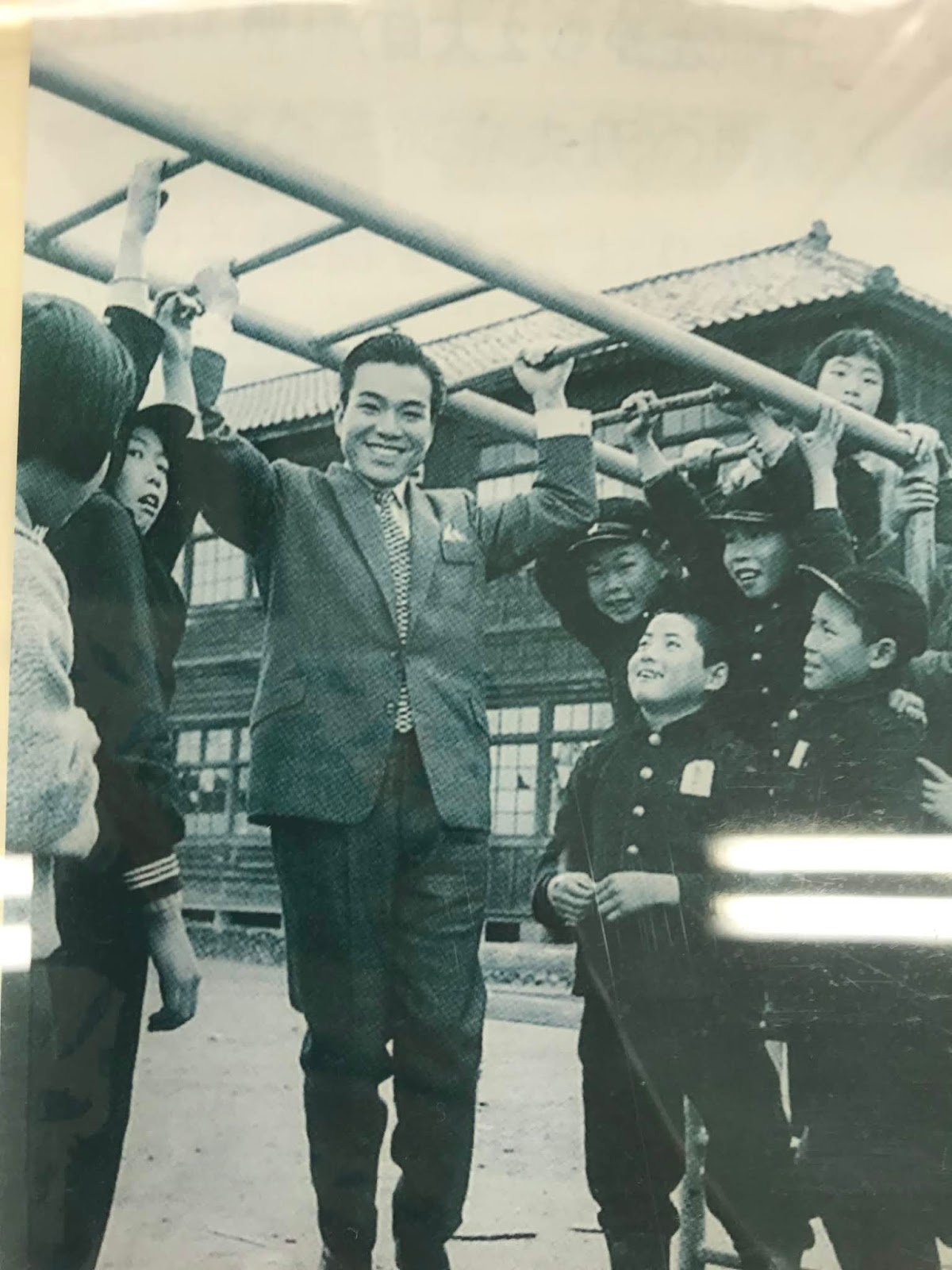
Yes, folks, the merry fellow you see hanging from the monkey bars was, indeed, Haruo Minami (三波春夫). He truly had a winning smile.
By the way, from now I will start referring to Minami as Haru-san from time to time as well. It's a fitting nickname I'd heard in a clip before, and I think it'd be more interesting to call him that alternatively than simply just Minami in my writings.
En route to Nagaoka
I had known about Minami's statue park from the time I discovered him, but visiting him wasn't really a concrete item on my list of things to do during my trip. It might seem odd considering what you all know about me by now, but I wasn't completely sure how frequent train service was on the Shin'etsu line running from Nagaoka to his hometown of Tsukayama.
But, of course, I eventually decided that I might as well give it a go as I don't think I'd have many other opportunities to visit Niigata otherwise (Minami or no Minami), so on one of the days in Tokyo, Mom and I took the shinkansen up to Nagaoka to check out Niigata and what of the Shin'etsu line. As it turned out, this local line does stop at Tsukayama moderately frequently - it was meant to be! ...This taught me to not be overly reliant on Wikipedia's train line information - there weren't many English sites with lesser known railway schedules like this, okay?
Anyways, having gone to Aizubange (Hachiro Kasuga's (春日八郎) hometown in Fukushima) and being impressed by being not so rustic as I thought it'd be, I suppose that gave me the not-so-realistic impression that Tsukayama may be more or less the same. Well, when we got there, it turned out to be what I had previously expected of Aizubange. It was very quiet and the facades of buildings had seen better days. However, it looked exactly like the villages featured on Channel News Asia's "Japan Hour" railway episodes, and it felt kind of strange (in a good way, of course) to actually be seeing it for myself.
And with it being Niigata, there were fields upon fields of rice with some plots being dotted by elderly farmers planting their crop. Up to that point, I had never seen how this Asian carb staple was farmed, so it was another first for this city kid. On the flip side, the farmers must be wondering what these two out-of-town folk were doing in a place like that. On another note, Tsukayama seems to be one of the hubs for the sports equipment company, Yonex. The juxtaposition of the occasional large factory blocks in the midst of old houses and rice fields was quite amusing.
Compared to the insane 45 minute hike it took to get to Hachi's museum,the 20 minute or so walk to this park was a breeze. But I would say my reaction upon seeing the one dubbed the National Singer standing on the pedestal was similar to seeing The First Enka Singer: Absolutely surreal.
It was the most realistic statue of a singer I had ever seen; his dimensions, that beaming and welcoming expression, the kimono. It felt incredibly bizarre looking up at it. It looked so real, it almost seemed like if I stared any longer, Minami would look down and say, "Hello"... That said, one of my perennial fears is for statues to animate and come after me, but this is one statue I wish would come to life.
Lyrics and melody of "Chanchiki Okesa" engraved in stone. Beside
is the music player.
Moving on, I have to say that this park was well put together. Besides the life-like statue and a little cherry blossom tree against the mountainous backdrop which forms a picturesque view, there are also a personal history plaque and some music plaques, at which you can play excerpts of 5 of his representative hits: "Chanchiki Okesa" (チャンチキおけさ), "Yuki no Wataridori" (雪の渡り鳥), "Tokyo Gorin Ondo" (東京五輪音頭), "Echiro Bon Uta" (越路盆唄), and "Sekai no Kuni Kara Konnichiwa" (世界の国からこんにちは). I believe the first I played was "Chanchiki Okesa", Haru-san's debut, to mark the occasion. Then I went on to play my favourite, "Yuki no Wataridori", and the rest of what was offered. As the music reverberated in this valley, I did look up at the statue a few times. Sadly, nothing happened.
Going on a tangent for a little bit: This was the first video I heard "Chanchiki Okesa" from. I don't know how but I didn't take notice of that first shot of him in his younger days at the very start of the video. Took me long enough (through the Marubell bromides) to realise how hot - I mean cute - I mean... nice... he looked back then.
KONNICHIWA, KONNICHIWA, NISHI NO - ARRGH!!
Coming back, as for my mother, she has come a long way since hating Minami. I remember she used to want to throw him into the dumpster - mind you, she didn't like Murata either, but dear Muchi only got the trash can. But she did eventually see merit in him through his versatility and crazy song fusions. Now she has done a complete 180. She even has a favourite song by him which she jumped at the chance to play at the park: "Sekai no Kuni Kara Konnichiwa". According to her, there was no better time than then to play this as we, being foreign fans from far off lands, have come to his hometown so it's fitting that he welcome us with none other than this apt ditty... ... Y'know, I like Minami a lot, and I agree with Mom, and this song is so him with how jolly it is, but I can't stand this song of his. It's just so infectiously annoying with the multitude of "Konnichiwas".
Okay, before the "Konnichiwas" burn a hole through my brain, let's continue. We had ekibens and juice bought at Nagaoka station for lunch at a strategically placed gazebo in the park. It was quite a comfortable place to take a break. But just be sure you have no trash to throw besides cans as there is no trash bin. We had to learn the hard way. Nearest proper bin was back at the station 20 minutes away.
Beside the park sat this firefly education center of sorts, which to my surprise, also had a little room that served as a museum space for this Tsukayama-bred talent. It wasn't particularly fancy, which was understandable as the main attraction is the statue park, and I was happy that there was at least a good number of Haru-san's artifacts on display, as well as pictures what seemed to be his entire discography. So I admired stuff like his calligraphy, movie posters (yes, he acted in stuff too), and old photos, all while lugging along a bag of trash.
And looking at his discography, Minami seemed to have sung an Ondo about essentially anything under the sun, from traffic safety to space to dinosaurs. Also, that pose for the cover on the left though... hmm.😕
What got the ball rolling. Also, how did I NOT notice it from this cover??? I must've been blind.
As for how Minami's typical style came about and how he became the first mainstream male singer to perform in a kimono, it happened that Mrs Yuki Kitazume (Mrs Minami) was the one who had encouraged him to do so. Y'know, one thing I noticed, as far as Haru-san and Hachi are concerned, their wives had a significant role in shaping their musical career. In that sense, I suppose the saying, "Behind every great man is a great woman" comes into play here.
Since he sang the theme to the Osaka World Expo in 1970, there was even a set of commemorative stamps with Minami on them!
I believe this was a gift he received on one of his anniversaries
in showbiz.
At the end of my round around the room, there was a section which featured the thoughts of school kids from that area on Minami, as well as a little trivia quiz to see how much one knows about him. I scored full marks... ... I... uh... don't know if that's good or bad.
That's a nice sketch!
At the end of it all, I was glad to have gone to Tsukayama. There weren't any trinkets I could get, but I did get a stamp in my notebook that included the statue. I also left my mark on the guest book. As we left, admittedly, I couldn't help but look back at the statue one last time.
To round this up, here is "Yuki no Wataridori". This song would be perfect if it were snowing. But then again, Niigata gets a tonne of snow and I don't fancy the idea of trudging through snow drifts for nearly half an hour.
Somehow, Minami, in spite of his refined mannerisms, could pull off a convincing ronin.
Well, that's 2 down, 2 more to go. The remaining ones are literally at opposite ends of the country though. I think the painted pikachu scream meme would fit in this situation.
Ever since encountering"Jan Naito Jan" (ジャン・ナイト・じゃん), I have always been marveling about how incredible Haruo Minami's (三波春夫) rapping ability was. However, I discovered that in the genre he's known for, rokyoku, there's rapid-fire narration, and I found that out through listening to "Tawaraboshi Genba" in its entirety. The veteran's delivery of this lengthy bit was incredibly fast yet articulate, and so that made me realise, in a sense he was technically rapping even before he decided to deviate a little from enka, and "Jan Naito Jan" was probably a piece of cake for him compared to his iconic hit decades before.
Here's "Jan Naito Jan" for reference.
To give some background info on "Tawaraboshi Genba" or "Genroku Mei Sofu Tawaraboshi Genba (元禄名槍譜 俵星玄蕃): It isn't your typical kayo-rokyoku. It falls under the category of Chouhen Kayo-Rokyoku (長編歌謡浪曲... long kayo-rokyoku). Creating this sub-genre was Minami himself who sought to revive this narrative style of singing that seemed to be dying by the end of WWII. A rokyoku song is usually quite a long one, and from what I've tried to watch (not very much, really) it can be rather draggy/boring. So, what Minami did was to condense a rokyoku story into a (comparatively) short and sweet package combined with enka-yo to make it more appealing to audiences that can be easily bored (like me). The narrative that was shortened here is Chushingura (忠臣蔵... The Treasury of Loyal Retainers), which refers to fictional tale that revolves around the Forty-seven Ronin's plot to avenge their master's death - the real historical event is called the Ako Incident. Minami had penned this rendition under his pen name Touji Kitamura (北村桃児).
60's Minami... don't get to see that all that often, now that I think of it.
Anyway, due to its length "Tawaraboshi Genba" isn't a tune I listen to all that much - also because my Minami compilation album doesn't have it. But recently I have developed a lot more appreciation for this kayo-rokyoku. The music, brought to you by renowned showa era composer, Yoshiji Nagatsu (長津義司), sounded like three different enka melded into one. It starts off noble - a little like "Yawara" (柔), then dips into something like a slightly jauntier version of "Otone Mujou" (大利根無情), after which the score picks up to become something akin to a crazier, faster paced "Ippon Doko no Uta" (いっぽんどっこの唄), before finally ending on that grand note it began with.
We also have Minami's delivery - by far my favourite part of "Tawaraboshi Genba" - which was as much of a roller coaster ride as the accompanying melody. As in "Otone Mujou", the fun comes when the expressions of the rokyoku master change fluidly like the face-changing characters in Chinese operas. One moment he's his usual beaming self that welcomes all with his chirpy vocals, the next his eyes have a murderous glint and he's screaming like a mad man and ruffling that neatly gelled back hair. Of course, there's also that intense "rapping" session - kinda sounds like chanting - I mentioned at the start of the article, so on a whole, "Tawaraboshi Genba" turned out to be more entertaining to me that what I had originally assumed.
"Tawaraboshi Genba" was released a number of times, most notably in April 1964 (original release) and in October 1992, the latter of which was actually a self cover rap mix with... an easy-going reggae version of "Sekai no Kuni kara Konnichiwa" (世界の国からこんにちは). Minami had sung the original twice on the Kohaku, the first being during his 7th appearance in 1964 and the second during his 31st and last appearance in 1999. Since it is a long song of about almost 9 minutes (about two/three normal enka songs long), most of the rokyoku portion was cut out when it was sung on TV due to time constraints.
A number of enka performers have attempted this kayo-rokyoku, and the ones I tend to see a lot are those by Aya Shimazu (島津亜矢) and Keisuke Yamauchi (山内惠介). Both are respectable but I have to say that Shimazu manages to convey the high intensity of "Tawaraboshi Genba" better than Yamauchi does.
Y'know although I'm not that much of a Haruo Minami (三波春夫) fan, I always enjoy seeing the Enka and Rokyoku (浪曲) singer on stage. I mean, he just emanated such positive energy! Generally dressed in light colored kimonos, one hand on his hip and last but not least with that trademark radiant smile of his he would be able to brighten up the stage once he came on.
Anyway, 'Otone Mujou' was Minami's8th single released in 1959, and not only is it an Enka song, but also a Rokyoku song, so there would be some narration in between the singing parts - Rokyoku's a type of traditional Japanese narrative singing. It was written by Ryo Inomata (猪又 良) and composed by Yoshiji Nagatsu (長津義司).
In this song, you would be able to see Minami turn from jovial to no-nonsense at the drop of a hat. Especially so at the last monologue where his narration grew from somewhat gentle, but still filled with savageness to kinda screaming it out with such intensity at the end like some crazy bloke. And you could also see that glint of ferocity mixed with a little insanity in his eyes too. So unlike the usual Minami!
But it was that versatility that intrigued me and got me to continue listening to 'Otone Mujou' even though it's not the type of Enka song - let alone Rokyoku song - I'd usually listen to. In fact, I only discovered this song while listening to Hideo Murata's (村田英雄) 'Osho' (王将). It was in the 'Suggested videos' list, so I thought, "Why not? Since I've not really heard any of Minami's songs." Fine, his graceful movements while narrating was also what caught my attention... well it is pretty cool!
In total, Minami sang 'Otone Mujou' 3 times on the Kohaku. And he had appeared on that event 29 times, putting him at 9th place in 'Most number of Kohaku appearances', which is quite impressive really.