Credits

I would like to give credit where credit is due. Videos are from YouTube and other sources such as NicoNico while Oricon rankings and other information are translated from the Japanese Wikipedia unless noted.
Showing posts with label Yoshie Kashiwabara. Show all posts

Thursday, September 10, 2026

Various -- I Only Want to Be with You


There are times when music critics and regular listeners totally agree on how good one particular song is. Of course, there are many more times when views and opinions clash between them and even among the two groups. And then there are songs that seem to have critics coming out with their knives unsheathed almost immediately as if they were Starfleet reacting to a sudden Borg incursion. 

Regular listeners end up looking rather bemused and stunned wondering what is up with all the hate. But apparently that was the case with "We Built This City" by Starship (and I'll have to take care of that as a ROY pretty soon...I actually like the song) and I have found out that it was also true with this week's subject of Reminiscings of Youth.

I am talking about "I Only Want to Be with You" which I had first thought was a one-and-only by Nicolette Larson released in July 1982. I used to hear this enjoyable rock-and-pop tune by the late Larson on radio all the time and though I didn't ravenously pursue the single, I always enjoyed hearing it on AM. Considering her other songs that have been highlighted on KKP, her take on "I Only Want to Be with You" was her having fun in a Linda Ronstadt way. And yet, reading the critique on Wikipedia, she was pretty much kicked into the end zone by a frustrated football player. And Larson wasn't the only one.

Several weeks ago, when I decided that I would feature "I Only Want to Be with You" under ROY, I discovered that the original version had been recorded by none other than Dusty Springfield back in 1963. Created by Mike Hawker and Ivor Raymonde, I actually like the old arrangement here with all of the hip-swinging it must have induced. Even for the original, a critic years later gave one of the all-time great backhanded compliments by referring to "I Only Want to Be with You" as a piece of lint but an entertaining enough piece of lint. Well, the lint reached No. 4 in the UK.

More than a decade later, the Bay City Rollers gave their own take on "I Only Want to Be with You" which was recorded right here in Toronto. Released in August 1976, this cover featured some powered-up strings. I couldn't find any punches hitting this one so maybe the band escaped. It did hit No. 3 in Canada and No. 12 in the United States.

Another big surprise landed on me on finding out that a 1979 take on the song had been recorded by the New Wave and rock band The Tourists. The Tourists included a couple of members, Annie Lennox and Dave Stewart who would later front the far more successful Eurythmics. Again, I've liked the basics about "I Only Want to Be with You" so I'm also a fan of this one especially with Lennox's vocals but once again, the knives were out (along with paint and tomatoes)...making the cover for the single look rather appropriate. Poor Annie looks shellshocked.

From Wikipedia

The second version that I'd ever heard of the song after Larson's cover was Samantha Fox's single from January 1989. I'd known about Fox through earlier songs and I'd heard that she was showing up in a lot of topless shots in UK newspapers. This form of the song was unsurprisingly 80s dance-pop. It reached No. 31 in the States while in Canada, it peaked at No. 29.

Wikipedia also mentions that many other covers in various languages including Japanese have been created...which goes to show that no matter the bricks and arrows aimed at a song, if it's catchy enough, it will remain deathless. Personally, I will always prefer Larson's version. And let us go with Larson's version when it comes to what was being released as singles in Japan in July 1982.

Yoshie Kashiwabara -- Shiawase Ondo(しあわせ音頭)


Hidemi Ishikawa -- Yu-re-te Shonan(ゆ・れ・て湘南)


Shibugakitai -- 100%...So Kamo ne!(100%…SOかもね!)

Thursday, May 21, 2026

Art of Noise -- Beat Box


I've already posted a number of Art of Noise articles in the past ten years as parts of the Reminiscings of Youth file here on KKP, and indeed, the avant-garde synthpop group consisting of Anne Dudley, Trevor Horn and all of the rest made up some of the most incredible collages of sounds to form music to add pleasure to my time in the 1980s. By the time that they came up with their version of "Dragnet" for the movie starring Dan Aykroyd and Tom Hanks in 1987, they were very much a welcome part and parcel of the decade's pop panoply.


However, several years earlier, I was honestly taken aback and maybe even somewhat intimidated by the Art of Noise when I heard their December 1983 debut single "Beatbox". It was nothing that I had ever heard before; they made this beloved song in the breakdancing world out of various sounds which emanated like and not like human voices screeching out a march alongside some pounding percussion and perhaps my first exposure to orchestral hits.

I've read and heard that there have been various takes (or diversions) on "Beatbox" on record and in music video. If so, then the music video below is the one that I've seen because I remember seeing that image of the London police officer getting duplicated and stretched out. It was quite the tourist video for London as well.


Among all of the diversions (I've seen No. 10), I think the one that I heard the most on radio was Diversion 1 which lasts more than eight minutes and finishes with a classy classical piano take on the core song. It's almost as if AON was trying to let us know that no matter all of the technology and sampling, music still comes down to a basic beautiful melody played out on an old-fashioned instrument.

So, as I said, "Beat Box" was released in December 1983. What else was being released in Japan in that month?

Yutaka Ozaki -- Juu-go no Yoru(15の夜)


Yoshie Kashiwabara -- Camouflage (カム・フラージュ)


Tatsuro Yamashita -- Christmas Eve

Thursday, April 23, 2026

Madonna -- Material Girl


Welcome to the weekly Reminiscings of Youth for this Thursday. I heard that Madonna was coming out with a new album sometime later this year. I went WOW since for a guy like me who's nearing retirement age, I first knew about Ms. Ciccone when I was in my late teens. Man, has this been a career for her!

Since hearing her for the first time back in 1983 for "Holiday", it was pretty much Madonna everywhere for the rest of the 1980s. I'm not sure how many nicknames she's picked up during that time, but one of them was The Material Girl because of that January 1985 single, "Material Girl", and it's the nickname that I usually associate with her (I just read that she hasn't been too fond of that one, though).

As with a lot of her hits, "Material Girl" was all over the airwaves and the music video was on heavy rotation on the local video shows with her going all Marilyn Monroe. Songwriters Peter Brown and Robert Rans wrote the lyrics to show that Madonna was all about the glam and goodies but the music video impressed upon the viewers that she was quite the opposite. The melody itself hit me as a synthy and slightly sinful song for Madonna done up in a cutesy yet sly fashion, and it was quite the change to see the lady done up in a totally different fashion compared to her previous videos. I also forgot that there were a couple of other celebs involved in the video: Keith Carradine and Robert Wuhl.

"Material Girl" reached No. 2 on America's Billboard and No. 4 on Canada's RPM. So, what else was hitting the record stores in Japan in January 1985?

Yutaka Ozaki -- Sotsugyo (卒業)


Yoshie Kashiwabara -- Lonely Canary (ロンリー・カナリア)


Seiko Matsuda -- Tenshi no Wink (天使のウィンク)

Monday, March 23, 2026

Yoshie Kashiwabara -- Shiawase Ondo(しあわせ音頭)


Listening to music all these decades and handling KKP for the past fourteen years, of course, I know all about those 45" singles and CD singles with their A/B sides and coupling songs. Sometimes though on a singer's J-Wiki discography, I encounter something called the kikaku single(企画シングル)or "planned single". I'm still not 100% on the meaning or purpose of these things, but from my experience, I can glean that they refer to special releases by a singer tackling a genre that's not usually in their wheelhouse.

And thus, we come to Yoshie Kashiwabara's(柏原芳恵)"Shiawase Ondo" (Happy Folk Song). I found this song just recently on YouTube and it took me a little longer than usual to track this down since "Shiawase Ondo" hadn't been included on Yoshie-chan's long single list. It was placed on the...you guessed it...the kikaku single list and it even got its own entry on J-Wiki.

I guess it's because Kashiwabara was covering something that wasn't her usual aidoru stuff. Released early in her career, July 1982, "Shiawase Ondo" is all about the festival minyo, and the dead giveaway was the title's use of ondo which is often used for the traditional folk songs of Japan. She's got quite the adorably cute delivery of Masato Fujita's(藤田まさと)lyrics but the music is also notable not only for the old-style jaunty folk (vocal whoops included) but the fact that it sounds quite Okinawan and technopop at the same time. I started thinking that Yellow Magic Orchestra had been involved, and sure enough, one third of the group, Haruomi Hosono(細野晴臣), provided the melody which Nobuyuki Shimizu(清水信之)then arranged into a spacey yet familiar tune that the kids would love to dance to. 

For Yoshie fans, "Shiawase Ondo" must have been quite the rare thing to covet since this kikaku single hadn't gotten onto an original album for years until March 2004 when it was finally included on the aidoru's CD box set "Kashiwabara Yoshie Premium Box"(柏原芳恵 プレミアムBOX). The single itself peaked at No. 70 on Oricon.

Saturday, September 6, 2025

Yoshie Kashiwabara/Miyuki Nakajima -- Nagisa Dayori(渚便り)


The last time I posted a Yoshie Kashiwabara(柏原芳恵)article was back in 2023 so KKP is due for a new one on the Osaka-born singer. Plus, I've started to get into the habit of checking out the B-sides for certain singers' big hits. You might say that I'm giving them their own due by bringing them outside of the A-sides' shadow.

Well, the very first Yoshie song that I ever wrote about on the blog was her major hit "Haru Nanoni" (春なのに)from January 1983. It was written and composed by Miyuki Nakajima(中島みゆき)and arranged by Katsuhisa Hattori(服部克久)so it definitely had that very refined and classical sense.

Nakajima and Hattori brought the same approach to the B-side, "Nagisa Dayori" (Correspondence from the Beach). Slightly more upbeat than "Haru Nanoni", it's still rather melancholy as a young woman recalls the romance that she once had but no longer does. Those strings are still blisteringly shimmering.

The thing is that Kashiwabara's poignant rendition of "Nagisa Dayori" is actually a cover of Nakajima's folksier original song which was a track from her April 1976 debut album "Watashi no Koe wo Kikoemasu ka"(私の声が聞こえますか...Can You Hear My Voice?), The album reached No. 10 on Oricon. For both versions, there's something in the arrangement that reminds me of the early songs of Rumiko Koyanagi(小柳ルミ子).

Thursday, March 20, 2025

Eurythmics -- Sexcrime (Nineteen Eighty-Four)

Wikimedia Commons
Nevil Clavain
 
George Orwell's dystopian "1984" (released in 1949) was required reading in high school. I'd heard about it before through media and fellow students, and as the year itself approached, there were all sorts of media taking snatches of its ideas for their own purposes...kinda like teeth from Winston's mouth. And perhaps even before the hype snowballed, expressions from the book such as "Big Brother" and "doublespeak" had already made their way into the vernacular.


One example was Apple launching the MacIntosh computer. It was a great commercial although I wouldn't get my own Mac for several years.


Even Canadian sketch comedy show "SCTV" did their own tribute to "1984" back in early 1981. Not sure how Orson Welles took his "casting" as Big Brother, but here's hoping that he had a sense of humour about it.

All that stuff about "1984" had me shivering in my boots because I'd gotten the paranoid impression that once 1984 arrived, everything would change and we would all be filling our sentences with antonyms.


Then came the news in 1984 (nope, Big Brother didn't arrive) that an actual cinema version of "1984" starring the late John Hurt would be appearing in theatres later in the fall. I'd already read the novel and was primarily interested in it for the twistings of language for political advantage but never really got the gumption to head to the nearest cineplex.


But in a way, I really didn't have to. The Eurythmics were more than willing to bring "1984" to us through their single and accompanying music video "Sexcrime (Nineteen Eighty-Four)" which had plenty of scenes from the Hurt film. 

Thus far on KKP's Reminiscings of Youth series, Annie Lennox and Dave Stewart have continued to amaze decades later with the iconic "Sweet Dreams (Are Made of This)" and then the rock 'em/sock 'em "Missionary Man". In between those two singles though was "Sexcrime" which was released at around the same time as the movie in October 1984. This one single had Annie and Dave in dance music remix mode with a whole bunch of sampling and the former sounding as if she were vigorously stating the affirmative in Japanese. The song was supremely catchy so that hearing it in the trailer for "1984" was a bit weird considering what the movie was all about. One would think that Big Brother would have sent the hounds after Eurythmics for "coolcrime".


Both the song and video got heavy airplay to the extent that I'd gotten my life's worth of "1984" visuals without having to read the novel ever again. On Canada's RPM, "Sexcrime" managed to hit No. 18 while in America, it only reached No. 81 on Billboard although on the dance club charts, it made it to No. 2.

Anyways, what was up on the charts when the movie and the single were released in October 1984? Those Top 3 look too familiar to me so I probably posted them up on a recent ROY article. Therefore, let's go with Nos. 5, 7 and 8.

5. Takashi Hosokawa -- Naniwa Bushi da yo, Jinsei wa (浪花節だよ人生は)


7. Akina Nakamori -- Jikai (1984) 


8. Yoshie Kashiwabara -- Saiai (最愛)

Spring Songs


The first day of spring supposedly arrived at 5:01 am this morning. It's not exactly warmer out there and in fact, it's looking downright gray but I'll take everyone's word for it. As my friend tells me annually, here in Toronto, we will never be sure of spring's arrival until May.

Anyways, I didn't realize it until yesterday but I had yet to put up an Author's Pick on spring-titled songs so here are some of them although I'm sure that there are plenty of those out there in the kayo kyoku/J-Pop zeitgeist. 

(1976) Candies -- Haru Ichiban (春一番)


(1977) Masao Sen -- Kitaguni no Haru (北国の春)


(1983) Yoshie Kashiwabara -- Haru Nanoni (春なのに)


(1994) Yumi Matsutoya -- Haru yo, Koi (春よ、来い)


(1997) Takako Matsu -- Ashita, Haru ga Kitara(明日、春が来たら)

Thursday, March 13, 2025

Gowan -- A Criminal Mind

Wikimedia Commons
Hector Sanchez

For this week's edition of Reminiscings of Youth, I'm once again going into the Canadiana vault because my good friend and KKP contributor JTM and I had a talk back on Sunday, and he was further interested in what other Canadian singers and bands were up to back in the ol' 1980s

Well, there has been one singer that's been on my mind for a while since he went by a mononym during the time that he had made a splash on the music scene in the 1980s. Singer-songwriter (Lawrence) Gowan struck us not only with his distinct name but also with his third single, "A Criminal Mind", and its accompanying music video. Coming out in January 1985, I think I was in the middle of my freshman year at University of Toronto when this sinister but alluring pop/rock number popped out with Gowan fully acting up the role as an unrepentant if somewhat tragic evildoer amid synthesizers and guitars done up in a gothic dark way. In a way, I thought "A Criminal Mind" was a musical cousin to Pet Shop Boys' "Opportunities", although the feeling is that the bad guys in the latter song were mere pretenders to Gowan's successful mastermind.

Videographer Rob Quartly was behind the making of the video which combined stylized live-action and classic comics-influenced animation. Watching it and hearing the delectably devilish delivery by Gowan definitely made it all stand out when it was given heavy rotation on MuchMusic all those years ago. 

"A Criminal Mind" made it to No. 5 on RPM here in Canada and it was a track on Gowan's second studio album "Strange Animal" which was released a month after the single. To raise the ante on the Canadian-ness of it all today, I also have to give my props to the sinister narrator at the beginning of the video, the late voice actor Len Carlson from Edmonton. I only found out that he was the same fellow who used to do all those soothing Kraft recipe ads that I saw as a kid (although I don't think my mother would ever try them out).


Of course, "SCTV" couldn't help but poke fun at those commercials. Eugene Levy was the Carlson-soundalike here.

So, what else was coming out as singles in Japan when "A Criminal Mind" lurked out of the shadows?

Yoshie Kashiwabara -- Lonely Canary (ロンリー・カナリア)


Yutaka Ozaki -- Sotsugyo (卒業)


Anzen Chitai -- Nesshisen(熱視線)

Thursday, November 21, 2024

Chaka Khan -- Through the Fire


A few months ago, my Reminiscings of Youth post was on Chaka Khan's funky-as-all-get-out "I Feel For You" from 1984 which probably had the folks hitting the dance floor to do their breakdancing. It is one of two songs that I will always associate with her. But the other song of hers that is up there with "I Feel For You" is "Through the Fire", a wholly different animal. It's a romantic ballad from April 1985 that was created by David Foster (and yeah, it sounds so Foster), Tom Keane and Cynthia Weil which will always put me at ease as one of the most heartfelt examples of Quiet Storm that I've heard. She can hit it out of the park with her love songs as well as her party hits. Not surprisingly, this and its video were on heavy rotation on radio and TV.

I was a bit surprised and disappointed that "Through the Fire" didn't hit too high on the charts, reaching No. 60 on the Billboard Hot 100 and then No. 15 on the Billboard Hot Black Singles. I thought it was a Top 10 song for sure. The ballad had already gotten out onto the market some months earlier as a track on Chaka Khan's October 1984 "I Feel For You" album.

So, what else was coming out on the Japanese record store shelves in April 1985?

Yoshie Kashiwabara -- Machikutabirete Yokohama (待ちくたびれてヨコハマ)


Akina Nakamori(中森明菜) -- Bitter and Sweet (album)


Yukiko Okada -- Summer Beach

Thursday, August 15, 2024

Katrina and the Waves -- Walking on Sunshine


I was reminded of this 80s hit because the song got covered as an instrumental jingle on one of the heavy rotation commercials during the Olympics.

Reading the Wikipedia article on Katrina and the Waves' "Walking on Sunshine" from April 1985, I discovered that the band itself had been rather tepid toward the song initially since even the lead vocalist, Katrina Leskanich admitted that none of them were exactly the most up-with-people types. Perhaps that was why the guys in the band looked distinctly cold and miserable for almost the entire length of the music video shot in London although Katrina indeed danced about as if she were really walking on sunshine. When I first saw the video as a university kid, that was the first big impression I got...Katrina was just having a really good day. And we got to see her everyday having a really good day because it was a hit song and the video got heavy rotation on the music shows.

"Walking on Sunshine" hit No. 3 in Canada (going Gold) and then No. 9 in the United States. A recent interview with Leskanich had her saying the song was probably going to outlive her. Well, it already has begun through the Olympics.

So, what else was coming out during that month? We've got the usual three.

Yoshie Kashiwabara -- Machikutabirete Yokohama (待ちくたびれてヨコハマ)


Yukiko Okada -- Summer Beach


Minako Honda -- Satsui no Vacance (殺意のバカンス)

Monday, November 13, 2023

Yoshie Kashiwabara -- Otome Gokoro Nani Iro?(乙女心何色?)


Well, yes, I am well aware that staying on tune was more of a helpful guideline rather than a hard and fast rule for an aidoru back in the 1980s, but I have to admit that whenever I hear the chorus part of Yoshie Kashiwabara's(柏原芳恵)4th single "Otome Gokoro Nani Iro?" (What Colour is the Heart of a Maiden?), I can't help but cringe. I'm not sure whether these are simply my ears registering the off-tune situation but it's the one way that I recognize the song.

Regardless, "Otome Gokoro Nani Iro?" was released in February 1981 and it's a young lady's oh-so-giddily happy treatise on spring as the season of budding love. She would know that for sure since she's head-over-heels herself. According to her, the colour of a maiden's heart changes seasonally and in spring, the magic hue is rose. Arranged by Tsugutoshi Goto(後藤次利), words and music were supplied by Haruo Chikada(近田春夫)which I was a bit surprised about since I'd always associated him more with New Wave, synthpop and rock n' roll. "Otome Gokoro Nani Iro?" is actually quite breezy and very aidoru-like.

The song peaked at No. 55 on the Oricon weeklies, selling about 40,000 records. It first appeared on an album in October 1981, her first BEST compilation "Kashiwabara Yoshie BEST"(柏原よしえベスト). Interestingly enough, her stage performances of the single were more on tune.

Thursday, February 16, 2023

Bill Champlin -- Tonight, Tonight/Ray Kennedy -- My Everlasting Love


Welcome to another Reminiscings of Youth session. Last Friday, I put up an article on a 1984 duet between one of the best voices in Japanese music Hiromi Iwasaki(岩崎宏美)and AOR singer-songwriter Bill Champlin titled "Both of Us". Noticing that it sounded somewhat like Earth Wind & Fire's "After the Love Has Gone" (and I wasn't the only one, judging from the YouTube comments), I was reminded of yet another love ballad that had similarities with that EWF classic.

Back in my days as a callow youth of the 1980s, I was taping the heck out of songs off the the various radio stations, and those included the ones that would be considered AOR and Quiet Storm, genre names that I hadn't heard of yet, but I guess that I just had a predilection for the light and mellow. Anyways, one song that I taped but didn't bother with recording the DJ's iteration of the singer's name and the title is the one that you can see above you. Well, thanks to my lack of foresight, I would then take on a multi-year odyssey searching for this mystery tune (along with others, Japanese and non-Japanese).

First off, though, let me say how happy I was when I was finally able to track down the fact that it was Champlin who sang this classy and smooth Perrier-friendly ballad "Tonight, Tonight" and it was from his December 1981 album, "Runaway". When I hear those soft keyboards and the buttery horns and strings, despite the earliness of the release, I get images of hedonistic lifestyles of that decade portrayed through television and movies (there's always dinner on crisp linen and fine china in that penthouse). I wasn't at all surprised that it had been created by the singer, David Foster and Raymond Louis Kennedy.

The search took me around thirty years since I noted in a very early KKP article from 2012 that I had just found Champlin's cover via YouTube. And yes, I have just said cover version because "Tonight, Tonight" is a redux of the original by the aforementioned Ray Kennedy who recorded it for his 1980 "Ray Kennedy" under the title of "My Everlasting Love". Strangely enough, I had heard Kennedy's "My Everlasting Love" through one of those American AOR compilations that I bought in Japan but wasn't sure at the time which was the original and the cover. According to the article for the 1981 "Runaway", Champlin had sung background vocals for Kennedy's original. I liked Kennedy's take but it wasn't quite the Champlin cover that I really wanted.

As it has been for a number of lost songs that I finally found, I had to go through a lot of cheap Canadian Tire tapes, radio listenings, university, and two stints in Japan over three decades to finally know the truth about "Tonight, Tonight". I ended up buying "Runaway" because I had wanted to get my own copy of the ballad. It didn't score too highly on the charts (well, pretty low at No. 178) and one critic disdained the tracks as being a pale version of the band Chicago according to the Wikipedia article. To be honest, I've only given the album just that one listen myself but especially after reading the mediocre reviews, I'm willing to give it another go. I have a thing for underdogs.

Now, what was in the Top 10 of Oricon for December 1981? Well, I have Nos. 7, 8 and 9.

7. Toshihiro Ito -- Sayonara Moyo(サヨナラ模様)


8. Yoshie Kashiwabara -- Hello, Goodbye


9. Iyo Matsumoto -- Sentimental Journey (センチメンタル・ジャーニー)

Saturday, November 26, 2022

Irene Cara -- Flashdance... What a Feeling

from Wikipedia

The name Irene Cara was on the Trending list on Twitter this morning, and usually when I see a name on that list, I think that the person is there because they have said something controversial or meaningful. But then out of curiosity and my nostalgia for the 1980s, I checked it out and I couldn't quite believe that the singer and actress had passed away yesterday. Holding onto that string of hope that it was just a sick joke, I checked CNN but sadly, it was all true.

I hadn't heard about Cara in many years. As such, I've always seen her as one of the many beacons of the 1980s. The other beacon was of course the poster of the 1983 movie "Flashdance" with star Jennifer Beals sitting towards the camera with that extended neck hole which became such a popular fashion statement of the decade. I never saw the movie but frankly I didn't have to. The movie became so popular that scenes were always being played on television.

I knew Cara for five songs. Two of them came from the 1980 film "Fame" with the title track and the heartfelt ballad "Out Here on My Own". One was the song of its times "Breakdance", and then there was another upbeat single "Why Me?". However, arguably her most famous song was the hit "Flashdance...What a Feeling" which was the theme song for the aforementioned "Flashdance" and Cara's March 1983 single.

The movie, the poster and that single created by Giorgio Moroder and Keith Forsey became the triumvirate as one of the pop culture icons of the 1980s. "Flashdance... What a Feeling" had those distinctive synths and a power pop styling that pretty much had aerobics instructors and students punching the air in triumph whenever it was played. As well, the song becoming a major hit for 1983 was a regular entry in the local TV music video rankings show "The CHUM Top 30", so I saw Beals doing her dance routine regularly as this song was playing. The accolades were enormous, too, as Cara won an Oscar, a Grammy and a Golden Globe for it. Not surprisingly, it hit No. 1 on the charts in many nations including the United States and Canada, and maybe even Japan, too. For one of my other ROY articles, the one for Commodores' "Turn Off the Lights", it was even listed as one of the songs that was showing up on the Oricon list. 

In any case, I hope that Cara's family, friends and fans are holding up together right now during this very sad time. Of course, when "Flashdance... What a Feeling" was released, there were songs up on the Oricon chart for March 1983. I think that the Top 3 have already been mentioned in another ROY article so this time around, let's go with Nos. 9, 10 and 11.

9. Takashi Hosokawa -- Yagiri no Watashi (矢切の渡し)


10. Yoshie Kashiwabara -- Haru Nanoni (春なのに)


11. EPO -- U, Fu, Fu, Fu, (う、ふ、ふ、ふ)


As a big P.S., I also have to say that "Flashdance... What a Feeling" has been covered by a number of Japanese artists with one being Miki Asakura(麻倉未稀), which became her 6th single released in July 1983. It was used as the theme song for the TBS drama "Stewardess Monogatari"(スチュワーデス物語...Stewardess Story).

Saturday, June 4, 2022

Yoshie Kashiwabara/Mayumi Itsuwa -- Haru Gokoro(春ごころ)


Lest that I would dare think that the summer has finally arrived, I went outside in my thin T-shirt an hour ago to get the paper and got a blast of 10-degree Celsius air with a stiff wind. It was brisk to say the least and was almost grateful that it felt so stuffy and warm inside my room. I could also say that winter, let alone spring, has yet to release us from its icy grip.

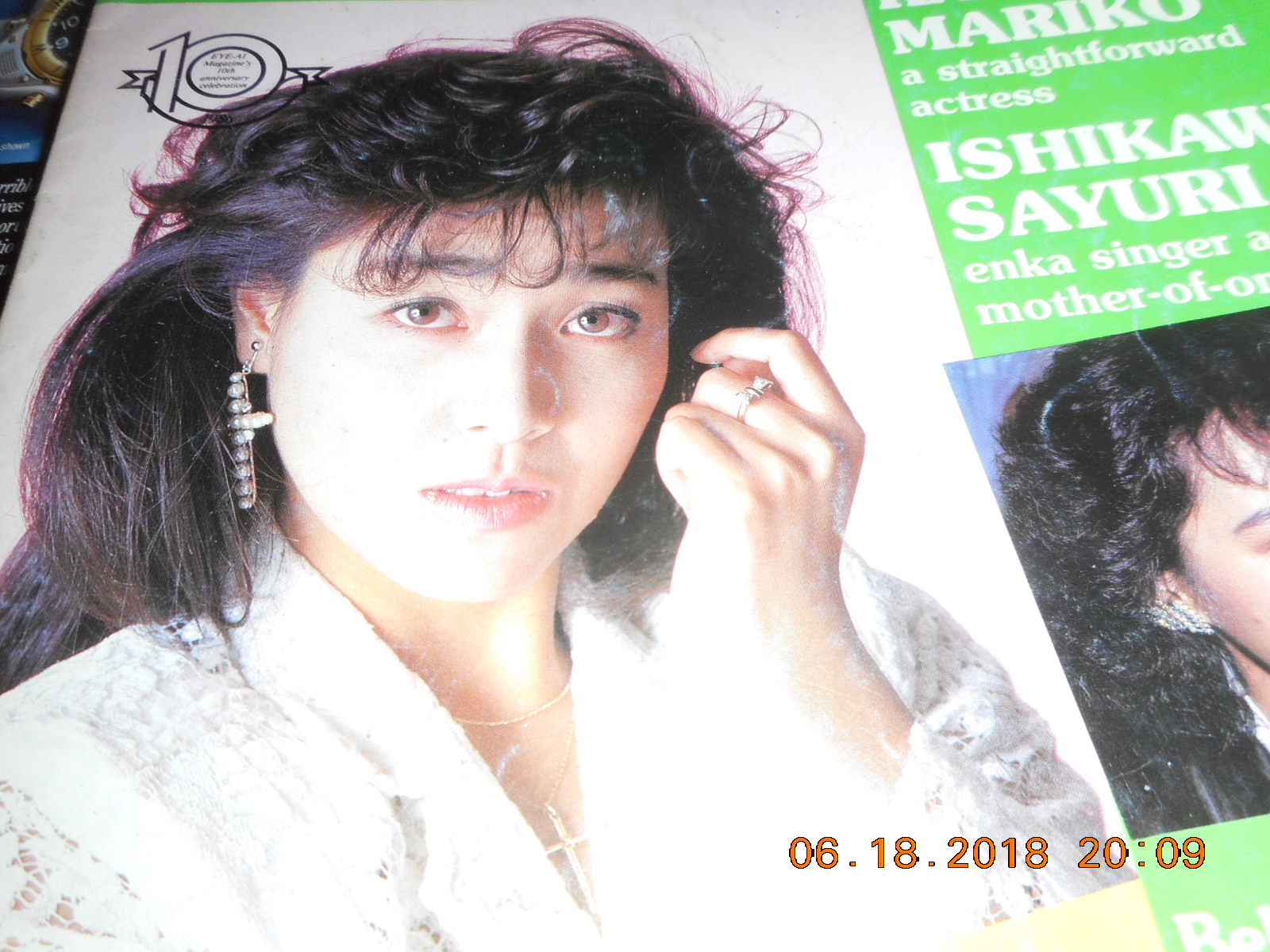
Anyways, that picture of 80s aidoru Yoshie Kashiwabara(柏原芳恵)is from the cover of the very first issue of Hawaii-based Japanese pop culture magazine "Eye-Ai" that I ever bought at Nippon Video back in the 1980s. That really was a big-hair era for her, wasn't it?

Listening to her 24th single from New Year's Day 1986, "Haru Gokoro" (Spring Heart), reminded me of her other spring-based hit, "Haru Nanoni" (春なのに), from a few years earlier. The melody is truly elegant (bordering on Fashion Music) with the strings and piano, and the lyrics are bittersweet and heart aching as they describe a relationship that may be about to hit the rocks for good. Of course, I immediately thought of singer-songwriter Miyuki Nakajima(中島みゆき)who had also come up with "Haru Nanoni"

However, digging into the J-Wiki article for "Haru Gokoro", I kinda smacked myself on the head when I saw Mayumi Itsuwa's(五輪真弓)name behind words and music with Mitsuo Hagita(萩田光雄)as the arranger. Itsuwa is definitely of the Fashion Music sub-genre with all of its elegance, class and pathos, and listening to the song again, I could definitely envisage either Kashiwabara or Itsuwa in a Parisian café sighing wistfully.

"Haru Gokoro" would be Kashiwabara's final single to reach the Top 10 to this date by placing at No. 10 with sales of over 60,000 records. It's also a track on her February 1986 BEST compilation, "Merci!" which peaked at No. 33 on the charts. Itsuwa would do a more mysterious and definitely non-Fashion Music cover of "Haru Gokoro" for her September 1986 14th album "Toki no Nagare ni"(時の流れに...In The Flow of Time).

Sunday, March 13, 2022

Yoshie Kashiwabara -- Café Bar Don Juan(カフェバー・ドンファン)


I almost forgot that March 14th is White Day, that supposedly Japan-only sequel to Valentine's Day back on February 14th when this time it's the women who give the chocolates to the men. I guess over here March 14th can also be considered to be Pi (𝝿) Day since the number begins with 3.14. But I would rather go with its more delicious homophone word, pie!


Anyways, since as of this writing, it's already White Day in Japan and less than 6 hours we make it to March 14th here, let's try this rather intriguing love song on for size. It's been a while since I've had 80s aidoru Yoshie Kashiwabara(柏原芳恵)on the blog, so I'm happy to have here again, and this time, it's for the track "Café Bar Don Juan" from her April 1984 9th album "Luster".

Now, according to J-Wiki, "Luster" was a concept album of sorts for Kashiwabara in that with the music industry still going somewhat ga-ga over synthesizers and other computers in pop music, the powers-that-be behind "Luster" wanted to apply the Fairlight CMI to all of the tracks to get that distinctive computer-y sound. Composer Kyohei Tsutsumi(筒美京平)and arranger Motoki Funayama(船山基紀)came on board to ply their trades to the entire album and lyricist Yasushi Akimoto(秋元康)wrote three of the ten tracks including "Café Bar Don Juan".

Sure enough, "Café Bar Don Juan" is brimming full of shiny metallic sounds so that first-time listeners like myself can be forgiven if thoughts of Yellow Magic Orchestra or early 1980s Akiko Yano(矢野顕子)came to mind. As for the lyrics, the lady in the story is almost daring the local Lothario to love her and leave her like his reputation suggests; I guess there might be something slightly sadomasochistic in there. "Luster" itself peaked at No. 22 on the Oricon weeklies.

Anyways, do enjoy your chocolates or pie!

Friday, November 23, 2018

Yoshie Kashiwabara/Chika Takami -- Shinobi Ai(し・の・び・愛)


By kismet, I guess this article could be considered to be a sequel to a couple of other articles with one being a slightly more distant cousin of sorts. Earlier today, I had written about the City Pop tune "Tawamure no Koi no Mama ni"(たわむれの恋のままに)whose refrain sounded fairly similar to the one for the song of this article here. And since I didn't want to leave readers hanging, I've decided to write on it tonight. The other cousin is the article that I'd written was "Osaka Tsubame"(大阪つばめ)just in the last several minutes, simply because 80s aidoru Yoshie Kashiwabara(柏原芳恵)is a born-and-bred Osakan herself.


"Shinobi Ai" is Yoshie Kashiwabara's 23rd single from September 1985. According to the J-Wiki article on the song and its lyrics that fairly scream "TAKE ME, I'M YOURS!" (well, not so loudly), the theme is about having an illicit affair. I was trying to figure out the meaning of shinobi in this case since the title is written in hiragana and depending on the different kanji, the definitions are quite different. If it's read as 「偲ぶ」, then it could mean "nostalgic" but the other kanji 「忍ぶ」could refer to "concealed" or "enduring". Frankly, I would go with the latter. The above is of Yoshie-chan's 2nd appearance on the Kohaku Utagassen singing "Shinobi Ai".


I do like the alternate version for the single. "Shinobi Ai" has that hint of City Pop in it and that breathy synthesizer intro adds some sultriness to the atmosphere. Plus, the arrangement (especially with the backing chorus) makes it sound like a ballad that Hiromi Iwasaki(岩崎宏美)could have performed at that time as well. The song peaked at No. 9 on Oricon and also got onto her 12th studio album of the same name from October 1985. That release got as high as No. 17.


Surprises are always welcomed on "Kayo Kyoku Plus" when it comes to writing about songs here. For example, the lyricist and composer for the song is Toshihiko Takamizawa(高見沢俊彦), one of the members from rock band ALFEE, and I found out here that Kashiwabara had actually provided a cover and not an original song. The original version was actually recorded all the way back in November 1979 as a B-side for Chika Takami's(高見知佳)5th single, "Cezanne no E"(セザンヌの絵...A Cezanne Painting), and that original was titled "Shinobi Ai ~ Don't Leave Me Alone" with a different set of kanji(しのび逢い...Secret Encounter[?]).

Although the lyrics are the same, the song here by Takami sounds more melancholy, innocent, folksy and 70s...perhaps as if the lovers are high school kids in a Romeo & Juliet situation sneaking off for a double-straw milkshake in a café on the other side of town. No idea how well the single did, but I'm glad to know of the song's original existence.

Sumiko Toyohiro/Yoshie Kashiwabara -- Tawamure no Koi no Mama ni(たわむれの恋のままに)


Commenter Mike gave me a tip back in April this year via my article on Yoshie Kashiwabara's(柏原芳恵)21st single "Saiai"(最愛)about this obscure singer named Sumiko Toyohiro(豊広純子)and her December 1982 single, "Tawamure no Koi no Mama ni" (Tumbling Head Over Heels). Toyohiro provided the lyrics and later, Yoshie-chan would cover it herself in the album "Saiai" in 1984. Tatsushi Umegaki(梅垣達志)came up with the melody.


Well, it's here now...and please...let it be here for a good long while. "Tawamure no Koi no Mama ni" is a sizzling torch song (perhaps approaching Level: Acetylene) that can belong to the classy night bar side of City Pop. Kimihiko Shiraishi(白石公彦)composed the shibui melody which should be served with a tumbler of the bar's very best scotch. Perhaps it can even be considered to be a representative of Fashion Music. According to one Japanese blog, "Tawamure" was created as an entry for the 13th Annual World Popular Song Festival sponsored by the Yamaha Music Foundation in 1982.

Along with the shibui aspect that I like in the ballad, I also enjoy Toyohiro's voice since it reminds me a lot of the fine vocals of Junko Ohashi(大橋純子). I can easily imagine Ohashi covering this one as well. Since Kashiwabara covered it, I also have to mention one other interesting aspect. At first, from listening to "Tawamure", the refrain had me thinking that this was the original version of a completely different Yoshie song since the refrain in that one sounds quite similar. In fact, the song that I had been thinking about was "Shinobi Ai"(し・の・び・愛), actually created by a different singer-songwriter which I will have to write about very soon.

As for Toyohiro herself, aside from the blog that I mentioned in the last paragraph and what Mike had told me, I have yet to find anything else substantial about the singer-songwriter herself. She did release one album "Water Heart", but methinks that this is one album that would be a lost treasure to track down.

Friday, September 8, 2017

The Works of Toyohisa Araki (荒木とよひさ)


According to Oricon via J-Wiki, the top five lyricists in terms of singles sold are Yasushi Akimoto(秋元康), Yu Aku(阿久悠), Takashi Matsumoto松本隆...the rankings are in his article), Tetsuya Komuro(小室哲哉)and Tsunku(つんく♂)as of December 2015. I've got a feeling that since then Akimoto has further left Aku and Matsumoto in the dust considering all those songs that he's created for his alphabet girl groups, and he was already in the hundreds of millions.

Lyricist Toyohisa Araki is not within that august group and I don't know where he ranks but considering the breadth of who he has provided words for over the past few decades, he can't be that far behind. I decided to write a Creator article about him one night when I took a look at his file on "Kayo Kyoku Plus" and noticed the wide variety of singers that he has collaborated with.

Araki was born in what is now Dalian, China in 1943. He attended the Nihon University College of Art in Tokyo where he was also a member of the ski club. Starting out as a writer, he broke his leg one time while skiing and ended up in a hospital. In gratitude to the nurses who helped him, Araki came up with a tune about a Niigata Prefecture onsen. The popularity of the song then started to spread around although the author behind it had remained unknown at the time until Araki finally admitted his participation.


That song turned out to be "Shiki no Uta"(四季の歌...Song of the Four Seasons)which was officially released as a single in February 1972 by Yumi Inui(いぬいゆみ). Listening to this original version, I wasn't quite sure whether it wanted to be a gentle folk tune or something with a bit of urban pizzazz. Not sure how it did on Oricon but the fact that it didn't seem to make a huge splash was perhaps not that surprising.


However, "Shiki no Uta" has been heavily covered over the years by folks such as Yujiro Ishihara(石原裕次郎), Chieko Baisho(倍賞千恵子)and the Dark Ducks(ダーク・ダックス), but the most successful cover was by singer Yoko Seri(芹洋子)as a 1976 single. Her version broke the Top 10 by hitting No. 8 and it even became a million-seller. Seri's take was a uniformly innocent pop ballad which most likely was more pleasant on listeners.


Since then, Araki has provided lyrics for many singers. In fact, the reason that I finally pulled the trigger to devote an article for him was re-discovering that he had written the City Pop classic "Fly-Day Chinatown"(フライディ・チャイナタウン)for singer and composer Yasuha(泰葉)in 1981. I've also discovered recently that "Fly-Day Chinatown" has also become another favourite one for all those Japanese Future Funk/Vaporwave enthusiasts (Round One, indeed).


He's also provided some pretty refined material for aidoru such as Yoshie Kashiwabara(柏原芳恵). The song here is the classy "Machikutabirete Yokohama"(待ちくたびれてヨコハマ)from 1985.


I think, though, Araki has tended to hover in the enka/Mood Kayo field. He wrote a number of songs for the late Teresa Teng(テレサテン)including one of my favourites by her, "Tsugunai"(つぐない). For me, it was one of the great examples of what I've called European enka.


The above songs have all been covered in the blog but I also found some new entries. "Nageki no Melody"(嘆きのメロディー...Melody of Grief) was sung by Yujiro Ishihara as a 1984 release. Takashi Miki(三木たかし), a frequent songwriting partner for Araki, came up with the melody so Mood Kayo that the record probably smelled of cigarette smoke and scotch as soon as it was taken out of the sleeve.


In 1990, Araki wrote the lyrics for this contemporary ballad sung by Yuiko Tsubokura(坪倉唯子)titled "Koufuku Game"(幸福ゲーム...The Happiness Game) as her 3rd single. Hiroshi Terao(寺尾広)composed the ballad which was used as the theme song for the TV Asahi drama "Utsukushii Uso Tsukemasuka"(美しい嘘つけますか...Can You Make A Beautiful Lie?). Love lost and gained seems to be a favourite topic especially for Araki and surrounded by a classy melody.


Another example of that theory also popped up in 1990 through Yoko Minamino's(南野陽子)"Double Game"(ダブルゲーム)which was also another collaboration between Araki and Miki. This was Nanno's 17th single from June 1990 and it peaked at No. 3.


Now, the last couple of Creator articles that I've written for the blog have been on songwriters who unfortunately left this mortal coil recently. Happily, though, it seems like Araki is still quite happy and kicking. Although it's not listed on his own J-Wiki entry, Araki, who is also a bassist, came up with his own release in 2015 titled "Sha Ba Da Ba Da"(シャバダバダ), a jolly song of party-hearty with the video showing the man himself enjoying the good things in life. I can only hope to be that lucky at his current age of 73. I just hope to be alive at 73.

As I said, Araki has written for a wide group of singers since 1972 so you can take a look at the rest of his works listed under his name in the Labels.

Monday, February 29, 2016

J-Canuck's 5 Leap Songs

Indeed it is February 29th 2016, Leap Day. In my view, we're in the midst of some rather unusual activities: we just had the Oscars handed out last night, tomorrow will be Super Tuesday in the United States, and today is the National Hockey League's Trade Deadline Day! For that last one, this has become such a quintessentially Canadian tradition that it should be made into a national holiday.

So, we've covered the cinematic, political and athletic. So why not go musical as well here?

These are my 5 choices for Leap Day since they all have something to do with jumping, flying and other synonyms within the title or the lyrics. The songs are not in any particular order.


1. Yoshie Kashiwabara(柏原芳恵) - Koibito tachi no Café Terrace(恋人たちのキャフェテラス)

This is the only entry on the list that has not had its own article on "Kayo Kyoku Plus" so I gather that I will be giving the largest paragraph here. The biggest thing I remember about the song is that lyricist Yoshiko Miura(三浦徳子)provided the phrase "Hop, skip, jump" for a ditty about a girl who just can't seem to raise the gumption to meet up with a guy she likes at a café despite her ardent feelings for him. This was Yoshie's 8th single from February 1982 composed by Masami Koizumi(小泉まさみ), and it has that folky bouncy flavour that I often associated with the aidoru's earlier releases. It peaked at No. 9 on the Oricon weeklies scoring over 190,000 sold and was the 72nd-ranked song for 1982. "Koibito tachi no Café Terrace" (Lovers' Café Terrace) was also a track on her 6th album "Summer Sensation" from June of that year.


2. Mayo Shouno(庄野真代) - Tonde Istanbul(飛んでイスタンブール)

Part of the exotic climes kayo that was popular back in the late 70s, Shouno's most famous song has certainly got the right verb in the title. At the time, tourists were probably hankering to fly over to those amazing far-off places.


3. Hiroshi Madoka(円広志) - Musoubana(夢想花)

This was the song that sparked my idea to put up a Leap Song list in the first place. When you have that epic repeated lyric of tonde in there, it was pretty much fait accompli


4. Mariko Takahashi(高橋真梨子) - Anata no Sora wo Tobitai(あなたの空を翔びたい)

One of the classic Mariko Takahashi songs that has become rather rare to find on YouTube, so we've got enka singer Sayuri Ishikawa(石川さゆり)pitching in as a guest singer of the blissful soaring song.


5. Machiko Watanabe(渡辺真知子) - Kamome wa Tonda Hi(かもめが翔んだ日)

This is another song that quickly came to mind when I thought about the verb tobu. A bit of a sad ballad despite the flight of seagulls.

Happy February 29th, everyone!


Saturday, October 31, 2015

Yoshie Kashiwabara -- Jikan wo Kudasai (時間をください)


I can't quite remember under what circumstances I ended up purchasing the audiotape of Yoshie Kashiwabara's(柏原芳恵)15th album, "Machikutabirete Yokohama"(待ちくたびれてヨコハマ)from Wah Yueh. Possibly it was due to hearing all those renditions of her "Haru Nanoni"(春なのに)on episodes of "The Top 10" and enjoying her voice.


In any case, that's what I did. And for the first time in perhaps a quarter of a century, I opened up the old tape of "Machkutabirete Yokohama" and put it into the player. To be honest, the only song I remember from the album is the title track by Toyohisa Araki and Takashi Miki(荒木とよひさ・三木たかし)because of how sprightly it sounded. So perhaps I can say that I was listening to the album again with fresh ears. My impression at my re-acquaintance is that the 80s aidoru was singing a mix of ditties that could have either taken place in the city or in a small town.

The first track, "Jikan wo Kudasai" (Give Me Your Time Please) can probably sit between those two areas....so perhaps it is a suburban aidoru tune? Also created by Araki and Miki, Yoshie-chan's vocals and that arrangement provide instant nostalgia of how aidoru tunes sounded a few decades ago with the combination of strings and twee synths. I could say that the melody about pining for love has that innocence of a high school girl back in those days with the sailor suit uniform and the dome of short hair that was fairly common back then.