I've been a fan of Japanese popular music for 40 years, and have managed to collect a lot of material during that time. So I decided I wanted to talk about Showa Era music with like-minded fans. My particular era is the 70s and 80s (thus the "kayo kyoku"). The plus part includes a number of songs and artists from the last 30 years and also the early kayo. So, let's talk about New Music, aidoru, City Pop and enka.
Credits
I would like to give credit where credit is due. Videos are from YouTube and other sources such as NicoNico while Oricon rankings and other information are translated from the Japanese Wikipedia unless noted.
Thunderbird...hmmm. Whenever I hear or see that word, I think of two things: 1) the famous Supermarionation show "Thunderbirds" by Gerry and Sylvia Anderson or 2) the running gag brand of cheap plonk known as Chez Thunderbird ("Would Monsieur care to smell le bottle cap?").
But I did notice that photo shot of the CD single in the folder of album shots, and as of this writing, it's occupying the weekly picture slot that you can see on the right under the Contact Form. Therefore, I've decided to take a gander at "Thunderbird", T.M. Revolution's 9th single released in October 1998. It was promoted as the singer's first ballad as a single.
Composed by frequent T.M. Revolution collaborator, Daisuke Asakura(浅倉大介)and written by Akio Inoue(井上秋緒), a lot of my nostalgia for the 1990s came rushing back when I first listened to "Thunderbird" since of course I was fully into my life in Japan at the time of its release. As would be expected for a T.M. and Asakura collaboration, there is the thrumming rhythm along with that certain wailing electric guitar, and the familiar slight warble in the singer's vocals.
"Thunderbird" peaked at No. 3 on Oricon and ranked in at No. 56 for the yearly singles in 1998, going Double Platinum and selling at least half a million copies. The single earned T.M. Revolution another invitation to NHK's Kohaku Utagassen that year following his appearance on the New Year'sEve special the previous year for "White Breath". It also got onto his 4th album"The Force" from March 1999; that album hit No. 2 and ranked in as the No. 40 release for that year, becoming a million seller.
Here in Portugal, the sky is white as it's covered by clouds and the air is chilly. It's been like this since last week as we're experiencing an accumulation of cold fronts and mild storms. At least, we can be thankful for the rain since the country is facing severe drought.
"White Breath" is one of the songs that comes to my mind when I think about Winter - mostly because of the title, since the music is pretty warm and upbeat, and Takanori Nishikawa (西川貴教) doesn't seem cold at all in the video above posted - as expected of the man.
The first time I listened to TMR was through one of the opening songs of the 2006 anime "Soul Eater". It wasn't until some years later that I found out he is quite the famous personality in Japan and this was the song that got him popular in the first place.
It is Akina Nakamori's (中森明菜) version that comes first to my mind when I think about the song, because I first listened to her cover version, included in the 2016 album "Belie". That year, Akina fans had quite the treat since the album was later promoted as a bundle with the LP "Vampire", which contained more cover songs. It managed to reach 8th place in the Oricon charts, according to Wikipedia. Good thing she's been releasing one or two albums per year.
The arrangement by Takeshi Namura(名村武, former bassist and vocalist for Ann Lewis), Koushi Kishita (木下航志, called the "Japanese Stevie Wonder") and Yoshinari Takegami(竹上良成, brass arrangement) gives the song a more classy and soulful feel which I personally enjoy over the original by T.M.Revolution. I think it suits better the lyrics, which talk about warming up in a Winter night with a significant other, leaving oneself somewhat vulnerable towards the partner. Akina's rendition definitely has some of this vulnerability.
Keep warm, everyone (if Winter's still around you)!
Another big blast from the past. TM Revolution(aka Takanori Nishikawa/西川貴教) appeared on the latest edition of "Uta Kon"(うたコン)a couple of nights ago, and he performed one of his old hits, "Hot Limit" with a bunch of little boys dressed up in that same crazed outfit that he had worn in the music video way back when. And yep, as some of the commenters on YouTube have stated as well, I feel old.
It was more of that TM Revolution B'z-like high-energy pop-rock with "Hot Limit" when it came out in June 1998. However for me, it was that music video which took the cake. I just saw TM out in the middle of a tropical ocean on a giant plastic star wearing something that seemed to have been inspired by Bridgestone Tires while a helicopter patrolled overhead and explosions went off around the star. You couldn't get more over-the-top than that. And the TV stations knew that as well since I remember seeing excerpts from the video all the time.
I guess that outfit also came out in traffic cone orange as well. Anyways, Akio Inoue(井上秋緒), who had been a manager for TM Network, wrote the lyrics for "Hot Limit" while Daisuke Asakura(浅倉大介), who was behind TM Revolution's earlier hit of "White Breath" took care of the booming music. The song went Double Platinum as it hit No. 1 on Oricon and became the 30th-ranked single of 1998. Unlike "White Breath", though, "Hot Limit" didn't punch another ticket to the Kohaku Utagassen for the fellow, but it did get him onto the annual FNS Song Summer Festival a few times this decade.
A decade later, the Okinawan rock bandHigh and Mighty Color did a cover version of "Hot Limit" as its 13th single in June 2008 to commemorate the 10th anniversary of the song. I knew a little bit about the band mostly through its long name but never got to know or remember its output. It had a 7-year-career from 2003 to 2010 with main female and male vocalists within its 6-7 people membership. Their "Hot Limit" got as high as No. 20 on the charts.
2014
is ending soon, so it’s time for another Author’s Picks post. As always, it was
hard to select a theme and, even harder, the songs that were going to be on the
list.
At
first, I thought about reuniting my favourite aidoru pop songs of 2014, but I
soon discarted the idea as a repetitive one, mostly because I gradually worked
on that through the year.
After
thinking a little more, I realized that one thing which was very stable and
omnipresent in my daily routine through the whole year was composer/producer
Daisuke Asakura’s (浅倉大介) works. As he’s probably my favourite
composer/producer right now, thanks to his high quality and fun electronic pop
songs, it was a fair decision to work on a list of ten songs he created for his
bands and other artists over the years.
Like
other similar composers/producers, such as Tetsuya Komuro (小室哲哉)
or Yasutaka Nakata (中田ヤスタカ), Dai-chan, as he’s dearly called by
his fans, developed a very personal style in the domain, so you can really tell
when he’s the guy behind a song. Also, his songs can be great even if the
vocalists are not among the best, as we’re going to see at some point, which
showcases how talented he is as a musician.
Other
than that, I tried to be very diverse with this list. Of course I couldn’t
cover all of Daisuke’s acts in just one list, and I didn’t even wanted that,
but I think the artists I included are able to show Dai-chan’s range as a
composer/producer, even though his music can sound somewhat similar according
to some fans out there.
The
song I chose to start this list is “SIREN’S MELODY”, a song Daisuke released as
the first single prior to his “ELECTROMANCER” album, a solo project he released
in 1995 after the breakup of access.
Daisuke,
just like Tetsuya Komuro, is not among the strongest singers out there, but
somehow he managed to create a song that combined well with his vocals. Also,
thanks to the angelic feel provided by the numerous layers of vocals during the
chorus, I often find myself thinking about floating in the sky while listening
to it. The gorgeous synth solo also helps creating this atmosphere.
“SIREN’S
MELODY” was released as a single in May 1995. It reached #8 on the Oricon
charts. Lyrics were written by Makoto Asakura (麻倉真琴),
while music and arrangement were done by Daisuke himself.
09)
Daisuke Asakura expd. Shingo Katsurayama -- RAINY HEART~Doshaburi no Omoide no
Naka (1995)
(karaoke version)
“RAINY
HEART~Doshaburi no Omoide no Naka” (RAINY HEART〜どしゃ降りの想い出の中) was the third and last single released by Daisuke for his
“ELECTROMANCER” album, but this time with vocals by actor Shingo Katsurayama (葛山信吾).
As
already noted, Daisuke is not a strong singer, so he often invites some guest
vocalists to take part on his solo projects. When Dai-chan released his first
solo album, “D-Trick”, in 1992, he met Hiroyuki Takami (貴水博之).
They recorded two songs for the album together, but the partnership went so
well that the two decided to start a new band called access.
Back
to “RAINY HEART”, it showcases Dai’s love for power ballads. Like any proper
song of this type, it have to build and reach its climax, so Daisuke did the
homework very well. The extended instrumental bridge with the synths and the
guitars before Shingo returns to sing the last choruses is probably my
favourite moment of the song.
Talking
about Shingo, I haven’t watched any of his works as an actor (apparently, he
starred in “Ju-On: The Grudge II”, but I watched it very long ago, at a time when the
only Japanese personalities I knew were Pokémon’s creator Satoshi Tajiri [田尻智]
and my beloved Megumi Hayashibara [林原めぐみ]. Nori-P also acted in this movie). Anyway, he sings “RAINY HEART” in a
very memorable way with his velvet-like voice.
“RAINY
HEART” was released in May 1995 and reached #14 on the Oricon charts. Lyrics
were written by Akio Inoue (井上秋緒), while music and arrangement were done
by Daisuke himself.
It’s
not a surprise that Daisuke produced more boys than girls, but sometimes he was
hired to compose for a couple of aidoru singers as well or, in this case, for
the young Fayray.
Before
making her “official” debut as a more mature singer in 2000, with the single
“My Eyes”, Fayray released a string of singles produced by Daisuke Asakura in
1998 and 1999, which resulted in her first album, called “CRAVING”. That said,
these first songs recorded by her had the distinctive electronic feel that’s
always present in Dai’s works.
“Taiyou
no Gravity” (太陽のグラヴィティー) was the first single she released
under Dai’s wings, in July 1998. As his other 90s works, it followed that
strange formula of mixing guitars with noisy synths. Other than that, it’s a
bouncy pop song that also highlights some percussions and whistles, adding a
light Carnival feel in the middle of Dai’s pop-house madness.
I
enjoy “Taiyou no Gravity” a lot, but, apparently, Fayray wasn’t the biggest fan
of Dai-chan’s Technopop sound, as she preferred a more mature, balladry and
piano-driven style of music for her career.
“Taiyou
no Gravity” reached #12 on the Oricon charts. Lyrics were written by Akio
Inoue, while music and arrangement were done by Daisuke himself.
As
noted before, access was formed by Daisuke Asakura and Hiroyuki Takami in late
1992. Together, they released three studio albums, eleven singles, two live
albums and one best collection before disbanding in early 1995. Basically, they
were active through 1993 and 1994.
After
the breakup of access, Dai-chan started his “ELECTROMANCER” solo project and
also produced a few other artists that I’m still going to introduce further in
the list, while Hiro went back to his solo career as a rock singer. It wasn’t
until early 2002, with the release of the single “Only the love survive”, that
they decided to reunite and release music as access again. However, after a
couple of successful releases, the duo started struggling on the charts, which
led to a period without new releases and access focusing only on live converts.
This scenery was only reverted in 2007.
In
2007, access recorded two songs that were successfully used in anime series.
The first one was “Hitomi no Tsubasa” (瞳ノ翼),
which became the opening theme for the last two episodes of “Code Geass:
Lelouch of the Rebellion” (コードギアス反逆のルルーシュ),
and the second one was “Doubt & Trust” (ダウト&トラスト),
a song used as the third opening theme of “D.Gray-man” (ディー・グレイマン). These two singles gave new life to the duo and they keep
releasing music, while also doing lots of concerts, since then.
If
the old access (1992-1995) can be roughly described as a fusion of Synthpop
with Arena rock, two music genres that were popular during the 80s, the new
access (2002-) is way more committed to hard Techno beats, even though they do
incorporate noisy guitars sometimes. “Vertical Innocence”, for example,
showcases this new direction taken by the duo very well with the complex
structure, rushing beat and epic distorted synths.
On
a side note, I really enjoy access’s live concerts, and I’m pretty sure the
fangirls also have a good time when the duo performs.
“Vertical
Innocence” was released in July 2014, reaching #10 on the Oricon charts. Lyrics
were written by AXS (Hiro and Daisuke), while music and arrangment were done by
Daisuke.
Yuki
Kimura (木村由姫) was a cute gravure aidoru whose
singing career was almost entirely produced by Daisuke in the late 90s/early
00s.
At
the time he started working with this cute aidoru, Daisuke changed his style a
bit in favour of Eurobeat and Trance, so her songs are a good example of how he
worked with these genres. Probably, her most famous single with him is the
heavy Eurobeat-esque “LOVE & JOY” (the video is hilarious and random with
scenes of Yuki Kimura riding a scooter in the middle of the city with the hyper
active Eurobeat song playing in the background), but I chose to write about
“Twinkle Heart”, mostly because it’s a fairly superior song and I can’t get
enough of it.
“Twinkle
Heart” is built around a galloping beat that keeps moving things forward in an
exciting way. The instrumental sections with the Eurobeat synths taking over
are also indicative of the exciting journey. However, the chorus is a bit
sweeter and I really like how Yuki Kimura’s vocals sound when she says
“romantikku night”. The girl, although a gravure aidoru, could sing well
without sounding like a high-pitched aidoru, so kudos for her. Also, as the
title suggests, there are a lot of catchy twinkle melodies through the song.
“Twinkle
Heart” reached #50 on the Oricon charts. Lyrics were written by Makoto Asakura,
while music and arrangement were done by Daisuke.
05)
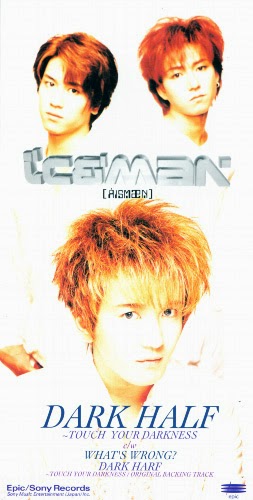
Iceman -- DARK HALF~TOUCH YOUR DARKNESS (1996)
(cover version)
Like
I said earlier, Daisuke’s early post-access career came down to recording a
solo album and producing a few artists here and there. In 1996, though,
planning to form a new band, he organised a number of auditions, which resulted
in the selection of vocalist Michihiro Kuroda (黒田倫弘)
and guitarist Kenichi Ito (伊藤賢一). Composed of these two guys, plus
Daisuke, Iceman was thus formed.
If
access already had that distinctive Arena rock feel in songs like “MOONSHINE
DANCE”, Iceman was even more devoted to noisy guitars, mostly because it had an
official guitarist on the band. Besides that, Daisuke’s synths were also a big
part of Iceman’s style, something that confuses me a lot when trying to
categorize them.
“DARK
HALF~TOUCH YOUR DARKNESS”, for example, showcases this constant battle between
guitars and synths in a very epic way with the exciting arrangement and rushing
beat. Although kind of heavy in the overall sound, the band manages to maintain
“DARK HALF~TOUCH YOUR DARKNESS” in a poppy vein with the catchy and powerful
chorus. I can’t even count how many times I caught myself humming its melody.
Apparently, the fangirls were also very fond of Iceman when they were at their
peak.
According
to generasia, the band stopped their activities in 2001, when vocalist
Michihiro Kuroda officially left the band to pursue a solo career as a rock
singer. Maybe Daisuke’s heavy electronic interferences were not well accepted
by him after a while.
“DARK
HALF~TOUCH YOUR DARKNESS” was Iceman’s debut single, which was released in July
1996, and reached #5 on the Oricon charts. Lyrics were written by Akio Inoue,
while music and arrangement were done by Daisuke.
04)
Daisuke Asakura expd. Takanori Nishikawa (T.M.Revolution) -- BLACK OR WHITE? (1995)
Probably
Daisuke’s most famous act, T.M.Revolution started working with him, still as
Takanori Nishikawa (西川貴教), during the “ELECTROMANCER” recording
sessions in 1995. The second single released prior to the album was “BLACK OR
WHITE?”, a song that was later remixed for Takanori’s debut album “MAKES
REVOLUTION”, re-released as a single in 1997, and also re-recorded and re-released
as a single in 2000 under the name of “BLACK OR WHITE? version 3”. Moreover,
Takanori still performs it sometimes.
“BLACK
OR WHITE?” is simply a great pop-rock song with Dai-chan’s catchy hyperactive
synths in the background. The “L.A. Mix” included in the “ELECTROMANCER” album,
and also presented above, is just even more exciting, because adds an entire
minute of pure repetitive instrumental near the end (I just love the synths in
this song). As for Takanori, I think he’s a great vocalist, even though I don’t
really like the majority of his songs.
“BLACK
OR WHITE?” marked the first time Daisuke and Takanori worked together. After
the release of “ELECTROMANCER”, the two would start their historic partnership
in 1996, which led to a big success during the later half of the 90s. Even
today, Daisuke is still involved in a good portion of T.M.R’s songs.
The
first version of the single reached #17 on the Oricon charts. The re-release in
1997 reached #51. As for “BLACK OR WHITE? version 3”, it reached #6. Lyrics
were written by Akio Inoue, while music and arrangement were done by Daisuke.
I
start my top three with an unnusual choice in Daisuke’s long history as a
producer, the “almost aidoru” male duo LAZY KNACK.
Comprised
of Sou Shimizu (清水聡) and Yuuna Katsuki (香月優奈),
LAZY KNACK’s early songs were created by Daisuke. Their first album, “FLASH” (January
1996), even included some access’s covers like “DRASTIC MERMAID” and an
acoustic version of “VIRGIN EMOTION”, but the one song from them that really
caught my attention was “NATIVE LOVE”, an infectious and catchy pop tune with
Dai’s well known happy and “not-very-subtle” synths (something I just love).
About
LAZY KNACK, I really like their lack of talent. Although it may be strange, I
do like how the boys sound strange at certain parts, almost struggling, like in
the lines before the choruses, for example. That said, it’s interesting how
Daisuke’s production can still shine with average vocalists like Sou and Yuuna.
With
no surprise, the duo ended a couple of years after their debut. As an “almost
aidoru” duo with lackluster sales, they couldn’t succeed in a scenario where
Johnny’s acts dominates the whole “boys” side of the coin. Nonetheless, with
all that in mind, I still like LAZY KNACK a lot. They have pretty good gems
like “NATIVE LOVE”, such as “CRYSTAL GAME” (1995), “SPARK” (1996), “DESTINY”
(1997) and “KNIFE” (1997), in their catalogue.
LAZY
KNACK’s “FLASH” album reached #16 on the Oricon charts. As for “NATIVE LOVE”,
it was written by LAZY KNACK and Akio Inoue, while music and arrangement were
done by Daisuke.
After
the “not-very-talented” male duo LAZY KNACK, we reach the “not-very-talented”gravure aidoru Akiko Hinagata (雛形あきこ) and “REMAKE IT!”, a song included in
her second album, “Hina Collection 2” (ヒナ・コレ2),
which was released in November 1996.
At
first, it was decided that the Akiko Hinagata song I would cover was going to
be “Yureru Koi Shoujo Iro”(揺れる恋乙女色), a brighter song that I listen to a lot more than “REMAKE
IT!”. However, after thinking a little bit, I changed my option and decided to introduce
the more subversive and chaotic “REMAKE IT!”, an electronic pop song full of
stormy synths that probably represents Akiko Hinagata’s most interesting moment.
Funny
thing about Akiko Hinagata is that she wanted to be produced by Tetsuya Komuro,
but, in the end, it was Daisuke who worked on her small singing career. In
fact, I consider he did magic with her, because she was probably even less
talented than LAZY KNACK, but, thanks to Dai-chan, had pretty interesting
electronic pop songs like the aforementioned “Yureru Koi Shoujo Iro” and other gems such as “Wonder Girl”, “DESTINATION” and “FUNKY GAME”, for
example.
“Hina Collection 2”
reached #73 on the Oricon charts. Lyrics for “REMAKE IT!” were written by Akio
Inoue, while music and arrangement were done by Daisuke.
I
couldn’t end my list without an old access song, but I have to say... this was
a pretty hard and unusual choice.
I
could talk about any of access’s early singles here, besides the gay themed “MermaidTrilogy” (“DRASTIC MERMAID”, “SCANDALOUS BLUE” and “TEAR’S LIBERATION”) and the
Arena rock inspired “MOONSHINE DANCE”, which I already covered before, but I
just decided to talk about a minor song in access’s discography. That said, I
will probably regret myself later, but whatever...
“REALTIME
LOVE” was not a single, but one of the highlights coming from access’s second
album, “ACCESS II”, which was released in September 1993.
About
the song, it’s one I always listen to while traveling to somewhere. I don’t
really know why, but the verses are sensual and mysterious, which makes me like
them more than the chorus itself. It’s probably the combination of Hiro’s
vocals with the cold synths. Other than that, it’s a song that reminds me of
80s Synthpop or New Wave bands, such as Duran Duran, for example. In fact, some
fans accuse access of ripping off Duran Duran’s “The Reflex” on “REALTIME LOVER”,
and I see where the comments are coming from, as the arrangements are very, very similar at certain parts.
What
else can I say? Daisuke took a little too much inspiration from “The Reflex”...
The “ACCESS II” album
reached #2 on the Oricon charts. “REALTIME LOVER” is credited under AXS (Hiro
and Dai).
Although
I could change some songs here and there, I’m pretty satisfied with the final product.
Also, I’m happy that I decided to talk about Daisuke’s work, because, with the
exception of access, I’ve never talked about any of the acts in this list here on
Kayo Kyoku Plus before.
As
I said in the Introduction, I spent most of 2014 covering new aidoru music for
the blog, so, consciously or not, I managed to ignore Daisuke’s productions.
However, they were a big part of my daily routine of traveling back and forth
from Resende, where I actually live, to Rio de Janeiro, where I study.
In
the end, it was great that I had the opportunity to talk about the overall
happy and fun pop music produced by Daisuke Asakura. I just hope you guys enjoy
some of the songs I chose to cover here.
Recently on an episode of comedian Shofukutei Tsurube's"Kazoku ni Kanpai"(家族に乾杯...Salute to Families), I got to see Takanori Nishikawa(西川貴教)for the first time in several years. The program usually has the host and the guest visiting some of the smaller communities in rural Japan, so Nishikawa sounded even louder than usual as the guys traipsed through the side streets. Anyone seeing the guy for the first time would have thought that he was yet another member of the Yoshimoto Kogyo comedy troupe.
Actually back in the 90s, he gained fame under the name of TM Revolution. When I first saw him get his big breakthrough hit via his 6th single, "White Breath", I just wondered if he had anything to do with the band TM Network. I mean, he and that particular band seemed to be swimming in the same genre, but there was still a palpable difference. As it turned out, though, producer and the composer of "White Breath", Daisuke Asakura(浅倉大介)was supposed to have been the one behind the name. According to J-Wiki, Asakura came up with "Takanori Makes Revolution" as a clarion call for him, Takanori, the staff and all of the fans to amass behind the project and go forward. The origin story gets more interesting since Asakura was also a support member for TM Network at one time although he said that he didn't really see the similarity in the names until sometime later. Apparently, he has also mentioned on TV and radio that Tetsuya Komuro(小室哲哉)from the band had given his blessing for Asakura to use the "TM".
"White Breath" was a song that I recall got a lot of heavy promotion on the airwaves as TM Revolution sang as if he were really trying to make a revolution of sorts, vocally speaking. And I think the music video set my visual impression of the fellow: a somewhat delicate-looking guy with the intense movements and shirt-optional fashion.
Along with Asakura composing the music, Akio Inoue(井上秋緒), a former manager of TM Network, came up with the lyrics. Released in October 1997, "White Breath" not only hit No. 1 on Oricon, but it also became TM Revolution's first million-seller hit with almost 1.3 million copies sold. It also punched his ticket to get onto the Kohaku Utagassen. Despite the relatively late release date, "White Breath" became the 39th-ranked single for 1997 and hung on to become the 66th-ranked single for 1998.
My other memory of TM Revolution involves his appearances on the Fuji-TV program "HEY! HEY! HEY! Music Champ". He always got the "good cop, bad cop" treatment from the hosts of the program, comedic duo Downtown, and Bad Cop Masatoshi Hamada(浜田雅功)comically abused the lad (often on his effeminate appearance) until he finally exploded. I wonder if music hadn't been TM's thing, whether he would have gone into Yoshimoto Kogyo for real.