I've been a fan of Japanese popular music for 40 years, and have managed to collect a lot of material during that time. So I decided I wanted to talk about Showa Era music with like-minded fans. My particular era is the 70s and 80s (thus the "kayo kyoku"). The plus part includes a number of songs and artists from the last 30 years and also the early kayo. So, let's talk about New Music, aidoru, City Pop and enka.
Credits
I would like to give credit where credit is due. Videos are from YouTube and other sources such as NicoNico while Oricon rankings and other information are translated from the Japanese Wikipedia unless noted.
The return of NHK's "Uta Con"(うたコン)last night from summer hiatus was a special one, to be sure. I don't think I've ever seen a special episode of the long-running music show devoted to a single artist; it's usually been a highlight reel of the year's best performances. But last night, concierge Shosuke Tanihara(谷原章介)had former aidoru Mizue Takada(高田みづえ)onto the show along with her friends and fellow singers Hiromi Iwasaki(岩崎宏美)and Ikue Sakakibara(榊原郁恵), and Takada was given a tribute in what was advertised as "a one-night-only comeback".
After the episode, I read an article regarding it on Mixi and it mentioned that in March, her husband, the former sumo wrestler Wakashimazu(若嶋津), had passed away at the age of 69 from pneumonia, something that I hadn't known about. My belated condolences to Takada, the rest of her family and his fans. I don't really know whether his passing and the aftermath triggered the idea to have this special episode but it was great to see Takada again on stage to perform a couple of her old hits including her 1980 single"Watashi wa Piano"(私はピアノ)which was the very first song that I had heard by her as a teenager and was therefore one of the first kayo that got me into this very long hobby in the first place.
"Watashi wa Piano" is this urban Latin-spiced song that has stayed in my memories for almost a half-century. However, the B-side is a completely different song. "Kikyou" (Homecoming) is a warm, folksy and calming tune about the old hometown and the feelings tied with it. With lyrics by Takashi Taka(たかたかし), the song was actually composed as an instrumental known as "The Poet and I" from 1974 by Canadian pianist Frank Mills. I don't think there was much change in the arrangement during its transition from "The Poet and I" to "Kikyou" so Mills' original was a fine fit for kayo kyoku.
Kinda keeping on the summer festival theme that I started from the previous article, I gather that another sign of the summer is fireflies or hotaru as we say in Japanese. In fact, where I taught in the former town of Tsukiyono, Gunma Prefecture, there was a firefly festival each year. The usual food stands and other temporary establishments associated with a matsuri were all set up while next door in the woods, adults and kids alike could see the dozens or perhaps hundreds of glowing fireflies flitting about, providing the evening with its own organic illumination.
This particular May 1990 single by enka singer Nobue Matsubara(松原のぶえ), "Hotaru"(Fireflies), popped up on one of the NHK music shows recently. Up to now, I only really knew one other firefly-related kayo kyoku and that was "Hotaru no Hikari"(蛍の光), otherwise known as the Japanese cover of "Auld Lang Syne", also used to signal the end of the old year and the beginning of the new one (and simply to signal closing time at some commercial complex).
Well, "Hotaru" is a much less grandiose song and much more of a grounded and calm enka about finding love among the flying fireflies. And certainly, I did see a few yukata-garbed young couples walking about at the Firefly Festival, so I guess that the hotaru season can also be another symbol for romance. Written by Takashi Taka(たかたかし)and composed by Tetsuya Gen(弦哲也), I'd say that it is indeed a woodsy traditional ballad of love.
I've been to Nagoya a few times and despite all the flak and indifference toward this major city in Japan, I think it's a perfectly nice metropolis to visit. Nagoyans and, on a larger scale, residents of Aichi Prefecture really bring the goods at wedding parties. Plus, the area is famous for all sorts of dishes that have been categorized as B-class. Ten-musu(天むす)in particular is one of my favourites. Just imagine...the combination of shrimp tempura and rice ball. Culinary match made in heaven ranking alongside peanut butter and chocolate to form Reese's Peanut Butter Cups! By the way, thank you Japanese Cooking 101!
As with a lot of other television programming, "Uta Con"(うたコン)is going on Golden Week hiatus but it still gave us one more episode. Since Wednesday is the beginning of the whole mess of national holidays in Japan with the first one being Showa Day, the NHK kayo kyoku show devoted a lot of its time to the Showa Era hits which was great.
Near the end, we got the usual new stuff from the guests. Enka singer and go-touchi song master Kaori Mizumori(水森かおり)came up with her latest single last month. "Koi no Owari no Nagoya ni Hitori" (Alone in Nagoya After the Love is Gone) is one song that makes it very nakedly plain that it's the typical number about recovering after heartbreak in the city of ten-musu. Written by Takashi Taka(たかたかし)and composed by Tetsuya Gen(弦哲也), it's quite upbeat and reassuring though and the ever-smiling Mizumori is more than happy to be the happy guide through the city in the music video.
First off, Happy 10th Birthday to the NHK music show"Uta Con". I saw their episode last night and it was nice not only to see some of the highlights from the past ten years but also get a tour of how the magic works at NHK Shibuya. It's amazing how quickly the years fly by...I remember when "Uta Con" got the baton passed over to it from "Kayo Concert"(歌謡コンサート)back in 2016.
Now, "Kayo Kyoku Plus" had its tenth anniversary back in 2022 so I actually pulled out most of the guns to celebrate our grand project back then, and of course, you can take a look at some of that via "10th Anniversary Special: 10th Anniversary Songs". However, I still wanted to commemorate the "Uta Con" achievement so I've opted to present a few songs over the years that have had something of the number 10 involved in the titles. I'll admit though to being a little cheat-y with my choices. But the important thing is that I also have the opportunity to present a new tune onto the blog by the late great Hideki Saijo(西城秀樹). Anyways, without further ado:
As noted above, I have this Hideki Saijo tune that has that 10-ish relationship (albeit through kanji association only). This is "Ai no Juujika"(Cross of Love), his 7th single from December 1973. Indeed, it shares the same title as Honda's song above but that's the only common denominator. It is otherwise a totally different animal.
Written by Takashi Taka(たかたかし)and composed by Kunihiko Suzuki(鈴木邦彦)under Koji Makaino's(馬飼野康二)arrangement, this is also the first time for me to hear Saijo's "Ai no Juujika", and from what I hear, it's a very early Hideki song of passion and angst. It's quite the cross for him to bear and I think he's even shedding a few tears in the concert audio above. All the better for the screaming fans to rush over to comfort him. Not surprisingly, the song hit No. 1 and finished 1974 as the 22nd-ranked single.
First off, many congratulations to enka singer Takashi Hosokawa(細川たかし)on his 50th anniversary in show business. I've often seen the man in formal Japanese dress on stage with a battery of traditional musicians supporting him in the back, although not to the degree that the fellow above has.
It was indeed fifty years ago that Hosokawa debuted with his classic April 1975 "Kokoro Nokori"(心のこり) that also works as a pretty bouncy kayo kyoku. Over the past half-century, he's become famous for a number of hits including this one which became a No. 1 hit and his ticket to the Kohaku Utagassen that year.
But let us not ignore the B-side. In this case, it's "Nakiguse" which translates into "Crying Out" on Jisho.org but I can also see it as being "Forever Crying" as if it's become a sad habit. Written by Takashi Taka(たかたかし)and composed by Koichi Morita(森田公一), the intro might have a bluesy sax as would be the case for any Mood Kayo, but the feeling here is heart-on-a-sleeve enka. I couldn't find the lyrics online but it sounds as if a guy is trying to render support to a weeping young lady one cold rainy night (of course, it would be a cold rainy night for this sort of thing to happen). Kouji Ryusaki(竜崎孝路)as the arranger provides a quaint sentimental atmosphere of solace as a shield against all that precipitation, meteorological and emotional.
I never took a ride in a Lamborghini; the closest that I ever got was getting a lift home in my friend's Ferrari. The passenger seat was so low and slung back that the only thing I viewed was the car's black ceiling as I got driven home...which was just as well. My friend had a notorious reputation as being a speed demon who drove on the roads as if the basic rules never really applied to him. I can only say that if I had been able to see my surroundings, I probably would have reacted in the same way as a captive roller coaster rider...not well.
Can't imagine what it must be like to be inside a Lamborghini going at highway speeds...or most likely higher. But perhaps chanteuse Hiromi Iwasaki(岩崎宏美)knows as she sings "Lamborghini ga Kiete" (The Lamborghini Fades Away), the second track on her October 1977 5th original album"Shishuuki kara....Otoko to Onna"(思秋期から…男と女...From the Autumn of One's Years...Men and Women). Written by Yu Aku(阿久悠)and composed/arranged by Takashi Taka(たかたかし), it's a fairly ominous tune that is punctuated by occasional engine roars, and the overall dramatic tone of the tune makes me wonder that all is not a joy ride and perhaps the shutting of that door means the ending of a relationship. Still, the horns are great and of course, Ms. Iwasaki's vocals are splendid as usual.
"Shishuuki kara...Otoko to Onna" managed to peak at No. 3 on Oricon. Perhaps being inside a Toyota Corolla is more secure if boring.
The personal early reviews on Jme thus far have been that there's been a slight dearth of kayo programming with NHK's "Hayauta"(はやウタ)and "Shin BS Nihon no Uta"(新・BS日本のうた)not really showing up on the schedule. I'm perhaps not that surprised about the latter since that show is coming from NHK's satellite service and so may not have been licensed or whatnot for Jme.
However, I have tried to fill in the big gap by occasionally bringing in the YouTube videos involving enka and/or Mood Kayo songs, and there are plenty of those to go around thankfully. One nice thing about this is that I've been able to encounter songs that I had yet to see performed on shows like "Uta Con"(うたコン). Case in point: Harumi Miyako's(都はるみ)"Tokyo Serenade", her 86th single from April 1982.
Yup, I saw this being performed by Miyako this morning on one of those enka compilation videos, and the music by Asei Kobayashi(小林亜星)under Hiroshi Takada's(高田弘)arrangement rather brings in some of that sumptuousness of Tokyo nightlife among the corporate execs back in those high-flying 1980s. There is some of it which seems to refer to Frank Nagai and Kazuko Matsuo's(フランク永井・松尾和子)classic Mood Kayo"Tokyo Nightclub"(東京ナイトクラブ)but again Takada's flair with tying it all together also incorporates some of that urbane pop although I wouldn't classify "Tokyo Serenade" a City Pop tune. But I can say that it can qualify as a New Adult Music number.
Takashi Taka's(たかたかし)lyrics certainly talks up a typical Mood Kayo scenario as a couple gets ready for a night of hubba-hubba, and of course, the genre loves to describe the love affair, illicit or otherwise. "Tokyo Serenade" peaked at No. 39 on Oricon. I have to admit that among all the appearances of Miyako throughout the decades of her long and successful career, I've found her time in front of the camera in those early 1980s as the most attractive. There's just something about her straight shoulder-length hair and her makeup back then.
My anime buddy is currently in East Asia right now, and he will be visiting the Matsushima(松島)area up in Miyagi Prefecture(宮城県)during his return to Japan. I'm expecting that he'll be taking hundreds of photographs of what is one of the three big Japanese landscapes. The above video is from Planetyze.
The Queen ofGo-Touchi Songs(ご当地ソング...geographically-based kayo), Kaori Mizumori(水森かおり), appeared on an "Uta Con"(うたコン)a few weeks ago where she said that she only has two more prefectures to sing about before completing her epic journey of providing enka tunes for all 47 territories ofJapan. And then she went on the stage to sing about one of her earlier go-touchi songs.
"Matsushima Kikou" (Matsushima Travelogue) is her 18th single from April 2010, giving tribute to the titular region. Written by Takashi Taka(たかたかし)and composed by Tetsuya Gen(弦哲也), Mizumori gives one of her gallant and gentle renditions of the area as she relates the story of a lady running away to forget the death of a romance but try as she might, she can't keep the dark cloud away from the sky above her head.
The song hit No. 2 on Oricon and became the 57th-ranked single of 2010, earning Mizumori her 8th invitation to NHK's Kohaku Utagassen at the end of that year.
Just as a preface, "Ginga Tokkyu"(Galaxy Special Express) has nothing to do with "The Galaxy Express 999"(銀河鉄道999), though both did come out at around the same time in the late 1970s.
Actually, "Ginga Tokkyu" was Shigeru Matsuzaki's(松崎しげる)16th single from April 1978 and I heard the veteran singer perform this one on a recent episode of "Uta Con"(うたコン)some weeks ago. It's quite refreshing because whenever Matsuzaki appears on any music show, it's usually de rigueur for him to sing his one-and-only "Ai no Memory"(愛のメモリー). Unless he made the request himself, I'm sure that he was in shock on being asked to perform anything other than his magnum opus.
"Ginga Tokkyu" was written by Takashi Taka(たかたかし)and composed/arranged by Kyohei Tsutsumi(筒美京平)as a happy musical journey for a couple of lovebirds around the Earth. As the tag for the video puts it, it's a slice of Japanese soul strutting with a touch of disco and a splendid background chorus. There's nothing like a love train of the 1970s to get everyone in a dancing mood.
I guess that you can call this the third of the "Bakayaro"(バカヤロ)series.
I do apologize, Cap. That wasn't a particularly nice word I've just written up there (then again, you've slipped some profanity here and there, haven't you?). To explain, the term "bakayaro" is a Japanese expletive that is officially defined as "Damn it!" or "You moron!", but personally speaking, I think it can go all the way up to the F word.
So, there were some kayo that got really popular because of the emotions expressed and the depth of them meant that "bakayaro" got slipped in. Back then, there was perhaps a bit of an issue although I don't think there are any now. In the past, I've written about two such songs which Captain America may not have been too happy with (provided that he had learned Japanese), Katsuhiko Miki's(美樹克彦)"Hana wa Osokatta"(花はおそかった)from 1967 and then Masahiko Kondo's(近藤真彦)"Blue Jeans Memory"(ブルー・ジーンズ・メモリー)from 1981, because of the inclusion of "bakayaro".
Well, tonight I can give you Song No. 3 in the "bakayaro" series: Hideki Saijo's(西城秀樹)"Shiroi Kyokai" (White Church). Released as Saijo's 15th single in October 1975, the reason behind the aidoru's impassioned outburst near the end is that he has just been to a wedding in the titular church where he saw the love of his life. Alas, he wasn't the groom however and he's literally seeing the lass solemnly walk down the aisle and away from his life for good.
The lyrics were written by Takashi Taka(たかたかし)while Kunihiko Suzuki(鈴木邦彦)took care of the music which begins stately enough before a languid and melancholy rock vibe enters to provide a palette for Saijo to express his beautiful anguish. He may be stoic and happy for the bride on the outside but he's smoldering on the inside.
I could find the original recorded version although not his second appearance on the 1975 Kohaku Utagassen. I wish I could witness the effect that Saijo had on his fans. Wouldn't it have been something to see some of them faint in their seats in the same way that The Beatles and Elvis Presley had their fans swoon all over the place?
"Shiroi Kyokai" managed to reach No. 4 on Oricon and was also placed on Saijo's 2-LP album to commemorate his 20th birthday, "MEMORY - Saijo Hideki no Hatachi no Nikki"(MEMORY - 西城秀樹20歳の日記...Hideki Saijo's Diary at 20)which was released in January 1976. Along with the "bakayaro", it's interesting to note that although the title is "Shiroi Kyokai", Taka's lyrics had Saijo singing the word "chapel" instead and even on the record jacket, the katakana version of "chapel" had even been written as furigana over the kanji for "kyokai".
It's Simcoe Day in Toronto so a good chunk of the population if not everyone is having a day off, and I'm just relaxing from my usual translation duties. The Tokyo Olympics are now a little over half way done with both Japan and Canada enjoying a nice variety of medals despite the typically hellfire that is summer in the city and COVID.
Speaking of the Olympics, I'd thought that Mari Hamada's(浜田麻里)"Heart and Soul" was the first time that a Japanese pop song was used as a theme for an Olympic TV broadcast, and indeed it was NHK's inaugural Olympic song for the 1988 Seoul Games. Apparently, it shares that distinction with Hound Dog's"Only Love" which was adopted by NTV for its Olympic broadcast that year. I found this out through a webpage put up by Entamedata which lists the various Olympic themes used by the Japanese TV networks over the decades.
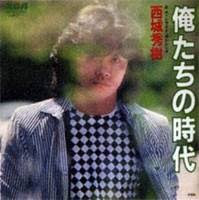
Well, I was a tad surprised to find out from that particular list that yet another kayo from several years in the past before "Heart and Soul" had been given the attempt to become an Olympic theme, and it was recorded by none other than Hideki Saijo(西城秀樹). The song was "Ore-tachi no Jidai" (Our Times), Saijo's 33rd single.
Released in June 1980, the original cover of "Ore-tachi no Jidai" had Saijo on the track ready to fly through the 100-metre dash as the song, written by Takashi Taka(たかたかし)based on the original lyrics by Masato or Masahito Kumano(熊野昌人), composed by Kimio Mizutani(水谷公生)and arranged by Jun Sato(佐藤準), begins with a rock riff followed by an upbeat funky and marching melody led by a beefy bass, tinkly synthesizers and a horn section and then ends with a strangely jazzy twist. Incidentally, this is just my theory, but I'm wondering whether the use of that synthesizer heralded what a lot of sports show themes would sound like in the years to come on Japanese TV. When I listen to Saijo singing "Ore-tachi no Jidai", I really feel like that he's putting some extra Saijo in his vocals for some reason.
As I said off the top, this was to have been an official Olympic song and according to that Entamedata list and J-Wiki, it was used by TV Asahi for one particular Olympic-themed special, but the real client was the Japanese Olympic Committee itself which was going to use "Ore-tachi no Jidai" as a cheer song for the 1980 Olympics in Moscow. Unfortunately, due to an international crisis looming over Afghanistan at the time which had the United States and the Soviet Union enter another one of their global fights in the Cold War, America and its allies, which included Canada and Japan, boycotted the Moscow Games. As a result, according to the J-Wiki article for "Ore-tachi no Jidai", that meant changing the cover for the single mid-sale to something more sober as you can see at the bottom.
Still, the single did pretty well by breaking into the Top 10 at No. 6 and finishing 1980 as the 99th-ranked single. I like the B-side "Moonlight Dancing"(ムーンライト・ダンシング)even more and you can read my personal recollection of that song there.
I was talking with Rocket Brown and Sanok on the Discord server earlier today, initially on the topic of Hideki Saijo(西城秀樹)when I realized that his birthday of April 13th passed by a few days ago. He would have been 66 this year, and so in commemoration, I'd like to put up a song of his.
(17:39)
His debut single, "Koi suru Kisetsu"(恋する季節), is already up on the blog, so I'm going to go with Saijo's second outing, "Koi no Yakusoku" (Promise of Love) which was released in July 1972, about 4 months following the first single. Single No. 2 for Hideki has that same sort of beefiness that "Koi suru Kisetsu" has but it also possesses an interesting combination of flute and marimba (?) which reminds me of some of the music offered on the original "Hawaii Five-0" and 1960s James Bond soundtracks. Because of that impression, "Koi no Yakusoku" has that certain air of mystery and suspense.
As was the case with that debut single, Takashi Taka(たかたかし)provided the lyrics of a young man left absolutely devastated inside though probably stoic on the outside at the end of a teen romance. However, instead of Kyohei Tsutsumi(筒美京平), it's Kunihiko Suzuki(鈴木邦彦)behind the music this time with Masahiko Aoi(葵まさひこ)handling the arrangements. "Koi no Yakusoku" did even better than "Koi suru Kisetsu" in the rankings as it hit No. 18 and it gradually became the 95th-ranked single for 1972. Both singles were also included in his debut album"Wild na Juu-Nana Sai/Saijo Hideki"(ワイルドな17歳/西城秀樹)from November 1972.
I may have mentioned this before, but there was a period during my Japan days which seemed to be filled with wedding invitations for friends and students. For one student, the reception took place at the dance club Twin Star around the Ichigaya area in Tokyo. That establishment was apparently one of the birth places for the para para dance craze but there was none of that occurring on that day. Anyways, when the announcement came for a toast to my student and her new husband's happiness, some of us at our table went slightly into Ricky Gervais (indeed he was in a feisty mood last night, wasn't he?) mode and surreptitiously muttered something like "Yeah, that's what they all say at first.". Since it's been many years since I've heard anything about that student, I have no idea how the marriage is doing.
That old vignette was brought back into memory by Fuyumi Sakamoto's(坂本冬美)"Iwaizake"(Celebratory Drink) which the veteran enka singer performed at last week's Kohaku Utagassen. There was plenty of brio in Sakamoto's time on the stage as she was backed up by a small battery of taiko drums and a large temple background.
At first, I'd assumed that this was a new single by Sakamoto, but I found out sheepishly that "Iwaizake" was actually her 3rd single released all the way back in April 1988. Layered onto Kosho Inomata's(猪俣公章)stately march-like music, lyricist Takashi Taka(たかたかし)provides not only reason to celebrate but also some forewarning about what married life is all about, and it's unsurprisingly not a bed of roses all the time. It almost sounds like everyone involved was infusing "Iwaizake" with that necessary parental advice.
"Iwaizake" hit No. 16 on Oricon and sold around 330,000 copies with it earning a Gold prize at the Japan Record Awards. By the end of 1988, it became the 24th-ranked single for the year, and it got Sakamoto the first of her 31 invitations to the Kohaku, and in fact, her performance of the same song last week was actually her 4th time doing so.
Recently, I found this YouTube channel of kayo called abapon yamada which consists a lot of videos which contain 10 songs each by a certain famous songwriter. It's been quite interesting for taking a look for a variety of enka, Mood Kayo and pop tunes.
One such video is in tribute to the late composer Minoru Endo(遠藤実), who I was surprised to find out had one of his compositions released as late as April 2008. This is "Kibou no Uta" (Song of Hope) as performed by enka singer Takeshi Kitayama(北山たけし).
(cover version)
The lyrics by Takashi Taka(たかたかし)relate the story of a couple breaking up for whatever reason but with them deciding to take the high road and resolving to remember the fun times before parting for good. Think of it as the Japanese version of Rick and Ilsa's story in "Casablanca"...or perhaps it should be Kamakura. In any case, it's another example of the kayo trope of smiling through the tears through Endo's jaunty melody.
"Kibou no Uta" got as high as No. 28 on Oricon. This may have been one of Endo's final songs since in December 2008, he would pass away at the age of 76.
Having watched Japanese comedy over the years, I've known and enjoyed acts such as The Drifters(ザ・ドリフターズ), Tunnels(とんねるず)and Kuniko Yamada(山田邦子). Ironically, though, I never got to know Kin'ichi Hagimoto(萩本欽一)quite as well although he seems to occupy the status of a grand marshal of variety shows and comedy. I recollect that I did catch a few episodes of his long-running show "Kin Don!"(欽ドン!)which also featured 3 comics who would become Imo Kin Trio(イモ欽トリオ)and spawn a novelty technopop hit "High School Lullaby".
Being such a famous figure on Japanese TV, Hagimoto had a lot of programs on the air over many decades, and on one of them, there was a recurring skit which featured a soba shop and its sassy proprietress, Tami-chan, played by former aidoru Tamiko Nosaki(野咲たみこ). Apparently, the skit was so successful that it either got spun off or the TV Asahi show itself was refitted to become "Tami-chan"(たみちゃん). The show had a weekly run on Tuesday nights for the better part of a year from June 1984 to March 1985.
Now, the reason that I mention all this is that the ending theme "Kimi ga No ni Saku Bara nara"(If You are the Rose that Blooms in the Field) is sung by Akiko Wada(和田アキ子). And for those who know the veteran singer/actress/tarento, she's known for singing a lot of soulful numbers with that boomer voice of hers. With "Kimi ga No ni Saku Bara nara", though, her delivery is as congenial and soft as lamb wool. And color me nostalgic, but I certainly don't hear ballads as countryside warming as this one anymore. Plus, I am a sucker for those shimmering strings. Toyohisa Araki and Takashi Taka(荒木とよひさ・三木たかし)took care of words and music respectively for her 42nd single from September 1984.
I basically had the same reaction as some of the tarento present on the show clip in the top video. It seems as if the bulletin came out either a little more than half an hour or 12 hours after his passing at 11:53 pm JST on May 16th.
I found out about the death of 1970s aidoru Hideki Saijo(西城秀樹)earlier this morning on NHK's "News Watch 9" when it came out as the second headline. My reaction was "Whoa!". For the past number of years, I knew that Saijo hadn't been in peak health since his mild stroke over a decade ago but it was still a shock to hear that he had actually died from acute heart failure at the age of 63.
Saijo was one of the three male singing idols in the 1970s that were collectively named the Shin-Gosanke(新御三家...The New Big Three)as the apparent heirs to the original Gosanke from the 1960s. It would be decades before I had been aware of this grouping of Saijo, Hiromi Go(郷ひろみ)and Goro Noguchi(野口五郎), but of the three, Saijo was the one that I first knew about as a boy since his long-haired and smiling figure in the 70s cool clothing (including bell-bottoms) was plastered all over the pages of those kiddy manga that my parents used to buy me at the old Furuya Japanese food store in Chinatown. Go and Noguchi were fellows that I only got to know from the 1980s, thanks to the Kohaku broadcasts that began in Toronto from 1981.
After I started getting into Japanese pop music big time following that trip to Japan in 1981, I actually borrowed a VHS tape of one of Saijo's concerts. I wasn't converted into a dedicated fan of his, but he basically had the audience wound around his finger through his hits and dynamic presence on the stage.
His presence was even felt in the anime world, specifically "Chibi Maruko-chan"(ちびまる子ちゃん). The show took place in the 1970s so the Sakura sisters were depicted as having their own favourite singers. Older sister Sakiko was always in thrall to the charms of her Hideki. As it turned out, the singer even provided the second ending theme to the long-running series, "Hashire Shoujiki Mono"(走れ正直者)in the early 1990s.
To give my humble tribute to Saijo, I've decided to feature his debut song"Koi suru Kisetsu" (Season To Fall In Love) which came out in March 1972. I've found that whenever I listen to the first single of any veteran singer, I always peg his/her delivery as the prototype version of the familiar vocals, and Saijo's first single is no different. His voice was a shade higher, perhaps a bit rawer but I could still recognize it as Hideki's.
Kyohei Tsutsumi(筒美京平)composed the brass-and-strings song which seems to herald the arrival of a brash young man into the big city. He's coming into Tokyo to conquer it and not the other way around. Well, perhaps conquer is too strong a word but he's there to make his mark with a smile. According to the J-Wiki article for "Koi suru Kisetsu", the catchphrase for Saijo was "The Wild 17-Year-Old"(ワイルドな17歳). Takashi Taka(たかたかし)provided the lyrics under one of his other pen names, Takashi Aso(麻生たかし).
"Koi suru Kisetsu" peaked at No. 42 on Oricon, and it was also a track on his debut album"Wild na Juu-Nana Sai/Saijo Hideki"(ワイルドな17歳/西城秀樹)from November 1972.
Over the course of this blog, there have been a few singers and songwriters who have left this mortal coil over the years, but there is a certain enhanced poignancy with Saijo's passing since his face was one that I knew since early childhood. And along with Pink Lady and Momoe Yamaguchi(山口百恵), Hideki Saijo was, to me at least, one of those pop culture figures that best represented the 1970s in Japan. I am absolutely certain that the next few days on the various wide shows will devote some of their programming to him, but here's hoping that come this weekend, some of the customers at the many branches of Big Echo and Karaoke Kan will give some tribute by engaging in a round of "Young Man"(ヤングマン).
This picture of Ikuzo Yoshi (吉幾三) doesn't have any relation to the song I'll be talking about in a while, but I'd say it's a good representation of how I felt when I discovered that there are some fans of KKP from Singapore. For some reason, I didn't think that I could come across other natives of The Little Red Dot via this blog. At the same time, I never thought I'd be able to interact with Singaporeans who really know about enka and kayo rather than simply seeing such songs as the originals of popular Chinese covers, so it was a happy yet oddly strange feeling to encounter Francium and Karen. I mean, there are probably more Singaporean readers here too, and there are probably others from the island nation who appreciate more genres of Japanese music than just anisong or current day aidoru/J-rock, just that I'm not aware of/haven't had the chance to interact with them yet. But still, it was quite an amusing and eye-opening experience.
With that thought out, let's move on to the topic at hand. The song I'll be talking about today is "Yume no Hana Sakasou", a fairly recent (2013) entry in the discography of a couple of enka singers I see on the Tube from time to time - the bubbly Mitsuko Nakamura (中村美律子) and the husky Daishiro Masuiyama (増位山太志郎). This was introduced to me via Karen in the comments of my The First article when I asked about the type enka she listens to, and I have to say that I enjoyed it a lot more than I expected.
I found Nakamura's version first when I looked up "Yume no Hana Sakasou", and my first impression of it was that it kind of reminded me of Hibari Misora's (美空ひばり) "Kawa no Nagare no Youni" (川の流れのように). Soon, I took a liking to Tetsuya Gen's (弦哲也) light and encouraging pop-inclined melody - which still has a hint of enka - for the low horns and the way the rolling drums and smooth strings swell at certain bits. I was also quite surprised to hear something like this from Nakamura as the impression I have of her is that she tackles the traditional side enka, but it's nice to hear that she can pleasantly carry stuff like this as well.
As for Masuiyama's take, it's pretty much the same in terms of arrangement but I find that both singers' differing deliveries give the same song a different flavour. From Takashi Taka's (たかたかし) lyrics, "Yume no Hana Sakasou" seems to be saying that despite how tough life's trials can be, one should persevere as there's always a light at the end of the tunnel - hits pretty close to home at the moment, if you ask me...With Masuiyama's soft and almost Yujiro Ishihara-like vocals, this message sounds rather reflective, as if it's coming from someone who's been through said trials and is now looking back on his experience. On the other hand, Nakamura's spunkier and more hopeful delivery feels like how a maternal figure would encourage you when you've hit a rough patch. Personally, I don't have a favourite version as I like both just as much.
Caught NHK's "Nodo Jiman"(のど自慢)earlier this afternoon and it looks like that bell ringer was in a pretty snotty mood. I don't think he gave the full ring of approval until almost halfway through the show, and it turned out to be for an elderly lady singing an old Hibari Misora(美空ひばり)chestnut.
It was indeed a fine rendition so I decided to look up this song "Omae ni Horeta" (I've Fallen For You) and was surprised to find out that it was created for the Grande Dame of Kayo Kyoku in 1980. Although I know that Misora sang right to the end of her days at the end of the 1980s, my impression was that most of her classic enka songs were from the 1960s. But this particular song has that certain grandness of some of those old hits such as "Yawara"(柔)and the male point of view but with the topic this time being the simple reaction of falling in love.
However, along with the grandeur, I also noticed an underlayer of gentleness in "Omae ni Horeta" as if the protagonist here wasn't exactly the youngest buck in the forest but an older and more courteous sort who's fallen in love with a lady who may be the proprietress of the local nomiya. There's not so much hormonally-fueled lust in the guy's eyes than there is a wistful interest in the lass.
Released in February 1980, the ballad was written by Takashi Taka(たかたかし)and composed by Koji Tokuhisa(徳久広司)who had tried his hand at singing for about a year in the mid-1970s before deciding making songs was more his forte. "Omae ni Horeta" ranked up there at No. 43 on Oricon.
I guess it has been that mixture of gusto and gentility that has made the song a favourite for enka singers since Misora's original version. Aya Shimazu(島津亜矢)has given it a fine go.
And so has Natsuko Godai(伍代夏子). I've also enjoyed the various versions for the fact that the singers have been given the chance to plumb the lower registers of their voices.
Now where have I heard this before? Taiko, Kokura, Muhomatsu. Even some portions of the strings in the Kosho Inomata (猪俣公章)-composed melody sound familiar... Ah! That's right, Hideo Murata's "Muhomatsu no Issho" (無法松の一生)! I wonder if "Abaredaiko" is some sort of tribute to her predecessor's own debut. It's either that or the Muhomatsu franchise just has a penchant for songs based on it to sound like that. I'd like to think it's the former.
Just like "Muhomatsu no Issho", Fuyumi Sakamoto's(坂本冬美)debut single has got a manly edge and the taiko adds more power to the intense score. Even Sakamoto's muscular delivery nicely depicts the violent character that is Matsugoro. But I have to say that it seems to have lost some of the intimidating factor with the acoustic guitar in it, which mellows the otherwise abrasive song. No matter though, it's still a cool tune and I can imagine Murata having a go at "Abaredaiko". Accompanying Inomata's composition was Takashi Taka's (たかたかし) lyrics.
(empty karaoke version)
"Abaredaiko" was released on 4th March 1987 and was quite well received, as seen by the "Newcomer Award" and "Best Newcomer Award" Sakamoto managed to bag at the 29th Japan Record Awards and the 20th Japan Cable Awards respectively. She had sung "Abaredaiko" on 46th edition of the Kohaku in 1995, as well as the 54th one in 2003. I wouldn't mind if it were to be sung again this year. Sakamoto's 2nd single, "Abare Taiko ~ Muhomatsu Ichidai Iri ~" (あばれ太鼓〜無法一代入り〜), which is in the video below, has an extra excerpt that - I think - includes more stuff on Muhomatsu.
Wow, Sakamoto playing the Taiko?! Even though she got emotional at the end, dang, she's one cool lady! Hmm, I believe she's the first female enka singer I've ever primarily described as "cool", rather than "demure"/"elegant". I mean, she is also those but I see her as more of the former.
hiro-star.at.webry.info/201303/article_15
Kokura Nadai wa Muhomatsu (小倉名代は無法松) - can't really disagree when songs that have Kokura (city) in them inadvertently feature Muhomatsu. Or should that be the other way round?
Ahhhh....one of the enka classics. Just that one song that I would love to hear inside a proper nomiya, and which most likely got plenty of play on multiple episodes of "Enka no Hanamichi"(演歌の花道)in one of those mock-up bars.
"Omae to Futari" (The Two Of Us) turned out to be Hiroshi Itsuki's(五木ひろし)biggest hit after it was first heard in October 1979. Written by Takashi Taka(たかたかし)and composed by Yoshio Kimura(木村好夫), lyrically speaking, it comes off as being counter-intuitive when compared to some of the other enka tunes. Usually when I hear an old ballad, I expect the story to be about the aftermath of a ruined love affair and one of the former couple drowning his/her sorrows in copious drink. But with "Omae to Futari", the story is of a couple together at last after some hinted trials and tribulations in the past...both of them escaping from unhappy marriages, a long separation due to various circumstances, etc.
Perhaps it is because of the meaning behind the lyrics that I tend to prefer the slower version of the song (as shown above) since it melodically describes that quiet denouement after all the unneeded tension. I could imagine the man and woman embracing on some bench in a park at a late hour celebrating their long-awaited reunion. That intro sets the mood perfectly. And of course, there are the heartfelt vocals by Itsuki himself which ensures a good patient listen by the entire audience.
"Omae to Futari" got as high as No. 3 on Oricon and became the 7th-most successful song for 1980. As well, it earned a Gold Prize at the Japan Record Awards for 1979.
Still, there is nothing wrong with the jauntier version of the song. I think it can be quite celebratory.