I've been a fan of Japanese popular music for 40 years, and have managed to collect a lot of material during that time. So I decided I wanted to talk about Showa Era music with like-minded fans. My particular era is the 70s and 80s (thus the "kayo kyoku"). The plus part includes a number of songs and artists from the last 30 years and also the early kayo. So, let's talk about New Music, aidoru, City Pop and enka.
Credits
I would like to give credit where credit is due. Videos are from YouTube and other sources such as NicoNico while Oricon rankings and other information are translated from the Japanese Wikipedia unless noted.
Aye, it is November 25th and within the world of "Kayo Kyoku Plus", that means the Christmas season has begun and so over the next month, there will be a liberal sprinkling of J-Xmas tunes popping up here and there like Keebler elves until December 25th. It looks like I may have accumulated a fair number of them for this year.
The first one for Xmas 2025 is a duet with Daisuke Inoue(井上大輔), the same fellow behind the Group Sounds classic"Blue Chateau"(ブルー・シャトウ)back in the 1960s when he was part of the Blue Comets, and the splendid Cindy. "Namida yori mo Merry Xmas" (Merry Xmas Over Tears) was released in November 1990. Composed by Inoue and written by Goro Matsui(松井五郎), this is a most bittersweet ballad in a contemporary pop style of the times that's quite typical of a number of Christmas tunes from Japan in which someone is waxing nostalgically over a past romance which had been sealed with that first kiss on Christmas Eve. Can't have Christmas songs be totally cheerful, after all.
To be honest, I can count the number of times that I've been up Tokyo Tower on one hand. For one thing, I'm a bit acrophobic and my impression when I went up the first time was that once was enough. The second time I was up there was because I had friends from out of town so when one of them showed interest in going up the tower, I amicably obliged.
Happily though, there are still millions of people who are willing to visit one of the capital's most visible landmarks and it still cuts quite the figure at night when it's all lit up. There was even a tribute compilation album for Tokyo Tower released in November 1991 titled "Tower of Love".
The first track is "Touch the Sky" by the late singer-songwriter Cindy. Quite the tenderly-sung love song for good ol Double-T, it was created by one of Japan's prolific composers Kyohei Tsutsumi(筒美京平)and arranged by Makoto Matsushita(松下誠). Anyone picking up "Tower of Love" and putting it into the stereo can really pick up on the 90s-ness of it all right from the intro for "Touch the Sky". I hear that couples often visit the tower for that romantic date and with the view of the city below them, it's probably no wonder; Cindy's contribution can help in the mood-setting.
Welcome to Urban Contemporary Friday on KKP! A few years ago, I posted this article on a scintillating duet between the soulful and bluesy singer-songwriter Masaki Ueda(上田正樹)and the just-as-soulful and sweet singer-songwriter Cindy titled "Letting You Go ~ Ai no Kageri"(愛の翳り). I mean, this was a 1985 song that would have had Bobby Caldwell clapping in appreciation.
Early last month, a commenter for "Letting You Go" gave me a tip on another collaboration between the two that occurred about a decade later when Ueda released his 28th album"Sweet Voice" in October 1995. Titled "SONG OF LOVE", it's indeed another soulful ballad that was composed by Ueda and written by Clay Rowley, and though in agreement with the commenter that it's not quite as spine-tingling as the earlier ballad, "SONG OF LOVE" is still a pretty hopeful love song with Ueda and Cindy giving their all behind the microphone. I wonder if they had ever performed this in concert; would like to know if there's a video out there for that.
I guess it's been a good week for new City Pop discoveries. Last night, I found out about CHiLi GiRL and then even the day before, I'd learned that there had been a digital album released in June 2022 in tribute to the late singer-songwriter Hiroshi Narumi(鳴海寛)called "Around the Thru Traffic". Tortured usage of prepositions aside, I was interested in the material since Narumi had been partners with songwriter Etsuko Yamakawa(山川恵津子)for their one-off 1982 album "Thru Traffic" as the duo Tohoku Shinkansen(東北新幹線), one of the finest works in the City Pop and J-AOR genres. The connection between the 2022 release and the original "Thru Traffic" was made complete with that gorgeous cover of an old-style house which would make a DuPont Paints salesman swoon.
Accordingly, I thought I would feature a few of the tracks from the whole she-bang of twenty tracks on "Around the Thru Traffic" which consists of selected songs from some of Narumi's other albums including the 2017 "Melting Pot featuring Narumi Hiroshi Live at Egg-man +" when he was part of the project Melting Pot. A couple of those selections are already up on the blog: "Summer Touches You" from the aforementioned "Thru Traffic" and "Nakushitamono ga Ohsugiru"(なくしたものが多過ぎる)from that 2017 album.
So let's begin with "Throw a Kiss" above which was also from "Melting Pot featuring Narumi Hiroshi Live at Egg-man +". It's a rollicking AOR number which sounds like it could have easily belonged to "Thru Traffic" and there's something about the beat that suggests a nice 1970s City Pop song.
"Desire" featuring Manaho Mori(森真帆)was the B-side to Hiroshi Narumi's own single version of "Summer Touches You", so I'm guessing that it is from 1982 as well. It's also a part of Narumi's "HIROSHI NARUMI WORKS SPECIAL 7inch BOX" which was released in June 2020 according to Amazon. It's quite the smoky and dusky City Pop tune that demands a tumbler of whiskey of similar quality. I believe that is Narumi's giving a bluesy performance on the guitar.
Not sure where "You & I", a duet between Narumi and Cindy, was originally from. The search for it always leads back to this album so could this be a previously unpublicized single? I doubt it but if anyone can educate me on this, that would be most appreciated. Anyways, this is a cool and playful song reminding me of some of the soulful tunes from the 1980s by folks like Al Jarreau and Whitney Houston. It's also rather poignant that all four of the singers that I've mentioned in this paragraph are no longer with us.
One more song that I'll feature here is the final track, Narumi's homemade "For Joao", and suitably it's a smooth and relaxing instrumental of bossa nova goodness (with some scatting) which highlights his guitar skills. Get me a glass of that fine caipirinha!
For all you Tohoku Shinkansen fans, maybe "Around the Thru Traffic" can make its way through traffic into your Christmas stocking this year.
Looking up the information for this particular song and singer GWINKO, I've realized that the lass was just a few days shy of 15 when her second album"Teenage Beat" was released in June 1988. And she was already singing and kick-stepping it up a notch.
Probably a lot of City Pop and J-R&B fans had been wondering if there were ever a duet between a couple of singers within the genre, and sure enough, there was something close to it. GWINKO and Cindy got together to do the first and title track from the album although it's been listed that Cindy was more on backup chorus rather than an equal partner. "Teenage Beat" was written by Akane Tsukinose(月の瀬 茜)and composed by Masatoshi Nishimura(西村麻聡). As for the type of R&B, I'm not quite sure...would it be funk or a milder form of New Jack Swing? There is something rather Janet Jackson about it.
Sorry the resolution for the above image from Aucview isn't very good but I did want to have some form of this medium to help explain myself and this particular song. This is the back of a laser disc (remember those?) that featured an album of past tunes paired with imagery by musician Hiroshi Sato(佐藤博)called "California Image Sketch ~ Twinkle Square" (1985). The uploader for the song of this article, BetoCrazy, mentioned that this is an extremely rare album, and I can believe it. I tried looking for it on Sato's long list of accomplishments on J-Wiki and even his own website, but I couldn't find any sign of "Twinkle Square" anywhere.
Anyways, I'm grateful that BetoCrazy was kind enough to upload one of the tracks from this unusual LD album. If you can squint and risk your eyesight on the thumbnail at the very top, you can see two tracks listed "Sweet Inspiration '85" and "Inspiration". The one here is supposed to be "Inspiration" and it's an English-language cover of the opening track "Sweet Inspiration", the opening track from Sato's June 1984 album"Sailing Blaster".
The original "Sweet Inspiration" is a happy funky animal but this new version "Inspiration" with singer Cindy Yamamoto, who was also the lyricist, taking over the mike this time. It's a whole lot mellower in a tropical way so I don't think that I would place it as a City Pop tune but it's pretty relaxing in an AOR way. Enjoy the rum punch on the Lido Deck!
Well, whaddaya know? YouTuber Reely Interesting was kind enough to upload the entire LD earlier this year, so enjoy the music and the views.
Happy Hot Monday! Well, it's evident that summer is not done with us yet because we may be seeing the old Humidex reaching 100 degrees Fahrenheit any minute now. Can really do with something refreshing like the above can of Max Coffee that I bought in Shin-Okubo, Tokyo back in October 2017. Mind you, the sugar would knock me back to last week.
So, this would be the ideal time and place to show off "Refresh!" by Casiopea(カシオペア)bassist Tetsuro Sakurai(櫻井哲夫)via his debut solo album"Dewdrops" from 1986. Earlier this year, I introduced the final track "Prophet Voyager" and was surprised that it was indeed the final track since it was simply a big fun jam session. I was then intrigued about what the rest of "Dewdrops" sounded like.
Perhaps then it's with some logic that I tackle "Refresh!" since it's the track that launches everything. Instead of the instrumental of "Prophet Voyager", Track No. 1 has lyrics by Masako Arikawa(有川正沙子)joining Sakurai's composition of hot and peppery Brazilian that can get any couch potato off their keester. The percussion is just out of this world...thank you, Motoya Hamaguchi(浜口茂外也)! Sakurai is joined on vocals by Kazuo Horiguchi(堀口和男), Marvin Baker and the late Cindy. The bassist and Yuji Toriyama(鳥山雄司)helped arrange everything. Definitely a nice way to start off an album...and a week.
Earlier in April this year, Marcos V. gave his impressions on Miho Nakayama's(中山美穂)September 1989 album "Hide n' Seek" and one of the songs that he covered was "Destiny", this bubbling New Jack Swing tune. It was actually a tune that has been familiar to me for years.
And the reason for that was "Destiny" was also used as the commercial song for a Hitachi component stereo system with Miporin herself strutting away in the ad. I used to see it quite a bit on the old telly in Gunma Prefecture.
Well, as has often been the case for a Miho Nakayama dance-pop number, it was the late singer-songwriter Cindy who provided words and music for "Destiny". When she released her own 1990 album "Angel Touch", Cindy also recorded her own cover of that very song. It's about a minute longer than the Miporin original and it still has plenty of that percolating New Jack Swing goodness in Cindy's cover as well as some sultry vocals.
Recently, I’ve been listening a lot to Miho Nakayama’s (中山美穂)
“Hide ‘n’ Seek” album, which was released by the charming aidoru in September
1989, and that’s probably because I was finally able to buy a used copy of it
here in Brazil – probably lost at someone’s basement, or something like that.
Anyway, it was one of the singer’s first albums I listened to more than a
decade ago, so it was very nice to have it in my collection after all these
years.
Like happened with many aidoru in the late 80s, Nakayama’s works were
getting more ambitious and sophisticated with the help from talented producers
and songwriters such as Toshiki Kadomatsu (角松敏生) and Cindy. It’s not
that in the early 80s famous aidoru stars like Seiko Matsuda (松田聖子)
or Naoko Kawai (河合奈保子) were not bestowed with great songs by famous musicians, since we all
know they were, but in the mid-to-late 80s – and this probably connects well
with the bubble mindset of the time – there was this will to directly adapt
trending sounds from the West right into the mainstream Japanese music scene.
So, with that in mind, “Hide ‘n’ Seek” seeks (pun not intended) a more Western
sound, far from happy-go-lucky aidoru tunes Nakayama released from 1985 to
1987.
More precisely, though, we can divide it in two halves, like it was
probably conceived, since, besides CD and Cassette, it was also released in Vinyl
format. The first half of “Hide ‘n’ Seek” is heavier, with a strong New Jack
Swing and R&B sound, courtesy of singer-songwriter Cindy, while the second half,
focused more on Anri (杏里) and Nakayama herself as the masterminds, is more
dance-pop oriented, even though it still maintains the R&B touch. Of
course, there are a couple of ballads in there too, like “Endless My First
Love” right before “VIRGIN EYES” and a stripped-down version of “You’re My Only Shinin’ Star” closing the album, but I’ll not talk about them in this article,
since I don’t think “Endless My First Love” is among Nakayama’s strongest
ballads, and this special “Album Version” of “You’re My Only Shinin’ Star”
lacks the magnitude of the single’s version, especially in the arrangement.
After an intro called “Party Down”, the album starts for real with the
title track, “Hide ‘n’ Seek”, an urban contemporary and New Jack Swing song. Think of Paula
Abdul, Janet Jackson or Bobby Brown and you’ll see what type of sound Nakayama
was trying to accomplish here. Personally, even though I’m not a New Jack Swing
enthusiast, I respect her artistic choice here, since Nakayama really started
exploring more intricate R&B/Western sounds in 1988, with the “CATCH THE NITE” album, produced by City Pop legend Toshiki Kadomatsu.
“Destiny”, which follows right after “Hide ‘n’ Seek”, is the other New
Jack Swing song from the album, and I like this one better. While I do love
Nakayama’s sultry performance, what really gets me every time I listen to “Destiny”
is the groovy bass line, which reminds me a lot of some Sonic the Hedgehog
music from the Sega Genesis era in the early 90s.
Like I said at the beginning, this second side of the LP explores
R&B in a different way than the New Jack Swing from before. Starting off
with an “Edit Version” of the dazzling and classy single “VIRGIN EYES” (the
horn section is amazing), we follow right into “Stardust Lovers” and its
equally engaging groove (I really love how Anri made these two gems connect).
In my mind, “Split Love” have always been “Stardust Lovers” sister
track, even though they’re separated by “Island Blue” in the album (another
good song that I didn’t select for this article, by the way). Anyway, it’s
straightforward post-disco sound just reminds me of something almost futuristic
with its spacey keys and the brief yet full of impact instrumental synth
breakdown, even though it’s very dated for the same reasons (I can’t tell why,
but I always think of Mtume’s “So You Wanna Be A Star” when I listen to “Split
Love”). The fact that Nakayama’s vocals are smooth is just a big plus. Well, to
be fair, she’s smooth in the whole album, and while she may not be the greatest
singer out there, especially in live performances, I truly enjoy her voice in
the recordings. Especially in the late 80s/early 90s.
According to generasia, “the album reached #1 on the weekly Oricon
charts, selling 189,930 copies. It also reached #62 on the yearly Oricon chart
for 1989”.
Happy Friday and getting into the City Pop for today with a really nice recommendation from Rocket Brown of "Come Along Radio".
Never knew that soulful Masaki Ueda(上田正樹)and singer-songwriter Cindy were involved in a duet but I was introduced to their work together on the song "Letting You Go ~ Ai no Kageri"(Cloud Over Love), which is a track on Ueda's 1985 album"Silence"(サイレンス). Written by Ralph F. McCarthy and composed by Takashi Tsushimi(都志見隆), the ballad pairs Ueda's characteristic heartfelt raspiness and Cindy's smooth-as-butter vocals over some of that mellow City Pop balladry for pure relaxation. It's just too bad that McCarthy's lyrics are about the slow disintegration of a romance but I can't deny the lovely music.
According to the site Groovenut Records, the album "Silence" also has Ueda exploring genres such as rock, blues and reggae, so there is quite a variety to enjoy. However, I'm quite happy as it is with this one track right now.
If I said the title "Baroque Hoedown" to you folks, I probably would be assailed by a swarm of question marks and snarky remarks such as "Classical Country Dancing". However, when you listen to the song with that very title, a lot of you in Japan would recognize it as the main theme for the Tokyo Disneyland Electrical Parade. "Baroque Hoedown" was first brought to giddy life by Moog synthesizer masters, Perrey and Kingsley back in 1967.
For me, though, I first heard "Baroque Hoedown" as the theme song for the ain't-science-fascinating program "Mr. Wizard" when I was a kid, although the above video is for a much later episode. Still, though, I think many kids and former kids in Japan will identify the song more with Mickey Mouse than Mr. Wizard.
Moving onto the topic of this article, I think this particular track from the late Hiroshi Sato's(佐藤博)"Sound of Science" album from July 1986, "Something in the Air" could have also made a similarly infectiously quirky tune for an NHK science show for kids, especially those first several bars. Being weaned on Sato's classic 1982"Awakening" album, I didn't think that the musician ever ventured into the synthpop sound.
And yet, here we are. "Something in the Air" was composed by Sato and written by Cindy Yamamoto(シンディ山本), who also sadly passed on nearly a couple of decades ago. As I said for that intro, I don't quite know what the exact name of that synthesizer is but that adorably puffy sound it emits has had me thinking of a more contemporary Mr. Wizard trying to boil water with an ice cube. The rest of the melody is light and bouncy and quite inviting for an intense round of kid-friendly skipping on the street, and yet Sato (and I'm assuming Cindy is being featured here and there) also brings in some creamy AOR rhythms in the middle. I can only gather that Sato truly was Japanese pop music's own Mr. Wizard.
Until recently, I only had the one Hiroshi Sato(佐藤博)album, the classic "Awakening" (1982) with Wendy Matthews, but on listening to some of the late keyboardist/songwriter's other songs, including the boppy "Sweet Inspiration" and the soothing "Always", I just had to add another Sato album to the collection. Well, both "Sweet Inspiration" and "Always" belong to the album following "Awakening", "Sailing Blaster" from June 1984.
When it comes to comparing "Awakening" and "Sailing Blaster", I kinda liken the former to an afternoon lounging on those deck chairs on a cruise ship whereas with the latter, Sato invites us for a good time in the ballroom for a really happening party that same night. And continuing on with a tradition from "Awakening", he also gives us his tribute to The Beatles. Right from Track 2, we get his funky version of "Eight Days A Week" and then Track 8, a really racing take on "I Feel Fine".
As was the case with "Sweet Inspiration", Cindy Yamamoto(シンディ山本)and Sato collaborated once more for "Love Is Happening" which comes across as the ideal driving song on the Ventura Highway. There is something nicely California about it as he gives his story about falling head over heels.
Lyricist Yoko Narahashi(奈良橋陽子), who's often helped out the band Godiego(ゴダイゴ), provided the lyrics to Sato's "Shine Forever", a defiant declaration with some reggae about stopping time and staying relevant for eternity. According to the liner notes, Narahashi was also on backing vocals. Could be good for "Doctor Who".
One of the three instrumental tracks and maybe the longest track on "Sailing Blaster" provided by Sato is "How ya been (Do Nai?)", a funky shuffle that could make for a highlight at the ballroom party on the cruise ship that I was analogizing about earlier. Looks like the band members themselves were having a ball jamming away on their instruments and making merry. It's a lively mix of honky tonk music and some Steely Dan.
My final entry here is the lone bonus track "Sweet Inspiration '85", a slightly more amped-up version of the original "Sweet Inspiration" with a dance remix feeling.
After hearing both "Awakening" and "Sailing Blaster", I'm musing whether Sato came up with an album that symbolized the midnight cool-down following the massive soiree.
It has been an interesting time if you're into Japanese pop culture and you are a foodie. Since returning from Japan back in late 2011, a lot of Japanese cuisine has rooted itself into the Toronto firmament: ramen, izakaya food, cheesecake and now it seems as if Japanese-style pancakes have arrived in The Six.
This is quite an ironic development. In my final year in Japan, this Hawaiian franchise decided to take a chance and see if their pancakes could make some inroads in the notoriously fickle nation of foodies. And these were just the usual flapjacks with the gimmick being that they were merely the base for a huge tower of whipped cream; the whole thing looked like the dessert version of a part of the Sagrada Familia in Barcelona. Well, the owner of the franchise didn't have to worry. Appreciation and interest were proven by the hours-long lineups. Admittedly, the dish was very Instagram-friendly.
Now, folks in Toronto might be getting into the really fluffy Japanese pancakes which are whipped into these inflatable cushions of egg yolks and other ingredients. I went to one such place a few days ago that opened up recently called Fuwa Fuwa. Nice pancakes and not a single drop of maple syrup to be found anywhere near my plate....quite eggy in taste and texture.
I was inspired by this sweet to introduce "Sweet Inspiration" by Hiroshi Sato (佐藤博...see what I did there?:)), the opening track from his 5th album"Sailing Blaster"released in June 1984. Provided lyrics by Cindy Yamamoto(シンディ山本)and composed by Sato, the singer-songwriter-musician is in his Howard Jones voice once more to give this quirky and boppy fun tune an even fluffier lift...like Japanese pancakes.
Wasn't initially sure how to definitively categorize "Sweet Inspiration". Although it's got the hint of City Pop through some of Sato's arrangement and instrumentation, I can't say that it is a downright piece of the city. In the end, I decided to play peacemaker and say that it can be both City Pop and straight pop. I'm fairly sure that Sato and Cindy wouldn't mind too much. It's still a pity that both of them are no longer with us.
September 16 2022: You can take a listen to Cindy's own cover of "Sweet Inspiration" (and on an LD, no less) here.
I've already featured songs by Miho Nakayama(中山美穂)that already got onto this BEST album of hers, but I think it was time to just put this out there. "Miho's Select" is her 4th album of best hits which was released on Xmas Eve 1991 but it's not the usual throw-in of her most successful singles but as the title says, it's a selection of popular tunes that were slightly remixed or given new arrangements. I still think the results kinda varied.
amazon.jp
Back in Toronto for a few months since returning from my JET stint, I picked this one up through the ancient process of "Eye-Ai" mail order and bank draft. There were some songs that I had already recognized but there were also some new ones and I have to admit that seeing the distinctive cover helped in making my decision. Anyways, here is the lineup:
Knowing that it has already been given its own article, "I Know" by Rui Serizawa(芹沢類)and Cindy is still my favourite song from "Miho's Select" and therefore it is the one that I've associated the most with this album.
"Heart no Switch wo Oshite" (ハートのスイッチを押して...Press My Heart Switch) was originally the B-side to Miporin's 8th single"Waku Waku Sasete"(WAKU WAKU させて)from 1986, and the above video has the original splashy version, but under its new guise of "SWITCH ON", it has a more urban contemporary feeling. Still kinda split over which version I like better but you can check the link to the samples for "Miho's Select" at Tower Records at the bottom of the article. Takashi Matsumoto and Kyohei Tsutsumi(松本隆・筒美京平)were responsible for its creation.
As soon as I heard "Kabin" (Flower Vase), I knew this was a Toshiki Kadomatsu(角松敏生)creation. The chorus and strings give it that sweep that I've often connected with a Kadomatsu ballad whether it be with Nakayama or Anri(杏里). The song deals with the aftermath of a downed relationship as the titular piece of pottery symbolizes that relationship as the flowers start drying up and frittering away. For a song about a doomed romance, it is atypically uplifting especially from the 4:30 point. Perhaps the lass has moved on. "Kabin" was the final track on Miporin's 6th album, "Catch The Nite" from 1988.
(4:30)
To be honest, "Long Distance to the Heaven" is borderline elegiac/creepy with that keyboard intro. Didn't take a deep look at the lyrics by Nakayama under one of her pen names, Mizuho Kitayama(北山瑞穂), but it sounds almost like a woman's final comments to her former lovers after she had died. Yeah, not one of my favourites. Nakayama also composed the song. I don't think the version in "Miho's Select" has changed.
There was also "COCKATOO" which I couldn't find online outside of the Tower Records excerpt. This was another track that I wasn't too thrilled with since I think it's a little leaden now with too many of those dance music sound effects from that time. Like "Long Distance to the Heaven", I don't think "COCKATOO" underwent much if any change at all from its original album "Dé eaya"(March 1991).
"Miho's Select" did hit No. 1 on Oricon. For me, it was an OK album but rather a mixed bag.
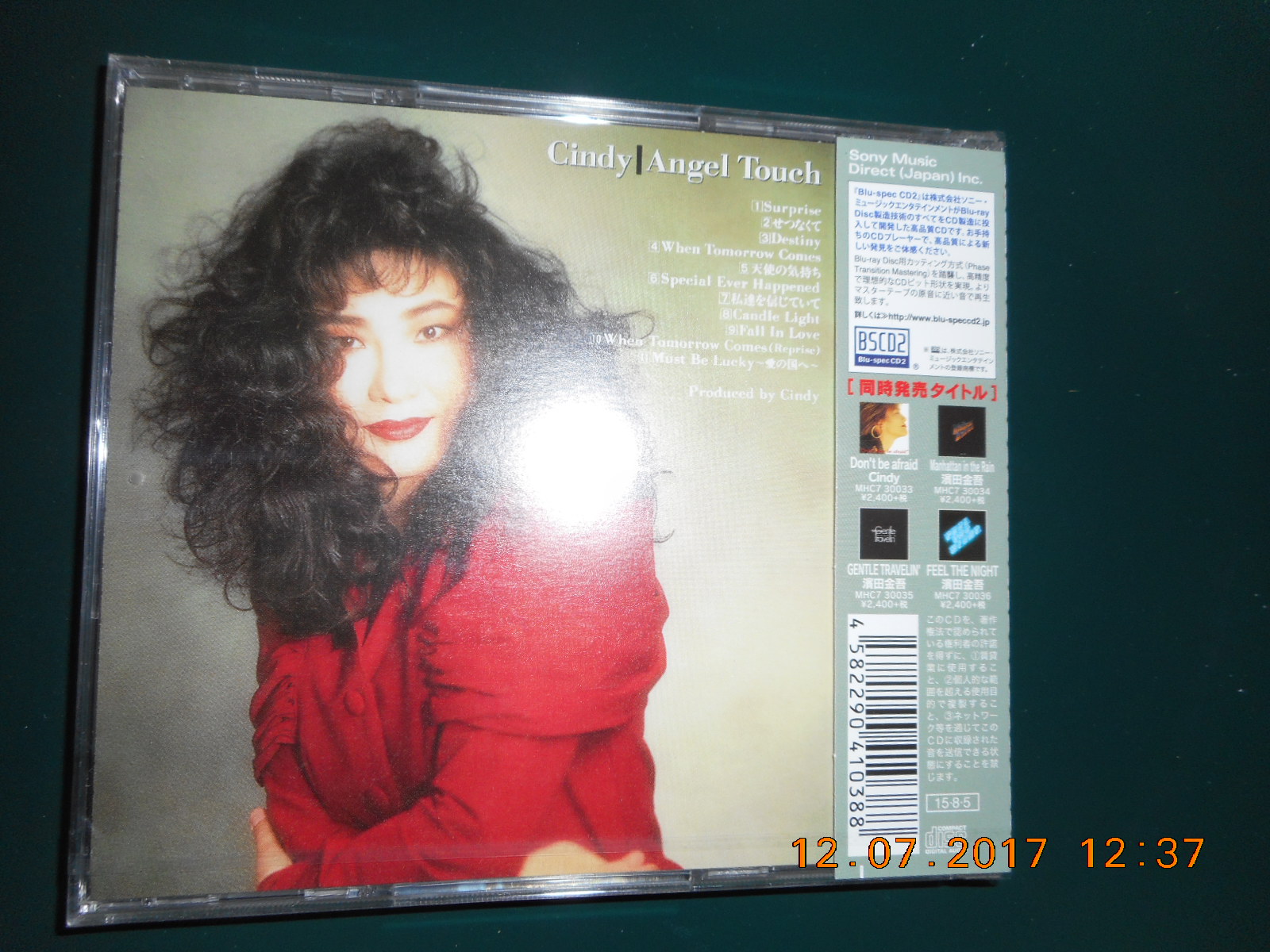
About 18 months ago, I was first made aware of the lovely stylings of the late singer-songwriter Cindy. Never heard of her or saw her on TV any time during my two stints in Japan but then back in the summer of 2016, I discovered some of her material from her 2nd album"Angel Touch" which came out in June 1990.
The song that first drew me in was "Watashi Tachi wo Shinjiteite"(私達を信じていて), a mid-tempo R&B number that grabbed me by the short-n-curlies (sorry for that analogy) and has yet to let go. The arrangement was heavenly (the Future Funksters certainly agreed) but what made it all gel was Cindy's lovely voice.
From "Watashi Tachi wo Shinjiteite" and a hearty recommendation in the Comments section for the song, I decided that I had to get the album. And thanks to Tower Records, I was finally able to purchase "Angel Touch" earlier this month as part of my Xmas bonanza. I put it on the stereo earlier today and I am now thrilled that I got it. It is truly ambrosia for the ears.
For example, "Surprise" which starts the album off. That is one lovely intro with a hint of Latin as Cindy takes us on a mellow romantic ride. Chinfa Kan(康珍化), who also took care of another pop chanteuse in the previous decade, wrote the song with Cindy taking care of the melody. It also happened to be the coupling song for "Watashi Tachi wo Shinjiiteite" when it was released as a single.
I also like Track 2 "Setsunakute"(せつなくて...Heartrending)written by Masami Tozawa(戸沢暢美)with music and arrangement by Rod Antoon. Was able to hear a lot of the old R&B tropes from that turn of that particular decade which got the nostalgia going. After listening to this one, I just went "Wow! And this was almost a decade before the arrival of Misia".
The same duo behind the classic "Watashi Tachi wo Shinjiteite", Kan and songwriter/musician Hiroshi Narumi(鳴海寛), also wove this splendid ballad "Special Ever Happened" for Cindy which also turned out to be her 5th single from November 1990. Warm brandy for the soul. Miho Nakayama(中山美穂)would make a cover of the song in the following year for her album "De eaya".
"Candle Light" is some nice downtown funk with Cindy's great vocals and sax. Listening to this one, I just had to wonder if there had been any sort of duet between her and Sing Like Talking's Chikuzen Sato(佐藤竹善). Rui Serizawa(芹沢類)provided the lyrics with Cindy and Yuji Toriyama(鳥山雄司)coming up with the music.
Plenty of other tracks remain but I will leave those to future articles. In any case, as the commenter mentioned, I owed it to myself to get "Angel Touch", and happy to say that this could be one of those heavy rotation discs.
I had been wondering about how Miho Nakayama(中山美穂)was doing recently since the last news I did hear was that she had divorced her husband, writer-composer Hitonari Tsuji(辻仁成)after 12 years of marriage. Tsuji had also been married once before to actress Kaho Minami(南果歩)who would later marry actor Ken Watanabe(渡辺謙)...but enough of that matrimonial merry-go-round. Apparently at this point, Miporin is continuing to live in France with her son but appeared in her very first stage play earlier this year and was a performing guest last December at the annual "FNS Music Festival" for Fuji-TV, her first appearance on a music show in 18 years.
My recollection of the the 80s female aidoruis divided into the early 80s aidoru featuring ladies such as Seiko Matsuda(松田聖子)and Akina Nakamori(中森明菜). But in the second half of the 1980s had the rise of a sassier and take-less-guff brand of aidoru; I always saw Shizuka Kudo(工藤静香)and Nakayama as the leaders of that "movement". And in fact, I read on J-Wiki that for that latter half of the decade, the aforementioned two aidoru along with Yoko Minamino(南野陽子)and Yui Asaka(浅香唯)were dubbed by the media as The Four Aidoru Queens.
In terms of music, my arrival in Gunma Prefecture came following the July 12th 1989release of Miporin's 16th single, "Virgin Eyes" which had me hooked because of that dynamic melody composed by Anri(杏里). And as a result, for some years, I kept my eyes and ears on the singer who seemed to be making that transition from regular aidoru to pop star because of "Virgin Eyes" without investigating too much about her earlier material.
Consequently, I didn't really know much about her preceding single which came out in February of that year, "ROSÉCOLOR", aside from the title all in caps. A bit of a pity since it is a nice little Latin-infused ballad which was written by Chinfa Kan(康珍化)and composed by Cindy.
One of the reasons that Nakayama and Kudo have stood out to me despite that label of The Four Aidoru Queens is that I always had that comparison between the two singers. Kudo was the aidoru with the oomph factor in her songs and dancing while Nakayama struck me as being at her best with the balladry, vocally speaking. But even in the above performance on "The Best 10", there were some of the characteristic off-notes that I've often associated her with when it came to her uptempo stuff. Still, it is a soothing tune that I wished I could have gotten to know earlier. Well as they say, better late than never.
"ROSÉCOLOR" was the 5th in a string of 5 No. 1 singles that Miporin had between 1987 and 1989 (she would have three more No. 1s after that). It would finish the year as the 27th-ranked single. The ballad would also be used in a Shiseido commercial.
I also came across a video featuring PSY-S' Chaka singing a more straight-ahead pop rendition of "ROSÉCOLOR"; no idea whether this was ever made into a track for one of her own solo albums or as part of some compilation project. The performance stops midway to introduce the cover (with some of that Latin flavour back) by composer Cindy herself for her 1991 album"Don't Be Afraid". She would cover it again in 1997 for her final album"Surprise". At the risk of offending fans of Miho Nakayama, I think Chaka and Cindy delivered smoother versions. The one other reason I put this article up was in a tribute to Cindy herself that I started with my first article on her.
I came across the above video and thought that if someone made an anime opening to the long-running soap opera "Days of Our Lives", it would look something like that. With that lass always on the pursuit, I can imagine the monologue going like this: "Like sands through the hourglass, so are the days of our liv--MATTE!"
Lame joke aside, I liked the song that was being sampled although I could have done without the fade-in and fade-out. Anyways, it didn't take too much of a look to find out that it was based on this tune.
"Watashi Tachi wo Shinjiteite"(Keep On Believing In Us) is a track on the album "Angel Touch"(1990) by Cindy. I have nothing to say except that I have fallen for this song: hook, line and sinker. It's that combination of the light soul melody and that drum pattern plus the vocals of Cindy. This would have been a fine song for EPO to tackle but I really love Cindy's voice which is smooth but it also has that appealing faint rasp. And most certainly, the real thing is better than the sampled version. "Watashi Tachi wo Shinjiteite" was written by prolific lyricist Chinfa Kan(康珍化)and composed by Cindy and Hiroshi Narumi(鳴海寛). It also did come out as her 4th single in June 1990 at the same time as the album.
If J-Wiki is correct, Cindy's real name is Mayumi Yamamoto(山本真裕美)and she was a singer-songwriter who debuted in 1984 with the single "Chance On Love". As a composer, she lent out her talents primarily to Miho Nakayama(中山美穂)on many of her songs. On her own, Cindy released 6 singles and 4 albums.
Sad to say, but Cindy passed away in Los Angeles in December 2001 from cancer. According to J-Wiki, the news was released by Nakayama herself on her own fan club site.
Miho Nakayama's(中山美穂)"Miho's Select" is an album of her BEST hits that was released on Christmas Eve 1991. When I saw a picture of the CD in the "Eye-Ai" CD shopping list for one issue, I was struck by the cover with the artistically overexposed image of Miporin sitting down on some street in what looked like a European city as she gazed upward to the sky. I was back in Canada at that point after 2 years in Gunma, and remembering that time period as the one which finally drew me in as a casual fan of hers, it didn't take much thinking to decide to write out that money draft to acquire that disc along with one or two others.
As mentioned, "Miho's Select" consisted of her hits which included "Rosa" and "You're My Only Shinin' Star". However, another song, a ballad, caught my attention as well. Titled "I Know", I initially assumed that it had been a relatively new song (at that time) past 1990 since the arrangement was about as non-aidoru as could be for Miporin. Rui Serizawa's(芹沢類)dreamy lyrics about finding love and the late Cindy Yamamoto's(シンディ山本)mature Latin-flavoured melody had me wondering if this had been a track from one of the singer's albums from 1990 or 1991. In actual fact, though, "I Know" was a ballad from her 7th album released in July 1988, "Mind Game". Unlike Miho, I didn't know.
When it comes to "Miho's Select", "I Know" is the song that I always associate the album with. Not that the other tracks are bad at all....they are her hits, after all. But that soft bossa ballad somehow left something more permanent within my engrams. And for me, for whatever reason, I've usually been drawn to Miho's more mature ballads such as "Midnight Taxi".


.jpg)