I've been a fan of Japanese popular music for 40 years, and have managed to collect a lot of material during that time. So I decided I wanted to talk about Showa Era music with like-minded fans. My particular era is the 70s and 80s (thus the "kayo kyoku"). The plus part includes a number of songs and artists from the last 30 years and also the early kayo. So, let's talk about New Music, aidoru, City Pop and enka.
Credits
I would like to give credit where credit is due. Videos are from YouTube and other sources such as NicoNico while Oricon rankings and other information are translated from the Japanese Wikipedia unless noted.
Showing posts with label Kazuko Katagiri. Show all posts
Showing posts with label Kazuko Katagiri. Show all posts
I'd like to give my sincere thanks to former "Kayo Kyoku Plus" contributor and good friend JTM for giving me a disc of 1960s and 1970s kayo kyoku by female singers titled "Enka Joushi Kou ~ Onna-tachi no Banka"(怨歌情死考~女たちの挽歌~...Songs of Grudges and Thoughts of Lovers' Suicides ~ Women's Elegies). OK, that title might be terrifying to some but the songs covered are in the pop and Mood Kayo vein as performed by Ako Midorikawa(緑川アコ), Noriko Ogawa(小川節子)and others with the lyrical theme of how love has done women wrong.
One of the songs that I heard last night on the CD was Mona Tachibana's(橘モナ)"Namida no Samba" (Samba in Tears) which, as the uploader of the video has put it, isn't really a samba. Maybe it's more of a horn-amplified cha-cha with a bit of rock, I'm not sure, but in any case, this was Tachibana's debut single in 1973. This was written by Kazuko Katagiri(片桐和子)and composed by Koumei Sone(曾根幸明), and Tachibana would release one more single under that name.
Yes, "under that name". Tachibana has had a bit of name-based intrigue perhaps rivaling the trials and tribulations that the protagonists of the compilation's songs have endured. I don't know her birth name for sure but as an actress, she made her debut as Yukiko Shino(篠雪子)on the Japanese crime thriller series "Playgirl"(プレイガール)in different guest roles in 1970 and 1971 (JTM gave a very detailed account of the show on the blog a decade ago). But then from later in 1971, under her new stage name of Kiyomi Ohta(太田きよみ), she was able to play one of the new main characters on "Playgirl" for several months. She made the switch to Mona Tachibana in 1973 for both music and TV but in 1975, she made yet another switch to Hitomi/Kazumi Yamazaki(山崎一美)for a couple of more singles and then back to Kiyomi Ohta for a 1979 single. Currently, she's working under the name of Kiyomi Sone(曾根きよ美), after marrying composer Sone as noted above.
I admit that I may have quickly scrolled down the Hiromi Iwasaki(岩崎宏美)file on "Kayo Kyoku Plus", but I was surprised to realize that it's almost been eight years since I actually covered one of her albums. Certainly, I've covered plenty of her individual songs in the last number of years, but the most recent album by her that I took a look at as a whole was her 1985 "Diamant"(ぎやまん)back in October 2015.
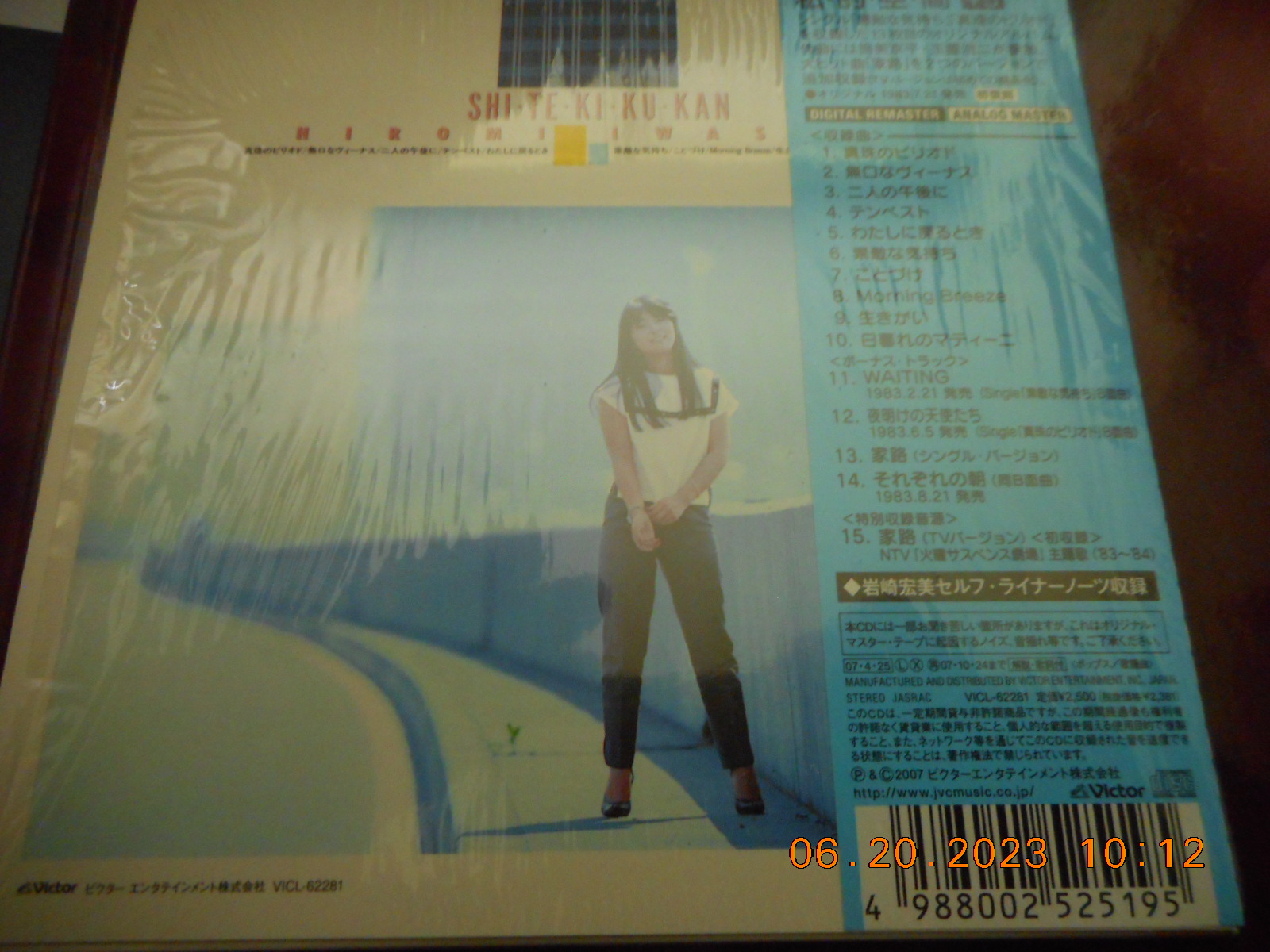
Well, allow me then to cover at least a part of her July 1983 album"Shi-Teki-Kuu-Kan" (Personal Space) tonight. I bought this one by Iwasaki several years ago and there is personal testimony from the singer herself in the liner notes. The one thing I remember the most by far from those notes is her hilariously embarrassed apologies in the second paragraph for her looking so "fat" in the photos. She took particular aim at her saggy arms and those bushy eyebrows before reassuring fans that she at least was able to upgrade herself in the years hence. Personally, she looks hot and has always looked so. End of story.
Incidentally, I'm covering the 2007 issue of "Shi-Teki-Kuu-Kan" so there are five bonus tracks including two versions of one of my favourite Hiromi songs of all time, "Ieji" (家路)which I actually profiled years ago. I'll cover those as well but among the original tracks, the truly relaxing "Suteki na Kimochi"(素敵な気持ち)is another song that I handled back in 2015.
There's a lot to see and hear so let's begin with the first track "Shinjuu no Period"(真珠のピリオド...Pearl Period) which was Iwasaki's 31st single from June 1983. It did decently on Oricon by peaking at No. 31 and I like it because it has that snazziness as it straddles the line between pop and City Pop. I love the old-fashioned "dabba dabba" chorus as well as the sharp strings and the horns coming in. Not surprised at all then that the master songwriters behind this one were lyricist Takashi Matsumoto(松本隆), composer Kyohei Tsutsumi(筒美京平)and arranger Mitsuo Hagita(萩田光雄). Considering how this one sounds, I had assumed that "Shinjuu no Period" was yet another Iwasaki contribution to the Tuesday Night Suspense Drama on NTV like "Ieji" was. But that wasn't the case here and Matsumoto's lyrics merely relate the bittersweet late summer story of a tryst at a beach house that is to end soon, and the lovers are trying to make the best out of what little time they have left with each other.
Track 2 is the sunny 70s soulful "Mukuchi na Venus"(無口なヴィーナス...Silent Venus). Once again, Tsutsumi provides his composing prowess here as he does for two more tracks on Side A of the original LP with Keiichi Oku(奥慶一)as the arranger. The late Rei Nakanishi(なかにし礼)was the lyricist here as Iwasaki sweetly and slyly assures a paramour that all's fine and dandy in Romance City and that nothing needs to be said at all.
There is a bit more brio in Iwasaki's vocals for Track 3, "Futari no Gogo ni"(二人の午後に...A Couple's Afternoon) with Mieko Arima(有馬三恵子)as the lyricist here while Hagita is back as arranger. We're definitely in the City Pop here. I like the layering of urban contemporary rhythm and keyboard underneath strings which paint a more romantically fantastical picture although the story is more negative as a couple go through the motions poolside even though the love dissipated a while back. Well, that's how the cake crumbles.
Not surprisingly for a title like "Tempest"(テンペスト), there's more melodic drama and rock guitar in this track which has Nakanishi, Tsutsumi and Oku working together. My mind pegs this one as a theme song for a detective show although once again such was not the case. Still, the tempest isn't only occurring outside but inside a hotel where a woman is anticipating an affair is about to turn a critical corner into permanent changes.
The final track on Side A is "Watashi ni Modoru Toki"(わたしに戻るとき...Getting Back to Me) has me getting some 80s Steve Winwood vibes. And this time, I also feel some West Coast AOR with the electric guitar thrown in there. Hagita is back but for this one, Kazuko Katagiri(片桐和子)was responsible for the lyrics for this jaunty love song. One other thing is that instead of Tsutsumi composing the tune, it was Anzen Chitai's(安全地帯)Koji Tamaki(玉置浩二)coming up with the melody. Iwasaki noted Tamaki's assistance in the liner notes and that he also composed a couple of other tracks on Side B. The singer noted that Tamaki's three contributions to "Shi-Teki-Kuu-Kan" were just before his band made it big with "Wine-Red no Kokoro"(ワインレッドの心)in that same year. Additionally, she remarked that Tamaki was dressed to the nines a la Humphrey Bogart right down to the fedora (usually apparently most songwriters would come over as casual as possible); he even sported an attaché case. Maybe he was trying to impress her; I have no idea.
To finish off Part 1 (Part 2 will be next week), I'm leaving the article with one of the bonus tracks "Sorezore no Asa"(それぞれの朝...Each Morning) which was the B-side to "Ieji". I actually first heard this song on an episode of that old CHIN-FM radio program "Sounds of Japan" and it sounded so beautiful despite all of the hissing and spitting of bad reception that I searched for years for the title of the tune. Kaoru Ito(伊藤薫)was both the lyricist and composer for this ballad that sounds like a lullaby for children. In point of fact though, it is a melancholy ballad about the end of a relationship signalled openly with phrases like "the end of love" and more tacitly with one line stating the coming of fall. To hammer the final nail in, there is a very morose harp playing there along with some splendid strings playing in the bridge. "Sorezore no Asa" will never get anywhere near a wedding reception but it's still a wonderful song.
I can say that for a lot of folks in Japan this Friday morning that they were more than happy to be bleary-eyed and tired this time because they got to see their men's soccer team beat Spain in their final intra-group game in the World Cup. They and their opponents go onto the knockout round but for now, everyone is having a party.
The Samurai Blue, I gather, made most of their chance that night, and as such I'm bringing Yoko Katori's(鹿取洋子)"Chance Tonight" in some celebration of the team's win. I realize that I'm starting the City Pop stuff several hours early this week, but then again, I've been leaking City Pop here and there all this week anyways, so I can pretty much just go ahead and have fun with my favourite genre. Plus, disco is a fun party genre.
I mentioned singer and actress Katori back in 2018 for her one-and-only 1980 album"LIBRA" which was also a disco and City Pop release. "Chance Tonight" wasn't only a track from the album, but it was also her 3rd single in the same year. Just bopping about with all sorts of happy downtown dance club vibes, I can see that disco ball glittering from the ceiling while all the young folks and the young-at-heart are dancing themselves dizzy.
I used those last three words in my previous paragraph intentionally. That's because Katori's "Chance Tonight" is a cover (much like her "Goin' Back to China" is a cover of Diesel's 1979 song of the same name) of English disco groupLiquid Gold's"Dance Yourself Dizzy" by Adrian Baker and Eddie Seago from February 1980. Kazuko Katagiri(片桐和子)provided the Japanese lyrics for Katori's version with Motoki Funayama(船山基紀)handling the arrangements. For the weekend anyways, let the good times roll in Japan.
While we're at it, here's Yomanda's 1999 remix of "Dance Yourself Dizzy".
Just a little over a year ago, I introduced singer and host Marie Igarashi(五十嵐麻利江)who I encountered through a snazzy City Pop number titled "Juu-roku-sai no Aki"(16才の秋)from her 1979 album"Umi wo Kanjiru Toki"(海を感じる時...When I Feel the Sea). Eventually, Igarashi would direct her musical talents toward opera in the middle of the 1980s.
But before her training in Italy, she had a couple of pop albums to get through. One song from her 1981 album"Daydream" was "Kibouhou made" (Up to the Cape of Good Hope) which comes across as a breezy and optimistic pop number providing a romantic travelogue through South Africa. The tour is definitely at a brisk pace. Igarashi, Masato Kai(甲斐正人)and Takayuki Inoue(井上尭之)were behind the melody while Takashi Nakahata(仲畑貴志)and Kazuko Katagiri(片桐和子)took care of the lyrics.
Speaking of "Umi wo Kanjiru Toki", I also found this basically short instrumental "Mujin Ressha"(Empty Train) which has some chorus-like vocals. Written and composed by Kei Ogura(小椋佳), it's dominated by electric guitar and hard-hitting piano as I get some Linda Ronstadt rock vibes in the arrangement.
I was listening to this cute little candy cane of a kayo and I was wondering what was it about "Pink no Kuchibeni" (Pink Lipstick) that fired off some memory engrams in my head. Well, first off, allow me to introduce Tomoko Kei(恵とも子)who had debuted in show business as one member of the dance-and-entertainment group Schoolmates back in 1963, joining the 1964-1966NTV music show "Star Parade"(スターパレード), and then she made her debut as a singer with the aforementioned "Pink no Kuchibeni" in October 1966. At one point, according to a very brief file at this website, the half-American/half-Japanese Kei had gained enough popularity that she was even compared to movie star Sayuri Yoshinaga(吉永小百合).
Written by Kazuko Katagiri(片桐和子)and composed/arranged by Osamu Shoji(東海林修), I like "Pink no Kuchibeni" for its arrangement that has me remembering some of that on-the-road country-style pop that I used to hear on the radio and see on TV via those old K-Tel record commercials. Even the lyrics are so innocent in that the heroine here is asking all listeners to keep the fact that she's putting on the titular cosmetic secret from Mom while she tries to lure in that boy of her dreams.
From what little more I could glean about Kei's career, she put out one more single in 1967 and then called it a day in 1968 as she left for the United States.
Now, as for that melody of "Pink no Kuchibeni" that sparked off some hints of familiarity, I think Shoji's music was probably given some inspiration from The Cascades' classic doo-wop"Rhythm of the Rain" from 1962.
This is another chance encounter with an aidoru who never really made it big but listening to "Aoi Suiheisen"(Blue Horizon), I think that there is some pleasant nostalgia when it comes to this teenybopper tune.
"Aoi Suiheisen" was sung by Tomoko Izumi(和泉友子...not sure about the reading of that first name; if it is actually Yuko, please let me know) as her first of only two singles according from what I could find on this archive for 70s and 80s aidoru. It was released in June 1981 and the timing was pretty appropriate since it does have that summery and breezy feeling. There is unsurprisingly no J-Wiki entry for Izumi because of her very brief discography but from that archive, the author mentioned some similarity to an aidoru who was becoming very big at the time, Seiko Matsuda(松田聖子).
The arrangement is quite reminiscent of that time going from the late 1970s to the early 1980s when it comes to aidoru music, but listening to "Aoi Suiheisen", I'm also reminded of the music of Yoshie Kashiwabara(柏原よしえ)and the vocals of perky Ikue Sakakibara(榊原郁恵). The song, which apparently didn't even break into the Top 100 on the Oricon weeklies, was written by Kazuko Katagiri(片桐和子)and composed by Yusuke Hoguchi(穂口雄右).
For as long as I've been writing on the blog, I've managed to find some more kayo where legendary band The Ventures have gotten involved.
Yumi Makiba's(牧葉ユミ)singing career didn't last too long, since it was just between 1971 and 1975. The Tokyo native somehow found herself behind the mike after a brief time as a staff worker at a company, and she made her debut with "Bouken"(冒険...Adventure)in July 1971. For the purposes of this article, allow me, though, to write about her third single, "Kaiten Mokuba" (Carousel) which came out in June 1972.
Kazuko Katagiri(片桐和子)wrote the lyrics about a young woman falling in love with a vagabond guitar player on some rock, although nothing about a carousel ever popped up from what I could find there. Still, Bob Bogle, a founding member of The Ventures, composed "Kaiten Mokuba". According to the YouTube description, the hint was that the song may have been a cover of a Ventures tune called "You and Me", but I couldn't find any thing of that tune by the band. In any case, I like Makiba's crisp and strong voice.
Makiba, whose real name is Yumiko Omura(大村由美子), released a total of 11 singles and 1 original album. From what I read on her J-Wiki profile, a very young Momoe Yamaguchi(山口百恵)had sung "Kaiten Mokuba" on the audition program "Star Tanjo"(スター誕生!...A Star Is Born!)back in December 1972 to pass through to the next stage in the competition. My compliments to the uploader MomoeKaitenMokuba in being able to create this video which was probably very difficult to pull off.