I've been a fan of Japanese popular music for 40 years, and have managed to collect a lot of material during that time. So I decided I wanted to talk about Showa Era music with like-minded fans. My particular era is the 70s and 80s (thus the "kayo kyoku"). The plus part includes a number of songs and artists from the last 30 years and also the early kayo. So, let's talk about New Music, aidoru, City Pop and enka.
Credits
I would like to give credit where credit is due. Videos are from YouTube and other sources such as NicoNico while Oricon rankings and other information are translated from the Japanese Wikipedia unless noted.
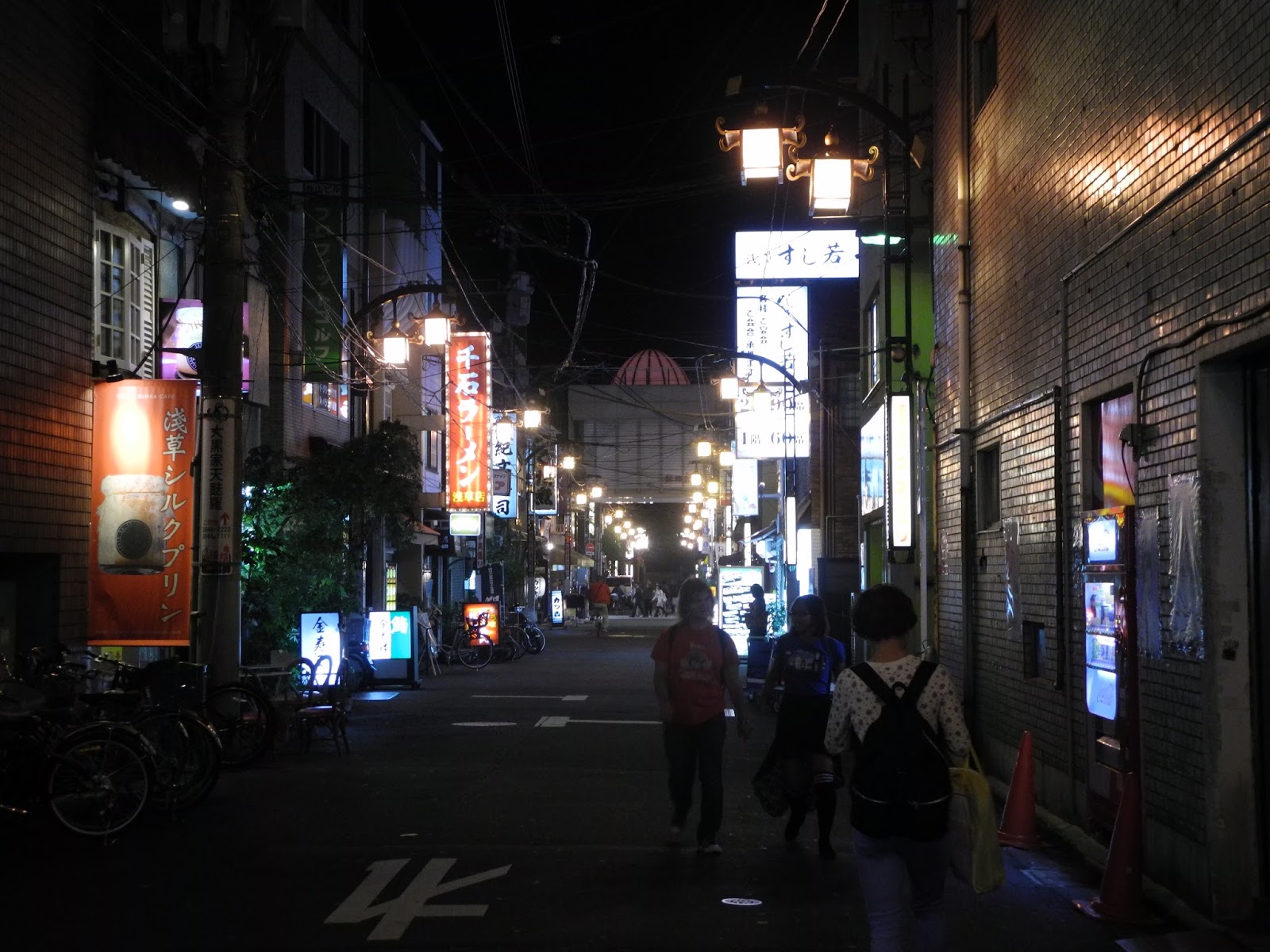
I only had that one two-night stay in Sapporo way back when and that was back in the late spring. If I have a chance to visit the city again, I wouldn't mind doing so during the winter. Even better, I'd like to check out the Snow Festival with its huge ice statues. However, I have to point out that the above photo is of the main entertainment quarter there, Susukino. I did walk along its main street when I visited.
Susukino in the dead of winter is what I think of when I listen to "Blue Night in Sapporo" by Miyoko Tashiro(田代美代子)from 1969. Written and composed by Domei Suzuki(鈴木道明), it's very much a love-done-me-wrong Mood Kayo thanks to Tashiro's mournful vocals, the just-as-melancholy backing chorus, the sad and shuffling rhythm and of course, the title itself (and don't forget the crying sax). It's probably not the greatest feeling plodding through sub-zero cold after a romantic breakup.
Crazily enough, I discovered that Shinichiro Hakozaki(箱崎晋一朗)would sing this very song a decade later in 1979!
We were watching the final episode of the kayo music program, NHK's"Shin BS Nihon no Uta"(新BS日本の歌...Songs of Japanese Spirit) which included up-and-coming teenage enka/kayo kyoku singer Kokoro Umetani(梅谷心愛). I've mentioned her once before in a Sites article about a couple of interesting shops in Asakusa earlier this month, and I'm going to have to write about at least one of her singles in the new year. But in any case, for a 17-year-old, she certainly took on a moody and pretty mature song on that episode. It reminded me of adolescent Hiromi Iwasaki(岩崎宏美)recording "Shishuuki"(思秋期)back in 1977.
The original recording of "Onna no Iji"(Pride of a Woman) was done by Sachiko Nishida(西田佐知子)back in October 1965. Written and composed by Domei Suzuki(鈴木道明), it was the B-side to her "Akasaka no Yoru wa Fukete"(赤坂の夜は更けて)which is a bit more jazzy (ironically, I wrote about that one exactly nine years ago). "Onna no Iji" is a straight melancholy Mood Kayo and enka mix about the complicated emotions a woman is going through after a relationship goes sour, and it all probably takes place in a bar community in Shinjuku, Ginza or Akasaka. The same musical tropes of a Mood Kayo are there, but I have to say that the tenor saxophone in "Onna no Iji" really stands out.
According to the J-Wiki article on the single, "Onna no Iji" was one of Nishida's favourite songs and around the beginning of the 1970s, it got a second look as its own single. It then became a favourite of many listeners to the extent that "Onna no Iji" managed to sell about 400,000 records. At the end of 1970, Nishida was invited to the Kohaku Utagassen that year to sing it. Her tenth appearance on the NHK New Year's Eve special, it would also be her final appearance on the show after getting married.
Over a decade ago, I wrote about a classic kayo, "Aishite, Aishite, Aishichattanoyo" (愛して愛して愛しちゃったのよ), which was performed by the Mood Kayo vocal group Hiroshi Wada(和田弘)and Mahina Stars(マヒナスターズ)along with singer Miyoko Tashiro(田代美代子). Since then, Mahina Stars have graced the pages of "Kayo Kyoku Plus" a number of times, but unfortunately it has been just the one article for Tokyo-born Tashiro.
Allow me to remedy that. Tashiro was a student at Meiji Gakuin University in Tokyo when she dropped out midway and began her career as a singer. She learned chanson from singer Yoshiko Ishii(石井好子)and jazz from singer Toshio Suzuki(鈴木敏夫). It wasn't long before she had that hit with Mahina Stars in 1965.
In September 1966, Tashiro released her own single "Inochi wo Kakete Aishitai" (I Want to Risk My Life Loving You), a light love song in the Latin-infused Mood Kayo vein written and composed by Domei Suzuki(鈴木道明). Characterized by a crying trumpet, bluesy guitar and silken strings, the kayo makes the listener feel like they are in a classy old-fashioned bar with the bartender shaking up a cocktail right then and there while Tashiro is singing on stage. Despite the mid-60s release date, "Inochi wo Kakete Aishitai" sounds somewhat timeless as if it could have been played at any time between the 1930s and the 1960s.
It's been about half a month since I've tackled a Mood Kayo and last night's "Uta Kon"(うたコン)was more on the folk stuff of the 1970s (which of course I was perfectly fine with), so nothing about the old bar songs there.
First off, let's have those Mood Kayo veterans Hiroshi Wada and Mahina Stars(和田弘とマヒナスターズ)back on KKP again with their 1966 song "Tokyo no Yoru wa Tanoshiku" (Fun Nights in Tokyo) which was actually a B-side to "Ginza Blues"(銀座ブルース), a single that had the group duet with Kazuko Matsuo(松尾和子). Written and composed by the same fellow behind the sultry music of "Ginza Blues", Domei Suzuki(鈴木道明), "Tokyo no Yoru wa Tanoshiku" has more of a galloping melody with some Latin hustle percussion and that steel pedal guitar so maybe even a bit of Hawaiian punch is included. The guys are basically happily exhorting all of those salarymen to Wang Chung (80s pop joke) the night away in the largest city on the planet. Good times, back then.
I've also thrown in this Tokyo-themed song by Mahina Stars called "Tokyo no Yoru wa Sasayaku"(Whispers in the Tokyo Night) although I couldn't track down the originating year for this one, though it's been contained on kayo compilations for the 1960s. I figure it was probably a non-single album track on one of the group's original LPs.
Written by Tetsuo Miyagawa(宮川哲夫)and composed by Hideki Mishima(三島秀記), "Tokyo no Yoru wa Sasayaku" has more of an intimate sensation on the ears, and I especially enjoy the almost-crystal like guitar plucking right from the start. The feeling is akin to a couple dancing really close on the nightclub floor buoyed by plenty of alcohol in the two of them. It's truly a Mood Kayo love ballad somewhere on the streets of Tokyo.
Haven't done a Mood Kayo in a while so I decided that I would finish off with one tonight. I realize that it's probable that the more popular nights for karaoke are Friday and Saturday, but I've wondered whether Sunday wouldn't be a good evening as well. After all, the next day is back to the grindstone, and it may be a good hobby to get rid of that pre-Monday stress by getting a few songs out of one's system. Not sure if everyone is more content to stay at home on Sunday night anymore.
Well, as the Mood Kayo tonight, I'm going with "Blue Night In Sapporo", a suitably melancholy ballad about lost love in one of the major cities in the northernmost prefecture. Sung by the late Shinichiro Hakozaki(箱崎晋一朗), this May 1979 release is notable for being quite short (a little over two minutes and thirty seconds) and for Hakozaki's high mournful tones.
Written and composed by Domei Suzuki(鈴木道明), I also chose this particular tribute to the north country because according to NHK reports and my own student last night, Sapporo may truly be singing the blues right now, due to a large lack of snow. Apparently, it's been quite a few decades since there has been such a dearth in the white stuff, and the SDF has been dispatched to truck in snow from other parts of Hokkaido. This is quite important since the annual Snow Festival is just around the corner, and of course, the ski resorts depend their livelihood on snow. So, hopefully things will improve in the next few weeks.
Always a grand area. Even if folks have said that since the Bubble burst and the 2011 earthquake, the lights of Ginza haven't been the same, I've never particularly agreed with the opinion that Tokyo's most famous neighbourhood has lost its gleaming luster. It's still a fine walk, day or night and whether or not the street is closed to vehicular traffic for its weekly pedestrians' paradise.
With the title of "Ginza Blues", I would have thought that this would have been an easy single for the Mood Kayo group Akira Kurosawa &Los Primos(黒沢明とロス・プリモス). After all, this was the group that performed a number of Ginza-based tunes such as "Ame no Ginza"(雨の銀座)and "Tasogare no Ginza"(たそがれの銀座). However, it was included as a track on (I'm assuming) their February 1970 album, "Sakariba no Yoru ni Utau"(盛り場の夜を唄う...Sing to the Night on a Busy Street), although the YouTube video just has "Yoru ni Utau" as the identifying album.
The song also did sound rather familiar, then I figured it out. "Ginza Blues" had been recorded previously in the 1960s and by a number of different artists. In fact, I had already written about the ballad just a few months earlier with Hiroshi Wada & Mahina Stars(和田弘とマヒナスターズ)and Kazuko Matsuo(松尾和子), among others. But what I found out was that the cover version by Los Primos, compared to the jazzier and swingier versions by those from the other article, has more of an intimate Latin feeling especially with that lone guitar. I imagine, for example, that the Mahina Stars and Yujiro Ishihara(石原裕次郎)would have performed their covers in a classy brightly-lit supper club in Ginza while Los Primos would be in closer surroundings with the spotlight placed right on them.
One of my first experiences having dessert in Tokyo was at a branch of the Cozy Corner franchise. Although I don't think that I have ever seen one of those sweet shops in the suburbs or bedroom towns of which my Ichikawa was one, Cozy Corner is pretty much everywhere in the main city (for example, there is one of the Ginza shops as you can see at the right of the above photo).
I remember being in a Cozy Corner with friends for the first time after landing in Japan to start my second stint as an English conversation teacher at NOVA. Let me say, first of all, the sizes of cakes vary greatly in Canada and in Japan. Without too much exaggeration, I was accustomed to getting a dangerously large wedge of Black Forest or Strawberry Shortcake which could easily be 1/5 or even 1/4 of a whole. However, when I got my first slice of Strawberry Shortcake at that Cozy Corner, I took a look at it and remarked "Do I eat this or do I inhale it?". Let's say that it was rather petite. However, as the years went by during my life in the Kanto, me and my stomach not only became accustomed to the massing down of cake but by the end, we actually were quite happy for the downshift.
Also, I gather that depending on where a Cozy Corner is located, the clientele can be quite different. My friend and I were sitting in one branch deep in Ginza having our cake and coffee, and we just noticed a lot of very high-class women varying in age between 20 and 40 all around us, knocking back the joe and taking drags on their cigarettes. I would say that approachability was effectively zero. Good cake, though.
On that note, I wanted to introduce a perfectly Mood Kayo tune right from the title itself, "Ginza Blues". A love letter of sorts to one of the world's most expensive neighbourhoods, this apparently has been quite the favourite for singers of the genre over the years. Written by Takeshi Sagara*(相良武)and composed by Domei Suzuki(鈴木道明), the first recording of this was by the perennial Mood Kayo combination of Kazuko Matsuo & Hiroshi Wada and Mahina Stars(松尾和子・和田弘とマヒナスターズ)back in May 1966. The above performance video also included crooner Frank Nagai(フランク永井). I don't know what the original recording sounded like but if it's anything like the stage performance, then the Mahina Stars' original had some of the Hawaiian part of the genre. Everyone here also got together to record "Dare Yori mo Kimi wo Aisu"(誰よりも君を愛す)several years previously.
Unfortunately, I couldn't find out when this recorded duet between Nagai and Matsuo was released, but considering their "Tokyo Nightclub"(東京ナイトクラブ)from 1959, these two just had to get back together to do "Ginza Blues". This version keeps the Mood Kayo flavour of course but this time, it veers a bit more toward the jazzy side if that clarinet is any indication. Jazzy and classy.
And of course, The Tough Guy had to get in on some of that "Ginza Blues" action, too. Once again, this was one of those recordings that I couldn't track down a date, but from the sound of Yujiro Ishihara's(石原裕次郎)voice, his cover may have been come from the late 1960s or 1970s. Finding out about all these different covers of this song, I've come to realize that despite all of them being in the same genre of Mood Kayo, they can each have their own individual arrangement. In Ishihara's case, there is quite the nightclub feeling, thanks to that boozy sax and the caressing/echoing vocals by The Tough Guy. The tumbler of Old Parr is on its way!
Last but certainly not least, there is Sachiko Nishida's(西田佐知子)cover of "Ginza Blues". This time, according to the notes for the YouTube video, I was able to find out that her version was a part of her 1969 album"Koi wo Utau"(恋を唄う...Sing of Love). Plus, her vocals lend a refreshing and "the night is still young" lightness to the proceedings, as if the setting were a pre-dinner visit to a bar instead of the after-dinner nightclub. The songwriter Domei Suzuki had also provided Nishida with another Mood Kayo classic, the 1965 "Akasaka no Yoru wa Fukete"(赤坂の夜は更けて), a tribute to another swinging area of Tokyo nightlife.
Because of money and the fact that I remain a very light drinker, I never really imposed myself into bar culture anywhere in Tokyo including Ginza and Akasaka, but at least, there were still a number of good cafes to inhabit, including Cozy Corner. Still appreciate the cakes there.
*The lyricist's name has a number of readings for both family and first names so I've taken a wild guess here. If someone knows the correct reading for him, please let me know. Also, Akira Kurosawa & Los Primos(黒沢明とロス・プリモス)have also given their contribution to this song.
When I was looking for a video of Sentimental City Romance's (センチメンタル・シティ・ロマンス)"Natsu no Hi no Omoide" earlier today for the article, I also found another song with the same title.
This "Natsu no Hi no Omoide" (Memories of A Summer Day) was recorded by the beautiful Teruko Hino(日野てる子)back in January 1965. Unlike the happy-go-lucky namesake by Sentimental City Romance, the B-side to Hino's 7th single"One Rainy Night in Tokyo"(ワン・レイニー・ナイト・イン・トーキョー) is a much more bittersweet affair and another example of how Japanese songwriters loved to use the seasons as analogies for the status of the heart. Written and composed by Domei Suzuki(鈴木道明), Hino sings about walking alone on that lonely beach during the height of winter while remembering the happier days at that same place when she was walking with that fellow who's no longer by her side.
Hino was born in July 1945 which means that she recorded "Natsu no Hi no Omoide" when she was still a few months under 20 years of age. That was quite the rich voice she had even back then. Its quality reminded me of another honey-coated set of vocals belonging to Naomi Chiaki (ちあきなおみ). That B-side became one of her trademark numbers which helped get it and "One Rainy Night in Tokyo" attain big hit status with over a million records sold. On J-Wiki, Hino has been categorized as a chanteuse of Hawaiian melodies but the original recording was definitely in the Mood Kayo area, although her above performance on stage was arranged with that Hawaiian feeling in mind.
The singer was born in Matsuyama City, Ehime Prefecture and debuted in 1964 with "Kaimana Hila"(カイマナ・ヒラ), with at least 30 singles and 15 albums (including BEST compilations) under her belt up to the late 1970s. Hino appeared three times in a row on NHK's Kohaku Utagassen between 1965 and 1967 which included her rendition of "Natsu no Hi no Omoide".
Sadly, Hino passed away at the age of 63 in 2008 due to lung cancer.
The Force may be with me tonight. Just hours away from the 66th edition of NHK's Kohaku Utagassen(紅白歌合戦), I decided to take a time trip back 50 years and see what was going on with the 16th edition in 1965, 2.5 months after my birth. In the lineup for the Red Team from that year, I came across Sachiko Nishida's(西田佐知子)name and the title "Akasaka no Yoru wa Fukete"(Akasaka After Dark) written and composed by Domei Suzuki(鈴木道明). And boy, is it a winner for me!
When it comes to the tony Tokyo district of Akasaka and Mood Kayo, I always had the impression of Latin music. However, "Akasaka no Yoru wa Fukete" is a lovely jazz ballad that came out as a single for Nishida and several other singers at around the same time near the end of 1965, but it looks as if Nishida was the winner of those sweepstakes. And I would say no wonder. Her evocative and echoing delivery breathes life into those lyrics about a woman pining away in some ritzy bar in the title area for her lost love. I can imagine the sadness, the diluted glass of scotch-on-the-rocks, the ashtray filled with plenty of lipstick-stained butts and a tousled head on the counter. This is what Mood Kayo is all about. For Nishida, her performance of "Akasaka" marked her 5th consecutive time on the Kohaku.
Since then, I think "Akasaka no Yoru wa Fukete" has become a Mood Kayo standard of sorts considering how many other artists have covered it since its release 50 years ago. The Big Man himself, Yujiro Ishihara(石原裕次郎), has also given the song its due, but his version has that Cool Cat Jazz arrangement compared to the Akasaka nightclub atmosphere evoked by Nishida's original. As someone as I've seen as the Japanese equivalent of Frank Sinatra as the leader of the Rat Pack, he and this version fit hand-in-glove.
Then we have Keiko Fuji's(藤圭子)take on "Akasaka no Yoru wa Fukete" which also has its own intriguingly different arrangement. With the accordion in there, the setting seems to be somewhere in some lonely bar in Paris with a bit more anguish from Fuji. All of the versions here are fine and there are quite a few more covers on YouTube as well.