I've been a fan of Japanese popular music for 40 years, and have managed to collect a lot of material during that time. So I decided I wanted to talk about Showa Era music with like-minded fans. My particular era is the 70s and 80s (thus the "kayo kyoku"). The plus part includes a number of songs and artists from the last 30 years and also the early kayo. So, let's talk about New Music, aidoru, City Pop and enka.
Credits
I would like to give credit where credit is due. Videos are from YouTube and other sources such as NicoNico while Oricon rankings and other information are translated from the Japanese Wikipedia unless noted.
Busy morning with the usual grocery shopping along with a banking issue to be resolved. Happily, both were resolved very amicably. The Force was with me or I didn't suffer any jinxes (no ladders, floor cracks or black cats got in my way).
And apparently, neither did singer-songwriter Mami Ayukawa(鮎川麻弥). Perhaps as her song title states, she truly doesn't believe in jinxes. "Jinx wa Shinjinai" (Don't Believe in Jinxes) is a track from her December 1986 5th album"Chase", and from the upbeat and somewhat updated Motown arrangement, the lass doesn't allow any bad vibes or bad luck to affect her at all. It's quite the catchy melody by Hideo Saito(斉藤英夫)with Keiko Aso(麻生圭子)behind the lyrics.
One of the tropes for kayo kyoku that I've often repeated is that especially for the late 80s aidoru, the arrangements surrounding them were very lush and top-notch.
Case in point: I've been listening to aidoru Miyoko Yoshimoto's(芳本美代子)first track from her December 1987 5th album "Yesterday's", "Sky Escape". Not quite sure how to describe Kazuo Zaitsu's(財津和夫)melody and its arrangement by veteran Mitsuo Hagita(萩田光雄), but it all just sounds so refined and it has some key changes that hit me right here: 💓. And I know that Zaitsu can twirl around a melody line wonderfully, in particular after hearing his marvelous "Fuyu no Main Street"(冬のメイン・ストリート). Keiko Aso(麻生圭子)was the lyricist here. As for the album, it hit No. 53 on Oricon.
I was just taking some snapshots from that aidoru guide and so here is this showing 80s teenybopper singer Yuko Nito(仁藤優子)on the cover of her September 1987 2nd single"Aki kara no Summer Time" (Summer Time from Autumn). Thought it would make for a nice addition on KKP, after putting up her debut single"Okorinbo no Ningyo"(おこりんぼの人魚)a few years ago.
And indeed, considering the release month and the title, the song is a refreshing blast of summery weather, musically speaking, with a little bit of 50s in the chorus and some synthesizer spaciness in the instrumental bridge. Written by Keiko Aso(麻生圭子)and composed by Hideya Nakazaki(中崎英也), "Aki kara no Summer Time" was Nito's most successful single by peaking at No. 10 on Oricon.
Welcome to November! Hopefully, Halloween was an enjoyable one for you with those candies and other treats. Looks like the first day of the month will begin with the usual Urban Contemporary Friday on KKP.
Today, we're starting off with a new name to the blog. Singer and actress Risa Yamamoto(山本理沙)was born Rieko Susa(諏佐理恵子)in Osaka although she did spend a lot of her high school years up in Sapporo. A lot of her TV career from the mid-1980s while she was in her teens involved a number of variety shows, dramas and commercials. However, she also had a brief recording career with five singles and one original album.
That May 1986 album, "You're In", included the track "Dance de Kizutsukete" (Hurting Through Dancing), which was created by lyricist Keiko Aso(麻生圭子)and composer Takashi Tsushimi(都志見隆). I think the song straddles the line between City Pop and pop although the rhythm has that champagne-and-caviar form of City Pop. It's not too bad especially with that horn section in there but that banging synthesizer before the verses can get a bit grating.
It is July 13th here which means that it is Akina Nakamori's(中森明菜)birthday! Once again, I give her my congratulations on reaching the big 5-9 and hope that all is fine with her and she's enjoying her special day with family and friends.
From Amazon
Now, over the years, whenever July 13th pops up, either fellow Akina fan and KKP co-administrator Larry Chan or I put up a post regarding one of her songs, and last year, I managed to write something on "Kagami no Naka no J"(鏡の中のJ) from the earliest of her aidoru days in 1982. To be honest, Larry and I have managed to cover most of her big hits in the 1980s and 1990s, and I've even explored two of my favourite albums by Akina: "Bitter and Sweet" and "D404ME". But then, right after those big releases, Nakamori decided to get into the production game when it came to her discography, and for a few years in the late 1980s, her singles and albums bifurcated into parallel tracks with the latter taking a more adventurous and perhaps avant-garde turn.
In fact, those albums were so different that they frankly drove me away for a time. Several years ago, I wrote on her December 1986 10th studio album"Crimson" after finally listening to it for the first time in over thirty years. When I had first heard the tracks there when I was a university student, I quickly dismissed them as Akina going weird again but then having that conciliatory listen after so long, I realized that the songs weren't too bad after all; my ears and brain were simply not ready. Still, "Crimson" hasn't gone down as being one of my favourite Akina albums.
However, all of that drama surrounding "Crimson" occurred because I'd listened to the album that had come before, "Fushigi", from August 1986. According to Wikipedia, the album was meant to be translated as "Mystery" or "Secret"...for me, I went with "Strange" or "Weird". I've already told my fellow Akina friends including Larry that after borrowing my friend's audiotape of it and giving it one listen, I mentally fled (not walked away) from "Fushigi". I do recall thanking my friend very politely though.
"Fushigi" was the singer's first self-produced album and from what I've read about her, she has always been an artist who wants to do things her own way including the type of music she wanted to explore. Well, she basically hitched a ride on the Enterprise and headed to Neptune here. Still, kudos to her for pushing the envelope and I think "Fushigi" does have its fans. I've read somewhere that the album could be described as Akina meeting The Cocteau Twins. I've heard of the group but I've never heard their music so I can't confirm.
The album cover of "Fushigi" was a big hint of what I would be hearing and then when I heard the first track "Back Door Night", my reaction was "Yeah, this is fushigi". Of course, I can't remember a single song since it was that one and only time listening to it back in 1986 so for her birthday today, I decided to return to "Fushigi" for the first time in 36 years and take another chance on it.
"Back Door Night" was written by Keiko Aso(麻生圭子)and composed/arranged by Japanese rock band EUROX, and indeed, revisiting it after so long, it still strikes me as being very different from what she had done before. It is by far the longest track on "Fushigi" at over 5 1/2 minutes long as if she wanted to make a strong statement right from the get-go: this is my music and it's not going to be typically Oricon-friendly. To add to the fushigi-ness of it all, I'd thought that there was something wrong with my cassette recorder. The music was rocking away in its New Wave way, but Akina sounded like she was several dozen metres away from the microphone, and then I learned that she was experimenting with various recording and production techniques, so it was intentional. Her voice was unmistakable but it sounded like she had been possessed by a wayward coven's witch who had gotten lost. Going through Aso's lyrics now, I think they would make a great background story for Kimiko Miyashiro from "The Boys".
Am I going to listen to the rest of "Fushigi" now that I've opened the back door to "Back Door Night"? Eventually, I will although it will probably be baby steps. Having said that, the album hit the top spot on Oricon and became the 15th-ranked album of the year.
Got Kayo Grace Kyoku standing in front of some tall skyscrapers which probably means that it's Urban Contemporary Fridays on "Kayo Kyoku Plus".
It was almost a couple of years back in April 2022 when I first posted a song by Shoko Arai(荒井尚子), "Kansho Ryoko"(感傷旅行)from her one-and-only 1990 album "Je Vous Aime", produced by Meiko Nakahara(中原めいこ). Arai is someone that I had not heard about but from "Kansho Ryoko", it sounds like the singer enjoyed some of that Quiet Storm in her music. And my posting of the song was deliberate since I also noted there that travel was finally beginning to awaken after a few years of the pandemic.
Well, another track from "Je Vous Aime" is "Circuit" which was created by the same duo behind "Kansho Ryoko", lyricist Keiko Aso(麻生圭子)and composer Tsunehiro Izumi(和泉常弘). The song takes things into the late 1980s City Pop and sophisticated pop realms, and it has quite the pop through the bass and percussion (was Sheila E in the house?:)). Of course, having the brassy saxophone lends even more brio to the proceedings.
Let's welcome back KKP AI representative aidoru Kayo Grace Kyoku to "Kayo Kyoku Plus" for the first time in 2024! Looks like she's had her Holidays and is now all rested up.
This might be the first entry for aidoru Mamiko Tayama(田山真美子)but she already has representation here on the blog because she was also a member of the aidoru trio Rakutenshi(楽天使)which itself was a cog in the big group Nanatsuboshi(ななつ星). I provided a few articles on Nanatsuboshi for the Xmas holidays including their "Juu-ni-gatsu no Tokubetsu na Yoru"(12月の特別な夜).
Born in Iwate Prefecture, Tayama got her beginnings in show business as a child actor in 1986 but then broke into her aidoru career in 1989 with "Seishun no Evergreen"(青春のEVERGREEN...Youthful Evergreen). Her discography isn't too extensive; she put out five singles and two original albums including her second album"Uta Shosetsu ~ Cynalyric"(詩小説(シナリリック)...Poetry Novel) from February 1991. One of the tracks is "Hajimete no Asagaeri" (First Time Going Home in the Morning) which has a darn catchy and cheerful hook by Jun Sato(佐藤準)and there's something about the arrangement which has me thinking of some PSY-S tunes. The other thing about the melody is that the chorus also reminds me of Stevie Wonder's"Sir Duke".
I couldn't find Keiko Aso's(麻生圭子)lyrics online but the title hints at that giddiness and embarrassment from heading home from the boyfriend's place for the first time. Maybe I'm just being naïve but I'm a little surprised that an aidoru tune actually covers this. The first time I actually came across the term of "asagaeri" was through Dreams Come True's"Ureshihazukashi Asagaeri" (うれしはずかし朝帰り) which had been released a couple of years earlier.
Man, when Arale-chan(アラレちゃん)wants to funk it up, she really funks it up!
Well, actually I am talking more about Arale-chan's seiyuu Mami Koyama(小山茉美). Strangely, her J-Wiki profile only lists her anime character songs in her discography and nothing of her records and singles as a pop singer. One album she did put out in 1985 is her "Vivid".
The opening track is "Distance no Manatsu" (Midsummer Distance) which has been described by one commenter as being similar to a Phil Collins song although they didn't identify it. However, I think I know which one it is..."Sussudio", thanks to the keyboard riffs. However, JASRAC lists it as being written by Keiko Aso(麻生圭子)and composed by Etsuko Yamakawa(山川恵津子), and it's a pretty decent boogying City Pop song of its time. Not sure whether I could ever see Arale-chan, Senbei or the rest of the Penguin Village characters bop to it, but I would be interested in hearing more of this "Vivid".
I haven't featured a TOSHITARO song since "Romantic Noise" in the past couple of years so I thought it was time to bring back this City Pop singer from the 1980s. I've read on sites where this particular song of his has only been known to the most knowledgeable of listeners (read [in Japanese]: maniac), but it was used in a commercial for a brand of tape cassette.
But that title threw me for a loop! "Am9 ni J - Eikaku Boy de Ite kure yo" from his May 1985 album"Paradise", had me scratching my head while I was listening to this strutting City Pop boogie twice. Who was J and what was so important that it had to happen at 9 am? Well, the mystery was such that I had to look it up online and fortunately, I was able to get most of my questions answered. Musician Taro Mejiro's(めじろたろう)November 2020 blog entry helped explain that "Am9" doesn't refer to a time but to the A Minor 9th chord, and after consulting with a YouTube video on that specific chord, it sounds like the song actually wraps itself around this very chord (TOSHITARO even shouts it out in the lyrics). Perhaps City Pop YouTuber Sora Satoh has even mentioned this in one of his videos.
Thanks, mahalodotcom!
As for the "Eikaku Boy" part, I've got no idea since eikaku translates into "acute angle". I tried to see via the search engine whether eikaku boy is a form of musical jargon but I couldn't get anything. So, basically speaking, the title in English is "J at A Minor 9th - Stay an Acute Angle Boy, Will Ya?". OK, whatever you say.😵
Keiko Aso(麻生圭子)was behind the lyrics for TOSHITARO's melody and from what I could glean, the protagonist is a fellow who's in love with a female radio DJ known only by her first initial J (so, Janice, Joyce, Junko?). As the singer shouts out, that A Minor 9th is the zinger to his heart for some reason and maybe J sang or spoke something at that chord. But the chorus throws back at the lad that she's already married so don't bother although the fellow is undeterred. In any case, I like the boogie in this one and the wailing guitar solo.
Yeah, the commercial for this tape cassette fairly screams "Typically Bizarre Japanese CM!".
The last time that I wrote about veteran singer Ryoko Moriyama(森山良子)was back in late 2021 when I provided an article on the first track, "Hito Natsu no Shi Seikatsu"(ひと夏の私生活), for her May 1986 album "At My Time". A driving Airplay-esqueWest Coast number, as I mentioned in that article, it was quite the surprising song.
Well, Track 2 continues the AOR tradition within "At My Time", but it's still quite different. "Natalie no Shuumatsu"(Natalie's Weekend) is not only more mid-tempo, but it actually sounds more elegant and brunch-friendly. It was written and composed by the same duo behind "Hito Natsu no Shi Seikatsu", lyricist Keiko Aso(麻生圭子)and composer Masamichi Sugi(杉真理). However, instead of the early 1980s Airplay, "Natalie no Shuumatsu" takes on more influence from cool jazz and material created by/for singers such as Akiko Kobayashi(小林明子)and Miki Imai(今井美樹)in those same mid-1980s. I'm always going to a sucker for that certain keyboard in play on this song along with the harmonica solo.
I couldn't find the lyrics for "Natalie no Shuumatsu", but it certainly feels as if the Natalie in Moriyama's song is considerably happier here than the Natalie in Mariya Takeuchi's(竹内まりや)"Natalie". Methinks that while the latter Natalie is regretting her dream, Moriyama's Natalie is living it.
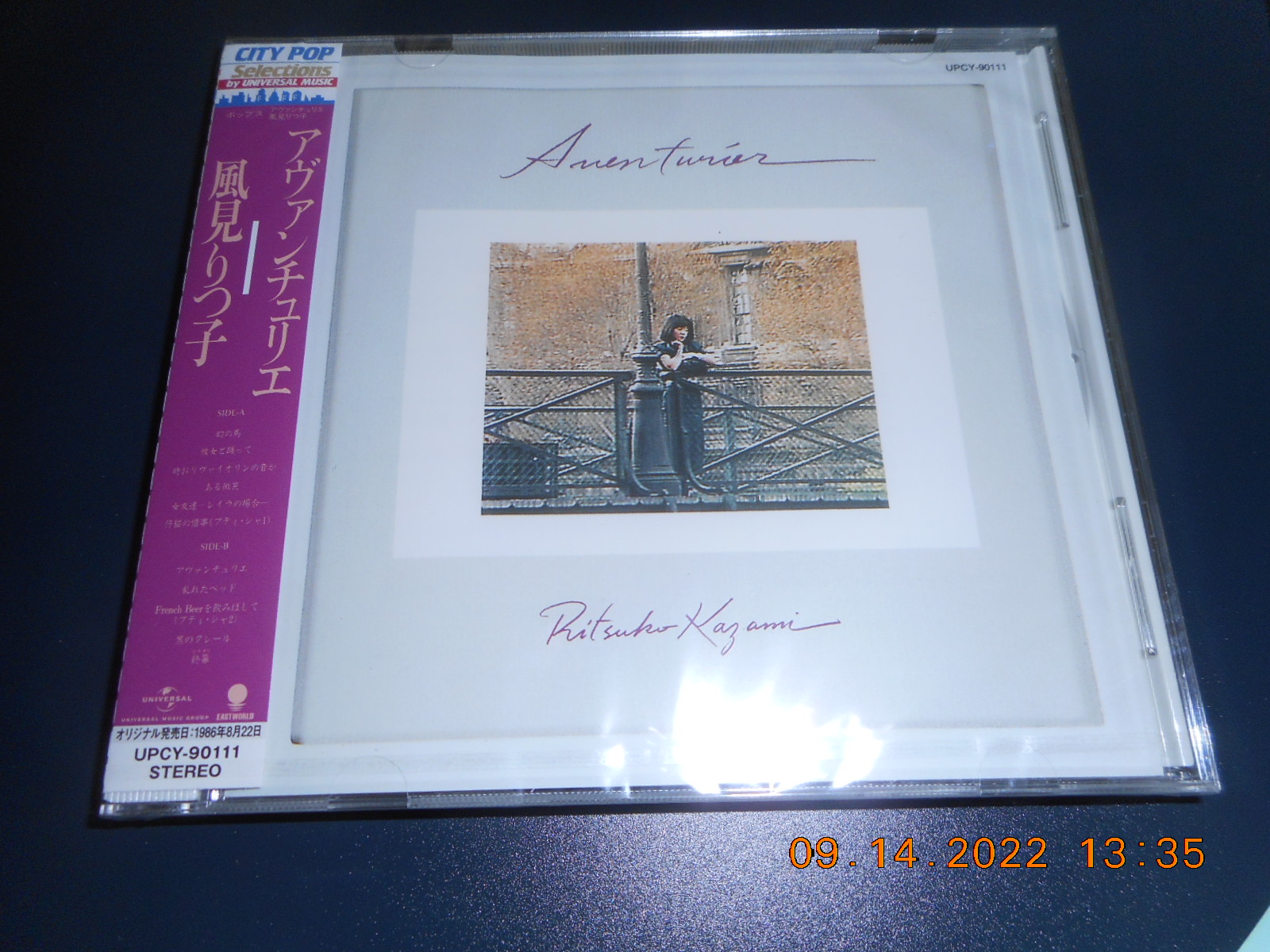
As I mentioned before, I made my first purchases of Japanese pop albums in several months through CD Japan and they arrived a few days ago. One was Junko Ohashi's(大橋純子)"Magical ~ Ohashi Junko no Sekai III"(大橋純子の世界III), one of her BEST compilations from 1984. I was very happy with that one, as am I with this regular album "Aventurier", the second of actress/singer Ritsuko Kazami's(風見律子)three albums released in August 1986.
A couple of tracks from "Aventurier" are already represented here on "Kayo Kyoku Plus", the title track and the appealingly techno-quirky"Onna Tomodachi: Reira no Baai"(女友達-レイラの場合)composed by Taeko Ohnuki(大貫妙子). The title track and single "Aventurier" is a pretty soaring piece giving me snippets of Henry Mancini and 60s international romance and adventure a la "Charade", but Kazami's soft and languid delivery also gives me those Fashion Music (Japan's form of baroque pop, I gather) vibes. In fact, I've seen so many examples of that sort of music over the years that I'm making this article the first one to get the Fashion Music label so I'm going to be doing some major back-labeling later on today.
In any case, why don't we go over the rest of the tracks then? I did read one of the YouTube comments thanking the uploader for putting up the entire album since the powers-that-be had just gone on a search-and-destroy mission for some of the individual songs. However as of this point, I was able to find a few of those left. One is Track 2"Kanojo to Odotte"(彼女と踊って...Dance with Her).
One thing that quickly made me a believer in "Aventurier" is how a mix of genres are in play for this album, and with "Kanojo to Odotte", there is the ennui-laden Fashion Music aspect along with some of the synthpop in the rhythm, and even City Pop, although the city here is more likely the City of Lights rather than Tokyo. Machiko Ryu(竜真知子)came up with the lyrics of a man tiredly encouraging a young would-be suitor to go dance with his girlfriend with the hint that the man wouldn't particularly mind if the younger fellow danced with her forever. He's pretty much tapped out of energy. Yukihiro Takahashi(高橋真梨子), drummer of Yellow Magic Orchestra, was the one behind the double-layer of slower silky strings and the more urgent keyboards; perhaps they were representing the two incompatible speeds of the potentially soon-to-be former couple.
I am glad that the next two songs have been left intact (for now) on YouTube since they form a set. Track 6 is "Koneko no Jouji ~ Petit Chat 1"(仔猫の情事(プティ・シャ1)...A Kitten's Love Affair) which is so string-heavy Fashion Music that I felt that I was gonna be handed a peeled grape to eat by my butler. The story of a lady who might be that lass from "Kanojo to Odotte", she's taking that leisurely and luxurious shower before curling up with her guy in bed, perhaps in a clothing-optional manner. Kazami herself wrote the lyrics while prolific composer Etsuko Yamakawa(山川恵津子)came up with the melody. I'd say that Yamakawa could have easily sung this as one of her own tunes judging from what I have heard from her as half of City Popduo Tohoku Shinkansen(東北新幹線).
(Sorry but the video has been taken down.)
Ah, now we come to the second of the set. Track 9 is "French Beer wo Nomihoshite ~ Petit Chat 2"(French Beerを飲みほして(プティ・シャ2)...Drink Up That French Beer) (at 35:09 of the video of the entire album below)which has the same Yamakawa melody but with a different arrangement (by Yamakawa as opposed to the original by Tachio Akano/あかのたちお). Moreover, the lyrics are different and supplied this time by the aforementioned Ryu, and this time, the lady is at a bar, newly separated and casually caustic toward her former paramour. Yamakawa's arrangement is more footloose and fancy-free as if to reflect the fact that the shackles of relationships have finally come off although I'm personally worried about the status of her liver.
For the last number of tracks, I'm going to go with the full album video since the above were the only standalone videos that I could find of individual tracks. Track 1 is "Maboroshi no Uma"(幻の馬...The Mysterious Horse) starts "Aventurier" jauntily with a feeling of Matt Bianco's techno jazz including that cool trumpet (or cornet?). Yamakawa was once again on music and arrangement while Reiko Yukawa(湯川れい子)wrote the lyrics about a romantically ignored woman thinking of some dangerous liaisons.
Placed as Track 3 at 8:15, "Tokiori Violin no Oto ga"(時おりヴァイオリンの音が...Sometimes the Sound of a Violin) kinda wavers between stately waltzes of Fashion Music and synthpop, and I couldn't help but feel that Taeko Ohnuki was involved here. Sure enough, going through the liner notes, it was her on melody with Keiko Aso(麻生圭子)on lyrics and Nobuyuki Shimizu(清水信之)handling the arrangement.
"Aru Hohoemi"(ある微笑み...A Certain Smile) at 11:22 is a classy pop tune invoking an old kayo trope of a woman, recently out of a relationship, traveling to a new city to refresh her outlook on life. It's quite the atmospheric track but out of the entire album, it's probably the most conventionally pop song. This time, it's Ryu and YMO's Takahashi handling the creation.
"Midareta Bed"(乱れたベッド...Messy Bed), Track 8 at 30:33, is composed and arranged by Shohei Narabe(奈良部匠平), a support keyboardist for Kome Kome Club(米米CLUB), and written by Ryu. It begins rather dramatically with the sound of a burgeoning storm, and the setting is the bed for a newly attached, shall we say, couple as a woman comes out of her slumber woozily and wonders what she has gotten herself into. There is a frenetic blast of synthesizers midway which could represent her frantically trying to remember the night before. My take? It may have involved absinthe. In the same song's refrain, the melody and Kazami are trying for a certain chanson-like stance.
At 39:44 is "Kuro no Clair" (黒のクレール...Black Clair) which is a cover of Ohnuki's classic version from her 1982 album"Cliche". It's not only a more contemporary pop (for that time) take but it feels like a version that Ohnuki herself could have done if she had opted to go away from her favoured French arrangement of the early 1980s for the late 80s style that she went for. Kazuo Shiina(椎名和夫)arranged everything here.
The final track at 44:57, "Period"(終幕), is a sad carnival-like waltz about a deteriorating romance, ironically in the spring when just the opposite should be happening. It's quite sensuous with images of frittering sakura petals, sounds of music boxes and Ferris wheels, fresh hot tears, and the painful slap on the face. Kazami was the lyricist with Narabe as composer/arranger.
"Aventurier" is indeed quite the adventure, and the overall feeling is that Kazami and company had wanted to go for one of those spirited Hitchcockian suspense capers of the 1960s joined by some of that music technology of the 1980s. As you can see from the Labels, it is chock-filled with plenty of big songwriting names to give their own melody flavours to the overall dish. I will always be fascinated with that sort of collaboration because of what the mixture could yield to listeners.
Welcome to Monday! I haven't really spoken on COVID here for a while but the mayor of Toronto has lifted the city's state of emergency after 777 days. Honestly speaking, I had completely forgotten that we were still under a state of emergency. But the daily infection rates have dropped quite a bit and for today at least, we haven't had any deaths and hospitalizations seem to be down, so we may be coming out of the 6th wave.
I gather then that we can start off this business week with something nice, light and bright. We have here a nice, light and bright "Destination" by singer-songwriter Ginji Ito(伊藤銀次)from his March 1987 album "Nature Boy". Written by Keiko Aso(麻生圭子)and composed by Ito himself, "Destination" is one upbeat song with a slightly growly electric guitar but otherwise surrounded by some City Pop goodness in the sophisticated pop vein.
Looking at that cover of a very posh-looking Ito sitting on that stool on the cover, it looks like he as well as "Destination" were going for some The Style Council style, especially with that brass blowing away. It's quite the different look for him when compared to his appearance on the cover of his"Deadly Drive"album from a decade earlier, and "Destination" certainly gives a nice attractive sheen to life in the big city.
Nice to bring back Ito to the blog as a singer again since the last time I wrote about him on that level was for a Xmas tune by him back in 2018.
Happy Thursday! And as I type this, the Japanese are entering the Golden Week holidays which may be the first time in a few years that folks there have been able to travel within the nation, let alone overseas. My good friend and student is planning an outing with his family, and KKP contributor JTM has informed me that there will be a number of Japanese travelers entering the Aloha State over the next several days. I myself would love to head over to Japan to see old friends but I don't think that the opportunity will come for a while at least. Regardless, for all those over there heading out, have a very safe trip!
So I wanted to start the Thursday April 28th 2022 edition of "Kayo Kyoku Plus" with something somewhat travel-oriented, and I came across this YouTube video put up last year by Island Fantasia, aka HRLE92 here on the blog. Titled "Kansho Ryoko" (A Sentimental Journey), this is a track from Shoko Arai's(荒井尚子)one-and-only album "Je Vous Aime" released in 1990. As noted by my fellow contributor, the album was produced by the one-and-only Meiko Nakahara(中原めいこ)and it has quite the luxurious lineup of composers and arrangers helping Arai out including artists such as musician Masahiro Ikumi(幾見雅博), Tohoku Shinkansen's(東北新幹線)Etsuko Yamakawa(山川恵津子)and singer-songwriter Masayuki Kishi(岸正之). You can read the rest of the lineup under the video on Island's page for it. One other website mentions that the album has a very refined pop sense along the lines of the works of singers such as Anri(杏里), Misato Watanabe(渡辺美里)and Eri Hiramatsu(平松愛理).
And I definitely can agree with the luscious arrangement behind "Kansho Ryoko". For this number, Keiko Aso(麻生圭子)was on lyrics while Tsunehiro Izumi(和泉常弘)took care of the melody with Shingo Kobayashi's(小林信吾)arrangement which has that feeling of 1980s Quiet Storm a la Anita Baker. It's quite the refreshing cocktail of a song, thanks to those sparkling keyboards.
Shoko Arai has her own J-Wiki article but with a slightly different kanji configuration(荒井晶子). Additionally, there is no mention of the music part of her career aside from the fact that she is listed as an actress and a singer. Hailing from Tochigi Prefecture, she won the Miss Nippon beauty pageant in 1987 and entered show business in 1990. In 1994, she married actor-singer Shingo Kazami(風見しんご).
Y'know...I've been doing "Kayo Kyoku Plus" long enough to know that there have been a number of artists over the years that have jumped the genre divide...and rather successfully, I might add. 70s teen aidoru such as Hideki Saijo(西城秀樹), Hiromi Go(郷ひろみ)and Hiromi Iwasaki(岩崎宏美)may have begun their careers singing those cute adolescent numbers but then switched into something more mature and urban contemporary, and even folk singers including Masashi Sada(さだまさし)and Iruka(イルカ)also traipsed into City Pop. By the same token, New Music and rock veteran Haruomi Hosono(細野晴臣)made that dramatic turn from plucking a bass guitar into jockeying synthesizers when he helped start up Yellow Magic Orchestra in the late 1970s.
I guess then that singer-songwriter Ryoko Moriyama(森山良子)is my latest discovery. I have known about her beginnings as a mellow folk singer from the late 1960s with "Kono Hiroi Nohara Ippai"(この広い野原いっぱい)and "Satokibi Batake"(さとうきび畑)and even the later part of her career when she sometimes took on bossa nova and straight-ahead pop. However, I hadn't been aware that at one point in the 1980s, she even tackled something like dynamic West Coast pop or AOR.
But that was apparently the case when she recorded her 40th album for release in May 1986, "At My Time". In fact, the launching track "Hito Natsu no Shi Seikatsu" (My Life One Summer), which was written by Keiko Aso(麻生圭子)and composed by Masamichi Sugi(杉真理), sounds like something that Airplay would concoct for Moriyama. The drum hits and the 80s synthesizer that entered my ears from the start kinda caught me off guard as something that I wouldn't have expected from the gentle guitar-strumming singer. And yet, she really gets into "Hito Natsu no Shi Seikatsu" in the same way that I would launch into a tenderloin steak...medium-rare with a touch of soy sauce. 😋 It looks like that she was really savoring that summer.
I finally got to have my first breakfast in a diner in about 20 months. It wasn't the highest quality of food there but heck I was just happy to have sausages again. Bacon is fine but I do have it every Sunday, so I appreciate another form of pork now and then.
Anyways, it's been a couple of years since I put up a Yoshimi Iwasaki(岩崎良美)song so here is "Snow Lie" from her November 1986 mini-album"Blizzard". I do like the song especially with the groove established right from the get-go but then as the melody progressed, I was wondering whether this was truly a City Pop tune. But on hearing the genres flit about flirtatiously all throughout "Snow Lie", I just said the "heck with it" and have placed it as a City Pop and a Pop number.
Lyrics are by Keiko Aso(麻生圭子)and the music/arrangement are by Satoshi Takebe(武部聡志). I couldn't quite get what "Snow Lie" is all about, but I can take it as some sort of romantic betrayal on the ski slopes. I did catch that "living together" lyric so perhaps the couple in question was already "living in sin" by the time the fall came.
Indeed, it is another Friday night. I'm hoping that at least some of you are enjoying some careful group outing on a patio somewhere with some tasty libations.
To complete my usual Friday night quartet of the urban contemporary in Japanese music, I have another track from the band RAMU's one and only "Thanksgiving" album from September 1988, "One and Only". As I mentioned back in the March 2017 article regarding a fellow track, "Rainy Night Lady", I, as a callow youth not so experienced in the language of music, hadn't been quite so sure how RAMU with 80s aidoruMomoko Kikuchi(菊池桃子)as the lead vocalist was going to be categorized.
Although I don't own "Thanksgiving", I can guess with a fair amount of confidence that the album would fall under the City Pop category, and having come out during the Bubble Era of Japan's crazed economic fireworks, there would be that feeling of champagne and caviar in the music itself. Sure enough, the composer for this track was none other than Kiyotaka Sugiyama(杉山清貴), the first main vocalist for Omega Tribe(オメガトライブ)with Keiko Aso(麻生圭子)as lyricist and Hiroshi Shinkawa(新川博)as arranger. "One and Only" is as cool and smooth as a ride in that convertible running through West Shinjuku. Will always appreciate a good sax solo.
Back when I was relying mainly on those rental videos of "The Best 10" and "The Top 10", I only saw Kikuchi as the mid-80s aidoruwho sang the twinkly stuff like "Sotsugyo"(卒業), and so when I first saw her come out fronting RAMU, I was rather shocked at the turn of events in terms of genre. However, if I had been a fan of hers living in Japan, I probably wouldn't have been surprised at all since there were these parallel tracks occurring in her young career with the aidoru music on one hand and then the more City Pop material on the other, through songs such as "Mystical Composer" (ミスティカルコンポーザー).
I literally waited several months to put this song up onto the blog and the day has finally come. Patience, be thanked!
"Hachi-gatsu, Saisho no Suiyoubi" (August, The First Wednesday) is the first track on aidoru Marina Watanabe's(渡辺満里奈)5th album"Sunny Side" from July 1988. And indeed today is the first Wednesday for August 2021 so it's rather nice to have this summery tune on board. For an aidoru tune, it's got some nice refinement in the arrangement. I couldn't find out who arranged the song but I wouldn't be surprised if it had been anyone behind the songs for Miki Imai(今井美樹)or Stardust Revue who were known for some very fine songs in the late 1980s.
As it is, MAYUMI(堀川まゆみ)was behind the melody, and she's been known to have created a few songs for Imai back then as well. Meanwhile, Keiko Aso(麻生圭子)provided the lyrics about a young lady trying to kick her boyfriend or husband off the couch and off the game controller (I'm wondering whether Aso had the power of prescience when she was writing up the words) so that they can enjoy some fresh air at the beach. The song is indeed nice but I think that opening synthesizer is a bit too tinny for something this smooth.
The more that I go further down the road learning about Miho Morikawa(森川美穂), the more I get interested in her songs. Since first learning about her via the 1990 anime "Fushigi no Umi no Nadia"(不思議の海のナディア...Nadia, The Secret of Blue Water), for which she provided the opening and ending themes including the dynamic pop/rock"Blue Water", I've discovered that she had started out as a regular mid-80saidoru with "Kyoshitsu"(教室)and then fairly quickly jumped onto the City Pop/J-R&B bandwagon going into the later part of that decade.
Well, I've been enjoying this really refined ballad from her November 1988 album"Ow-witch!" which sounds like an epithet that Bugs Bunny once threw out after he hit his head. "Eien ga Owatta Asa"(The Morning Eternity Ended) already has a great title but it also benefits from the light soul (maybe Quiet Storm?) provided by composer Julia and arranger Jun Sato(佐藤準). There's also some added class thanks to that soft jazzy piano.
Keiko Aso's(麻生圭子)lyrics relate the story of a woman who's gradually coming out of her funk from a relationship that is now in the past of her life. As one line puts it, no matter whether that fellow is in or our of her life, she's still there and she will be the pillar to support herself. I remember Morikawa going for some more of those lower-register vocals when she recorded "Blue Water", but with "Eien ga Owatta Asa", she aims for high and floaty. The song as a whole is a good reminder of how female vocalists and/or songwriters such as Miki Imai(今井美樹)and Akiko Kobayashi(小林明子)were enjoying some richer and perhaps more velvety melodies in the late 80s and early 90s.
As for "Ow-witch!", it reached No. 12 on Oricon on CD and No. 16 on LP.
Earlier in the year, I introduced singer-songwriter Toshitaro Hiejima(稗島寿太郎), aka TOSHITARO, through his cool and nocturnal "Tight Night" from 1986. As I mentioned in that article, it's been difficult gaining any information about the fellow, but I was able to dig up from Takechas Records that he made his debut through a band in 1979 called Toshitaro & Riverside(とし太郎&リバーサイド)which broke up sometime before or in 1984.
The following year, TOSHITARO released his June 1987 album"Romantic Noise", and I have to say that the cover of him looking like a Reservoir Dog or veteran comedian Teruyoshi Uchimura(内村光良)in one of his skits is quite kakkoii as well. Anyways, one of the tracks is "Lazy Tune" which is anything but. Written by Keiko Aso(麻生圭子)and composed/arranged by the singer, it's got bits and pieces of Motown, piano jazz and late-80s City Pop.
I'm not sure whether it's a real marimba or a synthesizer in there, but the sound adds whimsy although I would have preferred some real horns over the synth-horns in one of the instrumental passages. Still, "Lazy Tune" is a fun song with some nice vocals by TOSHITARO and the backup singers.
Another one of the many anime tropes that has popped up for decades is the introduction of the tenkousei, i.e. the transfer student. Like graduation from junior high to senior high school in Japan, the tenkousei showing up in a classroom is given far more gravitas than it has ever been here in North America. In my case, I was never a transfer student myself, but my band teacher once off-handedly instructed me to teach the new kid in the class the ropes. Over in Japan in anime and I assume real life as well, the tenkousei is required to stand up in the front of the classroom and give official introductions to everyone. Of course, in anime, the reactions can range from all sorts of fluttering valentines over the heads of students to knowing leers among the bullies that some fresh meat has arrived.
Now, Miki Fujitani(藤谷美紀)has been someone that I've known as an actress on many a TV drama in Japan for decades, but I hadn't known her as a singer. Marcos V. opened my eyes when he introduced her 1990 single"Believe in Myself", a Eurobeat blast.
Although Fujitani is simply described as an actress on J-Wiki, I think from what I've heard from "Believe in Myself" and this song, her debut single"Tenkousei", plus the fact that "Tenkousei" was released in April 1988 when she was only around 14 years old, I think the aidoru label isn't a bad one for her. Compared to the dynamic 1990 single, this first single feels like a typical late 1980s aidoru tune with the relative sweet lushness in the arrangement through the music by Masayuki Kishi(岸正之)and the words by Keiko Aso(麻生圭子).
Speaking about those lyrics, Fujitani expresses the loneliness of being a transfer student in a new school in a new neighbourhood, maybe even in a new city, but through a letter sent surreptitiously to her, she finds out that she's not only not alone but she's also being majorly crushed upon. Ahh...young love. Anyways, "Tenkousei" is also available in Fujitani's debut album"Foundation" from August 1988. Up to 1991, she had 9 singles and 3 original albums.


.JPG)