I've been a fan of Japanese popular music for 40 years, and have managed to collect a lot of material during that time. So I decided I wanted to talk about Showa Era music with like-minded fans. My particular era is the 70s and 80s (thus the "kayo kyoku"). The plus part includes a number of songs and artists from the last 30 years and also the early kayo. So, let's talk about New Music, aidoru, City Pop and enka.
Credits
I would like to give credit where credit is due. Videos are from YouTube and other sources such as NicoNico while Oricon rankings and other information are translated from the Japanese Wikipedia unless noted.
It's been a long day and one reason that I'm doing my two articles rather late tonight is that I was out for most of the day today. Yep, I caught "Spider-Man: Brand New Day". And I have to say that this may not only be the best of the "Spider-Man" franchise (up there with the second Tobey Maguire movie) but one of the best Marvel movies, period. It certainly stands out and away from the first three Tom Holland movies. But that's all I'm going to say.
Now, I had thought I gave my tribute to the movie through the official theme song commemorating the release of "Brand New Day" in Japan, Mrs. GREEN APPLE's"Brand New" back last Saturday. However, I wanted to see if I could find one more Japanese pop song that had an association with Your Friendly Neighbourhood Spider-Man. Of course, I've already covered the opening and ending theme songs for Toei's own "Spider-Man" show from 1978.
But scrolling down the J-Wiki article for the show, I also found an insert dance song that had been used in Episode 7 of the one-season series. Apparently, some band named Kotaro Kobayashi(小林幸太郎)& BB5 came up with "Spider-Man Boogie". With lyricist Shozo Uehara(上原正三)and composer Chuumei Watanabe(渡辺宙明)creating the rollicking rock and roll number, it's short and sweet. And one other YouTuber wanted to add a little more to the song in terms of visuals.
Hey, Maguire had his time on the dance floor...er, street. And of course, Holland has his background in dancing. Andrew Garfield...where are you?
It was about a decade ago when I posted an article on the first opening theme song for the 1970s tokusatsu hero show "Himitsu Sentai Gorenger"(秘密戦隊ゴレンジャー...Secret Task Force Five Rangers). Quaint is how I would put it considering I began the article with my assessment of the superhero movies coming out in 2016 at that point. My opinions on those MCEU and DCEU movies haven't changed, and the first "Dr. Strange" flick did turn out to be a solid if not incredible addition to the Marvel franchise. Well since then, let's say that Phase 5 of the master plan behind the MCEU hasn't been all that impressive to me although I'm hoping for great things for the new "Spider-Man" and "Avengers" entries later this year.
I was talking about the conventional comic book movies back then when I wrote about "Susume! Gorenger"(進め! ゴレンジャー). A few years later came the televised adaptation of "The Boys" which has managed to attract, entrance and shock the heck out of the pop culture fandom, and it's coming to a close with this final season that's on right now, and the video above is what I'm thumbnailing this article with. I don't subscribe to Amazon Prime Video but there has already been a ton of video evidence on the first few episodes shown along with reaction videos, and yep, the producers and the cast have managed to continue to pop viewers' eyeballs.
Let's go back to the 1970s then and Japan in particular when these hero programs had no shades of gray or hidden agendas at least not on the heroic side. Good was good and evil was evil, and so go the team members of the Five Rangers.
Usually when I saw and heard these tokusatsu programs, the opening theme was peppy, brassy and appropriately courageous while the closing them was more ballad-like and introspective. However, the first ending theme for "Himitsu Sentai Gorenger", the simply titled "Himitsu Sentai Gorenger", just keeps up the upbeat times of being a superhero of punching and sweep-kicking the henchmen (plus the kids must have loved emulating the onomatopoeia!). As was the case with the "Susume! Gorenger", the legendary Isao Sasaki(ささきいさお)manned the microphone but this time he was backed up by Koorogi '73(こおろぎ'73)instead of the Columbia Yurikago Kai (コロムビアゆりかご会), I guess, for a bit more gravitas in the delivery. Master tokusatsu composer Chumei Watanabe(渡辺宙明)was behind the music while at least one of the originating Toei Company producers wrote the lyrics under the collective pseudonym of Saburo Yatsude(八手三郎). "Himitsu Sentai Gorenger" was the B-side to the original "Susume! Gorenger" single released in April 1975.
It was almost five years ago that I posted the article for the opening theme for Toei's take on "Spider-Man" from 1978 because at the time "Spider-Man: No Way Home" was on its way to theatres with a flash-bang trailer leading the way. I'll let you know right now, I only got to see the whole film finally last month, and much to my regret, I wish I had seen the movie at theatres but with COVID restrictions and my parents' health a concern, there was no way I could do so.
Earlier this morning, the trailer for the next chapter in Peter Parker's life was released. I saw the big ad for "Brand New Day", and I'm definitely looking forward to this one. And hopefully this time around, I'll be able to catch this one at the cineplex at the end of July. For Peter's sake, I'm also looking forward to a happier movie overall as the title hints.
Well, then, to follow the pattern of the article for "Kakero! Spider-Man"(駆けろ!スパイダーマン), I will provide the ending theme for the 1978 Japanese show. The same people involved for that opening theme: singer Yuuki Hide(ヒデ夕樹), composer Chumei Watanabe(渡辺宙明)and lyricist Saburo Yatsude(八手三郎), are back for the ender "Chikai no Ballad" (Ballad of Vows). Not surprisingly, this one contrasts with the heroic opener by being more introspective and revealing of the costs of being a superhero: loss of loved ones and a lonely existence. Good heavens! It pretty much wraps up the whole story of "No Way Home" into a tightly-packed ball. Mind you, it's a ballad that almost reaches City Pop groove.
Welcome to the final full week of November 2025. With the autumn in full swing, it's easy to get a bit wistful about the passage of this year and time in general. And I've gotten into this mood as well. I've been doing "Kayo Kyoku Plus" now for what will be approaching 14 years so our baby has turned into a snappy teenager.
I first started the blog out by talking about the many examples of kayo kyoku and J-Pop that I purchased and knew for years and years and what the surrounding situation was for each article. Of course, that has changed since for the past several years, I'm writing mostly about new songs by familiar and not-so-familiar singers and bands that I've encountered and sometimes when I get into a whole long series of those, I do wonder about getting things "on track" in a manner of speaking and at least presenting those songs that I've known about since my toddlerhood.
We have "The First" category in the Labels and I remember that I put up my own article almost five years ago on some of the firsts that I achieved through particular songs such as the first kayo kyoku that I ever heard. Well, along that similar track, I'm going to post about the first examples of Japanese music media that I ever bought or got as a gift since they are different from that other list. The above thumbnail shows the first entry.
1. First Tokusatsu Maxi-Single: Kamen Rider/Mirror Man/ Silver Kamen/Ultra Seven (1972)
It is (or was in Japan) July 7th 2025 which means another day to celebrate Tanabata, commemorating the star-crossed lovers Orihime and Hikoboshi. This year, though, is particularly auspicious because July 7th is falling in the 7th year of Reiwa (another way of saying 2025 in Japan) and so people noticing that it is the 7th day of the 7th month in the 7th year, much hay has been made out of it. For example, couples have been flooding their local city halls to register their marriages today and in a lot of supermarkets, some products have been priced at 777 yen.
Now, I've done my commemorating of the holiday sometimes on "Kayo Kyoku Plus" for specific songs in the past, but this time, I've decided to become a little more ambitious by applying a few gimmicks to this Author's Pick.
First off, let's provide three songs that have something to do with the number 7.
(1967) The Echoes and The Misuzu Children's Choral Group -- Theme from Ultra Seven (ウルトラセブンの歌)
Yup, earlier today I met up with my good friend Danny for lunch and then to catch the latest Marvel entry "Thunderbolts*". And indeed, although I had already gotten some buzz that the movie was actually pretty darn good, I was still surprised to see, hear and feel a beating heart under all those special effects, intra-team sniping and gaudy uniforms. Maybe there is some hope for the MCU at last.
Well, I was kinda wondering how I could somehow connect that movie with anything to do with Japanese music. "Thunderbolts*" didn't come up with any assigned J-Pop song when the movie was shown in Japan. However, a bolt was struck within my cobwebbed memories. Decades ago, when I was perusing those thick manga especially meant for the kiddies, I found this one tokusatsu hero called Thunder Mask. Broadcast as a TV series in 1972, Thunder Mask was another one of those acrobatic sweep-kicking ministers of justice that was so tour de force in the 1970s. I just read that the God of Manga himself, Osamu Tezuka(手塚治虫), was impressed enough with "Thunder Mask" the show that he even made a manga adaptation of the series at around the same time. So, perhaps what I saw in the manga back then was the Tezuka original.
Of course, you can't have a tokusatsu hero show without a rousing opening theme sung by an exhorting male singer accompanied by a children's chorus or a vocal group. In this case, "Thunder Mask" had both the kids' chorus and a vocal group. Indeed, the Misuzu Children's Choral Group(みすず児童合唱団) and The Blessin' Four( ザ・フレッシング・フォー)joined Hiroshi Wakagi(若木ヒロシ)to perform "Thunder Mask" as this typically proud march for the fans. Kazumi Sada(佐田一美)was the lyricist while Takeo Watanabe(渡辺岳夫)took care of the melody.
Back when I was into kaiju and dinosaurs decades ago, I was a rather unhappy camper because I wasn't able to see the complete version of "Destroy All Monsters" (1968). It was broadcast on one of the local channels on Saturday night, and I figure it was probably because my father just had to see "Hockey Night In Canada". The pouting disappeared in pretty short order though and the 1970s, 1980s and so on passed by without incident.
Well, last night, I finally got to see the grand Battle Royale or the "Avengers: Endgame" version of all those Toho monsters including Godzilla go into the ultimate knock-down-drag-out against King Ghidorah. Of course, watching this over half a century later meant that the kiddy glee and bouncing about had long been eliminated from my system but it was still fun to see the gang fight it out with even Minilla tying the final bow on this present. And may I say, although I barely know anything about Gorosaurus, that was one nasty drop-kick he landed on the King. You go, Gorosaurus!👍
All that though got me thinking about Daiei Film's own cute monster, Gamera, every Japanese child's favourite gigantic turtle. Now here was a kaiju who was so beloved and famous that he could earn a couple of songs on his behalf in the 1960s: "Gamera no Uta"(ガメラの歌)and "Gamera March"(ガメラマーチ).
I had been wondering if his fame got him another song, and sure enough, it didn't take long before I found "Bokura no Gamera" (Our Gamera) which was used on the big lug's 6th entry "Gamera vs. Jiger"(ガメラ対大魔獣ジャイガー)in March 1970. Both it and "Gamera March" were featured so I guess Daiei was following the James Bond formula of having the original overall theme along with the official theme song of the movie.
Although the same duo behind the proud military "Gamera March", lyricist Hidemasa Nagata(永田秀雄)and composer Kenjiro Hirose(廣瀬健次郎), was behind "Bokura no Gamera", the song itself was styled more along the Club Tropicana Latin of "Gamera no Uta". Cocktails for Gamera! Mind you, the song was sung by the Daiei Jidou Gasshodan(大映児童合唱団...The Daiei Children's Chorus) so definitely no cocktails for them. The chorus also sang "Gamera March" and I found out via the director for one of the movies that unlike some of the other kids' choruses that had been popular back in the day, there was nothing official about the Daiei Jidou Gasshodan, they were just some kids wrangled together from the neighbourhood and brought together behind the mike. Maybe they got some free passes to "Gamera vs. Jiger" or they were given Gamera figures to play with.
Merry Christmas to one and all! I'm hoping that all of you who may be reading this are enjoying December 25th with family and friends and savoring the amity and smells of the season (turkey, potatoes and the like). The Kyoku family is certainly doing and so, and I believe that they'll be having an appropriate get-together later on tonight.
For the final Xmas 2024 entry on "Kayo Kyoku Plus", I've decided to go with a special Reminiscings of Youth song, and what better song to put on here than "White Christmas". Now of course, Bing Crosby is the traditional representative for this perennially sung Yuletide tune but I did want to begin with chanteuse Barbra Streisand because she wasn't only on that early 1970s Ronco compilation LP "A Christmas Gift" that my parents got me, but she was the first entertainer that I heard to sing the Irving Berlin classic while including that mystery first verse that's been usually omitted in other renderings of the song because it just took away (if briefly) that feeling of snow and cold and Christmas atmosphere. Apparently, Streisand's version was first heard on her 1967 album"A Christmas Album", and it's a solemn yet hopeful rendition.
"White Christmas" was first brought to ears in the 1942 holiday-themed musical "Holiday Inn" starring Crosby and Fred Astaire. It was one of many songs that was featured in this flick regarding Crosby's character's whimsical pursuit of running a countryside hotel that was only open on national holidays.
But "Holiday Inn" was a movie that I wouldn't discover until far into my life (actually, it was the Xmas episode of "SCTV" that introduced me to the existence of "Holiday Inn"). Before then, I had been accustomed to hearing it on those Crosby TV specials annually, Elvis Presley's cover of it, and then the movie "White Christmas" (directed by Michael Curtiz, the same guy behind the legendary "Casablanca") which came out in October 1954. Reading through the Wikipedia article on it, I'm not sure whether "White Christmas" the movie had been meant as a direct reconstruction of "Holiday Inn" despite the key presence of a countryside inn.
The movie was an annual ritual in my television life, especially at a time when I had known no other Turner Classic Movies-friendly Xmas flick at the time; "It's a Wonderful Life" and "Miracle on 42nd Street" would come to my attention many years later. "White Christmas" had a bigger main cast than "Holiday Inn" and between the bookends of the rendition of the song, the movie was chock-filled with some great song-and-dance moments (I've already talked about "Snow"here) such as "The Best Things Happen While You're Dancing" with Danny Kaye and Vera-Ellen, and may I say that Kaye was a great addition in terms of both his dancing and comedic prowess compared to Astaire who wouldn't join this movie and Donald O'Connor who had to bow out due to illness.
Of course, there is also the whole "Sisters" bit with the Haynes Sisters and then the parody by Bing and Danny. I'd always wondered whether the latter was ad-libbed since the laughter from the guys looked so genuine. And as it turned out, it was.
Is it a perfect Xmas movie? Maybe not...there were a few scenes in there that had me thinking "Yep, it was way back in the mid-20th century, wasn't it?" but that was then and this is now. Also, I've never been a fan of that latter-half manufactured tiff between Bob and Betty but I guess the writers felt that there had to be some conflict when things may have gotten too cozy for the couples too soon. Still, after not having seen "White Christmas" in many years now, I wouldn't mind taking another gander at it someday.
In any case, what are some other big songs from Japan that were hitting the airwaves in 1954?
I was doing some maintenance with hard drives and stuff, and I got to my anime one where I got to see the first episode of "Ochikobore Fruit Tart"(おちこぼれフルーツタルト...Dropout Idol Fruit Tart) for the first time in a few years. This 2020 coming-of-age comedy starring a quintet of girls trying to become an aidoru group was funny and it came out at a time when all of us could do with a lot of funny somehow, somewhere and sometime.
The last time I wrote anything having to do with the anime was back in late 2021 when I provided the article for the ending theme "Wonder!"(ワンダー!). Of course, there were a few other insert songs which I covered, but I had completely forgotten one that showed up near the end of the first episode. "Nezumi Sentai Nezu Ranger" (The Mouse Rangers of the Mouse Squadron). Initially introduced as the unofficial theme song for the girls' dormitory, Mouse House, the four (at the time) residents got together to perform this adorable tokusatsu tune as their first Fruit Tart tune in front of the neighbourhood train station. Lyricist Sasa Ando(安藤紗々)and composer Eiko Shimamiya(島みやえい子)took care of the song.
"Music hath charms to sooth a savage breast" by poet William Congreve, 1697
I guess KKP icon Kayo Grace Kyoku did do a number on Japanese pop culture icon Godzilla, even getting the big guy to flash a peace sign. If only it had been as easy in the movie I saw earlier this afternoon.
Yup, my friends and I caught "Godzilla Minus One". It's been getting rave reviews and we've been hearing that there was a very emotional core in this latest of the long-running kaiju franchise which surprised the heck out of me. All these decades, I've been accustomed to the Big G trampling the heck out of Tokyo with a mixture of clumsiness and goofiness while battling some odd monster in B-movie trappings.
No such thing in this movie at all. And for that matter, there's no fantastical super-weapon or a couple of tiny princesses giving advice. In fact, I actually had to reach for my Kleenex near the end of the movie. Good golly...there is a beating heart under all that sci-fi.
On the music (since this is a music blog, after all), my friends and I agreed that it was a thrill to hear the original Akira Ifukube(伊福部昭)theme from "Godzilla" (1954) during the final battle. But then there was another overarching song in the score by composer Naoki Sato(佐藤直紀)called "Resolution". When I heard it in the movie, those squealing strings which reminded me of the iconic score from "Psycho", I had thought it was meant as a warning that Godzilla was on the way. Now I realize that it was more of an exhortation for the protagonist to get out of his funk and get rid of the lizard and seeing it come to full orchestral epicness in the final part of the battle, it was glorious.
Sato actually already has representation on "Kayo Kyoku Plus". He's worked in the anime realm including the "Precure" franchise, providing the scores for the first five series. He also arranged the first opening theme song "DANZEN! Futari wa Precure" (DANZEN! ふたりはプリキュア)for the first series "Futari wa Pretty Cure"(ふたりはプリキュア), and he came up with my favourite theme song for a henshin sequence for any of the characters in the nearly 20-year history of the franchise, Shiny Luminous. From a cute little magical girl with mammoth pigtails to a gigantic green dinosaur with atomic breath...yeah, that's entertainment!
The first time I heard this song, I got the impression that this was some sort of tokusatsu theme song as would be the case for "Kamen Rider"(仮面ライダー) thanks to its marching beat and the kiddie chorus backing up the singer. However, there is no superhero on the poster that you see on the video thumbnail above but a samurai warrior as you would see in a jidai geki series such as the immortal "Mito Komon"(水戸黄門).
So, what is this interesting hybrid of two well-known Japanese TV tropes? Well, the theme song is for the 1959-1960 series titled "Hengen Mikazukimaru", a Fuji-TVjidai geki show for the children. And apparently, this was a tokusatsu jidai geki series with the hero warrior Mikazukimaru Hengen doling out justice with some of his amazing powers such as parting rivers and lakes just like Moses. It would therefore go that the theme song with the same name would have that familiar old-fashioned superhero theme...just one for a crime fighter from several hundred years ago.
The theme song was sung by Kazuo Ohno(大野一夫)with Toshio Oka(丘灯至夫)responsible for the lyrics while Teiichi Horie(堀江貞一)took care of the proud melody. I could only find one video with footage from the show itself and it was part of a variety program so the panelists were talking over the episode.
All firemen are heroes...that's without question. In Japan though back in the early 1970s, there was a Fireman who was a tokusatsu hero. "Fireman", or as he was known in certain overseas markets: "Magma Man", was a live-action series that premiered in January 1973 and was launched with two other similar series, "Ultraman Taro"(ウルトラマンタロウ)and "Jumborg Ace"(ジャンボーグA)in commemoration of Tsuburaya Productions 10th anniversary.
Ironically though, I never saw an episode of "Fireman". Actually, I remember the character in his manga form when my parents bought me those thick kids' books that were selling at the old Furuya food market in downtown Toronto back in those 1970s. Even back then, I thought that it was rather odd to name a superhero after a well-known essential service for any community, but I was informed that in Japan, firemen were and are known as shouboushi(消防士), so the character's name was still an exotic one.
Seeing Fireman in action through one of the YouTube videos, I didn't think that there was anything special in his battling of monsters that couldn't have been replaced by one of the Ultramen or I assume Jumborg Ace (since he showed up in that same thick manga book), but variety is the spice of life. The theme song, "Fireman", is the usual heroic ballad of dramatic horns and strings created by composer Asei Kobayashi(小林亜星)and lyricist Yu Aku(阿久悠)with perennial kids' hero singer Masato Shimon(子門真人)behind the mike.
Come to think of it, I'll have to take a look at "Jumborg Ace" as well.
Unfortunately, this week has started with the news of yet another celebrity in the music industry leaving this mortal coil. I found out on NHK News this morning that the Emperor of Anison, singer-songwriter Ichiro Mizuki(水木一郎), had passed away on December 6th due to lung cancer at the age of 74. Born Toshio Hayakawa(早川俊夫)in Tokyo, he was also affectionately known as the aniki or big brother, and I knew him for his appearances on various specials and other shows where he would put his all into his appearance and performances of the many anime and tokusatsu theme songs that he had recorded over many decades.
The first time I'd heard of Mizuki, it was through his recording of the opening theme song for the tokusatsu hero program "Chojin Barom-1"(超人バロム・1...Superman Barom-1), a show that I watched as a kid visiting Grandpa's farm in Wakayama Prefecture back in 1972. However, I think that for a lot of his fans, the theme for the robot superhero anime "Mazinger Z", which came out in the same year, will be the one to remember.
I never saw the anime myself. My first exposure to Mazinger Z was through Marvel Comics when the hero was placed as one of the three "Shogun Warriors". But his iconic looks were such that he would always be instantly recognized on either side of the Pacific for those mecha fans.
Written by Fumihiko Azuma(東文彦), whose real name was Kazuo Koike(小池一夫), and composed by Chuumei Watanabe(渡辺宙明), Mizuki was really putting some vocal acrobatics into "Mazinger Z", kinda like how the actual character was pulling off his moves against the bad guys, a snazzy disco tune which probably had the kids from 8 to 88 shouting along right with Mizuki.
Also in 1972, in a November episode of "Kamen Rider", the tradition of Christmas was broached and the insectoid tokusatsu superhero actually did his part to help Santa Claus out. Mizuki and the Columbia Yurikago Kai(コロムビアゆりかご会)children's chorus group recorded an insert song for the episode, "Kamen Rider Christmas" which has been done as the usual heroic march but with some of those jingle bells thrown in. Mamoru Tanaka(田中守)and Toshio Oka(丘灯至夫)were responsible for the lyrics while Shunsuke Kikuchi(菊池俊輔)took care of the music and arrangement.
It is a pity that Mizuki's dynamic performances in front of enthusiastic fans have come to an end. From what I've read on his Wikipedia profile, the singer had been more than willing to keep up the good fight and please all those who have appreciated his music over the years. My condolences to his family, friends and fans.
Continuing on with today's Halloween theme, I started thinking about all of those cosplayers out there. I mean, I know that cosplaying has never been restricted to October 31st, but it is on that night that cosplayers can really go full out into the city at large instead of just cosplayer functions such as a ComiCon. Incidentally, yes, that is indeed a lady pretending to be Yuki Mori from the Space Cruiser Yamato. I took the photo at the Tokyo Anime Fair at Tokyo Big Sight back in 2009.
So, I thought what if I could give some tribute to those cosplayers and Halloween in general through my own Author's Picks of songs connected with costumes that I have seen such as the yellow-and-black uniform that I see on the aforementioned young lady above? As for me, I've been in costume but just for Halloween, and one costume that I did wear was the gold uniform for Captain Kirk way back when.
All these years, I've only seen folks in the Yuki Mori uniform, but I have yet to witness anyone in the other male crewmembers' uniforms. I have also never seen anyone dressed as good ol' Captain Okita.
In the few times that I did attend Fan Expo in downtown Toronto last decade, I always saw a Sailor Moon(セーラームーン)and a few of her fellow Sailors traipse about in the Metro Toronto Convention Centre. In fact, I'd say that it wouldn't be a Fan Expo without Sailor Moon.
I can't be absolutely sure that I actually saw anyone dressed up as Rei Ayanami or Asuka Soryu either in Japan or Toronto, but I believe that it's a given that have been cosplayers who were more than happy to dress up in their getups...and there were folks who were happy to see them dress up in their getups. Just ask Kohei.
Kyary Pamyu Pamyu(きゃりーぱみゅぱみゅ)did come to the Art Gallery of Ontario to perform a few nights there, but I never got the opportunity to go. I could probably say that she was the first cosplaying singing star that I ever saw.
This last one here is for the fact that my brother wore a Kamen Rider(仮面ライダー)costume for trick or treat when he was a very small kid back when we were living downtown. He may have scared one resident out of her wits, but she may have had a phobia against insects.
Back last summer, I wrote up on the opening theme for the Japanese TV version of "Spiderman"(スパイダーマン)that ran from 1978 to 1979. At the time, a lot of us were getting some major Spidey Sense tingles for "Spider-Man: No Way Home" that would come out around Xmas. Well, I have to confess that I never managed to catch the movie unfortunately due to all of the COVID circumstances although I could see some of the jaw-dropping scenes via YouTube. I will be trying my hardest, though, to get a ticket to see "Doctor Strange in the Multiverse of Madness" when it shows up at theatres next week.
Considering all of the madness in the trailer, potentially anything could happen in "The Multiverse of Madness" so I'm hoping that there will be some solace for poor ol' Peter Parker. But I'm hoping that Sir Patrick Stewart gets his due in the movie; it's gotta be better than anything I've seen in Season 2 of "Star Trek: Picard".
Getting back to the Toei Spiderman though, the opening theme "Kakero! Spider-Man"(駆けろ!スパイダーマン)was the kickass banger by singer Yuuki Hide(ヒデ夕木)that a lot of the tokusatsu series liked to use to get the fans all excited and ready to battle along with their favourite heroes. By the same token and pattern, the ending theme, "Chikai no Ballad"(Oath Ballad) as sung by Hide as well, is an introspective and somber song to reflect the hero's often lonely journey and perhaps have the fans get all contemplative about what happened in the episode.
As was the case with "Kakero! Spider-Man", "Chikai no Ballad" was composed by Chuumei Watanabe(渡辺宙明)with Tohru Hirayama(平山亨)on words under the name of Saburo Yatsude(八手三郎). It's arranged as if Spiderman was the lone wolf cowboy getting justice for a tumbleweed town and then having to leave without any hope of settling down. I thought that it felt especially poignant considering the conclusion of "No Way Home".
Strangely enough (no pun intended), it wasn't anything Marvel that reminded me to do this song. It was just that some minutes earlier, there was an NHK vignette about how to teach kids and the topic of discussion was introducing nature to the little ones, with the one animal that popped up being a spider!🕷
Well...just when I thought things were starting to quieten down a tad in Marvel Land (haven't seen "What If?" yet) before "Shang-Chi and the Legend of the Ten Rings" makes its premiere next month, out comes not only the final trailer for "Eternals" but also "Spider-Man: No Way Home". Man, Marvel is really pushing the whole multiverse thing now.
In any case, in a similar way to how "Captain America: Civil War" looked like "Avengers 2.5", this latest Spidey movie featuring Tom Holland is making me wonder if this is "Doctor Strange 1.5". There's plenty of bang for the buck here and I'm sure that just like "Avengers: Endgame", there is a lot in this movie that is not being shown in the trailer, although we get to see an old welcome face again at the end.
Now going back further in the "Spider-Man" lore, earlier in the spring, I had devoted one of my ROY articles to the finger-snapping theme song for the original "Spider-Man" cartoon series from the 1960s, and as such, I related my memories of watching that series. Since then, I had heard that somehow Marvel gave permission for someone in Japan to create a manga series (can someone confirm?), I believe, and then came an actual tokusatsu show in the late 1970s.
Yup, Toei Company was allowed to produce a one-season series of Japan's own "Spider-Man" spanning a year between May 1978 and March 1979 according to the Wikipedia article. The iconic suit was indeed worn but that was about it for similarities. The hero wasn't photo-shooting Peter Parker but motorcycle-racing Takuya Yamashiro(山城拓也), and this time, he even had a ship called Marveller (ahem) which could transform into the robot Leopardon. Plus, like any tokusatsu hero, this Spider-Man was now battling alien enemy threats to Earth all on his lonesome.
YEAH! YEAH! YEAH! WOW! I'll be honest here and say that the opening theme for the Japanese "Spider-Man" won't ever eclipse the original jazzy theme song by Paul Francis Webster and Bob Harris, especially after hearing Michael Bublé's take on it. Still, "Kakero! Spider-Man" (Run! Spider-Man) has that heroic and disco tokusatsu esthetic complete with syn-drums galore. The singer behind it is Yuuki Hide(ヒデ夕木), someone that I have known for his joint recording with Kotaro Asa(朝コータロー)and Singers Three(シンガーズ・スリー)of the folk singalong and commercial jingle "Hitachi no Ki"(日立の樹)back in 1973. This time, though, Hide is putting more of his growliness into the theme. Chuumei Watanabe(渡辺宙明)was behind the music with Tohru Hirayama(平山亨)on words under the name of Saburo Yatsude(八手三郎), a collective pseudonym used by a number of Toei producers.
To bring things full circle, Diandra Ross, in a November 2019article for the "Screen Rant" website, stated that Yamashiro and Leopardon will make their debut in the Marvel universe when the sequel to "Spider-Man: Into the Spider-Verse" (2018) comes out late next year. Who knows? Maybe they'll even work side-by-side with Holland, Garfield and Maguire. Multiverses are just that unpredictable.
April 28, 2022: I've written about the ending theme!
My ardor for the "Ultraman"(ウルトラマン)tokusatsu series really only lasted for those mere few years in the early 1970s, although it did spark my very first trip to Japan in 1972. A lot of my television memories from that time consisted of the Nebula M78 heroes popping up to destroy the bizarre monsters weekly, and for me, they were Ultraman Jack and Ultraman Ace. After returning back to Canada, I did realize that there were the next generation of Ultraman Taro and Ultraman Leo but beyond that, I lost my interest although the heroes kept getting churned out. Merchandise sales need to pay for a lot of mortgages, you know.
Of course, my image of the typical theme song for any of the "Ultraman" series was a male vocal group backed up by a children's choir singing a proud militaristic march echoing the virtues and heroism of the titular hero such as the theme for "Ultraman Ace". So you can imagine my surprise on finding out that for a 1990s version of the hero, "Ultraman The Ultimate Hero" or as he was known in Japan, "Ultraman Powered"(ウルトラマンパワード), the ending theme sounded more like a swinging caviar-and-champagne song of that decade (although the Bubble had long burst by then).
Yeah, that's right. As the Wikipedia article will let you know, "Ultraman The Ultimate Hero" was a joint 1993 Japanese-American straight-to-video production starring a couple of people that I remember: Kane Kosugi as the hero (son of martial arts star Sho Kosugi) and American actor Harrison Page as the leader of the usual special squad designed to tackle alien threats. Page had played the long-suffering detective boss in the short-lived parody series "Sledge Hammer!" on ABC years prior.
Those straight-to-video episodes gradually made their way onto Japanese TV, specifically TBS from the spring of 1995, and that is when the urbane paint-the-town-red ending theme for "Ultraman Powered" appeared. "STARLIGHT FANTASY" was recorded by Hitomi Sudo(須藤ひとみ), a singer who's another mystery figure since I could barely find anything about her outside of the fact that she released at least three singles including "STARLIGHT FANTASY" according to Oricon. This particular song was most likely her debut single from April 1995 and it was written by Yukinojo Mori(森雪之丞)and composed by Akihiro Yoshimi(良実明宏).
It does beg the question, though. What would an Ultraman do for some decadent fun? Ah, I know!
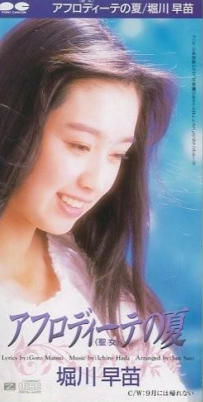
Released in July 1991, “Aphrodite no Natsu” was used
as the ending theme to a tokusatsu show called “Fushigi Shoujo Nile na
Thutmose” (不思議少女ナイルなトトメス). Well, I might have liked this crazy show about a
Japanese girl who was an Ancient Egyptian pharaoh descendant and had to fight
demons using magical powers, or something like that. Unfortunately, and unlike
predecessor show “Bishoujo Kamen Powatorin” (美少女仮面ポワトリン), it was not
aired in Brazil.
Starring as the heroine Thutmose, and singing both
opening and ending themes, aidoruSanae Horikawa (堀川早苗) had the right push to begin her career in the show
business. As was the case with many late 80s/early 90s aidoru singers, she was
cute and a somewhat stable singer, but would not be seen winning singing awards
anywhere in the world. Nevertheless, the Middle Eastern arrangement (sometimes
I think it also have a Latin bounce, but maybe it’s just me) and the catchy
chorus are very fun. In fact, I like it so much that I spent days playing this
thing on repeat in January. It was the height of summer here in Brazil, so it’s
fitting.
“Aphrodite no Natsu” reached #28 on the Oricon charts
and was later included on Horikawa’s album “Dear You”. Lyrics were written by
Goro Matsui (松井五郎), while music was composed by Ichiro Hada (羽田一郎).
As for the arrangement, Jun Sato was (佐藤準) the responsible.
Ahh...it's truly a pity that I lost the single cover for the "Ultraman Ace"(ウルトラマンA)theme so many years ago. It was kakkoii with the tokusatsu hero front and centre performing that famous Ultraman pose with the right fist and arm outstretched toward the viewer while their left counterparts were coiled down, ready to strike themselves.
I wrote the article on the triumphant theme song for "Ultraman Ace" back in 2013 and mentioned that during our very first trip to Japan in 1972, my brother and I enjoyed the show of Ace battling the evil monsters with his array of beams while the defense organization connected with him, TAC (standing for Terrible Monster Attacking Crew), was helping out with its own arsenal.
Of course, it was Ultraman Ace that we came to see weekly but I gotta admit that I hadn't been aware that TAC had so many weapons and ships at its disposal to make the Thunderbirds take notice. I mean, the force had the TAC Falcon, the TAC Arrow and the Golden Hawk among other vehicles. What's not to admire?
TAC also had its own kickass song to match the one for "Ultraman Ace", simply called "TAC no Uta" (The TAC Song). According to J-Wiki, the original version had been recorded by vocal group Honey Knights(ハニー・ナイツ)with The Misuzu Children's Choral Group(みすず児童合唱団)but the video above apparently features a cover version with that same vocal group but instead of Misuzu, it's the Columbia Yurikago Kai(コロムビアゆりかご会)instead.
"TAC no Uta" was written by Kyoichi Azuma(東京一)and composed/arranged by Toru Fuyuki(冬木透), the same duo behind the "Mirror Man"(ミラーマン)theme, and the song parallels the "Ultraman Ace" march in its progression with the opening grim trouble-is-brewing half before the major-chord winning latter half. Strangely enough, I think the "Avengers" theme may share some genes in that respect despite its decades-later creation.
My record with both the "Ultraman Ace" theme and "TAC no Uta" that my mother had bought back in 1972 may have been yet another more subdued cover since I don't really recollect hearing in my 45" Honey Knights' "wan dabadaba wan dabadaba" scatting which peppers the arrangement. Supposedly it was quite the thing for their scatting to populate a number of the tokusatsu themes they performed on, with the "Wan Daba" phenomenon even getting its own article on J-Wiki. I have to say that it does beef up the song quite a lot.
Nothing like a good kaiju movie on Sunday afternoon, and it was around this time almost 50 years ago that from time to time that one of the Buffalo New York television affiliates would throw on a movie starring Godzilla, Mothra or Gamera battling another gigantic threat to Tokyo. I think Gamera the lovable monster turtle, though, usually showed up on the Toronto channel, CITY-TV during the 1970s. The above is actually a scene from "Dai Kaijuu Kuuchuusen Gamera Tai Gyaos"(大怪獣空中戦 ガメラ対ギャオス...Gamera vs. Gyaos)which was first released in Japanese theatres in March 1967. Actually, I kinda recall seeing the Gyaos movie.
The theme for "Gamera Tai Gyaos" was "Gamera no Uta"(Gamera's Song). Now, back in early 2017, I had already written about "Gamera March"(ガメラマーチ), which was the first song associated with Gamera that I'd heard as a kid when one of its movies came out, and that was for the 1968 entry "Gamera vs. Viras".
With this earlier "Gamera no Uta", though, this was less a baseball championship march in comparison with "Gamera March", and more of a samba-based dance at the Club Tropicana as performed by the Hibari Children Chorus(ひばり児童合唱団). I'm not sure whether the big guy was even capable of it, but maybe he could swivel his back legs to this one. Hidemasa Nagata(永田秀雅), the producer of the movies, wrote the words to "Gamera no Uta", as he did for "Gamera March", while Akira Komachi(小町昭)took care of the music.


.JPG)