I've been a fan of Japanese popular music for 40 years, and have managed to collect a lot of material during that time. So I decided I wanted to talk about Showa Era music with like-minded fans. My particular era is the 70s and 80s (thus the "kayo kyoku"). The plus part includes a number of songs and artists from the last 30 years and also the early kayo. So, let's talk about New Music, aidoru, City Pop and enka.
Credits
I would like to give credit where credit is due. Videos are from YouTube and other sources such as NicoNico while Oricon rankings and other information are translated from the Japanese Wikipedia unless noted.
This is probably just my sort of thing, but whenever a City Pop song pops up in my head, I've often developed my form of cross-categorization. One particular angle is whether such a tune sounds like something for the daytime or the nighttime.
When it comes to Hitomi Penny Tohyama's(当山ひとみ)"Darling", which is the second track on her March 1985 album"Five Pennys", it's hard for me to categorize it in that diurnal way. Written by Eiko Kyo(許瑛子)and composed by Takashi Tsushimi(都志見隆), it has that bright and sparkly arrangement which hints at the daytime (especially around brunch) but then the chorus feels like a relaxing evening in the penthouse, especially when the sax gets unleashed. Lovely and breezy background vocals, by the way. In any case, "Darling" is that typical Tohyama tune of soul, sun and stars.
In reading up for this posting, I noticed that Hitomi Penny Tohyama's(当山ひとみ)album"Munasawagi"(胸さわぎ...Premonitions) has two different years that it was released depending on the website: either 1988 or 1992 which is quite the discrepancy. The person taking care of the Japanese-language site "90's City Pop Record Book" has given the theory that the 1988 was the original year for the LP while 1992 was the time when the CD version was put out onto shelves. Heck, I'm good with that.
One reason that I'm going with 1992 as the source year for "Munasawagi" is the second track "Itsu kara kashira"(Since When, I Wonder?) because the song doesn't sound like either the City Pop or the funky R&B that Tohyama was famous for during the 1980s. I've listened to it a few times already and I think that the song is a groovy light pop tune overall with an arrangement that sounds quite familiar for a lot of Japanese female singers back in the early 1990s. Megumi Ayukawa(鮎川めぐみ)was the lyricist here while Yukio Sugi(杉征夫)was the composer. In a way, it's kinda like Penny leaving the nightclub with the sun coming over the horizon and a morning on the way.
Well, it's more like a snowy morning there. It was one of the relatively rare times that heavy snow got plopped onto Ichikawa, Chiba Prefecture back in 2010. I hope that I didn't have to go to work on that day.
But it was a "Velvet Morning" for Hitomi Penny Tohyama(当山ひとみ)when she sang this track from her October 1985 album"Human Voice". I guess I'm following Miho Nakayama's(中山美穂)"Keep Awake" with another romantically satisfying (and remarkably guilt-free) morning-after situation. Shun Taguchi's(田口俊)lyrics tell the tale of a tryst at what seems like a seaside Motel 6 with the lady declaring that she's more than happy with a Coke and a rusty bicycle rather than champagne and a limo when it comes to spending time with her guy. Yoshihiro Yonekura(米倉良宏)came up with the oh-so-calming melody thanks to the keyboards and the guitar plucking away.
I just left a comment for MN, who was lamenting the loss of rock guitarist Makoto Ayukawa(鮎川誠), about how many of the musical greats in both Japan and overseas we've lost over the last year. And now I got word only in the last few minutes that American composer and pianist Burt Bacharach died yesterday at the age of 94.
It was only a few weeks ago that I presented "What the World Needs Now Is Love" by Jackie DeShannon as a ROY article, another Bacharach classic and as a song that has been permanently imprinted in my memories as one of the cherished standards. Not surprisingly, the man has been represented throughout the history of "Kayo Kyoku Plus" since his songs were songs that I used to hear all the time through radio and television, and I can say that any of them can be part of the Great American Songbook. And my image of the man will always be as it has been shown above in the "Austin Powers" cameo: sitting by the piano while decked out in a tuxedo giving an understated and dusky performance of one of his hits. He wasn't a great singer but he made other singers great!
This won't be a Reminiscings of Youth entry but more of my Author's Picks in the form of a tribute to the composer. The following are a few covers of his songs by Japanese singers.
Akiko Kobayashi -- I'll Never Fall In Love Again (2013)
In addition to the love that Japanese singers have had for Bacharach and his songwriting partner, Hal David, Bacharach's music has had some influence on certain aspects of Japanese pop music thanks to his brand of lounge and orchestral pop of the 1960s whether it be a bit of City Pop and quite a lot on Shibuya-kei. Three songs that come immediately to mind as examples are Hi-Fi Set's"Moon Highway", Ruiko Kurahashi's(倉橋ルイ子)"The Best In My Life" and Pizzicato Five's"Baby Portable Rock".
Allow me to finish this tribute by also noting Bacharach's contribution of an AOR song for singer Hitomi "Penny" Tohyama(遠山ひとみ), "Our Lovely Days" from 1983; it stands as his first entry in KKP. My condolences to the composer's family, friends and fans, and many thanks to him for his dazzling array of music.
My most recent Hitomi Penny Tohyama(当山ひとみ)article on "Heartbreak Calendar" was a little less than three weeks ago, and it's usually been my personal policy (and mine alone) to wait a month or so before writing about the same singer or band. However, I found the following.
J-DIGS, the official Nippon Columbia YouTube channel, put this video up about a month ago showing an interview by British radio DJ Nick Luscombe with Tohyama herself at music bar 45 in Shibuya, Tokyo. Of course, being the usual late comer to these things, probably a whole bunch of Penny fans and City Pop enthusiasts in general have already gone through this video a ton of times. Still, it's great to find this English-language interview with a singer from the City Pop genre when even encountering any local news reports on this genre in Japanese are still fairly rare or on the level of "WHY NON-JAPANESE PEOPLE?!". The only other recent interview that I recall that I believe was done in English with a City Pop Japanese artist was Junko Yagami(八神純子)in a newspaper.
Just call me Penny...or else!
Have a listen to Tohyama's vivacious talk on how she got into music and the albums that she recorded. One personal observation is that when I saw the cover for her debut May 1981 release"Just Call Me Penny", I'd assumed from that defiant way she was sitting on the chair and that hooded glare, she was about to have me for dinner if I didn't get her the smoke that she demanded. But according to the interview, she felt like a kitten among the lions.
The song here doesn't come from "Just Call Me Penny" but from her April 1987 album"One Scene". At first, I was wondering about what "7 Course no Prologue"(The 7-Course Prologue) meant; did it have something to do with a major dinner or something? According to Hikaru Kurashiki(倉敷光)and Penny's lyrics, it's about a woman poolside writing a final sad letter to a now-former lover with seven major statements including "What happened to our love?" and "I still love you" but a sudden squall has erased that seventh and final line, and probably the entire letter.
However, those lyrics contrast with Yoshihiro Yonekura's(米倉良宏)melody which is pretty upbeat all things considering, so putting the squall aside, maybe there's some hope beyond the horizon with the lady moving on into the future. And after all, the title has the word "prologue", so this is merely the beginning of a new stage in life. Hopefully, that new stage will include a transistor radio which will give up-to-date weather forecasting.
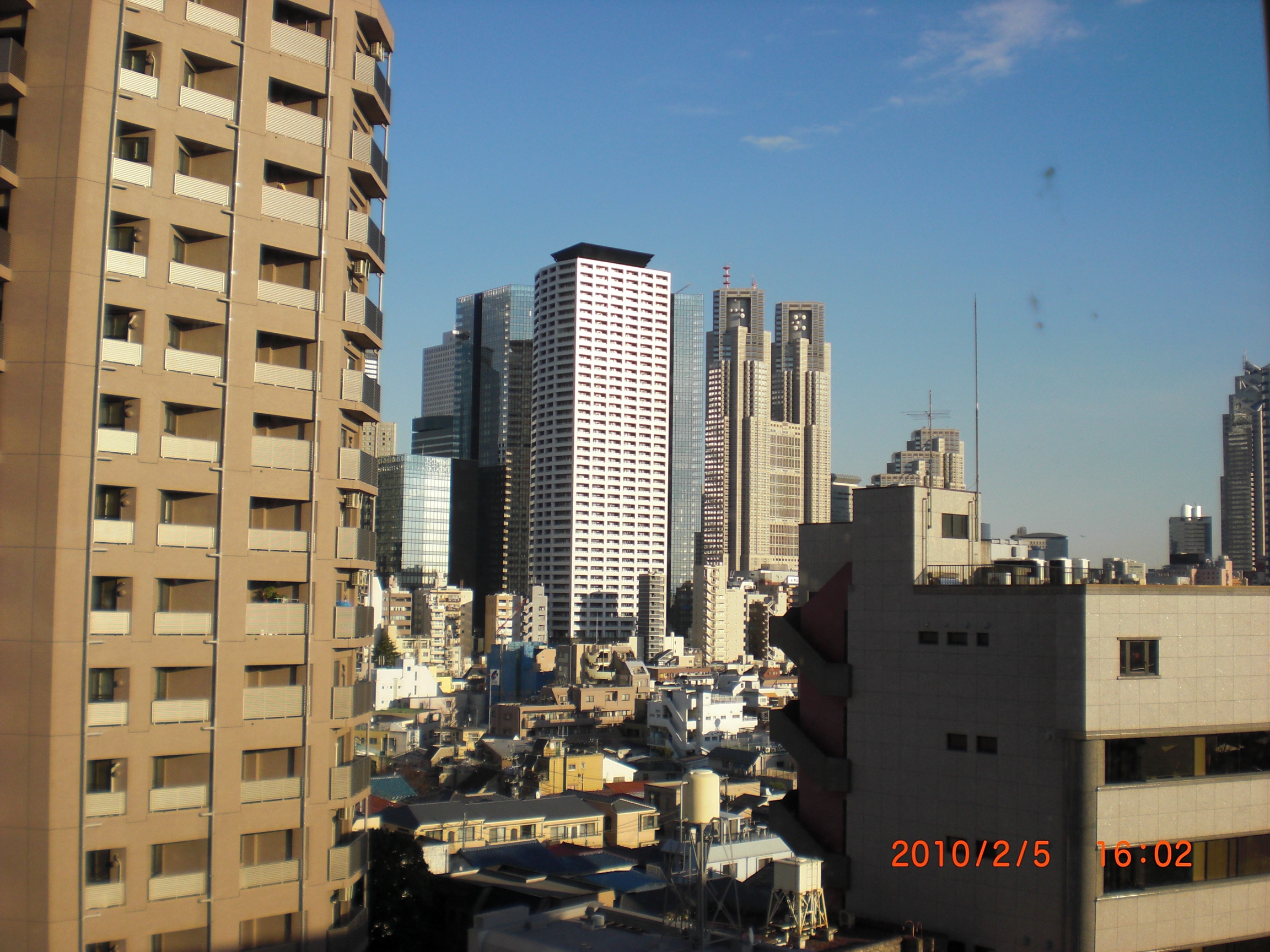
The above is an old photo from over a decade ago. I rather miss the view of West Shinjuku from the final school that I worked at in the late 2000s going into the early 2010s, and it's a thumbnail that I've used from time to time whenever I present a City Pop song on the blog.
And tonight I have for you Hitomi Penny Tohyama's(当山ひとみ)"Heartbreak Calendar" from her March 1988 album"Imagination". Masami Tozawa(戸沢暢美)provided the lyrics while Yuzo Hayashi(林有三)came up with the melody combining some soaring rock guitar and sharp horns within an environment that seems to combine the early 80s funky side of City Pop and the late 80s sophisticated pop plus sunny-side pop. Meanwhile, Penny is the constant with her tender vocals.
"Heartbreak Calendar" is the penultimate track on "Imagination", so I can imagine that the final song is probably a ballad. Therefore, the former is a nice way to finish off the party side of the album.
When I first saw the heading for this particular track from Hitomi Tohyama's(当山ひとみ)February 1983 fourth album, "Next Door", I humourously thought that "Take Off Your Sunglass" was referring to a particularly kakkoii version of that cyclopean Minion. After all, it's supposed to be sunglasses, and not sunglass.
But as it turns out, the original English subtitle for "Sangurasu wo Hazushite" is actually written out on the album as "Take Off Your Sunglass" and Tohyama actually sings it in that way, so who am I to judge? Anyways, it's the music that we're here for, and "Sangurasu wo Hazushite" is one of the mellower mid-tempo tracks tempered by the piano along with a horn section. The melody was provided by saxophonist Mitsuhiro Sonoyama(園山光博), who would later participate in the Far East Club Band which backed up Kazumasa Oda(小田和正)on the high-energy "FAR EAST CLUB BAND SONG" on his BEST album "Oh! Yeah!" several years later.
The lyrics by Chinfa Kan(康珍化)speak on a cool and mysterious man (and not a Minion) who is peering at a woman from afar. However, it's hinted that the woman knows who exactly Mr. Kakkoii is and is more than happy to have him focusing on her since it's possible that she's undergone quite the makeover. In fact, she's daring him to drop the pretension and just take off those darn sunglasses. The setting might sound rather dark-alleyish but the music is quite uptempo. Speaking of "Next Door", I've covered a couple of other tracks from the album: the tropical "High-Heel Dancer" and the Burt Bacharach-penned "Our Lovely Days".
It's been a while since we've had City Pop chanteuse Hitomi Tohyama(当山ひとみ)with us, so it's nice to bring her in to finish up tonight's usual urban contemporary tasting plate.
And interestingly enough, this is one song that's further down her discography timeline since it hails from her November 1989 album"After 5:00 Story". Usually up to this point, I had usually been tackling Penny's songs from the early to the mid 1980s. The track is "Namida no Night Game" (Night Game of Tears) which was written by Mari Kayano*(萱野真理)and composed by Shingo Kobayashi(小林信吾)as this slick and groovy City Pop or soul tune of the late 1980s going into the 1990s. Maybe it's even a J-Quiet Storm number as well. There is also some essence of a sophisticated pop arrangement in there, so of course I'm far from complaining.
*The kanji for the lyricist's family name has several readings according to my usual source, so I'm not sure what the proper one is. If anyone can let me know what the proper reading is, I would be eternally grateful.
This will probably be the first and last time that you'll ever read a City Pop equivalent of a Dad joke, so either savor it or spit it out. Still, it's a sunny Friday in Toronto and even better, it's a lot less oppressively humid than it has been for the past few days, but unfortunately heading into the weekend, the 3H (hot, hazy and humid) weather will be back.
Getting back on track, I've found a sunny and relaxing tune by Hitomi "Penny" Tohyama(当山ひとみ)from her debut album"Just Call Me Penny" released in May 1981 (considering that provocative way she's seated in the chair on the album cover, I may have no choice). "Baby, Baby, Baby" is a track written and composed by Yoshihide Yonekura(米倉良広)that possesses that essence of 70s soul, and I'm almost always going to enjoy anything that has a sweet flute and mellow horns in it. Unlike my City Pop oyaji gag above, I'm hoping that listeners will totally savor "Baby, Baby, Baby". Along with that 70s soul, I can also say that some Boz Scaggs got into the arrangement about halfway through.
I feel as if I've already covered a good chunk of "Just Call Me Penny" already since I have written up a number of articles for the individual tracks. You can also look at "Rainy Driver","Door Goshi no Good Song"(ドア越しのGood Song) and "SFO-OAKLAND".
I gather that with any country's popular music, there will be a fair share of songs that are named after women. Japan is no exception and over the years, I've come across "Irene", rumours about a "Cathy" and even "Sachiko".
Well, I've encountered another "Cathy" but this time it's not Junko Ohashi(大橋純子)relating the tale again, but Hitomi "Penny" Tohyama(当山ひとみ)behind this slightly bittersweet tale set to music. A track from Penny's 1983 album"Sexy Robot", it's a mellow and soulful ballad about someone helping out Cathy over the phone as she is crying over some the trials and tribulations of love as relayed in the lyrics by Chinfa Kan(康珍化). Cathy may be suffering the romantic blues but the fairly happy-go-lucky music by Yoshihiro Yonekura(米倉良広)lets us know that this is probably nothing new for both the lass and the counseling friend on the phone and everything will be as right as rain in no time.
As usual, Tohyama handles the vocals with aplomb. She hits the high notes and provides some nice smoke in her delivery. My compliments on the keyboardist as well.
Over the years of doing the blog, I've made a few observations about the late 1980s in terms of how Japanese popular music was moving on. Aidoru songs were either getting lusher arrangements or more dance beats while in the City Pop world, there were hints of sophisti-pop getting into those songs. One other thing that I've noted is how some female singers were looking abroad to non-Japanese composers to create some magic for them. There was indeed some different feelings with Seiko Matsuda's(松田聖子)"Marrakech" and Reimy's(麗美)"Shadow Play", for example.
Another example is Hitomi Tohyama's(当山ひとみ)"Imagination" which was not only a March 1988 single but the title track and the first track for her album which came out in the same month. According to the JASRAC database, Nat Kipner and Paul Wayne were responsible for the songwriting, although Chinfa Kan(康珍化)came up with the Japanese lyrics for "Imagination". The undulating keyboards and guitars remind of that certain West Coast AOR or the type of songs that would get played in a scene in many an 80s action flick.
Speaking of songwriters, I was wondering about Nat Kipner since that family name was also seen in the credits for Matsuda's "Marrakech", but for that one, the writer was Steve Kipner. Well, it turns out Nat was Steve's father.
Although I hung up my own dancing shoes decades ago in the name of good taste and sanity, I think that there are likely many folks out there right now who wished that they could get onto the dance floor with everyone else and boogey the night away. That's not possible at the moment but hopefully somewhere down the line in 2021, that could all come back.
Meanwhile we City Pop fans can live a tad vicariously and enjoy the sounds of songbird Hitomi Tohyama(当山ひとみ) through her "High-Heel Dancer" from her 1983 album"Next Door". On the same album as "Lovely Days", my first encounter with Penny, this is one happy-dance-in-a-Caribbean-nightclub sorta tune thanks to the melody by Yoshihiro Yonekura(米倉良広).
Prolific lyricist Chinfa Kan(康珍化)was responsible for this story daring anyone to keep up with this eternally pirouetting beauty in her stilettoes as she holds up night after night. I certainly don't think Tohyama or the songwriter ever meant it to be so, but the lyrics almost sound like the ideal storyboard for a Dr. Scholls' insole commercial. That's not to take anything away from the song which is light and fun possibly like the dancer herself, and I do like the keyboard work.
Well, hello to Friday so we've got another City Pop day lined up. Last weekend, I decided to do pull another Van Paugam with the help of J Utah on YouTube, and to explain, a couple of weeks ago, I discovered this YouTube channel called J Utah which specializes in videos displaying long drives through the big cities of the world. In so doing, I realized that I could play one of my "Light Mellow" City Pop/J-AOR CDs and enjoy that Van Paugam City Pop radio experience once more. I actually did that with the "Avenue" disc of "Light Mellow" which had Masataka Matsutoya's(松任谷正隆)"Kizuita Toki wa Osoi Mono"(気づいた時は遅いもの)while watching the Tokyo Skyline video. Pure bliss!
This time around, though, it wasn't with a "Light Mellow" album but I used Rocket Brown's most recent Come Along Radio podcast, his Los Angeles mixtape of City Pop/AOR tunes surrounding his hometown. I listened to that while viewing one of J Utah's Los Angeles drives, downtown specifically. Again, it was a very nice experience indeed.
One of the first songs on the mixtape really clicked with me as the video approached the Staples Center, I believe, and that happened to be "Another Day, Another Love" by Hitomi "Penny" Tohyama(当山ひとみ). I also realized that this was a cover of Junko Ohashi's(大橋純子)original rendition back in 1981 which I had already written about back in February 2019.
Listening to the two of them one after another initially, I couldn't really tell the difference, and that's not a pox on either house at all. But giving it another go today, perhaps I can say whereas Ohashi's"Another Day, Another Love" has that 1970s New York City sunny soul flavour, Tohyama's cover has got more of that slightly mellower West Coast feeling. In addition, being somewhat of the doofus that I am, I only realized today that Ohashi sang it in Japanese while Tohyama did her rendition in English. I am not sure who provided the English lyrics but it could have been Penny herself or the original lyricist Yoshiko Miura(三浦徳子). Of course, the composer is still Yoshihiro Yonekura(米倉良広).
"Another Day, Another Love" started off her 1982 album"Heart Full of L.A. Mind", so I can understand why Rocket Brown opted for this one for his Los Angeles-themed mix, and yeah, it certainly fits with a nice drive in downtown L.A. Her cover also reminds me of the first song that I had ever heard by Penny, "Our Lovely Days" that she would release the following year.
It's still early in the week for one of these, and I say it this way since I think for such a song, I would probably have put it somewhere on a Wednesday/Friday night because it's one of those tunes that is so made for urban contemporary soothing duties after a hard day or week at work. However, there is also such a thing as a lousy Monday, so for those folks, here you are.
From Hitomi Tohyama's(当山ひとみ)7th studio album"Human Voice" from October 1981, here is "Cheek Dance", a tune that has been described on Hip Tank Records as "....a gorgeous skyscraper midnight ballad". Yep, it's a mellow City Pop romance but I think I can place this one any time between sunset to sunrise; the setting itself is fine...enjoying a glass of Chablis with the one you love while sitting atop one of the highest buildings in the city is supremely splendid, but I would give "Cheek Dance" much more time than just a sliver of midnight.
It has that wonderful slow groove and the lovely solo horn while Tohyama and her backing chorus bring me memories of some fine 70s soul. Too bad that it wasn't included on my BEST collection for the singer but that gives me the impetus to see if I can get my own copy of "Human Voice". Equally too bad is that I couldn't find out who was responsible for words and music. Even the JASRAC database couldn't assist this time. Maybe the wonders of Daemonskald can come to the rescue again. 😁
The 80s to 90s shift was too big for most of the
bubble era superstars. Shizuka Kudo (工藤静香) probably didn’t feel it right away, but, by 1991~1992,
she had to try harder to release a timeless classic that could rival with her
string of successful singles from the late 80s. She did hit it big in 1993 with
“Doukoku” (慟哭), but the following one, “Watashi wa Knife”, just
skipped the mark entirely, turning, in retrospect, into one of her most obscure
and underrated singles (the song wasn’t included in any of her original albums,
only appearing in a couple of compilations over the years, and, besides the
usual TV performances, was performed only in one of her major tours).
Curious as it is, “Watashi wa Knife” is my favorite
among Kudo’s 90s singles, even though I agree it’s far from being her best.
However, there’s something about the lively synths and horns that always get
me, and I like how she had already matured into a sexy 90s aidoru both in the
vocals and image at the time of its release.
Alessandra
Mussolini -- Tokyo Fantasy / Amai Kioku
Yeah, we’re talking about Benito Mussolini’s granddaughter
here, Alessandra Mussolini, who is now a politician in her country, Italy. However,
during the 80s, she ventured into modeling, acting and, of course, music. Also,
if it wasn’t enough, the whole story becomes even more unusual when we learn
that her first and final album, “Amore” (1982), was sold only in Japan, and
that she sang a couple of songs in Japanese as well, with “Tokyo Fantasy”, probably
the main single, being the best example of it.
A melancholic disco song that can even be labeled City
Pop by the most enthusiasts, “Tokyo Fantasy” is, surprisingly, a very
solid song. The whole atmosphere, drenched in this strange mix of dreamy
romantic naivety with bits of sadness (the sharp keyboard notes after the
chorus), coupled with the sexy early 80s disco beat, is something hard to
absorb, but it’s kinda rewarding. And the coupling song, a melancholic tune
called “Amai Kioku”, deserves a listen as well.
Recently, Alessandra suddenly became known to the
English-speaking world, but not because of her almost forgotten music career.
Apparently, Jim Carrey posted something regarding her grandfather on Twitter
and she became angry about it, resulting in a quick discussion or something
like that. As a Brazilian, well…, let’s say I already have my own right-wing problems
here in my country right now, so I will not try to understand how Alessandra keeps her grandfather’s
political history alive in today’s Italy. The only thing I can say is that I quite
like the Alessandra Mussolini who sings sad love songs in Japanese atop of a
light disco beat. She seems like the queen of this alternative universe where it’s
totally okay to have the granddaughter of a famous fascist dictator trying to
be a songstress in Japan. Not strange at all.
Chisato Moritaka -- SO BLUE
When it comes to Chisato Moritaka (森高千里), I
like her 80s and very early 90s songs way more than the mid-to-late 90s stuff. The exception to
this rule is “SO BLUE”, which was released as a single in 1996, and reveals one of Chisato's main influences aside from the Euro/Aidoru stuff: 60s pop-rock and, more specifically, The Beatles.
In “SO BLUE”, we can easily hear some nods to “Hey
Bulldog”, one of the songs released by The Fab Four in the “Yellow Submarine”
soundtrack back in 1969, and considered a throwaway by John Lennon.
I’m no Beatles fan (but my father is a huge one, by
the way), but if I had to choose one of their songs, “Hey Bulldog” would be the
one, just because of how funky and cool it sounds. Now, in the case of “SO BLUE”,
I like how Chisato creatively uses parts of a song from one of her favorite bands and
turns it into something else. The addition of strings is also a big plus, and
combined with the constant piano, it helps creating the whole classic European
feel, yet with a rock-y twist.
Misaki
Iwasa -- Koi no Owari Sangenjaya (恋の終わり三軒茶屋)
About
a month or two, when I was watching an episode of NHK Nodo Jiman (NHKのど自慢) on TV, ex-AKB48-member-turned-into-Enka-singer
Misaki Iwasa (岩佐美咲) was the female guest on the
show. At the end, as usual
for the guest singers, she sang one of her own songs, which happened to be the
latest single “Koi no Owari Sangenjaya”.
Released back in early 2019, “Koi no Owari Sangenjaya” is
not that heavy and more traditional Enka song we are all familiar with, being
rather a Showa-Era ballad with a gorgeous arrangement and a slightly Latin feel
in the background. The melody is quite romantic and I like Iwasa’s vocals since
I first listened to her rendition of the classic “Ringo no Uta” (リンゴの唄) a
couple of years ago, so this song is a big winner in my book.
Hitomi Tohyama -- Goodbye~Sharp ni Daite (グッバイ~シャープに抱いて)
I wanted to finish this kinda eclectic collection of
songs with something mellower, and, from what I’ve selected before writing the
post, Hitomi Tohyama’s (当山ひとみ) “Goodbye~Sharp ni Daite” seemed like the obvious
choice here.
My first time listening to Penny was five years ago, thanks
to J-Canuck here, and, since then, some of her songs have become an
integral part of my oldies playlists, with my favorite being “Instant Polaroid”,
taken from the first album “Just Call Me Penny”. Another personal highlight, and
the one being introduced here, is called “Goodbye~Sharp ni Daite”, which was
released in 1983 as a part of the “Next Door” album.
A typical mid-tempo and groovy City Pop ballad with
some nice jazzy bits, what I like the most here is the chorus and how she
intonates the word goodbye in many different ways. I don’t really know what she
wants when she sings ‘sharp ni daite’, but it seems like she wants to be hugged
in a passionate way before parting away with her lover. I don’t know, since I
didn’t take my time to carefully translate the song, but that’s how I like to
feel it anyway. Other than that, the song is beautifully arranged, and Penny’s soulful
rendition makes it even more special. A great night listen, in my opinion.
Just a PS on my (J-Canuck) comment on Alessandra Musolini's"Amai Kioku"...I actually did find a Vaporwave version.
About a couple of months ago when we were on that cruise in the Western Caribbean, I didn't find much different with the layout of the Harmony of the Seas (which is currently the largest cruise ship on the planet until the Symphony of the Seas gets its launch early next year) when compared to the Oasis of the Seas that we had shipped on a few years ago. Deck 5, which I guess would be called the Promenade Deck, had most of the shops that we remembered on the Oasis in the same positions on the Harmony. But there were two differences.
One was that the cupcake shop was no longer there (darn!). The other was that there was The Bionic Bar. Two robots, Bio and Nic, and a rotation of handlers took care of their share of the cocktails in one corner of Deck 5. It was one of the few instances that I had ever witnessed where the bartenders garnered more attention than the drinks themselves. And on the fourth day of the cruise, I finally relented, went into the bar and made my order via a Samsung tablet for a simple Rum and Coke.
Not quite sure who took care of my order, Bio or Nic. But one of them dutifully pressed out the requisite cola and double shot of rum, and poured the mixture into my plastic glass. I have to say that it was a good Rum and Coke....probably too good, though. I was fairly floating for the rest of the evening. And if I had stayed at the Bionic Bar, I probably would have found the (TORTURED SEGUE ALERT) robots sexier than the comely young handler/systems operator who handed me the tablet.
OK, first off...I have no idea how Japanese R&B singer, Hitomi "Penny" Tohyama(当山ひとみ)nor the creators of this song, lyricist Chinfa Kan(康珍化)and composer Yoshihiro Yonekura(米倉良弘), came up with the idea for this song "Sexy Robot", the title track from her 1983 5th album. Perhaps they had some potent Rum and Cokes, too...or they were inspired by some of the robotic forms of breakdancing that were hot at the time in America and elsewhere.
In any case, it's an intriguing funky tune about someone who has apparently fallen for the Cybermen or the Replicants from "Blade Runner". And I can't doubt Tohyama's vocals which go all in for the song. Another notable observation is that she sounds quite a bit like another City Pop singer, Miki Matsubara(松原みき), with this particular song.
I'm sure with the pop cultural references of robots in Japan, there are most likely a lot of Japanese music fans who will listen to "Sexy Robot" and see the title, and figure that it's a most appropriate tune. For my part, I would just like to ask Tohyama and Kan about how the title and lyrics came about. There are many more R&B tunes from both sides of the Pacific that I would place higher than this one, but it's a pleasant enough ditty that does its part to add to the goofy and mystical side of Japanese pop.
My question is whether Bio or Nic was
able to pick up and drop the lemon wedge
into my Rum and Coke.
Back in 1990, midway through my 2 years in Gunma Prefecture, some of the staff at the town hall decided to take a trip through North America and for some reason, they wanted me along although there was a perfectly fine and professional bilingual guide who stayed with us throughout. All expenses paid and it was basically an order from the boss, so how could I complain? Plus, one of the highlights was visiting the city of San Francisco, a metropolis that I had always wondered about, mostly because it was the site of Starfleet Headquarters from the "Star Trek" franchise (yeah, I really needed to get a life back then), but also because of the wonderful sight of the Golden Gate Bridge.
The problem with a corporate Japanese trip is that folks seem to want to cram in a ton of cities within a period of a week. By the time we hit Vancouver just before San Francisco, all of us were exhausted. We couldn't even enjoy what would have been a hearty meal in a French restaurant because we were just kept moving all the time. However, at least our stop in San Francisco down the Pacific Coast was slight more yukkuri, thankfully. Mind you, we only had that total of one full day and one full night in the City by the Bay before we had to drive out to Sacramento in the centre of California. Still, I was happy to walk around Fisherman's Wharf, climb up Lombard Street, see those famous streetcars and even catch sight of the Transamerica Building. What we ironically couldn't view was the Golden Gate Bridge due to a massive amount of fog which rolled in, but that was made up by one of the finest Chinese food dinners that I ever had inside or outside of my hometown of Toronto, and my hometown has never been any slouch when it comes to good Chinese fare.
All that prelude to introduce another Hitomi "Penny" Tohyama(当山ひとみ)song. This is my fourth article on the singer, and as with two of them, "Door Goshi no Good Song"(ドア越しのGood Song) and "Rainy Driver", "SFO-OAKLAND" is from Penny's first album, "Just Call Me Penny" from 1981. To be honest, from listening to her BEST compilation, I've so far found her material to be hit-or-miss sometimes, and "SFO-OAKLAND" is somewhere in the middle. It's not quite a barnburner but it's happy enough to have me reminisce about those few days on the West Coast, and like a lot of City Pop songs, I think it did have some listeners in Japan thinking about that exotic life on the other side of the Pacific thanks to the sunny sounds and arrangements. Penny herself wrote the lyrics while Kiyoshi Hiyama(比山清)provided the melody.
In any case, the sunny "SFO-OAKLAND" was also the B-side to Penny's debut single of "Door Goshi no Good Song".
I've always loved that cover of Hitomi "Penny" Tohyama's(当山ひとみ)1981 debut album"Just Call Me Penny". The way the lady is sitting in that armchair makes me wonder if the title was meant to be more of a command rather than a kindly request. She's got that sexy if no-nonsense look about her.
In any case, I've chosen another track from that album, "Door Goshi no Good Song" (A Good Song Behind The Door) which actually launches "Just Call Me Penny". From the songs that I have heard by her on that 2-disc BEST album that I got online, I've known Penny mostly for her Japanese funk during the 80s. But with her first album, I think she was feeling her way around the genres.
The other song from that album that I've already profiled, "Rainy Driver", is a nighttime City Pop tune, but "Door Goshi no Good Song" has got that 60s American girl pop feel to it (complete with introductory voiceover in darn good English), so I start thinking Mariya Takeuchi(竹内まりや)from around the same time. However, the singer's delivery here has me imagining Ayumi Nakamura (中村あゆみ)with more silk and less husk. It's a light and pleasant song...I would say that it is the musical version of an aperitif that any record marketer wouldn't have pushed as a debut single but it makes for a nice way to profile her pure vocals.
"Door Goshi no Good Song", which also has the alternate title of "So Many Times", was written by H. Kurashiki and composed by Yoshihiro Yonekura(米倉良広). Although I have that BEST album, I'm sorely tempted to get "Just Call Me Penny" just on that album cover alone.
NHK News is reporting the annual temporary mass migration that signifies another Bon holiday season. So, there a lot of scenes of bumper-to-bumper traffic on the various highways. Here in Toronto, we also have the similar situation on a daily basis involving the country's largest parking lot known as the Don Valley Parkway. It gives me further vindication to my choice on not learning how to drive.
Not the smoothest segue into today's tune, but I'm still happy to introduce my 2nd Hitomi 'Penny' Tohyama song(当山ひとみ). The first one was the breezy, Bacharach-penned "Our Lovely Days" from 1983 that I wrote about all the way back in 2012. Today, I listened to CD 1 of the double-disc BEST album for Penny, "W Deluxe" that I got from Tacto some years ago, and came across this number, "Rainy Driver" which had originally been on the Okinawan singer's very first album, "Just Call Me Penny" from May 1981.
Unlike the AOR sunny "Our Lovely Days", "Rainy Driver", which was probably written and composed by Yoshihiro Yonekura (米倉良広...whoever was responsible for the production of the liner notes for "W Deluxe" just threw in the arrangers, composers and lyricists in romaji as if they were corporate cogs on a floor plan), is very much in the nighttime mode of pressing down on the accelerator on the highway as the city lights flash past. Kaz-shin on his Japanese music blog, "Music Avenue" wrote that although he didn't think the song was bad, he said that it was a bit of a waste to bring in a certain kayo kyoku air into "Rainy Driver". He later wrote as a summary for the whole of "Just Call Me Penny" that the music overall sounded somewhat dated, although he conceded that there were many people who enjoyed that sound. Yup, I would put myself into that category...as you readers have all figured out by now. City Pop is indeed my beat.
Listening to the rest of the songs on CD 1 of "W Deluxe", Tohyama did her share of 80s-style power ballads, and explored American funk and soul along similar lines as Irene Cara and Melissa Manchester from that time. And to respond to Kaz-shin's point about some of the dated nature from her first album, I thought that some of the later songs on "W Deluxe" such as "Let's Talk In Bed" went a tad overboard and entered pastiche territory. But as for "Rainy Driver", I'm fine with listening to that on any car stereo...on the passenger side, of course.
Hitomi "Penny" Tohyama (当山ひとみ)was another singer that I had only discovered on leafing through "Japanese City Pop", and that was for just one entry, her debut album "Just Call Me Penny" in 1981. I did a bit of cruising on YouTube and found that there were a number of videos of her songs aboard and tried this one called "Our Lovely Days".
Lovely breezy adult contemporary ballad...and then I checked who had composed it. It was none other than Burt Bacharach, the composer of 60s classics such as "The Look of Love" with Dusty Springfield which was probably the only good thing about the very first version of "Casino Royale" with Peter Sellers, and "I Say A Little Prayer" with Dionne Warwick. I've scoured the Net but I've yet to find out how Bacharach made his little contribution to Japanese popular music, but if and when I do, you'll be the first to know.
Based on hearing this song, I went out to that little old shop in Tokyo, Tacto, which sells old and rare kayo kyoku discs, and tried to find the album that this song was on, "Next Door" released in 1983. I did find a number of her other CDs but not that one, so I went for the next best thing which was getting her 2-CD Best album for about 5,000 yen. I've only given it just one listen so far but the overall impression is that her sound is reminiscent of American synth-&-R&B of the mid-late 1980s...kinda like Anri(杏里)of the same period, so the Bacharach-penned tune is perhaps a bit different. But basically speaking, Penny was quite a ways apart from the usual kayo kyoku that was being released at that time.


.jpg)