I've been a fan of Japanese popular music for 40 years, and have managed to collect a lot of material during that time. So I decided I wanted to talk about Showa Era music with like-minded fans. My particular era is the 70s and 80s (thus the "kayo kyoku"). The plus part includes a number of songs and artists from the last 30 years and also the early kayo. So, let's talk about New Music, aidoru, City Pop and enka.
Credits
I would like to give credit where credit is due. Videos are from YouTube and other sources such as NicoNico while Oricon rankings and other information are translated from the Japanese Wikipedia unless noted.
There have been a few times in the past when a bunch of us have gone out to dinner. Certain couples were with us and one time, at one restaurant where some hit music was playing over the speakers, the male half of the happy duo stated that the next song to play will be their song. Well, much to everyone's hilarity, it turned out to be Depeche Mode's "Master and Servant". I'm sure that their relationship took a turn there, and once again, the safety word was indeed APPLES.
I never experienced that situation ever again and probably never will (things on that level of funny are truly one-of-a-kind events). Still, I think this week's entry on Reminiscings of Youth could be another song that no couple would want as their go-to song, but man, it's still fun.
Several years ago, I posted Devo's "Jocko Homo" which was the first song by the band to get up onto the blog but actually, the first ever song that I'd ever heard by The New Wave Boys of Akron, Ohio was "Whip It" that was their August 1980 single. And as I explained on "Jocko Homo", I first came across the catchy and absolutely weird and kinky "Whip It" through a K-Tel compilation record commercial which showed a part of that (in)famous music video including a bunch of dude ranch tourists, a motherly type whipping up some cream, a couple of other ladies in various stages of undress (well, one only lost her shoes), and the band itself festooned in red flower pots and sleeveless turtlenecks. Man, those were wild and woolly days in music video production!
Not only was it the first time I got to know a little about sadomasochism (so, whips can be fun😈) but I also got informed on what New Wave was all about. The strange lyrics which could be taken as motivational encouragement against any and all challenges or a first-round exercise in S&M paired with the herky-jerky delivery of the vocals and those synths definitely made "Whip It" one of the most famous songs of the 1980s. In a way, the Devo song seared the image of New Wave bands as stoic and robotic performers at their keyboards.
"Whip It" just missed the Top 10 by that much on either side of the world's longest unmilitarized border with it coming in at No. 11 on Canada's RPM and No. 14 on America's Billboard. Of course, a lot of folks liked to do their covers of "Whip It", including the late great Catherine O'Hara as Brooke Shields (2:10 of the video below)..
Remember...when in doubt: WHIP IT GOOD!😁
Now, what was hitting the record store shelves of Japan when "Whip It" came out in August 1980? We have a few here.
To any and all American readers of "Kayo Kyoku Plus", Happy Fourth of July and also a Happy Sestercentennial (250th birthday). I recall that three years ago, I also provided a special list of America-related songs on July the 4th and mentioned that we would have to do something about 2026. Well, the day is here.
And so, this is my "America" Tunes 2. Unlike the first one which mostly dealt with songs that had "America" in their titles, I'm being a bit more geographically precise so I'll be listing those numbers referring specifically to states and cities. Without further ado then:
I can't quite remember how records and tapes by the big artists were being distributed back in my teenage years, and the reason I'm starting out this way is that the first time that I'd heard Blondie's "Rapture" was actually through one of those K-Tel compilation records in which there was one quick cut of the music video where Debbie Harry was holding her head while she purred the title. Now, I would think by that point, the song had long been released as a single and as part of an album, and so I was wondering why I hadn't heard of this one before. Blondie was already big in the world so I should have heard this one already on the radio or television.
Well, in any case, I eventually did hear the totality of the song and caught the video after it had been released in January 1981. "Rapture" was basically the first time that I ever heard rap in any form. Harry was talking in some rhythmic pattern about eating Cadillacs and entire bars which struck me as being some sort of weird New Wave-y thing. I think the only time that I heard anything similar to that was when I was watching a segment on "Sesame Street" featuring a cartoon bear pattering the first five numbers to a beatnik jazz beat.
In any case, Harry apparently had two parts to the song: the first part had her singing in those fluffy light vocals which reminded me of "Heart of Glass" and then the rap part in the latter half had her utilizing those richer and lower tones from "The Tide is High". Looking back at the song after so many years, "Rapture" certainly doesn't strike me as the usual rap tune with the tubular bells and the disco rhythms in there. Plus, I'm sure when the video was first shown, maybe there had been a disclaimer stating that one shouldn't be under the influence while watching it. Aside from Harry, the one other character that I still remember is the so-called "Man from Mars" in his white suit and top hat.
"Rapture" hit No. 1 in the United States while it reached No. 3 in Canada. I also recently found out through the YouTube comments for the song that it had become part of the lore in "The Boys" with Soldier Boy doing a cover on "Solid Gold". Personally, I wouldn't mind seeing Captain America trying it out himself.
Anyways, right on the day that "Rapture" was released, these three songs were at the top of the Oricon chart.
Welcome to the regularly scheduled Reminiscings of Youth article for this week. The Swedish group ABBA has immortalized itself in Japan with their "Dancing Queen", a song that has become so ubiquitous in the karaoke boxes that it's practically an obligation to sing it on every visit.
Strangely enough, I never mentioned this in the "Dancing Queen" article, but ABBA was quite the common quartet on Canadian and American television when I was a kid because of the popularity of their disco hits in the 1970s. It would be a rare day when I either didn't see a compilation album on TV hawking an ABBA song or hear one of their tunes on the radio. Disco wasn't disco without them.
Therefore, it's a tad ironic that for the second ever ABBA song on KKP, I've chosen "Super Trouper", their November 1980 single. For one thing, I think it's probably the least disco of all of the songs I've heard by them and yet, next to "Dancing Queen", it's the one ABBA song that I remember the most. It's also catchy as heck in a children's song-like way especially when the chorus hits.
OK, we've established that "Super Trouper" is one of my cherished ABBA tunes but there is the matter of the title. For the longest time, I naturally assumed that it was talking about a really determined and heroic boy scout type but I only found out in the last few days that it was referring to a kind of massive spotlight and from the lyrics by Benny Andersson and Björn Ulvaeus, despite that super trouper and all of the other spotlights blinding a superstar on stage, she knows that her darling is out there somewhere looking out for her. Awww...💓
I actually looked forward to hearing "Super Trouper" when I was in the car or listening to the radio. But I found out that it didn't do all that amazingly well in Canada or the United States with the former's RPM showing a No. 32 ranking while in America, it only went as high as No. 45. However, it did hit No. 1 in several European nations although ABBA's native Sweden wasn't one of them; it peaked at No. 11 there.
So, what was up in the Top 3 of Oricon in November 1980?
As was the case with Hidemi Ishikawa(石川秀美) in my previous article, it's also been over a year since I posted anything regarding chanteuse and songwriter Mayumi Itsuwa(五輪真弓), and that was a surprising one because it dealt with her creation "Omoide Sagashi"(思い出さがし)which was originally performed by Yujiro Ishihara(石原裕次郎)as an ending theme for his famous cop show "Seibu Keisatsu"(西部警察...West Police Division) in 1983. Not that I would ever accuse Itsuwa of being incapable of handling other genres other than the genteel Fashion Music and folky pop that I've known her for, but it was still revealing that she could provide a Mood Kayo for the Tough Guy. And she herself gave a cover version of "Omoide Sagashi" many years later.
Well, a few years earlier, Itsuwa had released her famous "Koibito yo"(恋人よ)in August 1980 as her 18th single. Basically, I see "Koibito yo" as the singer's trademark tune and for me, it's one of the examples of Fashion Music, that Japanese genre similar to what I've heard in Baroque Rock or Baroque Pop in the West. Therefore, it was once again with some surprise that I discovered that the B-side to this heartrending ballad was "Joker".
Nope, it doesn't have anything to do with "Batman" but once again, there is that genre flip that I didn't expect from Itsuwa. It's undeniably the singer's baby since she wrote and composed the song with Motoki Funayama's(船山基紀)arrangement, but this time, "Joker" has got that spritely City Pop beat down pat. It really feels like a commute on the Tokyo streets going into the 1980s. Lyrically though, "Joker" is about shock and betrayal as a lady suddenly gets told by her boyfriend that the relationship is over. As she sings it, the lady gets pulled with an Ace of Spades while the heel flips out a Joker card. The affair folds.🃏 Still, it's got a nice musical accompaniment and it does contrast with the very elegiac "Koibito yo".
Good ol' "Seibu Keisatsu"(西部警察...West Police Division) on TV Asahi. It was always fun to see fantasy and police work come in hand-in-hand with massive urban explosions, repeated gunplay and enough car collisions to send insurance companies into orgasm. Plus, it had the larger-than-life Tough Guy himself, Yujiro Ishihara(石原裕次郎), as the Chief of Detectives. My good friend, JTM, knows more about the old Japanese police dramas than I do so it was only in the last few hours that I discovered that there were three officially delineated series of "Seibu Keisatsu" with the first original series lasting between October 1979 and April 1982. Then came "Seibu Keisatsu Part II" which went from May 1982 to March 1983 and finally "Seibu Keisatsu Part III" from April 1983 to October 1984.
Along with the weekly pyrotechnics, there was another trope with the iconic cop show in that Ishihara would often provide the ending theme and at least one or two of them have shown up on the blog up to now. Well, here is a third one and this one is a little special. "Omoide Sagashi"(Searching for the Memories) was used only for Episode 31 on "Seibu Keisatsu Part III" in December 1983.
I don't know what the episode was about and according to the ratings for No. 31 on J-Wiki, it wasn't one of the more highly-rated shows but considering the one-off ending theme regarding the melancholy crooning over a reunion of former lovers, I do wonder if the plot involved Ishihara's Chief Kogure suddenly re-engaging with an old flame. In any case, I can imagine Tetsuya Watari's(渡哲也)loyal field leader and the No. 2 guy, Inspector Daimon, meeting up with his boss and friend at a bar at the end of the episode and telling him "There are always other fish in the sea".
Me waxing hypothetically aside, the other surprise was that "Omoide Sagashi" was actually written and composed by singer-songwriter Mayumi Itsuwa(五輪真弓). Itsuwa had once been called the Japanese equivalent of Carole King before she went into a more Fashion Music direction in the late 1970s. So, it was revealing that she did create this brooding Mood Kayo which was a perfect fit for Ishihara.
The amazing thing is that Itsuwa recorded a self-cover of "Omoide Sagashi" in her own refined style and although I had assumed it was originally done at around the same time as the one she offered to Ishihara, her version was actually performed for an August 2017 compilation, "Golden Best ~ Itsuwa Mayumi Special Collection"(GOLDEN☆BEST五輪真弓-スペシャルセレクション-). I know that it was a mere six years ago but I can only describe the arrangement here as Fashion Music with that rich piano and strings. Nice inclusion of the trumpet as well.
Listening to a Mayumi Itsuwa(五輪真弓)song, especially going into the 1980s, is like watching any heavily dramatic European movie. It's beautiful but also very lonely at the same time. Although it's just my ears that collect all of the information through tones and vocals, I still imagine a big "FIN" in my head at the end of the tune.
That's no different with "Tokei" (The Watch), the 25th single by Itsuwa released in October 1983. Written and composed by the singer, even on seeing that simple title, I knew that there was going to be a lot more going on than just imagining a Rolex or a Timex. And sure enough, the watch in question (no brand name identified) is on the wrist of a man who's sitting with who I assume is a female friend in their favourite café. She's staring at the watch, counting away the seconds before he ultimately leaves the place and presumably her forever for a significant other. The problem is that she had feelings for him that she could never express and now it's too late. Melancholy and ennui ensure. FIN.
It may not be the happiest song but the music by Itsuwa is tenderheartedly poignant. I simply cannot imagine myself in Japan with this one; instead it's some small neighbourhood coffeehouse on the outskirts of Paris or another French city. And the weather is gloomy outside. FIN.
Lest that I would dare think that the summer has finally arrived, I went outside in my thin T-shirt an hour ago to get the paper and got a blast of 10-degree Celsius air with a stiff wind. It was brisk to say the least and was almost grateful that it felt so stuffy and warm inside my room. I could also say that winter, let alone spring, has yet to release us from its icy grip.
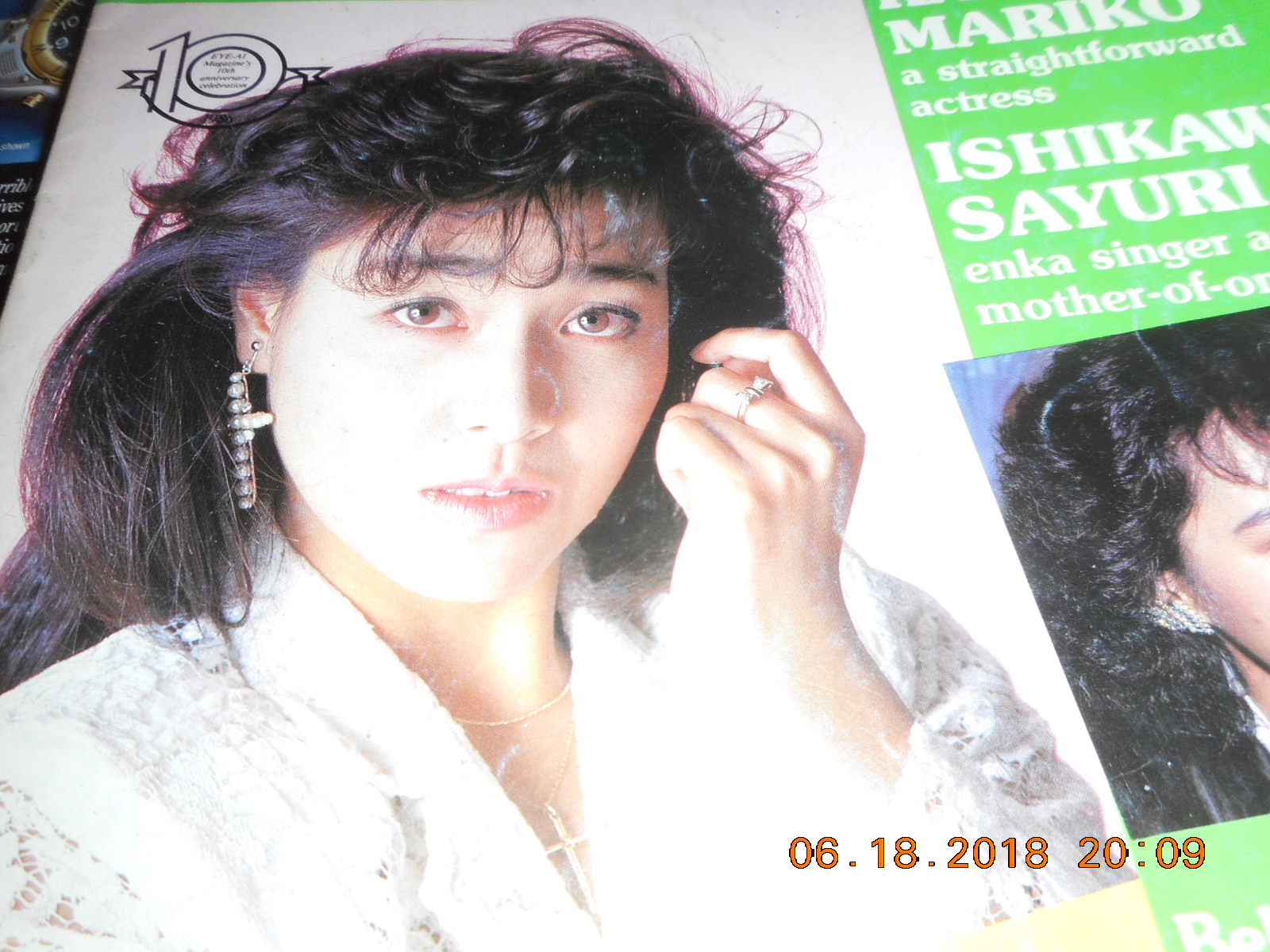
Anyways, that picture of 80s aidoru Yoshie Kashiwabara(柏原芳恵)is from the cover of the very first issue of Hawaii-based Japanese pop culture magazine "Eye-Ai" that I ever bought at Nippon Video back in the 1980s. That really was a big-hair era for her, wasn't it?
Listening to her 24th single from New Year's Day 1986, "Haru Gokoro"(Spring Heart), reminded me of her other spring-based hit, "Haru Nanoni" (春なのに), from a few years earlier. The melody is truly elegant (bordering on Fashion Music) with the strings and piano, and the lyrics are bittersweet and heart aching as they describe a relationship that may be about to hit the rocks for good. Of course, I immediately thought of singer-songwriter Miyuki Nakajima(中島みゆき)who had also come up with "Haru Nanoni".
However, digging into the J-Wiki article for "Haru Gokoro", I kinda smacked myself on the head when I saw Mayumi Itsuwa's(五輪真弓)name behind words and music with Mitsuo Hagita(萩田光雄)as the arranger. Itsuwa is definitely of the Fashion Music sub-genre with all of its elegance, class and pathos, and listening to the song again, I could definitely envisage either Kashiwabara or Itsuwa in a Parisian café sighing wistfully.
"Haru Gokoro" would be Kashiwabara's final single to reach the Top 10 to this date by placing at No. 10 with sales of over 60,000 records. It's also a track on her February 1986 BEST compilation, "Merci!" which peaked at No. 33 on the charts. Itsuwa would do a more mysterious and definitely non-Fashion Music cover of "Haru Gokoro" for her September 1986 14th album"Toki no Nagare ni"(時の流れに...In The Flow of Time).
Throughout the life of this blog, I've noted that whenever the talk of autumn comes up in a kayo, the lyrical theme will usually be on the loss of love for various reasons. So, I do wonder then if fall is considered to be the season of heartbreak, then what must winter bring?
Well, singer-songwriter Mayumi Itsuwa(五輪真弓)has the answer and it's not a happy one. Then again, her "Fuyuzareta Machi" (Wintry Town) isn't any sadder or more heartbreaking than some of the melancholy melodies that I've heard with the theme of autumn in there. It is a wistful tune as Itsuwa weaves the setting of a woman in tears as she sees her former lover for the last time walk off into the distance. To be honest, maybe the season isn't winter at all but it just feels like it because a chill wind has wafted in where her significant other's presence used to be.
As you probably have noticed from listening to the above video, Itsuwa sings "Fuyuzareta Machi" entirely in French and this song was from her 5th studio album"Etranger"(えとらんぜ)from June 1977. This was a self-cover of the her original 5th single, recorded in Japanese, which was released in February 1974. Unfortunately, I couldn't find that original version on YouTube although YO-EN gives a wonderful cover of that version below (as she does for Higurashi's "Aki no Tobira"). But getting back to that French cover, I have enjoyed it for the bluesy sax and the harmonica...they give the song that Parisian flavour.
It's been a few years since Itsuwa has been back on the blog...nice to see her again.
Most of Sachiko Nishida's(西田佐知子)songs represented on "Kayo Kyoku Plus" have been of her bluesy Mood Kayo outings in the 1960s, such as "Tokyo Blues"(東京ブルース)from 1964. However, going further into the 1970s, I think that she also gave some of the other genres a shot.
A couple of years back, I wrote about her "Hajimete no Machi de"(初めての街で)whose 1979 version mixed in jazz, country and even some folk in comparison to the original 1975 take that was more of the conventional Mood Kayo. Well, in between those two versions, Nishida released a July 1977 album "Itsumo no Gogo"(いつもの午後...The Usual Afternoon), and to echo one Japanese commenter said under the YouTube video above, I would like to hear more of the tracks.
The one reason is that I heard Track 4 on Side B of the original LP, "Sakeyoigusa", which is very different from either the original 1975 and the multi-genre 1979 version of "Hajimete no Machi de", although one commonality among the three songs is the drinking. In fact, there is nothing Mood Kayo at all in "Sakeyoigusa", and nothing of jazz or folk in there either. There's some hint of country through the guitar but I'd say that the song is pure New Music along the lines of Yumi Arai(荒井由実).
But the song was arranged and composed by one of the pillars of City Pop/J-AOR, Tetsuji Hayashi(林哲司), and it was actually a cover of Mayumi Itsuwa's(五輪真弓)7th single from October 1974 with Itsuwa herself providing the lyrics. Furthermore, from the sound of "Sakeyoigusa", it does mesh very well with how Itsuwa must have sung it originally; regrettably, I couldn't find her version of the ballad...otherwise, I would have had it here as well.
As for the meaning of "Sakeyoigusa", I couldn't find anything at my usual sources but looking at Itsuwa's lyrics which only mention the title once, I think the closest definition might be barfly as in someone who just hangs about at the local watering hole making small talk with any of the other customers. Indeed, both the melody and the vocals by Nishida herself paint a very woozy picture as the supposed tipsy barfly invites a fellow drinker for some convivial conversation over mass quantities. It's quite the different feeling from Nishida and as mentioned above, because of this particular song, I'd be interested in how the other tracks on "Itsumo no Gogo" come across.
This is slightly unusual for an Author's Picks article but I did want to acknowledge that on March 6th 2021, Lou Ottens who was the inventor of the cassette tape passed away at the age of 94. Before I got into all of the compact disc technology in the late 1980s, I had been relying heavily on vinyl records and cassette tapes in the early years of my love for kayo kyoku.
As you can see above, these are just some of the tapes that I've had. I purchased these at the various record stores in Chinatown in downtown Toronto when I was a university student. It was quite the expensive hobby but the distance between U of T and those places made things simply too irresistible. And thanks to Ottens, my all-nighters were kept quite bearable since I was able to throw in those tapes into the gray tape recorder for repeat play; really needed that music to keep me up although the multiple cups of green tea also helped.
Without further ado then, I have some sample songs from some of the above tapes in my pink (or lavender) case.
In the last few months, I realized that I was doing a disservice to arranger Motoki Funayama by not mentioning him in a large number of "Kayo Kyoku Plus" articles. Although I had long been mentioning lyricists and composers, I never really included arrangers for whatever reason. However, the fact that I kept seeing his name in the songwriting notes for songs and I was reacting with a "What?! He arranged THIS song?" much in the way that I had first reacted on seeing the late composerKyohei Tsutsumi(筒美京平)in a huge amount of kayo and J-Pop, I figured that the Tokyo-born Funayama had to get his due on KKP. The tipping point was when I was writing up "Oricon Top 5 Most Commercially Successful Arrangers", I discovered that he was the second-most prolific arranger after Tetsuya Komuro(小室哲哉). Keeping on the Tsutsumi connection, according to Funayama's J-Wiki biography, the arranger had the biggest association with Tsutsumi in terms of songs arranged.
Funayama was born in Meguro Ward, Tokyo in 1951 and from a young age, he had been interested in maps and sheet music, and on entering elementary school, he was on the bass drum in the school band. Jumping to his higher learning days, he attended the School of Political Science and Economics at Waseda University but kept his music connections by participating in the High Society Orchestra there where he was the concertmaster as he played the saxophone. However, according to the above video interview, Funayama mentions that he was absolutely horrible on the sax due to his inability to improvise...so I gather that jazz musician wasn't going to be one of his titles.
Once he became a junior at Waseda, he began working at the Yamaha Music Foundation including their Popular Song Contest where he learned the basics of music arrangement. Soon after, he dropped out of university and from 1974, he went on the path of a freelance composer and arranger.
(cover version)
According to J-Wiki, the first song that he arranged was "Azami-jou no Lullaby"(アザミ嬢のラライ)for singer-songwriter Miyuki Nakajima(中島みゆき)in 1975. Knowing Nakajima's distinct melodies and singing style, perhaps I can say that Funayama had a good hand in creating that style.
(short version)
Funayama's first big success was Kenji Sawada's(沢田研二)"Katte ni Shiyagare"(勝手にしやがれ)from 1977 for which the song earned a Japan Record Award Grand Prize. That dramatic bullfight intro probably has gone down as one of the more famous in kayo.
Ikue Sakakibara's(榊原郁恵)"Robot"(ロボット)from 1980 was one of those Tsutsumi/Funayama collaborations and it was another winner for both since Sakakibara ended up appearing on the Kohaku Utagassen because of its hit status. As such, Funayama was also willing to get into the synthpop craze of the time, and it's interesting in J-Wiki that following his stay between 1981 and 1983 in Los Angeles, he decided to purchase aFairlight CMI synthesizer. He then incorporated some of that computer technology into the music for some of his other clients later into the decade.
One of the songs mentioned taking on that synthpop style is "Romantic ga Tomaranai"(Romanticが止まらない)by C-C-B in 1985. This was another Tsutsumi/Funayama collaboration with Takashi Matsumoto(松本隆)as the lyricist. It is one of the band's trademark tunes and the arrangement was impressive enough that techno group Denki Groove(電気グルーヴ)adopted one riff from "Romantic ga Tomaranai" into their kakkoii "Nijuu-ichi Seiki mo Motetakute"(21世紀もモテたくて).
However, it wasn't all upbeat music with Funayama. He also arranged Mayumi Itsuwa's(五輪真弓)1980 hit "Koibito yo"(恋人よ) as this epic heartrending ballad dealing with an absolute end of an affair. The version above is fine, but I think the original recorded version with the strings hits the heart best. If there's an image created thanks to the arranger's work, it's that of the saddest person in the world lingering in a French café while the relentless rain represents the tracks of his tears. I wonder if an arranger comes up with those images as well when coming up with a way to illustrate a song to the finest degree.
There's no way that I could ever come close to totally encapsulating the oeuvre of Funayama's work no matter how grand I make this Creator article, so I will just include one more song here, and that would be Wink's "One Night in Heaven" from 1989. I have this one here because the arranger worked on so many of the duo's songs and I gather that his Fairlight CMI was helping out in the work behind this hit.
Anyways, more to search in the blog to see whether I have to put in the Motoki Funayama label. As of the 1990s, Funayama was also working on anison and commercial jingles along with songs by the various Johnny's groups. As of 2019, he has more than 2700 songs to his credit.
This is a soaring piece of feel-good by singer-songwriter Mayumi Itsuwa(五輪真弓). I'm not sure how this 11th single,"Umi" (Sea), fared on Oricon when it was released in June 1977, but I do feel certain that it did score ripples in a lot of her fans' hearts.
Written and composed by the Tokyo-born Itsuwa, the singer invites listeners to the healing effects of the ocean, to shed all of those pressures and worries once they come to the shore line. Just listening to "Umi" brings as much imagery of sun and cooling breezes as the average Japanese summer wind chime does. My impression of Itsuwa when I first heard about her in the 1980s was that she enjoyed the more contemplative music with a good dollop of Gallic feeling, but when she began her career back in the 1970s, her melodies covered that airier side of New Music, as if she had always created her songs while sitting on a grassy hill under a very large sky.
This is something that I've said almost on an annual basis but there are two signs in Japanese pop culture that the end of the year is indeed near: 1) the announcements of the participants in this year's Kohaku Utagassen (may be as early as next week) and 2) the announcements of the nominees for Top Catchphrases and New Words of the Year. The latter was announced earlier today and apparently, the nominees include No. 19 "Sho Time" for Los Angeles Angels phenom Shohei Otani, and No. 23 "TikTok" which I had to look up some minutes ago.
www.ebay.com
Well, speaking of catchphrases, I want to throw an old and probably not very well-remembered one at you: Fashion Music. Back in the early days of "Kayo Kyoku Plus", I wrote about a singer by the name of Asami Kado(門あさ美)and her song "Fascination". When I looked up the J-Wiki article for her, I found out that the catchphrase that was used by her people to describe her brand of musique was indeed Fashion Music (and not Fashion Pop that I may have erroneously used in other articles...🙏).
According to that article, Fashion Music may have become a brief sub-genre under the New Music banner in the late 1970s and early 1980s to describe an especially refined sort of popular kayo, perhaps somewhat like the sophisticated pop (Manhattan Transfer, Swingout Sister, etc.) of the West. However, although I punched in the katakana for this genre into Yahoo.jp, I got bupkis so perhaps to all concerned, Fashion Music was more Kado's catchphrase.
However, according to my memories, I think a case can be made that there was indeed Fashion Music featuring female singers for a few years at least around the turn of that decade to accompany the exotic kayoinvolving chanteuses singing about traveling through foreign countries and of course, the first high point of Japanese urban contemporary via City Pop. But unlike the inclusion of jazzy elements within sophisticated pop, my impression of Fashion Music is that it was distantly akin to the sweet music of American popular music of nearly a century ago as opposed to the "wild and immoral" jazz of the 1920s. Fashion Music is still perhaps not considered to be a true sub-genre, so my examples of what I consider to be part of it have been categorized under different genres ranging from New Music to general Pop, but in terms of sound, there is a certain Old World European feel often involving strings and maybe an accordion. The melody is also very mellow and occasionally melancholy or dramatic. Visually, I think the singer is on a chaise lounge performing the song while reaching for that solitary grape on a tiny wooden table.
But I've written enough for now here. Allow me to give my own examples of Fashion Music.
Well, why not start with the lady who first got the phrase coined? This is one person who I would also automatically picture on that chaise lounge on a balcony in some really ritzy hotel in the south of France. With Asami Kado's"Fascination", there is a tiny hint of bossa nova in there, another easy genre to relax to.
I also mentioned in that article for Kado's "Fascination" that Ruiko Kurahashi(倉橋ルイ子), one of my favourites, would also make for a fine member in Fashion Music. Her appearances on TV and her album covers have her looking very ennui-laden. The one song that seems to be one of her trademark tunes is "Last Scene ni Ai wo Komete"(ラストシーンに愛をこめて)which seems tailor-made (especially the instrumental bridge) to accompany an Oscar broadcast montage of classic romance scenes (such as the final one between Rick and Ilsa in "Casablanca"). Visually, I can only imagine a night walking along a canal in Venice.
Sweet music, indeed. Chika Ueda's(上田知華)strong vocals and a pop melody from the 1970s that has been given an arrangement dating back 40-50 years earlier really made an impression on me when I first heard it on "Sounds of Japan" decades ago. It's those strings by Karyobin which finally sparked me into writing this article. "Aki Iro Kesho"(秋色化粧)does sound like something that I would like to hear in an old-fashioned cafe while the master is expertly grinding those coffee beans.
Through listening to Mieko Nishijima's(西島三重子)music via "Sounds of Japan" for many years, I've categorized her brand of music as ranging from folk to AOR. As I put it in the original article, "Kamome yori Shiroi Kokoro de"(かもめより白い心で)is a reminder of a walk through sylvan woods in Europe, although perhaps with that titular seagull in the title, maybe Nishijima had meant the setting to be somewhere along the beach.
I could have done without the horns in the "Yoru no Hit Studio"(夜のヒットスタジオ)performance by Mayumi Itsuwa(五輪真弓), but listening to the original recording of "Sayonara Dake wa Iwanai de"(さよならだけは言わないで), it almost describes a scene from a 1960s French movie with Alain Delon and Charles Aznavour. It's one of my favourites by Itsuwa, and for other fans, I wouldn't be surprised if they said they had been transported to France.
Considering that I envisaged a trip to an old-style café for a couple of these songs, perhaps Fashion Music can also be known as Café Kayo. Any of these songs could call for a really finely brewed cup of coffee with a slice of pie or cake. The one word that I have yet to use here, though, is elegance. I guess the common denominator for all of these songs and perhaps songs that I have yet to come across is the elegance within them.
Certain things have different names depending on geography (which leads to dialects). Apparently, when it comes to that long piece of furniture in your living room, Americans might call it a couch while Canadians would prefer the term sofa (that is the case in my household) or chesterfield. Perhaps that may also be true when it comes to one of the perennial favourites in any playground: monkey bars or jungle gym. Not sure if these are geographical variants.
It was rather odd to me then that the lovely singer-songwriter Mayumi Itsuwa(五輪真弓)would come up with a tune titled "Jungle Gym". Considering her rich and ardent songs of love gained or lost, the title struck me as being rather kiddie. However, then I realized that compared to my country or the United States, the jungle gym perhaps has a deeper sentimentality in Japan. I've often seen scenes set in jungle gyms at night, such as the one above for "Tokyo Love Story", where one of the main characters heads to contemplate a troubling decision made or to be made.
Depending on your emotional state, the intro to Itsuwa's 10th single from April 1976 can have you tearing up. It sounds just like a mother's lullaby. And the singer's lyrics talk of the jungle gym as a metaphor for happier days of the past or a former lover or even Mom...all things that brought comfort when things were down. After hearing this ballad, I can now understand why jungle gyms have been the go-to objects for folks feeling down on their luck in J-Dramas.
According to today's weather report, the sun will be setting here in Toronto at 7:34 pm which means in about 5 minutes as I start writing this article. Yep, the days are getting shorter once more.
So I have found a very appropriate song. And it has been a while since I put up a Mayumi Itsuwa(五輪真弓)ballad so allow me to kill two birds with one stone. As much as I love Itsuwa's French-sounding music starting from the late 1970s, I think her early material starting from the early 1970s is also wonderful.
I've mentioned before that Itsuwa was once labeled the Japanese Carole King when she first launched her career, and I think her song "Rakujitsu no Tehma" (The Theme of Sunsets) kinda reflects that opinion. There is something quite leisurely and "Tapestry"-like about this Itsuwa-created ballad that wasn't an official part of her discography in terms of her singles or albums. It was actually created by the singer-songwriter as the theme song for an NHK drama titled "Bokutachi no Shippai"(僕たちの失敗...Our Failures)in 1974.
From what I read about the story on this Japanese blog, the drama had something to do with the struggles with a young couple in terms of arranged marriages and romance. Basically, it didn't end too happily with the pair breaking apart in the end. So I gather that would explain the melancholy nature of "Rakujitsu no Tehma". Still, it's a lovely early Itsuwa-esque entry. With all of the contemporary J-Pop out there now, it's nice to hear something this soft and resonant, and yep, it does fit that sunset theme. Speaking of which, the sun has been setting now for 7 minutes.
It was an all Japanese cuisine day for me. I discovered this Japanese fusion place literally across my university called Teara Lab where I had a marinated pork belly sandwich with kimchi and a Hokkaido milk tea. Pretty nice there and I'm hoping that they do grab the students once they return from summer vacation. Then some hours later, I met up with friends at the nearby yakitori place called Zakkushi where we went hog wild on the various parts of the chicken on skewers (heart, cartilage, intestines, name your favourite internal organ). That was good eating!
So I'm back home and ready to calm down. Tonight I've decided to go with a Mayumi Itsuwa(五輪真弓)number which is relatively recent to some of the other ballads from the 70s and 80s part of her career that I had been putting up. Called "Wasuretakunai Koi" (A Love That I Don't Want to Forget), it was a coupling song for her 35th single from October 1990, "Omae" (おまえ...You), and a track on her 19th album"Namonaki Michi"(名もなき道...The Road with No Name)from the same month.
The arrangements may have changed with the times but the lovely Ms. Itsuwa has kept that calm and wistful approach to her music and lyrics. She can even make a romantic breakup sound beautifully desirable. Still, I appreciate this song all the more for the fact that the strings aren't too heavy here so that there is a sense that the final separation was quite amicable.
When I listened to the entirety of "Namonaki Michi" a few days ago, I was quite happy at how the some of the songs were given that urban contemporary touch. Unfortunately I haven't been able to find any other YouTube entries of those songs yet but if I do find them, I will write an article on the whole album.
Kinda needed to cool down tonight. I had my usual Skype English lesson with my long time student who informed me that he needed some help preparing for a big meeting that he needs to conduct in English in a couple of weeks. Now, I've always appreciated his patronage and the lessons for the past number of years but it's even better to know that there is an imminent need to apply his language skills, so I was quite a bit more excited than he was about the prospects. In any case, I will be busy for the next couple of Saturday nights.
So, I was thinking about which kayo to cool down with. Mayumi Itsuwa(五輪真弓)is someone that I hadn't covered since last summer, and her songs are often very calming and introspective...the perfect cafe ballad. I actually thought about "Atsui Sayonara"(熱いさよなら)from 1984 but found out that I had already written about that one back in late 2014 (considering the number of articles up on the blog now, I can hopefully be forgiven for some memory lapses).
Well, that gave me the opportunity to explore some of her earlier material in the 1970s. And so I discovered her 5th single from February 1974, "Fuyuzareta Machi"(Wintry Streets). It starts with a thumping drum roll before some nostalgic piano comes on and then things slow down to match the pace of a stroll on those wintry streets after a major storm when the sun comes out and the snow seems to absorb all of the ambient sound.
Written and composed by Itsuwa, it definitely has that 70s pop sound that I've identified with her buddy Carole King and also with Minako Yoshida(吉田美奈子)at around the same time. It's interesting to compare her New Music days of that decade with the more French-sounding material in the following ten years. I guess in a way comparisons can be made between Itsuwa and Taeko Ohnuki(大貫妙子)in terms of how their respective careers evolved during the same time but there are some significant differences in their sounds.
The first time I heard Mayumi Itsuwa's(五輪真弓)"Tabako no Kemuri" (Cigarette Smoke) was through an episode of "Sounds of Japan" which devoted its entire 30 minutes one week to the singer-songwriter's lovely voice. Since the episode aired in the early 80s, all of the material basically consisted of her more French-sounding tunes, and then came "Tabako no Kemuri". And I was floored when I heard Itsuwa sing the song in flawless French. At first, I thought someone had gotten their tapes screwed up, but it was truly Itsuwa on the recording.
However, as I was to find out many years later, that French-sounding "Tabako no Kemuri" was actually a very early release by Itsuwa from October 1973. In fact, it was her 4th single. On hearing the original Japanese version, there was a jaunty beat to it (complete with honky-tonk harmonica) that was different from folk or aidoru, and certainly not enka nor Mood Kayo. It was something more along the lines of the music of Western singers of that time such as Carole King or Joni Mitchell, so I think I would peg it as one of the examples of New Music.
Itsuwa was indeed the writer and composer behind "Tabako no Kemuri", a tale about two people meeting in a presumably dark and perhaps seedy bar and not being able to see each other through the clouds of cigarette smoke (something that can no longer be imagined in Toronto 2015). However, the fellow who invited the young lady to the rendezvous casually implores her to be the key to unlock his dark heart. Despite the ominous lyrics, the song is rather genki as if the couple were on a happy shopping trip in a small town.
The above video features Itsuwa on the old Fuji-TV show, "Yoru no Hit Studio"(夜のヒットスタジオ)playing an even speedier version as if she were channeling Akiko Yano(矢野顕子). I'd always seen the singer in conservative pantsuits on her 80s album covers, so it was interesting to see her in something more hippie-ish back in the day.
My other entry tonight was on the playful side of cafes. However, I came across an old chestnut that I hadn't heard in years by beautiful chanteuse Mayumi Itsuwa(五輪真弓)that also envisions a cafe. Titled "Atsui Sayonara" (Passionate Goodbye), Itsuwa wrote and composed this bittersweet ballad as her 28th single from June 1984, and it's about a woman keeping on a good face while inevitably giving her farewells to a once-thriving romance.
When it comes to Itsuwa, I can always imagine her penning her songs at a Parisian cafe along the Seine while sipping that café au lait. As soon as I heard the first notes of "Atsui Sayonara", the song immediately hit me as an Itsuwa creation...the piano weaving a wonderful and introspective melody from decades past. First hearing this on a highlight episode of "Sounds of Japan", I could almost feel the chill of l'automne that Itsuwa could have felt while writing.


.svg.webp)