I've been a fan of Japanese popular music for 40 years, and have managed to collect a lot of material during that time. So I decided I wanted to talk about Showa Era music with like-minded fans. My particular era is the 70s and 80s (thus the "kayo kyoku"). The plus part includes a number of songs and artists from the last 30 years and also the early kayo. So, let's talk about New Music, aidoru, City Pop and enka.
Credits
I would like to give credit where credit is due. Videos are from YouTube and other sources such as NicoNico while Oricon rankings and other information are translated from the Japanese Wikipedia unless noted.
OK, I would like to note that the above photo of the Kyoku family has its members carrying glasses of non-alcoholic grape juice...not champagne. I don't want to be accused of catering to delinquent behaviour. Anyways, I would like to state to the Japanese: 「新年明けましておめでとうございます。」since they're now well into 2025. As I'm typing this though, we here in the Eastern Standard Time zone are still about eight hours away from making that transition. Yup, I did watch the Kohaku Utagassen but I will hold off on any opinions for at least a day until other folks have had a chance to see any reruns of it.
The New Year's holidays in Japan may be a more solemn and family-oriented occasion but of course here in North America, New Year's Eve is probably the biggest party night of the year. So as such, I thought it would be nice to add this song to the blog's coffers.
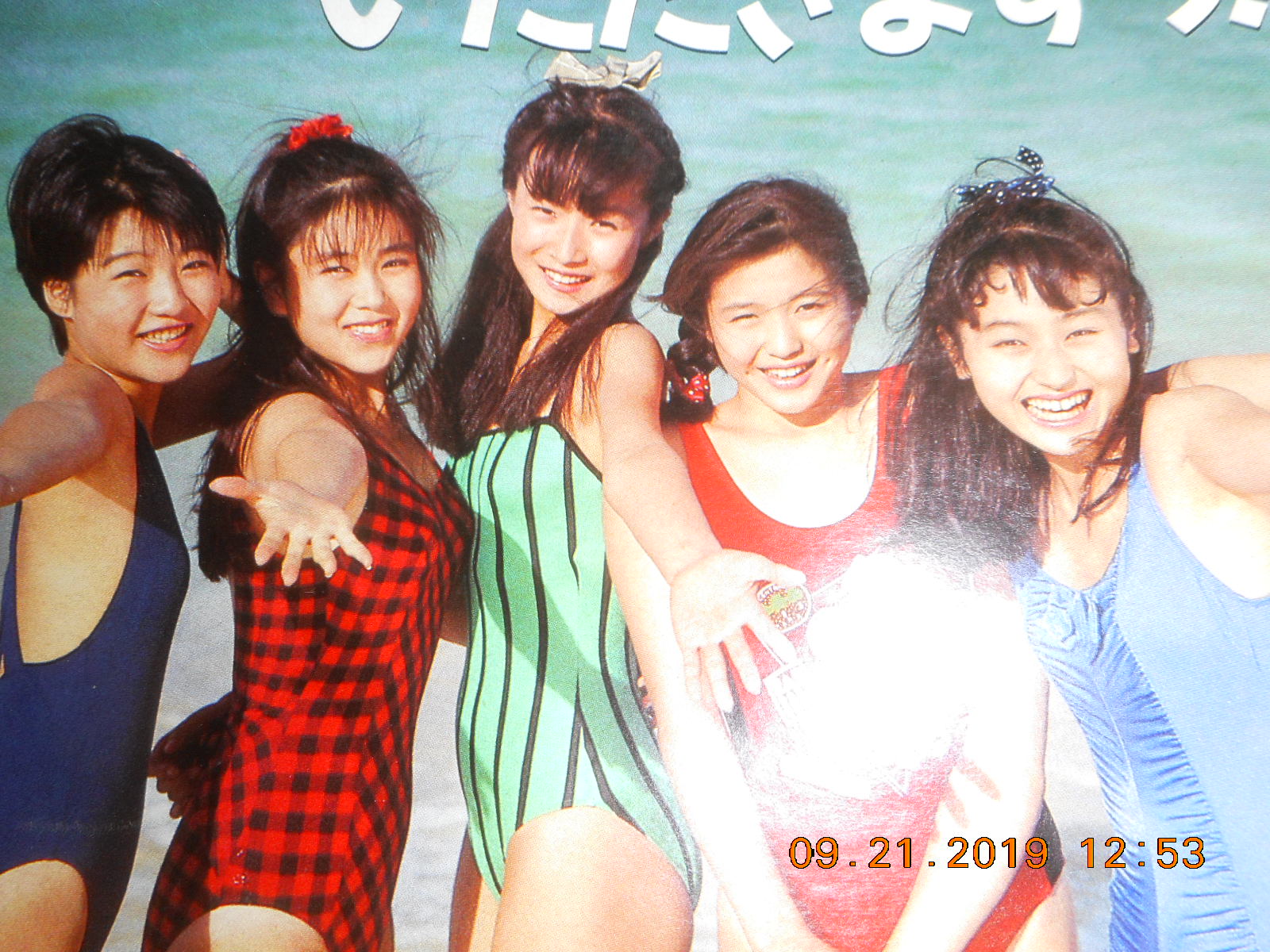
"Party Time" was C.C. Girls' 8th single from April 1994 and yeah, you can enjoy it with real champagne. Written by Mami Takubo(田久保真見), composed by Ichiro Hada(羽田一郎)and arranged by Hiroshi Shinkawa(新川博), it's appropriately sparkling fun times condensed into a 4-minute song with some rock here and perhaps some Eurobeat feeling. Hopefully, all of you going out tonight to ring in the New Year will have a good and safe time.
One of those 80s singers who quickly came and went, Kyoko Isobe(磯部恭子)first started out as a member of an aidoru trio known as BiOSPECIAL in 1987. At around the same time, she also worked as a model for the brand Mademoiselle NONNON【マドモアゼルノンノン】 .
Then in 1988, she made her start as a solo singer releasing just two singles. The second single was "Fujun?" (Impure? or Dishonest?) which was released in March 1989, and though it's been categorized as a funk/soul boogie on Discogs, I think that it sounds more like a Eurobeat/pop mix. The lyrics were provided by Sakiko Iwamuro(岩室先子)with Ichiro Hada(羽田一郎)as the composer. It's not a bad song at all although it apparently didn't measure up to any ranking on Oricon. Her debut single from October 1988, "CRUSH on LOVE" peaked at No. 93.
Isobe made a few appearances on "Music Station" and "Yoru no Hit Studio"(夜のヒットスタジオ)among other shows with a couple of appearances on one drama. However, she suddenly opted to get out of show business in 1989 and so a debut album that had already been titled "Spitz"(スピッツ)for release in June that year was given the hook. Strangely enough, a guitar pop/rock band would make better use of that album title in the 1990s as their own name.
I would just like to clarify that the double-decker bus doesn't cost 2,500 yen. By coincidence, I happened to take the picture when it was driving by a parking lot sign with that rate. 😝
Anyways, YouTuber Island Fantasia (aka HRLE92 here on KKP) posted this video up on his channel a couple of years ago. I never heard of singer-songwriter Hiroshi Murai(村井博)and his description on J-Wiki consists of merely the fact that he is a singer-songwriter with his five singles and three albums who was active in the late 1980s and early 1990s. Even the great kaz-shin of the Japanese music blog "Music Avenue" mentions that there is very little information on Murai.
On his third and final album"Natural" from June 1990 is his track "Hikigane" (Iron Nails) which is a new way of pronunciation of those two kanji together since I've never seen the "kun" or "on" readings depicted in that way for those two kanji before. However, kaz-shin states that this is the proper reading for the title and that's been seconded by Discogs. But getting back to brass tacks (instead of iron nails), "Hikigane" is a pretty funky number arranged by Greg Mathison or Mathieson with that nostalgic 90s sound. There's some discrepancy, though, between J-Wiki and "Music Avenue" about who the songwriters were, but since the JASRAC database agrees with kaz-shin, I'll go with the lyricist Mami Takubo(田久保真見)and composer Ichiro Hada(羽田一郎).
Actually, putting in the hiragana reading of hikigane(ひきがね)into Jisho.org brought the definition of "gun trigger" which would make sense since Murai sings about being either the hunted or the hunter. However, the kanji form of the word(引鉄)is different.
Happy Monday! And heck of a time to talk about winter when Toronto is on the cusp of hitting another 40-degree-plus Humidex tomorrow. Will need to slap on the sunblock for sure.
However, I have been wanting to place this article for a while since I do like the song by the late singer-songwriter Ritsuko Okazaki(岡崎律子). To explain, there was this 1991 OVA based on an original 1983 manga called "Ichi-gatsu ni wa Christmas"(1月にはChristmas...Christmas in January). There were a couple of firsts here: one is that veteran seiyuu-singer Megumi Hayashibara(林原めぐみ)who had been doing a lot of genki roles early in her career received her first cool-as-ice and even downright dour role as the main character, Mizuki Tateno, a young lady who mysteriously despises Christmas. That's kinda new to me since the only regular role that I see her in nowadays is her turn as the stoic and sometimes cranky Ai Haibara in the detective anime "Meitantei Conan"(名探偵コナン).
The above video has the entire 45-minute OVA and so in the last few minutes comes the theme song for "Ichi-gatsu ni wa Christmas", "Fuyu no nai Calendar" (A Calendar Without Winter) which turned out to be the first anime theme song that Okazaki sang. But the surprising thing is that Okazaki wasn't behind the songwriting this time. It was lyricist Mami Takubo(田久保真見)and composer Ichiro Hada(羽田一郎)who came up with this classy ending anison about finding love and warmth in a cold, cold world. Although it's not really an Xmas tune per se, I do like to compare "Fuyu no nai Calendar" with Ruiko Kurahashi's(倉橋ルイ子)"December 24", one of the memorable City Pop Xmas songs.
Hayashibara gave her tribute to Okazaki through a May 2017 album titled "with you" which had the former covering the songs connected to the latter, including "Fuyu no nai Calendar". The arrangement isn't too dissimilar from the original version, and it still feels like a romantic spree through Tokyo. "with you" made it up to No. 11 on Oricon. I believe that the original was also used for a Sunkus convenience store commercial; certainly, the fellow in the ad below looks to be sporting a 90s hairdo.
A couple of weeks ago, I received a comment under my article for GWINKO's "Natsu no Owari, Chikazuita Sora"(夏のおわり、近づいた空). Rebecca made a recommendation for the opening track of her May 1991 album"Tokyo Uki Uki Girl"(東京UKIUKI GIRL...Tokyo Cheerful Girl), "Heart ga Kiseki wo Matteiru" (The Heart is Waiting For a Miracle).
Nice recommendation, Rebecca. "Heart ga Kiseki wo Matteiru" is a percolating piece of that aspect of nostalgic R&B known as New Jack Swing, a genre that I'm still trying to wrap my head around since when I think of it, I usually come up with Bobby Brown's"Every Little Step" from 1989. Written by Goro Matsui(松井五郎)and composed by Ichiro Hada(羽田一郎), try to imagine the refrain from Kylie Minogue's"I Should Be So Lucky" done in New Jack Swing rather than Eurobeat.
Matsui has come up with the story of a young woman going out on a date in the big city and Hada's music definitely shows that she's more than over the moon in anticipation. As I mentioned to Rebecca, it makes for a fine start to "Tokyo Uki Uki Girl" although that album cover is a tad sinister.
The other day, I was listening to one of those aidoru compilation albums that former collaborator JTM was kind enough to give me and I encountered this particular fun one.
It's been a few years since we've put up a CoCo song onto the blog so the timing is just right. In fact, the song that I heard by this early 90s aidoru group was actually their 14th and final single"You're My Treasure ~ Tooi Yakusoku" (Distant Promise) from July 1994. As hinted in the title, the group used this song to give their thanks to all of the fans for all of the good times and support. It sounds like everyone got their chance to get behind the mike, except for Azusa Senou(瀬能あづさ)who had left CoCo earlier in 1992.
Written by Sayoko Morimoto(森本抄夜子)and composed by Ichiro Hada(羽田一郎), it's got the light and bright vocals by the ladies alongside those nostalgic 90s electric guitars and synths. Not certain how much longer some of the other aidoru groups in the early 1990s lasted but perhaps there was some poignancy especially with CoCo's final single since there was maybe a feeling that the long age of aidoru was coming to an end. But then came Morning Musume(モーニング娘。)some years later. In any case, "You're My Treasure" peaked at No. 17, and the song was also included on the group's final studio album"Sweet & Bitter" also from July 1994 which placed in at No. 28 on the charts.
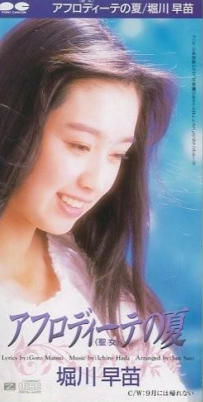
Released in July 1991, “Aphrodite no Natsu” was used
as the ending theme to a tokusatsu show called “Fushigi Shoujo Nile na
Thutmose” (不思議少女ナイルなトトメス). Well, I might have liked this crazy show about a
Japanese girl who was an Ancient Egyptian pharaoh descendant and had to fight
demons using magical powers, or something like that. Unfortunately, and unlike
predecessor show “Bishoujo Kamen Powatorin” (美少女仮面ポワトリン), it was not
aired in Brazil.
Starring as the heroine Thutmose, and singing both
opening and ending themes, aidoruSanae Horikawa (堀川早苗) had the right push to begin her career in the show
business. As was the case with many late 80s/early 90s aidoru singers, she was
cute and a somewhat stable singer, but would not be seen winning singing awards
anywhere in the world. Nevertheless, the Middle Eastern arrangement (sometimes
I think it also have a Latin bounce, but maybe it’s just me) and the catchy
chorus are very fun. In fact, I like it so much that I spent days playing this
thing on repeat in January. It was the height of summer here in Brazil, so it’s
fitting.
“Aphrodite no Natsu” reached #28 on the Oricon charts
and was later included on Horikawa’s album “Dear You”. Lyrics were written by
Goro Matsui (松井五郎), while music was composed by Ichiro Hada (羽田一郎).
As for the arrangement, Jun Sato was (佐藤準) the responsible.
Recently, I was able to listen to the 2nd of two original albums released by 1980s aidoru Maiko Okamoto(岡本舞子), "Fascination" (ファッシネイション)which came out in July 1986. In a past article about her, I remarked that despite her brevity in the spotlight (Okamoto was only active between 1984 and 1987), my belief was that she had quite a bit more talent in singing and in the songs that she received than she was given credit for.
Well, I think that was true for the material that she had recorded for "Fascination" which was well-titled. All of its eleven tracks (the 11th only being available on the CD) were arranged by guitarist Tsuyoshi Kon(今剛)or singer-songwriter Etsuko Yamakawa(山川恵津子), so that fact automatically perked up my ears. The first track "L.A. Lover" is pretty fascinating in itself. It was written by Goro Matsui(松井五郎)as a paean to the sunny beach life in the titular city and it was composed by J-funkster Toshinobu Kubota(久保田利伸)and Ichiro Hada(羽田一郎).
Often enough with me, unless the song just has that prototypically 80s aidoru cotton-candy arrangement, I also attach some sort of other genre Label. With "L.A. Lover", I'm not sure if I would even say that it's an aidoru tune and even with that title, I'm not sure if I would even place it as a City Pop song, either. It's just a really interesting pop number with its own bubbly groove thing and some spacey twanging in the musical ether. At the same time, though, I really get that feeling of lying on the beach blanket getting bronzed while listening to this first track.
Track 2 is the title track, "Fascination" and this one has more of the City Pop vibe to it. Written by Matsui and composed by Yamakawa, it's got the lovely synth-bass and other keyboards which would probably nominate it for Vaporwave processing if it hasn't already undergone it. Matsui's lyrics talk of the good romantic life from the 22nd floor of an apartment in what sounds like a modern resort area. Man, the setting could illustrate a City Pop album cover!
Another fascinating track is "Okubyou na Venus"(臆病なビーナス...Timid Venus) which was Okamoto's 5th single released in February 1986. Right from Note One, there is that gentle surf of AOR before the keyboards head on downtown, and when the aidoru starts singing, I immediately got that breathy vocal style and the urgent and anthemic melody of Ami Ozaki(尾崎亜美)who also provided the lyrics.
The single was also the theme song for a March 1986 OVA with the same title, and the main character of fictional aidoru Yumiko Kirita(桐田裕美子)was played by Okamoto herself while Ozaki provided the score. "Okubyou na Venus" just managed to peak at No. 91 on Oricon.
One more track that I will throw out here is "Stranger no Yoru"(ストレンジャーの夜...Night of the Stranger), and this is another City Popaidoru tune provided by the aforementioned Matsui and Yamakawa. It's shiny and slick as a car designed by Syd Mead (well, maybe I'm getting a little ahead of myself there), and putting on my kayo sommelier's hat on, I get some hints of Hall & Oates (through the keyboard riffs) and Junko Yagami(八神純子). Okamoto is singing about being thrown into a whirlwind romance and herself throwing caution to the winds. I do hope Mead designed those futuristic seat belts into that car she's riding.
Yup, "Fascination" is indeed fascinating and so I'm somewhat disappointed that the album only got up to No. 83 when it was first released. Maybe it was just a little too ahead of its time or maybe it was even behind the times in terms of mixing aidoru and City Pop, but the album was given a re-release in 2003, so I'm hoping that even now, those who have recently gotten onto the City Pop/AOR bandwagon will also realize the merits of Okamoto's final studio album. In parting, one other track on "Fascination" is her 4th single"Juu-Ichi-Gatsu no Sophia"(11月のソフィア)which has already been covered on "Kayo Kyoku Plus" and is one of her more aidoru-esque works.
A little more than 10 days before Christmas, I'm still trying to figure out what to get the family this year. I've got a few ideas here and there but nothing concrete as of yet. Tis the season to be uncertain.
Found this appropriately jingly J-Pop Xmas tune, "ONLY X'MAS NIGHT", wrapped in a wholly pleasant late 80s/early 90s urban contemporary wrapper. Belonging to singer Aya Fukuoka(福岡文), this was a track on her sole album"W-Face" from November 1991. There's very little written about her online, and I found out from this site that she may have only released two singles along with "W-Face", again all in 1991. From one other place, I discovered that Fukuoka had graduated from legendary singer-songwriter Masaaki Hirao's(平尾昌晃)music school. But that's about all I could find about her.
She was apparently marketed as an aidoru and it's the only one song that I have heard so far here, but her vocals and arrangement for "ONLY X'MAS NIGHT" have her sounding a lot more mature than the usual teenybopper. I can only hear this as a mid-tempo 1990s City Pop/AOR number composed by Ichiro Hada(羽田一郎)with arrangement by Yuji Toriyama(鳥山雄司). It all sounds quite cheerful but Goro Matsui's(松井五郎)lyrics relate a melancholy story about a woman who's probably going to spend the Holidays all by her lonesome as it seems a young man who has no idea that she has feelings for him is heading off to be with someone else. Looks like the poor lass will be hitting the Cup O' Noodles hard this December 25th.
I don't know what became of Ms. Fukuoka after 1991 but if anyone can provide any further details, I would certainly be appreciative of this.
One of my favourite forms of dinner time in Japan: eating out at a branch of Yayoi-ken(やよい軒). This is one of those restaurant chains where you put your bills and coins into a ticket vending machine after making your selection. Of course, whenever I visit Japan, I must have my karaage teishoku with bottomless bowls of rice, miso soup and tea along with the rest of the sides that come up with my fried chicken.
Mind you, when I was living in the nation, I couldn't afford to eat out every night obviously. However, I did like to cook when I had my days off, so I did a lot of stir-fry, homemade Sweet N' Sour Chicken, Taco Rice, and niku jaga among other dishes.
Unfortunately for Ritsuko Kurosawa(黒沢律子), her "Dinner Time" isn't a happy one. Her dinners have apparently been with a cad who's been far more style over substance, and she's finally at her wit's end. But dang, the music infusing this frustrating story is really nice.
"Dinner Time" is the lead track from her June 1993 album"Dish", and this is the second article in a row for Kurosawa that I've written about a song from that release. The lyrics by Miwako Saito(斉藤美和子)are as bitter as goya but I do like the bouncy melody by Ichiro Hada(羽田一郎)that goes with them. I wouldn't mind listening to this one over dinner, and I know that I will be having a far more satisfying repast than she has had.
That was indeed a nice cold glass of mango juice at the Tower Records Cafe in Shibuya back in November 2017...and I could've used that same glass today. It seemed like a bunch of disparate contractors just needed to alight onto my condo on the same day to do a number of things: clean out the dryer vents, search for the source of a leak in the master bedroom, and start a major balcony renovation. Plus, there was the whole issue of suddenly needing to secure a vent cover when the screw holes ended up breaking. Knock on wood, the day has ended peacefully with much less stress now.
Speaking of stress, I don't look at my teenage years too fondly. Lots of stress there. However, it seems for one singer named Satomi Matsushita(松下里美)from Yokohama, adolescence did fine by her. This is her debut single "16 - sixteen" from January 1989. And sure enough, she was indeed 16 (birthdate: April 28th 1972) when she recorded this.
According to her J-Wiki profile, she had belonged to the same management company as Misato Watanabe(渡辺美里), and with the two kanji in Matsushita's first name being the reverse of Watanabe's first name, a number of the latter's fans also joined the Matsushita bandwagon. I can also say that "16 - sixteen" has the same sort of cheerful pop/rock feeling that Misato's early songs possessed. However, Matsushita's vocals aren't quite the same booming vocals that Misato has had. In fact, I would say that maybe they are closer to LINDBERG vocalist Maki Watase(渡瀬マキ)when she was doing her solo pop thing.
The lyrics were written by the tandem of Rika Ooka and Yukiko Tanaka(大岡利加・田中友妃子)with Ichiro Hada(羽田一郎)providing the music. I just wrote about Hada's other composition last night for Anri's(杏里)"Morning Squall"(モーニング スコール). As for Matsushita's discography, she's released 14 singles up to 2012 and 4 albums up to 2007. "16" was in her first album"Doki Doki" from March 1989.
Decided to go for a twofer here, especially since it's been a short while since I've inserted an Anri(杏里)article. I'm going to cover both the A and B sides for her 18th single, "Morning Squall" released in June 1986. Yup, it's been over 33 years since this one came out, and considering how it's like right now weather-wise (steady precipitation), I'd say that this was a most appropriate choice.
First off, let's start with "Morning Squall". Launching with some distinct keyboards, I thought that there was a fair bit of foreshadowing in terms of what Anri's music was going to sound like later that decade. Yumi Yoshimoto(吉元由美), Anri's songwriting partner during that later dynamic R&B phase, actually took care of the lyrics for "Morning Squall" while Ichiro Hada(羽田一郎)brought about some of that light funk. I think there is still some of that Toshiki Kadomatsu(角松敏生)feeling in the overall arrangement (Kadomatsu having contributed to a lot of her music some years prior) although that role here was fulfilled by Jun Irie(入江純).
The B-side, "Evening Rain" reminds me slightly of some of her early 80s AOR/City Pop style, and taking into account the rain outside my window as I type this, this was the reason that I decided to go with "Evening Rain" before I then settled on including the A-side as well. Lyricist Kazunori Sonobe(園部和範)provided the story of what sounds like the perfect ride in a convertible with all of the trimmings before the rain starts coming in, but even then, the couple stays quite happy. The late Yuuichiro Oda(小田裕一郎)certainly shares the same sentiments in his music; for a rain song, this is one very upbeat tune.
"Morning Squall/Evening Rain" peaked at No. 51 on Oricon. The former ended up on Anri's 9th original album"Mystique" which also came out at the same time as the single with it reaching No. 6 on the charts. The latter song hadn't been placed on any album for the longest time until a remastered version of "Mystique" was released in 2011 with it included as a bonus track.
Yup, Cinnabon had its time in Tokyo as well...perhaps well over a decade ago. I remember the shop in one of the malls in Odaiba; the entire first floor of the complex perpetually had that distinctive aroma of cinnamon whenever I went there. That worked better than any advertising.
Anyways, I had my regular talk with JTM over the weekend and we were swapping information on various singers from the 80s and 90s, and one person he mentioned was GWINKO. Now, I had heard of GWINKO years ago and I recollect perhaps a Myojo article about her, but I kinda pooh-pooh'ed her off as one of the many aidoru that came and went during the 1980s.
However, JTM described her as being the female equivalent of Toshinobu Kubota(久保田利伸)! Wow! That got my attention. So she was a budding R&B type, eh? I then decided to look up her material on YouTube and found this one song titled "Yokubari na Weekend" (Greedy Weekend) which was her 5th of 7 singles from July 1990. I was fortunate that there was an official music video and once I looked at it, yep, I could see why my friend compared her to Kubota.
Plus, she could dance hurricanes around Kubota according from what I saw on the video (man, all that fashion back then)! Looking at the Okinawa-born GWINKO, who was born Ginko Kaneshiro(金城吟子)in 1973, I was stunned to realize that she kicked up her heels with her other dancing partners at the age of 17 in "Yokubari na Weekend"; I thought she was well into her 20s, and I mean that in the best sense of the word.
Junko Ohyama(大山潤子)wrote the lyrics of a young lady having the time of her life in the big city while Ichiro Hada(羽田一郎)and Takuo Sugiyama(杉山卓夫)brought in some of that snazzy funk-pop seemingly right from the United States. I kinda wonder whether GWINKO and all those dancers were inspired by Paula Abdul. In any case, another singer that I was set right about.
At last, I had watched an "Abunai Deka" (あぶない刑事) film! I managed to catch the latest installment of the buddy cop franchise that spanned three decades on the way to Japan about a month ago and it was aMAzing to finally see Hiroshi Tachi (舘ひろし) and Kyohei Shibata (柴田恭兵) in action.
Admittedly, the plot for "Saraba Abunai Deka" was rather weak, just as any nth sequel would have, and that it was pretty much an 80's action flick in modern clothes *ahem "The Expendables"*. But it did have its insanely cool and surprisingly funny moments. Plus, most of the guys were impeccably dressed and stunning to look at - Koji Kikkawa (吉川晃司), who played the villain, looked incredible with his silver hair, and there were even times where I didn't know who to root for! However, I think I might have appreciated it more if I had watched the previous films and/or the TV series as there seemed to be some running gags in there.
twitter.com/k0_8_1_8s/status/753277521811021824
There were a number of scenes that had my eyes popping right open and my excitement levels to the max. That includes Tachi going head to head with Kikkawa in a fist fight, and him riding a Harley with hands occupied by a shotgun - totally makes up for at least 5 minutes of seeing him mope and sulk after the tussle. And let's not forget about Shibata; dang, that guy really impressed me in this movie. He's got some slick dance skills, and seeing him sprint like his life depended on it (seems like a staple in the series) was incredible at his age!
I was quite taken by Shibata's chase scene, as you can tell from up there, and the background music that played as Sexy Oshita hunted down his target fascinated me. From what I vaguely remembered, there was this cool vibe to it, but at the same time it also had an element of urgency. Without a title and the only clue being that it was most likely sung by Shibata himself, I had to do some hunting myself.
It wasn't particularly hard to find what I was looking for as Kyo-sama's discography isn't particularly extensive, and I mainly focused on songs that sounded like they could be used in an intense chase scene. After some digging around in YouTube, I narrowed it down to "RUNNING SHOT", "TRASH", or "FUGITIVE". From what I'd been reading, "RUNNING SHOT" seemed to be the song I was looking for. But somehow I was underwhelmed when it was playing - I expected more. "TRASH" was decent, though I was aware that this was the least likely choice. Lastly, "FUGITIVE". The name itself also potentially implies hunting down a criminal so there was a chance that it might fit the bill.
If there's one word to use to describe "FUGITIVE", it's "unpredictable". Why? As the first few seconds of the song unfolded, you'd think it's some calm and soothing piece as the piano and sax hits your ears. Just as you're about to get nice and comfy, the drums, loud and sudden, kick in with a nice beat to wake you up, followed by the shrill synths to make a quintessentially 80's, high octane melody that keeps one (me, at least) going back for more. Also, I like Shibata's voice - deep and mellow. "FUGITIVE" is definitely my favourite out of the three tunes I picked.
Composing this was Ichiro Hada (羽田一郎). As for Chiroru Yaho's (谷穂ちろる) lyrics, I'm not entirely sure if they are in the wanted criminal's or the cop's point of view. Either way, to make sense of the sudden jump in tempo, I'm guessing that one of them must've been relaxing, maybe getting a cup of coffee or something, but one spots the other, setting off alarm bells in both their heads, and the game of cat and mouse begins.
Dang, he was really cute back in the day... And that voice... ~.~
Although I'm still unsure about whether or not "FUGITIVE" or "RUNNING SHOT" was used in Sexy Oshita's chase scene in "Saraba Abunai Deka", I managed to find a clip of half of the duo running after the bad guy with the former tune playing in the background. You can kinda see Shibata's knack for sprinting too - probably stemmed from his love of baseball.
"FUGITIVE" wasn't one of Kyo-sama's 15 singles, but it was released in his 1st album "SHOUT" on 21st June 1987.
I bought Masayuki Suzuki's(鈴木雅之)"Bayside Serenade" somewhere in Tokyo during one of my monthly sojourns from Gunma. At the time I got it, I was staying at my old friend's apartment in Itabashi Ward for the weekend, and he was kind enough to let me play the CD single on his component system. Well, my friend's place was small but pretty darn chic-looking, so hearing the jazziness from this song helped complement the mood. Mind you, Itabashi Ward is nowhere near Tokyo Bay, but looking out the window during that evening, the song certainly fit the bright lights and big city of Shinjuku.
"Bayside Serenade" is Martin's 10th single and was also a track on his 4th album, "Mood". The single was released in September 1990, and the music has all the sumptuousness of a luxurious night out on the town in that fine convertible going on the Bayside Highway. The music was provided by Ichiro Hada(羽田一郎), a composer/producer who had started a band with J-R&B singer Toshinobu Kubota(久保田利伸)during their university years, while the lyrics were by Chinfa Kan(康珍化) who has been behind a number of songs by Omega Tribe and Anri(杏里). "Bayside Serenade" may have that feel of a decadent and expensive Saturday evening, but in terms of the lyrics, Suzuki is wringing his hands in frustration at his lady love until it's time to take her home as usual. It's rather hard to imagine a guy who looks that icy-cool losing it over a woman, though.
The song peaked at No. 74 on Oricon. It may not have hit the big heights as some of his other songs, but it still makes for a nice musical companion on the car stereo if you're driving down by Odaiba. One point about Suzuki, though. He is indeed a nattily-attired fellow, but if a lot of folks saw someone dressed like that pounding the pavement in Roppongi or Shinjuku, they'd most likely make a beeline over to the other side of the street. However, Martin is apparently quite the gentleman.