I've been a fan of Japanese popular music for 40 years, and have managed to collect a lot of material during that time. So I decided I wanted to talk about Showa Era music with like-minded fans. My particular era is the 70s and 80s (thus the "kayo kyoku"). The plus part includes a number of songs and artists from the last 30 years and also the early kayo. So, let's talk about New Music, aidoru, City Pop and enka.
Credits
I would like to give credit where credit is due. Videos are from YouTube and other sources such as NicoNico while Oricon rankings and other information are translated from the Japanese Wikipedia unless noted.
Showing posts with label Mayumi Horikawa. Show all posts
Showing posts with label Mayumi Horikawa. Show all posts
I have to admit that I only found out about this song just earlier today. But as soon as I saw the title "Spy Dai Sakusen" which is the official Japanese title for the original American TV series "Mission Impossible", I knew that I had to investigate, since I remain a big fan of its first few seasons in the 1960s.
For one thing, what was I going to hear in Reiko Kato's(かとうれいこ)"Spy Dai Sakusen"? A moody City Pop tune or a really jazzy number along the themes for James Bond? Neither as it turns out. First off, "Spy Dai Sakusen" is a track on Kato's January 1995 album "Reiko" and it was created by lyricist Masami Tozawa(戸沢暢美), composer Mayumi Horikawa(堀川まゆみ)and arranger Yuji Toriyama(鳥山雄司). It actually sounds like an upbeat whimsical pop song which probably has so-called "combatants" in the spy adventure of love.
In Kato's J-Wikiarticle, there is indeed a note about this particular song and that the songwriters were all well aware of the title's significance but that's about it. As it is, Kato's "Spy Dai Sakusen" sounds as if it could have made for a theme song for a show of a totally different stripe instead of Bruce Geller's iconic series of adventure and intrigue.
I remember reading about this 1992 Mikiko Noda(野田幹子)album"Cute" while I was reading through my "Obscure City Pop CDs" book in a freezing Castle Frank subway station in downtown Toronto one February night in 2024 before meeting up with Larry Chan for dinner. It's not easy leafing through a fairly thick tome with gloves on, let me tell you that. But it was from reading on that particular album that I posted up the snazzy first track "Kakete Miyou"(駆けてみよう), a really nice sophisticated pop tune.
Then, recently, I encountered this lovely mid-tempo track from the same album. "Kono Eki kara" (From This Station) was written by Mayumi Horikawa(堀川まゆみ)and composed by Hiroshi Sato(佐藤博), and like a lot of songs that I do like, it's got a number of genres mixed into it: soul (quiet storm), jazz and pop. Of course, I'm a sucker for some of that keyboard work...maybe done by Sato himself...and the bluesy guitar solo. I don't think I'm exaggerating too much if I can say that "Kono Eki kara" could be the musical equivalent of a a really smooth Godiva chocolate bar.
The above is a picture from "Japanese City Pop 100 Selected by Night Tempo", and I was hoping to post it up on one of these City Pop articles. There's an interview there with the man himself that I'd like to translate sometime in the next several days or so.
May 2022 was the last time that I posted up a Mayumi Horikawa(堀川まゆみ), aka Mayumi, article on the blog, so it's about to time to post up another one. Once again, this is a track from her 1986 album"MAYM", "Lonely Play ~ Me-ism no Yoru" (A Night of Me-ism), and considering the hedonism that was going on during the 1980s, probably on both sides of the Pacific, it was probably a timely title.
Written by Masako Arikawa(有川正沙子), composed by the singer, and arranged by Shiro Sagisu(鷺巣詩郎), "Lonely Play" does give that Roppongi vibe of life among the nightclubs and discotheques, and from the title, things sound like it's not all happiness and light after all the dancing is done for the night. The music literally revs up for a night on the town with horns a-blazing and a smoldering rhythm that persists throughout. Some of the scatting reminds me of Matt Bianco while Mayumi is the congenial and sultry guide as the party goes on. By the end, though, we're left with a drunken if soulful piano playing us to the end of midnight, maybe missing the last train home (and considering how early the transit system closed back then, that wasn't difficult to do).
I do have to mention that there was a pretty charged lineup in the recording booth with Fujimal Yoshino(芳野藤丸)on guitar, Naoki Watanabe(渡辺直樹)on bass, Shin Kazuhara(数原晋)on trumpet and Sagisu himself on the synthesizer among other fine session musicians. You can check out Discogs for the lineups for each song.
I'm still trying to reconcile the fact that this sweet-singing aidoru of the 1980s was also starring in the tough-as-nails "Sukeban Deka"(スケバン刑事)franchise although I've seen my fair share of the episodes. Maybe along with the voice, it's Yuki Saito's(斉藤由貴)puppy dog eyes.
But I digress. I was watching one episode of "The Best 10"(ザ・ベストテン)recently and saw Saito appear on the TBS music show of the 80s. She sang her 8th single"MAY" which was released in November 1986, and I was immediately reminded that I had heard this one before, so my memory engrams came to the rescue once again. It was the chorus that got me to remember.
Written by Hiroko Taniyama(谷山浩子), composed by MAYUMI and arranged by Satoshi Takebe(武部聡志), it's pure lovable innocence as a young girl named May keeps trying to assert himself in front of the boy that she loves but, doggone it, she keeps coming up short. The pink fluffy aidoru clouds are further propelled by Saito's soft and slightly whispery voice.
I've only remembered "MAY" as a Saito single, but it's been associated as an NEC jingle and also as the theme song for the 1987 film "Koi suru Onna-tachi"(恋する女たち...Women in Love) with the singer as the star. The song was a track on Saito's 4th studio album"Fuumu"(風夢...Wind Dream) which came out in April 1987. While "MAY" peaked at No.2 and became the 39th-ranked single of the year, "Fuumu" hit No. 1 and was ranked No. 41 on the yearly charts.
Lyricist Taniyama herself did her own cover of "MAY" as her 19th single which was also released in November 1986. It reached No. 85 on Oricon.
Ryoko Tani(谷亮子), nee Tamura. Now that is a name that I haven't heard in years since she retired from competitive judo over a decade ago and decided to tackle the politicians in the Diet instead as a member of the House of Councilors. But when she was competing on the mat, she was probably as popular as any Oricon-populating aidoru star due to her cheerful and forthright nature, and of course, her abilities as a judoka. She even got the nickname of Yawara based on the main character in the judo manga by Naoki Urasawa(浦沢直樹), and that character of Yawara Inokuma(猪熊柔)was inspired from the first woman to win a world judo championship, Kaori Yamaguchi(山口香), in 1984. Tani would follow in her footsteps.
Having watched a lot of the anime adaptation of "YAWARA!" during my days in Gunma Prefecture, I've been able to remember a number of the theme songs used and profile them on "Kayo Kyoku Plus" over the past decade. However, the last time that I wrote about a "YAWARA!" theme tune was way back in 2017 with Mariko Nagai's(永井真理子)"YOU AND I", and to be frank, I hadn't known that this particular song was used as the ending theme for a one-hour motion picture entry of the franchise, "YAWARA! Sore Yuke Koshinuke Kids!!"(それゆけ腰抜けキッズ...Go For It, You Cowardly Kids!!)that was released in theatres in August 1992.
From what I've read in J-Wiki, "Daisuki na Shatsu 1990 Ryoko Sakusen" (My Favourite Shirt ~ The 1990 Travel Operation) had been even used during the original TV series, and it was released as Marina Watanabe's(渡辺満里奈)13th single on July 1st 1990, almost 32 years ago. When I first heard the song, I thought that it was awfully Shibuya-kei for an anime based on judo but heck, as I remember, there was plenty of whimsy in the show and I think Shibuya-kei is absolutely soaking in whimsy, too.
Well, it was no coincidence. Music and lyrics were provided by the Double KO Corporation which is actually the songwriting name for the duo Flipper's Guitar(フリッパーズ・ギター), one of the pioneers of Shibuya-kei itself. During those opening credit montages, the main character of Yawara was seen tripping the light fantastic throughout the streets of Tokyo and basically trying on every stylish outfit in sight. I would assume then that "Daisuki na Shatsu" would be the perfect accompaniment to a day on the town. Lyrically, it is all about that wonderful date outside with a guy, his favourite shirt and his favourite girl.
The coupling song to "Daisuki na Shatsu" is "Be With You", a light and mellow pop song that almost takes things into AOR territory. In fact, I'd probably say that it was quite close to a lot of the music that Miki Imai(今井美樹)had been performing at the time. I'm a sucker for the keyboard work and the chorus that sounds as if Tatsuro Yamashita(山下達郎)had some involvement (but probably didn't). Watanabe was in charge of the lyrics while Mayumi Horikawa(堀川まゆみ)and Hiroshi Shinkawa(新川博)took care of the composition and arrangement respectively. The entire single peaked at No. 31 on Oricon. From listening to both songs and Marina's vocals for them, I can say that the aidoru tag wouldn't be needed here.
Well, after a cool beginning to the week, things are heating up and the humidity is definitely rising as we head into the weekend. Summer is definitely encroaching upon us, and it's time to open up the patios. I could sure use a peach smoothie like the ones I used to make back in Ichikawa with the glass that I got for free from the Tokyo branch of Bubba Gump.
So to start off City Pop/J-AOR Friday, I've got a silky smooth but strutworthy number here by singer-songwriter Mayumi called "Summer Illusion" from her January 1986 album"MAYM". Heck of a time to have a track like this but perhaps Mayumi Horikawa(堀川まゆみ)wanted to remind folks shivering in cold Tokyo and elsewhere at the time that the hot season was on it way. I love the horns and the kittenish way that Mayumi delivers the song as if she were taking her sweet time in the downtown parts of the city that she basically owns. While the singer composed "Summer Illusion", Masako Arikawa(有川正沙子)took care of the lyrics.
With a title like "Summer Illusion", the song comes across as something that would have been ideal for a cosmetics commercial. Just my opinion, but in a way, the arrangement also hits me as if Taeko Ohnuki(大貫妙子)was behind it, and I could also imagine someone like Kanako Wada(和田加奈子)behind the mike in recording.
The long-standing fraternal duo Bread & Butter(ブレッド&バター)has explored the genres of folk, City Pop and AOR but one time after purchasing one of the "Light Mellow" CD series, I learned that the Iwasawa brothers also had their interest in Brazilian sounds.
"Non-Stop to Brazil" is the opening track for their 10th studio album from May 1987, "Aru Yoru no Dekigoto"(或る夜の出来事...It Happened One Night) and it was not only a catchy number that I enjoyed by the Iwasawas but I was also wondering whether I could get a chance to write about it on the blog. At the time, I couldn't find anything on YouTube but finally one uploader, Yousk Channel, was able to place this one up. It's always a wonderful feeling when a wish comes true.
Neither Iwasawa brother, Fuyumi or Satsuya(岩沢二弓・岩沢幸矢), had anything to do with the writing of "Non-Stop to Brazil". It was actually Mikiko Yamanaka(山中幹子)and Shun Taguchi(田口俊) behind the lyrics while MAYUMI, aka actress-turned-singer/songwriter Mayumi Horikawa(堀川まゆみ), brought together the bright samba melody. Happy to say that it does get the blood flowing and the mind wandering to warmer climes below the Equator.
We're here on the first Monday of 2022 and at least for my area, we're finally feeling what a proper January winter should be. It's sunny but cold, and thankfully the winds aren't whipping up so going out in multiple layers this morning kept me nice and toasty inside.
From columbia.jp
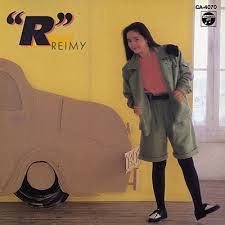
Today I thought that we can start the week off with something warm and sweet, not unlike honey hot chocolate, and that would be pop singer Reimy(麗美)and her sophomore album"R" from September 1984 which ended up being her highest-rated release by hitting No. 6 on Oricon. Now, as I've mentioned in a past Reimy article or two, I've seen her through three phases: 1) her early high-toned pop period with help from the musical Matsutoyas, 2) a brief interregnum in the mid-1980s exploring West Coast dance-pop, and then 3) her mellow and introspective singer-songwriting time going into the 1990s. It was that last phase when I first heard her material.
I was fortunate to get my copy of "R" thanks to past KKP contributor JTM and with that 1984 release, the album falls under her early phase. Having a first listen, I was quite drawn to the first track "Kagami no Meiro (Strangled In Love)"(鏡の迷路...Mirror Maze). Written by Shun Taguchi(田口俊)and composed by Mayumi Horikawa(堀川まゆみ), Reimy's older sister, I can hear this as City Pop albeit somewhat different from the other representative examples of the time, but strangely enough, "Kagami no Meiro" also has hints of what Yumi Matsutoya(松任谷由実)was whipping up at the same time with those swift strings and certain keyboard work. Taguchi's lyrics talk of a woman having some romance issues but she's also struggling with life in the city, generally speaking.
Methinks that I may have mentioned this as well in past articles, but I had assumed that this early phase of hers was of Reimy as an aidoru singer just because of how cute she looked on her first album covers. But after listening to "Kagami no Meiro" and this second track "Sora ga Ichimen Umi ni Mieta Hi"(空が一面海に見えた日...The Day When The Sky Looked Like The Sea), perhaps all involved in the production felt that she was able to go full pop. And sure enough, Reimy composed "Sora ga Ichimen Umi ni Mieta Hi" alongside another Taguchi set of lyrics centered around the saying of "parting is such sweet sorrow". From the mention of a (military) base in those lyrics, I gather that the setting may even be Reimy's native Okinawa. It's a straight pop number with her vocals going right up high almost to the point of breaking.
I was surprised hearing "Koi no Ichiji-kan wa Kodoku no Sen-nen"(恋の一時間は孤独の千年...An Hour of Love Means a Thousand Years of Loneliness) since up to now, I'd only known Yuming's(ユーミン)rendition of it on her 1992 "Tears and Reasons" album, not knowing that it was actually a cover of the original that she gave Reimy for "R". The songwriter was responsible for words and music and I have to admit that I enjoy the "Tears and Reasons" version more because there is definitely more of that authentic samba flavour there whereas Reimy's original sounds more like a cute Casio synthesizer doing Latin.
"Carry On" is another Taguchi and big sister Mayumi concoction with a nice beefy bass underlying a dynamic dramatic melody about a woman wanting to get back into the swing of things after a sad period of life. Maybe it's some foreshadowing for Reimy's second phase.
My last contribution to "R" is the final track "Kaze wa Ashita e"(風は明日へ...The Winds For Tomorrow) which had Taguchi and Reimy working together again. As much as I have realized that Reimy was never an aidoru, "Kaze wa Ashita e" is about the closest to an aidoru tune from her high-pitched delivery and the happy and hopeful lyrics and music. A young woman is up on a mountain waxing wistfully about a young man she's fallen for although he's somewhere distant.
There are a couple of more tracks that I've actually written about in the past, both of them being Yuming-penned numbers: "Seishun no Regret"(青春のリグレット)and "Zansho"(残暑). "R" is quite the intriguing introduction to early Reimy considering how different she would sound half a decade later.
Love is a karaage bento. My family doctor will strenuously disagree but only if I engorge in this on a daily basis. However, I never went quite that crazy on the fried chicken and rice, and I certainly don't get a chance to partake in it these days. But despite the years away from my go-to meal, I have yet to curl up into a fetal position in one corner of my home (not that I could physically do that anyways). I'm OK, you're OK.
For me, I guess that the karaage bento is quite the hedonistic pleasure, and perhaps that's what "Edenist of Eternity" is all about. This is a track from MAYUMI's, aka Mayumi Horikawa(堀川まゆみ), January 1986 album"Maym", and it's quite the banger. Unfortunately, I couldn't find the lyrics for "Edenist of Eternity" by Ko Suzuki(鈴木孝)but the music by MAYUMI herself with Masaki Matsubara's(松原正樹)arrangement certainly describes one heck of a good time during a Tokyo night. The song kinda straddles the funk of early 80s City Pop and some of that sophist-pop keyboard bounciness of the late 80s version. Before tracking down the songwriters, the sound of it had me initially thinking Hiroshi Sato(佐藤博)but of course I was mistaken there.
As for MAYUMI's singing partner in the happy duet, it's none other than Toshio Kamei(亀井登志夫)who helped out in the songwriting but not in the singing of one of the other tracks on the album "CA-SI-NO"(カ・ジ・ノ). Enjoy your Friday night!
Not quite a month ago, I put up an article talking about J-AOR crooner Junichi Inagaki's(稲垣潤一)6th BEST compilation album from December 1990, "TRANSIT". Because of the two discs containing oodles of his past hits, I decided then to focus on the first disc for that article, and as such, today we'll be taking a look at some of his stuff from Disc 2. As was the case with Disc 1, there are a few tracks here that I've covered in individual articles and I'll probably be leaving a few more here for their own articles in the future.
To be honest, when I first listened to "Ai no Super Magic" (Love is the Super Magic), I was caught a bit off-guard by that opening salvo of the title but when I got used to that particular greeting, I found the song pretty comfortable with that hint of Caribbean and Bacharach. The songwriting team of lyricist Kazumi Yasui(安井かずみ)and composer Kazuhiko Kato(加藤和彦)was responsible for this non-single track that was originally included in Inagaki's 6th studio album"Realistic" from March 1986. The album was a No. 1 hit for the singer and ended up as the No. 16 album of the year.
Inagaki's 7th album was also another No. 1 hit, "Mind Note" from March 1987 and it begat the reassuring love ballad "Toki wo Koete" (Beyond Time). Copywriter Yoshiaki Sagara(さがらよしあき)along with Hiroshi Shigemi(重実博)provided the lyrics about being there for someone during the hard times although I get the impression that there is a one-sided love thing about it all. Actress-turned-singer/songwriter MAYUMI came up with the perfectly AOR romantic melody which fits Inagaki to a tee.
Gotta be with my girl! That's the message from Inagaki's "Kimi ni Aitai Gogo" (The Afternoon I Want to See You), a track from his April 1989 9th album"Heart & Soul". Yasushi Akimoto(秋元康)wrote the words about a fellow who's barely enduring the weekdays that he has to go through before being able to see the girlfriend for a weekend of dining, driving and loving. Once again, MAYUMI was behind the music here which has the tropical feeling but also has that unmistakable sense of either Steely Dan or the Doobie Brothers.
I chose "Stay With Me" just to see how many Miki Matsubara(松原みき)fans would perk up, but although Inagaki indeed covered the Matsubara classic years later, this first "Stay With Me" is a wholly different animal. As another track on "Heart & Soul", this was once again written by the aforementioned Akimoto and composed by Junichi Kawauchi(河内淳一), and though this song won't have anyone forgetting that other "Stay With Me", this Inagaki original is pleasant enough with some hints of Motown. I probably would have preferred some horns over the synthesizers, though.
My final song for the article is Inagaki's 18th single"Shine On Me", a very uptempo and bright-sounding tune released in March 1990. Y'know, I'd always thought that the singer had the demeanor of a button-down mid-level manager in a huge corporation, and maybe the person who came up with the music video for "Shine On Me" thought the same as well. Inagaki looks perfect as a corporate kacho in that open-format office, but of course, he's also fine behind the mike to perform the song which was written and composed by songwriter Tatsuto Kuwamura(桑村達人). The song was also placed in Inagaki's April 1990 album"Self Portrait".
Following the listen to Disc 2, my general impression is that Inagaki gradually shed some of that Japanese City Pop as the 80s came to and end, and went into a more West Coast pop direction although I don't think that he strayed far from his AOR roots. He will always be my Mr. Relaxation of J-Pop!
I literally waited several months to put this song up onto the blog and the day has finally come. Patience, be thanked!
"Hachi-gatsu, Saisho no Suiyoubi" (August, The First Wednesday) is the first track on aidoru Marina Watanabe's(渡辺満里奈)5th album"Sunny Side" from July 1988. And indeed today is the first Wednesday for August 2021 so it's rather nice to have this summery tune on board. For an aidoru tune, it's got some nice refinement in the arrangement. I couldn't find out who arranged the song but I wouldn't be surprised if it had been anyone behind the songs for Miki Imai(今井美樹)or Stardust Revue who were known for some very fine songs in the late 1980s.
As it is, MAYUMI(堀川まゆみ)was behind the melody, and she's been known to have created a few songs for Imai back then as well. Meanwhile, Keiko Aso(麻生圭子)provided the lyrics about a young lady trying to kick her boyfriend or husband off the couch and off the game controller (I'm wondering whether Aso had the power of prescience when she was writing up the words) so that they can enjoy some fresh air at the beach. The song is indeed nice but I think that opening synthesizer is a bit too tinny for something this smooth.
BaBe may have had a brief time in the spotlight as singing duos go and the baton was passed over to Wink from the late 1980s into the early 1990s, but Tomoko Kondo(近藤智子)and Yukari Nikaido(二階堂ゆかり)left a still-recognizable and memorable sound in my head, thanks to singles like their Eurobeat-y "I Don't Know!".
In total, BaBe released 8 singles and 5 original albums between 1987 and 1990, and as I mentioned, whenever I think of any of their songs, I remember that Kondo and Nikaido were the pre-Wink Eurobeat aidoru duo. However, listening to their final single "She has a dream" which was released in March 1989, try as I might, I didn't really hear any of that familiar Eurobeat.
Written by Ken Takahashi(高橋研)and composed by Mayumi Horikawa(堀川まゆみ), I think BaBe and the powers-that-be behind them were trying to retool their sound somewhat into something more urban contemporary and sophisticated with "She has a dream". I certainly like the melody here and it was hoped that they would smash a hit out of the park. The song was even adopted as the official theme for the 1989 World Sports Fairtaking place in Japan; the annual event lasted between 1983 and 1992 and included introducing various sports from around the globe.
Alas, "She has a dream" did just OK by peaking at No. 37 and sold around 14,000 copies. The song was also included on BaBe's 4th album from April 1989, "Brand-new". However, about a year later in March 1990, it was decided that BaBe would disband.
Ever since I heard my very first Miki Imai(今井美樹)song, "Natsu wo Kasanete"(夏をかさねて), in that relaxing lodge-style café in Gunma Prefecture over 30 years ago, the usual reaction template was set whenever I hear one of her ballads: exhalation. Yup, just like walking through a forest or watching an ASMR video of someone getting a scalp massage, I exhale in relaxation and stress seems to slowly melt away.
(very short version)
"Haru no Hi" (Spring Days) is one of those Imai songs that does just that. A track from her July 1995 9th album"Love Of My Life", perhaps the timing is a bit off here, but putting this one up right now makes me forget that we're approaching the dog days of summer (albeit the weather was somewhat cooler today).
With lyrics by Imai, music by Mayumi Horikawa(堀川まゆみ)and arrangement by Yoko Kanno(菅野よう子), the singer's soft vocals, the resonant piano and what sounds like an accordion immediately puts me at ease, and I feel like returning to that mountain café for a cup of coffee. As much as I've not done too badly under the COVID-19 restrictions for the past few months, a song like "Haru no Hi" does make me pine a bit for a visit to a stylish coffeehouse with one or two buddies.
Well, first off, I would back away slowly from her with no sudden moves and then head off quickly into another direction. Far be it from me to bother Mayumi Horikawa(堀川まゆみ)while she's making sure her cosmetics have been applied correctly. I do believe that she's sitting on a park bench in New York City.
Perhaps the fact that the picture is a cover of her 3rd single"New York Doll" from September 1979 is a clue. However, that's not the subject of this article...it's actually the B-side "Climax". Maybe the original setting for the song was the Big Apple, but when I hear this now some 40 years after its debut in the record stores, I can't help but hear Tokyo back in the day. The funk is there for that City Pop feeling but Horikawa's vocals and those strings remind me of some of the more uptempo songs that 70s aidoru darling Momoe Yamaguchi(山口百恵)was releasing also in the latter part of that decade.
The wailing guitar, the disco strings and the boppy bass are also joined by some pretty thumpy percussion at times, too. Fujimal Yoshino(芳野藤丸)was behind the music while Machiko Ryu(竜真知子)took care of the lyrics.
Pretty busy day and night today, so before I end the festivities for another broadcast day, let's try one more City Pop outing.
Let's give Mayumi Horikawa's(堀川まゆみ)"CA-SI-NO" a spin on the roulette wheel. A track from her January 1986 album"Maym", and yep, despite the dark background for that video above, it still works. A song from the jazzier side of City Pop, it still provides some walking fun...or maybe some strutting fun...on any of the main avenues of Tokyo on a Friday or Saturday night. Fine funky beat, tight horns and that sax solo...just the instruments you need for some cool urban contemporary stuff in Japan in the 1980s.
Through the Daemonskald method, I could find out that Masako Arikawa(有川正沙子)was behind the words, while it was a joint effort between Mayumi and Toshio Kamei(亀井登志夫)for the boppy music. "Maym" also has the track "FM Radio Band".
Looking at my Facebook feed a couple of hours earlier, I found out that it was 80s aidoru Yukiko Okada's(岡田有希子)birthday today (August 22nd)! She would have been 52 years old. Of course, I can only speculate but I imagine that she could have either continued on TV as a veteran tarento or actress.
Over the years among JTM, nikala, Marcos and myself, we've managed to cover all of Okada's singles, at least the A-sides. So, in tribute to her birthday, this time I'm going to go with a non-single track from her 2nd album"Fairy" that came out in March 1985.
"Walking in the Moonlight" is a mid-tempo ballad that sounds as if it had been created from the mind of Taeko Ohnuki(大貫妙子), but it actually was composed by Mayumi Horikawa(堀川まゆみ), sister of Reimy(麗美), and then given lyrics by Yoshiko Miura(三浦徳子). The song kinda dances about the genres; of course, it's an aidoru tune but the melody flits around a fair bit so sometimes it ventures into City Pop territory but then I wonder if it's a bit more technopop.
Miura's lyrics are about regret and uncertainty. The woman in the song is taking a lonely walk at night after having a fight with her boyfriend and ends up sitting on a swing in the neighbourhood playground. She knows full well that she loves him and he loves her but would appreciate it if he could say express his feelings of love somewhat more, although she admits that she may have overreacted to the entire situation. All the while, Yukko's tenderhearted delivery comes through clearly. There is a similarity with Seiko Matsuda's(松田聖子)vocals but Okada's voice is still distinct.
Ugh! In the last couple of hours, I was confronted with a false fire alarm that brought an engine running over and then there was some drunk guy out not too far away from my home that a few of us had to take care of since he was unconscious on the grass with his key and wallet thrown out. Such is a Friday night in our fair city.
Anyways, it's indeed a Friday night so let's finish my quartet of songs today with a City Pop number. Last night, I was on my Steely Dan binge so I was listening to their best including "Peg", "Deacon Blues" and the above "FM (No Static At All)". I even got onto my Donald Fagen"The Nightfly" album and listened to "I.G.Y." and "New Frontier".
I was wondering whether model-turned-singer Mayumi Horikawa(堀川まゆみ)had been nibbling a bit on Steely Dan herself when she composed "FM Radio Band". Despite the similarity in the titles with this song and Steely's "FM", Horikawa's track from her 2nd album"Maym" (1986) is quite the different animal in that despite the lovely brass including Shin Kazuhara(数原晋)and Jake H. Concepcion, and Nathan East's bass along with the borrowing of that familiar Steely riff from the aforementioned "New Frontier", "FM Radio Band" is a much more chipper tune than the cool and romantic "FM".
In fact, I would say that Horikawa's creation also has a slight resemblance to a couple of other songs: Captain & Tennille's"Love Will Keep Us Together" and even Ben E. King's"Spanish Harlem". There are no deep musings about love here, just a whirlwind and comedic shopping trip in the more luxurious parts of Tokyo with the girlfriend literally dragging her hapless boyfriend along (these are just my images...the actual lyrics talk about the love of the titular band). But what a trip thanks to that brass and Robbin Ford's guitar solo. Perhaps "Maym" will be another target when Xmas comes around.
Considering the number of singers who were jumping up onto the City Pop bandwagon back in the late 1970s and early 1980s, I guess it shouldn't be surprising that even the triumvirate that made up the Shin-Gosanke(新御三家....The New Big Three)would try their hands and mouths on Japan's urban contemporary music. For example, Hiromi Go(郷ひろみ)tried it with "Irie Nite"(入江にて)and then there was Goro Noguchi(野口五郎)with his hit "19:00 no Machi"(19:00の街).
And finally, I found out originally through New J-Channel's running video of City Pop that Hideki Saijo(西城秀樹)also gave the genre a go of it. It was quite the pleasant surprise to hear the percolating and bubbly "City Dreams of Tokyo" from his 17th album"From Tokyo" released in June 1986. It's all in English, thanks to the lyrics and music by Mayumi Horikawa(堀川まゆみ).
Listeners might have an issue with Saijo's English pronunciation but I'm OK with it. For me, it's all about the cool funk of the mid-80s...makes for a nice little strut through the big city itself. Plus, I think it already sounds ready-made to become a Future Funk/Vaporwave project. Heck, the video is perfect as a visual Vaporwave piece.
"City Dreams of Tokyo" was also the B-side to Saijo's 54th single, "Tsuioku no Hitomi ~ LOLA"(追憶の瞳 -LOLA-...Reminiscing Eyes)from April 1986. It peaked at No. 26 on Oricon.
Another year, another Akiko Kobayashi(小林明子)article. I'm such a fan of hers but it is difficult to find a variety of her songs on YouTube, although some other sites have helped out. Still, it's always nice to have some sort of video representing her music.
Whenever I cast my eyes on to the cover of Kobayashi's 5th album"Bon Voyage", I always think that the singer-songwriter was taking things into a new direction. The photo of Kobayashi in her pure white outfit against a beautiful blue sky planted that image into my head, and the tracks in the album just seemed to have a fresher feeling.
"Maybe This Time" seems to be a fine representative of my thought. Written by MAYUMI and composed by Osny Melo, the song has that happy uplifting feeling with the lyrics talking about a couple of folks who have gone through romantic repercussions with other people in the past but are willing and hopeful for something more everlasting with each other. It's the sort of mellow pop that I would like to hear on a sunny day like today.
Strangely enough, the previous Akiko song, "Miracle of Love", also from "Bon Voyage" was written up on "Kayo Kyoku Plus" just around a year ago.
Caught "Deadpool 2" with the guys today, and although it wasn't quite as good as the first one, it still provided plenty of enjoyment, and there is a mid-credits sequence that has to be seen to be believed which will have the Marvel fans punching their fists in the air.
Quite the contrast talking about the raunchy Deadpool and then bringing in this calm and cozy song by Mayumi Horikawa(堀川まゆみ), but let me have my Blogger's Privilege here. This would be her 2nd single"Lemon Kankaku" (Lemon Feeling) from April 1979, and compared to her relatively melancholy debut effort "Daddy"(ダディ)from the previous year, "Lemon Kankaku" is lighter and happier. Perhaps I can even catch a bit of Motown in there.
Created by the same tandem who took care of "Daddy", lyricist Keisuke Yamakawa and composer Masataka Matsutoya(山川啓介・松任谷正隆), the song was also placed as a bonus track in what I'm assuming is the re-released version of Horikawa's debut album"Elm Douri no Shojo"(楡通りの少女...Elm Street Girl)which had been originally put out in December 1978.
Considering that she became more known as a songwriter for future singers such as Miki Imai(今井美樹)and Kyoko Koizumi(小泉今日子), it's always nice to hear her material as a singer herself.. It's not bad to hear kayo from the 1970s that are just straight-ahead pop.


.JPG)