I've been a fan of Japanese popular music for 40 years, and have managed to collect a lot of material during that time. So I decided I wanted to talk about Showa Era music with like-minded fans. My particular era is the 70s and 80s (thus the "kayo kyoku"). The plus part includes a number of songs and artists from the last 30 years and also the early kayo. So, let's talk about New Music, aidoru, City Pop and enka.
Credits
I would like to give credit where credit is due. Videos are from YouTube and other sources such as NicoNico while Oricon rankings and other information are translated from the Japanese Wikipedia unless noted.
Ahh, yes. That tender two-person configuration known as the hizamakura(lap pillow) which can denote a parent-child relationship or something more romantic with a young couple. Of course, the intimacy and awkwardness are squeezed for all they are worth in a lot of anime. For that matter, this can lead to another trope: ear-cleaning but since I've yet to find a kayo about that custom, I'll just go with the hizamakura for tonight.
I was able to find one with that exact title. "Hizamakura" was a single by kayo singer Michiko Maki(牧美智子)released in May 1974. The song was written by Kazuya Senke(千家和也)and composed by Daisuke Inoue(井上大輔)when he was still going by his real name, Tadao Inoue(井上忠夫), a few years after he had left his old Group Sounds band, Jackey Yoshikawa & His Blue Comets(ジャッキー吉川とブルー・コメッツ).
Unfortunately enough, I couldn't find the lyrics to "Hizamakura" online but from what I could hear from Maki herself, it seems as if her protagonist is perhaps enjoying her beau sleeping softly in her lap and wondering what the future portends for them. The music is suitably innocent but also has that sense of uncertainty. For the singer, this was not only her first single under the CBS/Sony banner but also her first single under the stage name Michiko Maki. In terms of her entire career, "Hizamakura" was her 5th single with the first four singles being released under the name Hiroko or Yoko Aihara(愛原洋子).
For all of the love I have for various aspects of Tokyo's architecture, one thing that never really impressed me about the megalopolis was its nightscape. I mean, looking at it from Odaiba, it's OK; Tokyo Tower is there along with Rainbow Bridge but I think New York's nightscape beats it by a country mile and even Toronto has a better looking view.
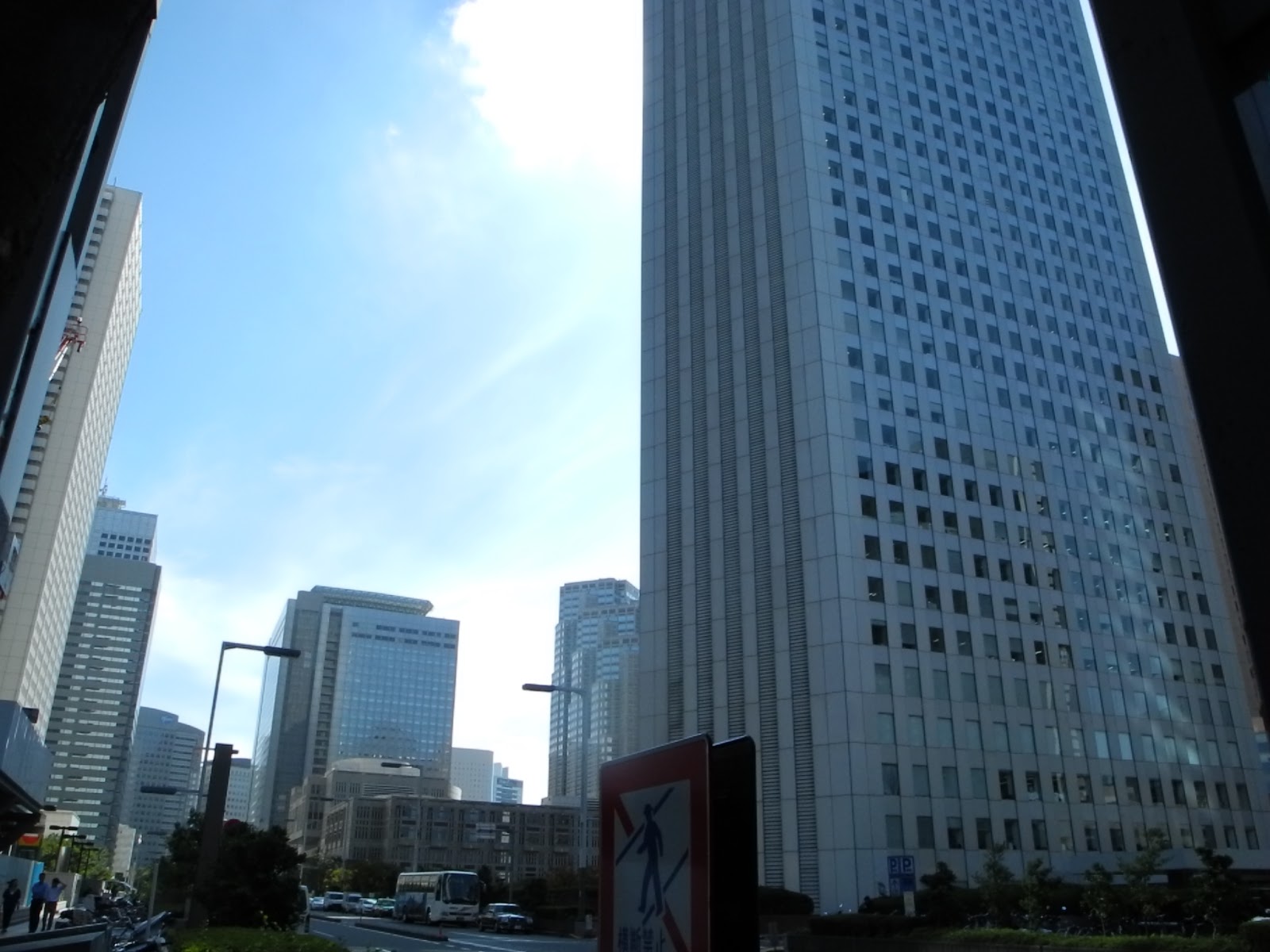
Part of the reason is probably because of the ever-present fear of earthquakes. Japan might have the best quake-prevention measures anywhere on the planet but the expression "earthquake-proof" was quickly stricken from the dictionary after the 1995 quake in the Kobe area. And besides, all those gleaming skyscrapers pressed together over several city blocks might look really pretty at night but I certainly wouldn't want to be among them if a Shindo 7 were to ever strike. Take it from someone who dashed out of a Shinjuku building on March 11 2011 with dozens of other people to see all of the buildings around us swaying like palm trees with a wayward crane helplessly swinging about next door. And I think we were very lucky compared to what happened in the Tohoku area.
All of my commentary on earthquakes and architecture was just to introduce a Michiko Maki(牧美智子)song titled "Machi no Tomoshibi" (The Lights of The City). I most likely have written it before in her previous articles but I think Maki is one of the underrated singers in the general kayo genre. She has a lovely crystal voice so it's a wonder that I had never heard of her before until I was well into writing the blog.
According to the description of the above video on YouTube, "Machi no Tomoshibi" is Maki's 4th single from April 1975 (apparently she didn't even merit an article on J-Wiki) and was created by Kazuya Senke and Koichi Morita(千家和也・森田公一). In addition to those wonderful vocals, I've liked the song because of that ballad-style 70s guitar and the strings (automatically induces nostalgia). Plus, there is that amazing electric piano in the middle.
The lyrics, though, are rather melancholy if somewhat hopeful. Senke weaves a story for Maki to sing about the big, bad and lonely city but with little bits of redemption popping up in the form of flowers. Not surprisingly, "Machi no Tomoshibi" was the ending theme for the cops-&-robbers drama "Tokyo Detective: Futari no Jikenbo"(二人の事件簿...The Case File For Two) which had its run from April-November 1975. There were some pretty big names guesting on the show as well including Momoe Yamaguchi(山口百恵), Agnes Chan(アグネス・チャン)and Akiko Wada(和田アキ子).
Walking down some of those side streets in the shitamachi area of Tokyo definitely brings in those old-fashioned arrangements of enka or Mood Kayo. Although I know it's already Saturday afternoon over in Japan as I type this, the Friday night probably had the usual uptick in drinking activity on those very streets.
I'm kind of surprised that I hadn't discovered this song earlier by the silky-voiced Yukari Ito(伊東ゆかり)but it took one of those old retrospective videos on "Uta Con" (うたコン) recently to let me know about "Koi no Shizuku"(Tears of Love). Released in January 1968, I could identify with the melody by Masaaki Hirao(平尾昌晃)as being a Mood Kayo not about drinking but about walking as a couple through those lantern-lit streets that I was talking about above, whether they be in Asakusa or Akasaka.
And man, is it ever drenched in Mood Kayo music! Lovely shimmering strings and that Latin guitar really do sound enticing enough for that couple to come in out of the rain for a bit of a drink. Unfortunately, Kazumi Yasui's(安井かずみ)lyrics make it pretty sure that any further joint drinking activities and other joint sessions are most likely over for the two. There is a lot of mention of the titular lachrymal fluid soaking into the guy's shoulder or being dappled onto his cheek. I had been hoping it was only because the lass was so happy in love. However, there was that one line where Ito sings about her hoping to forget what the guy had just said. I don't really take that as good news and besides, when it comes to the old kayo, the songwriters do love to use that "Parting is such sweet sorrow" phrase to heart.
Ito scored a No. 1 ranking on Oricon for "Koi no Shizuku". In fact, according to J-Wiki, the song provided the first time that a No. 1 ranking was given to a female artist since the Oricon charts began in November 1967. To give further glory, the song stayed at No. 1 for 4 weeks in a row and then after being dethroned for a few weeks, it was back on top for one more week. By the end of the year, "Koi no Shizuku" was the 5th-ranked single of 1968. Oricon may have been new but NHK's Kohaku Utagassen had already been well established; Ito was able to come onto the program for a 6th consecutive time based on the strength of this one song. It and "Koyubi no Omoide"(小指の思い出)are considered to be Ito's trademark tunes.
For such a song, cover versions are inevitable and there was one by Michiko Maki(牧美智子). Her version was included in her 1974 debut album, and it has a slight bit of 70sdisco to it while Maki's higher vocals provide less world-weariness and more innocence.
The more I listen to the songs of Michiko Maki(牧美智子), the more I think she was one of the unsung and underrated singers of the 1970s. She apparently doesn't even merit her own J-Wiki entry.
I listened to her 2nd single from October 1974, "Kuchizuke no Aki" (Autumn Kiss). There is a rich layer of lush strings and harp, and so when paired with that crystalline voice of hers, I wonder what she could have done with covers of some of those Disney classics. And the way that her vocals tip toe across the lyrics by Kazue Senke(千家和也), I also think that Maki may have had a past in ballet. The lovely kayo melody was composed by Daisuke Inoue(井上大輔)under his real name of Tadao Inoue(井上忠夫).
"Kuchizuke no Aki" was also the title track for her first album which came out in the same year as the single.
Aside from Japanese popular music, I'm also into jazz, 80s Western of all genres, and even some of the classical stuff. I know Beethoven's 5th and 9th, Chopin's "Polonaise" and "Nocturne", and Pachelbel's "Canon" among other masterpieces, but I can hardly say that I'm anywhere near the expert there that I am with kayo kyoku/J-Pop. Often when it comes to the centuries-old stuff, I usually characterize it with the name of the composer, a number and the key. Of course, I will hear something and know it but cannot for the life of me identify it by title.
Such was the case with the above piece. Until a few hours ago, I didn't know that it was titled Wolfgang Amadeus Mozart's"Symphony No. 40 in G Minor" although I have heard it many times in the past. In fact, I knew it as part of the "Hooked on Classics" album from 1981 which was a huge hit on radio and in stores because it gave all of the old masters' works a disco beat (that strange rumbling sound I heard was Tchaikovsky, Mozart and Beethoven rolling over in their graves). But even before that, it was played all the time as an accompanying piece on an early-morning aerobics show that was on TV when I woke up. I knew it as that Classical Exercise Song. Every time I hear it to this day, I get that image of a young woman contorting herself into a pretzel. It warped my fragile little mind.
However, even earlier than that, Mozart's "Symphony No. 40 in G Minor" had apparently been co-opted into a kayo, strangely enough. I only encountered Michiko Maki's(牧美智子)"Watashi no Gallery" (My Gallery) a few days ago and though it started off as the usual 1970s light kayo tune, it started veering into Mozartville enough that I just went "Whoa!" Oh my golly...the lady in the leotard just made a reunion with my mind for the first time in several years.
This was Maki's 7th and final single from May 1977...information that I got from the few lines of description under the YouTube video. As I mentioned for her other song "Akatsuki ni Kakeru"(暁に駆ける), there isn't a whole lot of data on this singer who went back to a normal life after the release of "Watashi no Gallery". But I have to say that she gave this song which wove back and forth between Mozart and kayoquite a nice little vocal spin...kinda like having white wine with eggs n' bacon...in a nice way, of course. Maki's voice could almost be considered operatic but she keeps it in the comfortable field of pop kayo.
"Watashi no Gallery" was written by Kazuya Senke(千家和也)and composed by Hiroshi Takada(高田弘). Well, part of it was composed by Takada....of course, there was that help from that fellow from Austria. No idea how well it did on Oricon and perhaps Mozart may have rolled around back then, too, but still, I give my compliments to Ms. Maki. Nice way to bow out.
And here is "Hooked on Classics" straight from my radio memories to you!
I have to admit that I have little idea who Michiko Maki(牧美智子)is. There is not a lot of data on this lady except from what I could find from a Japanese blog which describes her as having been born in Ishikawa Prefecture and debuting in the entertainment industry under the name of Yoko Aihara(愛原洋子)in 1971. She changed her name to Michiko Maki soon afterwards and worked in the geinokai until 1977.
However, I discovered this song that she sang as the theme tune for the TV Asahi cop show "Shin Futari no Jikenbo: Akatsuki ni Kakeru"(新・二人の事件簿 暁に駆ける...The New Case File For Two: Chasing After The Sunrise)which lasted from 1976 to 1977. "Akatsuki ni Kakeru" has that urgent beat about detectives on the beat with that horn and strings arrangement which will be familiar to all those who have seen the old Japanese police dramas. For me, it is that arrangement which has had me all nostalgic for the kayo kyoku of that decade.
The lyrics were written by Kazuya Senke(千家和也)who wrote a number of songs for Momoe Yamaguchi(山口百恵)and provided the words for the sung version of the classic anime theme for "Lupin The 3rd". Shunsuke Kikuchi(菊池俊輔)came up with the music which sounded as if it could have also served as the theme for a samurai drama as it did for a cop show (well, different time period, same sentiments).
As for the TV show, it featured Agnes Chan(アグネス・チャン)in one of the supporting roles as well as Maki herself as a police officer. The other reason that I wanted to feature "Akatsuki ni Kakeru" tonight was that I thought the cover for the single had a really nice shot of the tall skyscrapers of West Shinjuku. Bright lights, big city indeed!