I've been a fan of Japanese popular music for 40 years, and have managed to collect a lot of material during that time. So I decided I wanted to talk about Showa Era music with like-minded fans. My particular era is the 70s and 80s (thus the "kayo kyoku"). The plus part includes a number of songs and artists from the last 30 years and also the early kayo. So, let's talk about New Music, aidoru, City Pop and enka.
Credits
I would like to give credit where credit is due. Videos are from YouTube and other sources such as NicoNico while Oricon rankings and other information are translated from the Japanese Wikipedia unless noted.
Showing posts with label Toshinobu Kubota. Show all posts
Showing posts with label Toshinobu Kubota. Show all posts
The above comes from Cufon Fonts, a website from which you can apparently download fonts for free, and I hope that I can use their image above at the same rate as well. Feel free to take a look. But I wanted to start this article with this since Delication is not only a new font that actually celebrated its first birthday last month, it also happens to be the name of Etsuko Sai's(彩恵津子)January 1986 album. Other than that, it doesn't really exist in the English language.
Getting back to Sai's album, one track there is "Hitomi no Kirei na Lover Man"(Lover Man with the Beautiful Eyes). I've had this one on the backlog for so long that I was really feeling the pressure to finally get this one posted so here it is. Written by Sai herself, it's quite the breezy nighttime-sounding City Pop ballad (with lovely background chorus harmonies to match). Composing was a double-duty affair with Ichiro Hada(羽田一郎)and Toshinobu Kubota(久保田利伸)working on the melody. Yep, it's THAT Toshinobu Kubota very early in his R&B career, and apparently he and Hada had worked on some of the former's early songs.
Haven't seen J-funkster Toshinobu Kubota(久保田利伸)for a while. Hope he's doing fine wherever he is. From time to time, I come across an old song and I react "Why hadn't I written about this one before? I've known it for ages!". It seems like the windmills of my mind have had some rips in the vanes recently.
Anyways, with Kubota, I rediscovered "Dance If You Want It". I remember hearing and listening to it all the way back in my university days and then during my stint on the JET Programme in the 1980s going into the 1990s. It's got quite the funky strut but I'm wondering if this would fall under the New Jack Swing category as well (I'll be waiting for opinions). Written by Kubota and Masumi Kawamura(川村真澄) with the former also handling the melody, it was the lead track on his September 1988 3rd album"Such a Funky Thang!" (and he looks terrifyingly happy on the cover) and apparently it was so catchy that a few months later, the song got its own mini-album or maxi-single treatment which hit No. 2.
"World Business Satellite" is a nightly TV Tokyo program (began in 1988) on the economy that I've often heard about. However, not being interested in economic news, I've never watched it. According to its J-Wiki article though, it's had a long list of ending theme songs by some of the most famous singers in Japan although a lot of those titles are unfamiliar to me. Most likely, the artists created something specifically for WBS.
Well, I'm paying attention to one song now, and sure enough, it's the latest ending theme that started its run on the program as of March 2025. It's "Shogyou wa Mujou" (All Things Must Pass), created and recorded by J-R&B veteranToshinobu Kubota(久保田利伸). I swear the man doesn't age (he's 63!); he must have his own Dorian Gray painting in one of his closets.
Anyways, according to the singer himself, he made the song for the viewers who must be slogging away while trying to achieve their (business) goals. It's a tough world out there and it's easy to get discouraged or become hard and bitter but let's realize that kindness and compassion still mean something. And "Shogyou wa Mujou" isn't the usual hard funk from Kubota, but something that goes a bit more soulfully and softly.
I also found out that the song probably comes straight from the yojijukugo(四字熟語...four-character compound)shogyou mujou(諸行無常)meaning the same thing as above. I should learn more of those since they seem to impart their daily dose of wisdom.
Over a decade ago, I came up with the KKP article "J-Canuck's Nighttime Playlist" which was composed of songs with a nocturnal theme or mood thanks to a "Myojo"(明星)songbook collection. Of course, feel free to peruse that old chestnut. However, last night, my mind was wading through the usual dross as I was zoning out from watching the baseball game when I realized that there were a fair number of kayo kyoku with the word "night" in their titles. So, why not provide a small modest list of such songs for fun?
It's another Hump Day this week and as has occasionally been the case, I like to put up an Author's Pick article just to liven the middle of the week up. Today, I found out that June 11th is the International Day of Play according to the United Nations. Now, I wasn't sure what they meant by "play"; was it referring to board games, gaming or sports? Well, I should have known since we're talking about the UN here that it was about kids' having that right to play for health and development.
As such, I've been reminded of the undokai(Sports Day) that I attended while I was on the JET Programme over 35 years ago. Mind you, the sports day festivities took place in the autumn but they do reflect about what the International Day of Play is all about: getting the kids together to do all sorts of activities such as relay races and ball tosses throughout the day. Because I was in a village, Sports Day took on even bigger meaning as a good chunk of the population came out to cheer on the kids at my junior high schools. Afterwards, when the kids went home to rest and shower, the parents and staffers headed out to imbibe copious amounts at the local izakaya in what could have been called the International Day of Drink (followed by the International Night of Gastrointestinal Distress and Headaches).
Regardless, I heard a number of songs played repeatedly during those Sports Days on the loudspeakers as BGM or tunes accompanying some of the events. I'm listing a few of them here along with a couple of Western oldies.
Haven't heard from J-R&B singer Toshinobu Kubota(久保田利伸)in a while, and if I'm not mistaken, he should be approaching his 40th anniversary in show business pretty soon, if it's not this year.
His 41st single is "So Beautiful" which was released in November 2018, and it's amazing how he's been able to keep those high tones all these decades. As usual, he's at his crooning and serenading best with this ballad that he wrote and composed. The song reached No. 38 on Oricon, and it's included on Kubota's 14th album"Beautiful People" from November 2019 which broke the Top 10 and hit No. 8. "So Beautiful" was also used on an ad for KOSÉ Cosmetics.
Wow! I thought that this recording by YouTube channel City Pop Tokyo was so clean and new that I assumed it was an updated and slightly Vaporwave version of the original song. The video image as the song is playing certainly lends to that assumption.
But much to my delight and surprise, this is the original "Lazy Dance", a track from Yoko Oginome's(荻野目洋子) 4th original album"Raspberry no Kaze"(ラズベリーの風...Raspberry Wind) which first hit the record store shelves in April 1986. The album also shares space with Oginome's most famous hit, an English version of "Dancing Hero".
What can I say about it? Oginome was still seen as the danceable aidoru of the mid-1980s, but with "Lazy Dance" (which isn't lazy at all), I pick up not only on the City Pop, but also some Omega Tribe(オメガトライブ)feeling, 70s disco horns, good ol' funk, keyboards that had me thinking Vaporwave in the first place, and even some George Benson on the guitar noodling. It's perhaps Roppongi and Shinjuku of the 1980s all rolled up into one tune. And yet, "Lazy Dance", which is about all of the mind games and insecurity on the dance floor, didn't have Tetsuji Hayashi(林哲司)anywhere near the song. It was in fact composed by R&B singer Toshinobu Kubota(久保田利伸)with Masumi Kawamura(川村真澄)on lyrics and Nobuyuki Shimizu(清水信之)as the arranger.
As for "Raspberry no Kaze", it peaked at No. 8 on Oricon.
Toshinobu Kubota(久保田利伸)is known as a pioneer of Japanese soul, but his talent as a pop song creator cannot also be underestimated. "Natsu no Shigosen" is especially recommended as a refreshing medium-tempo track in "Neptune", one of his more summery albums in his discography. The progression of its easygoing melody fills me with a feeling of liberation and it's the part that I enjoy listening to the most, but that can also apply to Kubota's incredible vocal prowess.
The above comes from "Disc Collection Japanese City Pop Revised" (2020).
I found this in the "Japanese City Pop Masterpieces 100" list at the back of Yutaka Kimura's "Japanese City Pop" book as No. 60, so its time in the weekly Friday lineup on KKP will come in several weeks; this week, we're looking at No. 54.
Toshinobu Kubota(久保田利伸)has been known to me for years since my time on the JET Programme, but I have to admit that this is the first time that I've encountered "Natsu no Shigosen"(Summer Meridian). Well, better late than never as they say, but I'm still rather kicking myself that I've had to discover it this far into the 21st century. Well, better late than nev--never mind!😠
Coming from Kubota's 6th album released in July 1992, "Neptune", "Natsu no Shigosen" is a wonderfully hypnotic soul song that was written by Masumi Kawamura(川村真澄)and composed by the singer himself. Cooing a story of a man glimpsing a lovely young lady on the beach but only admiring from afar, he realizes that he may have lost an opportunity but he is still grateful even for the sight of the lass that is now permanently in his mind. I do love the summery sunset setup of the music and wish that someday, the original recorded version of "Natsu no Shigosen" will make its way onto YouTube, although I'm plenty impressed with Kubota's concert version.
As for "Neptune", the album peaked at No. 3 on Oricon and sold about 480,000 copies.
Although as I've come to realize over the years that R&B had been infusing into examples of Japanese music for many years before, at the time when I first heard the song stylings of the one-and-only funkster Toshinobu Kubota(久保田利伸)as a university student, I thought that the fellow was a first battering ram of the genre hitting the charts with his groove, looks, moves and charisma. There was one music show (can't remember which one it was) back in the 1980s when he just literally strutted his stuff on the floor, and I came away thinking that Kubota was gonna be a bona fide star. And he did become one going well into the 1990s, especially with one particular hit.
I'm surprised that this song hadn't been released as a single since it is a melodic version of a really kakkoii dance sequence. The way that Kubota trips the light fantastic singing his "Eien no Tsubasa"(Eternal Wings) like a modern-day Fred Astaire is probably the reason that I've seen the term tensai(天才...genius) written in one of the comments under this video. He makes it look easy and unsurprisingly so, since he is also the one behind words and music. It's a joyful R&B tune about finding that love and using those eternal wings to fly both him and his significant other.
As I said, "Eien no Tsubasa" wasn't an official single. It was instead a track on his 2nd album"GROOVIN'", released in April 1987, and although it didn't crack the Top 10 on the Oricon album chart, it did reach a respectable No. 14. The song was also used a few years later for a JAL Okinawa campaign commercial. Good choice!
It's been a couple of years since singer Mizuki Koyama(小山水城)has been up here so it's about time to bring in another song of hers.
The first couple of entries for Koyama both came from her November 1985 album"Angel's Dream": "River Side Cafe" and "Kare ni wa Kanawanai"(彼にはかなわない). Now, we have her "Oh! Daddy" track. It seems that her songs had some pretty big names behind them, and this particular song is no different. Casey Rankin from SHOGUN provided the lyrics while a young Toshinobu Kubota(久保田利伸), who was just about to break on the scene around this time, composed the song.
I have to say though that the first several bars of "Oh! Daddy" threw me for a loop since it sounds like "Dance on Your Knees", that segment which prefaced Hall & Oates' hit "Out of Touch" in the music video. However, the rest of the song is some sparkly disco R&B/City Pop punctuated with horns and Koyama's seductive vocals. According to Mizuki's website, "Angel's Dream" also had some big names in the recording booth including Jun Aoyama(青山純)on drums, Masaki Matsubara(松原正樹)on guitar and saxophonist Jake H. Concepcion.
A couple of months ago, when I was exploring Kyoko
Koizumi’s (小泉今日子) extensive discography,
one of the songs that quickly grabbed my attention was “NUDIST”.
Included in Koizumi’s 8th original album “Kyoko
no Sayaku Tanoshiku Utsushiku” (今日子の清く楽しく美しく), which was released in February 1986, “NUDIST” is a
shocking piece of risqué disco coming from the tomboyish aidoru.
From my experience after listening to her albums, it was quite unusual for Kyon Kyon to
tackle this more City Pop-oriented sound, but it’s exactly this combination of disco strings in the background, a sleazy bassline and, especially, Koizumi’s
yearning vocals that makes this song work so well.
Interesting enough, “Kyoko no Sayaku Tanoshiku
Utsushiku” was divided into two parts, the first one being the “IDOL SIDE”,
which included the hit single “Nantettatte Aidoru” (なんてったってアイドル), while the other was called “ARTIST
SIDE”. “NUDIST” was the opener of the “ARTIST SIDE”, which included another single,
“Majo” (魔女).
“Kyoko no Sayaku Tanoshiku Utsushiku” reached #2 on
the Oricon charts. NUDIST was written by Masumi Kawamura (川村真澄) and composed by Toshinobu Kubota (久保田利伸). As for the arrangement, Masataka
Matsutoya (松任谷正隆) was the
responsible.
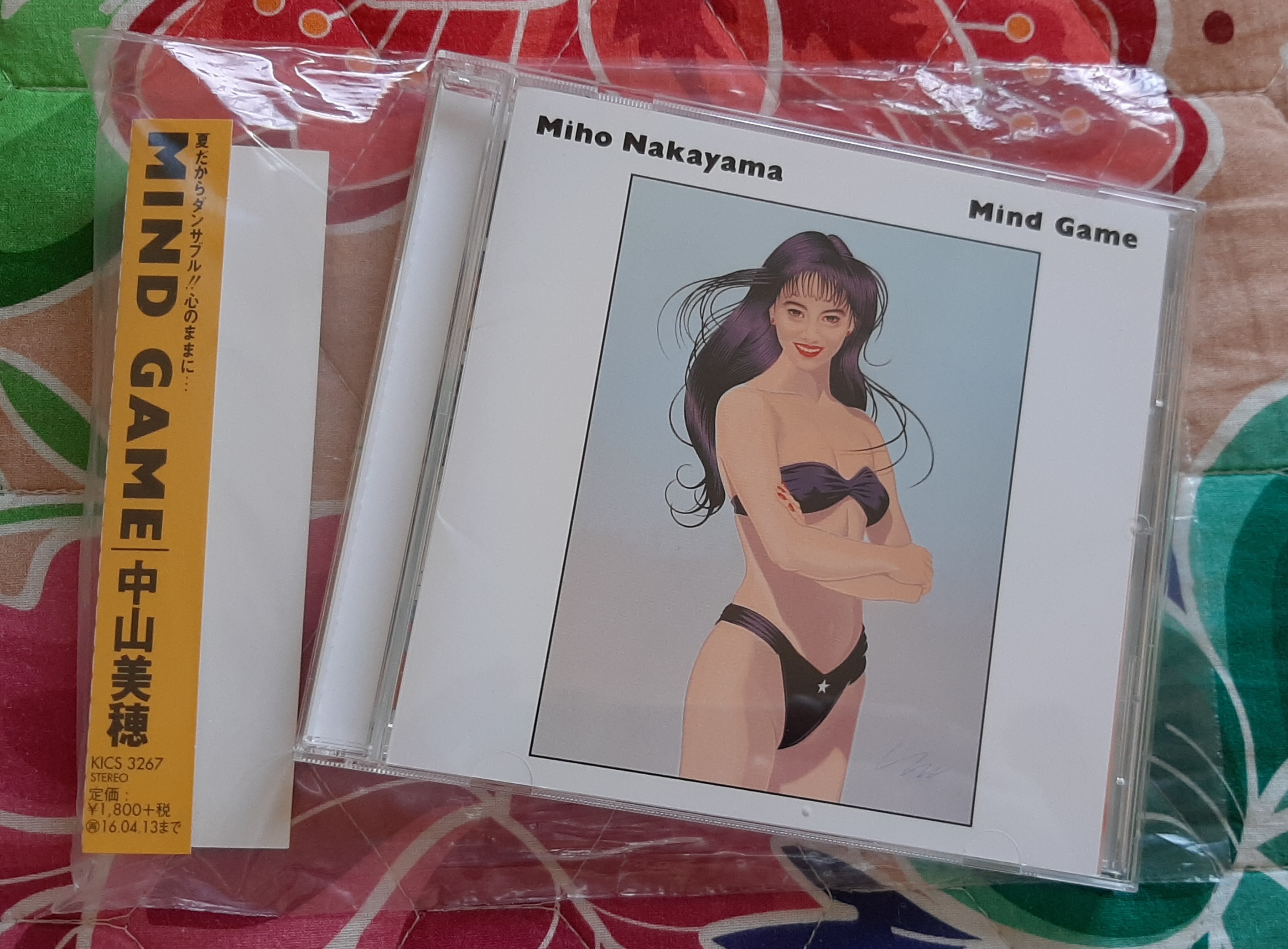
Miho Nakayama’s (中山美穂)
“CATCH THE NITE” album, which was released in February 1988, is a classic blend
of aidoru and City Pop, thanks to producer Toshiki Kadomatsu (角松敏生).
However, it was not the only great album released by Nakayama in that year,
since “Mind Game” and “angel hearts”
would also fulfill her summer and winter spot releases, respectively.
Released in July 1988,
“Mind Game” was produced by Toshinobu Kubota’s (久保田利伸)
team and I think it’s a standout album full of light and summery songs,
alongside a couple of ballads. After a short opening called “Into The Crowd”, the first proper
song, “Strange Parade”, already
establishes the album’s overall sound, a very late 80s synth-heavy pop/R&B
production. Besides the fat synth-bass and some great synth stabs, Nakayama’s
voice shines with a sultry and velvet-like singing, which became a trademark of
hers during that time, since she was not blessed with a great range and
stability (especially during live performances, but that’s not important here).
Right after, it’s “Why
Not?” dynamic sound that conquers the ears. It’s great how this song offers
some variety to the listener with its jazzy horns that during the break reminds
me of the famous Pink Panther theme song (well, just a little bit).
After the funky, yet not melodically outstanding “Cat Walk” and the tropical “Moonlight Sexy Dance”, which J-Canuck
had already covered here, it’s time for the first ballad, “In The Morning”. I like how the song evokes a romantic and languid
morning feeling, just like the title implies. It was released as a b-side to
the hit single “Ningyo-hime Mermaid”(人魚姫),
which was released at the same day of this album, and with the same cover, even
though the a-side wasn’t included on it.
Right after “In The Morning”, the album follows with
the title track “Mind Game”, which sounds
like a more robust version of “Strange Parade”, in my opinion, since they both
share this late 80s synth-heavy R&B sound. For me, the way Miho sings
“baby” in the chorus is very alluring… and well, I may sound a little bit
repetitive, but I think that’s a great quality of her in this album.
After the Cyndy-penned bossa-esque “I Know”, which J-Canuck had also
covered here, we have “Velvet Hammer”,
an upbeat and catchy pop song courtesy of Toshinobu Kubota. The guitar touches
are a nice welcome, alongside the bass and Miho’s engaging delivery not only in the chorus, but especially during the verses and pre-chorus.
Next, we have “Take
It Easy”, a song that I didn’t like very much years ago but has now become
one of my favorites from this album. Just like “Moonlight Sexy Dance”, it
introduces some tropical synths and a nice percussion break with some chants
before the last chorus. It’s a simple and light song, just like most of this
album, but it’s probably why it works so well when the listener is in the right
mood.
Another ballad, and this time a big one, “Long Distance To The Heaven” is a
strange song to be featured in a happy, summery album, since it was written and
composed by Nakayama herself for Yasuko Endo (遠藤康子),
a friend of hers who was also an artist, but committed suicide in 1986. In the
end, while it’s not my favorite ballad by Nakayama, I’ve become used to it over
the years. Again, not a song I’d put on a summer album, but it somehow works
well alongside the last song, which is a short, nostalgic and almost ethereal
one called “Husky Town”.
Finally, the controversial album cover was made by late
painter Robert Blue, which, according to Wikipedia, was famous “for his images
of pin-up girls in the 1980s and later his cowgirls of the New West series”. I
call it controversial because I’ve seen a lot of people saying the cover is
ugly and things like that on internet these days, which I disagree, since I’ve
always liked it a lot. In my opinion, it’s charming, full of personality and a
great cover for a late 80s summer album.
According to generasia, “Mind Game” reached #2 on the Oricon charts, selling over
252,000 copies. It also reached #36 on the yearly Oricon chart for 1988.
As much as Toshinobu Kubota(久保田利伸)was really funking it up in the 1990s, I think that I prefer his earlier years in the mid-1980s when he was mixing the R&B and the City Pop. In addition, there was also that wonderful voice of his.
The intro to his "Somebody's Sorrow" hit me right there and then as it goes into some light funk and soul provided by Kubota himself. Masumi Kawamura's(川村真澄)lyrics seem to throw out some tough love about not feeling sorry about oneself since at least one person will not give them the time of day if self-pity's their thing. They have to punch their own way out of the gloom. I guess in a way that this would have been the ideal sort of song for a Japanese trendy drama in the big city back then.
"Somebody's Sorrow" was a track on Kubota's debut album"Shake It Paradise" from September 1986. The album hit No. 11 on Oricon. That background chorus sounds awfully familiar and they should for Japanese pop fans of the 1980s since it is the Amazons.
In July 2017, I put up Yuko Ohtaki's(大滝裕子)first article featuring a song, "Koi no Warming Up"(恋のウォーミング アップ), which contributed to one of the world's peppiest jingles for a yogurt drink. Near the end of the article, I mentioned that later in the 1980s, she would join up with Kumi Saito(斉藤久美)and Tomoko Yoshikawa(吉川智子)to create the vocal group AMAZONS which not only put out their own albums and singles, but also helped as a backup singing trio for singers such as Toshinobu Kubota(久保田利伸)and Yumi Matsutoya(松任谷由実).
It appears that one of Japan's early funksters, Kubota, then returned the favour to AMAZONS by providing a song for them called "Suna to Diamond" (Sand and Diamonds), a track on their 1988 album"Nisemono Tengoku"(贋物天国...Fake Paradise). Composed by him and Takuo Sugiyama(杉山卓夫)with lyrics by Junko Ohyama(大山潤子), the song seems to be relating a tale of romantic cat-and-mouse between a man and a woman over a game of cards. Not sure if it's the strip variety of poker.
To be honest, I think that I actually enjoy the melody and arrangement more than the actual vocals by AMAZONS. I mean, the sultriness is there but the harmonies aren't quite perfect. However, the music stands out for its sneaky feline shuffle and the instrumentation used such as that synth-koto which reminded me of the Asian-American band Hiroshima and their "One Wish".
I only wrote about fusion band Casiopea just a couple of weeks ago with their bouncy-as-heck "Living on a Feeling" from their 1983 album"Jive Jive". Well, coming across this other Casiopea song which is just a couple of tracks away from "Living on a Feeling" at the end of the album, I simply had to give my two officially non-existent Canadian pennies on this one.
First off, do any of you folks of a certain generation remember "Don't Go Breaking My Heart"? Yup, this was a radio favourite back in the 1970s with the legendary Elton John doing that duet with English singer Kiki Dee. Listening to it and watching the video of John and Dee playing it up has brought a lot of warmth to my heart. If anything, it's been healing my heart.
Well, that last track on Casiopea's "Jive Jive" actually has Dee performing the vocals on the haunting "What Can't Speak Can't Lie". Composed and arranged by Casiopea guitarist Issei Noro(野呂一生)and written by Gary Osborne, who has also collaborated with Elton John in the past, "What Can't Speak Can't Lie" has got a cosmic soul inside all of that urban contemporary thanks to the spacey synthesizers. I mean, if Hollywood had ever decided to come up with a fusion of "2001: A Space Odyssey" and an 80s romance, this probably would have been the theme song.
Toshinobu Kubota(久保田利伸)did a cover of "What Can't Speak Can't Lie" with Casiopea one time.
In a strange way, those measured echoing beats in the song remind me of Art of Noise's cover of "Robinson Crusoe". That was one haunting theme song for a 1960s TV show.
Recently, I was able to listen to the 2nd of two original albums released by 1980s aidoru Maiko Okamoto(岡本舞子), "Fascination" (ファッシネイション)which came out in July 1986. In a past article about her, I remarked that despite her brevity in the spotlight (Okamoto was only active between 1984 and 1987), my belief was that she had quite a bit more talent in singing and in the songs that she received than she was given credit for.
Well, I think that was true for the material that she had recorded for "Fascination" which was well-titled. All of its eleven tracks (the 11th only being available on the CD) were arranged by guitarist Tsuyoshi Kon(今剛)or singer-songwriter Etsuko Yamakawa(山川恵津子), so that fact automatically perked up my ears. The first track "L.A. Lover" is pretty fascinating in itself. It was written by Goro Matsui(松井五郎)as a paean to the sunny beach life in the titular city and it was composed by J-funkster Toshinobu Kubota(久保田利伸)and Ichiro Hada(羽田一郎).
Often enough with me, unless the song just has that prototypically 80s aidoru cotton-candy arrangement, I also attach some sort of other genre Label. With "L.A. Lover", I'm not sure if I would even say that it's an aidoru tune and even with that title, I'm not sure if I would even place it as a City Pop song, either. It's just a really interesting pop number with its own bubbly groove thing and some spacey twanging in the musical ether. At the same time, though, I really get that feeling of lying on the beach blanket getting bronzed while listening to this first track.
Track 2 is the title track, "Fascination" and this one has more of the City Pop vibe to it. Written by Matsui and composed by Yamakawa, it's got the lovely synth-bass and other keyboards which would probably nominate it for Vaporwave processing if it hasn't already undergone it. Matsui's lyrics talk of the good romantic life from the 22nd floor of an apartment in what sounds like a modern resort area. Man, the setting could illustrate a City Pop album cover!
Another fascinating track is "Okubyou na Venus"(臆病なビーナス...Timid Venus) which was Okamoto's 5th single released in February 1986. Right from Note One, there is that gentle surf of AOR before the keyboards head on downtown, and when the aidoru starts singing, I immediately got that breathy vocal style and the urgent and anthemic melody of Ami Ozaki(尾崎亜美)who also provided the lyrics.
The single was also the theme song for a March 1986 OVA with the same title, and the main character of fictional aidoru Yumiko Kirita(桐田裕美子)was played by Okamoto herself while Ozaki provided the score. "Okubyou na Venus" just managed to peak at No. 91 on Oricon.
One more track that I will throw out here is "Stranger no Yoru"(ストレンジャーの夜...Night of the Stranger), and this is another City Popaidoru tune provided by the aforementioned Matsui and Yamakawa. It's shiny and slick as a car designed by Syd Mead (well, maybe I'm getting a little ahead of myself there), and putting on my kayo sommelier's hat on, I get some hints of Hall & Oates (through the keyboard riffs) and Junko Yagami(八神純子). Okamoto is singing about being thrown into a whirlwind romance and herself throwing caution to the winds. I do hope Mead designed those futuristic seat belts into that car she's riding.
Yup, "Fascination" is indeed fascinating and so I'm somewhat disappointed that the album only got up to No. 83 when it was first released. Maybe it was just a little too ahead of its time or maybe it was even behind the times in terms of mixing aidoru and City Pop, but the album was given a re-release in 2003, so I'm hoping that even now, those who have recently gotten onto the City Pop/AOR bandwagon will also realize the merits of Okamoto's final studio album. In parting, one other track on "Fascination" is her 4th single"Juu-Ichi-Gatsu no Sophia"(11月のソフィア)which has already been covered on "Kayo Kyoku Plus" and is one of her more aidoru-esque works.
Yoko's manager: Hey, Yoko? Anri just called. She'd like her style returned right now.
Just joking there. I'm sure that things were amicable if she and Anri(杏里)had ever met back then. I've known for decades that 80s aidoru Yoko Oginome(荻野目洋子)was closer to the (relatively speaking, anyways) danceable and dynamic side of teenybopper tunes when compared to the more conventional cutesiness of her contemporary Momoko Kikuchi(菊池桃子). Both have apparently dabbled into the urban contemporary genre of City Pop, though.
I'm surprised and delighted that even now that I can encounter material that I'd never heard before by singers that I've been cognizant of like the back of my hand for years. That also goes for Oginome and this song called "Lazy Dance" from her 4th original album from April 1986, "Raspberry no Kaze"(ラズベリーの風...Raspberry Wind).
This is anything but lazy. It begins with an intro that had me thinking of the stuff that Vaporwave dreams are made of, and "Lazy Dance" overall does indeed sound like something that Anri would tackle during this time, and maybe I can even pick up some Omega Tribe-friendly riffs there, too. I love the horns, especially when they strike me with that 1970s disco feeling. And don't forget that emulation of George Benson and his guitar in the middle there! Someone really went down to town on the production for this song at least.
Lyrics were by Masumi Kawamura(川村真澄)while the melody was provided by none other than Toshinobu Kubota(久保田利伸)in the really early days of his own career. Although it doesn't really sound like him, maybe he's the one behind the backing vocal of "Please don't let me be lonely tonight...". Nobuyuki Shimizu(清水信之)took care of the arrangement. As for "Raspberry no Kaze", that peaked at No. 8 on Oricon. The album also has the English version of Oginome's most famous contribution to her discography, "Dancing Hero".
Going into Hump Day today. And although it's only January, it may go down as one of the Humpiest Days this year so far on hearing that there was a massive commuter nightmare on the TTC here this morning due to a partially derailed subway, I think that the probably statistically few subway riders who had been caught up in that and actually look at "Kayo Kyoku Plus" could use something mellow to start things off.
I've been meaning to highlight this one in an article for a while now, and considering the bad traffic for many Toronto folks, perhaps this is the time for "Missing" by Toshinobu Kubota(久保田利伸). Written, composed and performed by the smooth-sounding singer, even if folks don't understand a word of Japanese, I think that this love song about the sorrow of being apart can reach anyone who's willing to give it a listen. Wouldn't mind hearing some of this soul in contemporary J-Pop someday again.
The original "Missing" was a part of Kubota's debut album"Shake It Paradise" released in September 1986 which peaked at No. 22. That album also includes "Shitsui no Downtown"(失意のダウンタウン). Above this paragraph here is a self-cover that was a part of his November 2010album"Love & Rain ~ Love Songs" that went as high as No. 11.
According to the J-Wiki article on the song itself, a long line of singers have also covered "Missing" such as Ms. OOJA (above) and Atsushi of EXILE.
That must have been quite the time for the trendy dramas in the late 1980s when the young characters enjoyed an improbably luxurious life and had jobs that were usually described in katakana such as kopiiraitaa(コピーライター)or dezaiina(デザイナー).
I found another one of those dramas tonight. Well, it's actually just the opening to be precise, but the credits for "Kimi no Hitomi wo Taiho suru!"(君の瞳をタイホする!...Your Eyes Are Under Arrest!)have that nostalgically goofy Chaplinesque appearance as trendy drama stalwarts such as Takanori Jinnai(陣内孝則), Toshiro Yanagiba(柳葉敏郎)and Atsuko Asano(浅野ゆう子)clown about (well, the first two actors anyways).
The theme song, "You Were Mine" was performed by none other than Toshinobu Kubota(久保田利伸)who was gaining a reputation as the up-and-coming funky singing dude. Compared with a lot of his later stuff, though, I think "You Were Mine" tends toward the poppier side of things, but still has a goodly dollop of that urban contemporary vibe to it. Nothing like some citified music to launch a show about happy and breezy romantic life in Tokyo. This was his 5th single released in February 1988.
Kubota took care of the music while Masumi Kawamura(川村真澄)provided the lyrics. It did very well on the charts as it made it all the way up to No. 3 on the Oricon weeklies, eventually becoming the 10th-ranked single for 1988. "You Were Mine" was also a track on his BEST compilation, "The Baddest" which was released in October 1989. That album hit No. 1 and became the 2nd-ranked album for 1989, becoming a million-seller.