Credits

I would like to give credit where credit is due. Videos are from YouTube and other sources such as NicoNico while Oricon rankings and other information are translated from the Japanese Wikipedia unless noted.
Showing posts with label Mieko Arima. Show all posts

Friday, June 12, 2026

Hi-Fi Set -- Mabushii Anata(まぶしい貴方)


For my fifth and final song for Friday, I'd been thinking of putting up that NHK theme song for the World Cup coverage that's been playing for months during the nightly sports segment, but the closest I could get was a mere TikTok excerpt. So, let's return to City Pop!

And we're going back to February 1977 when vocal trio Hi-Fi Set(ハイ・ファイ・セット)released "Love Connection" which would end up as the No. 1 album of the year. A little less than a month ago, I posted one track "Crystal Night"(クリスタル・ナイト)which had all sorts of elements of rock, disco, country and New Music. Usually, I would wait the entire month before putting in the same singer or group onto the blog.

However, I can break and bend the rules for Hi-Fi Set, especially with a No. 1 album. And with this other track from "Love Connection", it's worth it. "Mabushii Anata" which can be translated into "You Are Dazzling" (although one other YouTube video with the same song has it as "Putting It Down To The Way I Feel About You") isn't nearly as chock-filled with genre influences as its track mate "Crystal Night", but it's a straight-on nighttime breezy City Pop tune of the 1970s that would make for a pleasant drinking companion on a patio in some bar. I especially love those strings and the usual polished Hi-Fi Set harmonies.

Mieko Arima(有馬三恵子)and Kazue Ohashi(大橋一枝)provided the Japanese lyrics for the song which was composed by Ken Gold and Michael Denne with Ichizo Seo(瀬尾一三)providing the relaxing arrangement. I was curious about the composers...were they truly from America or elsewhere or were the names merely pseudonyms for coy Japanese songwriters? Well, as it turned out, after a bit of investigation, I found out that Gold and Denne were indeed bona fide songwriters who had created a song titled "You to Me Are Everything" for the British soul group The Real Thing in 1976. There's some similarity in the first verse when comparing this one to Hi-Fi Set's "Mabushii Anata" but in the end, they are different songs. Still, have a listen for comparison's sake.

Sunday, July 6, 2025

Sayuri Iwai -- Tokimeki no Kisetsu(ときめきの季節)


Yesterday, I covered aidoru Hiroko Mita's(三田寛子)August 1984 B-side song "Hatachi no Mae de"(20才の前で)which had a pretty lush arrangement in my estimation.

Well, I have another aidoru's B-side song from 1984, and by the way, welcome to KKP, Sayuri Iwai(岩井小百合)! The native of Kanagawa Prefecture had a relatively brief time as an 80s teenybopper singer with a total of 12 singles ranging from 1983 to 1987 with 4 original albums. That B-side, "Tokimeki no Kisetsu" (Season of Excitement), was on the flip side to her March 1984 6th single "Soushun Memory"(早春メモリー...Early Spring Memory), and it's one of the conventional types of aidoru tune with that gently lilting 50s love song style as Iwai swoons over falling in love for the first time. The lyricist and composer were Mieko Arima(有馬三恵子)and Kisaburo Suzuki(鈴木キサブロー) respectively.

Although Iwai's time as an aidoru was short, she's been able to continue to work in the entertainment industry for many years in roles including information variety reporter, pachinko parlour aidoru and thespian.

Wednesday, April 17, 2024

Nako Mizumura -- Suna no Onna(砂の女)


Welcome to another Hump Day on KKP! It's been a fairly dreary Wednesday so far here in Toronto. We're not getting soaked but neither are we getting any sun today.

To start off our middle-of-the-week session of "Kayo Kyoku Plus", we have another singer who's a mystery lady. I couldn't find a stitch of information about Nako Mizumura(水村なこ)outside of the fact that she did release some singles here and there, one of them being the 1971 record "Suna no Onna" (Woman in the Dunes). The melody by Yasumi Matsuo*(松尾安巳)with arrangement by Koji Makaino(馬飼野康二)has that late 1960s and early 1970s kayo rumble that I've often associated the more upbeat songs with, and it was interesting when I saw terms such as "kayo soul" and "kayo disco" to describe it. Hmmm...maybe I should have used those in Labels right from the start. In any case, if anyone out there has any information on Mizumura, please let us know. Even the Yahoo Japan search engine couldn't give me anything. By the way, Mieko Arima(有馬三恵子)came up with the lyrics.

*That first name is an educated guess by me.

Sunday, November 12, 2023

Saori Minami/Candies -- Kizutsuku Sedai(傷つく世代)


I may have mentioned this in yesterday's articles but we did get some snowflakes coming down on Saturday which had some of us grumbling. However, I think the kids probably and literally lapped them up. But yeah, winter is on its way.

This post is based on yet another old episode of "Yoru no Hit Studio"(夜のヒットスタジオ)that I caught recently. 70s aidoru Saori Minami(南沙織)appeared and this time performed a song which had a bit more of a rock punch compared to the calmer tunes I've usually associated her with such as "Soushun no Minato"(早春の港)from January 1973. In fact, "Kizutsuku Sedai" (The Hurt Generation) was the follow-up 7th single that came out in May of that year and as I just noted, it's slightly spikier with Minami frustrated at her very complicated boyfriend in a "can't live with him, can't live without him" relationship. The liner notes from her 30th anniversary memorial CD box collection "Cynthia Anthology" (2000) via J-Wiki stated that the song that expressed the feelings of a generation head-on. That must have been one cranky generation of kids.

It was definitely a popular entry in Minami's discography as it hit No. 3 on Oricon and ended up as the 35th-ranked single of 1973. Written by Mieko Arima(有馬三恵子)and composed by Kyohei Tsutsumi(筒美京平), it's also the title track of her 6th studio album "Kizutsuku Sedai" which was released just a few weeks after the single. It also broke the Top 10 by reaching No. 9. I've also noticed that the song has been placed on just about every BEST compilation that she's put out.


Aidoru group Candies(キャンディーズ)covered "Kizutsuku Sedai" in their debut album from December 1973, "Anata ni Muchuu ~ Uchiki na Candies"(あなたに夢中〜内気なキャンディーズ〜...Crazy for You - Bashful Candies). One piece of trivia that I discovered in the J-Wiki article is that when Minami appeared on the 1972 edition of NHK's Kohaku Utagassen to perform another song, a pre-debut Candies, probably without being even named yet, were her backing dancers. Speaking of that album, I've also posted an article on the title track.

Thursday, July 20, 2023

Hiromi Iwasaki -- Shi-Teki-Kuu-Kan(私・的・空・間), Part 2


Well, in another case of "Ach, my memory's going!", I completely forgot that I'd promised to have Part 2 of Hiromi Iwasaki's(岩崎宏美)"Shi-Teki-Kuu-Kan" (Personal Space) up by a few nights ago on Monday following Part 1 the previous Monday. I would have done it last night but Tom Cruise and Hayley Atwell kept me busy at their movie. Allow to make amends by taking care of things now.

Part 2 will logically go into Side B of the original LP although I'm basing this article on the 2007 issue of "Shi-Teki-Kuu-Kan" with its extra tracks. To start off, here is "Kotozuke" (ことづけ...Sending Word) which is a gently rolling pop ballad of a remembrance over a past romance. Although there doesn't seem to be any direct mention of sending messages to the old flame, Hiromi is singing that all's well with her and she hopes that the same is true of her former paramour. Mieko Arima(有馬三恵子)was the lyricist with Koji Tamaki(玉置浩二)composing and Mitsuo Hagita(萩田光雄)arranging.

Just seeing the title "Morning Breeze" had me assuming City Pop and/or J-AOR or a Febreeze spray scent. It's once again Tamaki and Hagita on composition and arrangement duties but the interesting thing is that the City Pop feeling tends to undulate throughout the song; at one point, it feels like a straight pop tune but then the chorus kinda kicks things into City Pop mode, and then the coda suddenly shifts into a different key, perhaps showing a bit of uncertainty in the romance department. This time, it's Yasushi Akimoto(秋元康)providing the lyrics of a couple enjoying the early hours rising from bed and then having breakfast. 


"Ikigai"(生きがい...Raison D'etre) has that undercurrent rhythm which reminds me of "Joanna" by Kool & The Gang, but otherwise, it's a wholly different animal. The rotation of songwriters continues here with lyricist Arima back with arranger Hagita but this time it's prolific Kyohei Tsutsumi(筒美京平)handling the melody. There's something of the Douglas Sirk melodrama imbued in "Ikigai" but if I've understood Arima's lyrics correctly, it may deal with a man and a woman...perhaps colleagues in the same company...who are sharing some secret personal time after hours but cannot afford to reveal their tryst.

The final track on the original Side B is "Higure no Martini"(日暮れのマティーニ...Martinis at Sunset) has Arima and Tsutsumi working together again but the arranger is Keiichi Oku(奥慶一). Sounding like an elegant ballad from the 1970s powered by a piano, the heroine here is sharing that titular martini with a new friend and she suddenly has this deja vu. Maybe love has come around once again? 

As I mentioned in Part 1, there are five bonus tracks on the 2007 issue of "Shi-Teki-Kuu-Kan". I covered one of them already there. Another one that I will talk about here is "Waiting" which was the B-side to "Suteki na Kimochi"(素敵な気持ち), Iwasaki's 30th single that I covered some years ago (and you can find the link to that article in the third paragraph from the top of Part 1. It's another grand contemporary pop ballad that the singer could do in her sleep with Machiko Ryu(竜真知子)behind the lyrics and Shinji Kawahara(川原伸司)as the composer under his pseudonym of Natsumi Hirai(平井夏美).

The other bonus track is "Yoake no Tenshi-tachi"(夜明けの天使たち...Sunrise Angels) and it's another B-side, this time for Iwasaki's 31st single "Shinjuu no Period"(真珠のピリオド...Pearl Period) that was actually described as the first track of "Shi-Teki-Kuu-Kan" in Part 1. Only two minutes and forty-nine seconds long, it ends rather abruptly but it's still pretty sweet and snazzy with some of that disco/City Pop and I'll always love those horns. Tsutsumi was behind the melody with Takashi Matsumoto(松本隆)handling the lyrics. For both bonus tracks here, Hagita took care of the arrangement.

Well, again, sorry for the delayed article and hope you enjoy both parts.

Monday, July 10, 2023

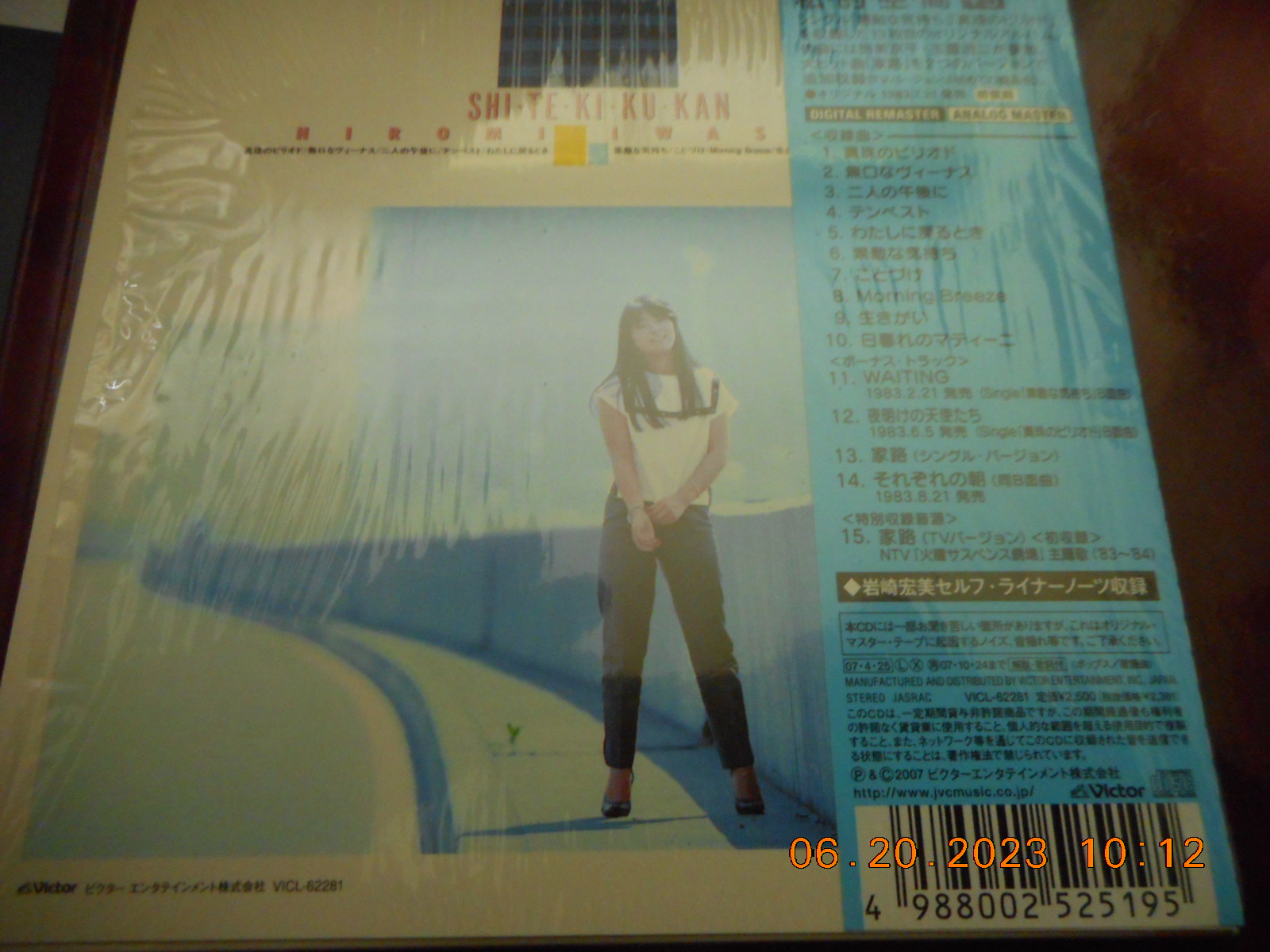
Hiromi Iwasaki -- Shi-Teki-Kuu-Kan(私・的・空・間), Part 1


I admit that I may have quickly scrolled down the Hiromi Iwasaki(岩崎宏美)file on "Kayo Kyoku Plus", but I was surprised to realize that it's almost been eight years since I actually covered one of her albums. Certainly, I've covered plenty of her individual songs in the last number of years, but the most recent album by her that I took a look at as a whole was her 1985 "Diamant"(ぎやまん)back in October 2015.

Well, allow me then to cover at least a part of her July 1983 album "Shi-Teki-Kuu-Kan" (Personal Space) tonight. I bought this one by Iwasaki several years ago and there is personal testimony from the singer herself in the liner notes. The one thing I remember the most by far from those notes is her hilariously embarrassed apologies in the second paragraph for her looking so "fat" in the photos. She took particular aim at her saggy arms and those bushy eyebrows before reassuring fans that she at least was able to upgrade herself in the years hence. Personally, she looks hot and has always looked so. End of story.

Incidentally, I'm covering the 2007 issue of "Shi-Teki-Kuu-Kan" so there are five bonus tracks including two versions of one of my favourite Hiromi songs of all time, "Ieji"  (家路)which I actually profiled years ago. I'll cover those as well but among the original tracks, the truly relaxing "Suteki na Kimochi"(素敵な気持ち)is another song that I handled back in 2015.

There's a lot to see and hear so let's begin with the first track "Shinjuu no Period"(真珠のピリオド...Pearl Period) which was Iwasaki's 31st single from June 1983. It did decently on Oricon by peaking at No. 31 and I like it because it has that snazziness as it straddles the line between pop and City Pop. I love the old-fashioned "dabba dabba" chorus as well as the sharp strings and the horns coming in. Not surprised at all then that the master songwriters behind this one were lyricist Takashi Matsumoto(松本隆), composer Kyohei Tsutsumi(筒美京平)and arranger Mitsuo Hagita(萩田光雄). Considering how this one sounds, I had assumed that "Shinjuu no Period" was yet another Iwasaki contribution to the Tuesday Night Suspense Drama on NTV like "Ieji" was. But that wasn't the case here and Matsumoto's lyrics merely relate the bittersweet late summer story of a tryst at a beach house that is to end soon, and the lovers are trying to make the best out of what little time they have left with each other.

Track 2 is the sunny 70s soulful "Mukuchi na Venus"(無口なヴィーナス...Silent Venus). Once again, Tsutsumi provides his composing prowess here as he does for two more tracks on Side A of the original LP with Keiichi Oku(奥慶一)as the arranger. The late Rei Nakanishi(なかにし礼)was the lyricist here as Iwasaki sweetly and slyly assures a paramour that all's fine and dandy in Romance City and that nothing needs to be said at all. 

There is a bit more brio in Iwasaki's vocals for Track 3, "Futari no Gogo ni"(二人の午後に...A Couple's Afternoon) with Mieko Arima(有馬三恵子)as the lyricist here while Hagita is back as arranger. We're definitely in the City Pop here. I like the layering of urban contemporary rhythm and keyboard underneath strings which paint a more romantically fantastical picture although the story is more negative as a couple go through the motions poolside even though the love dissipated a while back. Well, that's how the cake crumbles.

Not surprisingly for a title like "Tempest"(テンペスト), there's more melodic drama and rock guitar in this track which has Nakanishi, Tsutsumi and Oku working together. My mind pegs this one as a theme song for a detective show although once again such was not the case. Still, the tempest isn't only occurring outside but inside a hotel where a woman is anticipating an affair is about to turn a critical corner into permanent changes. 

The final track on Side A is "Watashi ni Modoru Toki"(わたしに戻るとき...Getting Back to Me) has me getting some 80s Steve Winwood vibes. And this time, I also feel some West Coast AOR with the electric guitar thrown in there. Hagita is back but for this one, Kazuko Katagiri(片桐和子)was responsible for the lyrics for this jaunty love song. One other thing is that instead of Tsutsumi composing the tune, it was Anzen Chitai's(安全地帯)Koji Tamaki(玉置浩二)coming up with the melody. Iwasaki noted Tamaki's assistance in the liner notes and that he also composed a couple of other tracks on Side B. The singer noted that Tamaki's three contributions to "Shi-Teki-Kuu-Kan" were just before his band made it big with "Wine-Red no Kokoro"(ワインレッドの心)in that same year. Additionally, she remarked that Tamaki was dressed to the nines a la Humphrey Bogart right down to the fedora (usually apparently most songwriters would come over as casual as possible); he even sported an attaché case. Maybe he was trying to impress her; I have no idea.

To finish off Part 1 (Part 2 will be next week), I'm leaving the article with one of the bonus tracks "Sorezore no Asa"(それぞれの朝...Each Morning) which was the B-side to "Ieji". I actually first heard this song on an episode of that old CHIN-FM radio program "Sounds of Japan" and it sounded so beautiful despite all of the hissing and spitting of bad reception that I searched for years for the title of the tune. Kaoru Ito(伊藤薫)was both the lyricist and composer for this ballad that sounds like a lullaby for children. In point of fact though, it is a melancholy ballad about the end of a relationship signalled openly with phrases like "the end of love" and more tacitly with one line stating the coming of fall. To hammer the final nail in, there is a very morose harp playing there along with some splendid strings playing in the bridge. "Sorezore no Asa" will never get anywhere near a wedding reception but it's still a wonderful song.

Anyways, Part 2 will be here next Monday.

Wednesday, October 19, 2022

Saori Minami/Megumi Asaoka/Mariko Takahashi -- Irozuku Machi(色づく街)


Unfortunately, the above photo is a poor one (especially since it was taken in 2019) to illustrate the fact that this autumn has been seen to have one of the more vibrant outputs of colour in recent years. Scientists have placed credit on a seeming perfect storm of meteorological factors. So, I gather for all of those Torontonian photographers, get those shots of trees and leaves when you can since I'm pretty certain that by Halloween, a lot of the flaming foliage will be on the ground...perhaps under some snow.

On last night's episode of "Uta Con"(うたコン), the show did place a bit of emphasis on the fall-themed kayo. And I got to be acquainted with a Saori Minami(南沙織)song that I hadn't heard before or at least hadn't heard in a very long time. "Irozuku Machi" (The Colourful Streets) was featured, and this was the 70s aidoru's 9th single from August 1973.

Written by Mieko Arima(有馬三恵子)and composed/arranged by Kyohei Tsutsumi(筒美京平), it's a light and fairly frisky aidoru tune of the times by Minami who sings about a young girl whose heart is filled with regret after a romantic breakup. Well, autumn is the time for such things, at least according to all of those kayo songwriters. In terms of Tsutsumi's arrangement, I'm gathering that along with the Fender Rhodes of City Pop, the growling electric guitar of contemporary enka and the bluesy saxophone of Mood Kayo, those plucky strings in "Irozuku Machi" have been rather emblematic of those 70s aidoru songs or pop tunes in general during the early part of that decade. Moreover, if I am going to be specific about instrumentation here, then I also have to mention that electric organ and bass in Minami's original song since they lend a certain French swing.

"Irozuku Machi" hit No. 4 on Oricon and ended up as the 37th-ranked single of 1973. It also got Minami to appear on NHK's Kohaku Utagassen for her third of eight appearances on the New Year's Eve special. Her eighth and final appearance in 1991, which was her first time on the program in fourteen years, had her sing that same song. It was also a track on Minami's 7th album "Hatachi Mae"(20才まえ...Before Turning 20)from September 1973 which peaked at No. 5 on the album charts.

The J-Wiki article for the song mentioned that it has become a kayo classic throughout the decades with everyone from newbie aidoru to veteran singers covering it. One of the earliest examples of this was via Megumi Asaoka's(麻丘めぐみ)cover in 1974 via her album "Golden Deluxe"(ゴールデン・デラックス). The arrangement doesn't seem to be all that different from Minami's original version.

However, I did find a very dramatically different cover by smoky-voiced chanteuse Mariko Takahashi(高橋真梨子)through her 1989 album of covers, "Sha"(紗...Silky Gauze). This time, "Irozuku Machi" has been taken off the autumn streets of Tokyo and whisked off to the romantic settings of Rio as the song is given a bossa jazz treatment. My compliments to the arranger.

Also from the J-Wiki article for "Irozuku Machi", it was learned on a 2000 episode of the NTV newsmagazine series "Super Terebi Jouhou Saizensen"(スーパーテレビ情報最前線...Super TV Information Cutting Edge) that teenager Noriko Kamachi(蒲池法子)had recorded at least some of Minami's trademark tune on a demo tape, just before she made her debut as aidoru Seiko Matsuda(松田聖子). I can only speculate that the year commemorated Seiko-chan's 20th anniversary in show business, thus the revelation. Unfortunately, the video has been taken down.

Saturday, September 24, 2022

Miyuki Fujikawa -- Asa(朝)

idol.ne.jp

Once again, I've come across a singer who was basically one-and-done with the accompanying dearth of any information whatsoever. What little I could find was through "idol.ne.jp" once more, and it only mentions that Miyuki Fujikawa(藤川みゆき)was born in September 1955 in the city of Kobe.

As I mentioned, according to that website, Fujikawa only released one single called "Asa" (The Morning) in March 1975. Although it didn't mention whether she was an aidoru or not, I can glean from her age and her vocals that she was probably treated as a teenybopper singer. Written by Mieko Arima(有馬三恵子)and composed by Masaaki Hirao(平尾昌晃), there is that 1970s aidoru feeling but at the same time, that soprano saxophone and the bass made me wonder whether there was some Mood Kayo thrown in as well.

That was all she wrote about Fujikawa. Since the above video has no display of what she looked like, I have put up a copy of the cover of "Asa" at the top.

Saturday, March 12, 2022

Betty & Petty -- Sasowarete Scandal(誘われてスキャンダル)/Chianti -- Ano Hito no Ashioto(あの人の足音)


On this Saturday night, we once again dive into the mountain of obscure 80s aidoru, and just to let you know right off the bat, the title above doesn't refer to two different aidoru groups but the same one with a name change.

Many years ago, I wrote up an article on a late 1970s aidoru group called Gyaru(ギャル)and over there I gave the lineup of the original members. However, there was one addition when one of those originals had left in 1978. Akiyo Nakaseko(中世古明代)joined up for that brief remaining time until Gyaru called it a day in 1979. But then in 1980, Nakaseko partnered with Kyoko Tsuda(津田京子)to form the aidoru duo Betty & Petty(ベティ&ペティ).

Betty & Petty put out a debut single in July 1980 titled "Sasowarete Scandal" (Invite Me, Scandal) which starts off with a streak of sky-high West Coast AOR before changing to a bit of Candies-like summery aidoru music, especially when the harmonies pour on in to sing out "scandal". Kaoru Ito(伊藤薫)was responsible for both words and music. 

Following their second single, though, Betty & Petty changed their name to Chianti(キャンティ). Not sure whether the name change into that of an Italian wine meant a similar transformation in their style but I have to admit on listening to the B-side, "Ano Hito no Ashioto" (His Footsteps), of their 1983 5th single "Shirakattano"(知らなかったの...I Didn't Know), it was quite the change at least for this particular song. Instead of channeling Candies, Nakaseko and Tsuda opted for the less cutesy and more elegant stylings of an older duo, The Peanuts(ピーナッツ). In fact, I've even decided to also categorize "Ano no Ashioto" as a Mood Kayo because of that arrangement. The lyrics were written by Mieko Arima(有馬三恵子)and the music was provided by Jun Suzuki(鈴木淳).

According to "Idol.ne.jp", there was one more single in 1984 by Chianti before they broke up. I'm not certain whether the duo produced an album.

Sunday, October 31, 2021

The Works of Makoto Kawaguchi(川口真)


I only found out the news a few days ago via a chance Twitter browsing and then it was further reiterated by commenter Jim Laker, but unfortunately another veteran songwriter has left this mortal coil. Composer and arranger Makoto Kawaguchi passed away at the age of 83 on October 20th due to sepsis.

Kawaguchi has had a fairly long list of songs represented on "Kayo Kyoku Plus", but I've yet to come across any official media reports of his death on YouTube which is unusual. There have been a few personal YouTube accounts that did cite his passing but for a composer like Kawaguchi who did create a lot of classic kayo including Mieko Hirota's(弘田三枝子)1969 "Ningyo no Ie"(人形の家)above, it's a little surprising that NHK hasn't mentioned anything although perhaps some of the commercial networks may have done so. 


The composer/arranger was born Masahiro Kawaguchi(川口眞弘)in the city of Kobe on November 5th 1937 but grew up in the city of Kurashiki, Okayama Prefecture. According to his J-Wiki profile, while studying in the Music Department at Tokyo University of the Arts, he became a part of chanson singer Fubuki Koshiji's(越路吹雪)backing band Claire de Charme as a pianist and then worked part time for composer Taku Izumi's(いずみたく)office. Kawaguchi dropped out of university in his senior year seeing that his job was becoming more of a full-time gig. 

Although in 1966, he helped arrange The Ventures' version of "Futari no Ginza"(二人の銀座), his official debut as a composer was in 1969 with the successful "Ningyo no Ie" with Rei Nakanishi(なかにし礼) providing the lyrics. "Ningyo no Ie" was Kawaguchi's third-most successful creation which was followed by Saori Yuki's(由紀さおり)1970 hit "Tegami"(手紙)and Akira Fuse's(布施明)1974 hit "Tsumiki no Heya" (積木の部屋)at No. 1 and No. 2 respectively.

I haven't really delved too deeply into what made Kawaguchi tick in terms of his preferences for songs but my surface impression at this writing is that in the early part of his career at least, he seems to have been drawn into the darker or sadder aspects of romance just judging from the songs including the ones above. Basically, he composed his music in the kayo realm with some stretches into aidoru and tokusatsu and even City Pop.

I'd like to introduce some of the other songs that Kawaguchi created that I had yet to put onto KKP, beginning with the late Kiyohiko Ozaki's(尾崎紀世彦)July 1971 "Sayonara wo Mou Ichido"(さよならをもう一度...Farewell, One More Time), the great singer's follow-up single to the iconic "Mata Au Hi Made"(また逢う日まで). With lyrics by Yu Aku(阿久悠), a frequent songwriting partner, I guess that another observation is that Kawaguchi liked to go brassy and proud with his compositions, and that fit hand-in-glove with the booming voices of Ozaki and, for that matter, the aforementioned Fuse.

"Sayonara wo Mou Ichido" is the tough-but-tender song of sweet parting since although the couple may not have Paris, they will always have tomorrow to get back together to talk of old times. The arrangement is indeed brassy and proud, and the song reminds me of folks like Tom Jones and Englebert Humperdinck. With an Oricon weekly ranking of No. 2 and an end-of-year ranking of No. 14, I'm sure that all involved were very proud of this one.

In the previous year, Aku and Kawaguchi had teamed up to provide Teruhiko Saigo(西郷輝彦)with his August 1970 56th single, "Manatsu no Arashi"(真夏のあらし...Midsummer Maelstrom), a story of being majorly distracted by the beautiful bodies around during the hot (and bothered) season. I believe that I mentioned Tom Jones above; well, I think that this is the wilder side of Jones singing through Saigo, and if I may be so bold, I think that Saigo's performance is rather similar to what soon-to-arrive Hideki Saijo(西城秀樹)would bring to the kayo zeitgeist of the decade. Strangely enough, Kawaguchi would compose songs for Saijo soon enough.

(5:07)

Kawaguchi delved into the aidoru realm alongside lyricist Mieko Arima(有馬三恵子)for 70s teenybopper singer Yuko Asano(浅野ゆう子)for a couple of songs, her debut single "Tobidase Hatsukoi"(とびだせ初恋)and the follow-up, "Koi wa Dan Dan"(恋はダン・ダン), both released in 1974. Asano's third and final single for that year was "Hitoribocchi no Kisetsu"(ひとりぽっちの季節...A Season of Loneliness) from December. Once again, tackled by Kawaguchi and Arima, those strings and what I think are an ocarina and an accordion bring forward a lot of spring innocence from a case of puppy love that doesn't seem to be heading to its happy end. 

One more song that I'll put up on his tribute here is "Doyoubi no Cinderella"(土曜日のシンデレラ...Saturday Cinderella) sung by Sawako Kitahara(北原佐和子)as her 3rd single in September 1982. It's another aidoru tune and the arrangement is perfectly suited to the time of the early 80s teenyboppers, with the swift strings this time and the jingly synthesizers. This time, Kawaguchi's songwriting partner was lyricist Masako Arikawa(有川正沙子)whose words almost make me wish the title was more along the lines of "The Taming of the Cinderella" as a young lady is, comically and physically or figuratively, poking a strong finger into her Prince Charming and demanding where the love and the glass slipper are. Again, I haven't explored the world of Kawaguchi in full but at first blush, it's remarkable how his melodies may have adjusted for the times and demands in music. Still, lyrically speaking, this seems to be along the lines of Kawaguchi's attraction to the not-so-happy themes in love.

Of course, there are the other Kawaguchi creations that you can cruise through under his name in the Labels section, but also if your Japanese ability is up to it, you can also look through his J-Wiki profile for a more complete list of his compositions. I never even touched his arrangements which is a separate list. Regardless, his accomplishments since the 1960s merit a tribute in kayo history.

Saturday, February 6, 2021

Masaki Niwa -- Le Ladies Hotel(ル・レディース・ホテル)


Often within the grand sphere of kayo kyoku, there are those songs that deal with heartbreak and the need for some change in scenery, accomplished through travel. Off the top of my head, there is the example of Sayuri Ishikawa's(石川さゆり)"Tsugaru Kaikyo Fuyu Geshiki" (津軽海峡・冬景色)in which the protagonist leaves for her old hometown in Hokkaido after breaking up with her boyfriend in Tokyo.

Well, singer-songwriter Masaki Niwa(丹羽応樹)has come up with a similarly-toned song but it's not an enka and the message of love gone wrong isn't quite as intense in this one.

This is "Le Ladies Hotel" which is essentially the title track from her 1979 album "Ladies Hotel"(レディース・ホテル). With music and arrangement by Niwa and lyrics by Mieko Arima(有馬三恵子), the song isn't so much about a geographical area but a specific special hotel somewhere where women who are suffering from the romantic blues can go, relax and recover. I'm assuming that the place has a really good restaurant, bar and an onsen.

As I mentioned, this isn't an enka at all and in fact I would posit that this is more of a New Music tune with a folksy French twist (the French article in the title pretty much bonks that theory right into my head). I actually got some Mayumi Itsuwa(五輪真弓)vibes from listening to it. Moreover, it doesn't really sound very maudlin. Instead, it just comes across as worthy of a sigh and one "C'est la vie!" after checking in at the hotel and then immediately enjoying the fancy amenities that such an establishment would offer.

Thursday, February 20, 2020

Jun Fubuki -- Ai ga Hajimaru Toki(愛がはじまる時)


Actress Jun Fubuki(風吹ジュン)is one of those veteran celebrities who has been around so long that I hadn't been aware that she even had a singing career. Well, to be honest, with her J-Wiki article stating only 4 singles and 2 original albums in the mid-1970s followed by a compilation album of all of her singles together, it wasn't exactly a very long run behind the mike. My memory of her really only involved her appearances in commercials. 


And so was her debut single, "Ai ga Hajimaru Toki" (When Love Begins) which was released in May of that year. When I first listened to this one, I actually thought that Fubuki was an aidoru with the somewhat off-tune delivery, but she was groomed to be a regular singer. I mean, it's cute enough but I guess that I can't be surprised that she left singing fairly quickly. Mieko Arima(有馬三恵子)and Masaaki Hirao(平尾昌晃)were the songwriters behind this song. Incidentally, Hirao was the fellow who had introduced Hong Kong-born Agnes Chan(アグネス・チャン)to Japan a few years earlier, and there is something rather Agnes-like with Fubuki's singing, so I wonder whether he was thinking about lightning striking twice.


I found out that Jun Fubuki is a stage name. According to the 1981 book "Cinema Koseiha Land"(シネマ個性派ランド...Cinema One-of-a-Kind Land) via J-Wiki, the person who decided on her new identity chose the family name Fubuki from the phrase "Kaze ni fukareta you ni detekita"かれたように出てきた......came in like the wind). As for her given name, Jun, the person simply liked the sound of it (perhaps the fact that it has the same pronunciation as the summery 6th month may have also been a factor). Although it wasn't given in J-Wiki, when I did the hunt for her birth name on Yahoo.jp, the search engine flung out in huge letters, Reiko Horikawa(堀川麗子)with one site adding another family name, possibly after her parents' divorce, and then her married name.


Speaking about celebrities who I hadn't known were singers early in their career, actress Yuko Asano(浅野ゆう子)impersonated Fubuki with her own rendition of "Ai ga Hajimaru Toki".

Thursday, June 13, 2019

Yukari Ito -- Ano Hito no Ashioto(あの人の足音)


Last month, I had put out an APB on that mysterious song that Yukari Ito(伊東ゆかり)had performed on what was probably a B-movie spy caper titled "Five Golden Dragons". Despite doing some searching, I still haven't been able to nail down the identity of that song, and so I'm thinking that maybe it was indeed just something that had been put together for just that movie. Perhaps it doesn't even have an officially-known title. But let's see what the future holds.


As I was doing that initial search via YouTube and J-Wiki, I tried out this September 1967 single by Ito titled "Ano Hito no Ashioto" (That Man's Footsteps). As it turned out, it wasn't the song from "Five Golden Dragons" but it has a similarly romantic Mood Kayo tone with some fine brass.

Written by Mieko Arima(有馬三恵子)and composed by Jun Suzuki(鈴木淳), "Ano Hito no Ashioto" is a slightly mournful ballad about a woman who misses the love of her life dearly and knows him so well that she can peg him just from the sound of his footsteps. No idea about what happened to the lad but regrettably for Ito, it sounds like he may be gone for good. I can just envisage her standing at the end of some foggy pier at night, just to bring in that well-worn Mood Kayo trope.

Thursday, January 31, 2019

Saori Minami -- Shiokaze no Melody(潮風のメロディ)


For readers of "Kayo Kyoku Plus" in much of North America currently, you may be ardently swooning over summer pictures like the above (although this was actually taken in October). Yes, that Polar Vortex of petrifying cold must be having you feeling lower than a centipede's pot belly. Over the last few days, I've been keeping my errands outside to a minimum. I get out to do one task and then get back inside. The nice thing is that temperatures ought to be rising up to a torrid -1 degree Celsius at least by this weekend, and up to a heavenly 7 degrees by next Monday.


Well, there's always the Fireplace Channel on cable for some of that lovely placebo effect or you can give Saori Minami(南沙織)a try through her 2nd single "Shiokaze no Melody" (Sea Breeze Melody). Released in October 1971 (perhaps the song was trying to keep those happy summery feelings alive), right from Note One, it's all warm winds and sunny sea coast as Minami recounts a romance by the ocean.

"Shiokaze no Melody" was written by Mieko Arima(有馬三恵子)and composed by Kyohei Tsutsumi(筒美京平)and had Minami performing it on a number of shows including music programs and even some dramas through cameo appearances, according to J-Wiki. Also, I gotta say that maybe the song provided one of the first music videos for a Japanese singer. The single peaked at No. 7 and ended up as the 91st-ranked song for 1971 and held on for another year to become the 99th-ranked single.


It was also the title track for Minami's first album of cover songs released in December 1971 as it broke the Top 10 at No. 10 on the Oricon weeklies. To end this, I've gotta make this rather bizarre statement and say that Minami on that cover for the album looks a fair bit like actress Chloe Bennet from "Agents of SHIELD".

Sunday, April 29, 2018

Yuko Asano -- Koi wa Dan Dan(恋はダン・ダン)


Somewhat belated news but I heard about actress Yuko Asano(浅野ゆう子)getting married late last year with the announcement coming out in early January of this year 2018. So many congratulations to her and the lucky fellow who is just a civilian not involved in the entertainment industry.


Well, I can't just let this piece of happiness go by without paying some tribute to the happy couple. And sure enough, I found this cute little song about love titled "Koi wa Dan Dan" (Love is B-Bump) which was Asano's 2nd single when she had been an aidoru. She was all of 14 years old when she released this ditty of a girl trying to make the leap to some more mature love.

"Koi wa Dan Dan" came out in August 1974. It was written by Mieko Arima(有馬三恵子)and composed by Makoto Kawaguchi(川口真), the same duo behind Asano's debut single "Tobidase Hatsukoi"(とびだせ初恋)which had come out in May of the same year.

Wednesday, April 11, 2018

Lili Iwabuchi -- Tonari no Otoko no Ko(隣の男の子)


About a week ago, I wrote about "Salvia no Hana"(サルビアの花), a folk song that I first heard by Lili Iwabuchi(岩渕リリ)on "Good Times Diva Volume 2" but couldn't find any hint of her version on YouTube. Instead, I found a few others including the original songwriter behind the song who had done their covers.


However, curious as I was, I wanted to see if I could track down a Lili Iwabuchi tune on YouTube, and it didn't take too long at all. As I mentioned in the article for "Salvia no Hana", she didn't have a long career...just 4 singles and 1 album up to 1973.

Single No. 3 was "Tonari no Otoko no Ko" (The Boy Next Door) from October 1972. As was the case with her "Salvia no Hana", Iwabuchi has a nice bell-like voice against the sweet arrangement which makes me wonder why she didn't go past 1973 in terms of her time in showbiz. Mieko Arima(有馬三恵子)took care of the lyrics while Masahiko Aoi(葵まさひこ)of the chorus group Honey Knights(ハニー・ナイツ)composed the song.

Thursday, February 16, 2017

Saori Minami -- Tomodachi (ともだち)


Took the night off last night since I was extremely tired from some large chunks of translation work that have been landing on me during this month. In fact, I'm still working but I made it a policy to stop at 7pm for sanity's sake. However I'm very grateful to Noelle and Marcos for putting up their respective articles on Wednesday. After reading the two of them, I'm awfully tempted to listen to one album again and buy the other.

Also, just to get my mind off work, I go to one of my hobbies which happens to be this blog.


First off, let me tell you something I do first thing in the morning. No...it doesn't always involve flushing. Actually when I wake up, I often find the TV already on with the channel set to TV Japan, and before NHK's "Newswatch 9", there is an English conversation study program titled "Shigoto no Kiso Eigo"(しごとの基礎英語...Standard English for Work). It always involves the learning of some business English phrases in the setting of a fictional corporation based in Japan with the mixture of sitcom-friendly native English speakers and Japanese staffers who are fairly fluent in their second language themselves.

Now, the program, and its other cousins, have been on for a few years now at 7:55 am, and with "Shigoto no Kiso Eigo", the star of the show happens to be this fellow named Aki who's not quite as fluent as his comrades in the company. Well, a few days ago, my mother asked me if I knew who he was. As I said, I have been very familiar with Aki since he not only stars in this English conversation show but also appears sometimes as a reporter on the other NHK program "Asaichi"(あさイチ). So I figured that Mom had some trivia for me.

Well, I got out of my groggy state fairly quickly that morning when she told me that Aki happens to be actor/tarento Akinobu Shinoyama(篠山輝信). He is the son of famed photographer Kishin Shinoyama(篠山紀信)and former aidoru Saori Minami(南沙織)....yep, the same one who had gotten her fame right from the get-go with "Juu-nana Sai"(17才)all those decades ago.

So on that note, perhaps it's time to put in a Minami song tonight. Here is "Tomodachi" (Friends), a nice and breezy tune about that familiar pop cultural trope of a girl in love with a guy but, gosh darn it, can't string the words together to tell him how she feels.

Written by Mieko Arima(有馬三恵子)and composed by Kyohei Tsutsumi(筒美京平), "Tomodachi" has that typical early 70s sound of happy-go-lucky. However, those strings sound almost downright disco at times. Gives the song some extra juice, and the horns provide a bit of a comical touch to the proceedings. Although I don't think Minami's 3rd single from February 1972 was ever used as such, it could have become a theme for a family comedy-drama.

A few nights ago, I wrote an article about Chiyoko Shimakura(島倉千代子)and how her song came about due to something that was connected with her personally. Well, the same thing was true about Saori Minami and "Tomodachi". At the time of her stardom, Minami had been living out of hotels and confessed to her staff around her that it was difficult to make close friends. From that spark, "Tomodachi" got its genesis. The song managed to get as high as No. 7 on the weekly charts and would eventually be ranked No. 55 for 1972. It was also included on her 3rd studio album "Junketsu/Tomodachi"(純潔/ともだち...Purity/Friends)which was released later in June. That album peaked at No. 2.

One wonders if Aki's Mom will make a surprise cameo on that English conversation program and show him up!

Saturday, November 26, 2016

Yuko Asano -- Tobidase Hatsukoi (とびだせ初恋)


As I intimated for my other article on actress Yuko Asano(浅野ゆう子), I first got to know her through all those sparkly trendy dramas that she starred in the late 1980s and early 1990s such as the one above, "Dakishimetai!"(抱きしめたい!...I Wanna Hold Your Hand). With the face and body of a model but with the temperament of a good buddy, it was no surprise about how popular she became as the face of the trendy drama. Plus there was that whole Double Asano fad whenever she appeared with fellow thespian and fellow beauty Atsuko Asano(浅野温子), although they weren't related to each other...Yuko Asano was actually born Yuko Akazawa(赤沢裕子)in 1960.


So I had to play some catchup when I discovered that she had once owned a career as an aidoru in the early 1970s. In fact, I managed to find a short version of her debut single "Tobidase Hatsukoi" (Jump Out, First Love) from May 1974. Yep, she's doing the cute teenybopper thing but the thing that floored me was that she was just at the higher end of 13 when she released this song! I'm looking at that video above and trying to wrap my head around the fact that she was just barely into adolescence as she was go-go dancing.


Mieko Arima(有馬三恵子)took care of the lyrics while Makoto Kawaguchi(川口真)composed the light and fluffy tune. Of course, her biggest hit would be "Sexy Bus Stop"  a couple of years later.


Tuesday, April 21, 2015

Saori Minami/Hiromi Iwasaki -- Soushun no Minato (早春の港)


If there is one thing that I used to tell students when they were inquired about the weather in Toronto, I always said "Predictably unpredictable". Catching the weather forecast every morning is a must. And this week is definitely one of those meteorologically wacky times. We were enjoying some seasonably spring weather but the temps are about to drop like the proverbial rock as we go further into the week, and there may even be snow (shudder). My anime buddy won't even change from snow tires until May, just to be sure.


Anyways, let's bring something a bit more seasonally appropriate here with Saori Minami's(南沙織)"Soushun no Minato" (Early Spring Harbour). It's actually been quite a few years since I've put up one of her tunes. Aside from her really big hit of "Juu-Nana Sai"(17才), I never really got to know her all that well, but I decided to listen to the 1973 edition of "Seishun Uta Nenkan"(青春歌年鑑), and came across this song on Disc 1. There were quite a few of Minami's tunes on this album.

"Soushun no Minato" is another sepia-toned kayo that brings an image of walking along the beach during a breezy and comfy spring day (the sound of waves crashing helps a lot). The Kyohei Tsutsumi-penned melody(筒美京平)including flute and steel guitar just brings that warm and mellow feeling as Mieko Arima's(有馬三恵子)lyrics about that woman pining for that far-off fellow are delivered by Minami in a honeyed voice that sounds a whole lot more mature than her age at that time of 18 or 19 years.

According to the J-Wiki article on the song, the song had had a previous incarnation as "Furusato no You ni"(ふるさとのように...Just Like Home) from a previous 1972 album of hers "Soushun no Harmony"(早春のハーモニー...Early Spring Harmony), but when it was decided that there would be a version of it coming out as an official single, the powers-that-be revised the lyrics and arrangement. "Soushun no Minato", by the way, was also a track on her 6th album from May 1973, "Kizu Tsuku Sedai"(傷つく世代...The Hurt Generation) which peaked at No. 9

Released in January 1973, "Soushun no Minato" almost broke the Top 10 by coming in at No. 11 and finished as the 79th-ranked song of the year. Popular folk singer Takuro Yoshida(吉田拓郎)was so impressed by the song when he heard it on the radio that he penned an answer song over 18 months later with help from Hiroshi Kamayatsu(かまやつひろし)under the title of "Cynthia" (シンシア)which happens to be Minami's English name. 


Then we have Hiromi Iwasaki's(岩崎宏美)wonderful cover of "Soushun no Minato" from her 2003 "Dear Friend II" album. If there were anyone who could match Minami or even exceed her with this song, it would be Iwasaki. Her voice here sounds as if it hadn't changed in 20 years, and I guess it's the low and mellow vocals of both her and Minami that sell the relaxation in the song. There's even more of an exotic element in her version with what sounds more like a mandolin than a steel guitar. That beach may have been in Greece rather than Japan. In any case, I could use some more of the sunny countenance in these old kayo to get through some of the rain and cold of this week.

Tuesday, August 26, 2014

Katsuko Kanai/Akina Nakamori/Yo Hitoto -- Tanin no Kankei (他人の関係)


Just like Teppei Shibuya's(渋谷哲平)"Deep", Katsuko Kanai's(金井克子)"Tanin no Kankei" (Relationship with the Other Woman) was a kayo kyoku that I'd found out about through the comic duo, Tunnels, on their Thursday night show. The guys always loved to take a poke at some of the old songs especially if the singer had a rather distinctive set of choreographic moves, and Kanai was definitely one beloved target.

"Tanin no Kankei" is a kayo classic partially because of the opening "pa pa paya pa" scat and Kanai's right-hand signaling. I think when it comes to the 70s stuff, that performance puts it on a par with any of the Pink Lady hits in terms of instant recognition. And considering that it was from the early 70s, the conspiratorial jazzy music by Makoto Kawaguchi(川口真)makes "Tanin no Kankei" sound like something from a decade before. Mieko Arima's (有馬三恵子)lyrics about a woman stating her relationship with a guy who makes two-timing a regular hobby evokes a lot of images of seedy lounges and bars.


Kanai's 31st single was her lone big hit out of the 42 records she released between 1962 and 1982. Debuting with "Hapsburg Serenade", the Tianjin-born, Osaka-raised singer started out in ballet before entering show business as a model. As with the above video from the early 60s, she both sang and danced in her appearances, and watching her here, she reminded me a bit of the young Shirley MacLaine.

She appeared in the 1966 and 1967 Kohaku Utagassen, and apparently earned the perhaps undesired label of being the first performer in the history of the NHK New Year's Eve special to show a bit too much underwear. I don't have that video unfortunately.

There was one more appearance by her on the Kohaku and that was in 1973 for "Tanin no Kankei" which was released in March. It was her only Top 10 hit, reaching No. 7 and becoming the 31st-ranked single of the year. It also won a prize at The Japan Record Awards.


Akina Nakamori(中森明菜)gave a pretty smoky cover version of "Tanin no Kankei" when she released "Mood Kayo -- Utahime Showa Meikyokushu"(ムード歌謡 〜歌姫昭和名曲集...Showa Divas' Famous Song Collection)(peaked at No. 30) in 2009. Maybe it's my imagination, but she sounded a fair bit like Momoe Yamaguchi(山口百恵).


And then singer Yo Hitoto(一青窈)will release her most recent 19th single (August 27th...tomorrow at the time of this writing) in the form of this song. This version seems to have more of the funk in there. Of course, Yo Hitoto has some famous past hits from the past decade so I will be covering those soon enough.