I've been a fan of Japanese popular music for 40 years, and have managed to collect a lot of material during that time. So I decided I wanted to talk about Showa Era music with like-minded fans. My particular era is the 70s and 80s (thus the "kayo kyoku"). The plus part includes a number of songs and artists from the last 30 years and also the early kayo. So, let's talk about New Music, aidoru, City Pop and enka.
Credits
I would like to give credit where credit is due. Videos are from YouTube and other sources such as NicoNico while Oricon rankings and other information are translated from the Japanese Wikipedia unless noted.
Wow! All this time knowing the song "Akai Sweet Pea"(Red Sweet Pea) by Seiko Matsuda(松田聖子)and the above 1910 painting is the first time I get to see a real red sweet pea. This is by Edward H. Mitchell (1867–1932) and it's in the public domain according to Wikimedia Commons.
One other thing that I found out on the first episode of "Uta Con"(うたコン)in 2026 last night was that "Akai Sweet Pea" is celebrating its 44th anniversary today since its release in 1982. Well, of course, I wrote up an article on one of Seiko-chan's evergreen hits all the way back in 2012 so I can't really repeat myself. However, I did look up the many cover versions of "Akai Sweet Pea" via J-Wiki and found this one.
It is indeed a very sweet version via the December 2020 album "VOICE ~ Seiyuu-tachi ga Utau Matsuda Seiko Song ~ Female Edition"(VOICE〜声優たちが歌う松田聖子ソング〜 Female Edition...Voice Actresses Sing the Songs of Seiko Matsuda). As the title says, a whole bunch of the big guns in the anime voice actress industry came together to provide their own versions of Matsuda's music. Their take on "Akai Sweet Pea" is the 12th and final track on the album and it is an appropriately stately but adorable cover sung by all of the seiyuu involved in the project to wrap things up: Aki Toyosaki(豊崎愛生), Maaya Uchida(内田真礼), Ayane Sakura(佐倉綾音), Miku Ito(伊藤美来)and Momo Asakura(麻倉もも). Probably not a dry eye in the house.
Anyways, all hail "Akai Sweet Pea"! All hail Seiko-chan!
Well, it looks like the 2nd episode of the heartwarming "Astro Note"(アストロノオト)is in the can. Back at the end of February, I had already spoken on the opening theme of this anime about a motley group of residents in a rooming house which includes an alien. Ai Furihata's(降旗愛)"Hohoemi Note"(ホホエミノオト)is a nice throwback to the 1980s.
I'm also glad to see that the non-credit version of the ending credits has just gotten up to YouTube thanks to Shochiku Anime Channel, and if there were any doubts about there being any romance in "Astro Note", the above sequence should quash them completely. The seiyuu behind the lovebirds of Mira Gotokuji(豪徳寺ミラ)and Takumi Miyasaka(宮坂拓己), Maaya Uchida(内田真礼)and Souma Saito(斉藤壮馬)respectively, were also in the recording booth to take care of the ending theme "Kokoro no Kagi"(Key to the Heart).
The opening notes of the song also briefly touch upon the otherworldly and othertimely of the 1980s, but then the arrangement pulls things back to the present day for the rest of "Kokoro no Kagi". Written by Tomomi and composed by Kohei Munemoto(宗本康兵), there's a bit of jazz here and a bit of Disney cartoon musical in the happy-go-lucky "Kokoro no Kagi". I also like the cover for the single with all of that 80s graphic design surrounding the bride and groom.
I was out most of the day today which explains why Wednesday was stuffed with a few more articles than usual including Marcos V.'s posting on "Ninna Nanna" last night so many thanks to him. Actually, I met up with my old anime buddy for brunch this morning and it was a bit of old times as we returned to his place for a truncated version of the old routine of anime and food that we'd once had before the arrival of the pandemic. I don't think we're resuming it but it was nice to visit again.
We even had a short respite of anison playing over the speakers and my friend had been steadily collecting his soundtracks and the like over the years. I was surprised then when he played a variation of a song that I've always enjoyed.
It turns out back in November 2021, in commemoration of the 10th anniversary of the original manga "Gochuumon wa Usagi desu ka?"(ご注文はうさぎですか?...Is The Order A Rabbit?), a CD was released titled "Gochuumon wa Usagi desu ka? 10th Anniversary Shudaika Rearrange & Hi Reso Best"(ご注文はうさぎですか? 10th Anniversary主題歌リアレンジ&ハイレゾベスト...Main Theme Rearrangements and High Resolution Best) which provides some of those "Gochiusa" songs with a new twist. My friend was able to play the new version of "Daydream Café", hands down my favourite theme song out of all of them in the anime franchise. Shoichiro Hirata(平田祥一郎) rearranged the original Aki Hata(畑亜貴)and Kaoru Okubo(大久保薫)version of the song that best reflected the atmosphere of one of the most moe anime ever made in the 2010s. I'm not saying that we'll be hearing the new "Daydream Café" being played by some DJ in a Harajuku dance club but it's got some nifty beats.
Sometime around the Holidays, there was a massive sigh of melancholy and moe happiness as the third season of "Gochuumon wa Usagi desu ka?"(ご注文はうさぎですか?)with the additional title of BLOOM ended and fans were left wondering when the next entry would show up.
The final 12th episode planted some seeds within the increasingly less shy Chino Kafuu that there are things to do and places to explore outside of Rabbit House and her peaceful town. I kinda figured that it was going to be time for wanderlust to start creeping into the littlest member of the main quintet in "Gochuumon", and well, maybe in a few years, Chino will end up doing a barista residency in Seattle. But my anime buddy told me that the final moments of Episode 12 may be presaging a big trip by the gang to France...perhaps even Colmar (according to the manga) where they will be looking rather quizzical as to why that place looks so similar to their hometown. I suspect a movie adaptation.
Anyways, it's time to provide a couple of musical pieces from the "Gochuumon" collection from way back. First off, I've got "Caffeine Fighter" which is the character song for Syaro, the irritable member who works at Fleur du Lapin and has a major crush on gung-ho Rize. As sung by Syaro portrayer Maaya Uchida(内田真礼), "Caffeine Fighter", true to it being a character song, has the seiyuu describing what makes the girl tick including her insecurities of being poor and the transformative power of coffee on Syaro. Aiko Takase(高瀬愛虹)provided the lyrics
Composed by Hiroaki Ishida(石田寛朗), it's got some light and punchy synthpop although something in the arrangement by Satoshi Nakayama(中山聡)hints at Syaro's ojou-sama mannerisms. From what I've read on the website for the series itself, "Caffeine Fighter" is included in the July 2015 character album "Heart Purupuru Jiken desu"(ハートぷるぷる事件です...The Heart-Trembling Incident).
One of my favourite pieces of music from "Gochuumon", though, dates all the way back to the first season with the soundtrack by Ruka Kawada(川田瑠夏). Titled "Zutto Issho ni" (Together Forever), I think that it may have made its debut in the last few minutes of the distinctly animated Episode 4 (although it may have popped up earlier in the first few episodes) when everyone except Rize were studying at the enormous library.
(20:00)
Beginning with the main melody on the harp, it really does sound like how the town feels and when the rest of the orchestra comes in, it comes across as this truly tenderhearted wistful waltz. I think "Zutto Issho ni" was very effective in those scenes of Episode 4 which is why I always put the song and those scenes together in my memory since the characters were rather affirming their growing friendships. Since then, the song has been used during any sort of quiet emotional scene such as the post-credits one from Season 3, Episode 12. It's probably a given that "Zutto Issho ni" will pop up sometime if and when the trip to France takes place.
Generally speaking, the whole soundtrack by Kawada is wonderful and I'd like to talk about that one someday soon as well.
My anime buddy and I were talking the other night and he marveled at the fact that 5 years have gone by since the second season of that show of moe and coffee and rabbits had ended its run. Yes, indeed. I am talking about the franchise "Gochuumon wa Usagi desu ka?"(ご注文はうさぎですか?...Is The Order A Rabbit?). At one point, I thought that everything was all done with Cocoa, Chino and the rest of the characters but a couple of specials in the intervening years kept hope alive, and sure enough, last year, it was announced that a Season 3 called "Bloom" would be heading out the gates in October...which it has.
I've been able to see the first two episodes of "Bloom" via YouTube and not through the auspices of my friend's giant TV screen this time around, but that's cool. The show has been fine and what better series to keep spirits nice and light like a well-made croissant during these times? It looks like the Japanese equivalent of Colmar, France is still going through summer, and I've gotten to see the girls and Tippy handle a flea market and the adventures of Lapin.
Of course, we gotta think about the themes and although the actual release of the singles will probably be some weeks down the line, at least, we can have a listen through the credits. The opening theme is "Tenkuu Cafeteria" (Heaven Cafeteria) by Petits Rabbit's (i.e. the main five seiyuu as listed at the bottom) as usual. Written by Aki Hata(畑亜貴)and composed/arranged by Kaoru Okubo(大久保薫), the same duo behind Season 1's"Daydream Café" and Season 2's"No Poi!"(ノーポイッ!), "Tenkuu Cafeteria" has the bounciness of the former and the tempo of the latter to basically create the melodic equivalent of...well, a rabbit.
In terms of the ending credits, Season 1 had that spinning wheel and the adorable and sedate "Poppin' Jump"(ぽっぴんジャンプ)to accompany it. Then Season 2 had viewers go into diabetic shock in terms of the visuals and the ending song "Tokimeki Poporon"(ときめきポポロン♪), and the FBI in the United States was probably wondering why their offices got inundated with phone calls.
Well, this time around, the ending credits and song have their cuteness but quite a bit more toned down compared to Season 2. Going mostly with an "Alice in Wonderland" motif, Chimame Tai(チマメ隊)consisting of seiyuu Inori Minase(水瀬いのり), Sora Tokui(徳井青空)and Rie Murakami(村川梨衣)sing, as they did for the above two enders, and go a bit jazzier with "Nakayoshi! Maru! Nakayoshi!" (Buddies! Circle! Buddies!). Although I like both the new opening and ending themes, I am even more curious about how the full version of "Nakayoshi! Maru! Nakayoshi!" will sound since I would like to hear the jazz band get even more into the riff during the instrumental bridge. Hata was again providing the lyrics while Tomotaka Ohsumi(大隅知宇)took care of music and arrangement. It's nice and catchy and this time, I don't think the FBI will need to hire more operators.
Never heard of this anime or the series of light novels that it originated from (then again, my anime buddy has developed an allergy against light novels for the past several years, so it's no surprise that he's never informed me), but by chance the other day, I heard the ending theme for "Seishun Buta Yaro wa Bunny Girl Senpai no Yume wo Minai"(青春ブタ野郎はバニーガール先輩の夢を見ない...Rascal Does Not Dream of Bunny Girl Senpai), "Fukashigi no Carte"(Inexplicable Carte). I think I heard it for the first time when it was used as the ending music for one of those anime compilation videos on YouTube whether it be KHORnime or one of the other channels.
I only took a glance at some of the scenes and apparently it's some psychological slice-of-life involving a bunch of high school girls and their relationships with one rather blunt-talking high school boy (would explain why I seem to have only caught scenes where he's being yelled at). The Fall 2018anime had a pretty high-powered cast including Maaya Uchida(内田真礼)and Inori Minase(水瀬いのり)who also hail from "Gochuumon wa Usagi desu ka?"(ご注文はうさぎですか), along with Nao Toyama(東山奈央), Atsumi Tanezaki(種崎敦美), Asami Seto(瀬戸麻沙美) and Yurika Kubo(久保ユリカ).
Getting back to "Fukashigi no Carte", I like it because of the cool jazziness of it all although I wouldn't place it strictly as a jazz piece, and I noticed a reggae rhythm in there, too. Strangely enough, there is something Ringo Shiina(椎名林檎)about it as well; not sure if she's even ever provided an anison. It just relays a feeling of a pleasant nighttime walk through the metropolis for me. Ameko Kodama(児玉雨子)and Hidehiro Kawai(カワイヒデヒロ)were responsible for lyrics and music respectively. The above video has all of the seiyuu singing together.
At the end of most of the episodes, the seiyuu performed "Fukashigi no Carte" separately although everyone got together for the song for the first and last episodes. The above video features Kubo's part while the video below stars Toyama.
Welcome to another new week. News has perhaps not been the happiest of late but for those fans of "Gochuumon wa Usagi desu ka?"(ご注文はうさぎですか), I think there's something to celebrate. Late last month, it was announced that the third season of high school girls, rabbits and cafes that can soothe the heck out of viewers has been slated for October 2020, so hopefully, in another 6 months, we can all see the latest adventures of Cocoa, Chino and the rest of the hot drink-loving gang in their lovely town.
In the meantime, we can all enjoy "Takarabako no Jet Coaster"(Treasure Box Roller Coaster) that came out in July 2015, between the first and second seasons. Performed by Petits Rabbit's, namely the main quintet of the cast: Ayane Sakura(佐倉綾音), Maaya Uchida(内田真礼), Inori Minase(水瀬いのり), Risa Taneda(種田梨沙)and Satomi Sato(佐藤聡美), it's a supremely breezy and bouncy number which brings to mind the opening theme for the second season, "No Poi!". Not surprisingly, it was made by the same duo, lyricist Aki Hata(畑亜貴)and composer Kaoru Okubo(大久保薫).
This is probably a very cornball thing to say, but I think if there is that hidden character that makes "GochiUsa" the adorable and popular franchise it is, it would have to be the town itself. The architecture and layout have always struck me as being so heartwarming and welcoming that I would love to visit it. Of course, with the money and time, I can because it does exist as the city of Colmar in northeastern France (the above video is given in French). Perhaps a good chunk of the inbound tourism to Colmar in the last few years has perhaps been due to those particular anime fans themselves. I can add that the original manga artist Koi should have earned a key to the city from the mayor.
Anyways, here's hoping that our current problems will blow away soon enough so that "Gochuumon wa Usagi desu ka? Bloom" will hit screens on schedule later this fall, and tourism will return in good numbers again to Colmar.
Last month, I wrote about the joyful jazz/pop waltz "Gin no Spoon ~ Blend of Memory"(銀のスプーン)that ended the Fall 2019 special in the "Gochuumon wa Usagi desu ka?"(ご注文はうさぎですか?)franchise with a duet between seiyuu Minori Inase(水瀬いのり)and Nana Mizuki(水樹奈々)that would have put a tear in a number of Gochiusa fans' eyes.
Well, along with that OVA, "Sing For You", came a DVD-ROM containing the songs that were created and performed during the special, including "Gin no Spoon". Unfortunately, a lot of those full versions of those tracks have been taken down by the powers-that-be, so I had to do some scrambling around. Basically, most of what I could find are just the montage-type snippets during the show.
The one that I really wanted to put up is the contribution by demure (but with a sly sense of humour) Chiya as played by Satomi Sato(佐藤聡美)since she actually puts up an enka number with the title of "Furimukeba Tsuki, Iie Dango"(振り向けば月、いいえ団子。...When I Turn, There is the Moon...Nope, It's a Dumpling.)as befitting her Wa style. With lyrics by the prolific Aki Hata(畑亜貴), I tip my hat off to composer Masahiro Mizoguchi(溝口雅大)since "Furimukeba" has some similarity to an enka classic by Sayuri Ishikawa(石川さゆり), "Amagi Goe"(天城越え).
Once again, just the briefest of snippets here but the song list also includes Syaro's aidoru-tastic "Hi Hi High☆" which has the usually button-down waitress of the Fleur de Lapin going bonkers on the stage, thanks to that most dangerous of drinks, coffee. Written by Aiko Takase(高瀬愛虹)and composed by Tako Yamaguchi(山口たこ), the song is well-titled since it may refer to Syaro's state of mind. It's for one of those times when decaffeinated simply won't do.
The only full version of a song on the soundtrack that I could find is the ultra-cheerful "Sing a Song Paya Poya Melody"(しんがーそんぐぱやぽやメロディー)that has the entire main cast of Petits Rabbit's and Chimame-tai(チマメ隊)performing. With lyricist Hata paired with Kaoru Okubo(大久保薫)again, after creating the adorable "Daydream Cafe", the very first opening theme for "Gochiusa", the two of them came up with "Sing a Song Paya Poya Melody" which could easily suffice as a possible opening theme for the the third season of the franchise next year. The beat is such that it could even rival the strongest rabbits in terms of how much bounce it can attain, and the song is quite similar to the opening for the second season, "No Poi!"(ノーポイッ!).
Hopefully, the other full versions of the songs will return someday, and there is one more song from the soundtrack that I would like to cover if the original gets put back up.
I couldn't quite believe it when I first heard about this Japanese cafe's existence in Toronto (as of this writing, it's been open for about a year). Not that I didn't think that a Japanese sweets establishment would actually show up in my city (we've been getting a diversity of Japanese restaurants over the past decade: ramen, izakaya, udon, tonkatsu, etc.), but I had never assumed one with that particular name, Amausaan Uji Matcha, existed.
The reason is the anime "Gochuumon wa Usagi desu ka?"(ご注文はうさぎですか?)which deals with happy-go-lucky teenagers taking care of their own distinct cafes. The prim and proper young lady with a subversive streak, Chiya Ujimatsu(宇治松千夜), is the proprietress of Amausaan「甘兎庵」, a cafe specializing in traditional Japanese sweets. If I'm not mistaken, the same kanji is used to describe the one that I went to yesterday afternoon, and with that rabbit logo, I just had to go "Hmmmm...". Getting back to the real Amausaan in Chinatown, apparently, Toronto is the latest in a number of branches in Asia and North America with this particular one being the biggest in floor size.
I had the matcha mille-feuille cake along with the cold hojicha. The cake was good and had both sweet and bitter tastes, and I was surprised that my hojicha was quite sweet...truly like iced tea from down south. It was also nice that it wasn't too busy during our hour there; don't let the interior photo fool you, customers did come in after the photo had been shot.
Since we're on the topic, allow me to throw in "Nantonaku Mirai"(Somehow The Future), the ending theme for the finale of Season 2 of "Gochuumon". Unfortunately, I could only find the truncated version but it's good enough to give you the idea of how the two seasons and movie have been like in terms of atmosphere: all very positive and gushingly cute. Performed by the main cast in the form of Petits Rabbit's (you can see the cast names in Labels under the article), "Nantonaku Mirai" was the coupling song for "No Poi!"(ノーポイッ!), the 3rd single by the unit released in November 2015 which peaked at No. 4 on Oricon. Prolific anime lyricist Aki Hata(畑亜貴)was at work here along with Tadashi Tsukida(ツキダタダシ)for the adorable music.
The thing is that when "Nantonaku Mirai" was playing over the ending credits for that second season finale, it just seemed to me and I'm assuming much of the viewing audience that the producers were putting a big period at the end of the "Gochuumon" sentence. However, a movie did come out and an OVA is scheduled for this month followed by a third season sometime next year. The gift indeed keeps on giving.
I don't get a chance to go downtown all that much but I figure that I will probably meet up with a fellow translator for lunch sometime this month and he was pretty eager to try out a new tendon place, Akimitsu, not too far away from Amausaan. The walk between the two establishments will come in handy, although calorie guilt will arise at the end of that day.
After several months of waiting following the release of the 60-minute special for "Gochuumon wa Usagi desu ka??"(ご注文はうさぎですか??...Is The Order A Rabbit??)titled "Dear My Sister" in theatres late last year, my anime buddy was finally able to get his hands onto the Blu-Ray (although he did see it at the theatre in Japan when he visited).
Yup, yesterday was the usual biweekly session of anime-and-food, and there was a fair bit of drama mixed in with the comedy for the afternoon part. However, after coming back from dinner (a lot of dumplings and fried rice), my buddy warned me that watching this short movie of the cafe-based adventures of Cocoa, Chino and the rest could potentially plunge me into either sugar shock or cotton-swaddled euphoria. Actually, it wasn't nearly that fatal although it was rather pleasant to see something so harmless that wouldn't even hint at psychological damage.
Heck, even in the rare moments when characters are angry (yes, even Cocoa has a momentary snit), they are cute angry. And any drama generated in "Dear My Sister" was basically at the beginning of the movie with some of the girls overreacting to Cocoa leaving town...for an entire week.
The ending theme for the movie is "Sekai ga Cafe ni Nacchatta!" (The World Has Become A Cafe!). Now, my favourite theme song for the entire "Gochuumon wa Usagi desu ka??" franchise will always be "Daydream Cafe", but "Sekai ga Cafe ni Nacchatta!" is pretty nice and is more reminiscent of the really genki second season opening theme "No Poi!"(ノーポイッ!)with some of that sunny 60s and some disco thrown in there. No surprise since both songs were written by Aki Hata(畑亜貴)and composed by Kaoru Okubo(大久保薫)who also took care of "Daydream Cafe".
The only difference with "Sekai ga Cafe ni Nacchatta!" is that all of the seiyuu voicing the teen baristas, aka Petit Rabbit's and Chimame Tai are together for perhaps the first time singing a theme song in the form of Petit Rabbit's with beans. And, yes, I would say that they probably would have needed to have downed quite a lot of coffee to record this with the energy that was mustered here.
On the way home, I asked my friend whether there could be another series or another movie from the franchise since one of the characters had hinted the possibility of the baristas going over to Cocoa's smaller hometown to the Hot Bakery. We both later agreed that chances are possible if small since we've heard that most of the material from the original manga has been used up for the original anime and that "Dear My Sister" is a wholly new work not based on the manga. Well, if so, then the movie was a nice way of saying goodbye to everybody in the world of coffee and rabbits.
It hasn't been just for Japanese pop songs that I've found YouTube to be a treasure trove. Over the past number of years, I've also enjoyed watching my fair share of cooking videos ("Binging with Babish" is one channel I recommend) and there are even the mixology videos. For people who know me quite well, they might be rather surprised by my confession on that last part of the sentence because I don't really drink alcohol all that much. I rarely drink outside with my friends (I can count on one hand the number of times I drink at a bar in an average year) and I only drink once at home with my family, and that would be at Xmas.
And yet, I've enjoyed seeing videos by Robert Hess for Small Screen Drinks as he concocts a variety of cocktails. Perhaps I simply admire seeing the process exerted by an expert...in this case, the Eagle's Dream in the above video involving an egg white and gin.
It's been a more entertaining anime season these past few months compared to Autumn 2017, one reason being the somewhat larger proportion of consumables-based anime. I did mention the second round of "Dagashi Kashi"(だがしかし), the show based on a few characters and their love for Japanese snacks. A number of us were disappointed that "Dagashi Kashi 2" was pared down from 30 minutes to 15 minutes but as my anime buddy and I were discussing last night, this may mean a third season in the not-too-distant future, and the addition of the hilariously Lucille Ball-like Hajime Owari late in the game has helped blunt the pain to a good extent.
Now what has taken over those last 15 minutes vacated by "Dagashi Kashi 2" also has something to do with something to put down your gullet but it's not exactly food. "Takunomi."(たくのみ。...Drinking at Home) is based on a manga about four young women living together in a shared house while savoring their love of drink which can range from Yebisu Beer to a Brown Cow (the default cocktail for me all these decades).
Of course, the disclaimer has to come out before every episode that only people over 20 years of age can touch the golden brew. Like a good Brown Cow...or Kahlua Milk, as it's called in Japan...the show is pretty mellow and slice-of-life, perhaps to the extent that my friend will most likely not get any DVDs of "Takunomi." as he has for other more favored anime. It's pleasant enough but I think it comes across more as pleasant filler than anything timeless.
Having said that, I do like the opening theme, "aventure bleu" by seiyuu/singer Maaya Uchida(内田真礼). She also plays one of the four main characters, Makoto, who is actually a more reserved woman compared to the somewhat wackier roles that I've been accustomed to seeing Uchida play. "aventure bleu" is Uchida's 7th single from February 2018 and it peaked at No. 14 on Oricon.
meg rock provided the lyrics but I'm especially drawn to Rasmus Faber's melody. Over the years, I've gotten a lock on a number of composers' sounds such as those for Tatsuro Yamashita(山下達郎)and Taeko Ohnuki(大貫妙子). With Faber, he tends to go with a dreamy/spirited groove when it comes to his music that does speak to me quite nicely. As I recall, he also came up with the opening theme for another favourite food-based anime back in 2015.
The above photo is of the 2nd soundtrack to "Active Raid" which has just completed its second season. My anime buddy and I got to see both seasons and they were pretty entertaining although of course, my friend understood the lingo much better than I could. It did remind me a lot of a past anime, "Patlabor" which also had its mix of mecha, drama, comedy, and political intrigue surrounding a put-upon military unit. I think the Japanese have an even greater love for the underdog than Canadians or Americans.
Now, the opening and ending themes for both seasons have yet to really grow on me. They were the usual guitar-and-synth numbers that my buddy enjoyed enough to get the actual singles along with the soundtracks but I don't think they have really clicked with me.
However, there was one song that was performed in one episode of Season 2 that got attention from the two of us. Episode 5 involved the sister of the leader of Unit 8 and a buddy attending a concert of a school chum who became an aidoru of a special type.
I figure that even now in the relatively new glammed-up Akihabara or Kabukicho, there is probably a live house that actually holds rather bizarre concerts for the otaku crowd. So, seeing Hinata and her friend watching young Mivv make her entrance over the backs of moaning topless otaku guys got a few chuckles from us. But hearing her spout out punk lyrics in the voice of Seiko Matsuda(松田聖子)to a 1980s aidoru melody had us going "Ohhhhhhhhhhhkkkkkkkaaaaayyyyyyyyy..."
And what was hilarious was that it was seiyuu Maaya Uchida(内田真礼)playing Mivv. My friend has the full song "Mivv♡Dream" on the 2nd soundtrack. Now, what she sings won't exactly astound David Mamet fans; to wit, the only English profanity that is in the song is "Kiss my ass" and "Sonovabitch" which is now considered acceptable swearing in prime time shows here in North America. Still, this is Uchida that I'm talking about and in the past few years that I've gotten back to anime, I've known the seiyuu for playing the timid types such as Sharo in "Gochuumon wa Usagi desu ka?"(ご注文はうさぎですか?)and out-there Rikka from "Chūnibyō demo Koi ga Shitai!"(中二病でも恋がしたい!). So, hearing her exhort her audience to tear out their innards in that sweet voice of hers was a fun thing to watch. The lyrics, by the way, were written by Naruhisa Arakawa(荒川稔久)while the happy melody was the responsibility of Sadahiro Nakano(中野定博). My respects to them for channeling the music of my youth.
Well, almost 3 months ago, I put up an article about what could be one of the most diabetes-inducing anison themes of the year with "Tokimeki Poporon"(ときめきポポロン♪) which has been the ending theme for the mellow "Gochuumon wa Usagi desu ka??"(ご注文はうさぎですか??)
Now that the 2nd series of moe girls in cafes is about to wrap up this weekend, I thought it was as a good time as any to talk about the opening theme "No Poi!" Compared to the adorable "Daydream Cafe" from the 1st series, "No Poi!" has more of a dynamic streak which rather fits the slightly more fantastical opening credits. I would say that there was even a bit of Swinging 60s pop fueling the song created by Aki Hata and Kaoru Okubo(畑亜貴・大久保薫), the same duo behind "Daydream Cafe".
(Sorry but the video has been taken down.)
I've got to give my compliments to XLEZZYTECHNIKA, the YouTube uploader and one of the folks who brought the band together to give their extended take on "No Poi!" After listening to this version, I'm now reconsidering whether I like the opening or ending themes better. I had thought that "No Poi!" was in an unenviable position being the 2nd opening theme after the great and still my favourite of all the themes for "GochiUsa", but listening to the full version on a cloud service, I've come to appreciate the joyful aspects of the song especially with the main voice cast being further challenged here.
And as it turned out, "No Poi!" has become the most successful of the themes on Oricon, getting as high as No. 4 on the charts.
There are a number of us reading this in our middle age who may remember a compilation of mecha anime known collectively as "Force Five" back in the early 1980s. At least in my neck of the woods, the show came on the heel of "Gatchaman"(ガッチャマン...known as "Battle of the Planets")and "Uchuusenkan Yamato"(宇宙戦艦ヤマト...aka "Star Blazers")and perhaps just before the arrival of "Robotech" and "Voltron". Despite the not-so-great dubbing and the fact that none of the five series in "Force Five" seemed to show the final episodes, it was still pretty good to me because when it comes down to it, dang it all, it was Japanimation! And Japanimation was cool! My favourite entries for "Force Five" were "Starvengers"(originally known as "Getter Robo G"...ゲッターロボG)and "Gaiking"(ガイキング).
Of course, when there have been so many mecha anime programs over the decades, some folks in the industry decided that it was time to take a poke at the genre. And so my anime buddy introduced me to a series called "Robot Girls Z" which premiered last year. Based on the works of manga artist Go Nagai(永井豪)who pioneered all those robot series with "Mazinger Z" and the ecchi genre, "Robot Girls Z" provides some hearty parody of the former and a bit of the latter. However, instead of manly young men jumping into the cockpit heads, the myriad characters are almost all moe girls sporting robot outfits. In fact, there are so many famous female seiyuu popping up and going full ham in the show that I wonder if the show is a mix of "It's A Mad Mad Mad Mad World" (yep, I'm definitely showing my age with that reference) and a crazed social club for the ladies. My friend and I have often remarked "SHE'S in this show?!" whenever a new character pops up.
As for the opening theme "Robot Girls Z", I could only imagine that this was created by musicians specializing in old 70s mecha anime after a few bottles of shochu. Written by Robot Girls Kenkyu Ongaku-bu(ロボットガールズ研究所音楽部...Robot Girls Research Music Department)and composed by ARM (IOSYS), it's not quite at earworm level for me but I really like the opening twangy guitar which sounds as if it had been inspired by Duane Eddy before the music and the singers take off. Speaking of the singers, Kikai♡Shoujotai(きかい♡少女隊...Machine♡Girls Squad)consists of the three starring seiyuu of Mariko Honda, Inori Minase and Kazusa Aranami (本多真梨子、水瀬いのり、荒浪和沙)and featured seiyuu Maaya Uchida and Minami Tsuda(内田真礼、津田美波)as they sing, yell, chant, hoot and generally have fun at the mike (that must have been some primo shochu being passed around in the recording room...or karaoke booth).
I couldn't find a full recording of it, but the ending theme for "Robot Girls Z", "Team Z no Chikara"(チームZのチカラ...The Power of Team Z)makes for pretty fun listening, too. Honda, Minase and Aranami as Robot Girls Team Z just have some happy-go-lucky times finishing off another deranged episode. Shuichiro Fukuhiro(福廣秀一朗)wrote and composed the plucky song, and considering that the composer and arranger has created jingles for McDonalds and Tokyo Disney Sea, I'm not surprised at the catchiness of it all.
Just had to finish everything here with the original opening from "Getter Robo G" with legendary Isao Sasaki(ささきいさお)providing the vocals.
Ever have these memories from your younger and more foolish days that you just want excised from your cranium forever? Ever cringe at those "What the heck was I thinking of?!" acts from your adolescence? Yuta Togashi and Shinka Nibutani share your pain. For me, it wasn't just Eighth-Grader Syndrome...the condition was pretty much my entire educational history until university.
I've just been going through the first season of "Chūnibyō demo Koi ga Shitai!"(中二病でも恋がしたい!...Love, Chunibyo & Other Delusions)from 2012 up to the episode where things got pretty darn serious all of a sudden with viewers finding out about Yuta's to-be girlfriend, kooky Rikka Takanashi's reason behind her syndrome. Up until then, things had been hilarious as the two other main characters of Yuta and Shinka tried to exorcise memories of their past embarrassing acts with mixed results.
One of the things I've enjoyed about "Chūnibyō " is the opening theme song by ZAQ, "Sparkling Daydream". Words, music and singing were all done by her, and it is a thoroughly soaring piece meshed well with the opening credits, especially with the left and right sides of the screen alternately flashing (not sure if that had been inspired by the fact that Rikka has that eyepatch). I just hope there have been no YouTubers uploading a loop of the credits with viewers watching them in a darkened room. Although "Sparkling Daydream" provides fine and fun background to the characters horsing around (Sanae Dekomori and her weaponized ponytails for example), I think the soaring aspect of the song can also be applied to the freedom in the characters' delusions whether through flight or power.
"Sparkling Daydream" was released in October 2012 as ZAQ's debut single (I've already written about her 2nd single) and broke through the Oricon Top 10 to reach No. 8. It is also a part of her 2014 album, "Noisy LAB." which also hit the No. 8 mark.
ZAQ was also responsible for words and music to the ending theme for the first season of "Chūnibyō ", "Inside Identity". However, instead of her singing it, she left it to the four main female seiyuu of the series as the show-specific unit Black Raison d'etre. The song has also gotten a lot of airplay on my hard drive just for the rock arrangement and the cute voices doing that near-rap. Once again, it worked well with the ending credits which kinda come off as one of those 80s music videos featuring dream states.
Just to inform you of those seiyuu, they are Maaya Uchida(内田真礼), Chinatsu Akasaki(赤﨑千夏), Azumi Asakura(浅倉杏美)and Sumire Uesaka(上坂すみれ).
"Inside Identity" peaked at No. 12 on the Oricon weeklies after its release in November 2012. Tap into that inner Dark Flame Master while you listen to it...and make sure no one sees you.
Well, in commemoration of the return of the bunch from "Gochuumon wa Usagi desu ka?"(ご注文はうさぎですか?...Is The Order A Rabbit?)for their 2nd season tomorrow morning Toronto time, I've decided to put up "Nichijo Decoration" (Everyday Decoration). This was the goodbye (or see you again soon, as it turned out) song that was at the end of the final episode of the first season of the anime which went from April to June 2014 last year.
Sung by the entire main cast in the form of Petits Rabbit's, "Nichijo Decoration" is not quite as hoppy as the opening theme, "Daydream Cafe", but it's still plenty sweet...as in "Would you like some coffee with your sugar?" sweet. This would be the type of song that would get the often insecure and dour character of Sharo flying all over the place. Written by Uran(うらん)and composed by Tomotaka Ohsumi(大隅知宇), it was a nice way to finish things off for the next several months before "Gochuumon wa Usagi desu ka??" (now with added question mark).
As much as this song, "Daydream Cafe" and the official ending theme of "Poppin' Jump" were some of my earworms for 2014, the entire anime has become an eyeworm of sorts since I've gone through the series about 3 or 4 times already and enjoyed specific funny scenes a number of times more. So I will be waiting with some anticipation the next time I head over to my anime buddy's home in about 10 days.
According to the good folks at Wikipedia, an earworm is "...a catchy piece of music that continually repeats through a person's mind after it is no longer playing...The word earworm is a calque from the German Ohrwurm...first used in the 1980s".
I myself also like to envision the earworm as the Ceti Eel used to torture and subdue Commander Chekov and poor Captain Terrell in the original version of "Star Trek II: The Wrath of Khan" all the way back in 1982. One wonders whether a German Trekkie was inspired by that movie to come up with the name for a song that just...blast it all...won't leave your mind.
For this year, I've got a couple of those aural larvae hanging out in my brain, and they just happen to come from the same anime. My buddy unleashed "Gochuumon wa Usagi desu ka?"(ご注文はうさぎですか?...Is The Order A Rabbit?)on me earlier this year, complete with the opening and ending themes. As for the show itself, it was adapted from a manga, and it's basically a pleasant half hour of watching 5 cute girls going through life while working at 3 different cafés in a small European-type town. Mind you, among those kids are a girl with a sister complex, a future NRA member and a moe version of Mr. Spock (yes, another "Star Trek" reference). Bringing in the foodie analogy, when I view "Space Cruiser Yamato" as some serious kaiseki ryori and "Space Dandy" as delectable junk food, "Gochuumon wa Usagi desu ka?" is basically a nice cup of coffee with a small slice of strawberry shortcake. And I do appreciate my cup of joe and shortcake.
"Daydream Café" is the opening theme, and just like the show itself, it is an adorable and breezy ditty featuring all of the 5 main seiyuu put together as the group Petits Rabbit's (as a former English teacher, that apostrophe in there annoys me to no end). Written by Aki Hata(畑亜貴)and composed by Kaoru Okubo(大久保薫), it is as sugary as a Xmas candy cane but without the added calories and can almost get me to skip on the street whenever I hear it...over and over again. I was surprised to find out that Petits Rabbit's Ayane Sakura(佐倉綾音), Inori Minase(水瀬いのり), Risa Taneda(種田梨沙), Satomi Sato(佐藤聡美)and Maaya Uchida(内田真礼)even pull off a nice little song-and-dance in the official music video as above.
Ceti Eel II is the ending theme, "Poppin' Jump" by Chimame Tai( チマメ隊). Inori Minase is joined by Sora Tokui and Rie Murakawa(徳井青空・村川梨衣)who voice two of the minor characters, and the name chimame is an acronym of the three characters of Chino, Maya and Megu who are classmates. If anything, "Poppin' Jump" is even cuter than the opening theme and if taken in large doses, could induce uncontrollable hopping just like the titular animal in the show's title. As it is, though, it has just gotten me to sway my head. Still, it is what it's doing inside my head that's been the problem. I can blame the creators of the song, Uran(うらん)and Yuuki Kimura(木村有希)for making me feel like a 5-year-old at Xmas time.
"Gochuumon wa Usagi desu ka?" will most likely not enter the annals of significant anime in the 2010s (note from 2019 me: Oh, really?) but neither will it send me to bed racking my brain about what the meaning of life is or trying to purge existential horrors. And you know what? The songs there are probably what I would like to hear in my brain when I enter and exit a particularly welcoming small café...not a Starbucks or even a Timmies.
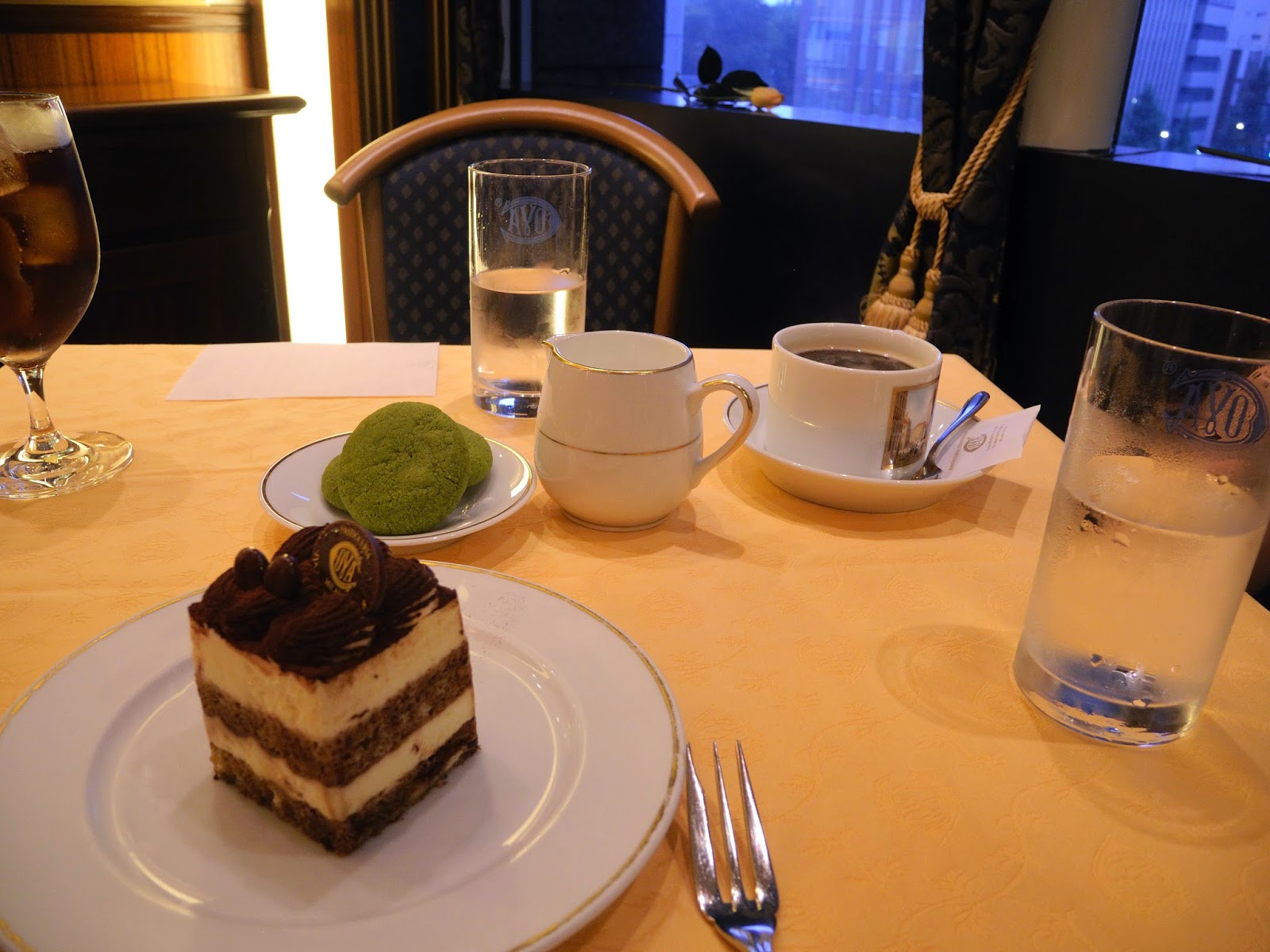
Tiramisu and coffee at Cova
in Shinjuku Times Square