I've been a fan of Japanese popular music for 40 years, and have managed to collect a lot of material during that time. So I decided I wanted to talk about Showa Era music with like-minded fans. My particular era is the 70s and 80s (thus the "kayo kyoku"). The plus part includes a number of songs and artists from the last 30 years and also the early kayo. So, let's talk about New Music, aidoru, City Pop and enka.
Credits
I would like to give credit where credit is due. Videos are from YouTube and other sources such as NicoNico while Oricon rankings and other information are translated from the Japanese Wikipedia unless noted.
The Nagoya Sumo Tournament wrapped up yesterday afternoon with Ukrainian wrestler Aonishiki(安青錦) grabbing the championship. Not only that, but he also secured his second promotion to the second-highest tier of ozeki as well.
I thought then that perhaps we can start this week's edition of KKP in this final week of July with something related to sumo. And sure enough, we come to the legendary enka singer Hideo Murata(村田英雄). He was known for bringing in some oaken manly-man verve into some of his discography, namely into those songs celebrating Japanese pastimes such as judo via "Sugata Sanshiro"(姿三四郎)and "Judo Ichidai"(柔道一代), and even shogi through "Osho"(王将).
Well, Murata presented his take on sumo with his January 1964 single"Otoko no Dohyo"(The Man and the Sumo Ring), and once again led the way on the odyssey to become a worthy rikishi in this ancient sport of Japan. This was actually written and composed by Murata himself and does so in a way that reminded me of the musical story of a masterless samurai wandering the Earth that often provided material for an enka tune...aside from the peppery percussion in the middle that often signals a sumo bout. Interestingly enough, "Otoko no Dohyo" was released in the same month as the judo-based "Sugata Sanshiro". As well, "Otoko no Dohyo" was performed by Murata on NHK's Kohaku Utagassen but not until 1976.
As with my previous article, the song of this posting was something that I had also seen last night on NHK's "Shin BS Nihon no Uta"(新BS日本の歌). Unlike Akira Mita(三田明), who was able to appear on the show to sing one of his hits, enka singer Hideo Murata(村田英雄)left this mortal coil back in 2002 but thankfully his legacy has been able to live on through his music via sources such as TV and YouTube.
One of Murata's trademark songs that was covered by Noelle Tham was the 1961 "Osho"(王将)where he sang about the wonder and dignity of the game of shogi. He also gave his tribute to the martial art of judo a couple of years later in February 1963 via "Judo Ichidai"(Judo for Life) and just as he had for "Osho", his oaken and proud delivery for this particular song belied an elegance which may have also reflected aspects of judo itself through the precise techniques and applied strength used.
Composer Shinichi Yamaji(山路進一)and lyricist Tetsuro Hoshino(星野哲郎)were behind the creation of "Judo Ichidai" which also became the theme song for the movie of the same name that was released in April 1963. The movie starred Sonny Chiba(千葉真一)and there was a small part for Murata himself, although the poster below seems somewhat misleading.
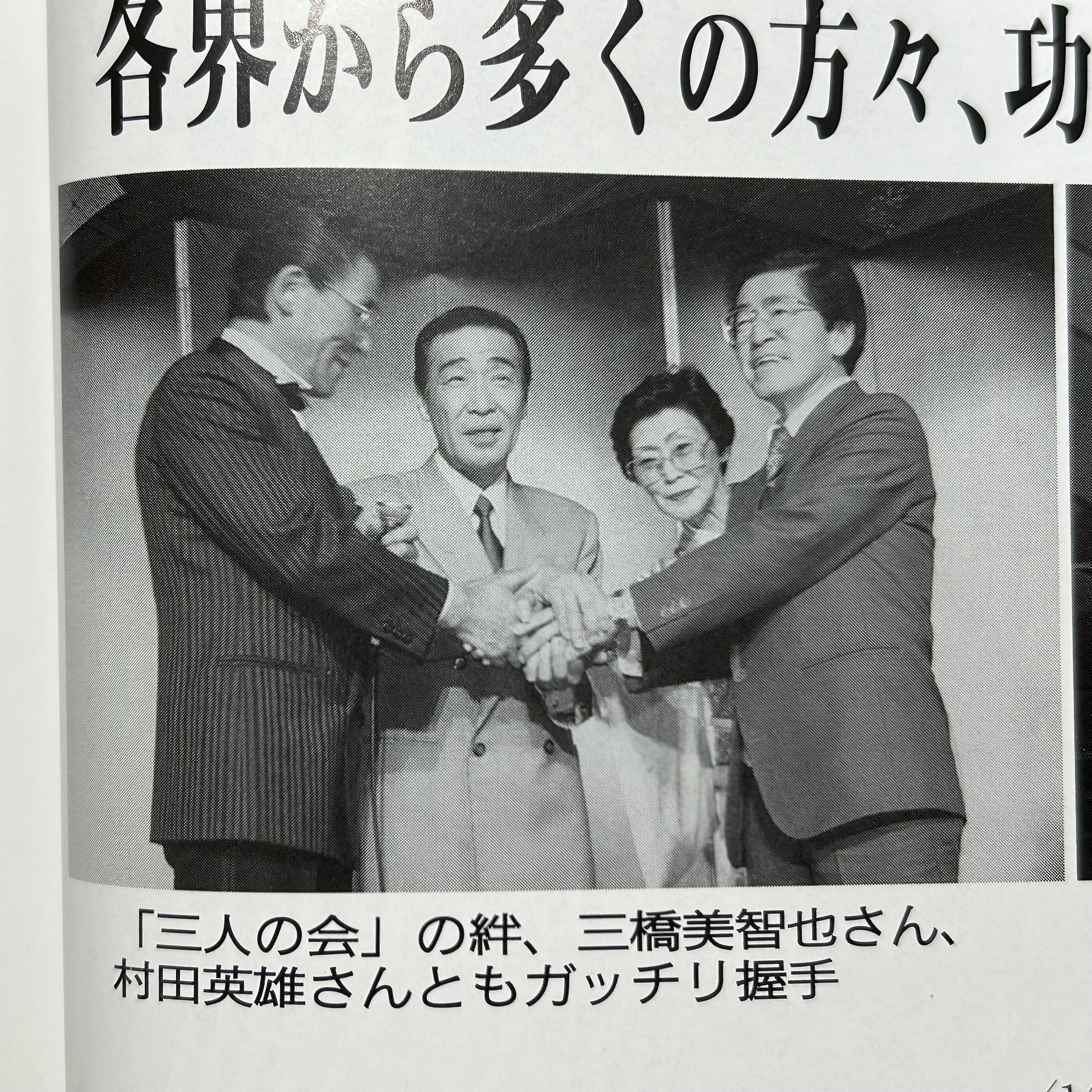
For the final piece of my Hachiro Kasuga (春日八郎) Centenary project, I would like to end with a piece on the Sannin no Kai (三人の会... Group of Three). I thought that this would be the perfect end since it was one of the singer's last enka activities and the trio was the reason I got to know Hachi in the first place. In fact, you may be able to trace my Hachi discovery via Sannin no Kai right here on KKP!
From Shinobu
The very first time I encountered Hachi was via a video of what was perhaps the intro to what I now know as the Sannin no Kai Concert somewhere in 1989 (if I'm not mistaken). Back then, I only knew rokyoku artist turned manly enka star Hideo Murata (村田英雄) and loved his shogi-themed hit Osho(王将)*, which made me give that video a watch. Little did I know that he and the two other singers were doing a mochi uta exchange where they sang each of their most significant hits. Murata sang Aishu Ressha (哀愁列車). Min'yo master Michiya Mihashi (三橋美智也) in an eye-popping pink kimono and yellow hakama set sang Akai Rampu no Shuressha(赤いランプの終列車). Finally, with bushy eyebrows and dressed in a tuxedo was Kasuga making a grand entrance fitting for Osho. Yet, I did not like the way he handled Osho. It just wasn't right. His presence was also not particularly outstanding, which was ironic considering he stood a head above his compatriots. With such a view in mind, 2014 Noelle watching that clip would not have envisioned that she would choose the one she thought was the most boring.
The mochi-uta exchange I watched ages ago.
So, what made made three of the biggest stars of the enka-kayo world join forces? Well, for one, they were already pretty good friends. Then, it just so happened that some time in the late 1980s as they were hanging out, Muchi broached the idea of joining forces to breathe new life into the twilight years of their careers and the enka realm. His seniors** gladly agreed, and thus the Sannin no Kai was formed with the goal of "enka no fukkatsu" (the revival of enka). The first concert they organised was in 1988 and held at a hotel owned by Michi. The subsequent concerts in 1989 and 1990 were led by Hachi and Muchi respectively.
During these concerts, the fellas unveiled a couple of new collaboration songs: Aishu (Sorrow) and Otoko no Furusato (A Man's Hometown). These were released as physical singles in 1991, the former before Hachi's death, the latter after. Both had their lyrics penned by Muchi; Michi took charge of composing Aishu, while Hachi did Otoko no Furusato. True to the group's constitution, both have that distinct enka sound derived from usage of the yonanuki scale. Aishu took the minor scale route, making it sound slightly melancholic atmosphere, while Otoko no Furusato took the major scale, giving it a masculine and powerful punch. The first I encountered and the only one of the two that's available online is Aishu, thus, it will be the one I feature today.
I remember freaking out upon encountering the blurry video of Aishu. I mean, how often do you get a trio of legendary artists in the kayo world doing songs where each of them have their own part? Despite the plaintive melody and title suggesting a sad time, Aishu paints a little picture of each of our fellows in each stanza. A cliff notes version of Hachi, Michi and Muchi, if you will. First up is Hachi, the man from the village at the foot of Mt. Bandai (Fukushima) and who rose to prominence by walking the path of enka. Then we have Muchi, the Kyushu native raised by the Genkai coast and who prides himself as the purveyor of manly songs since the beginning of time. Finally, we have Michi, toughened by the harsh winters of the north and who sought his musical future in the land of apples.
I talked about the Sannin no Kai and Aishu in the final part of my thesis. There, I brought up how only Hachi's part included the buzzword "enka" and enka being his life work. This made me wonder if Murata was cognizant of his buddy being heralded as enka's top figure and wanted to pay homage to that in this song. It may also have been that Hachi had a say in it too, considering he is the most senior (in age and kayo world experience). Either way, despite the fact that all three fellows are deemed as enka veterans by the late 80s, there was likely a common consensus even among themselves that it's Hachi who is the enka man. That, I argued, reinforced Hachi's "Preeminent Enka Singer" (Enka no daiichi ninsha) image that was developed over a decade prior. As I'm writing this article, I've now also noticed that Hachi's part also had the buzzword "furusato", something integral to the Bokyo Kayokyoku/Enka (Homesickness Song) genre. Hachi is often also considered the forerunner of Bokyo Kayo-Enka, so I wonder if Murata also gave a nod to that with the aforementioned term.
From Mikasa
The Sannin no Kai were probably every enka-kayo fan's dream team turned reality - it certainly is one of mine! My favourite part about the Sannin no Kai is seeing each of the member's different personalities. From the videos I've been seeing, what I've noticed is that Murata gives off fearless responsible leader who cares for his compatriots deeply. Michi, while seemingly withdrawn, is actually quite wild and very loud. Hachi, despite his status among them, seems the most laidback and speaks in lowercase (by that I mean he mumbles). It's really enjoyable to see them bounce off each other so naturally. So, it was heartbreaking to know that it lasted a mere three to four years. Hachi was the first to go in 1991, followed by Michi in 1996, leaving Muchi to power on in memory of his buddies until his death in 2002. That said, it was even more heartwarming to know that the three enka veterans had great fun working together while trying to keep alive the genre they hold dear.
* I can't believe it's been 10 going on to 11 years since I wrote my first articles on Hachi, Michi, and Muchi!
** Michi, while a year younger than Muchi, joined the pop music business earlier, hence making him Muchi's senior in this respect.
P.S. I very recently attended the Hachi fan club's new year gathering, the Shunyo no Tsudoi (春陽の集い). It was great fun meeting more members of the club and other figures affiliated with Hachi. I had to do a number of name card exchanges (as is common practice here, at least), and one of such figures did not bring his name card. So, as an alternative, he gave me what I can only describe as a piece of treasure in exchange for my flimsy old name card. I was dumbfounded to see Hachi, Michi, and Muchi smiling back me on the pristine telephone card you see above. Perhaps it was because I mentioned that the Sannin no Kai was how I had my fateful encounter with Hachi that this person insisted I have this card. If you haven't already noticed, the guys are wearing the exact outfits as they did in that mochi-uta exchange I watched. Seeing it reminds me of where I first began and how far I've come since then, so this telephone card means a lot to me, and I am extremely grateful to have been gifted it.
Quincy Jones (1933-2024) from the LA Times via Wikimedia Commons
Now that I've put up a rare Monday Reminiscings of Youth article just now and I'm going to do the same here, people must be wondering why I've gone all ROY on KKP. Well, one excuse is that it is a national holiday in Japan known as Culture Day. I don't usually include Japanese national holidays when I do the special holiday version of ROY, but for today I'm making an exception due to the passing of a couple of music figures in my life.
I've already posted one on singer Jack Jones and now we have here a tribute to Quincy Jones, one of the most prolific and successful songwriters and music producers the world has ever known. His file on "Kayo Kyoku Plus" is already fairly large thanks to entries such as his phenomenal 1981 album"The Dude" and his collaborations with Michael Jackson, including the album "Thriller".
Jones had already been in the music business for several years since the 1950s when he released his first single in 1962, "Soul Bossa Nova". Sound familiar?
If it does, you are probably one of the many folks who caught any of the "Austin Powers" movies with Mike Myers. One couldn't have asked for a more Swinging 1960s tune to accompany the British spy and his fellow dancers. The give-and-take between the flutes and the horns is truly groovy, baby!
Probably, though, for a lot of us Canadians, hearing "Soul Bossa Nova" as part of an "Austin Powers" movie was nostalgically surprising than revelatory. That's probably because we had heard it before...as the theme for the Canadian game show "Definition" with Jim Perry throughout the 70s and 80s. I certainly had no idea about what the title was and what its pedigree was...just knew it as the theme from "Definition" and it was probably the biggest thing that I can remember about the show.
According to Wikipedia, "Soul Bossa Nova" was also a track on Jones' 1962"Big Band Bossa Nova" album and apparently it took no more than twenty minutes for the composer to whip up. I had no idea that Lalo Schifrin, the master behind the themes for "Mission: Impossible" and "Mannix", was the piano player on "Soul Bossa Nova".
I know that Jones left this world a very elderly man at 91, but it's still a big void that he's left in music and we can be grateful at least that he's left this huge legacy of music from movies, television and the recording booth. My condolences to his family, friends and millions of fans.
"Soul Bossa Nova" was released in December 1962. Therefore, why not have the last three performers on the White team from NHK's Kohaku Utagassen that year show up?
Continuing on with the Gosanke(御三家)series, I believe that this will be the first of the series in 2023. To start off, I'd like to introduce the Enka Sanba Garasu (The Three Ravens of Enka) who actually predate the first music industry-based Ganso Gosanke(元祖御三家)by several years, although I couldn't find out when these three had the label put onto them. Mind you, the Ganso Sannin Musume(元祖三人娘)had been brought together before the Enka Sanba Garasu by a few years.
According to J-Wiki, there were three other Sanba Garasu within Japan's show business thus needing to put on the enka tab. For the Enka Sanba Garasu, we have Hachiro Kasuga(春日八郎), Michiya Mihashi (三橋美智也) and Hideo Murata (村田英雄). They all made their debut in the 1950s with Murata being the last one by coming out with "Muhomatsu no Issho" (無法松の一生) in 1958. As for why any trio back then would be compared with ravens or crows, I don't really have an idea since I think crows have had the image of being quite cunning and suspicious, but one part of J-Wiki mentions that the bird has had the title of being "a messenger for the gods". Mind you, I've had my own personal "encounters" with crows, usually on garbage day.
SongwriterJames Lord Pierpont (1822–1893) would probably be marveling right now at how ubiquitous and representative of Christmas his ultimate creation, "Jingle Bells" (1857) has become. Perhaps it may not be everyone's favourite Xmas song but it's most likely the most famous and one of the oldest Yuletide tunes on Earth.
I'm sure that "Jingle Bells" was already insinuating itself into my baby system a couple of months following my entry into the world via radio and TV, but one of the first times that I can remember Pierpont's magnum opus is through the piano scene featuring wunderkind Schroeder and crabby Lucy Van Pelt in "A Charlie Brown Christmas" (in the reruns). It was truly a technological marvel how Schroeder could change his instrument from grand piano to organ to toy piano. Maybe this was the inspiration for instruments like the synclavier.😉
From Ebay
To sidetrack slightly, it looks like a whole bunch of families fell under the sway of the television commercial for Ronco's "A Christmas Gift" in 1973 since I've been reading on YouTube how they ended up buying the compilation of Xmas classics. Our family was no exception and I still play it on the TEAC. It's just too bad that I can't find the original ad on YouTube.
And yep, my album can still open up to reveal that Christmas scene. In any case, I've already included one of the tracks from "A Christmas Gift" onto the blog, and that is Tony Bennett's scintillating take on "Santa Claus is Coming to Town". I only noticed a few hours ago that though I wrote it last year at the beginning of KKP's Xmas season, I'd forgotten to include Bennett's name in the Labels. Gave myself a Gibbs slap for that.
Track 2 of Side B is today's special Christmas ROY song. I'll be honest with you, though, and say that when I first heard jazz legend Duke Ellington & His Orchestra's version of "Jingle Bells", I wasn't sure what to make of it. Being less than ten years old at the time, I couldn't be expected to understand the call-and-response that often occurred within a swing jazz orchestra back in the day or the fact that improvisation was an obligation in jazz when handling an established song. But at the time, my thought was that it was "Jingle Bells" and it wasn't "Jingle Bells".
Fortunately, I did get into jazz deeply enough so that I even read into the history and mechanics behind one of America's great innovations, and understood what Ellington and his band were doing here. Now, it's very much a swinging delight which has become my favourite version of "Jingle Bells", thanks to the arrangement of the Duke's son, Mercer Ellington. It was originally recorded for the compilation "Jingle Bell Jazz" album from October 1962.
Thinking it is too difficult to track down which songs from Japan were coming out in that particular month, I'm going back to the Japan Record Awards for 1962. I've already picked some songs from that group when I did a ROY on Norman & Barry'sJames Bond theme, but there are a few more choices.
Best New Artist: Saburo Kitajima -- Namidabune (なみだ船)
Best Composer: Hachidai Nakamura for Jerry Fujio -- Tooku e Ikitai (遠くへ行きたい)
On this day in 1950, a musical legend was born with the formal name of Stevland Hardaway Judkins but we know him better as Stevie Wonder. Believe it or not, the master singer-songwriter already has some representation here on "Kayo Kyoku Plus" through Kimiko Kasai(笠井紀美子)and Chikuzen Sato(佐藤竹善), both of whom are also known for their soulful voices. To kill two birds with one stone, since today is also the regular day for Reminiscings of Youth, let us commemorate his birthday with one of Wonder's most iconic tunes, "Sir Duke" which originally appeared on his 1976 album"Songs in the Key of Life" but was also released as a single in March 1977.
So, why "Sir Duke"? Well, the short answer would be "Why not?". It's another great Wonder-ful song, and personally, when I was in high school in my final year of band class (I finally gave up on the clarinet in Grade 11...not much fun with the music teacher that I had), our group played the tune. Perhaps I should edit that previous statement by saying that we attempted to play the tune; Wonder wouldn't have been particularly awed by our performance. There was no way that we could out-Wonder the Wonder.
I read in the Wikipedia article for "Sir Duke" that Wonder had wanted to pay tribute to all of those singers and musicians who had so influenced and inspired him including the supreme jazz bandleader and composer Duke Ellington. He didn't want those artists such as Glenn Miller and Ella Fitzgerald to be forgotten. And so, I don't want Wonder to be forgotten, thus this special ROY article.
There is nothing maudlin about "Sir Duke" at all. It's all joy and celebration of the greats by a fellow great punctuated by those saucy funky horns. I was surprised to find out that Michael Sembello, who would gain further fame by coming up with his early 1980s hit "Maniac" for the "Flashdance" soundtrack, was the lead guitar on the song. What wasn't a surprise was that "Sir Duke" hit No. 1 on both the Canadian and U.S. charts.
So, what were some singles that came out in March 1977?
Hideo Murata -- Jinsei Gekijo (人生劇場) (according to Showa Pops, although Noelle states that it had been released in 1959, so this is probably a re-release.)
Ahhh, yes....the early days of music video! It was definitely the wild n' woolly n' wonderful West out there in terms of imagination for musicians and directors alike as they played with this brave new world of MTV and Much Music (here in Canada) like a kindergartner with Silly Putty. In those days, there were some really weird videos out there. In fact, there were enough of them that here in Toronto, one of the local video shows decided to present the eccentric stuff on late Friday nights on "City Limits". As long as I was allowed to stay up on Fridays, I could catch the earlier David Bowie songs, Nina Hagen, and The Residents.
I'm fairly certain that the music video for Devo's "Jocko Homo" would also make for a fine citizen on "City Limits". Strangely enough, up until a week ago, I'd thought that this song by the famous Akron, Ohio band was "Are We Not Men?" all these decades. I learned something! Anyways, welcome to another ROY article.
The thing is, though, that the March 1977 single"Jocko Homo" wasn't the first time that I had ever heard of Devo. It was actually the video for "Whip It"via a K-Tel record commercial that first exposed me to the craziness that was the Mothersbaugh brothers' collective. As time went by into the 1980s, I learned some more about the band and the whole thing about devolution, including the video which when I first viewed it scared the heck out of me due to its overall bizarre grainy nature, Booji Boy, and the band members wearing panty hose on their heads. Now, when I see Booji Boy scampering around the factory and Mark Mothersbaugh dancing and prancing around, I get all sorts of warm and fuzzy feelings for the ancient music video days and nights. And indeed, I think that this was the song and video combination that sent Devo on its merry way into fame and fortune.
Now, which singles were released in Japan in March 1977? Well, the first two were actually released far earlier but Showa Pops has them listed in the list for that month, so I'm assuming that they were re-releases.
Seeing that up to now, I've been taking care of all of the pop songs for the Tokyo House Party label over the past several days, it's now time to handle the genre of the most traditional heartfelt balladry. Namely, I'm talking about enka(演歌)with all of its sakura petals, heartfelt kobushi and Japanese instruments. I only gave a very bare bones assessment on last Saturday's livestream broadcast at "Tokyo House Party", so you can take a look at the Wikipedia description of the genre, and I can give you some of the main singers that have been representative of enka over the decades. I had initially thought that having the one article would be enough but I now believe that separating the topic into male and female articles was the right thing to do. Therefore, let's begin with the male singers.
I love sweets, but this will be what gives me cavities.
I think I've established that enka veteran Hideo Murata (村田英雄), in spite of his larger than life manly man demeanor, can turn on a dime and turn that ferocious scowl into an adorable grin... Pretty much the inverse of fellow kayo-rokyoku artiste Haruo Minami (三波春夫). He's like a burnt marshmallow - crusty and hard on the outside, but gooey and sweet on the inside. His penchant for recording very many meoto (husband and wife) enka over his long career furthers this soft side of his. The best example of that would probably be "Meoto Shunju" (夫婦春秋), with "Meotozake" being a close second.
Nana Hazono's (はぞのなな) words to "Meotozake" (Husband and Wife sake) talk about a couple who's been through some really rough times but have now achieved the happiness they strived for, and so are having a drink to that and to many more years to come. With words like that, one could imagine that "Meotozake" is like a sequel to "Meoto Shunju"; the latter highlighting the beginning and trials of the relationship and the former a celebration at how far they've come. Chiaki Oka's (岡千秋) rather grand sounding melody seems to aptly fit this celebratory, maybe even triumphant occasion. In true Murata fashion, he fiercely growls out certain bits and has his eyebrows set in a frown a third of the time, but somehow that just makes it sweeter every time he breaks into a smile and emphasizes the fact that the message is coming from a stoic showa era man who's usually too shy to bear his heart to the woman he loves.
"Meotozake" was released in 1980 and I think it was popular enough since Muchi sang it during the Kohaku in that same year.
Anyways, although I have "Meotozake" in one of my Murata compilation albums, the live versions just hit better, as with a number of songs I like in general. But, no live version of this ode to a happy marriage hits better than Murata and Minami's version in a rare joint performance in 1983, the whole of which can be watched here. Every enka fan's dream come true, the hilarious duet is easily my favourite part of this amazing collaboration. The biggest kicker being the moment the announcer said, "One of you has to be the WiFe, though." I think it's pretty obvious who took on that role... And I love how Haru-san is able to make Muchi blush. 10/10 I don't know how many times I've watched it already.
Objectively speaking, though, I like this duet because I thought the back and forth between man and wife fit the context of the song well. But, after being blessed with this rendition, I can never hear/see the studio-recorded "Meotozake" the same way again.
My heart...
OH, if the enka world EVER did shipping they'd surely be number one. Not even Hachi and Michi can top that. So, I tried giving them a ship name and settled with "Haru-Hide" because combining their names otherwise gave either "Haru-o" or "Hide-o" which defeats the purpose of a ship name... I'd drink to that. Oolong tea, of course.
Having talked about rather unorthodox entries by Hachi and Michi, as well as one simple and lighthearted one by Haru-san, this pick for Muchi seems the most... normal, in the sense that it is a true blue enka song.
That record you see up there was an incredibly rare find I came across during my first visit to an old record shop in Singapore a couple of years ago. I was stunned to see that there were a fair number of records by the likes of Hideo Murata (村田英雄) there, but more stunned was I when I pulled the record out backwards to find this:
👀
Prior to this, never would I have thought to find a piece of memorabilia with the autograph from any of the Yonin Shu at random, but there it was... ... That is his autograph, right? I mean, it's on his album and dated the year showa 55 (1980). I've never seen Muchi's autograph before and considering how unbelievable the find was to me, somehow I'm afraid that it may not be it...
But doubts aside, this album from the Kayo Deluxe series named "Jinsei Toge" has 2 vinyls containing some of the gruff singer's past hits like "Hana to Ryu" (花と竜) as well as up-to-date works like the titular song. From the annals of my mind, I recall that I'd heard "Jinsei Toge" on the then "Kayo Concert" a few years ago. I can't exactly remember who sang it - it was either Kiyoshi Hikawa (氷川きよし) or Takeshi Kitayama (北山たけし). But whoever it was, I had a good impression of it and would've gladly given it another listen, so that gave me another good reason for me to get the album.
"Jinsei Toge" is an encouraging enka that's as manly as the singer himself, even having deep drum rolls at the start and throughout the song, as if to fire-up the listener. Then you have Murata growling in his usual forceful manner about overcoming the many trials that life presents and that no matter what happens, you'll be fine. This actually more or less matches the first theme of today's episode of "Uta Kon", which I think featured some kayo about persevering and achieving one's goals.
Writing the words to "Jinsei Toge" was Tetsuo Miyahara (宮原哲夫), and the melody was done by Teruo Komatsubara (小松原てるを). The song came out in August 1979, and a few months later Murata sang it on his 18th appearance on the Kohaku. The link to this performance is above this paragraph.
In the way of my selections per era, we've delved into the ancient 30's and 40's, progressed to the 50's, and we've now arrived at our next stop: the 60's. Besides the technology and the overall condition of Japan improving by leaps and bounds, another thing I've noticed about this era is that this was when the musical genres seem to become more distinct and not just simply be lumped into the umbrella categories of ryukoka or kayokyoku, and Western influences get more deeply ingrained into the melodies.
With greater musical variation in this period, it kind of goes without saying that the songs on this list will more or less show that - I mean, it's probably not as varied as I think, but there's definitely more than just enka in store here. As per the other articles, the songs aren't arranged in a particular order and I will add bits of lyrics which I like to the blurbs as well.
Disclaimer: These will be my picks on my favourites from the 1960's, so you may or may not find songs that you like or feel should be on here.
That said let's get on with the show.
Duke Aces -- Onna Hitori (1965)
Shiozawa-gasuri ni Nagoya obi (塩沢がすりに名古屋帯) Mimi wo sumaseba taki no oto (耳をすませば滝の音) Kyoto Ranzan Daikakuji (京都 嵐山 大覚寺) Koi ni tsukareta onna ga hitori (恋に疲れた女がひとり)
Admittedly, I haven't been listening to this elderly vocal group all that much as of late. However, when I do want some Duke Aces (デューク・エイセス) and want to cleanse my palate from hardcore enka and, wouldn't you know it, modern J-pop, the first song that I will always choose is "Onna Hitori" (女ひとり). This installment from their ambitious "Nihon no Uta Series" (「にほんのうた」シリーズ) is one beautiful and rather therapeutic tune that wonderfully portrays Kyoto and three of its well-known temples. Ah, I wish I could see Duke Aces in the lineup above singing this song one more time.
Yoshio Tabata -- Shima Sodachi (1962)
Asa wa nishi kaze yo wa minami kaze (朝は西風 夜は南風) Oki no tachi gam'ya oki no tachi gam'ya (沖の立神ゃ 沖の立神ゃ) Mata kata senami (また片瀬波)
From the thousand year old capital we take a trip down south to the little island off the coast of Kagoshima. Similar to "Onna Hitori", I find Yoshio Tabata's (田端義夫) take on the Amami Oshima minyo "Shima Sodachi" (島育ち) so relaxing just listening to it feels like I'm at a quiet beach soaking up the sun - not like I need anymore of it.
I try hard not to repeat any singer in my lists so that they wouldn't be jam-packed with the same handful of them for, as I said before, that'd be boring. However, Batayan is that wild exception I'm willing to make. Yes, I like "Shima Sodachi" that much, so much so that I so readily put it down here as I'm biting my fist as I gloss over a certain fellow with an "8" in his name and the one with a smile for the ages.
Hibari Misora -- Yawara (1963) Yuku mo tomaru mo suwaru mo fusu mo (行くも住るも 坐るも臥すも) Yawara hitosuji Yawara hitosuji yo ga akeru (柔一すじ 柔一すじ 夜が明ける)
And from Amami Oshima, we come back to Tokyo for the Olympics.
Whoo! You can feel that ferocity emanating from that tiny figure! Madam Misora looks about ready to knock someone's block off. I believe I've said it before and I'll say it again: "Yawara" (柔) has got to be the manliest song sung by a woman of that time. The muscular and grand melody combined with Hibari Misora's (美空ひばり) moxie just makes for such a cool song.
Yuzo Kayama -- O-Yome ni Oide (1965)
Fune ga mieta nara nureta karada de (舟が見えたなら 濡れた体で) Tondekoi sora e dakiagete (とんでこい 空へ抱きあげて) Moeru kuchizuke shiyou (もえるくちずけしよう)
Ah, the Wakadaisho. If there's one song by him that consistently gets itself lodged into my cranium, it's the Hawaiian-esque "O-Yome ni Oide" (お嫁においで). It's a simple and oh-so-catchy ditty with a cute premise, and that alone is enough to keep it running through my mind.
Yujiro Ishihara -- Yogiri yo Konya mo Arigato (1967)
Unlike the other songs on this list my liking for "Yogiri yo Konya mo Arigato" (夜霧よ今夜も有難う) crept in slowly... like night fog. Sure, I was agreeable with it upon my introduction to Tough Guy, but with the right premise of me staying back in the safety of an almost empty class to finish up the daily assignment in the evening with a tropical squall battering outside and this jazzy number circulating through my earpieces, "Yogiri yo Konya mo Arigato" eventually became associated with warm comfiness and eventually one of my favourites.
Michiya Mihashi -- Hoshikuzu no Machi (1962)
Yubibue fuite kaerou (指笛吹いて 帰ろう) Yure nagara (揺れながら) Hoshikuzu wakete machi wo hanarete (星屑わけて 街をはなれて)
I'm usually picky with covers of my favourite, often times to an unfairly biased level - you probably have noticed it in some of my earlier articles. But lately, I've been more open minded. However, the one song that I remain absolutely (and, perhaps, infuriatingly) obstinate about is "Hoshikuzu no Machi" (星屑の町), in the sense that Michi fits the song best and the best renditions are those that are closest to Michi's. I like this song very much for how atmospheric it is and for how Mihashi's silky and unique delivery adds that extra layer of wistfulness. And without Michi's voice, "Hoshikuzu no Machi" loses half its flavour.
Watashi?
Hideo Murata -- Meoto Shunju (1967)
Sore ga meoto to karuku wa iu ga (それが夫婦と 軽くは言うが) Ore to omae de kurou wo shita (俺とお前で 苦労をした) Hana wa daiji ni (花は大事に) Sakasou naa omae (咲かそうなァ お前)
We've now come to the last song on the list. You were expecting "Osho" (王将), weren't you? After all, I said it was my ultimate o-enka. But having already talked about it and actually having another Murata number I can't get enough of, I decided to go with the latter, that being "Meoto Shunju" (夫婦春秋). This sweet and heartwarming song about a man showing his appreciation for his wife sung by one of the most gruff and imposing (in demeanor) fellows is absolutely adorable. I love the manly but gentle melody that goes along with it, and that "Omae" with that sheepish Muchi grin always melts my heart.
I have to say, this is probably one of the most un-Murata pictures I've seen to date but at the same time, it's also very Murata.
And on that sweet note I end my list of favourites from the 1960's. It was quite good fun planning these lists, and I hope you enjoyed as much as I did writing it. And on hindsight, I realise that a good number of the songs hear I'd easily put into an overall top 10 or 20. I might continue with this series of articles for the following decades, but we'll see how that goes. But that aside, what are your favourite songs from the 60's?
Before I begin this article, I read a couple of nights ago that Mr YOUNG MAN Hideki Saijo (西城秀樹) had passed away just a few days ago. I am not a big fan of Saijo but he was one of the singers who ushered me into the world of kayo early on. As such, it was a big shock to read that he's gone so soon. J-Canuck has done a nice little tribute to him which you can check out here. I'm happy that I had the chance to see this icon of the 70's a couple of times on TV. Rest in peace, Mr Saijo.
Well, let's continue on a brighter note, shall we? (Shoo, onion ninjas! Shoo!)
For a couple of weeks between the end of April and early May, I was back in Japan for what may be my last visit to the land of the rising sun for a while - I'll be heading off to university soon so I wanted to take care of some outstanding items on my list before I get shipped off. I did accomplish the goals I set out for this trip (at the cost of my bank account) around a fragment of Tohoku, a bit of Hokuriku, and of course, Tokyo, and I had an incredible time travelling with Mom for most of the time, and hanging around, as J-Canuck calls it, The Big Sushi, on my own for a few days. As with my previous trips, I would like to share with you guys the highlights. To start, I'd like to talk about my return to Mukashi no Uta no Mise, a karaoke joint somewhere in the middle of Sugamo'sJizodori.
I recorded down my first visit to this quaint joint a couple of years ago, so you can check that out here. This sequel will be a long one as it encompasses my third and fourth visit, so sit back and get comfy. Alright, let's begin.
My acceptance gift.
I was at Mukashi no Uta no Mise last December for my second visit, but with it being a weekday, there was hardly anyone there so I took it as some sort of a practice round to try out some songs I had been meaning to sing. This time around, however, was a whole different ball game. This third visit (and first of this recent trip) was during the middle of Golden Week, more specifically Children's Day Saturday, and I was on my own. I was a little worried as to whether there'd be anyone there as I thought that the oldies would be spending that day with their grand kids (if they had any). But I was dead wrong as an hour into opening time and the "party" was already in full swing. The Mama-san was happily surprised that I showed up again, and one of the folks, this uncle I'll call Y-san, recognized me from two years back.
With a rowdy audience of 6 (at that moment) and hyped on coffee, I went in over my head and picked my opening song, Ikuzo Yoshi's (吉幾三) "Hokugen Kaikyo" (北限海峡). I'd never sung it before (karaoke style) but I love it, so what could go wrong? - Oh, things went wrong. It was a bad idea to start with an unfamiliar song and the key was wrong and I couldn't quite get it either. I could feel the disappointment from the crowd too, especially since one of them even mentioned, "Oh, this looks promising," at the start. I stabilized a little, but I thought it was a travesty. I am so sorry, Yoshi.
"Omae...", the sweetest bit, but the hardest to sing, in my opinion.
With my senses slapped back into me, I switched to my original plan, which was opening with Hideo Murata's (村田英雄) "Meoto Shunju" (夫婦春秋). I thought it was decent - after tweaking the key a bit, though a little rough on the lowest notes than I'd hoped, I felt like I was redeemed in the eyes of the regulars, most of whom had honed their skills to a fine point. "All the oji-sans would shed happy tears when they hear you sing this," was my favourite comment. I was given a seal of approval and offered sushi (the first of many, many other snacks) that the group had brought along. By that time, the most rowdy member of the club had arrived - a flamboyant purple haired oji-san in a kimono whom I shall call Y-chan. He fanned the flames of an already noisy bunch to new heights with oolong highballs - much to the chagrin of this old lady beside me, though.
I followed it up with Hachiro Kasuga's (春日八郎) "Ore wa Nora Inu" (俺は野良犬), a song which I have decided to make my Juu-hachi ban. It was definitely a blast from the past for the audience with its nostalgic sound. Personally, I felt that this was my best song for that day.
By then, the handful of folks became two handfuls, and passionate cheers of encouragement like "Mattemashita!" (I waited for this!) were constantly thrown out to everyone. It also became apparent to the oldies that I knew a lot of enka - frankly, it's more because they picked many I so happened to know - so it became almost like a game to see if I could recognize or even sing whatever they sang. It was amusing... or they thought I was amusing.
En-ya-saaaa-to mawashiteeeeee...
Next was Haruo Minami's (三波春夫) "Funakata-san yo" (船方さんよ), which was personally the hardest to sing, not because I had problems with the song itself, but because the oldies were at peak levels of excitement while screaming out their kakegoe to go along with the song and Y-chan kept singing with me (it's one of his favourites), so I had a hard time listening to myself... I need more karaoke experience (this was only my third time ever). Overall, I thought it was OK in spite of the distractions.
After dwelling in the oldies, I decided to go with something more modern. By that I mean Kiyoshi Hikawa (氷川きよし) and "Choito Kimagure Wataridori" (ちょいと気まぐれ渡り鳥), and after, "Omokage no Miyako" (面影の都). The former I felt was better than the latter, plus it was a lot more fun to sing. It made me realize, however, that the Sugamo bunch couldn't be very much bothered about the Prince of Enka, so that made the serifu portion a little dull, though I did get a "Hai, ojou-san!" from the lovely Grandma K. The video above, which first also shows "Otone Nagare Tsuki" (大利根ながれ月), a song I sang at a later date, will give you an idea of how fans react to the whimsical "Choito Kimagure Wataridori".
My 8th choice and the last for that whole afternoon session, was Michiya Mihashi's (三橋美智也) "Yuyake no Tonbi" (夕焼けとんび), thus completing the Yonin Shu set. I also thought it'd be a good idea since it didn't require as much vocal gymnastics, and it was evening (around 5 pm) by then. Again, I had to tinker with the key, but it was a satisfactory end to Saturday. This being another of Y-chan's favourites, he actually gave me some notes for improvement, of which I felt honored for having received advice from one of the day's best singers.
There were handshakes here and there, and I even managed to arrange another meeting with some of them on the following Monday - I planned to go for another round anyways, so all the better with a few more folks. 'twas then when I finally introduced myself. Suddenly, I didn't feel so lonely anymore.
Monday came soon enough and I was back in Sugamo. As expected, it was pretty quiet and there was only a crowd of 3 strangers, and later the 2 folks from Saturday who promised to show up, Grandma K and this sweet lady called K-chan, much to my joy. I took it as another opportunity to try out more songs, which indeed I did - I (unwittingly) sang a total of 13 songs! Takoyaki was brought by grandma to the karaoke to share, which was enough for all present, though both ladies insisted I had theirs, so I ended up with 3. I was glad and relieved that the red ginger taste was very mild.
The first of three.
This session was partially me retrying a few numbers from my 2016 round, beginning with Hikawa's "Hakone Hachiri no Hanjiro" (箱根八里の半次郎), which I can always rely on for a warm-up, Minami's "Yuki no Wataridori" (雪の渡り鳥), Muchi's "Osho" (王将), and Michi's "Hoshikuzu no Machi" (星屑の町). The later three attempts I would consider "meh" - was in too mellow a mood to "feel" the them.
Oh boy, do I miss them...
New tunes were attempted too, and some of my best that day, I felt, were Duke Aces' "Onna Hitori" (女ひとり), and Haruo Oka's "Akogare no Hawaii Koro" (憧れのハワイ航路). I was nervous over their keys as well, but it all worked out in the end. For once I could agree with audiences' "Umai!" and "Jouzu!", and not see it as common courtesy .
To mix things up a little, I picked some daring stuff too, like Hikawa's version of "Benten Kozo" (弁天小僧), which was a real crowd-pleaser the moment I did it in his expressive manner - a deliberate decision. And also his recent single, "Shoubu no Hanamichi" (勝負の花道).
HA!
It goes without saying that I did another Hachi number, this time being "An' Tokya Doshaburi" (あん時ゃどしゃ降り), and the MV showcased the movie he was in from 1957. They knew I love Hachi, so I think they yelled out something on the line of "There's your Hacchan!" when he appeared. Yes, grandmas, myHacchan...
0:49-0:57 though... ma heart...
Duets were quite commonplace that day, with a couple of the uncles wanting to sing something with Grandma K - she was pretty good for someone over 80. Eventually, she even invited me to sing 2 songs with her! Her choices were "Kiyoshi no Zundoko Bushi" (きよしのズンドコ節), followed by Dick Mine's "Tabi Sugata Sannin Otoko" (旅姿三人男), the latter chosen with the knowledge that I love matatabi enka. From the former, I noted that I had problems singing duets as I couldn't concentrate on my own key when my mind goes off listening to my partner's. The latter was better, though after that was when I truly felt exhausted from forcing out the low notes (my nemesis).
As the session came to a close, I wondered what song would be a meaningful end (for now, at least) to my fun-filled days at Mukashi no Uta no Mise. Frankly, I thought of saving the encouraging "Shoubu no Hanamichi" for this, but having already sung it earlier, I needed a replacement. And then a light bulb appeared - why not return to my Japanese music roots?
I chose "Hajimari wa Itsumo Ame" (はじまりはいつも雨) by Aska. The folks knew I'm all enka, but I wanted to show them what came first. Frankly, while I felt that it was a good attempt and better than a good half of my enka choices, the reception was lukewarm - except for K-chan, who was perpetually excited for anything. Grandma K and this other grandpa had no clue of the song's existance, and I have a bad feeling that the Mama-san did not approve of my choice, considering Aska's tarnished record - it's been 5 years, though...
Anyway, at the end of everything, I was pleasantly surprised albeit quite tentative to recieve some parting gifts from the folks. After all, I had only known them for two days. But they insisted, so I agreed to a pair of geta from K-chan, and a dinner treat from Grandma K. It was an awkward sushi dinner - not because I had problems communicating with the old lady, but because I had problems interacting with the sushi chef. Geez, he must have been wondering what this grandma was doing with this young foreigner who could barely speak Japanese...
I am very grateful to have met such wonderful people and experience their hospitality on this trip, and saying goodbye wasn't the easiest thing to do, to be honest. But I hope to see them again soon - now I'm aware that I have to appear on Saturdays or Sundays for most of the Sugamo bunch to be in attendance. Until then, I intend to fully learn Grandma K's favourite song, "Kantaro Tsukiyo Uta" (勘太郎月夜唄).
With that, we've come to the end of this article. It's been a long article - thank you for sticking through and I hope you enjoyed reading it!
Left: Conch; Right: Salmon
Far right: A gross pile of ginger
P.S. During one interview, Kohei Fukuda (福田こうへい) saidthat if you sing any one of the Yonin Shu's (Hachi, Michi, Muchi, Minami) songs, the oldies will go wild. I can strongly attest to that.