Credits

I would like to give credit where credit is due. Videos are from YouTube and other sources such as NicoNico while Oricon rankings and other information are translated from the Japanese Wikipedia unless noted.
Showing posts with label Rui Serizawa. Show all posts

Monday, July 13, 2026

Akina Nakamori -- Ame no Requiem(雨のレクイエム)


Just to echo my friend, fellow KKP administrator/contributor and occasional lunch/dinner buddy, Larry Chan, Happy 61st Birthday to Akina Nakamori(中森明菜). As I mentioned in my comments to him following his article on "Gomen to, Suki to"「ごめんと、好きと」, it used to be the tradition on the blog whenever we celebrated July 13th that we gave our greetings in the form of nervously hoping that Nakamori was doing OK wherever she was. Well, in the last couple of years, it looks like she is feeling fine and so I'm ready to retire the tradition and know that she's in pretty good spirits.✌

Reading the previous article, I was more than happy to have our annual July 13th Akina article written by Larry with my blessing since it's been another tradition to alternate our contributions, year by year. But then I thought why not have the two of us providing articles on this hot summery day? Mind you, both of us gave our Favourites lists a dozen years ago: "Larry's Akina Top 6 Picks (post-1991 era)" and "J-Canuck's Favourite Six Akina Songs"...man, time flies quickly!

Since a lot of us on the blog put up a lot of Akina tunes from early on in KKP's history, it's been a little difficult as of late to find something "new", but I was able to once again scour the early B-sides of the lass' singles. As a result, I was able to find this one titled "Ame no Requiem" (Rainy Requiem) which was the flip side to her September 1983 single "Kinku"(禁区). That song, coincidentally enough, was the very first Akina song I heard and it was the song that she sang during her first appearance on NHK's Kohaku Utagassen at the end of that year. 

"Kinku" was that rather dramatic technopop hit composed by Yellow Magic Orchestra's Haruomi Hosono(細野晴臣), and so I figured that knowing that, "Ame no Requiem" would most likely be a much softer ballad vocalized by Akina in that high and feathery love song style that she used to do in her earliest years to contrast with the deeper voice that powered songs like "Kinku", 

Well...yeah..."Ame no Requiem" was definitely a different kettle of fish. It came off as being so French that while I was listening to it, the taste of garlic and butter escargots popped into my mouth along with a glass of Bourgogne Aligoté. The surprising thing was that the composer was none other than Koji Tamaki(玉木浩二), lead singer of Anzen Chitai(安全地帯); never realized that he had that much of the City of Lights in him. He definitely brought in the Fashion Music for Akina! Rui Serizawa(芹沢類)was the lyricist while Mitsuo Hagita(萩田光雄)took care of the arrangement (he probably helped out with the French flavourings, too).

If you have any B-sides of Akina that you've enjoyed, please let us know!

Thursday, February 19, 2026

Kaori Moritani -- Chiffon no Tsubasa(シフォンの翼)


He passed away only relatively recently in 2023 at the age of 85, but Bill Saluga was a comedian who was part of the improv troupe The Ace Trucking Company. He'd been performing since the 1960s but the one character that certain generations will always remember him for was the nattily-attired Raymond J. Johnson Jr. His schtick was that whenever anyone called him Mr. Johnson, he would take umbrage and rattle off all of the different permutations of his name that he preferred to be addressed by. I did see him on the old variety shows on television and commercials doing that bit. Typically, it goes like this (and this is from his Wikipedia profile):

"NOOO!!! You don't have to call me Johnson! My name is Raymond J. Johnson Jr. Now you can call me Ray, or you can call me J, or you can call me Johnny, or you can call me Sonny, or you can call me Junie, or you can call me Ray J, or you can call me RJ, or you can call me RJJ, or you can call me RJJ Jr. . . but you doesn't hasta call me Johnson!"

And that is who I was reminded about when I first heard about 80s aidoru Kaori Moritani(守谷香). Now, a number of celebrities in Japan have gone through multiple name changes in their careers, including enka legend Hiroshi Itsuki(五木ひろし), and so on that note, the Aichi Prefecture-born Moritani isn't any different but for some reason, Moritani just sparked my image of Raymond J. Johnson although the lass is far prettier. Along with the above name, she's also gone by a different reading of that family name which is Kaori Moriya in different configurations of kanji and hiragana(守谷佳央理、もりや かおり). She's also gone by Kaori Morizumi(守純かほり)and even, briefly, WANKU.

Her first six singles, in fact, were recorded under her name of Kaori Moritani, and for the purposes of this article, here is the  B-side for her May 1987 debut single "Yokokuhen"(予告編...Trailers), "Chiffon no Tsubasa" (Chiffon Wings). It is indeed a cutesy aidoru tune but with some of that Doobie Bros. bounce thrown in to help launch things. You can thank composer Takashi Ike(池毅)and arranger Ichizo Seo(瀬尾一三)for that along with lyricist Rui Serizawa(芹沢類). It managed to reach No. 12 on Oricon.

One other notable piece of trivia regarding Ms. Moritani is that she had once been married to TOSHI, one of the members of X Japan, for several years. She even left show business to help run her husband's entertainment agency. As of right now, she is going by the name of Kaori Moriya.

Friday, January 26, 2024

Yutaka Kimura Speaks ~ Japanese City Pop Masterpieces 100: Yasuhiro Abe -- Juu-ni-gatsu no Yuki(12月の雪)


Number: 042

Lyricist: Rui Serizawa

Composer: Yasuhiro Abe

Arranger: Nobuo Kurata

From Abe's 1991 album "Tengoku wa Mattekureru"

If this book were to select a Christmas song, this would be straight-up the one. "Juu-ni-gatsu no Yuki" is the song that you want to hear on a silent holy night overlooking powder snow that has fallen without any sound. Done with Abe's(安部恭弘)sense of style channeling The Great American Songbook, for some reason, the more luxurious the sound gets, the more I get that wistful feeling that gets me right here.

The above comes from "Disc Collection Japanese City Pop Revised" (2020).

Friday, February 24, 2023

Ruiko Kurahashi -- Windy(ウィンディ)


I received all sorts of warm and fuzzies listening to this one for the first time in a long while. Perhaps in this decade, I ought to refer to that expression as ASMR.

The reason for that is the arrangement of the cool keyboards including the Fender Rhodes, the wailing guitar and the young lady behind those wonderful vocals, Ruiko Kurahashi(倉橋ルイ子). Here she is performing "Windy" which is a track from her 1983 "Rolling" album. Given lyrics by Rui Serizawa(芹沢類)and music by City Pop stalwart Tetsuji Hayashi(林哲司), "Windy" is truly breezy but this is not a park but the concrete jungle of Tokyo. The warm and fuzzies come from the overall melody which hints at the metropolitan life back then whether it be the hotel bar in Shinjuku or a street-level Renoir café anywhere in Tokyo.

Twitter friend halcali remarked a few days ago that they enjoyed my name dropping of Kurahashi when I mentioned her in Tsugutoshi Goto's(後藤次利)"file" where I also referenced her "Itsuka Dokoka de"(いつかどこかで). It's always nice to encounter a fellow Kurahashi fan online since they are so few and far between, so I opted to bring "Windy" into the KKP fold. Besides it's been almost a year since I put up a Kurahashi article, and I also wanted to remind folks that she wasn't just an interpreter for laconic Fashion Music but also someone who could also bring in the urban and urbane; after all, she also recorded "December 24".

Monday, December 27, 2021

Yuko Tsuburaya -- Ame no Uta(雨の詩)


The final Monday for 2021 has been a dreary start to this week. I have the right sort of song, though.

(36:26)

Mind you, "Ame no Uta" (Rain Song) is actually quite the cheerful tune with the hint of 80s West Coast AOR. This is a track from Yuko Tsuburaya's(円谷優子)debut album "Colors" from April 1989. Written by Rui Serizawa(芹沢類)and composed by Hitoshi Haba(羽場仁志), the arrangement and Tsuburaya's clear vocals has me thinking of ironically far sunnier days in California than a damp cloudy one in Toronto. 

According to J-Wiki, Tsuburaya started her career as a part of the regular membership of girls on the TBS variety show "Momoco Club"(モモコクラブ), based on the weekly aidoru pinup magazine "Momoco". There are excerpts of the show (October 1986 to September 1987) on YouTube, and there are some similarities to 1980s aidoru supergroup Onyanko Club's(おニャン子クラブ)representative TV program "Yuyake Nyan Nyan"(夕焼けニャンニャン); the lasses of "Momoco Club" even had had their membership numbers as in the case of Onyanko Club's members and, as can be seen below, they even showed up to do musical numbers although my impression is that "Momoco Club" was more about how photogenic its members were than how musically inclined they were.

Incidentally, Tsuburaya's number was 1980 which I had initially mistook for the starting year of her career. Another interesting point that I saw in her J-Wiki profile was that her senpai in her talent agency KEN-ON(研音), none other than the Akina Nakamori(中森明菜), made a point on "Music Station" to introduce and promote Tsuburaya when she did make her debut in late 1988 as someone with a lovely voice. I can only imagine the gratitude and pressure that the young singer must have felt at the time.

Going into the late 1990s, Tsuburaya would release 10 singles and 3 albums including one single under the aegis of Tetsuya Komuro(小室哲哉)which became a big hit. But I'll have to do that one sometime in the New Year.

Monday, December 23, 2019

Yasuhiro Abe -- Juu-ni-gatsu no Yuki(12月の雪)


Yeah, the above was an October photo of snow in our city. That isn't happening this year for Xmas. The temperature is 9 degrees Celsius as I'm typing this and my window is open to let in some of that fresh balmy air. It's gonna be a green December 25th with all of the positives and negatives.


However, we kayo kyoku fans in Toronto can imagine a bit with the help of this song that I first heard on the Xmas edition of Come Along Radio last night. This is Yasuhiro Abe's(安部恭弘)"Juu-ni-gatsu no Yuki" (December Snow) which was the coupling song for his 14th single, "China Rain In Christmas" released in November 1990. The song was also a track on his 8th album "Tengoku wa Mattekureru"(天国は待ってくれる...Heaven Can Wait).

At first, I was thinking about categorizing it as a City Pop Xmas tune but after listening to it a few more times, I realized that this was more of a sentimental mix of jazz standard and pop...kinda like the stuff that I used to hear decades ago and more along the lines of a Michael Buble seasonal song. Written by Rui Serizawa(芹沢類)and composed by Abe, "Juu-ni-gatsu no Yuki" is a classy and cuddly ballad crooned ably by the singer about those tender white flakes coming down one night before Xmas. Maybe it's one of those tunes to imagine while taking a breather outside away from the jolly cacophony inside the house during the annual get-together.

Wednesday, September 11, 2019

Mariko Yoshida -- Eien no 20cm(永遠の20cm)


Just seemed like autumn was well on its way in the past few days when summer decided that it wasn't quite done with us yet. Yup, the Humidex may be hitting 32 degrees Celsius today and it's indeed fairly humid out there although for some reason, it hasn't been necessary to turn on the air conditioner. However, I have to make dinner tonight so I'm sure that situation will change.


Perhaps this song might be considered to be a summer/fall tune. This is "Eien no 20cm" (Endless 20cm) by aidoru-turned-pop singer Mariko Yoshida(吉田真里子). I'd never heard of her before but she debuted in May 1988 but considering her vocals and nature of this tune, I think she had fairly quickly left her aidoru presence behind.

"Eien no 20cm" is a track on Yoshida's 4th album "Crescent"(クレッセント)released in January 1991, and despite the release date of the album, this does sound like a summery tune although my injection of the fall in there is because of Rui Serizawa's(芹沢類)lyrics. The twenty centimetres of the title refer to the physical distance between a man and a woman meeting at the station for the first time in a while. They have been close friends but she'd been secretly wishing for a level-up in the relationship so that her arm could span that short distance to link with the lad's arm. Alas, it never got to that point and the way the song is going, it looks like she's given up the pursuit.

Hiroshi Uesugi(上杉洋史)was behind the music and arrangement. I have to also compliment Yoshida's singing as well. She released 8 singles and 5 albums between 1988 and 1991, and then had an indies period (1993-1999) during which she put out a further 4 singles and 2 albums. Yoshida then got married in late 2001 after which she announced her retirement from show business.

Tuesday, September 4, 2018

Beers -- Mistress


I guess I can finally say this:

I'M A CANADIAN AND I'VE GOT BEERS, EH!🍻

Yes, the sound of crickets and crows can be rather deafening, I know...

Now, to be exact, what I do have is the album "Mistress" by the pop duo Beers. It is in fact the only album that was ever released by the tandem of Megumi Saito(斉藤恵)and Yoko Takahashi(橋本ヨーコ)in 1983. And perhaps it is so obscure that even my bible of "Japanese City Pop" hasn't even bothered listing it...at least, in the first edition.

Thanks to YouTube, I was lucky to have come across Beers and was instantly charmed by the first track "Kowareta Wiper"(壊れたワイパー)and one other song to the extent that I decided to pick up "Mistress". And thanks to Tower Records, I was able to do so.


That one other song I mentioned in the previous paragraph is "Random ni"(ランダムに...At Random)which is Track 3 on "Mistress". Written by Etsuko Kisugi(来生えつこ)and composed by Daisuke Inoue(井上大輔), it's a bit of radio-friendly morning drive disco that would probably have me get this urge to invest in one of those ancient listening boxes by SONY. It was between this and "Kowareta Wiper" as to what I would have first put onto the blog but ultimately I went with the latter. Still, "Random ni" is plenty fine music from the old days, and although I've put in that commuting theme, there's a part of the song that seems to soar softly into the sky. Makes me hope that those experimental flying cars finally become a reality.


But it's not all about the glitter ball here. Saito and Takahashi put their songwriting skills to use to make this soulful ballad "Ai no Kagi"(愛の鍵...Key of Love)that takes things further into the 1980s rather than the late 1970s of "Random ni". At the same time, I could recommend this song as another nice driving tune but for more of a nighttime spin on the highway close to midnight.


Heard of the Marlboro Man and that famous theme of "The Magnificent Seven"? Well, I don't know whether this track ever did help out in the commercials for another brand of cigarettes, but here is "Lucky Strike Man"(ラッキー・ストライク・マン). Unlike the Western theme for the Marlboro dude, "Lucky Strike Man" has more of a laidback mix of reggae and pop or even New Wave. Inoue took care of the music once more but Yoshiko Miura(三浦徳子)provided the lyrics here.

(4:05)

This is another fine song as the second track, "Aoi Asa ~ Day Break Rain"(蒼い朝...Blue Morning) with Inoue on music and Rui Serizawa's(芹澤類)words gracing it. I like the AOR-ness of it all especially with the string section. In a way, it's rather timeless...I could really imagine it spanning the 70s and 80s as Saito and Takahashi give "Aoi Asa" more of the softly, softly approach.

I'm not sure how long the relationship lasted but this duo with the unusual name has provided me with some comfortable music. I can have repeated dai jokkii of this.🍺


Monday, April 9, 2018

Rajie -- Rajie All Time Selection, Disc 2


Happy Monday! It's been less than 24 hours since I put up the article for Disc 1 of Rajie's "All Time Selection" from 2018, but since I was able to get all my work done today, I now have oodles of time to write about Disc 2 now.

Disc 2 includes selected tracks from d) Mahiru no Hodou (真昼の舗道...1980) e) Acoustic Moon (1981) f) Gogo no Relief (午後のレリーフ...1984) g) Espresso (エスプレッソ...1985), and yeah, I'm keeping the order that I had from last night's Disc 1 article so that's why it's starting from d).

Unlike in Disc 1, you won't be finding any links under here and only a few lettered tracks since neither nikala nor I have talked about Rajie's material beyond nikala's article for "Mahiru no Hodou". However, this gives me a chance to find out more about the songs that she performed for those last three albums.

The lineup for the second disc then.

1. Last Scene(ラスト・シーン)(d)
2. Itsuwari no Hitomi(偽りの瞳)(d)
3. Radio to Futari(ラジオと二人)(d)
4. Yojirean Twist(ヨジレアン・ツイスト)(d)
5. ROSY BLUE
6. Black Moon(ブラック・ムーン)
7. Bara no Glass(薔薇のグラス)
8. Do you wanna dance
9. Memory Through (Tsuisou)(メモリー・スルー (追想))
10. Ce Soir(セソワ)
11. Goodbye Transfer(グッド・バイ トランスファー)
12. Ruriiro no Koibito-tachi(瑠璃色の恋人達)
13. Double Moon(ダブルムーン)
14. MAMAMIYA ~ Uchuu kara no Okurimono(宇宙からの贈物)
15. Espresso
16. Misshitsu(密室)
17. Yumeiro Densetsu(夢色伝説)
18. Hikari to Kage(光と影)

Tracks 1~4 are d), 5~9 are e), 10~14 are f) and 15~18 are g). For those first four tracks, originally from "Mahiru no Hodou", you can just click the link in the second paragraph to find out more about them.


Since "Mahiru no Hodou" is already well represented, shall we begin with Rajie's 5th album "Acoustic Moon"? Above is "ROSY BLUE", a happy-go-lucky number that weaves between down-home and classy. Written by Keisuke Yamakawa(山川啓介)and composed by Masamichi Sugi(杉真理), it might be telling a tale of a woman teasing a new beau over his past while tripping the light fantastic. Despite the songwriters involved, I couldn't but feel that there was a feeling of Eiichi Ohtaki(大滝詠一)infused into this song. "ROSY BLUE" was also the B-side to Rajie's 8th single "Do you wanna dance" from 1982.


Speaking of that A-side, here is "Do you wanna dance" which is another rather split-personality song which has a doo-wop refrain sandwiched in slices of what sounds like French jazz of the 1960s. Rajie is playing into this quite well with her flirty vocalization. Shigesato Itoi(糸井重里)and NOBODY took care of words and music respectively.


"Black Moon" from "Acoustic Moon" has Rajie seemingly channeling some Junko Yagami(八神純子)and Hi-Fi Set(ハイ・ファイ・セット)from the 1970s. Etsuko Kisugi and Yoshitaka Minami(来生えつこ・南佳孝)have teamed up to create this tribute to some classy City Pop with European undertones. No fusion of genres here....just some pleasant music that I would enjoy having some steak and alcohol with at The New York Grill in Shinjuku. "Black Moon" was also her 7th single from 1981.


Going into Rajie's 1984 "Gogo no Relief" (Afternoon Relief), "Goodbye Transfer" is a pretty atmospheric piece straddling between 1980s City Pop and the sophisticated pop coming in the latter part of the decade. Kingo Hamada(浜田金吾)was responsible for the moody music and Kazuko Kobayashi(小林和子)took care of the lyrics which talk about a woman getting ready to take off from a fogbound airport to leave her romantic woes behind.


"Double Moon" is a another heady song with some bossa nova. Lyricist Rui Serizawa(芹沢類)and composer Akira Nishimoto(西本明)created this one.


"Espresso" is Rajie's final original album and the title track is a smooth and light technopop number by Serizawa again and Yuji Karaki(唐木祐史). For some reason, I'm quite attracted to these cabaret-type songs done with synths.


Then on the same album, there is "Misshitsu" (Secret Room), a sultry song in which a woman and her paramour have a little tryst in an elevator while heading up to the 15th floor. I gather that back then, apartment or hotel elevators weren't all that fast. The same fellows behind "Double Moon" in the previous album also took care of this technopop tune which is about as different as Rajie could get when compared to her earliest City Pop entries. Again, I have yet to get "Espresso" the album but my feeling is that it could be similar to "Quatre" from 1979 which also had Rajie going for a more synthesized sound.

And that is what makes this BEST compilation interesting since Rajie didn't settle on one particular sound during those years between 1977 and 1985. She continued to evolve so it's been fun listening and comparing the songs.


Thursday, December 28, 2017

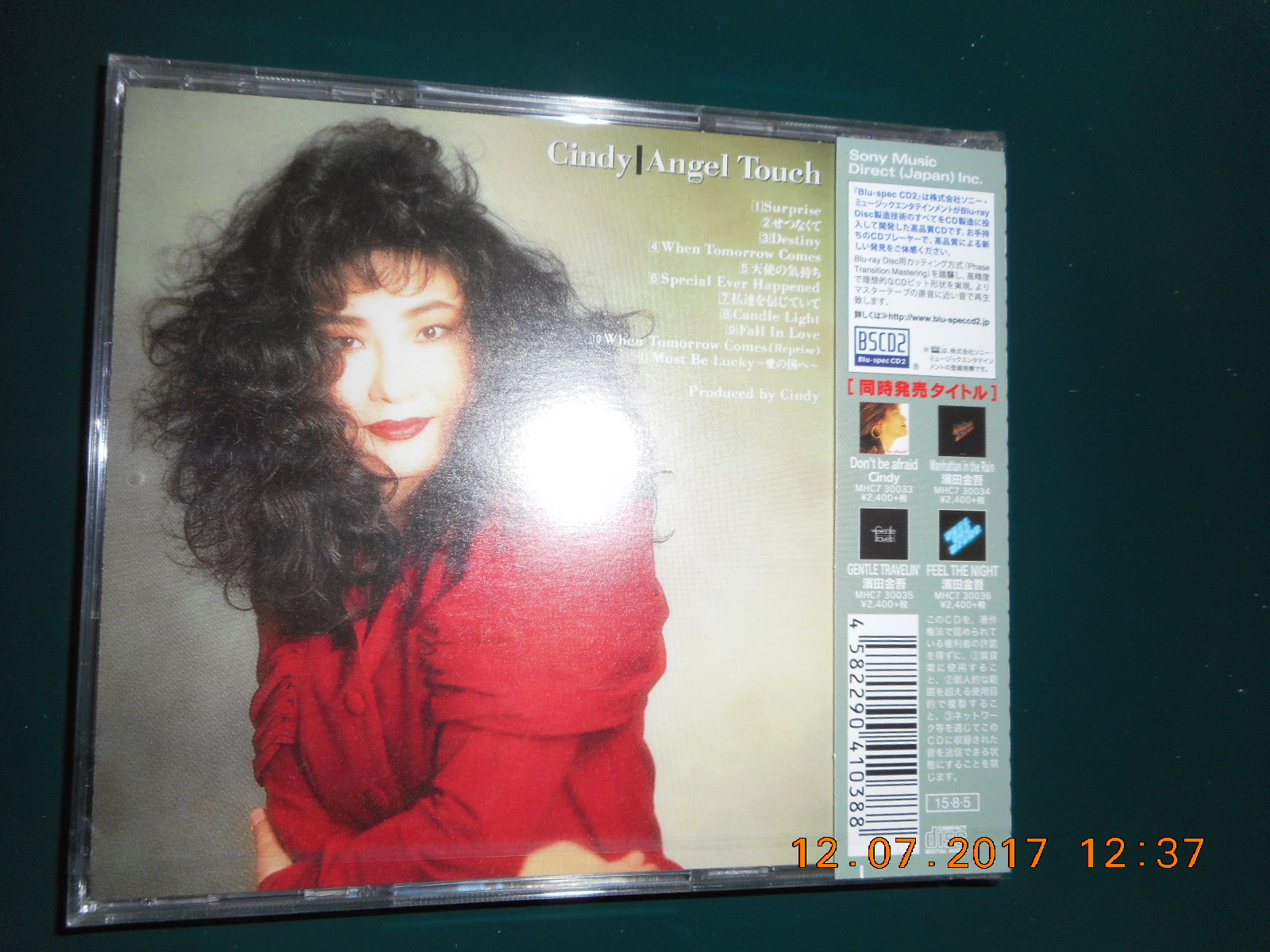
Cindy -- Angel Touch


About 18 months ago, I was first made aware of the lovely stylings of the late singer-songwriter Cindy. Never heard of her or saw her on TV any time during my two stints in Japan but then back in the summer of 2016, I discovered some of her material from her 2nd album "Angel Touch" which came out in June 1990.

The song that first drew me in was "Watashi Tachi wo Shinjiteite"(私達を信じていて), a mid-tempo R&B number that grabbed me by the short-n-curlies (sorry for that analogy) and has yet to let go. The arrangement was heavenly (the Future Funksters certainly agreed) but what made it all gel was Cindy's lovely voice.


From "Watashi Tachi wo Shinjiteite" and a hearty recommendation in the Comments section for the song, I decided that I had to get the album. And thanks to Tower Records, I was finally able to purchase "Angel Touch" earlier this month as part of my Xmas bonanza. I put it on the stereo earlier today and I am now thrilled that I got it. It is truly ambrosia for the ears.

For example, "Surprise" which starts the album off. That is one lovely intro with a hint of Latin as Cindy takes us on a mellow romantic ride. Chinfa Kan(康珍化), who also took care of another pop chanteuse in the previous decade, wrote the song with Cindy taking care of the melody. It also happened to be the coupling song for "Watashi Tachi wo Shinjiiteite" when it was released as a single.


I also like Track 2 "Setsunakute"(せつなくて...Heartrending)written by Masami Tozawa(戸沢暢美)with music and arrangement by Rod Antoon. Was able to hear a lot of the old R&B tropes from that turn of that particular decade which got the nostalgia going. After listening to this one, I just went "Wow! And this was almost a decade before the arrival of Misia".


The same duo behind the classic "Watashi Tachi wo Shinjiteite", Kan and songwriter/musician Hiroshi Narumi(鳴海寛), also wove this splendid ballad "Special Ever Happened" for Cindy which also turned out to be her 5th single from November 1990. Warm brandy for the soul. Miho Nakayama(中山美穂)would make a cover of the song in the following year for her album "De eaya".


"Candle Light" is some nice downtown funk with Cindy's great vocals and sax. Listening to this one, I just had to wonder if there had been any sort of duet between her and Sing Like Talking's Chikuzen Sato(佐藤竹善). Rui Serizawa(芹沢類)provided the lyrics with Cindy and Yuji Toriyama(鳥山雄司)coming up with the music.

Plenty of other tracks remain but I will leave those to future articles. In any case, as the commenter mentioned, I owed it to myself to get "Angel Touch", and happy to say that this could be one of those heavy rotation discs.


Monday, April 4, 2016

Yoko Ishida/Shoko Nakagawa -- Otome no Policy (乙女のポリシー)


I actually have already brought in Yoko Ishida(石田よう子)into the annals of this blog via her cover of "Sugar Baby Love" for another anime but this is the article for her "official welcome" of sorts since I will always think of this particular song when it comes to the anison singer. Commenter Edu P.R. sparked me into finally putting up "Otome no Policy" (Policy of a Young Lady) for which I'm thankful.

It was also surprising to find out that "Otome no Policy" has the distinction of being Ishida's debut single from March 1993. I've been hearing her songs from time to time and seeing her name in the opening/closing credits of anime for some time now but never realized that she started from the franchise of "Sailor Moon"(セーラームーン).

Of course, when it comes to the music of "Sailor Moon", there is that iconic tango of an anison "Moonlight Densetsu"(ムーンライト伝説)which started each episode in the early years of the original series but frankly, I wasn't all that enthused about the first couple of ending themes. Then, when the second season of the show "Bishoujo Senshi Sailor Moon R"(美少女戦士セーラームーンR)premiered fresh after literally resurrecting Usagi and the rest of the gang from evil, there came the new ending credits with the refreshingly down-to-earth images of Meatball Head just walking then running down the street. All this was accompanied by this cheerful and catchy song which became the first ending theme from "Sailor Moon" that I enjoyed.


The song was created by Rui Serizawa and Makoto Nagai(芹沢類・永井誠), and the lyrics were pretty much the policy of Usagi Tsukino:

I will never ever give up no matter how hard it becomes
That's right! That is the sweet policy of a young lady

Yup, she's the one...Sailor Moon. Mind you, Sailor Mars would probably snark off something under her breath, and of course, Moon would somehow be able to hear it, leading to a mass punch-up. By the way, "Otome no Policy" managed to peak at No. 77 on Oricon and sold around 300,000 copies.


(excerpt only)

Huge anime fan and singer Shoko Nakagawa(中川翔子)covered the song in her 2007 album "Shokotan ☆ Cover - Anison ni Koi wo Shite."(しょこたん☆かばー 〜アニソンに恋をして。〜...Shokotan Covers - Fall In Love With Anison)That album went as high as No. 17 on the Oricon weeklies. Apparently her fans really wanted her to cover a "Sailor Moon" song.


And even Seiko Matsuda's(松田聖子)daughter, Sayaka Kanda(神田沙也加), sang a brief but very sweet excerpt from "Otome no Policy" for a snack commercial. Excuse me...I've got something in my eye.

To finish off, "Otome no Policy" isn't the only "Sailor Moon" ending theme I've liked. There is a later tune with a different beat which has been just as fun.


P.S. I haven't been able to see the new "Sailor Moon" and my anime buddy hasn't exactly been too enthused about viewing it. Apparently, although it may have quite the lineup in seiyuu including the original Sailor Moon herself, Kotono Mitsuishi(三石琴乃), it's been said that the new series is lacking a lot of the humour that was the chief draw for me for the original series in the 90s. The above video was one of the biggest examples of hilarity...I don't think I've ever seen a gag involving sleeping feet anywhere like this.

Saturday, February 16, 2013

Shoko Aida -- Jóia


In my first entry for Kayo Kyoku Plus, I decided to talk about “Jóia”, the second single from Shoko Aida’s (相田翔子) post-Wink career, released in April 1996. “Jóia” is a typical “bossa nova” styled song, and although I’m Brazilian, I don’t quite listen to “bossa nova” or “samba”. “Jóia”, in the other hand, is a song that I enjoy a lot, so let’s check out the reasons.


First of all, some translation notes. If the reader is curious, “Jóia”, in Portuguese, means jewel. And the phrase “de noite eu espero por você”, repeated by the backing vocalists in the last minute of the song, means “I wait for you at night”.

So, talking about the song itself, I can tell that Shoko’s vocals were very beautiful, and if the reader is a Wink fan, you can agree with me how much her voice had matured if compared with Wink’s first smash hit, “Ai ga Tomaranai ~Turn It Into Love~” (愛が止まらない), released in 1988. It’s important to notice, of course, that in “Ai ga Tomaranai ~Turn It Into Love~”, Shoko’s vocals were young and innocent, something very welcomed and necessary in aidoru singers.

Even though Shoko’s vocals are, for sure, one of the charming points of “Jóia”, the soft melody contributes a lot to the whole atmosphere.

I firstly came across this song when I discovered Wink some two years ago (not a long time). After becoming a big fan of the duo, I started checking both girls solo efforts. I remember listening to this song a lot while traveling. Don’t know why, but it’s a good travel song. Maybe the beautiful melody combined with Shoko’s voice was something pleasant to hear while relaxing in a traveling bus.

The PV is simple, but the song doesn’t ask for anything really elaborated. Shoko’s beauty is enough for me in the video.

The single failed to chart on the Oricon (source: generasia) and we can surely understand why. Besides being a beautiful “bossa nova” styled song, “Jóia” doesn’t quite match the requisites of a J-pop hit song of the year 1996. We can’t tell, but Shoko was probably aware that it was not going to climb high on the charts. But she surely wanted to try out this type of sound, as an entire “bossa nova” album, called “Jóia” (same name of the track, I know), was released one month after the single. And maybe I’m more worried about the Oricon charts than Shoko herself was at the time. Who knows? Even Wink’s last singles were poorly received on the Oricon charts, but that’s something we can discuss better in other article.


“Jóia” was written by Shoko Aida and Rui Serizawa (芹沢類). The music was composed by Shoko herself and the arrangement was put together by Robbie Buchanan (source: generasia).


To end this post, I decided to share one of my favorites renditions of "Ai ga Tomaranai ~Turn It Into Love~" in which Shoko Aida sings it live without her Wink partner, Sachiko Suzuki. This footage is from 1997, one year after Wink's official disbandment.