I've been a fan of Japanese popular music for 40 years, and have managed to collect a lot of material during that time. So I decided I wanted to talk about Showa Era music with like-minded fans. My particular era is the 70s and 80s (thus the "kayo kyoku"). The plus part includes a number of songs and artists from the last 30 years and also the early kayo. So, let's talk about New Music, aidoru, City Pop and enka.
Credits
Wednesday, August 19, 2026
Shinnosuke "Peter" Ikehata -- Yoru to Asa no Aida ni(夜と朝のあいだに)
Friday, March 13, 2026
Keiko Saijo -- Okaerinasai(お帰りなさい)
The whole thing about anime is that it's filled with oft-repeated tropes and expressions. And one of them is the well-worn offer by a young wife to her husband: Would you like to have a bath, dinner or me? Of course, most of the time, it's played for laughs.
Tuesday, November 25, 2025
Tsugumi Morita -- Koishite Kaigan Douri(恋して海岸通り)
With one of the shortest aidoru careers that I've noted on KKP, I was still attracted to Tsugumi Morita(森田つぐみ)because of her sweet vocals and the cover of her final single to date, "Koishite Kaigan Douri" (Love Me, Beachside Street).
Released in December 1976, "Koishite Kaigan Douri" is the story of a breezy and intoxicating love affair in Yokohama that was written by Rei Nakanishi(なかにし礼)and composed by Ken Takeda(竹田賢). The melody has got a nice skippy rhythm reflecting the innocence and issue-free romance that the lovebirds are enjoying in the port city.
Morita was born Tsugumi Fujiwara(藤原嗣美)in Metropolitan Osaka in 1959 and she won a championship on a NET TV (now TV Asahi) audition show. She made her debut in spring of 1976 and released a total of three singles and one album in that one year before apparently disappearing from the recording booth for good, although she may have continued her television career for a wee bit longer. In 2014, she began running her own establishment, Cafe & Bar Alii's(カフェ&バー アリーズ)in Nishonomiya, Hyogo Prefecture.
Thursday, November 6, 2025
Rumiko Koyanagi -- Fuyu no Eki(冬の駅)
One day, I was reading through the J-Wiki article on enka and there was a list of all of the enka songs that actually made it to No. 1 on the Oricon weeklies. Among them, one song was Rumiko Koyanagi's(小柳ルミ子)"Fuyu no Eki" (Winter Station) which was her 13th single.
Released in October 1974, just from that jaunty arrangement, I don't really consider it to be an enka song per se; it strikes me more as a straight-up kayo kyoku, and even the article for "Fuyu no Eki" itself has it categorized as such and not as an enka. Written by Rei Nakanishi(なかにし礼)and composed by Kazuhiko Kato(加藤和彦), it's characterized by a jangly guitar and Koyanagi's light and airy vocals. With the season and the setting in the title, I figured that it would be about a romance that has hit its reluctant end.
As mentioned in the first paragraph, "Fuyu no Eki" hit No. 1 on Oricon through three non-consecutive weeks and it ended up not only as the 63rd-ranked single for that year, it became the 27th-ranked single for 1975. Koyanagi would also get her 4th invitation to the Kohaku Utagassen at the end of 1974 to perform "Fuyu no Eki" during her 18 straight years of appearing on the annual New Year's Eve special.
Friday, October 24, 2025
Hitomi Aki -- Tegami(手紙)
Sunday, October 5, 2025
Jun Mayuzumi -- Koi no Hallelujah(恋のハレルヤ)
![]() |
| Wikimedia Commons |
My very first article on singer-actress Jun Mayuzumi(黛ジュン)was back in 2016 when I wrote up on her 1968 hit "Tenshi no Yuwaku"(天使の誘惑). I categorized it as one of the most cheerful Mood Kayo that I had ever heard.
I also noted in that article about Mayuzumi's debut single "Koi no Hallelujah" (Love Hallelujah) which was released in February 1967. And once again, referring back to "Tenshi no Yuwaku", this was actually a restart for Mayuzumi since she had actually debuted back in 1964 under her first stage name of Junko Watanabe(渡辺順子) (same pronunciation as her real name「渡邊順子」but with one kanji different). Anyways, this single representing a new start with a new record company has all that jangly nature of a Group Sounds tune. It was a very successful hit for Mayuzumi as it sold well over a million records by 1968.
"Koi no Hallelujah" was written by Rei Nakanishi(なかにし礼)as one of his earliest works and it was composed by Kunihiko Suzuki(鈴木邦彦). According to the J-Wiki article on the song, Nakanishi had been spurred on to include the word "hallelujah" from his own emotions as a little boy years previously after arriving in the coastal city of Huludao, People's Republic of China as a refugee. His lyrics are also imbued with his feelings toward his old hometown in Manchuria and against war.
In November 1994, a cover version of "Koi no Hallelujah" was released as Yoko Oginome's(荻野目洋子)33rd single. The original GS arrangement was replaced with a dance-club R&B vibe (with a goodly amount of orchestra hits), and it scored a No. 76 ranking on Oricon. Oginome's take was used as the campaign song for Noevir Cosmetics.
Sunday, August 24, 2025
Poppies -- Koi wa Kibun(恋は気分)
The J-Wiki profile on this sextet singing group Poppies(ポピーズ)is fairly sparse, but they formed in 1974 and at the time of their formation, they consisted of Junko "Jun" Yamada(山田順子), Sayoko "Boku-chan" Nishida(西田さよ子), Yukiko "Mikki" Katada(片田雪子), Tomoko "Monroe" Sugiyama(杉山智子), Akemi "Eve" Sakamoto(坂本明美)and Sachiko "Lark" Matsumoto(松本祥子)*. Poppies debuted in April 1974 with "Koi no Chance"(恋のチャンス...Love Chance) but for this article, I'm featuring their sophomore effort, "Koi wa Kibun" (Love is a Mood).
My impression of "Koi wa Kibun", which was created by veterans Rei Nakanishi(なかにし礼)and Tadao Inoue(井上忠夫) (who would change his name to Daisuke Inoue/井上大輔), is that all involved wanted to put out a rapid-fire tune with old-fashioned 60s girl pop mixed in with a bit of ABBA disco and a soupcon of sex kitten. Think of it as Candies(キャンディーズ)fare with some of that Pink Lady kick-step although both girl groups still had their best days ahead of them when this single was released in September 1974.
After their third single, there were some major changes in the lineup and Poppies went down to being a group of five ladies with only Nishida and Sugiyama remaining from the original team. When their final single was released in 1978, they were down to just four.
*The given name kanji for Ms. Matsumoto can be read in many ways. I've gone with Sachiko for now but if anyone can confirm or correct this reading, that would be greatly appreciated.
Tuesday, June 10, 2025
Naomi Chiaki -- Watashi to Iu Onna(私という女)
NHK's long-running music program "Uta Con"(うたコン)is provided through three viewings on Jme, the first live show at around 7 am Tuesday morning Toronto time and then two reruns later in the day. I have breakfast in the dining area around the corner from the TV so I can only listen to what's being performed for the first several minutes of "Uta Con".
Mom noted that the show this week was being broadcast in a Japanese house setup which was rather unusual. Usually it's held on the grand stage at NHK's Shibuya studio in Tokyo or at the Osaka equivalent in front of a live audience, but it looks like for some reason, it was one of those rare bottle shows with just a few guests and a lot of old VTR clips. Maybe NHK Shibuya was undergoing major cleaning or something and the Osaka studio was booked for some other event.
The themes of today's show was a glance back at the 1974 Kohaku Utagassen and a tribute to the wonderful singer Naomi Chiaki(ちあきなおみ). She's been away from the limelight for over 30 years now, but when she was active for that time starting from the 1960s, she cut quite the figure: smoky voice, sad brown eyes and that full head of hair.
One new song that I discovered during the NHK tribute was "Watashi to Iu Onna" (A Woman Like Me) which was her 8th single from June 1971. Written by Rei Nakanishi(なかにし礼)and composed by Jun Suzuki(鈴木淳), who had been her composer for all of her singles up to this one, it's a fairly lighthearted, perhaps even a bit flippant, kayo kyoku about a lady who may have seen another one of the good guys slip through her fingers while hinting through the title itself that she's one of those women who has seen this situation all too often.
I really like this live version below because the arranger really amped up the brass. But even with the original, there is the appealingly skippy rhythm and those shimmery strings. By the way, "Watashi to Iu Onna" was her ticket to perform on the Kohaku Utagassen in that year of 1971. Of course, the following year would have her perform her most famous song on that New Year's Eve special.
Sunday, October 13, 2024
Kouki Kotokaze/Hibari Misora -- Mawari Michi(まわり道)
Earlier this afternoon, my father was interested in watching some of his old karaoke videos on the telly. Yep, I did say videos...VHS, in fact. The old-school medium. There were some sold by the Teichiku corporation back in the day which usually contained four karaoke videos a tape.
One of the videos contained a tune titled "Mawari Michi" (Detour). It was definitely an enka tune in sound but I'd never heard it before, and to my surprise, it was originally recorded by sumo wrestler Kotokaze who had been in the ring between 1971 and 1985. He now goes by the name Kouki Kotokaze(琴風豪規) (though his birthname was Koichi Nakayama) after retiring from the sport earlier in May following many years as the stablemaster Oguruma(尾車).
Kotokaze isn't the first sumo rikishi to make it onto the pages of "Kayo Kyoku Plus". That honour goes to Daishiro Masuiyama(増井山大志郎)when I wrote about his 2013 "Yuko no O-Mise"(夕子のお店)more than a decade ago. However, Kotokaze had hit the microphone and the recording booth a few decades earlier when he cut his first record with "Mawari Michi" in October 1982 while he was still active as a wrestler.
He definitely had some big guns helping out in the creation of "Mawari Michi", a song about admiring that young lady from afar (although the Teichiku karaoke video plainly showed an obviously successful couple walking that titular short cut). Lyricist Rei Nakanishi(なかにし礼)provided the words while Takashi Miki(三木たかし)took care of the stately music. On the Oricon chart, "Mawari Michi" did fairly well as it hit No. 34 on the weeklies, ending up as the No. 51 single for 1983 and selling half a million records.
It says something about a kayo kyoku when the Queen of Kayo Kyoku herself, Hibari Misora(美空ひばり), was willing to cover it, and in fact, she covered "Mawari Michi" which was included on "Cover Song Collection ~ Hibari Enka wo Utau"(カバーソング コレクション~ひばり演歌をうたう...Hibari Sings Enka) from 2008. Obviously, because Misora passed away all the way back in 1989, she had recorded the song much earlier; I was able to find an image of one CD containing her version of "Mawari Michi" which showed the year 1988, so I'll go with that. Her take is a more playful tune.
This is a karaoke version of the song but not the one that I viewed earlier today.
Friday, July 5, 2024
Masachika Ichimura -- Shoufu no Tetsugaku(娼婦の哲学)
It's almost been a couple of years since I posted the first article for bon vivant, actor and singer Masachika Ichimura(市村正親). For his "Hotel Blue"(ホテル・ブルー), I noted that he has had the flamboyance and showmanship of Takeshi Haga(鹿賀丈史)from "Ryori no Tetsuji"(料理の鉄人...The Iron Chefs) fame, and I guess another thing that the two entertainers have in common is that they both had their City Pop phases.
"Hotel Blue", for example, was his City Pop 2nd single from November 1982. Well, Ichimura also put out a lone album titled "Kagiri naku Yasashiku"(限りなく優しく...Gently Without End) in March 1982 whose tracks were all written by Rei Nakanishi(なかにし礼)and composed by Kyohei Tsutsumi(筒美京平). One track is the playful but urbane "Shoufu no Tetsugaku" (Philosophy of a Prostitute).
Thanks to that slightly tinny piano, there is a feeling of old-time jazz but then the City Pop rhythm quickly flows in and the disco strings hint at a time now gone by. I guess it's because of Ichimura's showman style but I can imagine the fellow welcoming tired inbound guests at Narita Airport and then having them get their second wind by simply showing them the bright lights and big city of Tokyo. His vocals are indeed the key here. Considering the title, I'm not sure whether he is leading them to Kabukicho or the area between Shinjuku and Shin-Okubo.
Outside of any "Miss Saigon" Japanese revivals, the last time I've seen the entertainer was as the occasional host of the NHK infotainment series "Ashita ga Kawaru Torisetsu Show"(あしたが変わるトリセツショー...The Instruction Manual Show to Change Your Future).
Wednesday, May 22, 2024
Reiko Ohshida -- Onna no Gakko(女の学校)
It was back in September 2013 when KKP friend and writer JTM provided one of his many great articles on the old Japanese television shows with the program of note being "Playgirl"(プレイガール). Lasting between 1969 and 1976, I gather that this could be compared to America's "Charlie's Angels", which premiered on ABC in 1976. "Playgirl" had a much larger main cast though, with full female teams changing throughout the run of the series.
One of the cast members that JTM mentioned in one paragraph was singer and actress Reiko Ohshida(大信田礼子)who joined "Playgirl" as one of the second wave of female crimefighters skilled in all sorts of martial arts and other hobbies. According to the video introduction above, her character of Reiko Ohta(太田礼子)wasn't shy in describing herself either.
Written by Rei Nakanishi(なかにし礼)and composed by Kunihiko Suzuki(鈴木邦彦), the short-but-sweet tune has Ohshida singing in a breathy and kitten-ish way against an arrangement that's a mix of kayo soul and a snake charmer's song (reinforced by some of that bluesy sax). Nakanishi laid down a story of a supposedly irresistible woman telling off any and all suitors since she will only give her love to the one that she truly loves.
Tuesday, February 13, 2024
Akemi Ishii -- Ai wa Arashi(愛は嵐)
It's been a little over four years since I posted my last Akemi Ishii(石井明美)article and that was for her "You Make Me Happy" song from her debut album "Mona Lisa"(モナリザ)from November 1986.
"You Make Me Happy" was something that I noted as a City Pop contribution to "Mona Lisa", and listening to it again after a while, yep, it's very much of the Japanese urban contemporary stripe. However, its track mate on "Mona Lisa", "Ai wa Arashi" (Love is a Storm) is quite different in that it sounds more like a European synthpop tune. The late Rei Nakanishi(なかにし礼)provided the lyrics but then I saw the composer whose name was Romano Musumarra, an Italian composer and arranger.
And sure enough, with a bit of digging, I realized that "Ai wa Arashi" is indeed a cover of a synthpop tune originally recorded and released by Princess Stéphanie of Monaco in March 1986 titled "Ouragan", French for "windstorm". According to its Wikipedia page, the official English title though was "Irresistible". It was a big hit in France as it went all the way up to No. 1 and it didn't too badly in Spain and West Germany either since it reached No. 2. There isn't all that much different between the original and Japanese versions aside from a breathier delivery by Ishii.
Saturday, November 4, 2023
Akiko Wada -- Sasurai no Blues(さすらいのブルース)/Otoko to Onna no Rock(男と女のロック)
Singer-actress Akiko Wada(和田アキ子)has been in the entertainment limelight for over 50 years and considering her height (5'9" which was considered to be very tall and rare for a Japanese woman back in those days) and her very straightforward manner of speaking, she's most likely been one of the more intimidating celebrities all these decades. Therefore, I'm not all that surprised that her first starring role in a movie was that of a gang leader in "Onna Bancho: Noraneko Rock"(女番長 野良猫ロック...Stray Cat Rock: Delinquent Girl Boss) which hit theatres in May 1970. The above is a scene from the movie where she is singing in English.
"Otoko to Onna no Rock" (Rock for Men and Women) was used as an insert song for "Onna Bancho: Noraneko Rock", and it's a pretty laidback bluesy number backed up by an orchestra with Wada singing about the state of men and women and their relationships.
That song was actually the B-side to Wada's 5th single "Sasurai no Blues" (Those Wandering Blues) which was released in July 1970. With that lonesome trumpet and the jingle-jangle rhythm, I'd almost say that "Sasurai no Blues" hits me like a cowboy tune and at points, there is something approaching enka. Lyricist Rei Nakanishi(なかにし礼)and composer Kunihiko Suzuki(鈴木邦彦)were responsible for both songs.
"Sasurai no Blues" was the follow-up to one of Wada's most famous songs "Waratte Yurushite"(笑って許して)which was released earlier in March that year. And though it did only half the sales that "Waratte Yurushite" had done, I don't think 110,000 records sold is anything to laugh at, and according to J-Wiki, "Sasurai no Blues" hung around for a long time on the charts, peaking at No. 28.
Thursday, August 17, 2023
Shinichi Mori/Keiko Fuji -- Hatoba Onna no Blues(波止場女のブルース)
A couple of weeks ago, I posted my usual Thursday Reminiscings of Youth article, that time on The Carpenters' "We've Only Just Begun" and noted that I couldn't put up the Top 3 on Oricon as the usual comparison kayo kyoku because I hadn't ever covered any of those three. So, I started remedying that by posting No. 1 from Oricon's August 3rd 1970 Top 10 list which turned out to be Hide & Rosanna's(ヒデとロザンナ) "Ai wa Kizutsukiyasuku"(愛は傷つきやすく).
Well, No. 3 on that list was Shinichi Mori's(森進一)"Hatoba Onna no Blues" (Woman on the Wharf Blues), his No. 16 single from June 1970. Written by Rei Nakanishi(なかにし礼)and composed by Charlie Ishiguro(チャーリー石黒)under his songwriting pseudonym Miyoshi Shiro*(城美好), I guess this is one of those songs that could straddle the Mood Kayo and enka line.
On J-Wiki, it's been categorized as an enka and Mori's characteristic gravelly voice sure does retain a whole lot of emotion, apropos for a song of that genre. However, the arrangement by Kenichiro Morioka(森岡賢一郎)strikes me as being Mood Kayo with that bluesy saxophone and that insistent beat. In any event, a poor lady is left bereft without her significant other at her side anymore. This is the type of tune that I could see Mori performing on an episode of "Enka no Hanamichi" (演歌の花道) because the show loved to have their musical guests sometimes standing on a pier contemplating the future before breaking into song.
"Hatoba Onna no Blues" reached No. 2 on Oricon and became the No. 17 single of the year. It also earned Mori a Japan Record Award in Best Performance. There have been covers of the song including one by Keiko Fuji(藤圭子)in 1973.
*That last name of 「城」can be read in many different ways according to my usual site, and I couldn't find the proper way to pronounce it. If anyone can confirm or correct what I put down, I will be thankful for it.
Monday, July 10, 2023
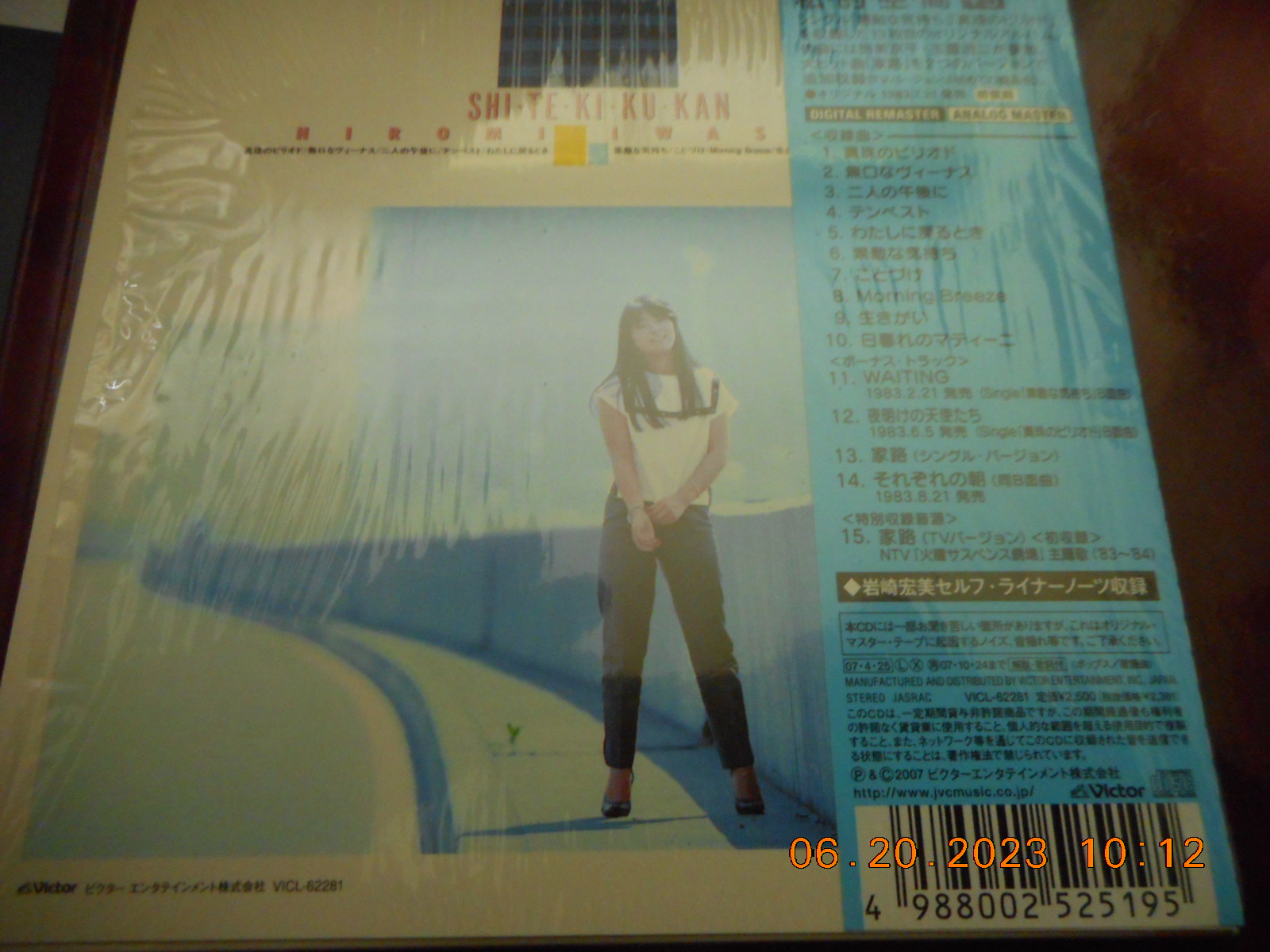
Hiromi Iwasaki -- Shi-Teki-Kuu-Kan(私・的・空・間), Part 1
I admit that I may have quickly scrolled down the Hiromi Iwasaki(岩崎宏美)file on "Kayo Kyoku Plus", but I was surprised to realize that it's almost been eight years since I actually covered one of her albums. Certainly, I've covered plenty of her individual songs in the last number of years, but the most recent album by her that I took a look at as a whole was her 1985 "Diamant"(ぎやまん)back in October 2015.
Well, allow me then to cover at least a part of her July 1983 album "Shi-Teki-Kuu-Kan" (Personal Space) tonight. I bought this one by Iwasaki several years ago and there is personal testimony from the singer herself in the liner notes. The one thing I remember the most by far from those notes is her hilariously embarrassed apologies in the second paragraph for her looking so "fat" in the photos. She took particular aim at her saggy arms and those bushy eyebrows before reassuring fans that she at least was able to upgrade herself in the years hence. Personally, she looks hot and has always looked so. End of story.
Incidentally, I'm covering the 2007 issue of "Shi-Teki-Kuu-Kan" so there are five bonus tracks including two versions of one of my favourite Hiromi songs of all time, "Ieji" (家路)which I actually profiled years ago. I'll cover those as well but among the original tracks, the truly relaxing "Suteki na Kimochi"(素敵な気持ち)is another song that I handled back in 2015.
There's a lot to see and hear so let's begin with the first track "Shinjuu no Period"(真珠のピリオド...Pearl Period) which was Iwasaki's 31st single from June 1983. It did decently on Oricon by peaking at No. 31 and I like it because it has that snazziness as it straddles the line between pop and City Pop. I love the old-fashioned "dabba dabba" chorus as well as the sharp strings and the horns coming in. Not surprised at all then that the master songwriters behind this one were lyricist Takashi Matsumoto(松本隆), composer Kyohei Tsutsumi(筒美京平)and arranger Mitsuo Hagita(萩田光雄). Considering how this one sounds, I had assumed that "Shinjuu no Period" was yet another Iwasaki contribution to the Tuesday Night Suspense Drama on NTV like "Ieji" was. But that wasn't the case here and Matsumoto's lyrics merely relate the bittersweet late summer story of a tryst at a beach house that is to end soon, and the lovers are trying to make the best out of what little time they have left with each other.
Track 2 is the sunny 70s soulful "Mukuchi na Venus"(無口なヴィーナス...Silent Venus). Once again, Tsutsumi provides his composing prowess here as he does for two more tracks on Side A of the original LP with Keiichi Oku(奥慶一)as the arranger. The late Rei Nakanishi(なかにし礼)was the lyricist here as Iwasaki sweetly and slyly assures a paramour that all's fine and dandy in Romance City and that nothing needs to be said at all.
There is a bit more brio in Iwasaki's vocals for Track 3, "Futari no Gogo ni"(二人の午後に...A Couple's Afternoon) with Mieko Arima(有馬三恵子)as the lyricist here while Hagita is back as arranger. We're definitely in the City Pop here. I like the layering of urban contemporary rhythm and keyboard underneath strings which paint a more romantically fantastical picture although the story is more negative as a couple go through the motions poolside even though the love dissipated a while back. Well, that's how the cake crumbles.
Not surprisingly for a title like "Tempest"(テンペスト), there's more melodic drama and rock guitar in this track which has Nakanishi, Tsutsumi and Oku working together. My mind pegs this one as a theme song for a detective show although once again such was not the case. Still, the tempest isn't only occurring outside but inside a hotel where a woman is anticipating an affair is about to turn a critical corner into permanent changes.
The final track on Side A is "Watashi ni Modoru Toki"(わたしに戻るとき...Getting Back to Me) has me getting some 80s Steve Winwood vibes. And this time, I also feel some West Coast AOR with the electric guitar thrown in there. Hagita is back but for this one, Kazuko Katagiri(片桐和子)was responsible for the lyrics for this jaunty love song. One other thing is that instead of Tsutsumi composing the tune, it was Anzen Chitai's(安全地帯)Koji Tamaki(玉置浩二)coming up with the melody. Iwasaki noted Tamaki's assistance in the liner notes and that he also composed a couple of other tracks on Side B. The singer noted that Tamaki's three contributions to "Shi-Teki-Kuu-Kan" were just before his band made it big with "Wine-Red no Kokoro"(ワインレッドの心)in that same year. Additionally, she remarked that Tamaki was dressed to the nines a la Humphrey Bogart right down to the fedora (usually apparently most songwriters would come over as casual as possible); he even sported an attaché case. Maybe he was trying to impress her; I have no idea.
To finish off Part 1 (Part 2 will be next week), I'm leaving the article with one of the bonus tracks "Sorezore no Asa"(それぞれの朝...Each Morning) which was the B-side to "Ieji". I actually first heard this song on an episode of that old CHIN-FM radio program "Sounds of Japan" and it sounded so beautiful despite all of the hissing and spitting of bad reception that I searched for years for the title of the tune. Kaoru Ito(伊藤薫)was both the lyricist and composer for this ballad that sounds like a lullaby for children. In point of fact though, it is a melancholy ballad about the end of a relationship signalled openly with phrases like "the end of love" and more tacitly with one line stating the coming of fall. To hammer the final nail in, there is a very morose harp playing there along with some splendid strings playing in the bridge. "Sorezore no Asa" will never get anywhere near a wedding reception but it's still a wonderful song.
Anyways, Part 2 will be here next Monday.
Monday, April 24, 2023
Sergio Mendes & Brasil '77 -- Aisareta Ato de(愛されたあとで)/The Magic Wheels
Happy Monday to you all, especially since we're on the final Monday for April 2023. I thought that we can start this KKP week with something mellow once more. Bossa nova has always been one of my favourite genres anywhere around the planet, and so, I often think of Sergio Mendes & Brasil '66 and their classic "Mas que Nada" which I will really have to cover on a future Reminiscings of Youth. I actually have covered a Mendes song through ROY but it was one of his AOR hits, "Never Gonna Let You Go" from 1983 which still retains a lot of sentimental value to me.
Tuesday, December 27, 2022
Mitsuko Baisho/Teruhiko Aoi (Johnnys)-- Tokei wo Tomete(時計をとめて)
Chieko and Mitsuko Baisho(倍賞千恵子・倍賞美津子)are sisters who have been veterans in the acting and music industries for decades. The former is someone that I've known better primarily because she was acting as Sakura, the kind and dutiful sister to the legendary comical traveling salesman Torajiro Kuruma(車寅次郎)in the very long-running movie series "Otoko wa Tsurai yo" (It's Tough Being a Man) that my family used to watch for years. However, the younger Mitsuko Baisho is someone that I've also gotten to know through television dramas and commercials, and she has quite a different air about her. She has had more of the sexier and more voluptuous side.
But what I hadn't known about her until recently is that like her elder sister Chieko, Mitsuko Baisho has also had her time behind the recording microphone. In fact, she has released 23 singles and 2 albums up to 1985. Her 10th single was "Tokei wo Tomete" (Stop the Clock) which came out in 1967. The title might sound like the name of an American game show but Rei Nakanishi's(なかにし礼)lyrics put that rumour to rest by describing a lady's ardent request for time to be stopped so that she can spend as much remaining time as possible with the love of her life. Mitsuko seems to have her sister's singing ability with an operatic voice.
Now, actually "Tokei wo Tomete" is a cover of a bolero song titled "El reloj" which was created by Mexican singer-songwriter Roberto Cantoral when he was a member of the music trio Los Tres Caballeros and released as a single in 1957. According to Wikipedia, Cantoral had a tryst with one of the women participating in a tour by the trio through America and was inspired to write the song based on the brevity of time Cantoral had with the lass before they had to part in their different directions.
Along with Baisho's version, there were other covers of "El reloj" (The Clock) including an even earlier one by Teruhiko Aoi(青井輝彦)as a solo when he was still a member of the very first Johnny's Entertainment aidoru group, Johnnys(ジャニーズ). Released in 1966, the Japanese lyrics were handled by another person, Masaru Kamo(かもまさる). His rendition has a less strident feeling and more of a lullaby approach to the song, partly thanks to Aoi's creamy vocals. I can imagine the lad's fans simply fainting in the aisles now.
Friday, November 11, 2022
Sara Takahashi -- Rhapsody(ラプソディー)
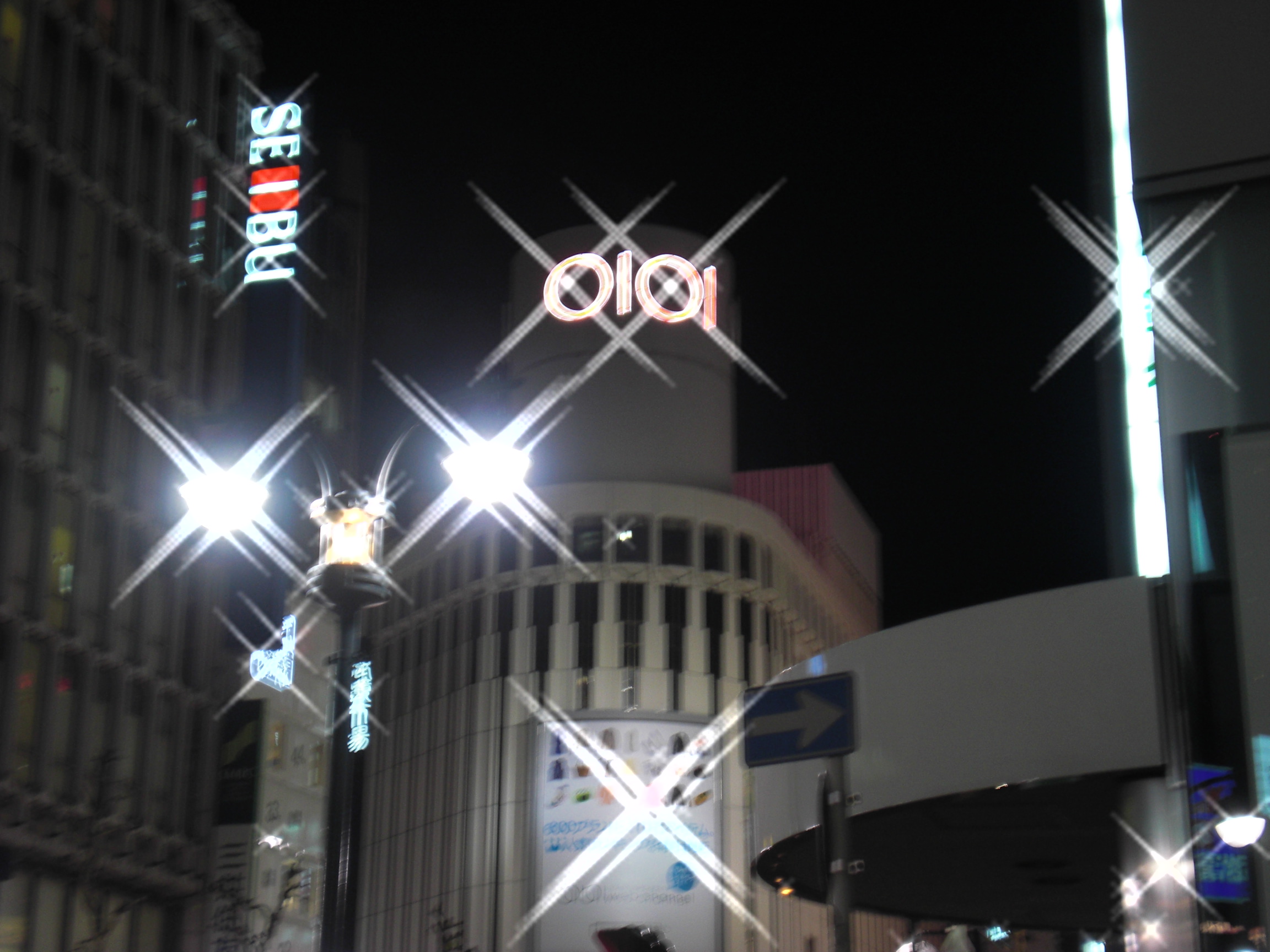
The above photo is of Marui Department Store in Shibuya. I rather miss that sparkly function on my old Casio camera; it sets the right note for City Pop Fridays on the blog.
At the end of September, I wrote up the first Sara Takahashi(高橋沙羅)article and it was for her second single "Savanna Kankaku"(サバンナ感覚)from March 1981. This was a heady concoction of City Pop, Mood Kayo, and Latin by composer Kisaburo Suzuki(鈴木キサブロ), arranger Masataka Matsutoya(松任谷正隆)and lyricist Rei Nakanishi(なかにし礼).
Well, I also found the B-side which is "Rhapsody". Suzuki and Nakanishi were behind the creation of this song, too, and although I couldn't find definitive proof of it, I'm assuming that Yuming's(ユーミン)husband was the arranger as well. This time, there's no real hint of Mood Kayo and the Latin beat is a bit more subdued though present, especially at the end. However, "Rhapsody" does feel like a City Pop tune with the added presence of sophisti-pop worthy of a stay at the Tokyo Prince. I do get vibes of Quincy Jones via "The Dude" album from the same year and the Manhattan Transfer when I hear this.
Monday, October 24, 2022
Sayuri Ishikawa -- Hamauta(浜唄)
Although the shore by my grandfather's village in Wakayama Prefecture was too small to have any of the large fishing vessels moored there, as a kid visiting the place in 1972, I do remember witnessing my grandfather and his fellow villagers bringing in the nets filled with fish. The name that I heard mentioned for that fish was kamasu(かます), and I recollect that it was delicious grilled, although it was still years before I finally appreciated sushi and sashimi. The thing is though when I looked up kamasu in the J-E dictionary, the translation came out as barracuda! My impression had been that one was more likely to be bitten by a barracuda than vice versa.
In any case, to start off this week of "Kayo Kyoku Plus" tunes, I'm going with Sayuri Ishikawa's(石川さゆり)105th single, "Hamauta" (Ballad of the Shore) which was released in March 2012. With the guitar-powered brio of contemporary enka but lyrics that seem to be more evocative of older enka regarding sending fishing fleets out to sea for their daily bountiful catch, it has Ishikawa once again putting her all into her vocals. Folks like Saburo Kitajima(北島三郎)would probably nod in respect.
Rei Nakanishi(なかにし礼)came up with the lyrics while Tetsuya Gen(弦哲也)composed "Hamauta". Looking through the lyrics, I thought it would be some sort of go-touchi song like the ones that I have been writing about every Saturday, but there is no mention of any specific place in the lyrics so the song can apply to anywhere around the Japanese archipelago.
Friday, September 30, 2022
Sara Takahashi -- Savanna Kankaku(サバンナ感覚)
Well, KKP has its second Sara to come on board the blog. Sara Takahashi(高橋沙羅)now joins fellow City Popster Sara Hamamoto(浜本沙良), and that's not the only situation where names can be confused. One Japanese blogger has even pointed out that there could be some mix-up between this Tokyo singer and the winning ski jumper Sara Takanashi(高梨沙羅)with just one kanji difference.
Regardless, Takahashi is a singer about whom there's not much information. Once again, I had to refer to "idol.ne.jp" to help out and it was there that I did find out that she was born Masae Takahashi(高橋正枝). As well, she spent four years overseas in the United States and Spain, so she's fluent in English and Spanish. Her hobbies include cooking, travel and pachinko.
According to that idol site, Takahashi released just three singles between 1980 and 1984 with the second one being "Savanna Kankaku" (Savanna Sensation), released in March 1981. Listening to the song a few times now, there are a few influences in play here: City Pop, Mood Kayo, and Latin (maybe even some last vestiges of disco), thanks to Kisaburo Suzuki's(鈴木キサブロ)melody and Masataka Matsutoya's(松任谷正隆)arrangement. Rei Nakanishi(なかにし礼)took care of the lyrics, which according to that blogger that I referred to above are fairly raunchy. OK, I'll just take that at face value then.