Credits

I would like to give credit where credit is due. Videos are from YouTube and other sources such as NicoNico while Oricon rankings and other information are translated from the Japanese Wikipedia unless noted.
Showing posts with label Hachiro Kasuga. Show all posts

Monday, April 6, 2026

Hachiro Kasuga — Izakaya (居酒屋)


Ever had a food you disliked and actively avoided for as long as you could remember, but one fine day you decide to give it another chance, and you end up liking it? For me, that’d be spring/green onion. As a child, I found its green presence in what I thought would’ve been the perfect dish highly offensive. But the aforementioned process occurred somewhere along the line, and now it’s something I actively want in my food. It’s such a strange phenomenon, isn’t it?

In the kayo context, my spring onion is what is commonly referred to as Hachiro Kasuga’s (春日八郎) signature sound. It’s a dark and plaintive sort of melody on the minor key of the yonanuki (pentatonic) scale that adds a layer of foreboding to Kasuga’s already forlorn tone. Generally speaking, I was never really keen on this sort of melody as I was of the mind that listening to stuff like that would dampen or exacerbate my poor mood. My picky taste thus had me avoiding such Kasuga Bushi, which ironically, were the bulk of Kasuga’s hits. Writing my thesis and joining the Kasuga Enka Denshokai made me accept the “enka” in the “enka singer”, but the greater exposure to Hachi’s vast discography did little to change my preferences. Then one day just this year, something in my brain chemistry must've changed, but I became more open to the Kasuga standards I'd been actively avoiding. There were days when my usual selection just didn't sit right with my mood - neither sad or happy - but these darker numbers were able to just about compliment it. Their haunting melodies and their arrangements suddenly became so fascinating and hypnotic. Nothing represents this change I had better than Izakaya.

Izakaya is a constant in Hachi's compilation albums and recitals, and seems to be a fan favourite. It was released in January 1958, and written by lyricist Hiroshi Yokoi (横井弘) and composed by Toshiyo Kamata (鎌多俊与). Its somber atmosphere and theme of moping at a bar would become key enka genre attributes, but I couldn't understand its appeal. My initial enka-kayo pickiness had me dismissing it as a boring mood dampener, and in later days, just one of the representative enka prototypes. 

However, I was quite recently doing something that had me picking an enka-like Kasuga Bushi that encompasses someone very enka and very Hachiro Kasuga. The first song that popped into my head, for some reason, was Izakaya. At the time, I had only just begun to appreciate the dark, minor key tunes and their magnetic arrangements, and Izakaya rarely if ever came up on my radar until that moment. Still, I was satisfied with my choice, and I think that was when I began to savor the flavours Toshi-san had created in this beloved hit: bitter, heavy, dry... But highly addictive. For something I disliked, it did a great job for getting stuck in my head. I could've sworn I listened to it at least twice a day for the past couple of weeks.

It also goes without saying that Hachi's mournful warble blended perfectly with the haunting melody. It makes the protagonist sound like he's struggling to hold back tears of anguish from falling into his drink. Yet, Hachi is also fantastic at conveying hope and empathy in the midst of despair, and so the consoling, emotional warmth our protagonist gets from his go-to bar cuts through the song's overall melancholic tone. 

So, is this what folks mean when they say "Kasuga Bushi", or rather, "Kasuga Enka"? I think I'm starting to get it.

Speaking of which, by some mind-bending coincidence, the aforementioned enka person later sang Izakaya while representing the Hachi club at a karaoke recital. I also have reason to believe that it's one of their cherished Kasuga Bushi, although I didn't know that when I affixed the song to them. Weird. I suppose that just affirmed by intuition.

Hachi would re-record Izakaya on stereo in 1970 with a different arrangement (the above video). While his more matured, slightly lower voice accentuates the song's inherent sadness, the haunting atmosphere of Toshi-san's original arrangement is what I can't get enough of... Sorry, Toshi-san, you really did cook with this one - I was the clown for not seeing it this whole time.

Anyway, Izakayas are not my kind of place. I bury my head in my favourite singers or surround myself with nature when depressed. So, in that respect, I don't think I can resonate completely with the concept of moping in a bar over alcohol as in the likes of Izakaya. That said, slowly coming around to enka style tunes/enka/Kasuga Bushi of this sound feels like quite the big milestone in my enka journey I'd never thought I'd reach. And that took me like, what, 12-ish years? 

"You'll understand enka when you're older." This is a phrase often used to explain enka's older fan base. I had even been told that several times - in fact, that very enka person had even said that I'm still too young to fully comprehend enka and its emotional depth. Admittedly, I took some offence to that, and just took it as a generalizing statement. After all, everyone goes through different things, and thus a listener can interpret and resonate with a song in different ways. But after this Izakaya episode, I'm inclined to believe that there's some truth to this saying, one way or another. I suppose it is really like acquiring the taste of spring onions.

P.S. J-Canuck did a writeup on Izakaya several years ago, so you can check it out here.

P.S.S. Izakaya was theme song of episode 8 on the first radio show Hachi hosted, Kasuga Hachiro no Shinmiri Enka Daizenshu (春日八郎のしんみり演歌大全集) in late 1982. The episode had the great Yokoi on as a special guest, and they talked about the results of a kayokyoku survey held by the Nihonshu Center (日本酒センター) that featured postwar kayo with themes, titles, and lyrics related to alcohol released between 1950 and 1981. To my mild surprise, Hachi claimed the top spot for being the singer with the most number of said songs: 26. Yokoi came first in the lyricist category, while Minoru Endo was first in the composer category.

Tuesday, March 17, 2026

Hachiro Kasuga -- Kurashiki no Hito (倉敷の女)

Kasuga performing at the Kurashiki no Hito promotional recital.
The band conductor (extreme right) is likely Hayashi.
From Mikasa, 14 April 1968 Issue

It goes without saying that a singer's voice is their main attraction... Well, most of the time I would think it is. It certainly is one of them for me. I tend to favour the smoother, resonant vocals of singers from the 1930s and immediate postwar era, and value the singer's ability to convey emotion without having to go over the top - I'm looking at you, do-enka singers. I suppose it's no surprise by now that the one who is the perfect intersection of everything I like in a singer's voice is Hachiro Kasuga (春日八郎)

Hachi ordinarily delivered his songs according to the music sheets with little to no room for adlibbing, for this seemed to be a hardline expectation for artistes in the old kayo world (approx. late 1920s to early 1960s). Such an expectation began to fade by around the 60s or so as more and more amateur singers came on to the scene. By the time enka the genre sprouted (1964-65), conveying anguish/sadness/drama, as well as not sounding "perfect" nor singing according to the (music) books seemed to take priority - in enka, at least. Nevertheless, Hachi still mostly sang as he did when recording songs, though on the rare occasion he does surprise me. One of such times is in Kurashiki no Hito (Woman of Kurashiki)


Part of Kasuga's late-to-take-off "Onna Series"* (女シリーズ), Kurashiki no Hito hit the shelves in March 1968, was written by Takashi Tsukasa (司太可志), and composed by Isao Hayashi (林伊佐緒). I got to know this song several years ago when I was still testing the waters with Hachi. I was on board with it fairly quickly with it being a romantic blues Mood Kayo with the saxophone blaring away and all. Topic-wise, its your standard enka and Mood Kayo fare, i.e. our song protagonist is reminiscing and pining for the titular woman from Kurashiki - a love that wasn't meant to be. However, at the time the Hachiro Kasuga whom I knew as generally sounding measured if not somewhat gloomy seemed to let loose and essentially cried out in anguish at the song's crescendos. So emotional is this cry that his voice was on the cusp of breaking. I was floored. I don't know why, but it sent my heart racing. "Kasuga could sound like that??" I thought. Admittedly, I still feel the same way now, despite it being at least 6 years from that very moment. I suppose there's something attractive in him straying from his usual, rather placid demeanour and expressing more primal-sounding emotion.


I don't think Hachi ever reprised the same vocal style in recordings since then, and I did wonder why this sudden anomaly with Kurashiki no Hito. This is pure speculation on my part, but this song emerged around the time when blues Mood Kayo singers like Shinichi Mori (森進一) and Mina Aoe (青江三奈) made it big. Both were known not just for their unique, husky vocals, but also heavily emotive cries or sighs of anguish - particularly Mori. Considering Hayashi sensei's melody was made in a similar vein to the younger singers' hits, I wonder if Hachi decided - or was instructed - to take on a style not unlike them. 

Moving on, Kurashiki no Hito is a go-tochi song that is set in Kurashiki, a quaint town in Okayama prefecture where the vestiges of the Edo era remain. It seemed like it was made with the Kurashiki town council's support with hopes that it'd boost tourism - one of the pluses that come with being featured in a go-tochi songs. To that end, the song was also quite heavily promoted in the town/the prefecture, enabling it to perform fairly okay in terms of sales. Unfortunately, it didn't really stand up to the test of time, and it wouldn't be wrong to say that it's mostly a deeply buried gem.

I got this at a a used book flea market in
Shinbashi for 200 yen
 

I've not been to Kurashiki yet, but I have in my mind's eye only what photos, videos, TV shows, have shown me, and the romantic picture Tsukasa had so vividly depicted in Kurashiki no Hito: traditional houses with snow white walls and ash grey tiled roofs, waterways lined with willows hanging lazily over the water's surface, etc. Correct me if I'm wrong, but I think it was considered Japan's answer to Venice. I think it's high time I heed the call of this go-tochi song and head down there for one of my solo trips. I'm also a big fan of author Seishi Yokomizo's detective Kosuke Kindaichi series, where several instalments were set in Okayama. There's a little museum exhibition in a town around Kurashiki where Yokomizo had evacuated to during WWII and served as the setting to the series' first tale, so that'd definitely be on my must-visit list.

I would've loved to see Hachi singing Kurashiki no
Hito live. 
From 
Mikasa, 14 April 1968 Issue

Anyway, let's circle back to Kurashiki no Hito to end things off. Despite it being a relatively unknown Kasuga Bushi, it's sung fairly regularly at the Kasuga Enka Denshokai. I decided to give it a go for myself during my first visit of the year. Ordinarily, I'd be shaking from the nerves, or being too self-conscious with singing the songs "right," but I thought that if Hachi could let loose and put his all into conveying Kurashiki..., so could I. I think it was the only song that I was able to sing with no inhibition. And by golly, that felt so good! And to sing it with/for people who enjoy Kasuga bushi as much or even more than I do felt so good. 


*A series of songs with the word "onna"(女) but read as "hito"(ひと) in their titles. It was technically kickstarted by Kasuga with Nagasaki no Hito (長崎の女) in 1963. However, it became associated with Saburo Kitajima (北島三郎), who more consistently released songs of this theme since his Hakodate no Hito (函館の女). By the time Kasuga began to be more consistent with the "Onna series" in the late 1960s, the series' association with Kitajima essentially became almost set in stone.

Wednesday, December 31, 2025

The Kasuga Bushi with Isao Hayashi, Toshiyo Kamata, and Tadaharu Nakano (林伊佐緒、鎌多俊与と中野忠晴の春日節)

It's hard to believe that another year is coming to a close. Looking back on 2025, I did a lot, especially in the realm of ryukoka and kayokyoku, so much so that I’d mistaken some events for having taken place the year before. That said, I’m exhausted. I don’t know what’s in store for 2026, but I look forward to it.

Anyways, during some Decembers, I usually put up an Author's Picks article that summarises all or some of what I like. I ended up going with the latter. What theme did I go with? Well, for the main ingredient, we have my favourite Hachiro Kasuga (春日八郎). That is to say that all the songs featured will be his. They are commonly called Kasuga Bushi (春日節… Kasuga Song). And then, we have 3 different spices to add to this main ingredient: Isao Hayashi (林伊佐緒), Toshiyo Kamata (鎌多俊与), and Tadaharu Nakano (中野忠晴). These 3 men worked as composers in postwar King Records and spawned a plethora of hits for the artists they wrote for, including Kasuga. Other King Records composers are most known for creating the Kasuga Bushi with its signature plaintive sound, and I may talk about them in an article similar to this another time. But here, I will only highlight a Kasuga Bushi made by the aforementioned 3. 

Why Hayashi, Kamata, and Nakano specifically? Because their faces make my heart melt. It's really as simple as that. Well, there is also the fact that I have been looking into their works on my own volition, so it’s easier for me to curate an article about them. I actually got this idea when coming up with a theme to my song selection at the bi-monthly Kasuga Enka Denshokai (春日艶歌伝承会) karaoke circle. Dubbed the "Handsome Boy Composer" theme, each of the 3 songs I picked were composed by these 3 guys. With the context out of the way, let's begin.


Catching Both Rabbits with Isao Hayashi: Rozario no Shima (ロザリオの島) (1964)


Getting the ball rolling is Hayashi sensei. Among the 3 composers here, he had made the most number of Kasuga Bushi (about 24, give or take, excluding unreleased and made-to-order external requests), and can be considered one of the fan favourite Kasuga Bushi producers. An old guard of King Records, he had been wearing both the singer and composer hats since the early 1930s, and would often be singing his own works. Apparently, he had been advised to focus on one path and not double dip, using the proverb "If you run after two hares, you will catch neither." The man himself even admitted that he might have been more successful if he stuck to just singing or music-making. But he felt that he was most happy doing both, even if it costed the (relatively) reduced fame, and so that's what he did until the end of his life. Considering his list of successes in both fields, though, I think it's safe to say that he managed to catch both rabbits.

The very first song Hayashi made for Hachi was Nigate Nanda yo (苦手なんだよ) (1957), and the last was Kunashiri no Hito (国後の女) (1982), making him one of the composers who worked with Hachi fairly consistently the longest. To me, the Hayashi Kasuga Bushi tend to sound rather exotic and raw. The atmosphere created by his melodies and arrangements makes it feel as though I'm in the location featured in the song, be it a grimy alley, a lonely harbour, or somewhere outside the major cities in Japan. However, another feature I've now been looking for is if the Hayashi Kasuga Bushi was a recycled Hayashi original. It was something noticed upon delving deeper into Hayashi's self-composed postwar releases, as some of them sounded remarkably similar to some of the songs he made for Hachi. Putting two and two together, it became fairly obvious that Hayashi likely reconfigured his own songs that never became hits and sent them back out into the field to be sung by artists popular at the time (50s & 60s), like Hachi, in hopes of scoring a hit.

Hayashi as a special guest at the unveiling of Rozario no Shima in 1964.
From Shinobu

Anyways, one of Hayashi-made Kasuga Bushi which I suspect could've been one of Hayashi's originals is Kasuga’s revival hit Rozario no Shima from August 1964. Rozario… with its dramatic yet somewhat foreboding atmosphere is easily one of my favourite pieces Hayashi made. It allows Hachi’ signature forlorn delivery to shine, all while also enabling him to showcase the extent of his vocal prowess. Its unique melody fits Hachi so well that I was inclined to say that nothing like this had been made prior, and then I stumbled upon Hayashi’s own Nangoku no Yo wa Fukete (南国の夜は更けて) from May 1956. The latter had a much lighter arrangement, but there was no mistaking that intro with the deep, rhythmic thrumming of the guitar (?) and the melody’s dark yet exotic tone. As far as I know, Nangoku… never became much of a hit, likely overshadowed by other incredible releases at the time. Perhaps Hayashi refused to let this interesting piece go to waste, and so he passed it on to someone who might be able to bring life into it. Hachi had already saw a resurgence in popularity with Hayashi’s Nagasaki no Hito (長崎の女) in 1963, so maybe Hayashi saw this opportunity for another of his works about southern Japan to finally shine. Shine it did.

Hayashi recycling Nangoku no Yo wa Fukete to make Rozario no Shima theory is pure speculation on my part, but it does give a new meaning to Hayashi being able to catch both the rabbits he was chasing after.

Toshiyo Kamata's Got That Fight in Him: Ruten Garasu (流転がらす) (1957)


Next up is Toshi-san. Based on what I know, he made the least Kasuga Bushi among our 3 (about 11 or so). Like Hayashi sensei, Toshi-san can also be considered one of King's old guard, having been one of the company's stars as the shadow of war loomed over Asia in the mid-30s and early 40s. Unlike Hayashi, Toshi-san solely stuck to composing music once the Pacific War ended.

The very first Kasuga Bushi Toshi-san made was Yuhi wa Moete (夕陽は燃えて)(1956), the last was Magokoro Sakaba (まごころ酒場) (1962). I believe he moved to Toshiba (records) from about 1963. I'm not sure how long he stayed at Toshiba, but he may have moved back to King in the 80s for a little bit, but I'm unclear on that. To be completely honest, I struggle to identify any distinguishing traits in the Kamata Kasuga Bushi, especially when compared to the other 2 composers. I’m by no means saying that they’re not good, though. They’re rather simple in melody and arrangement, but are nevertheless catchy and capable of striking a chord with listeners; a few of them even seem to be fan favourites and are staples in any Hachi compilation album. So, Toshi-san’s gems do find their way among the other well-loved Kasuga Bushi.

My personal favourite Toshi-san Kasuga Bushi is Ruten Garasu. It's an easy-to-listen-to matatabi mono about a down and out wanderer drifting through life. The gentle peaks and dips of the tune allows you to enjoy the smoothness and richness of early Hachi's maturing vocal quality. For some reason, I can't get Ruten Garasu out of my head, and I'd been listening to it so often this year that it became my most played song on Spotify for 2025. Apparently, in the span of 7 months, I listened to it almost 150 times. Fair play to you, Toshi-san.

Tadaharu Nakano's Butter Miso Soup: Ruten no Yoru (流転の夜) (1955)


Finally, we have Mr. Nakano to wrap up the article. I've talked about Nakano's postwar escapades and Nakano-made Kasuga Bushi extensively over the past couple of years, since I love this snazzy jazz man almost as much as I do one of the pioneers of enka. But here's a consolidated cliff notes version of what I'd talked about over several articles:

Unlike Hayashi and Kamata, Nakano, originally affiliated with Columbia Records, joined King Records in mid-1952 as a contract composer. He had left the music world in 1947, but returned after a business venture turned south. He made a mini attempt to re-debut as a singer under the moniker of Young Nakano (geez, why you gotta be so cringe, Nakano?), but that didn't really work out either; he didn't seem satisfied with his diminishing vocal abilities at the time as well, and so he stuck to making music behind the scenes, where he rediscovered success.

Nakano made about 20 official Kasuga Bushi singles, the first being Jirocho Tabi Shigure (次郎長旅しぐれ) (1953), and the last Kore ga Jinsei (これが人生)(1964). As with Nakano's other postwar compositions, the Nakano Kasuga Bushi's main attraction are the refreshing arrangements derived from snappy rhythms and a variety of instruments, often times making them sounding extremely western or (traditional) Japanese-sounding. Even for the more ordinary kayokyoku, the arrangements make sure you’re in for at least an interesting listening experience. This mostly attributed to his main collaborator, arranger Masao Ueno (上野正雄). That said, Nakano's Kasuga Bushi tend to be overshadowed by those from other composers, including the above 2, and were only middling hits at best. If I were to be completely honest, there is just something in Nakano's melodies that don't exactly match Kasuga, but I just don't know what it is. On the contrary, they fit Kasuga's junior and rival Michiya Mihashi (三橋美智也) to a T. Nevertheless, I thoroughly enjoy how Nakano’s works take Kasuga into territory I ordinarily wouldn’t expect from him.

A Nakano Kasuga Bushi I would love to feature is Sogen no Okami (草原の狼), a thrilling cowboy Western with nods to prewar Kōya Mono. Alas, this is such a deep cut that it’s not available online, and so I will have to hold off on it until its audio file magically appears on the internet. So, in the meantime, I shall feature a number where Ueno’s arrangement shines the brightest, and where Hachi sounds the most at home singing: Ruten no Yoru. I’ve already written an article about it, so you can read more about it there. I have cherished memories attached to it, and suffice to say, I love this song dearly. I think this is a good place to end off my last article for 2025.

Here's to a smooth-sailing year ahead. See y'all in 2026!

Tuesday, November 4, 2025

Noelle's Autumn Playlist (秋のうた)


Autumn is finally upon us - if you’re living in the northern hemisphere, that is. Otherwise, happy spring to y’all in the south. Autumn is best season in my opinion. The temperatures are now at habitable levels and a little chilly, and the foliage is starting to turn into vibrant shades of red, orange and gold. There’s also Halloween and the cute and zany ghouly and pumpkiny decor that come with it. Overall, it’s a cozy time.

Going in line with the season, I’ve decided showcase my collection of songs that reflect autumn. To preface, I don't think most of them are directly be about autumn. Rather, some have imagery synonymous with it, and others simply conjure up the cozy feeling I associate with the season. As such, I have labelled the songs accordingly: Spider lilies (manjushage), the moon (o-tsukimi (moon viewing)), autumn foliage (maple leaves, falling leaves), Halloween, jazz-inspired tunes. If you're wondering about the last category, it's just that certain types of of jazz convey autumn in my head. I don't know why, but they just do. 

Anyway, similar to the summer playlist I did in 2024, I won't provide info on the songs and will only list them with short, sometimes unhinged comments, if at all. It's a brain-off piece that'll hopefully get you in the autumn spirit. With that, here's my list of autumn songs.

Spider lilies: Koi no Manjushage (恋の曼珠沙華) -- Akiko Futaba (二葉あき子)


I know autumn is finally on its way when I see stalks of these popping up in the most random of places. I've read that red spider lilies have some sad tales and macabre meanings attached to them, which sort of makes its striking appearance rather intimidating. Still, there is a sort of forlorn beauty to them, which Futaba's wistful number encapsulates. 

The moon: Tsukiyo no Sanpo (月夜の散歩) -- Tadaharu Nakano (中野忠晴)


If there's one event that marks the start of autumn in Japan, at least, it's o-tsukimi (moon viewing) during mid-autumn on the lunar calendar (around mid-September). While it's meant as a festival to appreciate the moon at its roundest and show appreciation for a bountiful harvest, I only see this as the time of limited edition egg and dango foods at all F&B joints. That aside, if this tune sounds familiar to you, that's probably because this is Nakano's rendition of Side by Side.

Strolling down the avenue, moon shining up above, holding Mr. Nakano's arm... *Ahem* Great song.

Leaves: Tasogare no Hakage ni (たそがれの葉陰に)-- Katsuhiko Haida (灰田勝彦)

Not necessarily relating to autumn foliage, but the warm atmosphere in Haida's bossa nova tune about a rendezvous under the soft shadows of the trees at twilight somehow feels perfect for autumn at golden hour.

Hai-Katsu waiting under a gold ginkgo at golden hour, waiting to hit the town together... *Ahem* Nice song.

Maple leaves: Momiji Oiwake (もみじ追分) -- Duke Aces


Perhaps the image most synonymous with autumn is the maple leaf, and it just so happens that Duke Aces has a song related to it. It's based on Tochigi - I'm not familiar with the prefecture, but I'm guessing it's one known for its maple trees (momiji) and, by extension, its autumn scenery.

Falling leaves: Ochiba Shigure (落葉しぐれ) -- Koichi Miura (三浦洸一)

If you were to ask me for a kayo I'd equate to autumn, my first answer would be Ochiba Shigure at least 80% of the time. It's simply because of the image of falling leaves I get just from its title, literally meaning "Fallen leaf showers" (showers as in rain).

Halloween: Yurei wa Odoru (幽霊は踊る) -- Columbia Rhythm Boys

I feel like you can't talk about autumn without Halloween, so here's a spoopy little ditty from the Columbia Rhythm Boys.

Jazz-inspired tune: Mune no Furiko (胸の振子) -- Noboru Kirishima (霧島昇)

Now we've entered the part of the list where the songs have no autumn imagery, but just feel autumn. Mune no Furiko is hands-down my favourite song by Kiri-san. It's so sweet and warm, and listening to it feels as though you're being wrapped in a fuzzy blanket.

Jazz-inspired tune: Otoko janaika (男じゃないか) -- Hachiro Kasuga (春日八郎) 


Rounding things off with Hachi. The song in question is the last in the compilation and comes in at the 24:28 mark. If you're like me and you think you're about to hear enka because you saw the title, you'd be wrong. This is a snazzy jazzy number, and it has me imagining a Hachi skipping down an avenue lined with red maples on a clear autumn day without a care in the world.

Wednesday, October 22, 2025

Hachiro Kasuga -- Kaze ga Yobu kara (風が呼ぶから)

Today (22nd October) is Hachiro Kasuga's 34th death anniversary, and just a couple of weeks ago, on 9th October, was his 101st birthday. Since I had nothing planned for this Hachi-filled month, I shall commemorate it with a Kasuga Bushi that I've been resonating with as of late: Kaze ga Yobu kara (Called by the Wind).

This one was a slow burn for me. I encountered Kaze ga Yobu kara some time last year and thought it was a pleasant enough listen, especially with the distinctive shifts between the major and minor scales in each of its 3 stanzas. I've also always thought that the phrase "I'll go where the wind takes me" was really cool. It's probably because a lone wolf character I admired from a super sentai series I watched as a kid. This song's title, as it is, already sounds like said phrase. Yet, the song as a whole never really stuck around in my head. That was until I began to sing it at the Kasuga Enka Denshokai karaoke gatherings, which had me paying greater attention to it, and eventually gaining a greater appreciation for it.

Let's take a closer look at Kaze ga Yobu kara. It was released as the B-side to Ore to Kageboshi (俺と影法師) in November 1956. Its lyrics, penned by Takashi Umemoto (梅本たかし), has Hachi singing from the perspective of a wanderer who, seemingly on a whim, found himself in parts unknown in vague pursuit of something - a dream, someone to love, kindred spirits... A carefree vagabond-like figure with just an acoustic guitar on his back (he's likely a drifting nagashi), he seems to have hope in fulfilling these abstract goals, as the swelling strings and accordion played in the major scale Susumu/Shin Yamaguchi's (山口進) composition suggest. Yet, the dramatic dips in mood, caused by the abrupt, albeit temporary, shifts to the minor scale seem to show that our protagonist has his moments of sadness and loneliness. It ain't all sunshine and rainbows. Hachi, with his emotive high tone, effortlessly conveys both of the protagonist's contrasting states of mind.

As one of the Denshokai members aptly put, it can be seen as a song about hope (kibo no uta). Kaze... was released during a time when young hopefuls from all over Japan flooded the major cities for work, play, perhaps, to achieve big aspirations. So, it's possible that some of said demographic might've found some resonance in the tune should they have come across it. Perhaps Hachi may have related to it on some level too, considering he himself was one such figure who came to Tokyo for school and work, and eventually to pursue his dream in spite of the hardships. 

Despite coming into contact with Kaze ga Yobu kara almost 70 years after it hit the shelves, I feel like I see a part of myself in it. Often times, I wonder how I got here. More than being called by the wind, it feels as though I'm a tumbleweed being tossed around by said wind, sometimes going forward, sometimes going backward, sometimes getting caught in trees and rocks. But amidst the trial and tribulations, I guess I never really lost that desire and hope to pursue what I thought were abstract dreams and to encounter kindred spirits. For now, I'm glad that I managed to find some of what I came in search of. Naa, Hacchan?

Thursday, June 5, 2025

Hachiro Kasuga -- Tasuke Mago Uta (多助馬子唄)

My Hachiro Kasuga (春日八郎) Centenary Project may have ended, but I’ve been almost exclusively listening to Hachi songs for the past few months so, of course, I’m going to do another Hachi feature.

(Unfortunately the video has been taken down.)

Sometime earlier this year, I’ve had the privilege to receive what is perhaps the first ever and, perhaps, only album containing all of singer-songwriter Tadaharu Nakano’s (中野忠晴) compositions for Hachi. I cannot thank Hachi fan club vice president Fukui-san for creating what is the physical manifestation of my love for both the Enka veteran and the jazz dandy. There were my familiar favourites, entries I know by title but have never heard/not thought of listening to, and works I’d never seen before. Out of the latter categories, some eventually became constants on my current everyday playlist. One of them comes from the second category and is the tune of this article: Tasuke Mago Uta (Tasuke's Horse/Horse-leading Song).

Tasuke Mago Uta was released in March 1957, and accompanying Mr. Nakano's music was Jusaburo Tojo's (東條寿三郎) words. I was made aware of its existence via a mini Kayokyoku Shu (歌謡曲集… Pop song collection) from 1957 I got many years ago. This booklet contained the lyrics and music scores of some of a season's releases from various artists, Kasuga included. Tasuke... was one of those tunes that floated around YouTube, so I could've easily checked it out. Yet, I had this assumption that it was some sort of redux of Tsumakoi Toge* (妻恋峠), but infused with more Komoro Mago Uta (小諸馬子唄) min'yo. The fact that the same men made both songs reinforced this invisible barrier. It was only upon receiving the aforementioned Hachi-Nakano album when I was proved so very wrong.

Oh... Hachi...
From Kayokyoku Shu (1957)

For one, Tasuke... had nothing to do with the Komoro Mago Uta and I wouldn't say it has much/any min'yo flavour. But it still has to do a horses - more on that in a bit. The swelling strings and accordion, accompanied by the rhythmic thrum of the acoustic guitar and the flute whistling playfully produce a cheerful atmosphere and a sense of optimism. Said flute also adds a layer of rusticity; together with Nakano's melody that moves at a languid pace, it feels as though you're walking through a lush valley with the mountains towering overhead. On the note of tempo and Masao Ueno (上野正雄) arrangement, even though Tasuke… predates enka's birth by several years, it's a kayo which I feel, for the above reasons, most reminiscent of modern-day enka. I don't know if Tasuke Mago Uta will find its way into my Hachi Top 10, but I can say that I like it a lot.

Moving on to Tojo's lyrics. The main question I had was: Who is this "Tasuke"? A quick search online and confirmation with the Hachi club folks revealed that he was a real Edo-era businessman Tasuke Shiobara (塩原太助). Tojo based Tasuke Mago Uta's premise on the rakugo and rokyoku tales that were inspired by his life - the original tale was the rakugo Shiobara Tasuke Ichidaiki (塩原多助一代記), and the later-day rokyoku was simply called Shiobara Tasuke (塩原多助). It was the norm for kayo and, in later days, enka to derive its source material from other forms of entertainment. Among which was none other than the once ferociously popular rokyoku - which, in turn, derived much of its source material from even older types of entertainment, like the much-loved rakugo and kodan. So, I'd say Tasuke Mago Uta is one good example of this source material borrowing chain.

Coming back to Tojo’s lyrics on the tale of Tasuke Shiobara, the song zeroes in on the part of the story before the businessman’s rise to greatness where he had to leave his Gunma hometown for Edo. In doing so, however, he also had to part ways with his beloved horse, Ao, who had been his trusted companion for (I believe) over a decade. Tojo illustrated Tasuke's sorrow and even depicted him tearfully telling Ao to take care in his absence. To my knowledge, there aren’t many kayo that specifically depict the melancholy of parting with one’s horse, so Tasuke Mago Uta’s narrative instantly reminded me of what is perhaps the kayo with this scenario: Michiya Mihashi's (三橋美智也) Tassha de na (達者でナ). Oddly enough, this was also composed by Mr. Nakano, albeit in a considerably different style. You can have a taste of it in the video below.


* Tsumakoi Toge was from 1955 and the first hit Nakano produced for Kasuga. Its main draw was the inclusion of the Nagano variant of the horse leading min’yo, Komoro Mago Uta in each stanza. The fact that the min’yo and Tasuke... share the term “Mago Uta” you can see how my assumption arose. You can give it a listen in the video below. I sound as if I dislike Tsumakoi Toge, but I'm actually fine with it. It's just that it's not one of my go-to tunes.


Wednesday, March 26, 2025

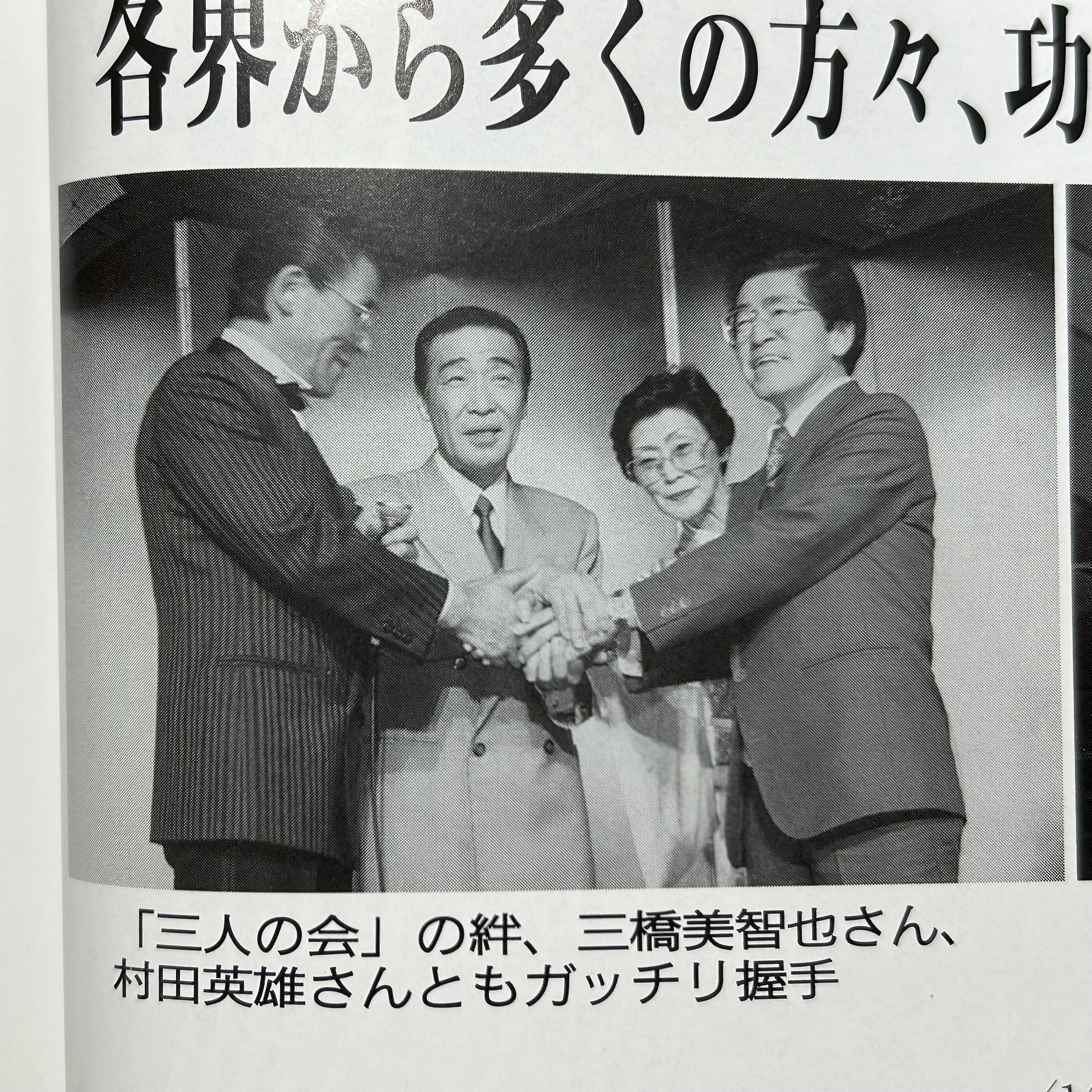
Hachiro Kasuga, Michiya Mihashi & Hideo Murata (Sannin no Kai) -- Aishu (哀愁)

For the final piece of my Hachiro Kasuga (春日八郎) Centenary project, I would like to end with a piece on the Sannin no Kai (三人の会... Group of Three). I thought that this would be the perfect end since it was one of the singer's last enka activities and the trio was the reason I got to know Hachi in the first place. In fact, you may be able to trace my Hachi discovery via Sannin no Kai right here on KKP!

From Shinobu
 
The very first time I encountered Hachi was via a video of what was perhaps the intro to what I now know as the Sannin no Kai Concert somewhere in 1989 (if I'm not mistaken). Back then, I only knew rokyoku artist turned manly enka star Hideo Murata (村田英雄) and loved his shogi-themed hit Osho (王将)*, which made me give that video a watch. Little did I know that he and the two other singers were doing a mochi uta exchange where they sang each of their most significant hits. Murata sang Aishu Ressha (哀愁列車). Min'yo master Michiya Mihashi (三橋美智也) in an eye-popping pink kimono and yellow hakama set sang Akai Rampu no Shuressha (赤いランプの終列車). Finally, with bushy eyebrows and dressed in a tuxedo was Kasuga making a grand entrance fitting for Osho. Yet, I did not like the way he handled Osho. It just wasn't right. His presence was also not particularly outstanding, which was ironic considering he stood a head above his compatriots. With such a view in mind, 2014 Noelle watching that clip would not have envisioned that she would choose the one she thought was the most boring. 

The mochi-uta exchange I watched ages ago.

So, what made made three of the biggest stars of the enka-kayo world join forces? Well, for one, they were already pretty good friends. Then, it just so happened that some time in the late 1980s as they were hanging out, Muchi broached the idea of joining forces to breathe new life into the twilight years of their careers and the enka realm. His seniors** gladly agreed, and thus the Sannin no Kai was formed with the goal of "enka no fukkatsu" (the revival of enka). The first concert they organised was in 1988 and held at a hotel owned by Michi. The subsequent concerts in 1989 and 1990 were led by Hachi and Muchi respectively.

During these concerts, the fellas unveiled a couple of new collaboration songs: Aishu (Sorrow) and Otoko no Furusato (A Man's Hometown). These were released as physical singles in 1991, the former before Hachi's death, the latter after. Both had their lyrics penned by Muchi; Michi took charge of composing Aishu, while Hachi did Otoko no Furusato. True to the group's constitution, both have that distinct enka sound derived from usage of the yonanuki scale. Aishu took the minor scale route, making it sound slightly melancholic atmosphere, while Otoko no Furusato took the major scale, giving it a masculine and powerful punch. The first I encountered and the only one of the two that's available online is Aishu, thus, it will be the one I feature today. 


I remember freaking out upon encountering the blurry video of Aishu. I mean, how often do you get a trio of legendary artists in the kayo world doing songs where each of them have their own part? Despite the plaintive melody and title suggesting a sad time,  Aishu paints a little picture of each of our fellows in each stanza. A cliff notes version of Hachi, Michi and Muchi, if you will. First up is Hachi, the man from the village at the foot of Mt. Bandai (Fukushima) and who rose to prominence by walking the path of enka. Then we have Muchi, the Kyushu native raised by the Genkai coast and who prides himself as the purveyor of manly songs since the beginning of time. Finally, we have Michi, toughened by the harsh winters of the north and who sought his musical future in the land of apples. 

I talked about the Sannin no Kai and Aishu in the final part of my thesis. There, I brought up how only Hachi's part included the buzzword "enka" and enka being his life work. This made me wonder if Murata was cognizant of his buddy being heralded as enka's top figure and wanted to pay homage to that in this song. It may also have been that Hachi had a say in it too, considering he is the most senior (in age and kayo world experience). Either way, despite the fact that all three fellows are deemed as enka veterans by the late 80s, there was likely a common consensus even among themselves that it's Hachi who is the enka man. That, I argued, reinforced Hachi's "Preeminent Enka Singer" (Enka no daiichi ninsha) image that was developed over a decade prior. As I'm writing this article, I've now also noticed that Hachi's part also had the buzzword "furusato", something integral to the Bokyo Kayokyoku/Enka (Homesickness Song) genre. Hachi is often also considered the forerunner of Bokyo Kayo-Enka, so I wonder if Murata also gave a nod to that with the aforementioned term.

From Mikasa

The Sannin no Kai were probably every enka-kayo fan's dream team turned reality - it certainly is one of mine! My favourite part about the Sannin no Kai is seeing each of the member's different personalities. From the videos I've been seeing, what I've noticed is that Murata gives off fearless responsible leader who cares for his compatriots deeply. Michi, while seemingly withdrawn, is actually quite wild and very loud. Hachi, despite his status among them, seems the most laidback and speaks in lowercase (by that I mean he mumbles). It's really enjoyable to see them bounce off each other so naturally. So, it was heartbreaking to know that it lasted a mere three to four years. Hachi was the first to go in 1991, followed by Michi in 1996, leaving Muchi to power on in memory of his buddies until his death in 2002. That said, it was even more heartwarming to know that the three enka veterans had great fun working together while trying to keep alive the genre they hold dear.

* I can't believe it's been 10 going on to 11 years since I wrote my first articles on Hachi, Michi, and Muchi!
** Michi, while a year younger than Muchi, joined the pop music business earlier, hence making him Muchi's senior in this respect.


P.S. I very recently attended the Hachi fan club's new year gathering, the Shunyo no Tsudoi (春陽の集い). It was great fun meeting more members of the club and other figures affiliated with Hachi. I had to do a number of name card exchanges (as is common practice here, at least), and one of such figures did not bring his name card. So, as an alternative, he gave me what I can only describe as a piece of treasure in exchange for my flimsy old name card. I was dumbfounded to see Hachi, Michi, and Muchi smiling back me on the pristine telephone card you see above. Perhaps it was because I mentioned that the Sannin no Kai was how I had my fateful encounter with Hachi that this person insisted I have this card. If you haven't already noticed, the guys are wearing the exact outfits as they did in that mochi-uta exchange I watched. Seeing it reminds me of where I first began and how far I've come since then, so this telephone card means a lot to me, and I am extremely grateful to have been gifted it.

Tuesday, February 18, 2025

Hachiro Kasuga -- Ai no Nokoribi (愛の残り火)

"Do you still like Kasuga as much as before?"
 "Yeah." ( ;∀;)

From Shinobu

At the end of my thesis defense, I was asked if I still liked Hachiro Kasuga (春日八郎) as much as I did before I embarked on my research journey. It would be natural if I ended up getting sick of him after toiling away on the biggest project I've done thus far with him as my focal point for 2 years. There were times when it felt tedious. I'd often joke that studying my favourite singer meant that there was not a time when I could take a break from him: In work mode, I would be analysing his songs; in rest mode, I would be listening to his songs. But I also felt that because it was Hachi, I was able to continue toiling away at my work. So, as you saw in the introduction, I gave an affirmative to my professor's query.


I came across "Ai no Nokoribi" (Embers of Love) at a Kasuga Enka Denshokai session, sung by one of the members, not long before that examination. Its melody caught my attention immediately and I knew I had to look it up once I got home. I soon found out that even though "Ai no Nokoribi" was recorded in March 1969, it only left the King Records storage almost 30 years later on 24th April 1998 via the album Kasuga Hachiro Zoku Hizo Mihappyo Meikyoku Shu (春日八郎 続・秘蔵未発表名曲集... Precious Unreleased Masterpiece Compilation Part II), a compilation of his unreleased works.

That said, its melody was just as I had remembered from the club: A mellow pop sound with a hint of Mood Kayo that creates a warm, cozy atmosphere reminiscent of a nice spring afternoon. Making this tune was Kenji Yoshidaya (吉田矢健治), the man often cited as the origin of the Kasuga Bushi (春日節... Kasuga's signature type of song). The Yoshidaya-made Kasuga Bushi is generally identifiable by its plaintive mood, i.e. opposite to "Ai no Nokoribi". Yoshidaya was responsible for a large chunk of Hachi's discography and made stuff based on trending music styles, so my initial surprise upon seeing his name attached to this tune quickly dissipated.   

And then Hachi's delivery. "Ai no Nokoribi" has the singer tackling the lower range of his vocals, contrary to the clear high tone he was most known for. It was different to hear Hachi sing in such a low register for at least 50% of a song and not hear his high tone, but I think kinda works for this song. From my understanding, Haruki Tango's (丹古晴巳) words tell of a man who is taken aback after discovering that the woman he broke up with is still in love with him. Her dedication seems to stoke the embers of love in his heart, long dormant after all the time that had passed. The protagonist's feelings of disbelief and regret are conveyed in Hachi's soft vocals, and one can feel a faint desire to start anew, particularly when the singer's voice swells then peters out with the strings at the chorus. It’s a song that doesn’t express a particularly extreme emotion and the character is more introspective, yet Hachi’s lower voice still managed to aptly convey what our main character must be feeling.


After the defense, I reflected on my answers to the panel, including that for the last question. In hindsight, I actually don't like Kasuga as I once did 2 years ago. No, after all that, I'd say that I've come to like him even more than I used to. While my research made me doubt and push away his enka-ness, meeting some of his biggest fans during this process allowed me to accept this crucial element of "Hachiro Kasuga". I gained a greater appreciation for the artist who shaped both kayokyoku and enka, and I was finally able to enjoy Hachi as a whole once again.

Wednesday, January 15, 2025

Hachiro Kasuga -- Jirocho Tabi Shigure (次郎長旅しぐれ)

From "Kasuga Hachiro Kayo Shi"

Happy New Year! I hope everyone is having a good start to 2025. 

One thing that I've started doing since the tail-end of 2024 was participate in the Kasuga Enka Densho Kai (春日艶歌伝承会).This is essentially the Hachiro Kasuga posthumous fan club's (Zenkoku Kasuga Hachiro Shinobu Kai… 全国春日八郎偲ぶ会) karaoke circle. The club is organised around the goal of ensuring Hachiro Kasuga's (春日八郎) songs will live on in the artist's absence and has been active since July 2000, its participants congregating every first and third Saturday of the month. Considering the frequency of the meetings and the regularity of which certain club members show up, I can only say that my love for Hachi is paltry compared to these veterans. To my knowledge, Kasuga Enka is exclusively sung at these gatherings. The neat thing about it is that ALL of Hachi's songs, from singles to albums to unreleased recordings, are available to sing thanks to the work of some of the members. 

Thus far, I've only participated in two meetings: the final one of 2024 and the first of 2025. Since this was organised by the Kasuga fan club, it was the perfect space for me to be as extra as possible with my oshikatsu shenanigans, i.e. bringing along a Hachi bromide and setting it on the table. I don't think the members expected the extent of my Hachi fangirling. On the other side of the coin, though, I didn’t expect the members to zero-in on my secondary fixation with Tadaharu Nakano (中野忠晴). If you've read some of my past Hachi articles, you'd know that Mr. Nakano was responsible for some of Hachi's moderate successes and minor works, a few of which I greatly enjoy. As such, the very first song I attempted was "Ruten no Yoru" (流転の夜) my current favourite entry among all the Nakano Melody. My explanation of choosing this tune partially for its composer and brandishing the Nakano photo card manufactured by one of my friends seemed to have bewildered the good folks. That incident seemed to have conditioned them to expect a Nakano composition when my turn comes around as one of them went, "Ah, of course it's a Nakano one!" when I picked "Jirocho Tabi Shigure" during my second attendance.    


Released in May 1953, "Jirocho Tabi Shigure" was Hachi's 4th single and the first song that Mr. Nakano composed for him. To my knowledge, this song has only been re-released as part of Hachi's 40th Anniversary super album "Kasuga Hachiro / Daizenshu Uta Koso Waga Inochi" (春日八郎/大全集歌こそ我が命) from 1991, though it is available on YouTube for easy access. Nevertheless, I would consider one of Hachi’s deeply buried gems considering how early in his career this was produced. This was also a Matatabi Kayo - while a perennially well-loved genre/sub-genre, it wasn’t Hachi’s specialty, so that may have accounted for the lack of attention to it, even after he became a national star. To be more critical, perhaps it’s also because it sounds too... orthodox. To Yuzaburo Wakasugi's (若杉雄三郎) lyrics featuring infamous yakuza ring-leader Shimizu no Jirocho (清水次郎長), Nakano provided a melody that sounds like one from your bog-standard Matatabi Kayo. This is pure speculation on my part, but it could be that the powers that be in King Records demanded that Nakano, then still a new King employee, make something that would sell, i.e. an easy to consume kayokyoku piece that fits the theme. And so, he did. Despite what my spiny critique suggests, though, it’s not a bad song at all, and I actually like it quite a lot… No, it's not just because Nakano made it… I think. 

Putting any biases aside, "Jirocho Tabi Shigure" is a jaunty song that is simply pleasant to listen to. The blaring horns and strings swelling grandiosely with a steady rhythm make for a heroic-sounding tune that I think conveys the masculinity and power of the titular gangster. I say it's orthodox because Matatabi Kayo, as with stories of chivalrous yet morally grey figures like Jirocho, generally portray their source material characters in such a light. Another running trope these characters express in this sort of narrative is the conflict between duty and compassion/humanity (giri-ninjo). While they may present themselves as stoic and duty-bound, these figures are still written to have a soft side hidden away from the public eye. I think Wakasugi’s portrayal of Jirocho conveys this aspect, which is wildly contrary to my impression of the gangster: fearsome and father figure to other infamous Shizuoka-based ruffians, namely Mori no Ishimatsu (森の石松). I suppose, in this respect, Mr. Nakano's melody represents Jirocho's giri tatemae (front), while Wakasugi's words disclose his ninjo honne (real feelings).

Wednesday, December 25, 2024

Bing Crosby/Barbra Streisand -- White Christmas (song and movie)


Merry Christmas to one and all! I'm hoping that all of you who may be reading this are enjoying December 25th with family and friends and savoring the amity and smells of the season (turkey, potatoes and the like). The Kyoku family is certainly doing and so, and I believe that they'll be having an appropriate get-together later on tonight.


For the final Xmas 2024 entry on "Kayo Kyoku Plus", I've decided to go with a special Reminiscings of Youth song, and what better song to put on here than "White Christmas". Now of course, Bing Crosby is the traditional representative for this perennially sung Yuletide tune but I did want to begin with chanteuse Barbra Streisand because she wasn't only on that early 1970s Ronco compilation LP "A Christmas Gift" that my parents got me, but she was the first entertainer that I heard to sing the Irving Berlin classic while including that mystery first verse that's been usually omitted in other renderings of the song because it just took away (if briefly) that feeling of snow and cold and Christmas atmosphere. Apparently, Streisand's version was first heard on her 1967 album "A Christmas Album", and it's a solemn yet hopeful rendition.


"White Christmas" was first brought to ears in the 1942 holiday-themed musical "Holiday Inn" starring Crosby and Fred Astaire. It was one of many songs that was featured in this flick regarding Crosby's character's whimsical pursuit of running a countryside hotel that was only open on national holidays.


But "Holiday Inn" was a movie that I wouldn't discover until far into my life (actually, it was the Xmas episode of "SCTV" that introduced me to the existence of "Holiday Inn"). Before then, I had been accustomed to hearing it on those Crosby TV specials annually, Elvis Presley's cover of it, and then the movie "White Christmas" (directed by Michael Curtiz, the same guy behind the legendary "Casablanca") which came out in October 1954. Reading through the Wikipedia article on it, I'm not sure whether "White Christmas" the movie had been meant as a direct reconstruction of "Holiday Inn" despite the key presence of a countryside inn.


The movie was an annual ritual in my television life, especially at a time when I had known no other Turner Classic Movies-friendly Xmas flick at the time; "It's a Wonderful Life" and "Miracle on 42nd Street" would come to my attention many years later. "White Christmas" had a bigger main cast than "Holiday Inn" and between the bookends of the rendition of the song, the movie was chock-filled with some great song-and-dance moments (I've already talked about "Snow" here) such as "The Best Things Happen While You're Dancing" with Danny Kaye and Vera-Ellen, and may I say that Kaye was a great addition in terms of both his dancing and comedic prowess compared to Astaire who wouldn't join this movie and Donald O'Connor who had to bow out due to illness.


Of course, there is also the whole "Sisters" bit with the Haynes Sisters and then the parody by Bing and Danny. I'd always wondered whether the latter was ad-libbed since the laughter from the guys looked so genuine. And as it turned out, it was.

Is it a perfect Xmas movie? Maybe not...there were a few scenes in there that had me thinking "Yep, it was way back in the mid-20th century, wasn't it?" but that was then and this is now. Also, I've never been a fan of that latter-half manufactured tiff between Bob and Betty but I guess the writers felt that there had to be some conflict when things may have gotten too cozy for the couples too soon. Still, after not having seen "White Christmas" in many years now, I wouldn't mind taking another gander at it someday.

In any case, what are some other big songs from Japan that were hitting the airwaves in 1954?

Akira Ifukube -- Godzilla (ゴジラ)


Hachiro Kasuga -- Hyotan Boogie (瓢箪ブギ)


Hibari Misora -- Hibari no Madorosu-san(ひばりのマドロスさん)


Hachiro Kasuga -- Tokyo Sakaba (東京酒場)


I've been doing a lot of thinking. Well, maybe a bit too much because I think I'm beginning to see smoke coming out of my ears. But much of it revolved around Hachiro Kasuga (春日八郎) - shocker. I've had an entire year to figure out where I think he stands in the world of enka and kayokyoku. For the most part, I came to the conclusion that he's not just an enka singer, but a singer who can sing any genre. I focused on the point that he and his biggest hits were turned into enka when the genre was formally formed in the late 1960s/early 1970s, and grew hesitant to call him an enka singer. But my inhibitions have been lowered the more I read about and listened to Kasuga's thoughts on enka and after getting a feel of what his die-hard fans thought of him and the genre. Kasuga genuinely seemed to have embraced enka as his own and worked hard to show it from at least the 1970s all the way up to his death in the early 1990s. He released many overtly enka songs and albums, founded a club that supported aspiring enka singers in the 1970s (Enka wo sodateru kai (演歌を育てる会)), and hosted enka radio programs in the 1980s. Of course, I still believe that Kasuga can do more than just enka and that he was made into an enka singer. But if my Hachi believed that he was true blue enka, then that's what he is. I only managed to sort out my thoughts on this matter just today, mainly because it's the crux of my thesis and I can see the deadline catching up to me. But it was also something I felt that I had to figure out as a Hachiro Kasuga fan. 

Throughout my Hachi Centenary project, I had solely focused on his works produced before 1975, the majority of which, I would say, had little to no enka flavour. But since I have finally accepted that Hachi is an enka singer and began to re-listen to some of his later-day works, I would like to feature a Kasuga Enka for my final post as the singer's centenary celebration year comes to a close. This song is "Tokyo Sakaba".


This Kasuga Enka (春日艶歌) has everything: Bar stools (tomarigi), alcohol (mizu-wari), Tokyo, bars (sakaba), heartbreak, pining for one's lover at the bar, backup singers going "haa", and the koto (?) played in the tremolo manner. The only thing preventing me from getting an Enka royal flush is that this is a yonanuki pentatonic major scale song, not minor. Still, "Tokyo Sakaba" is truly an enka with a capital "EN". Seiji Kibugawa's (葵生川正治) melody makes this one of those enka tunes that sounds cheerful with its snappy melody, but once you hear what Hachi is actually singing, you realise how depressing it is. Ryutaro Kinoshita's (木下竜太郎)* words feature a man feeling the bite of a broken heart over his drink in a cozy bar in the heart of the city. I joke about the backup singers going "haa", but it's reminiscent of our protagonist's sighs as his ex-lover doesn't show up to their usual bar once again. 

"Tokyo Sakaba" was released in Hachi's original album "Asu e no Shuppatsu" (明日への出発), which was released in 1981. Based on one of the Kasuga Kayo-Enka medley videos uploaded by user kiibo55 that includes this song, "Asu e no Shuppatsu" was meant to commemorate both Hachi's 30th Anniversary in showbiz and King Records' 50th Anniversary. Admittedly, I haven't listened to 80s enka in a really long time, especially not from Hachi, so listening to "Tokyo Sakaba" and the other entries in this album is a nice change in pace. Kinda like having a nice, warm barley tea after all that coffee and earl grey. Sake would be a better EN-alogy in this case, but I do not drink. 


What a year it has been. I finally joined the fan club of my favourite artist, met people who love him as much or even more than I do, and learned so much more about him than I ever had in the previous 6 years of being a fan. Doing my Hachi Centenary project on KKP has also been really fun, so it feels a little sad that it's coming to a close. I think I'll keep it going until March next year since I started the series in March of this year. With that, I'd like to wish you guys a Merry Christmas and a Happy New Year!


*I was doing up a Hachi singles discography as an appendix for my paper, and I came across some interesting songwriter names amidst the sea of Kenji Yoshidaya (吉田矢健治) and Ryo Yano (矢野亮) in my references. Perhaps one I found the most amusing was Kinoshita's, because there were a few songs he made that had their lyrics written by one Noboru Taki (滝のぼる). There's this myth that if a carp successfully swims up a waterfall, it will turn into a dragon. Taki's name literally means "Climb the waterfall" and Kinoshita's has a dragon under a tree, which makes me wonder if they were a songwriting duo that wanted to represent this myth in their names. It sounds auspicious, so maybe they were hoping it would bring them luck with producing hits.

Sunday, November 17, 2024

Cover Songs With Kasuga Hachiro (春日八郎のカバー曲)

Michi, Koga Sensei, Hachi
From "Shinobu"
Hachiro Kasuga (春日八郎) recorded a lot of cover songs, ranging from Meiji-Taisho enka to early Showa kayo to 1980s pop enka. It's thanks to these covers that I got to learn a fair amount about a wide array of songs, some of which becoming personal favourites. But did you know, that the concept of covering pop songs, produced by record companies, wasn't as commonplace as it is now prior to the late 1960s? 

Feel free to correct me if I'm mistaken, but based on my understanding of sources like Yusuke Wajima's (輪島裕介) "Tsukurareta 'Nihon no Kokoro' Shinwa" (創られた「日本の心」神話) (2010), it was due to the old record company contract system from the late 1920s. What this system entailed was that a songwriter or singer, bound to a particular record company by contract, could not provide songs for a different company/sing songs made by a different company. There was also this concept of the mochi uta, where a song made for a singer was theirs and theirs only; to cover another's song (officially) was, I quote from venerable lyricist Kikutaro Takahashi (高橋掬太郎), "akin to betrayal", even if they were from the same company. For instance, Akira Matsudaira (松平晃) would not be able to cover Tadaharu Nakano's (中野忠晴) "China Tango" under most circumstances, even though they were both from Columbia Records. Or Columbia's Mr. Nakano would not have been able to cover King Records' Isao Hayashi's (林伊佐緒) "Kiso Bushi Bolero" (木曽節ボレロ). Rather limiting stuff. 

Miura, Hachi, Yukiko Nomura
From "Shinobu"

Of course, there were multiple exceptions and there were instances of insane loophole gymnastics. And one of these loopholes would change the record industry game for the better. This watershed moment that got rid of this limiting restriction was Shinichi Mori's (森進一) (Victor) cover album of Masao Koga's (古賀政男) (Columbia) works, "Kage wo Shitaite" (影を慕いて), from 1968. Initially seen as inconceivable, composer Kosho Inomata (猪俣公章) who was the album's director managed to do some insane contract red tape gymnastics and dodging Koga Sensei's initial wrath to get it done. This involved picking only the Koga Melody that did not "belong" to Columbia Records, i.e. those that were from the legendary composer's early Victor and Golden Age Teichiku days. The album's resounding success threw out the stigma around covers and cross-company collaborations. So much so that now it's essentially a given in at least the enka world. I'd go so far as to say that some past kayo have become "must covers"/a rite of passage for any modern day enka singer. Oddly enough, one of these enka rites of passages is doing a Koga Melody cover.

In terms of same company covers, assuming the producers at King Records weren't being hyperbolic, the first full-on same company artist collab album was Hachi and his junior Michiya Mihashi's (三橋美智也) "Ougon no Utagoe" (黄金の歌声) from 1970. That was where both artists covered about 14 of each others' mochi uta. I believe it was also in 1970 when Kasuga began recording cover songs in earnest. 

Anyways, this brief Japanese record industry history tidbit leads me to what I want to feature for my Hachi Centenary Project article: Hachi's cover songs I enjoy. I've always been picky about original singers, but sometimes covers just hit different, sometimes with better arrangements or better vocals. It's with these factors in mind that I share my picks of Hachi covers. At the same time, perhaps these songs may introduce you to some Taisho and Showa era classics, as they did for me. As a side note, I will also mention some of the albums each song is in.


Ochiba Shigure (落葉しぐれ) (1953) -- Koichi Miura (三浦洸一)

This song is difficult with some intense peaks and dips, but Hachi maneuvers them so effortlessly and smoothly in this classic nagashi/sasurai mono. Maybe folks are right in saying that Hachi is just good at these sort of enka style kayo.

Albums: Showa no Enka Kasuga Hachiro Fukyu no Meisaku wo Utau (昭和の艶歌 春日八郎不朽の名作を歌う) (1971)Kasuga Hachiro Enka Hyaku Sen (春日八郎 演歌百選) (1973)

Dotonbori Koshinkyoku (道頓堀行進曲) (1928) -- Ichiro Utsumi (内海一郎)

Hachi said that jazz doesn't fit him and some have said that he couldn't express that jazz feeling. I have to admit that there are some number where I felt that the jazz feeling was lacking a little. But not with this one. Also, it may be a hot take to fans of early Showa Japanese jazz, but this is the best version of "Dotonbori Koshinkyoku" with the best arrangement. I will die on this hill.

A point to note is that Hachi re-recorded this in his 1975 "Kasuga Hachiro no Osaka Jocho" (春日八郎の大阪情緒), but its arrangement was not as raw and... jazzy. The original cover from the 1962 "Taisho/Showa Hayari-uta" (春日八郎の大正・昭和はやり唄) album is the one I'm for.

Albums: Kasuga Hachiro no Taisho/Showa Hayari-uta, Kasuga Hachiro no Osaka Jocho, Kasuga Hachiro Osaka wo Utau (春日八郎 大阪を歌う) (2011)

Nagasaki Chanson (長崎シャンソン) (1946) -- Shizuo Higuchi (樋口静雄)
The song comes in at 24:24.

I praise the creative decision to have Hachi sing the chorus, "Batten Nagasaki __ no machi, mimase yokatoko yori masse" (But Nagasaki's the city of__, c'mon over and check out this fine place... The line is in the Nagasaki/Kyushu dialect), unlike Higuchi's original. Higuchi's wasn't bad, but it just felt lacking to have just the back-up singers handle that crucial bit.

Albums: Kasuga Hachiro no Nagasaki no Jocho (春日八郎の長崎情緒) (1976), Kasuga Hachiro Showa Kayo wo Utau (春日八郎 昭和歌謡を歌う) (2010)

Karisome no Koi (かりそめの恋) (1949) -- Machiko Sanjo (三条町子)

Fun fact: I believe this was one of the songs Hachi saw/hear Mrs. Kasuga, Keiko Watabe (渡部恵子), sing while she was working as a part-time singer at the same restaurant as him back in the day. On a side note, I feel that Hachi's soft, forlorn-tinged voice fits this sort of blues/Mood Kayo-like songs to a T.

Album: Nihon no Uta Meiji/Taisho/Showa Hayari-uta (日本の歌 明治・大正・昭和はやりうた) (1977)

Onna no Kaikyu (女の階級) (1936) -- Shigeo Kusunoki (楠木繁夫)

Of all the songs on this is one of the rare numbers where I enjoy both the original and the cover in equal measure. Anyways, I've read that Koga Sensei wanted "Onna no Kaikyu" to be of a slower pace, contrary to the brisk pace of Kusunoki's original. I think it's in covers like Hachi's where you can hear the composer's intended vision.

Albums: Kasuga Hachiro Koga Melody wo Utau (春日八郎 古賀メロディーを歌う) (1971/1975/1992), Kasuga Hachiro Koga Masao wo Utau (春日八郎 古賀政男を歌う) (1974), Showa no Enka Kasuga Hachiro Fukyu no Meisaku wo Utau, Kasuga Hachiro Enka Hyaku Sen 

Palau Koishiya (パラオ恋しや) (1941) -- Haruo Oka (岡晴夫)

Hachi's smooth delivery makes Okapparu's mochi uta more polished, and I think you can feel it in a relaxed tropical island number like "Palau Koishiya". Interestingly enough, even though Kasuga recorded this cover, it wasn't included in his 1977 Oka cover album, "Kasuga Hachiro Oka Haruo wo Utau" (春日八郎 岡晴夫を歌う). Rather it seems to have only been released decades later in 2010 via "Showa Kayo wo Utau". Perhaps they'd already hit the song limit for the 1977 one, so "Palau Koishiya" got dropped.

Fun fact: Okapparu, known for that strident and nasally delivery with large lung capacity, was said to have developed these attributes during his days as an enka shi/nagashi (street musician). Because of the cigarette smog in bars, he learned to sing in this manner to reduce the need for inhaling the smoke and damaging his vocals.

Albums: Kasuga Hachiro Showa Kayo wo Utau

Hoshi no Nagare ni (星の流れに) (1947) -- Akiko Kikuchi (菊池章子)

The hardship of immediate postwar Japan can be felt in this song about the realities of many women who had to turn to working the night to survive. Perhaps it would be more appropriate sung by a woman, but Hachi's voice is more filled with a pained longing than heavy melancholy, which fits the emotions expressed in this song.

Albums: Enka to wa Nandarou Kasuga Hachiro Show (演歌とは何だろう〈春日八郎ショー〉)(1973), Kasuga Hachiro Enka Hyaku Sen, Kasuga Hachiro Showa Kayo wo Utau


Epilogue
Something I noticed when studying the covers Hachi recorded was that he never covered any (Ryoichi) Hattori (服部良一) Melody save for one: Mieko Takamine's (高峰三枝子) "Kohan no Yado" (湖畔の宿) - correct me if I'm wrong. I wonder if it's because R. Hatter was known for jazz and "pop", and thus not fitting with the enka rhetoric in the 70s and 80s.

On a different note, among the other fellas I love, Hachi has covered Akira-san's, Bin Uehara's (上原敏), and Yoshio Tabata's (田端義夫) stuff. As I've said, I can be very picky with covers. As much as I love Hachi, originals win here, especially for Bin-san and Batayan. I'm more forgiving with the Akira-san covers, though. This is because Hachi and Akira-san vaguely share a similar vocal quality in that they are great at conveying forlornness - the difference is that Hachi sounds empathetic while Akira-san sounds needy (purely subjective). So, I thought the former's covers of the latter's hits, "Isoge Horo Basha" (急げ幌馬車) and "Circus no Uta" (サーカスの唄), were pretty good, but the arrangements just fell short. 

"Isoge Horo Basha"

But, y'know, a dream Hachi cover of mine is "China Tango". I know I'll regret it because, while I know it'll be good, Hachi has nowhere near the same level of sex appeal as Mr. Nakano to pull it off. But I just want to hear it. Not because it'll be hot, but because I think it'll be kinda funny.