I've been a fan of Japanese popular music for 40 years, and have managed to collect a lot of material during that time. So I decided I wanted to talk about Showa Era music with like-minded fans. My particular era is the 70s and 80s (thus the "kayo kyoku"). The plus part includes a number of songs and artists from the last 30 years and also the early kayo. So, let's talk about New Music, aidoru, City Pop and enka.
Credits
I would like to give credit where credit is due. Videos are from YouTube and other sources such as NicoNico while Oricon rankings and other information are translated from the Japanese Wikipedia unless noted.
It was about four years ago that I first introduced aidoru Tomoko Ishizaka(石坂智子)onto the pages of "Kayo Kyoku Plus". Her second single"Digital Night Lullaby"(デジタル・ナイト・ララバイ)from September 1980 gave me the impression that she was going to be quite the funky teenybopper singer.
From that cover in the thumbnail, it looks like the minders around young Ishizaka wanted to ply some of that Seiko Matsuda(松田聖子)effect onto her. Anyways, this was her December 1980 third single"Futari no Koi wa ABC" (A Couple's Love is as Simple as ABC) and it's also quite the spirited tune kinda reflective of the footloose-and-fancy-free material that Seiko-chan and Ishizaka along with many other aidoru of the time were releasing.
Words and music were provided by Kaoru Ito(伊藤薫)who had also created "Digital Night Lullaby" and it's got quite the chuggy and funky beat. Also like that sophomore single, "Futari no Koi wa ABC" has got some interesting and soaring keyboard (celesta, perhaps?) work during the instrumental bridge. The song was also used for a UCC Coffee commercial. It's got quite the caffeinated energy so it's pretty apt.
A couple of years ago, I posted an article regarding the first of two singles that the obscure Mayuko Miyahara(宮原巻由子)had recorded in February 1983, "Hana Akari"(花明り). It was a very pleasant number and down below, there was a comment by someone regarding their enjoyment of Miyahara's second and remaining single. My apologies for not responding but sometimes comments tend to fly under the radar with me not noticing.
That second single is "Tori no Uta" (Bird Song) which was released in August 1983. Sounding either like a heartwarming enka or a children's folk song from the 1970s, there is even a kids' chorus backing her up in the latter half. Written by Yu Aku(阿久悠)and composed by Koichi Sakata(坂田晃一), I even get some shades of early Hiromi Iwasaki(岩崎宏美); the ocarina definitely helps.
The thing is, though, Miyahara was actually covering "Tori no Uta". The original version can be claimed by actress/singer Kaoru Sugita(杉田かおる). I had thought that I already posted something by Sugita, who I only knew as one of the more tart-tongued tarento on Japanese television, but as it is, this is her first entry on "Kayo Kyoku Plus". Welcome aboard, Ms. Sugita...please don't kill me. The original doesn't sound particularly different from the Miyahara cover, but it was released as her 10th single in June 1981 and was even utilized as an insert song in the second season of an NTV drama "Ikenaka Genta Hachi-juu Kilo"(池中玄太80キロ...Eighty Kilograms of Genta Ikenaka) which included Sugita as the stepdaughter of the late Toshiyuki Nishida(西田敏行)who was playing avian photographer Genta Ikenaka. Sugita's version reached No. 10 on Oricon and ended up as the 56th-ranked single for 1981.
(I'm sorry but the video has been taken down.)
But returning to the Miyahara single, I also wanted to bring you folks to the B-side of her "Tori no Uta". "Dancing dancing" is a much more different animal, sounding more like a West Coast AOR including a wailing electric guitar. Nothing wistful here...just images of running happily along the beach. Kaoru Ito(伊藤薫)was responsible for both words and music.
Last week, I posted Part 1 of my article on Hiromi Iwasaki's(岩崎宏美)July 1982 11th studio album"Yugure kara...Hitori"(From Twilight--Alone), and so today, I'll be completing the release with this Part 2 which is essentially Side B of the original LP. The final track, by the way, was the version of "Madonna Tachi no Lullaby" (聖母たちのララバイ)which was used as the ending theme for "Kayo Suspense Gekijo"(火曜サスペンス劇場.... The Tuesday Night Suspense Movie) on NTV and you can read about that particular song through the link. However, let's get through the remaining four tracks.
Starting off Side B is "China Reef" which was written and composed by Kaoru Ito(伊藤薫)and arranged by Nobuyuki Shimizu(清水信之), the same duo behind Side A's"Yoake no nai Asa"(夜明けのない朝...Morning Without a Dawn) . Although this time around, it doesn't quite stray into Fashion Music territory like "Yoake no nai Asa", the creators of "China Reef" still maintain that certain jaunty pop elegance that Iwasaki could bat right out of the park. I have no idea where this China reef is located but it apparently is quite the magical place.
I especially love the intro and the rest of "Etranger"(エトランゼ...The Stranger) which has that lovely City Pop vibe and that Iwasaki elegance, to boot. Not surprising, considering that it's Tetsuji Hayashi(林哲司)behind the melody and arrangement with Masako Arikawa(有川正沙子)providing the lyrics about a woman who has gone off to an exotic locale, ostensibly to forget a past romance, and trying to ensure that she remains a stranger in paradise without any further love entanglements. Iwasaki's voice gets to further shine here as it plumbs more depths and heights. The ending is interesting, though, since it almost sounds like it's lifted a City Pop riff via flugelhorn from another song.
All you bass addicts rejoice as we dive into "Go-juu-ni Kai no Off-Stage"(52階のオフ・ステージ...52nd Floor Off-Stage) which is a slightly more down-to-town City Pop tune with Akira Ohtsu(大津あきら)behind the lyrics, Kisaburo Suzuki(鈴木キサブロー)taking care of the melody and Masaaki Omura(大村憲司)as the arranger. These three were also behind "Single Man" which finishes off Side A, and it's quite the different animal from the 50s pop of that final track, as the boppy urban contemporary takes over here, thanks to the aforementioned bass and the sax solo. Hiromi-chan seems to be singing about analogizing the whole experience of heading up to an exclusive nightclub at the top of a really tall skyscraper and its surrounding tapestry of sunset hues and cityscape as a major love play.
Ohtsu, Suzuki and Omura also collaborated on this final track of this article, "Heartbreak Twilight"(ハートブレイク・トワイライト). Beginning with a twangy guitar and keyboards, it's a mid-tempo melancholy melody as a high-flying couple realize that it's time to part ways with each other. In fact, aside from a slight peep into major chord territory before the second verse, "Heartbreak Twilight" keeps up the sad drama with the keyboard arrangement sounding downright sinister and creepy. One would almost think that the boyfriend was Nosferatu.
So, "Yugure kara...Hitori" has plenty of City Pop and elegant pop tunes for all of the Hiromi Iwasaki fans circa early 1980s. As well, the tracks have their own different tempos to keep ears alight. The original LP scored a No. 4 ranking on Oricon.
Chanteuse Hiromi Iwasaki(岩崎宏美)has been in the music industry so long that she's had a lot of different images since her debut as a teen in 1975. However, the one image that will always stick with me is the one when I had first known about her in the early 1980s as you can see above: elegant, svelte and hair that went all the way down to her waist.
Yugure kara...Hitori
Today, I want to explore her 11th studio album from July 1982, "Yugure kara...Hitori"(From Twilight--Alone). I've already written about some of the tracks on this No. 4-ranking LP: the surprisingly downtown warp-speed "Koi wa Senso"(恋は戦争), the 1970s kayo kyoku-reminiscent 27th single"Lemon"(檸檬)which begins the album, and the follow-up single "Madonna Tachi no Lullaby"(聖母たちのララバイ)that has become one of her trademark songs. Even with those three covered, there are seven more tracks on the original LP alone so I'll be splitting up my impressions into two parts with Part 2 coming in next week.
Let's see if we can go for three songs here beginning with the second track. Following the innocent and sweet "Lemon", there is "Tobashite, TAXI"(Step On It, Taxi), a keyboard-funky urban tune of giddiness about a woman hopping into a taxi to confront a lover at his hotel on whether the rumours surrounding him are true; apparently, she's still in the denial stage. Written by Chinfa Kan(康珍化), composed by Toshio Kamei(亀井登志夫)from the band NASA and arranged by Masaaki Omura(大村雅朗), the lyrical content may be rather tense but the arrangement speaks of one exciting time in the big city. This particular song isn't to be confused with the similarly-titled "Tobashite Taxi Man"(とばしてTaxi Man) by Yurie Kokubu(国分友里恵)from her 1983 album"Relief 72 Hours". May I just complete this paragraph by noting how amazing her voice is when she yells "TAXI!". The multi-cab crash that could result if she yelled it in that way.
Following Track 3"Koi wa Senso", Iwasaki turns from the disco-lined streets of Roppongi to an area that's much more discreet...say a boutique hotel off the main drag or an exclusive restaurant. "Yoake no nai Asa" (夜明けのない朝...Morning Without a Dawn) sounds like it should have been recruited to become a theme song for those weekly murder-mystery dramas on Japanese television as was the case with "Madonna Tachi no Lullaby" and a few other contributions by her. However, it remained just a track on "Yugure kara...Hitori" but it stands out for that wonderful intro and throughout the song it has that one foot in classy Fashion Music territory although the chorus rhythm with the punchy percussion keep things in the metropolis. Kaoru Ito(伊藤薫)was responsible for words and music with Nobuyuki Shimizu(清水信之)handling the arrangement here.
If I'm not mistaken, "Single Man" was the final track on Side A of the original LP. Taking on a gentle 1950s pop ballad form, Iwasaki sings about the realization that a summertime romance is about to head to its end as the autumn comes. Good times...but hey, that's the way it goes. Akira Ohtsu(大津あきら)was the lyricist here while Kisaburo Suzuki(鈴木キサブロー)and Kenji Omura(大村憲司) were the composer and arranger respectively.
Just before tackling the album here on KKP, I had been wondering whether I would be getting a mix of her City Pop from the late 1970s and that murder-mystery balladry that was her thing in the early 1980s. So far, I think I've been getting even more variety with "Yugure kara...Hitori". Looking forward to the second half which will basically look at all of Side B.
I admit that I may have quickly scrolled down the Hiromi Iwasaki(岩崎宏美)file on "Kayo Kyoku Plus", but I was surprised to realize that it's almost been eight years since I actually covered one of her albums. Certainly, I've covered plenty of her individual songs in the last number of years, but the most recent album by her that I took a look at as a whole was her 1985 "Diamant"(ぎやまん)back in October 2015.
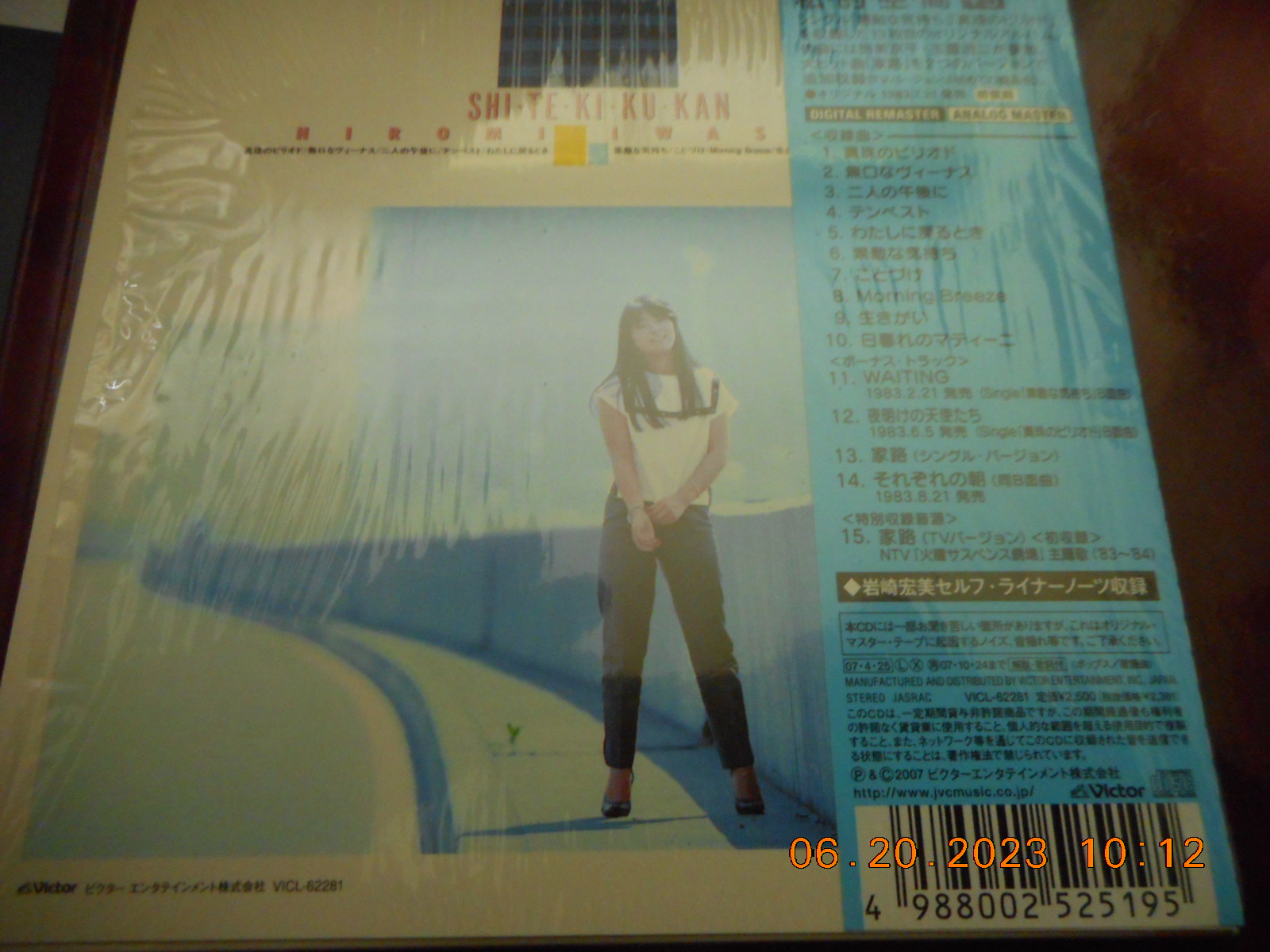
Well, allow me then to cover at least a part of her July 1983 album"Shi-Teki-Kuu-Kan" (Personal Space) tonight. I bought this one by Iwasaki several years ago and there is personal testimony from the singer herself in the liner notes. The one thing I remember the most by far from those notes is her hilariously embarrassed apologies in the second paragraph for her looking so "fat" in the photos. She took particular aim at her saggy arms and those bushy eyebrows before reassuring fans that she at least was able to upgrade herself in the years hence. Personally, she looks hot and has always looked so. End of story.
Incidentally, I'm covering the 2007 issue of "Shi-Teki-Kuu-Kan" so there are five bonus tracks including two versions of one of my favourite Hiromi songs of all time, "Ieji" (家路)which I actually profiled years ago. I'll cover those as well but among the original tracks, the truly relaxing "Suteki na Kimochi"(素敵な気持ち)is another song that I handled back in 2015.
There's a lot to see and hear so let's begin with the first track "Shinjuu no Period"(真珠のピリオド...Pearl Period) which was Iwasaki's 31st single from June 1983. It did decently on Oricon by peaking at No. 31 and I like it because it has that snazziness as it straddles the line between pop and City Pop. I love the old-fashioned "dabba dabba" chorus as well as the sharp strings and the horns coming in. Not surprised at all then that the master songwriters behind this one were lyricist Takashi Matsumoto(松本隆), composer Kyohei Tsutsumi(筒美京平)and arranger Mitsuo Hagita(萩田光雄). Considering how this one sounds, I had assumed that "Shinjuu no Period" was yet another Iwasaki contribution to the Tuesday Night Suspense Drama on NTV like "Ieji" was. But that wasn't the case here and Matsumoto's lyrics merely relate the bittersweet late summer story of a tryst at a beach house that is to end soon, and the lovers are trying to make the best out of what little time they have left with each other.
Track 2 is the sunny 70s soulful "Mukuchi na Venus"(無口なヴィーナス...Silent Venus). Once again, Tsutsumi provides his composing prowess here as he does for two more tracks on Side A of the original LP with Keiichi Oku(奥慶一)as the arranger. The late Rei Nakanishi(なかにし礼)was the lyricist here as Iwasaki sweetly and slyly assures a paramour that all's fine and dandy in Romance City and that nothing needs to be said at all.
There is a bit more brio in Iwasaki's vocals for Track 3, "Futari no Gogo ni"(二人の午後に...A Couple's Afternoon) with Mieko Arima(有馬三恵子)as the lyricist here while Hagita is back as arranger. We're definitely in the City Pop here. I like the layering of urban contemporary rhythm and keyboard underneath strings which paint a more romantically fantastical picture although the story is more negative as a couple go through the motions poolside even though the love dissipated a while back. Well, that's how the cake crumbles.
Not surprisingly for a title like "Tempest"(テンペスト), there's more melodic drama and rock guitar in this track which has Nakanishi, Tsutsumi and Oku working together. My mind pegs this one as a theme song for a detective show although once again such was not the case. Still, the tempest isn't only occurring outside but inside a hotel where a woman is anticipating an affair is about to turn a critical corner into permanent changes.
The final track on Side A is "Watashi ni Modoru Toki"(わたしに戻るとき...Getting Back to Me) has me getting some 80s Steve Winwood vibes. And this time, I also feel some West Coast AOR with the electric guitar thrown in there. Hagita is back but for this one, Kazuko Katagiri(片桐和子)was responsible for the lyrics for this jaunty love song. One other thing is that instead of Tsutsumi composing the tune, it was Anzen Chitai's(安全地帯)Koji Tamaki(玉置浩二)coming up with the melody. Iwasaki noted Tamaki's assistance in the liner notes and that he also composed a couple of other tracks on Side B. The singer noted that Tamaki's three contributions to "Shi-Teki-Kuu-Kan" were just before his band made it big with "Wine-Red no Kokoro"(ワインレッドの心)in that same year. Additionally, she remarked that Tamaki was dressed to the nines a la Humphrey Bogart right down to the fedora (usually apparently most songwriters would come over as casual as possible); he even sported an attaché case. Maybe he was trying to impress her; I have no idea.
To finish off Part 1 (Part 2 will be next week), I'm leaving the article with one of the bonus tracks "Sorezore no Asa"(それぞれの朝...Each Morning) which was the B-side to "Ieji". I actually first heard this song on an episode of that old CHIN-FM radio program "Sounds of Japan" and it sounded so beautiful despite all of the hissing and spitting of bad reception that I searched for years for the title of the tune. Kaoru Ito(伊藤薫)was both the lyricist and composer for this ballad that sounds like a lullaby for children. In point of fact though, it is a melancholy ballad about the end of a relationship signalled openly with phrases like "the end of love" and more tacitly with one line stating the coming of fall. To hammer the final nail in, there is a very morose harp playing there along with some splendid strings playing in the bridge. "Sorezore no Asa" will never get anywhere near a wedding reception but it's still a wonderful song.
What I'm covering here is "Kimagure Juu-dai" (Capricious Teen) by aidoru Miyuki Kosaka(香坂みゆき). I have a number of adjectives to describe my teens, and capricious isn't one of them. Awkward and depressing are two of them.😞
But I digress. I was just entering adolescence when "Kimagure Juu-dai" as a track on Kosaka's 3rd album"Sugao no Mama de"(素顔のままで...Just the Way You Are) was released in December 1978. Written and composed by Kaoru Ito(伊藤薫)and arranged by Kei Wakakusa(若草恵), it's a typical aidoru tune of that time with the twangy guitar, the breezy strings and Kosaka's light and happy vocals. It's also one of the shortest aidoru tunes I know at a mere 2 1/2 minutes.
This is the earliest song by Kosaka that I've covered in her discography to date. She has explored some other genres going into the 1980s as well including synthpop and City Pop.
Years ago, when I was with what is now known as the Japan-Canada Students' Association at the University of Toronto, we had a Monday night activity called English TV (ETV) where we showed various movies with subtitling to the Japanese segment who were interested in picking up some vocabulary and expressions, and then enjoy the movie. I got involved with the organizers so I helped out in choosing the movies and then selecting certain vocabulary which could be useful to the students. It was just one of the many activities that the JCSA had over the week so those early 1990s were quite the busy ones between my stint on the JET Programme and then my far longer odyssey in Japan.
Anyways one movie that most likely I chose since I was one for the Golden Age of Hollywood was "An Affair to Remember". Starring Cary Grant and Deborah Kerr, it was a frothy 50s romantic comedy which Grant could handle with ease. It did have its pathos which may have had viewers reaching for their hankies by the end, especially accompanied by the gloriously dramatic orchestral score.
That movie along with similar flicks came to mind when I first listened to "Too far away" by Keiko Mizukoshi(水越けいこ). Released initially as a May 1986 single, it's been released several times in the years since for some reason according to her J-Wiki discography. The lyricist/composer was Kaoru Ito(伊藤薫)and the arranger was Masaaki Omura(大村雅朗), and the one reason that I got reminded of those old Hollywood romances was the intro which brought in some majorly tenderhearted strings that immediately had me pegging it as a Fashion Music tune. I also think that Ruiko Kurahashi(倉橋ルイ子)could do a pretty good version of "Too far away" as well.
Contemporary arrangements do come into play though as we get into the song but it's all about the lyrics and Mizukoshi's delivery. Just like the final third of "An Affair to Remember", there is perhaps a need for the handkerchief as she sings about a man missing his significant other deeply because she's left this mortal coil due to illness. Mizukoshi herself sounds as if she's about to burst into tears herself. It would be a spark to hug that loved one somewhat harder and more closely.
Tokyo is so large that it has several discrete major urban hubs whether it be the Teen Mecca of Shibuya, glitzy Ginza and Akasaka, bayside Odaiba and the salaryman's old-style haven Shimbashi among other sites. Depending on what and how much you want to see, it could take a few days to get even the major neighbourhoods under your belt.
Singer/actress Miyuki Kosaka(香坂みゆき)has sung on the wonders of one of the world's largest cities a number of times whether it be through "Tokyo ga Suki"(東京が好き)that I've already written about, and a couple of others that I have yet to tackle: "Get Back Tokyo" and "Tokyo Shadow". However, I do have one song, "Tokyo Magic Town" that I can reveal here and now.
A track on her March 1982 6th album"Backstage", this was written by Kaoru Ito(伊藤薫)and Kosaka and composed by Masaaki Omura(大村雅朗). "Tokyo Magic Town" kinda straddles between City Pop and regular pop, although on repeated listenings, that busy bass can have me rescinding that latter genre and just go full bore into the urban contemporary. It's quite the paint-the-town-red excitement powering the tune as it feels like a drive on the Kan-Etsu interweaving the many skyscrapers of the capital itself.
A sad day for manga artists and fans as the news has come out about the passing of veteran Fujiko A. Fujio(藤子不二雄Ⓐ)at the age of 88 today.
Fujiko A. Fujio was born Motoo Abiko(安孫子素雄)in Toyama Prefecture and along with fellow manga artist, Fujiko F. Fujio(藤子・F・不二雄), they were the duo known as Fujiko Fujio (藤子不二雄) collaborating on projects such as the very popular "Obake no Q-Taro"(オバケのQ太郎)but the two also worked on separate solo works.
Fujiko A. Fujio didn't just do the cute stuff either. He also came up with the comically dark "Warau Salesman"(笑ゥせぇるすまん...The Laughing Salesman) which began as a one-shot in 1968 known as "Kuroi Salesman"(黒イせぇるすまん...The Black Salesman) that spooked his editor. But he was able to get it published between 1969 and 1971 in a weekly manga magazine.
I actually first saw the first anime adaptation of "Warau Salesman" when it was a regular segment of a TBS nighttime variety show, "Gimme A Break"(ギミア・ぶれいく)in 1989. From the episodes that I saw, it was all about Fukuzo Moguro(喪黒福造), a stout, ever-grinning and waddling fellow in black suit and hat who granted wishes to those who needed help. But before one can say "Be careful what you wish for", the requester/victim invariably gets greedy and ends up in even worse shape. As one commenter has said, there is a certain Rod Serling touch to this relatively modern take on Aesop's fables, but I also think that considering the slightly sadistic punishment that is doled out at the end, Moguro might even be another variant of Loki in the Marvel Multiverse. In the original 1989 anime, he was played by the late seiyuu and actor Tohru Ohira(大平透).
Apparently in the first run of the anime between 1989 and 1992 (a more recent anime came out in 2017), there was no theme song although there was that squawking oboe music that introduced Mr. Moguro each episode. However, for the specials and any reruns, "Warau Salesman" did get its opening and ending themes in one single released in March 1993. The opening theme was "Kodoku no Uta"(Song of Isolation) was performed by actor and enka singer Tomio Umezawa(梅沢富美男), who I had known only for his big 1982 hit of "Yume Shibai"(夢芝居).
Written by Fujiko A. Fujio and composed by Kaoru Ito(伊藤薫), this was Umezawa's 15th single and it's done as this grand karaoke-friendly kayo which starts out as waddling as the main character himself, before the singer continues along a slightly spooky melody, finally transitioning to a full-blown orchestral enka/Mood Kayo refrain, perhaps a tad tongue-in-cheek. Fujiko's lyrics seem to describe each of the self-pitying sad sacks that Moguro encounters and "cures".
Lyricist, composer and singer all get together again for the coupling song and ending theme "Kokoro no Uta"(Song of the Heart) which goes back into the Great Japanese Songbook of the past to pick out what sounds like a folksy pop arrangement of the 1970s or early 1980s. It's most definitely Umezawa but I also get some strong Takuro Yoshida(吉田拓郎)vibes from it. In fact, it sounds so upbeat that it feels like there is a disconnect between "Kokoro no Uta" and the episode.
My condolences to Fujiko's family and associates. But I am hoping that the artist has happily rejoined his old partner, Fujiko F. Fujio who passed away in 1996, and might be having a drink in some cosmic izakaya.
On this Saturday night, we once again dive into the mountain of obscure 80s aidoru, and just to let you know right off the bat, the title above doesn't refer to two different aidoru groups but the same one with a name change.
Many years ago, I wrote up an article on a late 1970s aidoru group called Gyaru(ギャル)and over there I gave the lineup of the original members. However, there was one addition when one of those originals had left in 1978. Akiyo Nakaseko(中世古明代)joined up for that brief remaining time until Gyaru called it a day in 1979. But then in 1980, Nakaseko partnered with Kyoko Tsuda(津田京子)to form the aidoru duo Betty & Petty(ベティ&ペティ).
Betty & Petty put out a debut single in July 1980 titled "Sasowarete Scandal" (Invite Me, Scandal) which starts off with a streak of sky-high West Coast AOR before changing to a bit of Candies-like summery aidoru music, especially when the harmonies pour on in to sing out "scandal". Kaoru Ito(伊藤薫)was responsible for both words and music.
Following their second single, though, Betty & Petty changed their name to Chianti(キャンティ). Not sure whether the name change into that of an Italian wine meant a similar transformation in their style but I have to admit on listening to the B-side, "Ano Hito no Ashioto" (His Footsteps), of their 1983 5th single"Shirakattano"(知らなかったの...I Didn't Know), it was quite the change at least for this particular song. Instead of channeling Candies, Nakaseko and Tsuda opted for the less cutesy and more elegant stylings of an older duo, The Peanuts(ピーナッツ). In fact, I've even decided to also categorize "Ano no Ashioto" as a Mood Kayo because of that arrangement. The lyrics were written by Mieko Arima(有馬三恵子)and the music was provided by Jun Suzuki(鈴木淳).
According to "Idol.ne.jp", there was one more single in 1984 by Chianti before they broke up. I'm not certain whether the duo produced an album.
Welcome to another Ides of March! However, I have to admit that despite first hearing this in high school English, I had to look it up at Wikipedia once more to find out what it was all about. Apparently, it was not only the day of several religious observances, but the day that Julius Caesar had been assassinated, a figure that I had also read about in high school English and barely remember (basically just the line "Et tu, Brutus").
Anyways, this week's round of "Kayo Kyoku Plus" goodness starts off with another 80s aidoru who basically came and went like a breeze, much like the vast majority of teenage girls with stars in their eyes. When I first saw the face of Tomoko Ishizaka(石坂智子), I'd immediately thought of the popular aidoru Mako Ishino(石野真子)who had made her name in the late 1970s, and, according to J-Wiki, it seems as if I wasn't the only one to notice the uncanny resemblance between the Ishikawa Prefecture-born Ishizaka and Ishino.
Ishizaka, who was actually born Tomoko Kobayashi(小林智子), won the inaugural Toshiba Talent Scout Caravan in 1979, and in the following year in June, she made her debut in the recording booth with "Arigato"(ありがとう...Thank You). This would be her one and only hit that was used as the first theme for a Fuji-TV drama titled "Tadaima, Hokago"(ただいま放課後...I'm Back, After School) starring the Tanokin Trio(たのきんトリオ)of Masahiko Kondo(近藤真彦), Toshihiko Tahara(田原俊彦) and Yoshio Nomura(野村義男).
Her 2nd single, released in September 1980, was "Digital Night Lullaby" that took on a more mature theme of a young woman in the city who has been sadly treated as just another temporary plaything for a playboy before being tossed away. With that first word in the title and the opening sparkling synthesizer, I had assumed that "Digital Night Lullaby" would be a techno kayobut instead it goes more for an appealing mixture of disco and a late-career Momoe Yamaguchi(山口百恵)song of fire.
Words and music were by Kaoru Ito(伊藤薫)and Masaaki Omura(大村雅朗)arranged "Digital Night Lullaby". The song only climbed as high as No. 61 on Oricon and sold around 50,000 records. Ishizaka would release only three more singles, two albums and one BEST compilation going up to December 1981 but despite being praised for having a good promising voice, the strong competition among aidoru at that time with Seiko Matsuda(松田聖子), Naoko Kawai(河合奈保子)and Yoshie Kashiwabara(柏原芳恵)making their own debuts at the same time meant that by the end of 1981, Ishizaka would leave show business at the age of 18.
Ahhh...nothing like a beefy Mood Kayo while looking over the bright lights and big city. That would especially hold true of Tokyo. Even better if one was holding a glass of bourbon.
I don't quite remember how I found out about kayo singerKawai Fujii(藤井香愛)but I figure that it must have been during one of my random browsings of YouTube. In any event, I do like her 2nd single"TOKYO Maigo"(Lost Child of Tokyo) which came out in July 2019 for that languid bluesy melody with the saxophone in there; something nice and old-fashioned. That melody was provided by veteran composer Kaoru Ito(伊藤薫)with the lyrics coming from Chisato Sakura(さくらちさと).
Those lyrics have Fujii pining for a love in the big city or she may be just missing the megalopolis in general. I certainly can understand that latter feeling. Mind you, under the current circumstances I'm grateful to be with family here in Canada, but the Tokyo area still remains a home away from home for me.
(shortened version)
"TOKYO Maigo" managed to get up to No. 62 in Oricon. As for Fujii herself, according to her J-Wiki file, she'd been a big admirer of Speed and Namie Amuro(安室奈美恵)when she was a kid, and started dance lessons and voice training from the time that she was in Grade 2, but due to her parents' influence, she began getting interested in enka and kayo kyoku, including the songs of Momoe Yamaguchi(山口百恵). She made her debut in 2018 with the song "Tokyo Rouge"(東京ルージュ).
Several years before that hit came out, there was Junko Sakurada's(桜田淳子)"Party's Over", her 28th single from August 1979, and yep, I wouldn't say that it was even bittersweet although the music tries to keep things light. It's just plain sad as Sakurada sings about a woman who put on her best black dress to get that dance with the guy she had feelings for. But alas, we all know about best-laid plans, don't we? The night's over, the party staff is putting away the empty champagne bottles and the poor lass is still hanging about while everyone's headed home. Sakurada even sounds a bit shaky as she's singing this as if the frustration and drunkenness is being relayed through her own mouth. The only thing worse that could happen is if an annoyed staffer started turning the lights off and on to pester her to get out. But to make her feel better, no one less than a superhero had been in the same boat, but last year, we all found out that everything worked out in the end.
Words and music were provided by Kaoru Ito(伊藤薫), and according to the J-Wiki article on "Party's Over", this was her first creation to be released as a single for any singer. The music here is appropriately sad and wistful. Plus, it's also quite innocent and more sophisticated with those strings to hint at the high-class nature of the soiree. Geez, it's too bad about the romance, but I hope the food and drink were worth it.
"Party's Over" peaked at No. 51 and was also the title track on her 12th album from September in the same year. As for songwriter Ito, she's already got a few songs represented on the blog including her contribution to Anri's(杏里)"Cotton Kibun"(コットン気分). She had debuted in 1972 as one-half of a folk group called Ryu + 1(龍+1), later to be renamed Ryu to Kaoru(竜とかおる...Ryu and Kaoru). Following the breakup, she continued her career as a guitarist in backing bands and also for creating commercial jingles.
Found another one of those obscure songs from one of those obscure singers. Not surprisingly, there isn't much information on Mie Kitabatake(北畠美枝).
However, I did find out through the "Oricon News"website that " U・SO・TU・KI" (L-I-A-R) was her 2nd single from December 1993. I like that sound that I could possibly classify as being 90s City Pop; in any event, it does have that urbane tone with the synths and guitar, thanks to Kaoru Ito(伊藤薫)who took care of both words and music. I'm not completely sure so I've also thrown in the Pop categorization. Image-wise, I'm thinking of a betrayed woman walking unhappily through the streets of West Shinjuku at night.
From what I could find at "Oricon News", Kitabatake released at least four singles and one album between 1993 and 1995. However, according to this other website, it may have been as many as seven singles and three albums.
Singer-songwriter Keiko Mizukoshi's(水越けいこ)"Hoho ni Kiss Shite"(Kiss Me on the Cheek) was a song I found on one of the discs for the "Good Time Divas" series of female singers in the latter half of the 20th century (in fact, the 2nd picture in the article for that series is the CD that has the song). From what I've heard of some of her other songs on YouTube, the Yamanashi Prefecture native sounds like another one of those singers that I would like to get to know better and perhaps grab a BEST compilation.
Initially performing as one-half of duo Hime Daruma(姫だるま), she decided to go solo and debuted with "Shiawase wo Arigato"(しあわせをありがとう...Thanks, Happiness)in June 1978. But it was with her 3rd single in July 1979, "Hoho ni Kiss Shite", that she hit some measure of success on the Oricon charts. Kaoru Ito(伊藤薫), who later provided Anri(杏里) with the cute "Cotton Kibun"(コットン気分) in 1981, wrote and composed this just-as-cute ditty whose lyrics and arrangement reminded me of an updated 50s novelty song. On listening to this, I immediately whipped up an image of a newlywed couple in their new manshon in which happy wife is waiting for that peck on the cheek from slightly embarrassed hubby before he takes off for his 12 hours at the company. Yup, cute as Hello Kitty.
The song managed to get as high as No. 33 on the singles charts and is also included as a track on "Heart",her 2nd album from August 1979.
In 2012, entertainment company Sun Music Productions introduced their first aidoru, individual or group, in 21 years since Michiyo Nakajima(中嶋美智代). Named Sunmyu(さんみゅ~), the group consists of 8 girls in their late teens and up to this point, they've released 5 singles of which their first three were covers of songs by Mizukoshi, Yukiko Okada(岡田有希子) and Jitterin' Jinn. Sunmyu's version of "Hoho ni Kiss Shite" is bright and skippy and the intro beat reminds me of the one that starts off Misato Watanabe's(渡辺美里)"My Revolution". Released in April 2013, it got as high as No. 91.
(Sorry but the music 163 link is dead.)
I didn't think I would find a copy of it on the Net, but the above is Noriko Sakai's (酒井法子)cover of "Hoho ni Kiss Shite" from February 1990 in all its synth glory. And Sakai sounds as cute and twinkly as ever. It was the coupling song to her 13th single, "Kofuku Nante Hoshikunai wa"(幸福なんてほしくないわ...I Don't Need Anything Like Happiness).
I thought I would put up Anri's(杏里)"Cotton Kibun" (That Cotton Feeling) since although it follows her ever-sunny image of the American coastline, it's a lot more poppier than her later R&B-accented songs. Released in April 1981 as her 7th single, it also comes across as being somewhat more cheerful when compared to her earlier softer ballads. It was written and composed by Kaoru Ito(伊藤薫), the same songwriter who had come up with the power ballad, "Love Is Over" for Feifei Ouyang back in 1979.
First hearing "Cotton Kibun" on Anri's BEST album, I would also later hear it used as a jingle for a commercial for what else? Facial tissue. I think even for an early 80s Anri song, this is a pretty darn fluffy-and-happy little ditty.
I first heard...and saw....Goro Noguchi(野口五郎) on the 1983 Kohaku Utagassen performing this song, "19:00 no Machi"(7 p.m. City). At the time, I didn't know about his career as an aidoru in the 70s or his media-created loose association with Hideki Saijo(西城秀樹) and Hiromi Go(郷ひろみ) as the Shin-Gosanke(新御三家....The New Big Three), although I did see those two on the first few Kohaku I had caught on TV here. But I do remember the announcers on that 1983 show along with the audience creating a louder-than-usual hoopla when he made his appearance for some reason. Apparently, Noguchi had been a fixture on the NHK New Year's Eve program since he had appeared consecutively from 1972 to 1981, but not having any sort of hit in 1982, his invitation was summarily dropped which caused some ripples. So his return in 1983 was a bit of a comeback of sorts, although this appearance would be his very last one up to the present day.
I enjoyed "19:00 no Machi" as the dapper Noguchi performed it in front of that darkened huge staircase behind him all decked in lights. It helped give that image of nightlife that the song was providing. The lyrics by Kaoru Ito(伊藤薫) concocted a nighttime metropolitan scene during the winter as a light sleet hit the glass and the fog rolled into the city; I especially enjoyed that early metaphor of "The city is the ocean, the people are the desert, and love is the mirage". There are also references to the cars passing by and cigarette smoke floating up....makes me miss the ol' Tokyo scene. The bluesy, languid music by Kyohei Tsutsumi(筒美京平) evokes images of being in that hotel top lounge, and perhaps it's the high-pitched chorus behind Noguchi but that refrain reminds me a tad of a Bee Gees song. About a few years later, I was actually to pick up the song via a compilation tape sold in Chinatown.
"19:00 no Machi" was Noguchi's 43rd single since his debut in 1971. It was released in January of 1983, and was used as the theme song for a drama that starred him called "Dareka ga Watashi wo Aishiteiru"(誰かが私を愛してる....Somebody Loves Me). The song also got its fair share of accolades as it was his 30th single to get into the Top 20 of Oricon, and it was his first single since his 1978 "Good Luck" that was able to get into the Top 100 for the year....71st place for 1983 with 177,000 records sold. On the weekly charts, it peaked at No. 16.
Interestingly, Noguchi also got one more accolade for his song. It won the Julio Iglesias Prize at the 12th Annual Tokyo Music Festival World Competition. I guess when it came to this Shin-Gosanke, where Hideki Saijo was the rocker and Hiromi Go was the Casanova heartbreaker, Noguchi would probably be seen as the urbane man-about-town....somewhat akin to Iglesias. That 1983 Kohaku would also be the final get-together of that trio.
As someone noted on YouTube, this is to be listened over a good drink. Considering the lyrical content (a woman dumping a guy), that bar stool is gonna be occupied a long time.
The singer most associated with "Love Is Over" is Taiwanese singer Feifei Ouyang (欧陽菲菲) who had first started her career in 1967 in Taipei before coming to Japan in 1971. She became an instant hit with her first single there called "Ame no Midosuji"(雨の御堂筋...Rainy Midosuji), which sold more than a million records and earned Ouyang a Newcomers Prize at the 1971 Japan Record Awards. She also appeared the next year at the Kohaku Utagassen.
In 1979, Ouyang first sang "Love Is Over" as a B-side to another song which only sold 20,000 to 30,000 copies. However, it seemed that the singer never gave up on the ballad and by 1982, the song was re-released as the A-side, hitting the big time throughout 1983 and 1984. At the end of 1983, it had finally reached the top spot on the Oricon weekly charts and stayed there for 2 weeks. It became the 18th-ranked song of the year in 1984. Furthermore, in 1991, she finally performed the song at that year's Kohaku. By the way, the song was written and composed by Kaoru Ito (伊藤薫).
In 1981, Ruiko Kurahashi(倉橋ルイ子) debuted with her album, "Without Sugar". On the album, she gave her own version of "Love Is Over"; it was similar in style to the Ouyang version in that it was recorded as a pop power ballad with Kurahashi actually openly sobbing near the end of the song. However, a later version was recorded in which the arrangement had been changed so that this newer rendition was done as a jazz ballad. In this case, it's just Ruiko's voice and a piano. This version can be found in a number of her BEST albums, but it seems like its first appearance was in the 1985 album, "Ballad wo Kaban ni Tsumete"(バラードをかばんにつめて....Put the Ballads in the Pouch).
Take a listen to both Ouyang and Kurahashi versions and tell me what you think. In any case, the song has been a popular one (for us older folks anyways) at the karaoke box.