I've been a fan of Japanese popular music for 40 years, and have managed to collect a lot of material during that time. So I decided I wanted to talk about Showa Era music with like-minded fans. My particular era is the 70s and 80s (thus the "kayo kyoku"). The plus part includes a number of songs and artists from the last 30 years and also the early kayo. So, let's talk about New Music, aidoru, City Pop and enka.
Credits
I would like to give credit where credit is due. Videos are from YouTube and other sources such as NicoNico while Oricon rankings and other information are translated from the Japanese Wikipedia unless noted.
Near the end of last month, commenter Francois informed me of a Linda Yamamoto(山本リンダ)song that I hadn't heard before titled "Crazy Baby", so I decided to investigate.
"Crazy Baby" is actually the B-side to Yamamoto's 37th single from February 1978, "Minato no Soul" (Harbour Soul) and just seeing the title had me intrigued enough to tackle this one first. And yup, it's certainly got that strutting soul as the chorus pipes up like horns on a ship as they rattle off some of the major ports around Japan such as Yokohama. This was written by Akira Ito(伊藤アキラ)and composed/arranged by Tetsuji Hayashi(林哲司), no slouch when it comes to the City Pop department. Some nice horns come in near the end as well.
The disco continues with "Crazy Baby" and once again, it was the team of Ito and Hayashi behind this B-side which is a little peppier than "Minato no Soul". Francois and I also noted the sexy and soft kittenish vocals by Yamamoto for both songs compared to the Charo-like voice on her classic "Nerai Uchi"(狙いうち)from a few years earlier. But then again, I think Yamamoto did something similar for her debut single"Kommachauna"(こまっちゃうナ)although not as softly.
It was less than a week ago when I posted up "Tokyo Songs" which of course would have to include Shogo Hamada's(浜田省吾)"Tokyo"(東京), a not-so-positive but probably more realistic account of what life in the big city could be like at the time. Maybe it was released as a counterpoint to Kenji Sawada's(沢田研二)hit "TOKIO" which was also out there in the same year.
Well, I was curious then to hear what the B-side of Hamada's "Tokyo" was like, so I came across "Kayaku no You ni"(Like Gunpowder). With that title, I had been expecting something quite hard rock and explosive, but it's actually quite the cordial rock n' roll story about a couple of high school buddies who choose to skip class and hop onto the motorcycle and hit the beach to play music and scope out the ladies. Ahhh...life in 1980 Japan...or maybe even 2026 Japan, I don't know.🤷 Hamada was behind words and music with Kimio Mizutani(水谷公生)arranging everything.
Time for a crazy coda for this article. As I was looking over the information on "Kayaku no You ni" on J-Wiki, I found out that the song was actually Hamada's own self-cover of a track that he'd provided aidoru Momoe Yamaguchi(山口百恵)all the way back in August 1977 when her 12th studio album"Golden Flight" was released. It was titled "Ai no Twilight Time" (Twilight Time for Love) at the time, had different lyrics about lost love by Akira Ito(伊藤アキラ), and though Hiroshi Kato's(加藤ヒロシ)arrangement kept things in rock, it had more of a honky-tonk style with a bit more in the production. "Golden Flight" hit No. 3 on Oricon. Always fascinating to hear a new Momoe tune and this one is no different.
The photographer of the above, Andy Li, put the above shot of creamy scrambled eggs on toast at Loro's Café totally into the public domain according to Wikimedia Commons. Still, I wanted to acknowledge his work as something utterly scrumptious. In fact, my final meal before I had to undergo 30 hours of fasting before Monday's colonoscopy had been a low-fibre round of scrambled eggs with white bread. I savored every puff of egg there, I tell you.
Apparently, there are two types of scrambled eggs that I know. One is the dry popcorn variety that I was weaned upon for years. The other is the really creamy variety...just about a lumpy sauce, actually. I've enjoyed both, especially with that aforementioned toast. If I'm going to have the latter, then I want a goodly amount of butter in there.
Perhaps for those City Pop fans with a brunch fetish, I can recommend "Scrambled Eggs" with their scrambled eggs. This is by Goro Noguchi(野口五郎)who had his brush with the 70s and 80s urban contemporary and the track belonged to his October 1981 album"On the Corner". With lyrics by Akira Ito(伊藤アキラ), Noguchi himself composed the melody, and I guess that he must have liked Al Jarreau and Jay Graydon since a bit of that melody sounds like part of Jarreau's "Closer to Your Love" from his breakout album "Breakin' Away" from June the same year. Hey, if I were Noguchi and felt like whipping up a cool City Pop tune, I probably would have gone shopping at Chez Jarreau, too, for a hook or two. Plus, as I've said before, I will always be a sucker for a fine Fender Rhodes arrangement.
I put this particular celebratory birthday photo of Naoko Kawai(河合奈保子)up and then checked when her birthday was. Well, as it turns out, I'm still about a couple of months away from the big 62 for one of the 1980s' most representative aidoru.
Anyways, as I've always said on KKP, never forget about those B-sides. And for Kawai today, I've checked out the B-side for her 2nd single "Young Boy"(ヤング・ボーイ)released in August 1980. "Aoi Shisen"(Blue Gaze) is a slightly less dramatic song than its A-side, but it's still a spirited number that has hints of disco and summer-side fun...kinda like a lot of other aidoru tunes from those days. Written by Akira Ito(伊藤アキラ)and composed/arranged by Makoto Kawaguchi(川口真), those Naoko-chan vocals soar like crazy and I do like it when the synthesizer warps from one headphone to another a couple of times.
As is the case with "Young Boy", "Aoi Shisen" deals with some innocent romantic sturm und drang. A boy and a girl who have feelings for each other are still literally and figuratively distanced from each other at some beach locale...neither willing to make that forward move and even having problems trying to initiate even the most furtive eye contact. Talk about hard to get! 😳 I think they both need Orange Mimosas to take the edge off.
Uh...no. This article has nothing to do with Anri's(杏里)classic "Cat's Eye"or the famous manga-turned-anime from the 1980s. But in fact, there was a brief time when this duo existed in the late 1970s known as Cats★Eye(キャッツ★アイ).
It was somewhat providential then that I had written a Pink Lady article yesterday afternoon since Cats★Eye was born in the throes of the Pink Lady boom starting from the mid-1970s. Consisting of Chikae "Non" Ohtani(大谷親江)and Nana Yamanaka(山中奈奈), the duo made their debut around mid-1977 and released a mere four singles and an album before the show was all over for them sometime in 1978.
Their second single was "Mekkiri Tsumetaku Narimashita" (It's Become Really Cold) which was released in September 1977. Just judging from their performance above on what I think is "Yoru no Hit Studio"(夜のヒットスタジオ), I gather that they were going for some of that Pink Lady choreography although their singing style was more akin to Candies. Written by Akira Ito(伊藤アキラ)and composed by Yukinojo Mori(森雪之丞), it's one upbeat tune that sounds a bit reminiscent of those 1950s pop ditties, specifically "Please, Mr. Postman", although Ito's lyrics are a woman not just describing the coming cold of an autumn turning into winter but also the same thing happening with a romantic relationship.
Speaking of things going cold, according to the J-Wiki article on Cats★Eye, apparently Non went no-no to the rest of her singing career and basically fled the geinokai. Yamanaka tried to hold the fort as best as she could, but as I said above, the duo was done like dinner later in 1978.
Midnight in Japan for me was illustrated by a tired old English teacher finally reaching his apartment past 12 am after a long commute from the other side of Tokyo back to Chiba Prefecture. My neighbourhood in Ichikawa City was relatively dark although there were street lights, but it was quiet and completely safe. Plus, my two wonderful vending machines just a few metres away from the steps to my home always greeted and plied me with cold drinks.
I would also think that a song and a final album track titled "Midnight" would offer the same sort of deal in the form of a ballad. However, on singer-songwriter Machiko Watanabe's(渡辺真知子)album "Fog Lamp"(フォグ・ランプ)from November 1978, that wasn't the case at all. It is actually quite the spirited finish to Watanabe's 2nd original album with its disco and City Pop showing off some type of action-thriller aural piece. There's probably a car chase squeezed somewhere among the notes woven together by Watanabe herself.
Just a few minutes ago, I had finished off the latest Yuko Asano(浅野ゆう子)1970s disco tune "Potsuri Potsuri"(ぽつりぽつり). Lyricist Akira Ito(伊藤アキラ)and arranger Motoki Funayama(船山基紀)had their hands in that one, and so they did with this one, too. "Midnight" also shares track space with Watanabe's "Blue" on the album.
Back in August, I covered the B-side of Yuko Asano's(浅野ゆう子)October 1977 single. The song was called "Sunset Seaside"(サンセット・シーサイド)and it was a stately disco kayo.
Well, that A-side is titled "Potsuri Potsuri"(Little by Little). It can also be translated as "Drip, Drip" for those who like their onomatopoeia, and perhaps the story is about something taking its sweet time. Compared to "Sunset Seaside", "Potsuri Potsuri" maybe goes a bit harder into the Donna Summerdisco although Asano's vocals here remind me of those belonging to a young Junko Yagami(八神純子). As with the B-side, this particular song was also created by lyricist Akira Ito(伊藤アキラ), composer Kyohei Tsutsumi(筒美京平)and arranger Motoki Funayama(船山基紀).
Well, I was talking about that "It's Twilight Time!" article that I'd written a few days ago on Tuesday, and here comes yet another song with a title containing that mystery word...well, its synonym anyways.
Aidoru (at the time) Yuko Asano's(浅野ゆう子)"Sunset Seaside" was actually the B-side to her 12th single "Potsuri Potsuri"(ぽつりぽつり...Little by Little) from October 1977. Akira Ito's(伊藤アキラ) lyrics refer to a couple who may be spending their last days together on the beach as the fall beckons closer, and of course, kayo fans know that autumn is the time when love usually comes to die. There isn't much talking between the man and woman with only cigarette smoke as the communication medium.
Kyohei Tsutsumi(筒美京平)and Motoki Funayama(船山基紀)were the composer and arranger respectively who put together this rather stately disco tune for Asano. In fact, I'd probably say that there is some Donna Summer in that arrangement.
Probably this will be today's final entry and this month's final entry before we enter September. I just read in the newspaper that none of the days in August here in Toronto hit 30 degrees Celsius, although the Humidex did go above that. Still, that achievement (or disappointment, if you're really into summer) may gain some envy from at least some of the Japanese who have been suffering through a very torrid summer. But what I've also read is that the Labour Day long weekend will get some really hot temperatures.
Anyways, last year just when the winter was starting, I decided to get cute and post something that would reflect that fact with Yuriko Ohmori's(大森有里子)"Fuyu no Hito"(冬の人...Winter Fellow) which was the B-side to her 1981 debut single"Rai Rai Mirai"(Come Come Future). "Fuyu no Hito" is a pretty calming and chamomile tea-friendly song though the lyrics describe a woman's resentments against a cold former beau.
I noted in that article that "Fuyu no Hito" was pretty close to being labeled as Fashion Music although the protagonist probably wanted to throw rocks instead of peeling grapes. Well, with "Rai Rai Mirai", I swear that there is something in that jaunty rhythm that made me consider if the song was approaching exotic kayolevels. The same three people involved with that B-side were also behind the A-side: lyricist Akira Ito(伊藤アキラ), composer Ohmori and arranger Tetsuji Hayashi(林哲司). Lyrically, there is that bittersweet feeling once more as a woman wants to forget her past romance and go ahead with a potential new love interest but memories about the ex are still holding her back. Tug of war and love, indeed.💔
The Divine Maki Nomiya(野宮真貴)...I'll always see her as the figure of Shibuya-kei and cool 60s fashion prancing around the streets of Paris and New York and Tokyo thanks to her time as the third and most prominent vocalist of Pizzicato Five. However, there had been a time when Nomiya was in a different type of music altogether before she joined P5 in the 1990s. I've already written a bit about that through her time with the New Wave band, Portable Rock, in the 1980s.
According to a feature in a December 2019 issue of the magazine "Showa 40-Nen Otoko"(昭和40年男...1960s Man), when she was in her pre-teen years, Nomiya had begun listening to Western music artists such as The Carpenters, Sergio Mendes and Michel Polnareff before getting into glam rock and then hard rock as a high schooler. She even helped set up a rock band but realized that her voice wasn't really suited for hard rock but then she got into New Wave and technopop as she graduated from high school, becoming an admirer of Plastics' Chica Sato. To be honest, I had always thought that there were some similarities in looks between the two.
Following her graduation from technical school and a failed attempt at starting up a New Wave band, Nomiya became an employee at a computer company and was a frequent customer at a New Wave-themed coffee house in Shibuya, Nylon 100%. Don't bother going there to find it. It closed down in 1986. Anyways, she was scouted into the music industry, first becoming a junior member of the band Halmens, and then in 1981 at the age of 21, she got to record and release her very first solo single, "Onna Tomodachi" (Female Friend).
Written by Akira Ito(伊藤アキラ)and composed by Keiichi Suzuki(鈴木慶一), the jaunty "Onna Tomodachi" is one adorable New Wave and technopop tune. With Nomiya's smooth and high vocals, I could say that the song could have belonged to the techno aidorucategory. The main chorus sounds like an excerpt from "The Nutcracker Suite" and Ito's lyrics are pretty ironic in that Nomiya sings herself as a pretentious yet stylish ojou-san (although her delivery is not an affected one at all) addressing the beliefs by someone, presumably from the lower class, that they could actually be friends on an equal footing. If I'm not mistaken, Nomiya ended up appearing as that sort of character when she became the Queen of Shibuya-kei a decade later.
I don't know how the single did on the charts but it was the launching track for Nomiya's debut album"Pink no Kokoro"(ピンクの心...Pink Heart) which was also released in 1981. Commenter YMOfan04 let me know about this last night which sparked this article, so many thanks to her.
I believe that Winter will be arriving officially here in Toronto at around 4:45 pm today, so as of this writing, sometime in the next 45 minutes. It's sunny and not too cold right now, but supposedly from tomorrow, things will get severely wrenched around meteorologically speaking and we may be getting a Godzilla of a storm for the next couple of days. We may indeed get our White Christmas this year but we might also end up with a city-wide power outage and other sorts of damage.
As such, with the first day of Winter being today, I've opted to bring in a seasonal song but not necessarily of Christmas (although a Xmas kayo will be coming soon enough later tonight). Actually, "Fuyu no Hito" (Winter Fellow) isn't actually referring to the season but more likely to a person's personality.
"Fuyu no Hito" was a part of the first of two singles provided by singer-songwriter Yuriko Ohmori(大森有里子)in 1981. With the A-side being "Rai Rai Mirai"(来・来・未来...Come Come Future), the B-side's "Fuyu no Hito" was written by Akira Ito(伊藤アキラ), composed by Ohmori and arranged by Tetsuji Hayashi(林哲司). With Hayashi's name in there, City Pop might be popping up in all of our minds, but strangely enough, this particular tune doesn't have anything to do with the urban contemporary of Japan, but it is a folksy and congenial pop song that almost ventures into Fashion Music territory. As I said, Ohmori's melody is very pleasant on the ears, but Ito's lyrics vent forth a woman's resentment against a former beau's icy-cold indifference towards her. Ouch!
Ohmori released one more single in 1982 and that's all she wrote for her own songs. However, on "Idol.ne.jp", this Kyoto native began her pro career early from her teens as she won a national electone contest at the age of 13, and has gone on to becoming a singer-songwriter, musician and producer. From her own website, it's listed that she even had a stint as an NHK announcer before going Stateside to study at UCLA and getting a job at CBS Records as an interviewer, and apparently her subjects included Stevie Wonder, Herbie Hancock, ELO, Earth Wind & Fire, and TOTO. All this happened even before getting scouted and then releasing that first single. That is one humdinger beginning to a career!😲
I took my share of photographs of everyday things and food with my old Casio digital camera when I was living in Ichikawa. Unfortunately, one shot that I didn't get was of a package of incense that I'd bought at Tokyu Hands. Over here, we've got all of those Febreeze sprays and plug-ins, and Japan is selling those, too. However, there is the somewhat more traditional method of incense or senkou(線香).
Unlike the one shown above by YouTuber Kodo The Way of Fragrances, the incense in my old apartment wasn't in the form of joss sticks but in these tiny cones of compacted powder. All I had to do was light the tip of the cone in a small plate and then a second later, wave off the flame, and let the slow combustion do the rest in sending that intoxicating fragrance into the air. Well, it worked very well in my small 2K apartment. Let's say when I regained consciousness a few minutes later, I had to open the windows to lessen the olfactory impact.
The brand that I bought wasn't the most famous one. That label would probably go to Seiun(青雲...Blue Sky), an incense brand that has been manufactured by Nippon Kodo(日本香堂)since 1965. One reason that I put up the YouTuber's video a couple of paragraphs back was that just showing the commercial here for Seiun wouldn't have revealed what the product was. A lot of Japanese commercials love to be enigmatic that way.
In any case, "Seiun no Uta" (The Blue Sky Song) has probably insinuated itself into everyone's brain in Japan. Originally created by lyricist Akira Ito(伊藤アキラ)and composer Koichi Morita(森田公一), the latter himself sang the folksy 30-second jingle as something that could hint at old-fashioned Japanese houses in the countryside with that fragrant smell emanating from the ancient wood. I was actually surprised that "Seiun no Uta" had actually been recorded in 1981; it sounds like something from at least a decade further back.
(I'm sorry but the video was taken down.)
Not sure what the relationship between kites and incense is, but I'll just let it go. Anyways in 1991, the resonant and comfortable vocals of the late Kiyohiko Ozaki(尾崎紀世彦)took over for Morita in the singing of the famous "Seiun no Uta".
I used to hear the jingle and watch the commercial all those years without really knowing initially what the product was all about. However, what got me to write up this article was on witnessing rakugo storyteller Taihei Hayashiya(林家たい平), someone that I usually see weekly on NTV's "Shoten"(笑点), do his version of "Seiun no Uta" on the show himself. His fellow rakugo-ka good-naturedly chided him to not make fun of the sponsor. And I don't think he was because he actually got to perform his 30 seconds with the accompaniment of a whole orchestra for Nippon Kodo itself.
What you're looking at above is the view from the automated Yurikamome transit line in Tokyo beginning from Shimbashi Station. Quite a lot of folks have probably seen it in action on YouTube since night footage has been included in those City Pop videos. I've been on it many times before to head over to Odaiba.
Perhaps the thumbnail isn't the most appropriate for this song titled "Chikatetsu Fantasia" (Subway Fantasia) by the short-lived aidoru duo Cupid(キューピット)since the Yurikamome operates above ground. But anyways, from what I could scrounge from their J-Wiki and "idol.ne.jp" entries, they were twin sisters Emiko and Yumiko Izumiyama(泉山恵美子・泉山由美子)from Shizuoka Prefecture. Called Emi and Yumi (hmmm...sounds familiar), they made their debut in 1978 and released five singles up to the end of 1979.
"Chikatetsu Fantasia" was their 3rd single from April 1979 with Akira Ito(伊藤アキラ)on lyrics and Mitsuo Hagita(萩田光雄)handling both melody and arrangement. It's quite the spirited aidoru tune with warp-speed strings and an intriguing guitar plucking away, although those lyrics relate the sad story of romantic heartbreak at a subway station. Also notable is that the Izumiyama sisters sang in a slightly lower register.
Speaking of that debut, Cupid's first single was "Ai no Duet"(Duet of Love) released in September 1978. If that song sounds similar to you, I guess "Grease" is the word. It's a cover version of "You're the One That I Want" originally performed by John Travolta and Olivia Newton-John for the cinematic adaptation of the musical. Tsuzuru Nakasato(中里綴)wrote the Japanese lyrics over John Farrar's original melody. The song was used for a lotion commercial.
One of our stops during that 1981 summer graduation trip to Japan was Toyota City in Aichi Prefecture since it was the hometown as it were for the famous automobile enterprise. Through one of the many pamphlets that I got on Toyota and its corporate philosophy, there was also a hierarchy showing everything from the most inexpensive car in the line to the most expensive which was the Crown. Basically, as that name intimates, the Crown was for company presidents and similarly statured executives.
If I'm not mistaken, the second-highest car in the Toyota line was the Cressida. Strangely enough, not long after our trip to Toyota City, we had our three days of homestay in Nara with the Tezukayama Girls' High School students. My host sister and her father came to pick me up and the latter drove us to his home in his Cressida. At the time, I didn't really think about what Akiko's father did for a living but that was one fine interior for the Cressida.
I'm not sure where the Toyota Corona fit in the grand scheme of things but at one point, it did have a snazzy tune for its commercials, namely in 1983. There's just a thimble of information give about singer Hideki Naoi(直井秀樹)which is simply that he is currently a music producer and that back in the day, he had at least one single and one EP come out under his name. The single was "Omae wa Inryoku" (You are the Attraction) which was that snazzy tune.
Composed by the late Kazuhiko Kato(加藤和彦), written by Akira Ito(伊藤アキラ)and arranged by Akira Inoue(井上鑑), according to the writeup of the song on Hip Tank Records, "Omae wa Inryoku" had some inspiration from Elbow Bones & The Racketeers"A Night in New York", a 1980s return to all that jazz and high-flying class which was on heavy rotation on the radio here back when I was a high school kid. There is some of that feeling in "Omae wa Inryoku" but I don't think that the Elbow Bones' influence is quite that direct and it's mixed in with some of the tropical jazz from Kid Creole & The Coconuts. But let's not take anything away from "Omae wa Inryoku"; it's still a fun and bouncy tune for Naoi.
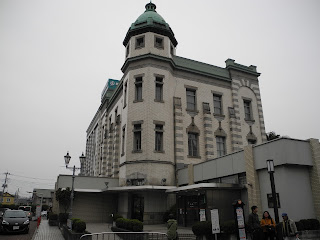
When I went to visit Japan again in 2017, my friend Hiro and I got to go to a section in Kawagoe City, Saitama Prefecture called Koedo(小江戸)which features a lot of historical architecture including the building in the above photo. It apparently was a bank back in the day. But aside from that municipality, the only other city that I've visited in Saitama was the capital, Saitama City.
Indeed, I've heard of Kasukabe City in Saitama but alas I never had the opportunity to visit it. Apparently, it's home to the famous anime character of Crayon Shin-chan(クレヨンしんちゃん)and his family. By the way, the video is by the channel Virtual Walk/All Over Japan.
Earlier tonight on the news, the anchor reported that Carnaval has started up once more in Rio which I'm happy about, and that one of the first things to get under way was some sort of samba festival. So I thought that I could find something samba-esque among the kayo.
Well, I did find "Kasukabe Samba" but it really doesn't sound like a traditional Brazilian samba at all. Still, it's very pleasant listening although I was surprised that this was actually a single provided by the folk duo Cherish(チェリッシュ)in 1990 as a promotion for the city of Kasukabe. The reason that I was surprised was that in spite of the release year, it certainly sounds more like something that came from the 1970s, around the same time that the duo's arguably most famous hit, "Tento Mushi no Samba"(てんとう虫のサンバ)was released. This was written by Akira Ito(伊藤アキラ)and composed by Shunichi Makaino(馬飼野俊一).
I don't quite remember how I found out about this January 2004 2-disc album which features the Yokohama-themed kayo called "Yokohama Fantasy". All I know is that I just had to have it and I did get it as part of my shopping spree recently. Although of course, the album had been released years before I launched "Kayo Kyoku Plus", it still reminds me of that rather little Yokohama-based kayo article that I came up with early in the blog's history.
Ironically, neither Hiroshi Itsuki's(五木ひろし)"Yokohama Tasogare"(よこはま・たそがれ)nor Ayumi Ishida's(いしだあゆみ)"Blue Light Yokohama"(ブルーライト・ヨコハマ)shows up in this collection although both of them can be considered to be the crème de la crème of Yokohama kayo. Rocket Brown posited that copyrights may have come into play while I think perhaps that those two had been assumed to be just a bit too obvious (however, there's a very rearranged version of the latter song by singer-songwriter Tomoko Tane(種ともこ)on Disc 2).
One thing that I noticed was that the booklet inside the CD case seemed unusually thick, but as it turned out, the reason for that was the presence of a map of Yokohama centering upon the famous Yokohama Bay. That's rather magnanimous of Sony and especially now when international tourism is rather vital for Japan, it gives me some inspiration to definitely visit the Japanese port city again and maybe even spend a few days there on my next trip.
Without further ado then, I would like to feature a few tunes from Disc 1 today because I'd never heard them before. Still, it's quite evident that Yokohama kayohas made for a good part of KKP since I have already covered them in the past, although I've also noticed that there isn't any Mood Kayo on either disc. I gather then that Sony was going more for the pops part of the kayo. As for the tracks on Disc 1:
15 Beautiful Yokohama -- IN THE GROOVE (ビューティフル・ヨコハマ)
You may have noticed that there are two songs by 70s aidoru Momoe Yamaguchi(山口百恵)in the mix but I'll be doing those as a twofer in the near future. For that matter, I'll be doing the same for the remaining tracks aside from the three that I'll be covering here today.
Let me start with Hiromi Ohta's(太田裕美)12th single "Doll" from July 1978. Created by the songwriting dream team of lyricist Takashi Matsumoto(松本隆)and composer Kyohei Tsutsumi(筒美京平), Ohta sings this smooth if jaunty song of slightly melancholy intent in the setting of Yokohama.
If I've interpreted Matsumoto's lyrics correctly, the young lady here may be recovering from a broken romance while feeling somewhat out-of-sorts just like a doll without any strings or owner to love her. I was a little confused by the repeated statements of celluloid initially; was she referring to her life being like a film (melodrama is part and parcel of the kayo experience, after all)? However, I figured out that celluloid in katakana refers actually refers to a certain type of doll as pictured on J-Wiki.
"Doll" peaked at No. 21 on Oricon and has been included on Ohta's 8th studio album"Elegance" from August 1978 which went as high as No. 13. The singer also performed this particular tune on the Kohaku Utagassen at the end of the year.
From the brassy Miki Hirayama(平山三紀), I have the just-as-brassy "Beautiful Yokohama", and this one is an especially auspicious tune because the song happened to be Hirayama's debut tune released in November 1970. Tsutsumi was once again the composer but back at that time, his lyrics-writing partner was Jun Hashimoto(橋本淳), and as I recall from doing other articles, those two were quite the tandem, too.
Hirayama was all of 21 with that husky voice of hers when she recorded it as this worldly young woman who made Yokohama her oyster and her men her pets tightly wound around her finger (two of the many men's names that she mentions happen to be the songwriters' sons). According to the J-Wiki article on this song, Hirayama had been attending the Takarajima Music Office for singing lessons at the Hotel New Japan. It just so happened that both Hashimoto and Tsutsumi had founded the organization and offered her "Beautiful Yokohama" as her first original tune. The cover of the single was also photographed with Hirayama at Yamashita Park right by Yokohama Bay. Ranking at No. 64 on the singles chart, the song was placed in her debut album"Beautiful Album"(ビューティフル・アルバム)from November 1971.
My final example is Machiko Watanabe's(渡辺真知子)"Minato Scope"(Port Telescope). When I saw that katakana for the second word in the title, I'd first thought that it was the translation for "scoop" which didn't make a whole lot of sense to me. But then on reading Akira Ito's(伊藤アキラ)lyrics, I realized that Watanabe's protagonist was looking through a telescope on a cruise ship entering the harbour in Yokohama to see if she could improbably spot her old flame and probably her memories with the guy. Watanabe came up with the City Pop melody punctuated by the buzzy electric guitar.
It certainly comes across as another fresh City Pop discovery and Watanabe's vocals sound as wonderfully resonant as ever. "Minato Scope" was the B-side to her 12th single from February 1982, "Suki to Itte"(好きと言って...Tell Me You Love Me). Motoki Funayama(船山基紀)arranged everything.
As mentioned, I'll take a look at some of the other tracks in individual articles in the coming weeks and months, but otherwise, I'll see if I can get Disc 2 up here in March.
Over the past month or so since NHK's "Uta Con"(うたコン)came back from summer hiatus, it's been running a week behind so tonight we got to see the October 12th telecast. For a kayo kyoku loving guy like me, it definitely struck me as one of the more memorable episodes since it was a wonderful tribute to the Showa music. Tatsuya Ishii(石井竜也)of Kome Kome Club(米米CLUB)covered Machiko Watanabe's(渡辺真知子)"Kamome ga Tonda Hi"(かもめが翔んだ日), a new talent that I definitely have to cover, Little Black Dress, covered Junko Yagami's(八神純子)"Mizuiro no Ame" (みずいろの雨), rock guitarist superstar Char actually appeared for the first time on the show, and it all began with a touching duet between actor/singer Kanji Ishimaru(石丸幹二)and 88-year-old legend Yoichi Sugawara(菅原洋一)on the latter's "Shiritakunaino"(知りたくないの).
In fact, I would put it as a double Junko night. Along with the cover of the Yagami song, I was delighted to actually see singer Junko Ohashi(大橋純子)appear on "Uta Con" tonight. Back in 2018, I mentioned in one of her articles that Ohashi had been diagnosed with esophageal cancer, and although it was at an early stage, that didn't mean I didn't worry. But there she was on the NHK stage for the first time alongside singer-songwriter Okayu(おかゆ)to sing one of her biggest hits and the first song that I had ever heard from her, the atmospheric "Silhouette Romance"(シルエット・ロマンス), and she was in fine voice and form. One question that had been lingering in my mind for three years was happily answered.
Now obviously since I've already covered "Silhouette Romance", I've decided to take a look at the B-side for her November 1981 single. "Sugitekita Kawa" (Passing River) isn't anything like the A-side and that's nothing new, but it also doesn't follow the City Pop or funky tunes that I've discovered over the years since hearing "Silhouette Romance". It's a light, footloose and fancy-free ditty which feels like an old standard from decades ago with a touch of jazz propelled by Ohashi's wonderful boomer of a voice. I will always appreciate a good harmonica.
"Sugitekita Kawa" was written by Akira Ito(伊藤アキラ)and composed by Yasuo Higuchi(樋口康雄). Although it wasn't on the original version of this album, it did get onto an expanded re-release of Ohashi's August 1981 album"Tea For Tears". Incidentally, City Pop's favourite communication number shares track space with this one. Additionally, I also have to add that "Kayo Kyoku Plus" has just passed 8000 articles as of now.
The above photo is one that I actually found on the website Royal Toiletry and this gold toilet is selling for about $2,199. Incidentally, if Royal Toiletry comes across this article and isn't happy about seeing the photo as a thumbnail, then please let me know and I'll remove it. Anyways, I was surprised at the price since it's actually only half as expensive as the TOTO toilet that my friend got from Japan with all of the technological knick-knacks.
Well, the reason for Goldie above is that this song was in the backlog (and I'm not being cute by using that word here) for a lot of months, so I thought it was time to give it its due. This is "O-Toire Song"(The Toilet Song) and it's this cute little ditty sung by Yuuji* Nakazawa(中沢勇志)that was used as the commercial jingle for a bathroom air freshener called Picolet.
Lyricist Akira Ito(伊藤アキラ)provided the words for this kid who really wanted to go and then enjoyed the pause that refreshes while the late CM song master Koba Hayashi(はやし・こば)presented this tango-esque melody. I tried my best to track down when this record was made and it took a photo of the single and a very weathered date tag of Showa 56(昭和56年)to finally inform me that it was most likely released in 1981.
I did find the actual commercial itself thanks to Mirror Record with a rather worried angel helping the kid over to the little guy's room. Was kinda surprised about that release date since the song and even watching the commercial itself had me thinking that "O-Toire Song" was a far older creation. And just in case, you want a further whiff of toilet (ahem) music...
*It seems that the kanji for the first name of young Nakazawa has a few readings but I did go with Yuuji, according to Jisho.org. However, if anyone knows the official pronunciation, please let me know here, too.
Oh, yes...a nice photo of the south Shinjuku pedestrian bridge as taken from the entrance of Takashimaya Times Square back in August 2009. Simply reading that month has me feeling beads of sweat rolling down my back and forehead; summer is definitely one season not to be trifled with in Tokyo. I recall gulping down a lot of bottles of Max Coffee back then.
To be frankly honest here, I realize that it is City Pop/AOR Friday on "Kayo Kyoku Plus" but I'm not entirely sure that this song by Ikue Sakakibara(榊原郁恵), "Akirameta hazu na no ni" (I Thought I'd Given Up On You) really applies. Oh, to be sure, the people involved have loved their urban contemporary; we have Akira Ito(伊藤アキラ)on lyrics, Etsuko Yamakawa(山川恵津子)on music and Tetsuji Hayashi(林哲司)taking of the overall arrangement.
Certainly, I can say that Sakakibara herself graduated from the genre of aidoru music going further into the 1980s although I agree that "Akirameta hazu na no ni" is a happy bouncy affair. There is indeed a City Pop-py saxophone solo but overall I think this ultimately comes across as a really cheerful straight pop tune. As the title hints, the song is about realizing that the feelings are still there for that special someone despite some initial relenting but the overall sensation is that of striding gleefully through a park. It just doesn't have to be a city park. The song was a track on Ikue's 15th album"Niji Iro"(虹彩...Rainbow Colours) from June 1983.
The above video is of some scenes from the 1975 NTV cop show "Ore-tachi no Kunshou"(俺たちの勲章...Our Medals) starring the late Yusaku Matsuda(松田優作), later to appear as the villain in "Black Rain" (1989), and a very young Masatoshi Nakamura(中村雅俊)as tough detectives. The music for the show was provided by a folk/rock band whose name I'd heard before in the past but have not gotten to feature on the blog until today.
TRANZAM is a band whose name made me wonder if it had come from those Pontiac Trans Am cars but according to J-Wiki, the moniker was inspired by the American Transcontinental Railroad. The band was first brought together sometime around 1973 with the original lineup consisting of drummer Chito Kawachi(チト河内), guitarists Hideki Ishima(石間秀機)and Nobuhiko Shinohara(篠原信彦), lead vocalist Tome Kitagawa(トメ北川)and someone whose name is well-represented here on "Kayo Kyoku Plus", bassist/songwriter Tsugutoshi Goto(後藤次利), all of whom had come from other rock or Group Sounds bands. The lineup changed quite a bit over the years with Goto himself leaving in 1974 after recording on their 2nd album"Funky Steps"(ファンキー・ステップス). Kohei Miyuki(幸耕平), the songwriter behind many of Junretsu's(純烈)songs, was also a part of the band as a percussionist.
TRANZAM's first single wouldn't come out until 1975 and it was actually the theme song for "Ore-tachi no Kunshou" with the song title taking on the show title. In May of that year, the band would release their 2nd single"Ahh, Seishun" (Ahh, Youth) just a month after "Ore-tachi no Kunshou" through what was called Black Records but now is part of Teichiku Entertainment in comparison with the debut single which had been produced at Toho Records.
As some of you KKP readers may have noticed, I usually don't point out record companies, but in this case I am doing so since for whatever reason, Toho Records decided not to put the band's name on the soundtrack that was TRANZAM's work and that even included the instrumental version of "Ahh, Seishun". However for the single "Ahh, Seishun", the jacket has the song labeled as coming from the cop show, so maybe there was a bit of a marketing ploy and some amends-making in place there on the part of Black Records (although they weren't at fault). To further add to the trials and tribulations of record release, "Ahh, Seishun" has been considered to be the band's true debut single since it is the first one to be sung with the name of the band.
Anyways, when it comes to the ending themes of 70s cop shows inJapan, I usually think they come in two styles: the Mood Kayo type that has often been the hallmark of the finish of a Yujiro Ishihara-starring series and the folk/rock type which seems to illustrate the lone wolf cop's never-ending odyssey for justice. "Ahh, Seishun" may have only been used as part of the background music for "Ore-tachi no Kunshou" but I think it would have also made for an ideal ender for each episode since just from the title alone, I believe that the cops played by Matsuda and Nakamura would have always been wistfully reminiscing about their much more carefree youth to try to get through each day. Mind you, copious amounts of alcohol probably helped, too.🍻 The above is what I found on TRANZAM's J-Wiki site but considering the slightly complicated nature of the whole thing, if anyone knows better about the situation, please let me know.
"Ahh, Seishun" was written by Takashi Matsumoto(松本隆)and composed by Takuro Yoshida(吉田拓郎), and it really does have that let's-look-at-the-sunset-and-remember sensation from its bluesy folk arrangement by drummer Kawachi. On Oricon, the song peaked at No. 42 and sold around 80,000 records. The echoing vocals by Kitagawa (who would leave TRANZAM following this song) and company along with the piano are what make this song.
What I've also read about TRANZAM is that they also provided a lot of commercial jingles, over a hundred according to the blog of Nobu Takahashi(高橋のぶ)who became the new vocalist for the band once Kitagawa left in 1975. In fact, they recorded a cover version of a Coca-Cola jingle in August 1976, "Come On In", that had originally been recorded in America under its creation by Billy Davis among others and arranged by B.J. Thomas with Akira Ito(伊藤アキラ)providing the Japanese lyrics. Not surprisingly, it's also quite folksy and the delivery reminds of another folk group, Alice.
Strangely enough, I can't seem to remember "Come On In" in America although I do remember the classic Coke jingle "I'd Like To Teach The World To Sing In Perfect Harmony", and of course in Japan, "I Feel Coke". Both of those songs can be heard in the article for the latter. TRANZAM would finish their run in 1981.


.JPG)