I've been a fan of Japanese popular music for 40 years, and have managed to collect a lot of material during that time. So I decided I wanted to talk about Showa Era music with like-minded fans. My particular era is the 70s and 80s (thus the "kayo kyoku"). The plus part includes a number of songs and artists from the last 30 years and also the early kayo. So, let's talk about New Music, aidoru, City Pop and enka.
Credits
I would like to give credit where credit is due. Videos are from YouTube and other sources such as NicoNico while Oricon rankings and other information are translated from the Japanese Wikipedia unless noted.
Apparently, there have been a few songs known as "Minna Ii Ko". One is the Japanese title for rockabilly singer Carl Perkins' "Everybody's Trying to Be My Baby" from 1956, and the other is the Beatles' cover of said tune.
Well, this "Minna Ii Ko" isn't that "Minna Ii Ko". For one thing, it's a perfectly homegrown song with lyricist Shigesato Itoi(糸井重里)and composer Kunihiko Kase(加瀬邦彦)having created it for Kenji Sawada's(沢田研二)14th originalalbum "BAD TUNING" released in July 1980. Tsugutoshi Goto(後藤次利)took care of its arrangement as a somewhat New Wave piece. Not sure if the original Perkins' song title would apply for this "Minna Ii Ko". Perhaps we can go with "Everyone's A Good Girl" since although I couldn't track down any lyrics online, I get the impression that this one lass out of the usual flock that the song's protagonist runs around with is not only the one who doesn't fall for his charms, but she's the one that he's most interested in. Such is life and love. Maybe I ought to extend my translation to "Everyone's A Good Girl (Except You)".
It's been almost five years since I last put up a posting for 80s aidoru Juri Hamada(浜田朱里). My last article on her was for the light and mellow "Sincerely" which was on her 3rd album, "Hitomi ~ Sentimental"(瞳・センチメンタル...Eyes - Sentimental) from December 1981. It's about as AOR as she could get as a teenybopper singer.
Well, about a year earlier, Hamada released her 2nd single "Anata ni Necchu" (Crazy About You) in October 1980. In the article for "Sincerely", I mentioned that producers everywhere were looking for the next Momoe Yamaguchi(山口百恵)when the real Momoe Yamaguchi happily decided to call it a career at the tail end of the 1970s, and Hamada had been one of the potential targets as the post-Momoe Momoe. With "Anata ni Necchu", I can see how the powers-that-be could have been pointing her into that direction with the addition of those wailing electric guitars for that rock music edge within the rollicking arrangement...much like how Momoe's music had sounded in the latter part of her career.
Lyricist Shigesato Itoi(糸井重里)and composer Koji Makaino(馬飼野康二)were behind the creation of "Anata ni Necchu" which only broke in at No. 100 on Oricon. Hamada didn't become the next Momoe (no one really did or should have) but those attempts to bring in the Momoe-esque latter 70s sound would shape the music for a number of early 80s aidoru such as Akina Nakamori(中森明菜).
On the latest episode of "Uta Con"(うたコン)before it went on official summer hiatus for a month, the show began with a medley of summer kayo favourites. One such song was a Takashi Hosokawa(細川たかし) tune that I hadn't heard in a very long time and hasn't been included on the blog until now.
Probably the reason that it was placed into the summer medley was the generous inclusion of beer into the lyrics, and if I'm not mistaken, Hosokawa's 38th single from May 1991, the feel-good "Ouenka, Ikimasu" (I'm Going with the Fight Song) was used for a beer commercial, though I have yet to find it. It's an interesting song to be sure because though the veteran enka singer uses some of those enka vocal techniques, the melody by Motoyoshi Iwasaki(岩崎元是)is much more along the lines of the late pop troubadour Eiichi Ohtaki(大滝詠一)and sure enough, I've found out through Iwasaki's J-Wiki file that he was greatly inspired by Ohtaki. Actually, the Hokkaido singer-songwriter already has representation on KKP via his own City Pop stuff from the mid-1980s.
The lyrics of enjoying the company of good buddies and beer were created by veteran Shigesato Itoi(糸井重里). Frankly, I was surprised that "Ouenka, Ikimasu" hadn't been given its own J-Wiki article since the song seems to have created a lot of good vibes for that year including folks raising their mugs of suds. At this point, I'm not sure how well the song did on Oricon but it must have been done well enough to earn Hosokawa his invitation to the Kohaku Utagassen in 1991 and 2014 to perform this particular tune.
I can imagine that the beer gardens in Tokyo are packed right now with some very thirsty drinkers, especially with the usual heat and humidity that beats down on residents in a typical Japanese summer. Drink hearty, my friends!🍻
I almost neglected to mention that this is a follow-up to Noelle's original article on the song.
I know that Robert Altman's"The Player" was still a decade away from being released in theatres, but I couldn't help but think of this Hollywood movie satirizing Hollywood when I first listened to this single by aidoru Iyo Matsumoto(松本伊代).
Her 3rd one, to be specific, "TV no Kuni kara Kirakira" (Gleaming from the Land of TV) was released in May 1982. It seems as if lyricist Shigesato Itoi(糸井重里), composer Kyohei Tsutsumi(筒美京平)and arranger Shiro Sagisu(鷺巣詩郎)all decided to concoct a tongue-in-cheek aidoru tune about the whole fantastical mystique surrounding an 80s aidoru while having the lass herself wonder where the line between reality and illusion appears.
Iyo-chan certainly sells it with her puppy-dog happy nasal delivery and Sagisu's arrangement is just as peppy with all of the horns and strings bouncing about. The song fits what the teenybopper entertainers were all about during the Golden Age of the Aidoru: supremely kawaii, bouncy and flouncy. "TV no Kuni kara Kirakira" hit No. 15 on Oricon.
I first heard the news on Twitter yesterday morning and then it was confirmed through a November 26th"Nikkan Sports"(日刊スポーツ)article via her J-Wiki profile, but 80s aidoruand current tarento Iyo Matsumoto(松本伊代)suffered an injury to her back while appearing on the TBS variety game show "Ohkami Shonen"(オオカミ少年...Wolf Boy/Lie or Truth) on the 24th. At the one-minute mark in the above video, the show displays the series of hatches which opens over piles of sponges below for which I'm assuming wrong answers will earn celebrities a quick trip down.
Unfortunately, something apparently didn't work but when Matsumoto fell through the hatch, she ended up seriously injuring her lower back requiring at least three months of treatment. In that J-Wiki article, it is also stated that in 2021, she had suffered the same injury while doing exercise, so what happened a few days ago may have been a complication on that issue. Regardless, I'm hoping that Matsumoto is resting as comfortably as she can and that she will make a swift recovery. The incident has reminded me of an injury that another former aidoru, Momoko Kikuchi(菊池桃子), had suffered earlier this summer.
Since I am writing about Iyo-chan, why not go into one of her early singles? In fact, let's go into her 4th single from August 1982, "Otona ja nai no" (I'm No Adult). With one of the more raucous intros to an aidoru tune that I've ever heard, the song almost seems perfect as an anime theme as a so-called teenage witch tries to bewitch a high school boy. It could almost be the Japanese version of "Bewitched" for the youth set.
I had initially thought that "Otona ja nai no" was going to be a techno-aidorutune because of that intro, but it quickly became that usual sprightly early 80s teenybopper song with those shimmering strings and horns. And of course, Iyo-chan's vocals are instantly recognizable. Kyohei Tsutsumi(筒美京平)was responsible for the melody, while Shigesato Itoi(糸井重里)took care of the lyrics and Shiro Sagisu(鷺巣詩郎)was behind the overall arrangement.
"Otona ja nai no" took in quite a few awards along with that No. 16 peak ranking on Oricon (ended up as the No. 85 single for 1982). It took the silver award at the 12th annual Ginza Music Festival, a silver award at the 9th annual ABC Kayo Shinjin Grand Prix(第9回ABC歌謡新人グランプリ...ABC Kayo Rookie Grand Prix), yet another silver award at the 15th annual Shinjuku Music Festival, and Best New Artist honours at the 8th annual Zen Nihon Kayo Ongaku Sai(全日本歌謡音楽祭...All Japan Kayo Music Festival).
My first impression when I heard the aidoru manzai comic duo Yasuko and Keiko Haru(春やすこ・けいこ)was "Man, they are Osakan to the core!". It was like they'd stepped out of my relatives' home as unknown cousins. But no, Yasuko and Keiko are not related to me...or each other, for that matter.
Yasuko Nakajima(中島泰子)and Keiko Kobayashi(小林恵子)as they are known now indeed hail from Osaka and they first met in their teens when both were with the Shochiku Geino Talent Agency in 1973. Their act as Yasuko and Keiko Haru began in 1976 after which their star rose steadily. Another Kansai-based sister act Senri and Mari Unabara(海原千里・万里)were ending their time in 1977, so expectations were high and the Harus were seen as "the post-Senri and Mari". Moreover with the aidoru song-and-dance duoPink Lady(ピンク・レディー)riding the waves of popularity at the time, Yasuko and Keiko were also dubbed the Japanese comedy world's equivalent of Pink Lady. They hit a lot of the variety shows and of course, they were called upon to do their part for commercials as you can see above.
Naturally once celebrities reach a certain level of fame in the country, many of them are called upon to show off their singing prowess (or lack of). So Yasuko and Keiko released two singles in 1981, the first of which was "Heartbreak Hotel wa Man'in" (Heartbreak Hotel: No Vacancy). Nope, it has nothing to do with Elvis Presley but the good ol' 50s and 60s rock n' roll that was part of kayo's soundscape at the time was fully imbued thanks to composer and arranger Ichinen Yamazaki(山崎稔)with lyricist Shigesato Itoi(糸井重里). Itoi made sure that the Osakan was also in there with the dialect's exhortation of "NO GOOD!": Akan(あかん). Yeah, I heard plenty of that in my childhood. Gotta also say that those hairdos are really nostalgic and the ladies did quite well in the recording.
Yasuko and Keiko Haru won the Best New Artist prize (!) at the 1981 edition of the Kamigata Manzai Comedy Awards and a Hope prize at the 1982 Japan Broadcasting Entertainment Awards. The act though broke up in 1985.
Yes, quite the line of romance to throw out on a first date...after which the next thing thrown will be a glass of that red wine.
And yet, that is the translation of a track from Hiromi Go's(郷ひろみ)"Hiromi-kyo no Hanzai"(比呂魅卿の犯罪), his 21st album from April 1983. Judging from the titles of both the track and the album which translates as "Lord Hiromi's Crimes", and even the look of the cover, I take it that the folks behind the production of the album were going for something Halloween-y.
However, there is a nice feeling of urban contemporary with "Kimi no Na wa Psycho". Although I could hear the synths and a slight echo with Go's voice, I don't think it's so much a technopop tune than it is something in the City Pop genre. But no need for me to fret too much over that since it is Ryuichi Sakamoto(坂本龍一)who concocted and arranged the music (in fact, he was the sound producer for the entire album), and he's had plenty of experience in both genres. Shigesato Itoi(糸井重里)wrote the lyrics about a woman that Lord Hiromi may be simultaneously infatuated with and afraid of. The music is cool and the story might be just as cool...although as cool as a knife going between your ribs.
Happy Monday! It's been less than 24 hours since I put up the article for Disc 1 of Rajie's"All Time Selection" from 2018, but since I was able to get all my work done today, I now have oodles of time to write about Disc 2 now.
Disc 2 includes selected tracks from d) Mahiru no Hodou (真昼の舗道...1980) e) Acoustic Moon (1981) f) Gogo no Relief (午後のレリーフ...1984) g) Espresso (エスプレッソ...1985), and yeah, I'm keeping the order that I had from last night's Disc 1 article so that's why it's starting from d).
Unlike in Disc 1, you won't be finding any links under here and only a few lettered tracks since neither nikala nor I have talked about Rajie's material beyond nikala's article for "Mahiru no Hodou". However, this gives me a chance to find out more about the songs that she performed for those last three albums.
The lineup for the second disc then.
1. Last Scene(ラスト・シーン)(d) 2. Itsuwari no Hitomi(偽りの瞳)(d) 3. Radio to Futari(ラジオと二人)(d) 4. Yojirean Twist(ヨジレアン・ツイスト)(d) 5. ROSY BLUE 6. Black Moon(ブラック・ムーン) 7. Bara no Glass(薔薇のグラス) 8. Do you wanna dance 9. Memory Through (Tsuisou)(メモリー・スルー (追想)) 10. Ce Soir(セソワ) 11. Goodbye Transfer(グッド・バイ トランスファー) 12. Ruriiro no Koibito-tachi(瑠璃色の恋人達) 13. Double Moon(ダブルムーン) 14. MAMAMIYA ~ Uchuu kara no Okurimono(宇宙からの贈物) 15. Espresso 16. Misshitsu(密室) 17. Yumeiro Densetsu(夢色伝説) 18. Hikari to Kage(光と影) Tracks 1~4 are d), 5~9 are e), 10~14 are f) and 15~18 are g). For those first four tracks, originally from "Mahiru no Hodou", you can just click the link in the second paragraph to find out more about them.
Since "Mahiru no Hodou" is already well represented, shall we begin with Rajie's 5th album"Acoustic Moon"? Above is "ROSY BLUE", a happy-go-lucky number that weaves between down-home and classy. Written by Keisuke Yamakawa(山川啓介)and composed by Masamichi Sugi(杉真理), it might be telling a tale of a woman teasing a new beau over his past while tripping the light fantastic. Despite the songwriters involved, I couldn't but feel that there was a feeling of Eiichi Ohtaki(大滝詠一)infused into this song. "ROSY BLUE" was also the B-side to Rajie's 8th single"Do you wanna dance" from 1982.
Speaking of that A-side, here is "Do you wanna dance" which is another rather split-personality song which has a doo-wop refrain sandwiched in slices of what sounds like French jazz of the 1960s. Rajie is playing into this quite well with her flirty vocalization. Shigesato Itoi(糸井重里)and NOBODY took care of words and music respectively.
"Black Moon" from "Acoustic Moon" has Rajie seemingly channeling some Junko Yagami(八神純子)and Hi-Fi Set(ハイ・ファイ・セット)from the 1970s. Etsuko Kisugi and Yoshitaka Minami(来生えつこ・南佳孝)have teamed up to create this tribute to some classy City Pop with European undertones. No fusion of genres here....just some pleasant music that I would enjoy having some steak and alcohol with at The New York Grill in Shinjuku. "Black Moon" was also her 7th single from 1981.
Going into Rajie's 1984"Gogo no Relief" (Afternoon Relief), "Goodbye Transfer" is a pretty atmospheric piece straddling between 1980s City Pop and the sophisticated pop coming in the latter part of the decade. Kingo Hamada(浜田金吾)was responsible for the moody music and Kazuko Kobayashi(小林和子)took care of the lyrics which talk about a woman getting ready to take off from a fogbound airport to leave her romantic woes behind.
"Double Moon" is a another heady song with some bossa nova. Lyricist Rui Serizawa(芹沢類)and composer Akira Nishimoto(西本明)created this one.
"Espresso" is Rajie's final original album and the title track is a smooth and light technopop number by Serizawa again and Yuji Karaki(唐木祐史). For some reason, I'm quite attracted to these cabaret-type songs done with synths.
Then on the same album, there is "Misshitsu" (Secret Room), a sultry song in which a woman and her paramour have a little tryst in an elevator while heading up to the 15th floor. I gather that back then, apartment or hotel elevators weren't all that fast. The same fellows behind "Double Moon" in the previous album also took care of this technopop tune which is about as different as Rajie could get when compared to her earliest City Pop entries. Again, I have yet to get "Espresso" the album but my feeling is that it could be similar to "Quatre" from 1979 which also had Rajie going for a more synthesized sound.
And that is what makes this BEST compilation interesting since Rajie didn't settle on one particular sound during those years between 1977 and 1985. She continued to evolve so it's been fun listening and comparing the songs.
Bringing in a bit more summer to you through this song and the commercial that it will eternally be attached to. Yoshiko Miyazaki(宮崎美子)is a veteran actress and tarento who I've seen as this very smiley and kindly presence on the various shows she's appeared on. However, her default image will always be the one she presented on a Minolta commercial way back in 1980 while in her early 20s. It's the one where she stripped off her T-shirt and jeans to reveal her buxom figure in a blue bikini. It's often the case that when she appears on a variety show, that particular commercial will be shown.
Of course, there is that campaign song which came with the ad titled "Ima no Kimi wa Pikapika ni Hikatte" (You Are Now Sparkling) by singer-songwriter Tetsuo Saito(斉藤哲夫). Categorized as a folk and New Music singer, Saito's June 1980 single though has much more of a mainstream summery pop feel to it. Written by Shigesato Itoi(糸井重里)and composed by Keiichi Suzuki(鈴木慶一)of The Moonriders, the singer delivers this hit as if he were just strumming away at his guitar while sitting by a palm tree and admiring Miss Miyazaki from afar.
I think the song and commercial are pretty much tied at the hip now and forever since whenever I see the latter, I will always hear the former. "Ima no Kima wa Pikapika ni Hikatte" peaked at No. 9 on Oricon.
Since I've gotten into that nostalgic "Ponkikies"(ポンキッキーズ)mood thanks to writing about "Kimi to Boku"(キミとボク)in the last several minutes, I found another catchy song from the Fuji-TV kids' show. The songs used for the program were not only used in the music segments but also for the intros and outros. One particular song that resonated with me at the end of an episode was "Saa Boken da" (Hey, It's An Adventure) since the video involved scenes from the 1902 French movie "A Trip to the Moon".
This was sung by veteran soul singer Akiko Wada(和田アキ子)as her 59th single from September 1995. At first, I hadn't been able to recognize that it was the relatively tall and tough Wada since she approached it vocally with a lighter touch, and certainly it was a different sort of melody for her. In fact, I was downright impressed by the names involved in the making of "Saa Boken da". Chisato Moritaka(森高千里)and Shigesato Itoi(糸井重里)wrote the lyrics while Tatsuya Ishii(石井竜也)of Kome Kome Club(米米CLUB)took care of the music with the band arranging the whole thing.
"Saa Boken da" has that fun and carefree spirit of a road trip whether by car or motorcycle, and it looks like it was filtered through The Beatles with that harmonica in there. However, that melody also seems to be following a pattern similar to that old musical song "Ol' Man River". And just like that standard, "Saa Boken da" keeps rolling along to the next destination.
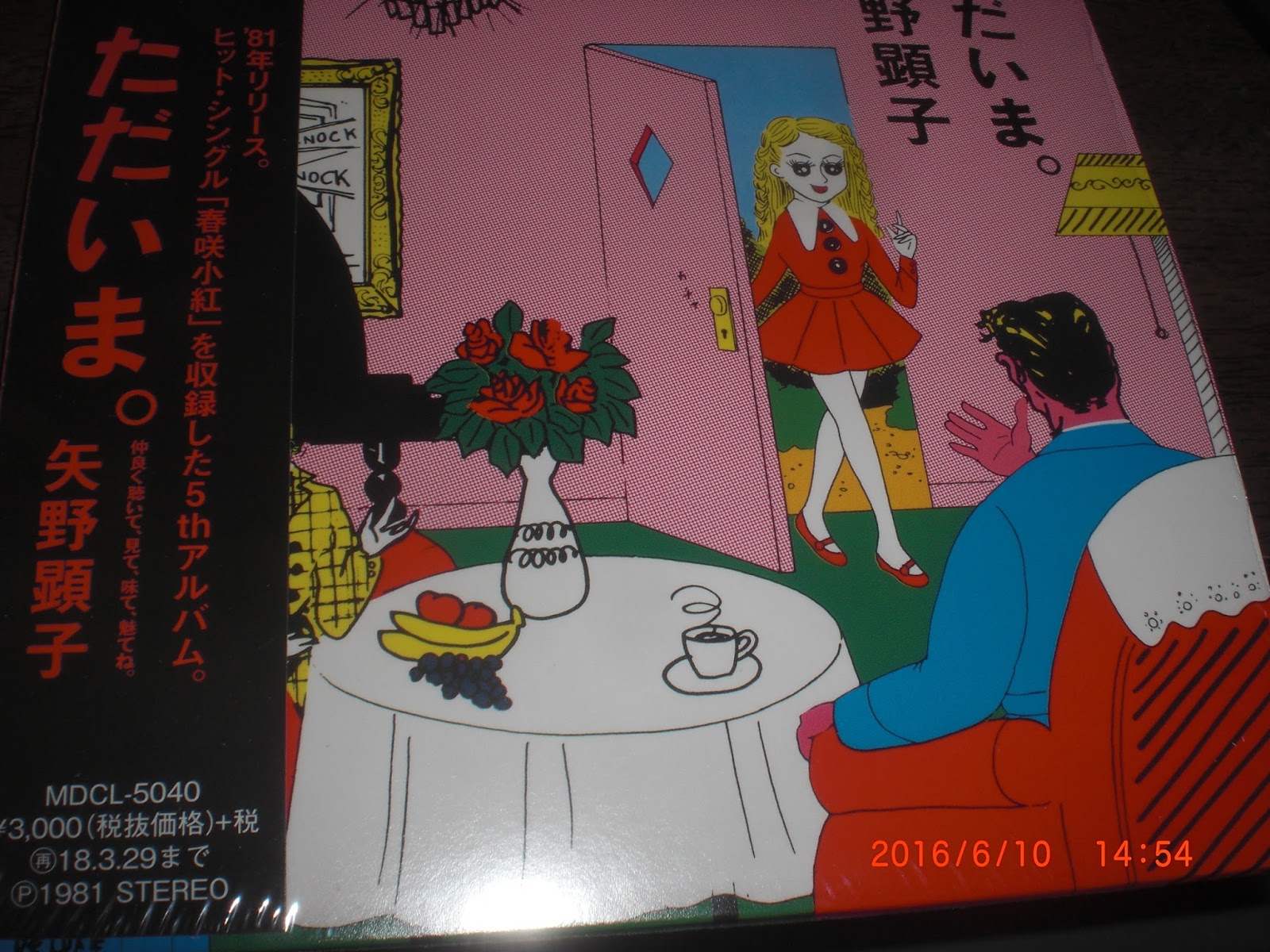
Out of my purchasing blitzkrieg a couple of weeks ago, the one album that has gotten the biggest pleasure out of me is Akiko Yano's(矢野顕子)"Tadaima"(I'm Home). Originally released in May 1981 as Yano's 5th studio album, it came out just a couple of months before my fateful high school trip to Japan. If I had known about it, I probably would have grabbed the audiotape or even the LP since my then-embryonic interest in Japanese pop music at the time was Yellow Magic Orchestra. Anything that had a synthesized pulse would have been in my radar range at the time.
I've already written about a couple of the album's tracks, "Itsuka Oji ga" (いつか王子様が...which finally triggered me to get the album) and one of her biggest hits, the super-catchy "Harusaki Kobeni"(春咲小紅)which I couldn't resist from bringing back here. And although I realize that Yano's albums have had a whole assortment of album covers, I think the one for "Tadaima" just strikes me as being so Yano-esque for the lack of a better term. It's kinda weird and adorable at the same time...somewhat like me in front of my niece.
But I will officially start off with the first and title track "Tadaima" which continues her technopop phase that began with her previous album "Gohan ga Dekita yo"(ごはんができたよ). Written by Shigesato Itoi(糸井重里)and composed by Yano, it has the spacy but warm Ryuichi Sakamoto(坂本龍一)synths and the singer's vocal whoops and onomatopoeia...this time emulating cats and dogs for some reason. In the song, she's pining to have her home filled with loved ones to greet her when she comes in instead of merely the empty darkness of being a single resident. Still, instead of it being a sad ballad, it's got that zippy energy that also infuses "Harusaki Kobeni". Yano might feel a little lonely but she can happily hang on for a while before that family comes in.
"VET" is Yano going way off on a New Wave tangent with spacy synths that really had me reminiscing about those British songs from the early 80s. I could have imagined her and her band all dressed up in tin foil and performing all Devo-like to this song about fighting the good fight against animal diseases. The interesting thing is that I can barely hear her rapid-firing those English lyrics.
"I Sing" is another all-English song written by Yano and composed by her then-beau YMO's Ryuichi Sakamoto which seems to be her giving advice to a less experienced singer on how to handle fame. Even with all of the electronics in there, I think this is a very sunny and gentle pop song.
My final song is indeed the final track "Rose Garden". Now with a title like that and the fact that it was placed as the last tune had me assuming that it would be a typically slow ballad to bring "Tadaima" to a nice close. But instead, it's a Yano-made technopop earworm with the singer rapping out her lyrics to a galloping melody that could be identified as a new synthesizer accompaniment to a traditional dance at the summer O-Bon festival. I would love to see any ambitious choreographers hammering a dance out from this one. And just some minutes ago, I was commenting on Marcos V's article on a Kyary Pamyu Pamyu song; I wonder what she could do with it as a cover.
As I stated in the "Itsuka Oji ga" article, I had read that "Tadaima" was even more well-regarded than "Gohan ga Dekita yo" although at this point, I'm not quite sure whether I would agree with that assessment just yet. There are some really hook-friendly songs on that previous album but "Tadaima" is still a fun release to finally get. Still, I'm now quite interested in hearing her even earlier material from the mid-1970s before Yano found her techno-muse.
Christmas has come and gone for another year, and so I am left with another round of purchased Japanese CDs to peruse for the next several days, including the above one. Yep, I bought another couple from the "Light and Mellow" series of Japanese pop music with oodles of City Pop and J-AOR tunes over the last few decades.
One of the tracks that stood out from the compilation was Tomita Lab's(冨田ラボ)"Zutto Yomikake no Natsu" (which I will translate as That One Summer) featuring the R&B duo of CHEMISTRY. I thought it rather fateful to have two musical acts named CHEMISTRY and Lab get together to concoct one lovely smooth ballad which turned out to become the latter's 4th single from September 2005.
Considering how much I really liked a number of the tracks from Tomita Lab's debut album, "Shipbuilding" in 2003, I'm slightly smacking myself upside my head for not having been aware of "Zutto Yomikake no Natsu" in the 10 years since its release. Composed by Tomita Lab and written by veteran lyricist Shigesato Itoi(糸井重里), the song has that particular summery laid-back vibe which I've characterized as being Lab's sound. And the accompanying music video of a young teenager knowing love and heartbreak in a span of a day goes very well with the song.
"Zutto Yomikake no Natsu" is a track on Tomita Lab's 2nd album from 2006, "Shiplaunching" and also CHEMISTRY's "the CHEMISTRY Joint Album" from 2009. The single itself got up to No. 37. It's almost a shame to read that since I think it deserved even better but perhaps it just wasn't the era for that sort of song.
Despite having the word for "Snow" in its title, I find that "Yuki Ressha" has a comfortable and warm feel to it rather than cold, and I think that's due in part to the mellow and moody music. The soft strings and rhythmic thumping of the drums makes you feel as though you're watching snow flakes drift down on a chilly day from the safety of your home heated by a crackling fire, or just a heater.
Renowned musician Ryuichi Sakamoto (坂本龍一) had done the composing for Kiyoshi Maekawa's (前川清) first solo single from October 1982 (when he had that awful perm), and it is not so much of Mood Kayo as it is Pop, but there seems to be a slight touch of enka to it. My guess is that Mae-Kiyo was trying to deviate from the genre he started with and go with something more contemporary. After all, Mood Kayo popularity was starting to wane in the 80's. Shigesato Itoi (糸井重里) penned the lyrics, and they seem to be about our protagonist reminiscing the enjoyable times he had with a past lover on a winter's day.
Just to share a little something with you guys: "Yuki Ressha" had served as inspiration to one of my narratives I had written more than a year ago. As you can see, every time I have this forlornly delivered song playing, it has me picturing a lone figure seated by the window on a train all while the frigid, dreary snow-covered landscape topped by an equally as grey sky zips by before his wistful eyes. So on one of the mornings on the way to school, I just so happened to not be as groggy as I thought I'd be - that was still during my first year at college and classes started at 8.30 am sharp and I didn't have the pleasure of living close by and I'm not a morning person by nature - allowing my creative juices to flow and formulate something substantial out of that little scene from my mind's eye.
The writing process for this story also went pretty smoothly and I doubt I'd forget ever forget it; I wrote the "Yuki Ressha" bit in school (the module I had that day was lax, so was my teacher) and the remaining three-quarters of it at home over the weekend. While at home, I restarted the project near midnight when, oddly enough, my creative juices flow best, and typed away for hours until I was done... at nearly 4 am the next day. It was my first time pulling an almost all-nighter doing something remotely productive. It quite the experience.
In the first month or so after I get an enka/kayokyoku singer's yearly compilation album, I'd typically just listen to the handful of songs that made me want to purchase the CD, then leave the rest for later discovery on days where I feel rather adventurous or just plain bored or both. Yesterday was one of those days. I got pretty bored listening to the same songs ad nauseam (Kiyoshi Maekawa, George Yamamoto, Haruo Minami, etc.), then I realised that I hadn't touched my Takashi Hosokawa (細川たかし) playlist in a while, and there were still a number of tracks out of the 16 from his 2015 compilation album I had yet to sample.
First one I picked was "Sado no Koi Uta" (佐渡の恋唄), which was decent, but it didn't make me any less bored. Next came "Oenka, Ikimasu", mostly because its title piqued my interest. Now this one finally got my lazy brain to start working again - Friday was a tiring day - since it was a lot faster in pace and more joyful than "Sado no Koi Uta". In terms of the music composed by Motoyoshi Iwasaki (岩崎元是), it seems to lean more to the genre of Pop than enka and, to me, it didn't sound like a song Hosokawa would sing, more specifically at the portions before the chorus. I actually kept envisioning a whole list of other enka singers who'd be a better fit for "Oenka, Ikimasu". However, with all the power-packed, Minyo-backed "Ah ah..." and "Ha...", I'd say Hosokawa made the song his own.
That Noh mask still makes my skin crawl...
While reading (and listening to) the lyrics penned by Shigesato Ito (糸井重里), one line that Hosokawa repeats a total of 7 times in the entire song managed to grab my attention: Nama biru ga aru janai ka?
I think that translates to, "Is there any draught beer?" or, "Would you like some draught beer?" Either way, every time I hear it, I can't help but imagine Hosokawa starring in a Sapporo/Asahi beer commercial, wearing a sparkly suit with a bow tie - he looks weird with a necktie - and offering up a glass of the golden malt to the masses. Doing some research on "Oenka, Ikimasu" allowed me to find out that I wasn't too far off point in thinking that this cheerful tune would fit perfectly in a beer commercial since it did indeed star in one... not Sapporo or Asahi, but Kirin... Close enough!
On to the song's statistics. "Oenka, Ikimasu" was released on 1st May 1991 as Hosokawa's 38th single. The enka singer sang it twice on the Kohaku, in 1991, then only just last year in 2014, which was my first viewing of the year end competition. No wonder I found it so familiar, especially that "Nama biru" bit.
(Unfortunately, the karaoke video with Hosokawa has been taken down but here is another karaoke video.)
Here's the karaoke version with Hosokawa in it. In the later half when he faces the camera with that smile, it looks like he's in a beer commercial.
A little over a couple of years ago, I wrote an entry on Akiko Yano's(矢野顕子)"Ramen Tabetai"(ラーメン食べたい), her musical yearning for a bowl of simple ramen in a time when it was intimidating for a lot of women to enter a ramen shop on their own. That song was back in 1984.
Well, some 13 years later, Yano came up with another slurp-themed tune, but this time it was on the Western side of things. I listened to "Cream Stew" for the first time in ages last night and was reminded of those old House Foods commercials on TV for the titular stuff whenever the autumn came around. It's kinda interesting comparing how beloved cream stew is in Japan while in North America, we seem to go ga-ga over beef stew or chicken soup.
In any case, "Cream Stew" was released as a single in May 1997 although my relationship with the song was via her July 1997 album, "Oui Oui" (peaked at No. 21 on Oricon). Composed by Yano and written by copywriter-lyricist Shigesato Itoi(糸井重里), the song was also arranged by Noriyuki Makihara(槇原敏之) who also pops up as a backup vocal in the refrain. Unlike the mild urgency and thriller aspect of the earlier "Ramen Tabetai", Yano sings "Cream Stew" as the best remedy for the blues by the cheeriest doctor. Chicken soup indeed. To her, there's nothing like a bowl of the creamy broth and tender vegetables to clear away any negativity.
For me, I was more partial to a hearty bowl of minestrone but her point is well taken. It was just a happy-go-lucky Yano yarn that got me to buy the entire album.
When I was working as a NOVA teacher in the Asakusa branch from 1995-1997, I sometimes walked down the grand shopping street known as Shin-Nakamise Dori which started from just across Asakusa Station all the way down to Tawaramachi Station which was the next station down on the Ginza Line. Near that station was the Asakusa ROX Building which contained all sorts of stores and restaurants. It had been around a while by the time I first set foot in there, but I enjoyed checking out the CD/bookstore and then occasionally grabbing a bite to eat on the restaurant floor right at the top. No, it wasn't exactly the healthiest fare I got there, but at least it was better than my frightening diet of McDonalds/KFC several times a week. Still, looking back on those days, it was nice to get in there especially when the weather was rather inclement.
"Jitensha de Oide" (Come By Bike) was the song that was used in a commercial for ROX, and it hits that right tone in terms of how I feel about the place. Composed by Akiko Yano(矢野顕子) and written by Shigesato Itoi(糸井重里) in 1987 for her album, "Granola", I came across it through her 1996 BEST album, "Hitotsudake" (it was never released as a single...at least, not as an A-side). Ryuichi Sakamoto(坂本龍一) gives a faint echo of Yano's technopop past in the keyboards, but basically the duet with Motoharu Sano(佐野元春)is a laid-back invitation to listeners to come (by bike) and spend some relaxing off time with that friend over tea and good conversation. It must've made for a good jingle for ROX, and for the Asakusa neighbourhood in general since I could envision the old houses and narrow streets through the lyrics.
The slide guitar and the gentle piano can slow down the heartbeat quite nicely, and the distinctive voices of Yano and Sano (who also provides the whistling) make it sound as if they were intimately performing in one of those cafes, old/new or chain/mom & pop, that line Kaminarimon Dori in the area. Strangely enough, I think a light rain would be the perfect meteorological backdrop for this song.
This was actually the very first Miharu Koshi(コシミハル) song I heard, thanks to Volume 2 of the"Good Times Diva" series that I collected years ago. As I mentioned in one of the earlier articles on this most chameleon-like of Japanese pop singers, I'd seen her interesting CD covers on the shelves in the various shops: one cover for her collaboration with Haruomi Hosono(細野晴臣) looking like a slinky sexy French gamine, another later album showing her dressed up like a Can-Can dancer. So I naturally wondered how she sang, especially if Hosono was involved.
Then, I heard "Hashire Usagi"(Run Rabbit) which came from her mid-80s period as a techno chanteuse via "Good Diva". The song was written by copywriter Shigesato Itoi(糸井重里) and composed by Hosono himself, and I found it appealing in a quirky way. The synths are bounding across the plain like the titular lapin as Koshi sings in that new high voice she introduced to us when she took on that new persona from 1983 through her 4th album, "Tutu". "Hashire Usagi" is a track on her 6th album from 1985, "Boy Soprano" which seems to be a good title considering that high register she was singing at. And when you take a look at the YouTube video above, get a load of that new look on the album cover.
In this song, Koshi takes on that musical trope of the aftermath of a crashed relationship as she sings about getting on that Vespa and racing through the streets (of Rome, perhaps?) throughout the night, like the proverbial rabbit, trying to rid herself of the memories of the lost love. I rather wonder if this is what Princess Anne from "Roman Holiday" fame did after she gave her final goodbyes to Joe Bradley (y'know, if she could escape from her royal minders a first time...). I think the way she delivers the lyrics, it almost sounds like a technopop operetta of sorts.
As an extra, I've thrown in a brief performance by Koshi of "Ryugu-jo no Koibito"(竜宮城の恋人....Ryugu Castle Lover).
Yup, this is a real rabbit. In October 2011, my friends took me
to a Rabbit Café in Harajuku. Very pleasant experience although
there were plenty of bunny "land mines" on the floor, if
you know what I mean.
February 3 2015: I found out by happenstance that Koshi's version was actually a cover of the more City Pop original by lyricist/singer Yuko Kanai(金井夕子). Her "Hashire Usagi" was found on her February 1982 4th album, "ecran". The technopop is still in there but Kanai's lower vocals and the overall arrangement make it sound less whimsical and more Tokyo downtown.
Yes, before he went New Wave, before he went Glam Rock, musical force of nature and bon vivant Kenji Sawada(沢田研二)had decided to take a fashion tip from Sgt. Peppers when he made his live performances of "TOKIO", his 29th single released on New Year's Day 1980. "TOKIO" is a rousing tune that Sawada rather makes into a fun tourism advertisement for Japan's largest city. According to the lyrics, it's the city where the kind girls sleep and the sad boys howl....whatever that means....must be kinda fun, though.
I first heard "TOKIO" on a spotlight episode on Sawada on "Sounds of Japan", and it reminded me of my time there in 1981. The frenzy of the electric guitar and the bubbliness of the synthesizer rather wrapped up my images of the big city....perfectly operating vending machines selling skinny 90-yen cans of Coke, cafes with video games played on the tabletops and the incredible humidity of that July.
As for those appearances by Sawada on TV, I'm not sure whether the Sgt. Peppers outfit was his idea, but apparently the parachute behind him was....which played into the oft-repeated lyric of flying. He was definitely an entertainer, that one. "TOKIO" was written by copywriter Shigesato Itoi(糸井重里)and composed by former Wild Ones guitarist Kunihiko Kase.(加瀬邦彦).Tsugutoshi Goto(後藤次利), who would later be involved in many of Shizuka Kudo's(工藤静香) songs, was the arranger, and for his efforts, he won the Best Arranger Prize at the Japan Record Awards for that year. The song peaked at No. 8 and became the 39th-ranked song of 1980, selling over 300,000 records.
The B-side to "TOKIO" is "I Am I", a much more subdued ballad which I've already profiled.
On "Hitotsudake", the BEST selection of Akiko Yano's(矢野顕子) songs, this tune with the obsessive-compulsive title, "Donna Toki mo, Donna Toki mo, Donna Toki mo"(No Matter When x 3) just followed her big hit single of "Harusaki Kobeni"(春咲小紅) on the track list. And I thought it made for a good thematic sequel for it as well. The fun and frenzy of "Harusaki Kobeni"seemed to reflect a girl's joy/panic at getting that date with the handsomest boy in class while "Donna Toki mo x 3" was at the end of the date when that tired but still happy lass realized her new beau had been just as nervous; she could now take the driver's seat and calm him down.
Little did I know that Yano and Shigesato Itoi(糸井重里) had written the lyrics from the boy's point of view according to the pronouns used. I guess Yano's sweet breathy voice and the coquettish melody had me thinking otherwise. It is still very much an adorable love song from the guy to his girl with Yano singing at the very end that the lass will always be wonderful no matter when, no matter when, no matter when.
The guys from Yellow Magic Orchestra are backing her up here, and there is this great steel guitar by Hiroki Komazawa which comes during the bridge and the end which neither makes "Donna Toki mo x 3" sound Country nor Hawaiian, but it does add to the marvelous world of whimsy that Yano inhabits. The song was never released as an official single but is a track on her 6th album, "Ai ga Nakucha ne"(愛がなくちゃね....Gotta Have Love, Eh?), which was released in June 1982.
Perhaps I should've made this one the Valentine's Day entry.
Anri's(杏里) 3rd album, "Kanashimi no Kujaku"(Sorrowful Peacock), is not my favourite album of hers ("Boogie Woogie in Mainland", "Circuit of Rainbow" or "Wave" rank quite a bit higher), but it is one of the more interesting that I've come across, and one that I've wanted to profile for a while.
Released in September 1981, I came across it in one of the CD shops in Tokyo. I'd already bought a number of her late 80s/early 90s discs when she was in full thrall with American R&B, and their covers consisted of a very vivacious and smiley Eiko Kawashima standing against a very summery setting. On the other hand, the cover for "Kanashimi no Kujaku" from those early years had Anri looking very pensive in a heavy jacket standing against a tall rugged man with 5 o'clock shadow. Later buying her first 2 albums, "apricot jam" and "Feelin'", the cover for her 3rd album also had her looking more mature when compared to her teenage sylph-like looks on those covers.
In any case, looking at that distinctive cover, I snapped up that album in a jiffy. I listened to the 12 tracks and found them revealing in that Anri sounded very un-Anri-like. Her creamy vocals were still recognizable, but they were pushing in a totally different direction. Case in point, the 2nd track, "Espresso de Nemurenai"(エスプレッソで眠れない....Can't Sleep Cause of the Espresso) is basically Anri's telling of an Italian romance-comedy in which a love 'em-and-leave 'em Casanova takes off in his green Fiat while his latest conquest is left wondering whether he'll return. The lyrics were by prolific Shigesato Itoi(糸井重里) and the song was composed by Keiichi Suzuki(鈴木慶一) (I wonder if Suzuki had been a few of those small cups of the killer coffee when he was creating this song). The video is up above. The song was also Anri's 9th single released in February 1982.
Like "Espresso de Nemurenai", the rest of the tracks in this album took on a more European New Music feeling which, as Anri fans would know, was a dramatically different bent for the singer, who had just turned 20 at that time. The official age of turning into an adult in Japan is the big Two-Oh, so perhaps Anri may have wanted to reflect this more mature turn of musical phrase. In the album, she took on old-fashioned French pop, something that sounded more Central Asian, and even a touch of New Wave via Blondie mixed in with some of that old summer pop through Track 10, "Itsu no Hi ka Happy End"(いつの日かHappy End...When Is My Happy End?) which was written by Taeko Ohnuki(大貫妙子), who herself had been going through some musical changes at the time as well.
(full album)
Keiichi Suzuki, the producer of the album, was also the lead vocal for The Moonriders, a pop and rock band that had started up in 1975, and he and a couple of other members of the band were helping out in the production. The above links have a couple of more songs from "Kanashimi no Kujaku". First up is the mournful title track (composed by Anri and written by Nanako Sato[佐藤奈々子]) at 36:17 which finishes the album; Anri sings of waking up beside a lover in the morning and realizing that the relationship was coming to its inevitable end. And the next song is probably the shortest Anri song in her very long repertoire at 16:34, "Riviera kara no Tegami"(リビエラからの手紙...A Letter From The Riviera) (composed by Suzuki and written by Sato), which is a Dear John letter with a musically spooky sinister edge. If you're detecting a theme through the three songs profiled, I can assure you it's not all romantic gloom and doom....about half of it is, but not all.
In any case, listening to the album again today after so many years to prepare for this profile proved to be a fascinating experience, especially in light of what was to come for her in the form of another producer by the name of Toshiki Kadomatsu(角松敏生). There wasn't much information even in Japanese concerning "Kanashimi no Kujaku", but what little I could get I found on The Moonriders website which did give some insight into this very different Anri album. After Anri's debut success with "Olivia wo Kikinagara" in 1978, the singer went through a dry spell for a number of years. I mentioned that perhaps the coming-of-age for her may have influenced her temporary direction into this European sound, but it could also have been an attempt to break out of the slump. Thanks in part to Kadomatsu and Anri's efforts, she could finally achieve that lasting success two years later with "Cat's Eye".
The streets of Manhattan
Anri -- Kanashimi no Kujaku
As a bit of a PS, I came across this cover version of "Espresso de Nemurenai" by a singer/model by the name of nAo, which was released in 2011.


.jpg)