I've been a fan of Japanese popular music for 40 years, and have managed to collect a lot of material during that time. So I decided I wanted to talk about Showa Era music with like-minded fans. My particular era is the 70s and 80s (thus the "kayo kyoku"). The plus part includes a number of songs and artists from the last 30 years and also the early kayo. So, let's talk about New Music, aidoru, City Pop and enka.
Credits
I would like to give credit where credit is due. Videos are from YouTube and other sources such as NicoNico while Oricon rankings and other information are translated from the Japanese Wikipedia unless noted.
I wasn't surprised but the episode of "Uta Con"(うたコン)that I just finished watching almost a half-hour ago was the last one for 2024. The next show will be on January 21st 2025. Things will probably be going into high gear for the preparation of the 75th edition of the Kohaku Utagassen on New Year's Eve.
At least, tonight's episode was on the happy rediscovery by Generation Z regarding all those Showa Era kayo kyoku. It seems as if the current crop of junior high school kids and folks in their twenties have been enjoying all those songs from the 1960s to the 1980s. For a guy like me, that's always heartwarming to realize. Moreover, it says a lot about how long "Kayo Kyoku Plus" has been running when every single song that was featured on "Uta Con" tonight has been covered on the blog. For those young people who are into kayo kyoku and want to brush up on their English, we bid you a cordial welcome here.
It's pretty rare that I actually put up a Sites article since I thought I'd put up every place that I used to frequent in the Tokyo area for my music. However, "Uta Con" itself did something pretty rare for the show and actually had enka singer Keisuke Yamauchi(山内惠介)and a couple of members from Sakurazaka 46(櫻坂46)do an onsite segment in Asakusa, Tokyo which is apparently the Mecca for enka music (I had personally assumed that Osaka was the birthplace).
Of course, I have never visited these places myself but Yamauchi and those two aidoru were kind enough to introduce a couple of shops in Asakusa (my old stomping grounds in the mid-1990s). One is Oto no Yo-Ro-Do (Music Yo-Ro Shop) which can be found by going beyond the famous Kaminarimon gate onto Nakamise Street and then hanging the first left before going down several metres past the bar called Walk and seeing the store on the right. The first floor sells enka and kayo kyoku singles and albums but the second floor is a tiny live house where a lot of singers got their humble start including Yamauchi. In the above video which is a year old, new singer Kokoro Umetani(梅谷心愛)introduces herself and actually she was also on "Uta Con" tonight with Yamauchi. It's just too bad that the shop's YouTube channel doesn't seem to show any exterior shots of Yo-Ro-Do.
I had better luck with Marubell-Do (Marubell Shop) which can be accessed by going deeper onto Nakamise Street and then taking the third left onto Shin-Nakamise Street (I've walked along this street many times in search of food or heading for the Rox Building) and then heading down until you almost reach Asakusa Chuo-Dori Street. It will also be on your right. The first floor is famous for its sales of those bromides...promotion photos of the stars ranging all the way back to the Queen of Kayo Kyoku herself, Hibari Misora(美空ひばり). On the second floor is a photo studio where customers can pick their items and costumes to get their own bromides of the Showa Era taken by the owner.
Oto no Yo-Ro-Do: 1-18-6 Asakusa, Taito Ward, Tokyo (10:30-5:00). Closed on Thursdays and Fridays.
Marubell-Do: 1-30-6 Asakusa, Taito Ward, Tokyo (11:00-4:30 on weekdays; 10:30-6:00 on weekends and holidays)
Mata kimashita yo, Bin-san. Genki ni shiteimashitaka?
In July 2023, I went to Odate, Akita, to pay my respects to Bin Uehara (上原敏) on my own. In July 2024, I went to see Bin-san again, but this time, it was with the Uehara Bin Tsudoi (上原敏集い).
I was actually moderately on the fence about heading to Akita again for summer vacation this year for the Ruten Ki (流転忌). As much as I love Bin-san, it was, admittedly one of those soft "Yeah, I'll do it," situations, mainly because I've just been going to Tohoku so much and I'd been wanting to explore different parts of Japan. But as July 2024 drew nearer and having Bin-san grinning at me from my shelf, the idea of heading up north again became more tangible. And then came an update about the memorial and the Tsudoi's festivities from history researcher who'd done work on Bin-san, Yuta Inoue (井上裕太). Seeing that the memorial would start at 10 am, in other words, attendable if I stayed in Akita City or Aomori, and knowing that there are post-memorial activities, I knew I had to go. Or, rather, it cemented my resolve to go.
"Oiwake Dochu" (追分道中) (1939)
And so, immediately after a movie-music event, I headed up to Tohoku once again. Actually, I even had to leave earlier, otherwise I'd miss my train... Oh, Bin-san, what I'd do for you.
Y'know, I'd chosen to stay in Hirosaki, Aomori, for its closer proximity to Odate - besides also wanting to see the famed Nebuta Festival, of course. I took one of the early trains and reached Odate station from Hirosaki on the morning of 29th of July with ample time to spare. But sometimes, things just don't work out as planned. Bus mix-ups and rain happened, so by the time I reached Keijo Park, it was about 10 minutes past 10 am. In other words, the Ruten Ki with its sing-a-longs just ended... I won't let myself live this down, but, there's always a next year. Bin-san, ireisai ni okurete gomenasai.
"Ruten" (流転) (1937)
I know "Ruten" is the theme for the memorial, but I didn't need a ruten experience of my own...
Mishaps aside, I still got to meet the wonderful Uehara Bin Tsudoi and its members. Leading the Get-Together was Matsuyama-san, a former high school English teacher, at a spritely 84 years-old. There were about 6 or so other members who'd been in the club since its establishment in the 1980s who showed up. As expected, most members were pushing or over 85. However, there were a few members who managed to bring the average age down a little by being below the age of 45. Besides Inoue-san, there was also Ogawa-san, both of whom I mostly knew as online presences - it was great to finally see them in the flesh and put faces to the names. But what surprised me the most was the attendance of Muroya-san, who was the same age as me and highly knowledgeable about Bin-san's discography. This was apparently his first appearance at the memorial as well.
"Toori Ame no Uta" (通り雨の唄) (1939)
It was raining in Odate and I'd mentioned rain songs, so Muroya-san recommended this. I ended liking this a lot.
Besides the Bin-san Tsudoi members, in attendance were also a couple of members of the from Bin-san's senior Taro Shoji's (東海林太郎) fan club, and Taro-san's museum chief Sasaki-san. It was an honor to be in the presence of not just the Bin-san club, but even the Taro-san one.
"Shunkoden" (春香伝) (1939)
After the self-introductions and news press interactions, it was time to pack up and begin the post-memorial events. As with this sort of memorials, Bin-san was showered with sake and beer (I read that he loved his alcohol), as well as some snacks on on the side. On top of that were a few bouquets of flowers. To not let these items go to waste, they were split among the members. I got one of the bouquets. Ordinarily, it's you who's supposed to bring the flowers for the dearly departed not receive them when you go to memorials. Plus, it was pretty obvious that the bouquet I received was one meant as grave visitation offerings (chrysanthemums). But I found that to be highly amusing. More than anything, though, I loved it very much. Why? Because I took it as Bin-san's way of showing his appreciation for visiting him again. A bouquet from him. Making that "Bin-san is my Muryu-sama" fantasy of mine a reality, HUH?
Sadameshi kimi wa tada hitori
Anyways, the post-Ruten Ki events included a visit to the next door Akita Dog Museum, followed by around of karaoke at a local karaoke box. I have to say, meeting fans of a singer you love IRL is one thing, but singing his songs with them is another. It was absolutely surreal when every single song was more a group sing-a-long than an intimidating solo. There was this member, this sweet and chatty grandpa (I am so sorry, but I forgot his name), whose favourite Bin-san tune was "Hatoba Katagi" (波止場気質). That also happened to be my favourite Bin-san tune. So, we sang it together, which was wild because I'd yet to meet someone who liked "Hatoba Katagi" and had bittersweet memories tied to it until that moment.
Namaji kakeru na usu nasake Yume mo wabishii yoru no hana ~
Considering it was just a standard karaoke machine, Bin-san only had six songs in the system (including two duets). So, after Bin-san's numbers, there were some Taro-san tributes as well, and even an Akita prefecture anthem (??) But there was still some time remaining before lunch. I had made it clear early on that while I love Bin-san, Hachiro Kasuga (春日八郎) is my main priority. The folks promptly registered that information and I was encouraged to do some Hachi numbers: "Otomi-san" (お富さん) and "Uramachi Yakyoku" (裏町夜曲). That was my first time being a Hachi ambassador, if you will, at such a music gathering and that was absolutely surreal.
When all was sung and done, it was time to adjourn for lunch. I went with a katsu don. Katsu don is generally uncharacteristic choice for me, but it's something I choose once in a blue moon for maximum energy replenishment, which I needed after the morning I'd had. This wasn't just a regular katsu don, though. It was Hinai Chicken (Hinai Jidori) katsu don... So, basically some chunky fried native Odate chicken slathered in sweet-savory egg. Bin-san looks like he approved of the choice.
While it had been an incredibly fun morning of activities, after lunch was where things took on a more serious tone as the future of the club was brought to the table. A reason why I wanted to partake in the posthumous club's activities was to experience how these clubs functioned and better understand the problems they face in the new decade. The post-lunch meeting very clearly showed me that.
It was obvious from the few members in attendance, but membership of the Uehara Bin Tsudoi and its nationwide branch has been steadily shrinking. This is due in part to the members getting on in their years. Many have already left the mortal coil, or find it increasingly difficult to attend the Ruten Ki because of their age. As is, Matsuyama-san also admitted that it's getting harder for him to take charge of the festivities. And so, much of the responsibilities has also been shouldered by the much younger Inoue-san, who'd been in the club for quite some time.
"Otoko Hare Sugata" (男晴れ姿) (1941)
Also, Bin-san has been gone for 80 years at the writing of this article and had a short career of eight years with comparatively fewer objects to remember him by. The passing of time thus making it more and more difficult to keep him relevant in current society. Inoue-san's research on Bin-san's and Taro-san's club activities, as well as his efforts to spread the awareness of these clubs via social media and the local press, and wrangling up us young fans, has been to ensure the survival of not just these clubs. It was also to also ensure that the achievements of these singers who contributed much to the world of Japanese pop music will not be forgotten. Still, it is an uphill task, and various methods of club survival and Bin-san awareness were discussed. I personally liked the Bin-san portrait plus QR codes of his background and hits at Odate station (or maybe the Akita Dog visitor center) idea.
But, despite the gloom and the worry over Uehara Bin Tsudoi's future activities, Grandpa Hatoba Katagi said something that tugged at my heartstrings. It went something along the line of:
It doesn't matter if there are activities organised after the memorial. I will still go to [Keijo Park] every year on this day to pay my respects to [Bin-san]. Having activities isn't that important - I just want to be able to see everyone. The activities aren't a must. I'll just be happy to see if everyone's doing well.
My professor at school mentioned that music plaques (in Okinawa) have the capability to facilitate community building, among other uses. Going by Grandpa Hatoba Katagi's words and having now experienced the Tsudoi's activities firsthand, I believe Bin-san's plaque serves the same purpose. I believe that, on top of preserving the memory of the long-deceased but well-loved singer, the Get-Together brings people together. Not just long-time fans and folks who grew up with the music, but new fans, younger fans in search of a community built around an artist who plays a big role in their lives.
I cannot thank the Uehara Bin Tsudoi for allowing me to join their activities and Inoue-san for spreading the word and the invitation. If you're wondering, yes, I did become a member of the Uehara Bin club. The entry procedures were easy: Just say that you are a member of the club, and there you go - Bin-san club member.
"Hatoba Katagi" (1938)
This year, Bin-san had two fans below the age of 30 visiting him. This is despite the fact that that he had been gone for 80 years. I would like to think that he is happy, where ever he is.
Honni ano (hito) no shiawase wo Ureshi namida de inoru no sa
P.S. I'd wanted to get this out on Bin-san's birthday (26th August), but I ended up not finding the time to do so... Because I was at Kasai Rinkai Koen looking at fish and doing oshikatsu instead. Also, that photo card was made by none other than PC maker Ms. C.
This will be a long Bin san appreciation post, so buckle up, folks.
For my summer vacation mini trip, I'd decided to head up to Akita. This part of Tohoku wasn't high on my list of go-to places - I'd actually wanted to go to the neighbouring Aomori. But cementing my decision to visit the prefecture rich with cultural heritage this summer was none other than Bin Uehara (上原敏). Bin san's memorial plaque in Odate city was a spot I knew I had to visit some time, but having done projects on him and his death anniversary coming up, I felt like the time was now. And so, up north I went in late July.
But before we get into that, I don't think I've given Bin san a proper intro on KKP, so I'll do so here for some background info on the bespectacled singer. This intro is brought to you by the following: Kiyomaro Kikuchi's (菊池清麿) "Showa Enka no Rekishi", Masato Mori (毛利眞人) and Yuki Kobari (小針侑起) from the album liner notes in "Oya Koi Dochu Uehara Bin 1936-1943", the introduction in Odate Museum, and the J-Wiki :
From the Odate Museum.
Uehara was born as Rikiji Matsumoto (松本力次) on 26th August 1908 in Odate city, Akita. He learned the violin from a young age and honed his singing skills from music teacher Aira Owada (大和田愛羅) when he moved to Tokyo to attend Senshu University. He didn't pursue music despite his love for it and joined the sales department of Wakamoto Pharmaceuticals in 1934 after he graduated. But opportunity to enter the world of kayo came a knocking when Polydor Records' Jugo Chichibu (秩父重剛) scouted Matsumoto at a baseball game between both companies' teams. Considering his love for baseball, the fact that Matsumoto got his dream career via his favourite sport was quite the amusing coincidence. He made his debut as Bin Uehara (combination of author Bin Ueda (上田敏) and actor Ken Uehara (上原謙)) in July 1936 with"Tsukimi Odori" (月見踊り), an ondo duet with geisha singer Kiyoko Shinbashi (新橋喜代子). Following which came smash hits starting with "Tsuma Koi Dochu" (妻恋道中), "Ruten" (流転), and "Uramachi Jinsei" (裏町人生), and he was loved for his sentimental tenor with a rustic, minyo flavour. He was described as a serious but earnest individual - my impression is that he seemed rather... square, but by no means is that bad at all.
"Tsuma Koi Dochu"
Despite his success, by the early 40s, he intended to throw in the towel and start a ranch in Chiba with his wife when he realised that the harsh recording and performing schedule was taking a toll on his health and voice, and that his popularity was declining in light of the war. Unfortunately, the ranch plan never came to pass as he was drafted into the infantry in 1943 (possibly by mistake) and shipped off to Papua New Guinea, where he never returned. Some say malaria got him, some say an air raid. Maybe both. I was reading about this in visceral detail via Kikuchi's fantastic summary just to make sure I was leaving no stone unturned for my paper and presentation. At 7am. Needless to say, reading about one's favourite singer's tragic end on the morning rush hour train is not advisable.
Oh, Bin san, you poor thing (;-;).
Odate from Keijo Park
Despite his short life and career, Uehara's legacy lives on, albeit on a much smaller scale despite (still) being overshadowed by fellow Akita native and Polydor Records senior, the great, still-like-a-lamp-post Taro Shoji (東海林太郎). His hits have become enka-kayo standards today, and a plaque was erected in his memory in his hometown in 1976. The monument stands in the historical Keijo Park which overlooks the town. Not only does it relate Bin san's life and achievements, but it also serves as the "Tsuma Koi Dochu" music plaque. Bin san doesn't have a grave stone (as far as I know), so this plaque seems to serve as a stand-in. It's where Uehara fans regularly gather to pay their respects to the singer on the morning of his death anniversary on 29th July in the annual Ruten Ki (流転忌... Ruten Memorial... I'm not too sure on the last kanji's pronunciation), among many other tribute activities, according to Yuta Inoue's (井上裕太) findings. If you can read Japanese, Inoue did articles detailing memorial activities and sites dedicated to various musicians including Bin san - interesting stuff.
On an even smaller scale, I reckon there are also folks like me trying to showcase Uehara and his works through other outlets. In my case, while I'm still stumbling around with my work, I wanted to show that Uehara was a significant figure in the world of kayo and worth remembering; he wasn't just "Shoji Taro No.2". It was part of the reason why I chose him as the center of my past couple of music-related school projects. I toiled over them, especially my recent one, and I don't know if they really amounted to much (besides grades I can acknowledge), but I guess I just wanted to make Bin san proud some how.
"Ruten"
Anyways, on the note of Inoue, I believe he was the same person whose tweet I saw on the Twitter (...*sigh* X) grapevine about the Ruten Ki when I was planning my pilgrimage. That made me determined to travel all the way to Odate on 29th July. I was curious and wanted to know what the current Bin san fan demographic was like. Unfortunately, I wasn't able to catch the memorial as it was held at 9am - my train to Odate was at 9.44am from Akita city at the earliest, and it was a 1 hour 45 minute ride (one way) plus a 15 minute bus ride to the park. Slightly regrettable, but I made it to Odate at around noon nonetheless.
Odate (大館市), north of Akita city, is by no means miniscule. It's also the home of the world renowned Akita Inu and Japan's best tasting poultry, the Hinai chicken. There were some tourists, local and foreign. Yet, like most countryside towns in the mountains I've been to, barely anyone roamed the streets. Perhaps the unseasonably high temperatures (still better than Tokyo and Saitama) had most taking refuge indoors. Keijo Park, the site of the Odate castle ruins, was also mostly empty save for a a grand total of 2 people sitting in the shade and a group of teens taking school group photos. It was quiet. But I appreciated the quaint afternoon atmosphere.
"Hatoba Katagi"
For the occasion, I'd been listening to Bin san's stuff the whole journey there and had "Hatoba Katagi" (波止場気質) playing as I neared the park. This was the song that made me aware of his existence and the lyrics are some of the most bittersweet I've heard, especially with the singer's gentle yet forlorn delivery. It ended just as I stood before the plaque. I joked with my friends over a naan that I'll cry when I "see" him, but that clown statement *almost* became more than a statement. All the more so when I said, "Hi, Bin san. I've come to see you as promised."Oh, boy, that still gets me.
But this was why I was glad for the near empty park and for missing the Ruten Ki. I wanted quiet time to pay my respects to one of my beloved artists and tell him about how my projects on him fared. Doing so on his death anniversary only made it more impactful. As you would've seen in the previous pictures, I also brought my bromide along for the ride. Just because.
Here are some close-ups of the front with his introduction and the first stanza of "Tsuma Koi Dochu". The back was in the shade and harder to discern the carved words, but it detailed how he fell victim to the war. Apparently, folks will sing "Tsuma Koi Dochu" and "Ruten" during the Ruten Ki. I naturally went for "Hatoba Katagi" and "Shunkoden" (春香伝) first.
"Shunkoden"
After saying my piece, I went to do a little sight-seeing around town before my train back. Since I had bromide Bin san with me, I decided to do what the young'uns have been doing as of late: Oshi-katsu, which refers to doing activities revolving around your favourite artist or character. Technically, me visiting his memorial plaque is one such activity, but another includes taking photos of your favourite personality's acrylic stand, plushie, etc. against the backdrop of something. So, that's what I did. At the Akita Inu museum and the Ishida Rose Cafe. With Bin san's bromide... Look, it took me 500 years to get to the town and I planned the trip around this one specific day, so I wanted to be as extra as I could. This brand of oshi-katsu was a first for me, but I have a feeling it won't be the last because it was oddly... fun? (Not gonna lie, I feel slightly guilty for the extra special treatment I gave to Bin san compared to Hachi and Haru san... But my boi deserved it.)
It was a fulfilling day, I'd say. Rather, it was cathartic. And I headed back to Akita with a feeling of accomplishment. Next, I intended to go check out Akita city's Taro Shoji museum. While he's not one of my favourites, I still respect him considerably and I figured it'd be good to have a look see. Or so I thought.
Remember Inoue? As expected, he gave an update on the earlier Ruten Ki on Twitter (I can't with X). But on the next day (30th), he added a tweet about a visit to the Odate Museum (大館郷土博物館)... which had some Bin san artefacts on display... To go, or not to go? That was my question. The 9.44am Odate-bound train had already left. Taro museum, then? But it felt like a crime to choose that over the one with some Uehara stuff on my Bin san tribute trip. It'll be a "Shoji Taro No.2" moment! The audacity. I could NEVER.
So, I jumped on the 11.40am train back to Odate.
Thinking it'd save some time over taking the only bus that'll take me only half of the way there at the time, I decided to walk the 40 minutes there. It took me through the fields of the town and I got to appreciate what Akita's nature and farmlands. But I never felt more like a melting popsicle until then.
Mt. Ho-Oh (Hōō) in the back with a "大" (for Odate... 大館) carved into it.
Somehow, I made it to the museum without melting into a puddle and I found what I was looking for. Indeed, as per Inoue's tweet, there was only 1 record (an "Ore wa Funanori" (俺は船乗り) record), Uehara's script from a movie he appeared in ("Yaji Kita Kaidan Dochu" (弥次喜多怪談道中)), and 2 bromides (1 signed). But I was happy nonetheless. You don't get to see Bin san artefacts every day.
Also, I always say that Bin san looked the most ordinary and plain out of my 5. Again, not to say that it's bad. He looked quite cute with that little grin and, somehow, it's that aforementioned serious nature and simple charm that makes him... like an adorable guinea pig to me. Particularly a brown, short-haired one that looks like a potato. But that tuxedo shot was uncharacteristically spicy. Marubell, please, just print this one. I only ask for just this one. Please.
With Bin san pilgrimage II done, I checked out as much of the larger-than-expected museum as I could before my last bus (thank goodness there was one scheduled) back into town for my last train to Akita city. Besides the famous dog and chicken breeds, Odate is home of mage wappa, the art of bent woodwork. Basically the woodworker would take an extremely thin slice of wood and turn it into rounded objects, most notably bento boxes and buckets. It used to be a mining town as well, but one with quite a dark history. I shall not go into that here, but you can look up the "Hanaoka Incident" (花岡事件) if you're keen. It is grim and controversial, but I'm glad the town clearly noted what happened without any skewed viewpoints.
In the end, I didn't have the time for Shoji's museum, but I did check out his statue and memorial plaque near Senshu Park on my first day, so I may do a short Shoji piece featuring those. Next time, I'll make sure I have time to call on Shoji.
Overall, I enjoyed my time in Akita and learned a lot more about the northern prefecture than I thought I would've since this short summer vacation essentially turned into 200% Bin san oshi-katsu time. Even my Hachiro Kasuga (春日八郎) and Haruo Minami (三波春夫) pilgrimages weren't to that extent - and I've been to both places twice! But I guess that was the idea...? I don't know. Perhaps it's because it's exceedingly rare to find anything on Bin san compared to the others due to his short life and the earlier time period in which he was active, so the fact that there were even some things was enough to make me happy. Perhaps it was also because his tragic end really tugged at my heartstrings. And perhaps because there was way more emotional significance attached to the trip. Either way, I'm glad that I could pay tribute and convey my message to him. And it was oddly fun to tour Odate and Akita city "with" him. I hope he'll be happy. And where ever he is, I hope he is at peace.
Nagasu namida wa koi janai
Honni (Bin san) no shiawase wo
Ureshii namida de inoru no sa
P.S. Inoue actually reached out and so graciously gave me a heads up on the Bin san memorial activities just recently. Turns out that the fan club heads to the local community center for a song fest after the Ruten Ki. That sounds like great fun. Maybe next summer...? I believe next year will be 80 years since Bin san's passing, so I wonder if there'll be special stuff planned... Ack, but next year is Hachi's centenary too!
As frequent readers have known all along, I used to live in Ichikawa City, Chiba Prefecture near Minami-Gyotoku Station on Tokyo Metro's Tozai Line. My neighbourhood was basically a bedroom town for all those working in the megalopolis and I was fortunate that the area around the station had plenty of restaurants, cafés, supermarkets and other establishments for a nice life for the better part of two decades.
Asagaya(阿佐ヶ谷)is a similar area located in Suginami Ward, Tokyo. I visited there once with a small combination of teachers and students because we were invited by one of the latter to her apartment for lunch. It is also a lovely area with plenty of conveniences and before we all headed off for home, our host was nice enough to show us the local sumobeya(相撲部屋...sumo stable) and what I discovered was that at one point, there were three such establishments in the area for training sumo wrestlers. The above video by the way is under the aegis of the YouTube channel Slow Tokyo Walk so you can get an idea of what Asagaya is like. There's even a band which has the area included in its name: Asagaya Romantics(阿佐ヶ谷ロマンティクス).
Now, the whole reason for me going seemingly tourist guide on you folks is that Rocket Brown sent a tweet out late last night or early this morning about a middle-aged couple who run a music bar in Asagaya called Romansha(浪漫社). About four months ago, they put out a YouTube video addressing their surprise and interest in how Japanese City Pop has been grabbing a certain segment of overseas fans over the past few years, with some of those fans even visiting Romansha and making requests. One question that they try to answer is where the name "City Pop" comes from, and there has been some controversy about this.
By their own admission, the English subtitles aren't the best but I'm still appreciative about them all the same. Frankly speaking, their opinions on City Pop came across as more down-to-earth and warmer than that NHK "Asaichi"(あさイチ)City Pop segment that I'd seen back on Monday, but that doesn't really surprise me. What was also nice was that they did put out a welcome mat for anyone who might want to visit Romansha someday including video of the place outside and inside. For someone like me who's never been all that adventurous about taking a poke into some unknown drinking establishment on his own, it's nice to see, and certainly since it seems as if Japan is finally opening up, if I ever do get a chance to get back to Tokyo, I would be willing to visit and spend an hour or two drinking and listening and maybe even chatting.
But sad to say that I have to change the tense for that last sentence into the past since I read on their Twitter account that Romansha closed up shop on December 30th last year. If I've gotten that wrong, please correct me quickly. It just seemed a bit odd that they didn't mention anything about closing down in the video so close to the supposed ending date. Romansha also has an Instagram account. To finish off, the couple are also a ukulele duo known as Hetarere(ヘタレレ).
I wasn't sure whether I would ever place a Sites article on the blog ever again since I covered most of the places that I frequented in the Tokyo area. The last place that I did write about for that particular Label was in July 2016 for the late, great Recomints in Nakano Broadway, and the last Sites article proper was done by Noelle Tham in 2018 when she visited Haruo Minami's(三波春夫)hometown in Fukushima Prefecture.
However earlier today, I went to downtown Toronto's Chinatown because I had read about the record store Sonic Boom on Spadina Avenue in what I believe is called the Robertson Building that you can see above. My niece had recently gotten her first LP for her birthday (a Taylor Swift) and with a new record player, I was kinda thinking maybe she could do with another record by the superstar. As well, considering that I'd only known the smaller used record shops in Toronto since my return here over a decade ago, I was curious about visiting a bona fide new record store because I had thought that such places were as dead as dinosaurs. HMV closed up shop a few years ago and the final major store selling actual records, Sam The Record Man, had gone out of business years before HMV.
I couldn't take any photos inside of Sonic Boom but I did find a video on YouTube from a few years back featuring the band Greta Van Fleet doing some browsing about in the shop so at least you can get a look at the place inside.
Not only was I able to get my Swifty niece the album "Lover" for Christmas but I could get an album of remixes by Ms. Ciccone above because my brother was a big fan of Madge back in the 1980s.
From Discogs
I'd taken a look at the website for Sonic Boom before going down to the actual place today and found the interior quite inviting with all of that warm and folksy wood, and sure enough, it was nice and reassuring to browse around the place for several minutes. It did feel like the old days again when I was first searching around for records at my local branches of The Bay and Sam's as a high schooler and then when I was going through the bins at places like Recomints in Tokyo.
Now just for a stab in the dark, I checked whether there were any Japanese records selling somewhere in Sonic Boom before making my purchases of global superstars past and present. Well, once I got my bearings in the place, I did find a small but interesting collection of LPs from my old stomping grounds including a number of City Pop platters including Makoto Matsushita's(松下誠)"First Light" with the original and better cover of that LA intersection. I also saw an Akiko Yano(矢野顕子), a Hiroshi Sato(佐藤博)and even a Haruomi Hosono(細野晴臣)among others, so if there are any City Pop fans locally who are willing to shuck out the dozens of loonies and twonies for vinyl versions, there they are.
For me, the visit to Sonic Boom was a wonderful look back and perhaps a hope for a rosier future for the good ol' record. And I no longer have to look with envy when I see videos of rabid City Pop fans get their LPs at shops in New York and Los Angeles.
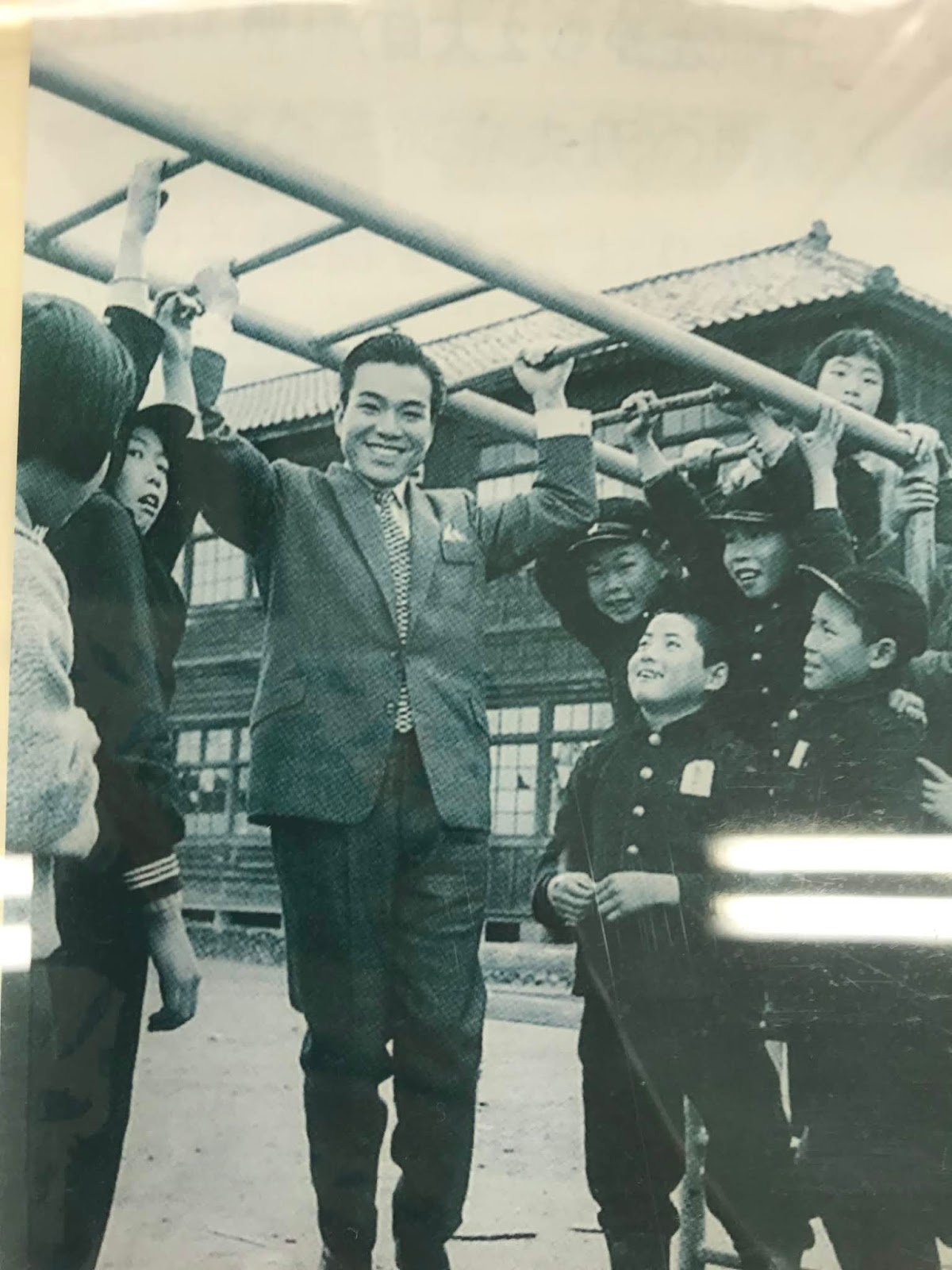
Yes, folks, the merry fellow you see hanging from the monkey bars was, indeed, Haruo Minami (三波春夫). He truly had a winning smile.
By the way, from now I will start referring to Minami as Haru-san from time to time as well. It's a fitting nickname I'd heard in a clip before, and I think it'd be more interesting to call him that alternatively than simply just Minami in my writings.
En route to Nagaoka
I had known about Minami's statue park from the time I discovered him, but visiting him wasn't really a concrete item on my list of things to do during my trip. It might seem odd considering what you all know about me by now, but I wasn't completely sure how frequent train service was on the Shin'etsu line running from Nagaoka to his hometown of Tsukayama.
But, of course, I eventually decided that I might as well give it a go as I don't think I'd have many other opportunities to visit Niigata otherwise (Minami or no Minami), so on one of the days in Tokyo, Mom and I took the shinkansen up to Nagaoka to check out Niigata and what of the Shin'etsu line. As it turned out, this local line does stop at Tsukayama moderately frequently - it was meant to be! ...This taught me to not be overly reliant on Wikipedia's train line information - there weren't many English sites with lesser known railway schedules like this, okay?
Anyways, having gone to Aizubange (Hachiro Kasuga's (春日八郎) hometown in Fukushima) and being impressed by being not so rustic as I thought it'd be, I suppose that gave me the not-so-realistic impression that Tsukayama may be more or less the same. Well, when we got there, it turned out to be what I had previously expected of Aizubange. It was very quiet and the facades of buildings had seen better days. However, it looked exactly like the villages featured on Channel News Asia's "Japan Hour" railway episodes, and it felt kind of strange (in a good way, of course) to actually be seeing it for myself.
And with it being Niigata, there were fields upon fields of rice with some plots being dotted by elderly farmers planting their crop. Up to that point, I had never seen how this Asian carb staple was farmed, so it was another first for this city kid. On the flip side, the farmers must be wondering what these two out-of-town folk were doing in a place like that. On another note, Tsukayama seems to be one of the hubs for the sports equipment company, Yonex. The juxtaposition of the occasional large factory blocks in the midst of old houses and rice fields was quite amusing.
Compared to the insane 45 minute hike it took to get to Hachi's museum,the 20 minute or so walk to this park was a breeze. But I would say my reaction upon seeing the one dubbed the National Singer standing on the pedestal was similar to seeing The First Enka Singer: Absolutely surreal.
It was the most realistic statue of a singer I had ever seen; his dimensions, that beaming and welcoming expression, the kimono. It felt incredibly bizarre looking up at it. It looked so real, it almost seemed like if I stared any longer, Minami would look down and say, "Hello"... That said, one of my perennial fears is for statues to animate and come after me, but this is one statue I wish would come to life.
Lyrics and melody of "Chanchiki Okesa" engraved in stone. Beside
is the music player.
Moving on, I have to say that this park was well put together. Besides the life-like statue and a little cherry blossom tree against the mountainous backdrop which forms a picturesque view, there are also a personal history plaque and some music plaques, at which you can play excerpts of 5 of his representative hits: "Chanchiki Okesa" (チャンチキおけさ), "Yuki no Wataridori" (雪の渡り鳥), "Tokyo Gorin Ondo" (東京五輪音頭), "Echiro Bon Uta" (越路盆唄), and "Sekai no Kuni Kara Konnichiwa" (世界の国からこんにちは). I believe the first I played was "Chanchiki Okesa", Haru-san's debut, to mark the occasion. Then I went on to play my favourite, "Yuki no Wataridori", and the rest of what was offered. As the music reverberated in this valley, I did look up at the statue a few times. Sadly, nothing happened.
Going on a tangent for a little bit: This was the first video I heard "Chanchiki Okesa" from. I don't know how but I didn't take notice of that first shot of him in his younger days at the very start of the video. Took me long enough (through the Marubell bromides) to realise how hot - I mean cute - I mean... nice... he looked back then.
KONNICHIWA, KONNICHIWA, NISHI NO - ARRGH!!
Coming back, as for my mother, she has come a long way since hating Minami. I remember she used to want to throw him into the dumpster - mind you, she didn't like Murata either, but dear Muchi only got the trash can. But she did eventually see merit in him through his versatility and crazy song fusions. Now she has done a complete 180. She even has a favourite song by him which she jumped at the chance to play at the park: "Sekai no Kuni Kara Konnichiwa". According to her, there was no better time than then to play this as we, being foreign fans from far off lands, have come to his hometown so it's fitting that he welcome us with none other than this apt ditty... ... Y'know, I like Minami a lot, and I agree with Mom, and this song is so him with how jolly it is, but I can't stand this song of his. It's just so infectiously annoying with the multitude of "Konnichiwas".
Okay, before the "Konnichiwas" burn a hole through my brain, let's continue. We had ekibens and juice bought at Nagaoka station for lunch at a strategically placed gazebo in the park. It was quite a comfortable place to take a break. But just be sure you have no trash to throw besides cans as there is no trash bin. We had to learn the hard way. Nearest proper bin was back at the station 20 minutes away.
Beside the park sat this firefly education center of sorts, which to my surprise, also had a little room that served as a museum space for this Tsukayama-bred talent. It wasn't particularly fancy, which was understandable as the main attraction is the statue park, and I was happy that there was at least a good number of Haru-san's artifacts on display, as well as pictures what seemed to be his entire discography. So I admired stuff like his calligraphy, movie posters (yes, he acted in stuff too), and old photos, all while lugging along a bag of trash.
And looking at his discography, Minami seemed to have sung an Ondo about essentially anything under the sun, from traffic safety to space to dinosaurs. Also, that pose for the cover on the left though... hmm.😕
What got the ball rolling. Also, how did I NOT notice it from this cover??? I must've been blind.
As for how Minami's typical style came about and how he became the first mainstream male singer to perform in a kimono, it happened that Mrs Yuki Kitazume (Mrs Minami) was the one who had encouraged him to do so. Y'know, one thing I noticed, as far as Haru-san and Hachi are concerned, their wives had a significant role in shaping their musical career. In that sense, I suppose the saying, "Behind every great man is a great woman" comes into play here.
Since he sang the theme to the Osaka World Expo in 1970, there was even a set of commemorative stamps with Minami on them!
I believe this was a gift he received on one of his anniversaries
in showbiz.
At the end of my round around the room, there was a section which featured the thoughts of school kids from that area on Minami, as well as a little trivia quiz to see how much one knows about him. I scored full marks... ... I... uh... don't know if that's good or bad.
That's a nice sketch!
At the end of it all, I was glad to have gone to Tsukayama. There weren't any trinkets I could get, but I did get a stamp in my notebook that included the statue. I also left my mark on the guest book. As we left, admittedly, I couldn't help but look back at the statue one last time.
To round this up, here is "Yuki no Wataridori". This song would be perfect if it were snowing. But then again, Niigata gets a tonne of snow and I don't fancy the idea of trudging through snow drifts for nearly half an hour.
Somehow, Minami, in spite of his refined mannerisms, could pull off a convincing ronin.
Well, that's 2 down, 2 more to go. The remaining ones are literally at opposite ends of the country though. I think the painted pikachu scream meme would fit in this situation.
At the end of the very first article I wrote about Hachiro Kasuga (春日八郎) on KKP 4 years ago, I featured this silly picture on google images of whom I thought to be quite a moderately stoic performer doing the "maru" sign. I was intrigued, and as the years followed I hoped to find it - possibly through a record or a video. And then in late April this year, I saw the grinning Hachi, and many, many other variations of him I'd never thought I would have the pleasure to see, face to face.
As mentioned in Part 2 of my Sugamo karaoke romp, there were some outstanding matters I wanted to take care of in Japan. Out of the those on my list, going to Kasuga's museum stood at number one, for reasons explained my recent articles on him, and also for fear that it might close before I got the chance to visit it - I got worried after seeing Yujiro Ishihara's (石原裕次郎) close down in 2017. It was also the first item crossed on my list as Mom and I visited it on our second day during this two week trip.
View from Nanukamachi, a town along the Tadami line we
explored before heading to Aizubange.
Hachi came from a little town in Fukushima called Aizubange, which sits towards the western end of the prefecture and not too far away from the neighbouring Niigata (another destination on this list on my to-do list). To get there (if you're coming from Tokyo), one has to take the shinkansen to Koriyama city, then take the local Banetsu line inland through farm country to the samurai town that is Aizuwakamatsu (where we stayed for 3 nights), AND THEN take the one-man operated train through more paddy fields on the Tadami line to finally reach your destination. I'd never train-ed so much in my life. However, the views of rolling rice plantations backed by snow-capped mountains, little hamlets, and occasion sakura trees in bloom were a rare sight and a feast for the eyes for a city kid.
To Aizubange
As per usual, my anticipation was at a all time high but overcompensated with an overly aloof demeanor as we sat on the virtually empty train to Aizubange. Playing with a mischievous Abyssinian Eagle Owl in an owl cafe at the quaint town of Nanukamachi earlier did little to satiate the excitement. This old lady kicking her feet up on the train seats was an amusing sight, however.
When at last at Aizubange's decent station that's more than just a lonely platform unlike some others, I was greeted by Hachi's statue outside, and that cool facade cracked. It's not the best statue of a singer I've seen, but it ain't the worst either. Beside the bronze memorial of him, you can listen to the first stanza of his debut "Akai Lamp no Shuressha" (赤いランプの終列車).
Contrary to my belief, the First Enka Singer's hometown was not as empty and quiet and old as I'd thought a place like that in the boonies would be. In fact, it was quite bustling and there were lots of children running around. But, of course, many still stared at us funny for being the only two foreigners there.
The train ride was only half of the journey. The other, if you were like us with no car, was by foot. Half an hour (at the minimum) by foot. I was very glad that it was a clear and windy day. I can't imagine trudging through these farm roads, albeit nicely paved, in the rain. Still, it was pretty arduous, and the rice field scene riddled with brand new tractor showrooms and the occasion sign pointing in the museum's direction got tedious after about 15 minutes. This train and hiking experience was reminiscent of the "Local Sen" (Local Train Line) series on the Japanese travelogue on Channel News Asia, "Japan Hour", wherein a pair of celebrities try to find attractions at towns along local lines around Japan.
Around 45 minutes later and after loops of a line "Inaka no michi wa tsuzuku mono" from Hibari Misora's (美空ひばり) song "Hanagasa Dochu" (花笠道中) going around in my head for the nth time and Mom trailing some distance behind me, I reached the museum. I know it sounds dramatic, but I almost wanted to run towards it when I was near.
Couldn't get the full tree, so here's part of the "Wakare no Ippon Sugi" sugi.
I saw the huge cedar standing tall amongst the shrubs and other trees in the park that housed the "Wakare no Ippon Sugi" (別れの一本杉) plaque. And every time someone steps near this plaque, the iconic enka starts playing and has the deep melancholic notes of acoustic guitar reverberating throughout the countryside. Just as I was about to reach the tree, I heard my mother exclaiming over something, and almost immediately after, a huge tour bus emerged from nowhere and pulled into the building's nearly empty parking lot. By golly, I didn't know local tour groups stopped by Hachi's memorial hall! There I was thinking that we'd be the only ones there! I was shook.
Unfortunately, the plaque's lyrics weren't painted in, so they were
hardly visible in the afternoon sun.
I made my way to the plaque to get a good look at the plaque and a good listen to the song before the swarm of elderly came. It didn't take long for them to realise that I knew Hachi and one of his hits, and as much as I wanted to go into the museum ASAP, I was stuck outside for a while and subjected to the usual muddled interview of what a Singaporean was doing in a place like this. At least I got to train my Japanese listening skills.
Anyway, on to the actual attraction. The building wasn't huge but it was well put together and spacious. From what I had seen from older pictures of the museum, its orientation and presentation of the items had changed for the better. The first section you'd see upon entering contains the singer's brief history on a plaque, his personal artifacts, his well-loved instruments, awards, song sheets, fan magazines, and photos of him with his family and other celebrities, among other miscellaneous things.
As expected, Michiya Mihashi (三橋美智也) was in quite a number of shots with Hachi - both were in the same record company after all. Others big names he was with included the legendary Masao Koga (古賀政男), Misora, Minoru Obata (小畑実) and Ichiro Wakahara (若原一郎 ).
One of the lyric sheets on display. This one is of "Nagasaki no Hito" (長崎の女).
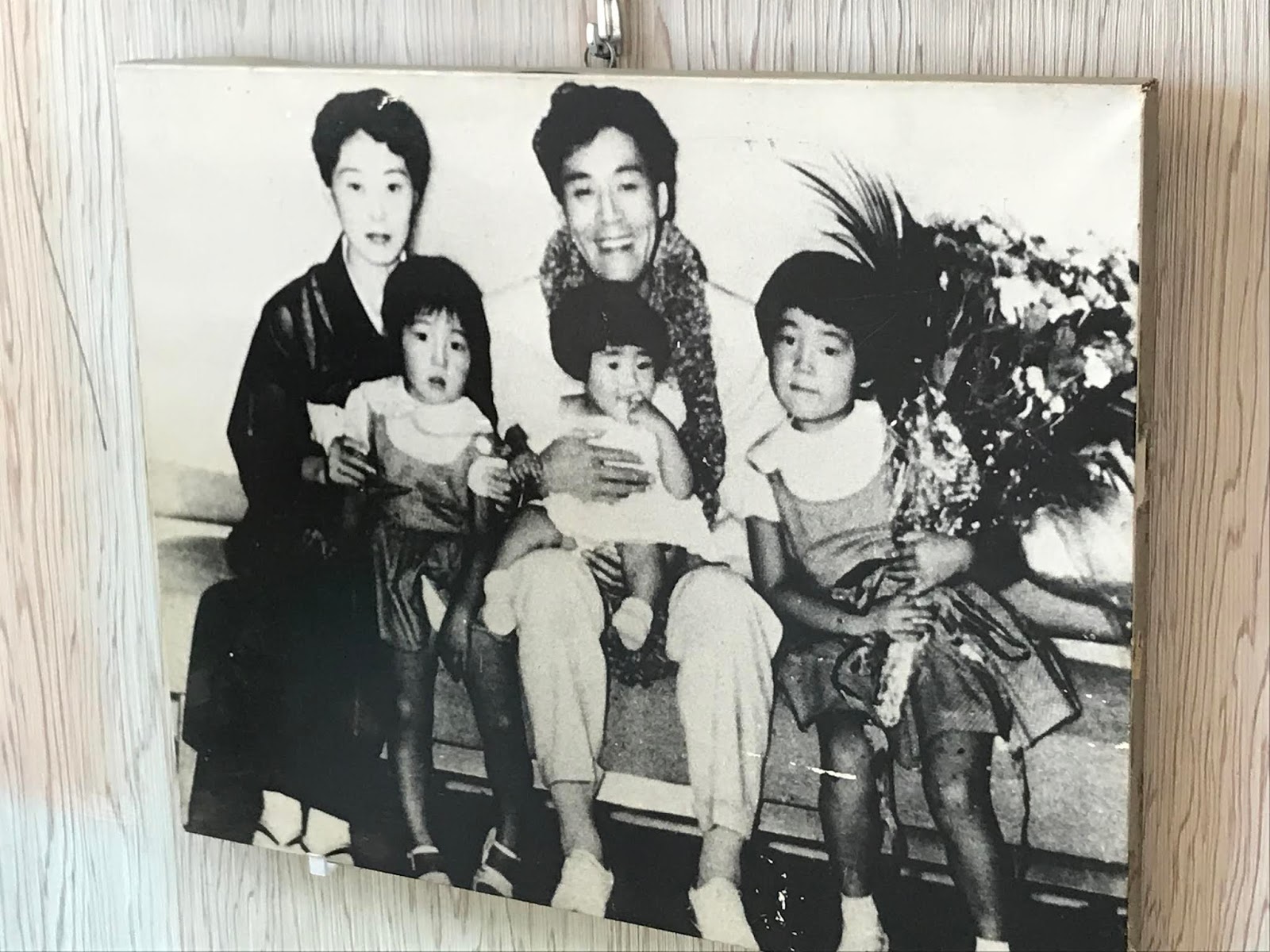
Here we have Kasuga with his wife Keiko Watabe, who played a big role in kick-starting his career - basically, without her, there'd be no "Akai Lamp no Shuressha" or Hachi... Thank you, Mrs Watabe - and 3 of their 4 daughters. The eldest, seen on the right above, Nobuyo Watabe (if I'm not wrong), served as her father's manager in his later days.
According to the curator, Ms Watabe was to visit the museum later in May... I missed a chance to meet the person who would be as close as I can ever get to meeting Hachi himself - all the more so because she looks very much like him - by a few weeks. I AM ANGERY. Well, the curator said she'd mention our visit to Ms Watabe when she visits, and I did put my name down in the guest book, so I suppose I have that. Can't have the cake and eat it too, even though I wish I could. >:(
Anyway, those booklets in this picture here were his fan club magazines, "Mikasa". The cover that had him next to Mrs Watabe at the lower left corner had a smaller picture of him sitting in a corner showering. Considering that his fan base was predominantly women in his younger days, that's fan service if I've ever seen it. Speaking of fan service, there was also Hachi in swim trunks spear fishing (?) at the top left corner, and sitting atop his trusty piano was an extra candid photo of him in an undershirt and boxers.
Well, OK then.
When he received the purple ribbon (circa 1989) - one of the honors
for someone who had contributed a great deal to the arts in Japan.
With Yuriko Futaba, Muchi, Batayan, Michi, Peggy Hayama.
Needless to say, I love this picture.
The wall adjacent to all that featured more interesting photos (like the one at the top of this article), concert and movie posters, and records.
Apparently Hachi could walk on stilts. It baffles me as to how one can balance on such sticks.
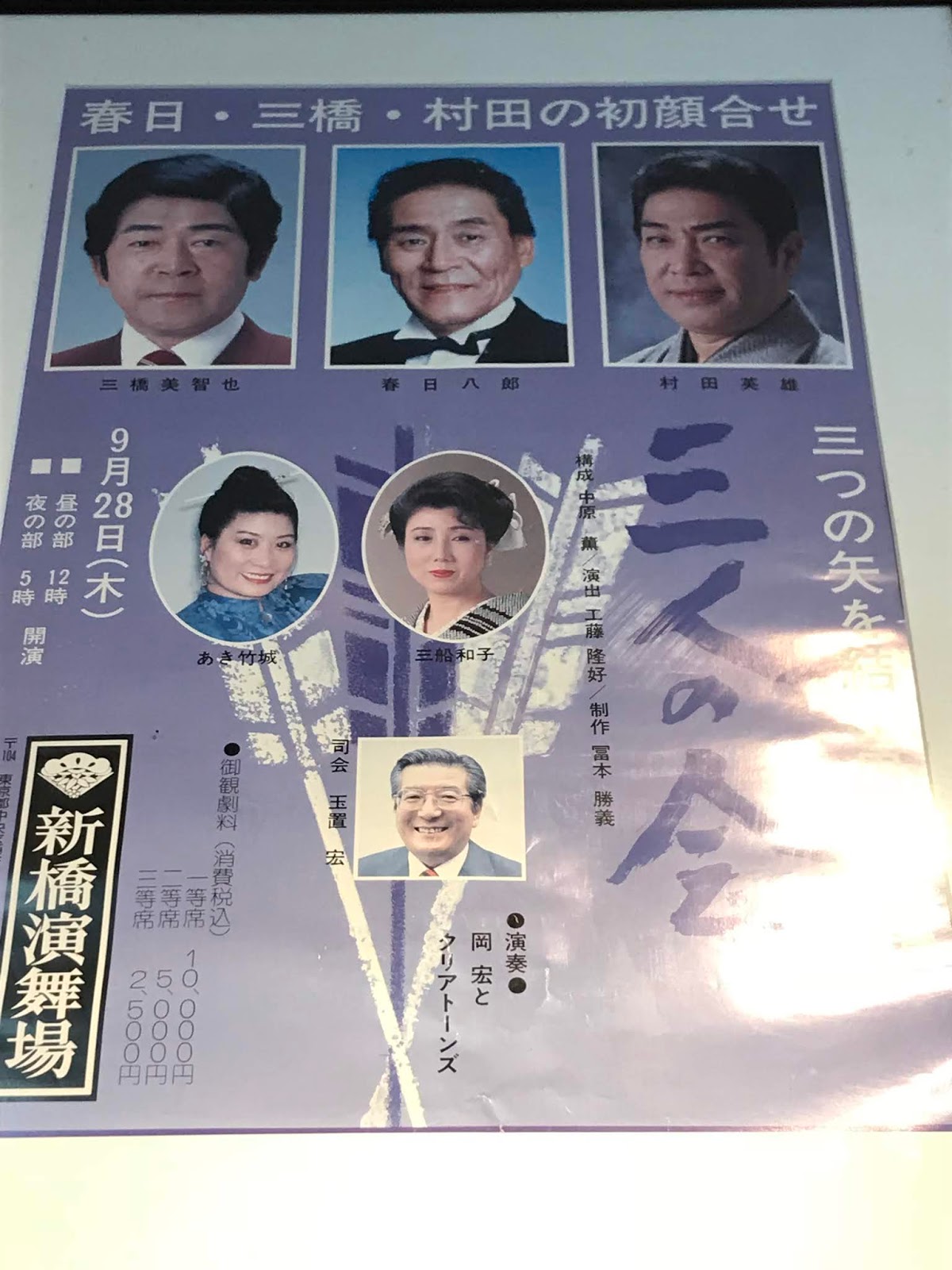
There were the Sannin no Kai posters up on display too! It's like getting a 3 in 1 in this museum! I know this wasn't Yuzo Kayama's (加山雄三) museum, but "Shiawase dana...."
I got my hands on the middle one via Miyada Records.
Sitting square in the middle of the museum was its merchandise shop which sold both Hachi merchandise, as well as local knick-knacks and food. Next to that was the karaoke section with a little TV playing original karaoke videos of a good number of the enka singer's works. Anyone can go up to have a go at their favourites; "Otomi-san" (お富さん) was the go-to choice for everyone.
I didn't exactly have any intention to sing, and at the same time was rather self-conscious, so I initially declined when first offered to pick up the mic. However, when the tour group left and we were the only ones left, I decided, "Why not? Since I'm at the place, I might as well do so." I took this opportunity to try out some of Kasuga's songs I had always wanted to attempt, like "Nigate Nandayo" (苦手なんだよ), "An' Tokya Doshaburi" (あん時ゃどしゃ降り), and of course, "Akai Lamp no Shuressha".
When it came to "Akai...", much to my surprise and slight horror, another full group of local tourists came in just as it started - the human traffic coming in and out of this place was far more than expected. Oh, the pressure was intense, but I think I pulled it off pretty well. When I saw the happiness etched on to the faces of these old folks and hearing them sing along with me... I don't really know how to describe how I felt at that moment. It differed greatly from my Sugamo stints - it was more emotional here than the simple highs of pride and unbridled joy I got in Tokyo.
For me to sing the debut song of one of the key foundations in enka in his very museum; to have relayed it to his fans who saw him as their youth and get their seal of approval; to show that old enka like this is far from being forgotten... I guess I felt... very, very honored to be in that position. It was truly an incredible feeling that I'd never felt so strongly until then.
Well, moving on, I couldn't leave the place without any merchandise (it'd be a crime if I did), so I got a surprisingly modern-looking T-shirt with a caricature of Kasuga on it, as well as a couple of key chains, including one that had his autograph. What impressed me was that the items were all very well-stocked despite being in such a far flung area. I suppose with all the tour groups coming for a look-see, it has to be. In fact, the moment we arrived, so had the new stock! Take that, Takashi Hosokawa (細川たかし)! ... ... I'm sorry, Hosokawa... I mean, you've got senbei with your name on it...? 😌
When all was said and done, it was near closing time. Having heard of our trek all the way out into the countryside, the curator took pity on us and decided to give us a quick ride back to the station before the scheduled train arrived. Earlier, I talked about the segment on the show "Japan Hour", well, hitching a ride from kind locals was what always happened in most episodes, so we did indeed have the full "Japan Hour Local-sen Experience" all in one day. I am eternally grateful for this lady for saving us the hassle of calling for a cab and for shortening our journey back to the station by 40 minutes.
Compared to the other museums I had been to thus far, Hachi's definitely felt the most surreal and dreamlike to me. Perhaps it was the combination of being in such an environment I had only seen on TV, standing in the memorial hall of a singer I'm absolutely crazy about, and that intense karaoke bit with his fans. I remember that after the immediate euphoria of entering the building and snapping photos, I actually had to take a breather to actively remind myself that I wasn't dreaming.
Needless to say, after all the travelling the day before and the amount of activity done on this museum pilgrimage, I felt like a piece of tofu on the following day. But it was all worth it.