I've been a fan of Japanese popular music for 40 years, and have managed to collect a lot of material during that time. So I decided I wanted to talk about Showa Era music with like-minded fans. My particular era is the 70s and 80s (thus the "kayo kyoku"). The plus part includes a number of songs and artists from the last 30 years and also the early kayo. So, let's talk about New Music, aidoru, City Pop and enka.
Credits
I would like to give credit where credit is due. Videos are from YouTube and other sources such as NicoNico while Oricon rankings and other information are translated from the Japanese Wikipedia unless noted.
Showing posts with label Michiya Mihashi. Show all posts
Showing posts with label Michiya Mihashi. Show all posts
Hello! It's hard to believe that we're in February already. I hope this new year's been going well for you guys.
I, though, didn't have the best start to 2026. I'd come down with a horrendous case of the flu since New Year's day. Perhaps it was all the residue fatigue from 2024 and stressors of 2025 compounded with a particularly serious flu season this winter, but I was put out of commission for almost two weeks. My sinuses were the main source of grief; that in turn caused my ears to become rather sensitive, so much so that I couldn't stomach listening to music. The dynamic rhythms and the emotive voices of the singers I ordinarily listened to caused me discomfort. That's saying a lot, because I can't remember a day where I didn't listened to a single song. It was two kayo-less days before I finally had the desire to listen to something. This song was Michiya Mihashi's (三橋美智也)Muteki (Fog whistle).
Yes, onlyMuteki.
Muteki is an 80's enka written by prolific lyricist Hiroshi Yokoi(横井弘) and composed by Toshiyo Kamata (鎌多俊与). According to the J-Wiki, it first surfaced in Michi’s 1982 album, Furusato Zessho (ふるさと絶唱), before being sold as a single in December 1983. Admittedly, I came across this just a few months ago while sampling as many of the Toshi-san-composed Michiya bushi (みちや節). Based on the comprehensive discography in Hiroshi Ogino’s (荻野広)Michiya Mihashi: Sengo kayo ni miru Showa no sesou (三橋美智也: 戦後歌謡に見る昭和の世相), Muteki seemed to be their final collaborative piece.
As for why I could stomach this singular song (I must've listened to it at least 6 times on the day I broke my music fast), it's because it's an extremely easy-listening enka. Toshi-san's melody of a medium-ish tempo is pleasantly jaunty, yet not too intense; the plucky notes of the acoustic guitar and whistling flute making it lively enough. Even the dramatic segments were arranged in such a way that isn't too jarring while still working as intended. Later-day Michi's more subdued delivery still holds a level of despondence that carries the sadness within Yokoi's story - that of an ill-fated pair whose tragic love story began at a foggy wharf. Every aspect of Muteki just melded together so seamlessly, ill me could enjoy it without a shred of discomfort. Even after recovering, I still listen to Muteki fairly frequently since it fits almost any mood I'm in. I guess I found my kayo equivalent to chicken soup, although I wouldn't have foreseen it being a Michiya bushi.
Summer’s almost over - or, technically, it should be but the extreme heat over here in Japan is saying otherwise. Over in the Kanto area, we’re still getting highs of 36-39 degrees (Celsius), and being Southeast Asian is no longer a buffer against these insane temperatures in this country. And so, I decided to go north (again) to cool off for my summer break.
It’s been about a decade since I last visited Japan’s northernmost prefecture of Hokkaido, and I’d never been to its southernmost major city, Hakodate. My parents, having been there fairly recently, had said good things about this quaint, historical locale and its sumptuous seafood, so I thought it was high time I paid it a visit. But, you know me, my vacation choices within Japan are governed by one thing: the presence of anything kayo-related. Hokkaido is one of the most enka-centric locations, and Hakodate alone has connections to the venerable Saburo Kitajima (北島三郎) and prolific lyricist Kikutaro Takahashi (高橋掬太郎). However, there was one figure from that area in particular whom I wanted to "see": Michiya Mihashi (三橋美智也).
Hi, Michi
I tend to choose flying for their short durations when I travel domestically (it's actually cheaper too), but this time, I specifically chose to go by bullet train. Why? Because I wanted Michi to welcome me to Hokkaido.
The 北海道 Man
Mihashi, hails from the town of Kamiiso (上磯郡), which is now under Hokuto City (北斗市) jurisdiction. Thus, a memorial plaque dedicated to the legendary min'yo kayo singer had been constructed outside the Shin Hakodate-Hokuto shinkansen station in late 2015. Additionally, a chic painting of the man strumming his shamisen decorates the brick-lined walls at a rest area within the station. Seeing those dedications to him upon setting foot in Hokuto, it felt as though I were reuniting with an old friend, and nostalgia hit me like a Hakodate-manufactured brick.
Because I had planned for this to be a Michi-centred* trip in terms of oshikatsu, part of the prep had included digging for Mihashi tunes which were Hokkaido or, at least, north country-themed. In the process, I uncovered Fuyu no Hanabi (Winter Fireworks). Fireworks, as far as Japan is concerned, screams summer, what with all the massively extravagant fireworks shows in August nationwide. But there's also "winter" in the title, which conjures up frigid conditions and snow-blanketed streets. Hokkaido/Tohoku generally is far cooler than most regions in the country, and I was going there in summer.
Fuyu = Winter = Cold/Cool
Hanabi = Fireworks = Summer
Fuyu no Hanabi? Cold place in summer?
... Yes, I'm aware of how ridiculously thin I was stretching my imagination, but it was a fine song I wanted to bring to Hokkaido, so I rolled with my half-past-six logic.
Fuyu no Hanabi was released on 15th October 1982 as the B-side to Echigo Zessho (越後絶唱). This single was meant to mark the 30th anniversary of Michi's professional singing career, and its sales allowed Michi to become the first Japanese singer to hit one hundred million in record sales, according to the J-Wiki. An incredible milestone indeed.
Looking at the titles of both songs, they do radiate ENKA, don't they? But doesn't Echigo Zessho just feel more like an enka A-side and looks right as the fronting tune to this single? Michi, in recounting the production process of this single in his autobiography Michi no Jinsei Enka (ミッチーの人生演歌) (1983), mentioned how he liked Echigo Zessho from the get-go, being in a buoyant mood during its recording and even assuming it to be the A-side. However, unbeknownst to him, it was Fuyu no Hanabi, which had been recorded earlier, that had been set as the A-side. After much discussion, Michi's insistence won out and the song order was switched to what we see now.
Having listened to both, I thought both were pretty good enka and I'd be fine with either being the lead song. But I'm a bigger fan of Fuyu no Hanabi. The lyrics were written by Hiroshi Yokoi (横井弘), one of Michi's long-time collaborators. Yokoi painted a picture of a snowy hot spring town deep in the mountains in the midst of a winter festival. Our protagonist arrives by steam train (of course) after a long journey, and he searches high and low for the one that got away ages ago, hoping to make things right. But this is enka, so of course his efforts are in vain and he feels nothing but regret and sadness. Michi's voice is, to me, usually cold and hollow-sounding, so it certainly amplifies the despondence of the protagonist feels here.
Classic enka storyline aside, it was the music that got me hooked. Toshiyo Kamata (鎌多俊与) was responsible for the pop-like melody with a funky rhythm. The rhythmic guitar rifts, however, are my favourite part as they feel reminiscent of snow swirling in the wind and falling heavily. This, combined with the dramatic strings, seem to articulate the protagonist's anxious yet hopeful state of mind in his search.
The winter imagery in Fuyu no Hanabi was a good enough fit for my stereotypical view of Hokkaido, and so it was a tune that was constantly in my ears during my whole trip there. It was undoubtedly cooler than Saitama, being around 8 to 10 degrees lower in general. But instead of snow, I got rain. A lot of rain. That photo of Michi at the very top is a fairly good visual of what it was like to walk around town on most of the days, but I was certainly less composed as I fought the wind and horizontal sheets of rain that came with it. That said, it was still an enjoyable trip and I would revisit Hakodate. I reckon that if I were to head there again during winter, Fuyu no Hanabi would been even more fitting.
Say "Cheese"!
During my tour of the Hakodate region, which included a stop at the town of Esashi, I was predominantly listening to Michi songs, something I hadn't done in several years. I mentioned the nostalgia upon "meeting" Michi earlier, but it actually also came with a hint of sadness and even guilt for practically almost forgetting about him for a very long time. This trip, while mostly meant for me to completely shut out the stressors of school and work for a bit, had helped me to reconnect with the singer I used to admire greatly. And that only took me, like what - 8 years? Better late than never, eh, Michi?
I'm trying to imagine another time line where, at that fork in the road about 8 years ago, I chose Michi over Hachi (Hachiro Kasuga... 春日八郎). I think things would've turned out quite differently. Then again, it may turn out more or less the same, just with a different fellow.
* I say "Michi-centred", and for the most part that is true, especially in terms of the music aspect. But the photos I brought along included Hachi and Muchi. Admittedly, I didn't have the confidence to tote "just Michi" photos yet. I still needed my support Hachi.
Having hung around staunch Hachiro Kasuga (春日八郎) fans and overheard opinions from Michiya Mihashi (三橋美智也) fans, it seems that while there are folks who embrace both of the twin pillars of King Records' golden era (1950s) equally, there are others who are quite clearly either Team Hachi or Team Michi for one reason or the other. I don't know how clean this division actually is, or how intense the fan rivalry is. The current Hachi and Michi posthumous fan clubs often collaborate in this era where early Showa artists are fading into obscurity and dwindling membership. So, on an official fan club level, at least, it's fairly harmonious. But I wonder if that wasn't necessarily the case in between the 1950s and 1990s. What if it was like the classic Hiroshi Itsuki (五木ひろし) and Shinichi Mori (森進一) fan rivalry? Now, that one was intense.
As you may have known by now, I am Team Hachi. But with the added nuance that I still enjoy Michi stuff on occasion and acknowledge that the min'yo star has strengths that my Hachi lacks. Recently, I've picked up a Michi biography literally titled Mihashi Michiya (2015) by Michi scholar Hiroshi Ogino (荻野広). Admittedly, my main prerogative for doing so was research, but I figured that it was high time I set aside my biases and learn more about the man who was closely associated with Hachi. After all, before Hachiro Kasuga stole the show, I was mesmerized with Michiya Mihashi.
I say "biography", but half of Ogino's piece may as well have been a research paper with its fairly in-depth Michi song analysis. To understand Michi's success, Ogino did a lyric comparison between Michi's tunes and hit Showa kayo against the backdrop of Showa era history. I love stuff like this, so it was an insightful read. He featured both the min'yo man's greatest hits and shone the spotlight on countless gems buried by the sands of time, giving them the attention they deserve or at least an acknowledgement of their existence. As someone who tried doing this in her Hachi thesis, I can only say that Ogino must care greatly for Michi. Ogino also provided Michi's full discography as an appendix, which I happily scanned through and investigated entries that piqued my interest, of which there were several.
I completely forgot that Michi's disco phase (late 1970s) churned out the disco version of Tassha de na (達者でナ), renamed Bye Bye Horse; I didn't know he had something that may as well have been a theme song to a cowboy flick, Tokyo no Hato (東京の鳩... Tokyo Pigeon/Dove), or had an ominously moody tune that began with a pained, "BAKAYAROOOOOO" (Ganpeki no Otoko (岸壁の男)... Man by the Cliff). I always make it a point to say that Hachi was a singer who could sing anything, but I failed to realise that Michi was actually not that different in this respect. My apologies, Michi. Considering how Mihashi's stylistic range was far wider than I had once thought, though, a rock kayo shouldn't have surprised me, yet Cho-cho to Kakashi (The Scarecrow and the Butterfly) had me raising my eyebrows.
Cho-cho to Kakashi was released on March 1970 as the B-side to Kimi Yobu Machi (君呼ぶ街). Its lyrics were written by Hiroshi Nagai (永井ひろし), and was composed by Tadaharu Nakano (中野忠晴) ... ... ... ... Okay, you caught me - this was the reason I looked up this song. But, you see, Nakano had passed away in February that year, so this makes this tune the last piece Nakano wrote for Michi, released posthumously (so, of course I'd want to hear it). Mr. Nakano composed way more for Michi than Hachi - over 40 Michi entries, as opposed to about 20 Hachi ones. The few I've heard up till then (the hits) sounded "Michi-like", wherein despite Nakano's main arranger Masao Ueno's (上野正雄) funky arrangements, they still felt like they followed Michi's min'yo vocal contours fairly closely. Therefore, that's what I expected with Cho-cho to Kakashi.
To me, just the title itself seemed to suggest that it could be a more traditional Japanese-sounding piece - it even had me in the first couple of seconds with the hyoshigi (wooden clappers), something I'd hear in kabuki-themed tunes. Instead, Nakano made a fun rock-inspired melody, the metallic twang of the electric guitars strumming to the brisk beat of hollow bongos has echoes of the ereki and GS booms of the mid-to-late 1960s. It feels kinda Beach Boys-esque (I think?), and for some reason, also reminiscent of those quirky anime openings from the late 2000s. Michi sang it in such a breezy manner that I couldn't imagine anyone else singing it.
Now, what is Michi singing about in Cho-cho to Kakashi? Nagai's narrative introduces the titular butterfly and scarecrow. The butterfly has took off to the city... by train. The scarecrow wants to follow, but is stuck (in the fields), having but one leg. And so, it can only stand by its lonesome near the train station. Days go by, and it eventually grows weary and despondent with no sound or sight of the butterfly, but continues to wait. I think it's safe to say that Nagai's scarecrow is an allegory for a countryside folk who, for one reason or another, is unable to follow their beloved, the butterfly, who left for the city for one reason or another. A classic example of the bokyo kayo variant, a zanryu mono, to borrow bokyo kayo researcher Hidetada Fuji's (藤井淑禎) terminology.
Meaning songs of those "left behind", zanryu mono focus on the family, lovers, friends, etc. of those who left the countryside for the cities for work during the postwar mass employment movement (approx. 1954-1973). Usually depicted are their pining for those who'd left, hoping they'd soon return, or bitter because they had left. This (sub)genre experienced peak popularity in the late 1950s when urban migration was going strong and aforementioned scenes were commonplace. Michi seemed to have been best known for these zanryu mono type stuff, sometimes called furusatomono/kayo. Oddly enough, Hachi was known best for the reverse, shukkyo mono (songs of those who left).
While this work-induced urban migration slowed by the 1970s (due to several reasons including factories opening plants in the countryside), it still occurred. By this point, it was usually farmers from Tohoku who temporarily left their homes during winter to eek out a living since agriculture was not an option with heavy snowfall. Also, I'm fairly sure there were an even greater number of youngsters who wanted to escape to the glamourous cities. So, I can see why the bokyo kayo themes from days of yore still pop up at this time. Also, there's the whole "bokyo kayo is a main strand of enka" thing which gained great traction in the 70s, which may have enabled something like Cho-cho to Kakashi to still be produced in the 70s.
I'm glad I read Ogino's Michi biography. Hachi will always still be the superior one in my heart, but my appreciation for Michi has grown tremendously after the read. I think I'm finally ready for that trip to Hakodate.
P.S. Just so you know, Tokyo no Hato and Ganpeki no Otoko were also Nakano compositions. Yes, I was sifting through the Michi discography for everything Nakano-related. It's most effective way to get me to listen to stuff I ordinarily wouldn't listen to, okay!
One of the first things that I learned about Japan as a high school student was that the nation was very resource-poor. A lot of the raw materials needed for manufacturing had to be imported. But I gradually came to realize that the Japanese still had a mining industry for various minerals within their own nation for centuries which included coal. I didn't have to look up anything (although I did read some of the "Mining in Japan" article on Wikipedia) to know though that coal mining was difficult, dirty and dangerous just from what I knew about the industry in North America.
As has been the case with other industries in Japan such as woodcutting and fishing, mining has also had its kayo kyoku representation. I've already posted on one min'yo titled "Tanko Bushi"(Coal Mine Melody) via Minyo Crusaders and the famous Michiya Mihashi(三橋美智也). And just recently, from watching an episode of NHK's "Shin BS Nihon no Uta"(新BS日本のうた), I found out about another Mihashi tribute to coal mining, "Oira Tankoubu" (We Are Coal Miners) that was released in 1957, about a year following his version of "Tanko Bushi".
Written by Hiroshi Yokoi(横井弘)and composed by Hachiro Konoe(近衛八郎), under the pseudonym of Toshiyo Kamata(鎌田俊與), "Oira Tankoubu" has, for a lack of a better word, a rather industrious melody although not quite as cheerful as the legendary "Heigh Ho". There's a certain swagger in Mihashi's vocals (even some min'yo exhortations) as well, and in combination with Konoe's music, the message seems to be "We don't look too great, we don't smell too great but we are doing great...for Japan's economic boom".
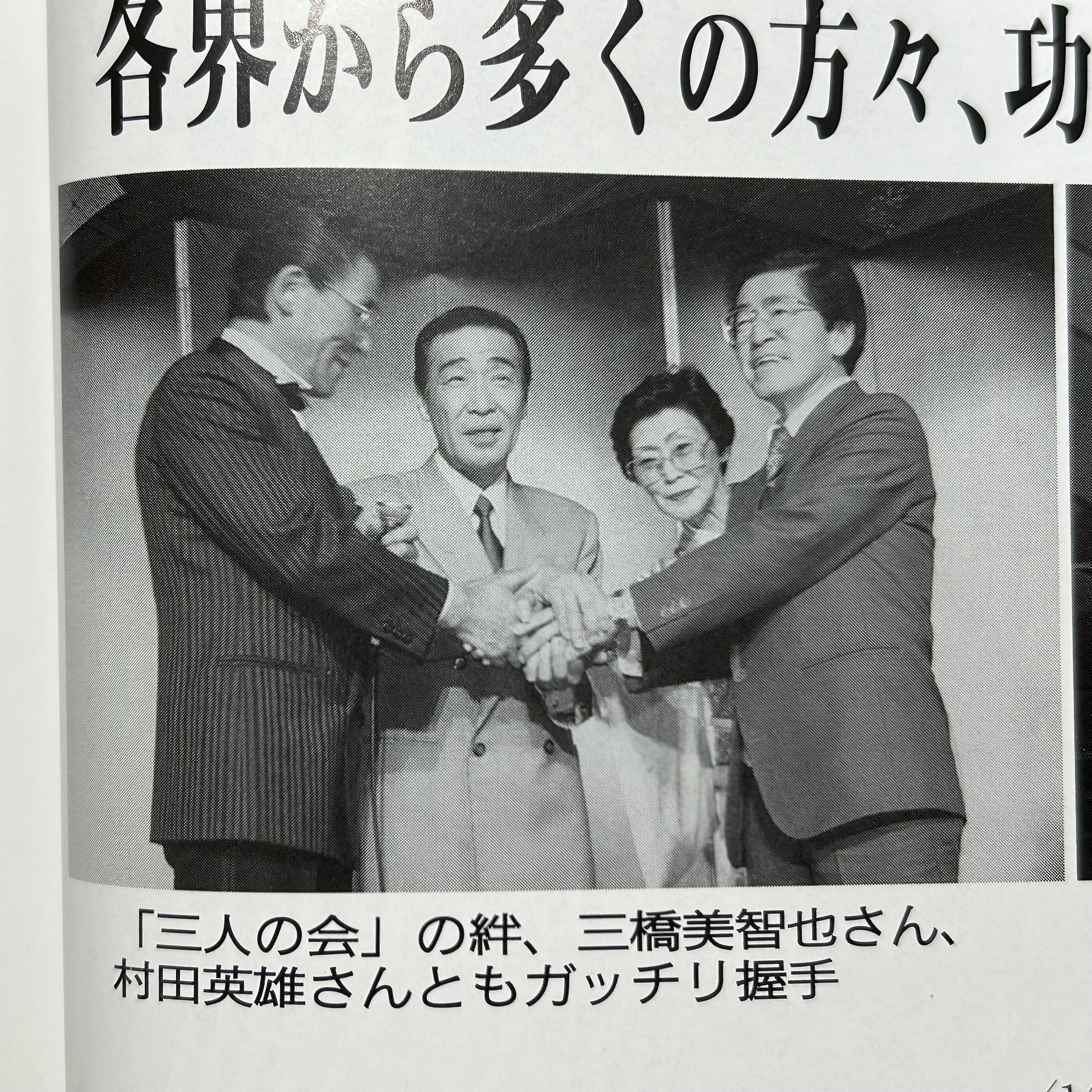
For the final piece of my Hachiro Kasuga (春日八郎) Centenary project, I would like to end with a piece on the Sannin no Kai (三人の会... Group of Three). I thought that this would be the perfect end since it was one of the singer's last enka activities and the trio was the reason I got to know Hachi in the first place. In fact, you may be able to trace my Hachi discovery via Sannin no Kai right here on KKP!
From Shinobu
The very first time I encountered Hachi was via a video of what was perhaps the intro to what I now know as the Sannin no Kai Concert somewhere in 1989 (if I'm not mistaken). Back then, I only knew rokyoku artist turned manly enka star Hideo Murata (村田英雄) and loved his shogi-themed hit Osho(王将)*, which made me give that video a watch. Little did I know that he and the two other singers were doing a mochi uta exchange where they sang each of their most significant hits. Murata sang Aishu Ressha (哀愁列車). Min'yo master Michiya Mihashi (三橋美智也) in an eye-popping pink kimono and yellow hakama set sang Akai Rampu no Shuressha(赤いランプの終列車). Finally, with bushy eyebrows and dressed in a tuxedo was Kasuga making a grand entrance fitting for Osho. Yet, I did not like the way he handled Osho. It just wasn't right. His presence was also not particularly outstanding, which was ironic considering he stood a head above his compatriots. With such a view in mind, 2014 Noelle watching that clip would not have envisioned that she would choose the one she thought was the most boring.
The mochi-uta exchange I watched ages ago.
So, what made made three of the biggest stars of the enka-kayo world join forces? Well, for one, they were already pretty good friends. Then, it just so happened that some time in the late 1980s as they were hanging out, Muchi broached the idea of joining forces to breathe new life into the twilight years of their careers and the enka realm. His seniors** gladly agreed, and thus the Sannin no Kai was formed with the goal of "enka no fukkatsu" (the revival of enka). The first concert they organised was in 1988 and held at a hotel owned by Michi. The subsequent concerts in 1989 and 1990 were led by Hachi and Muchi respectively.
During these concerts, the fellas unveiled a couple of new collaboration songs: Aishu (Sorrow) and Otoko no Furusato (A Man's Hometown). These were released as physical singles in 1991, the former before Hachi's death, the latter after. Both had their lyrics penned by Muchi; Michi took charge of composing Aishu, while Hachi did Otoko no Furusato. True to the group's constitution, both have that distinct enka sound derived from usage of the yonanuki scale. Aishu took the minor scale route, making it sound slightly melancholic atmosphere, while Otoko no Furusato took the major scale, giving it a masculine and powerful punch. The first I encountered and the only one of the two that's available online is Aishu, thus, it will be the one I feature today.
I remember freaking out upon encountering the blurry video of Aishu. I mean, how often do you get a trio of legendary artists in the kayo world doing songs where each of them have their own part? Despite the plaintive melody and title suggesting a sad time, Aishu paints a little picture of each of our fellows in each stanza. A cliff notes version of Hachi, Michi and Muchi, if you will. First up is Hachi, the man from the village at the foot of Mt. Bandai (Fukushima) and who rose to prominence by walking the path of enka. Then we have Muchi, the Kyushu native raised by the Genkai coast and who prides himself as the purveyor of manly songs since the beginning of time. Finally, we have Michi, toughened by the harsh winters of the north and who sought his musical future in the land of apples.
I talked about the Sannin no Kai and Aishu in the final part of my thesis. There, I brought up how only Hachi's part included the buzzword "enka" and enka being his life work. This made me wonder if Murata was cognizant of his buddy being heralded as enka's top figure and wanted to pay homage to that in this song. It may also have been that Hachi had a say in it too, considering he is the most senior (in age and kayo world experience). Either way, despite the fact that all three fellows are deemed as enka veterans by the late 80s, there was likely a common consensus even among themselves that it's Hachi who is the enka man. That, I argued, reinforced Hachi's "Preeminent Enka Singer" (Enka no daiichi ninsha) image that was developed over a decade prior. As I'm writing this article, I've now also noticed that Hachi's part also had the buzzword "furusato", something integral to the Bokyo Kayokyoku/Enka (Homesickness Song) genre. Hachi is often also considered the forerunner of Bokyo Kayo-Enka, so I wonder if Murata also gave a nod to that with the aforementioned term.
From Mikasa
The Sannin no Kai were probably every enka-kayo fan's dream team turned reality - it certainly is one of mine! My favourite part about the Sannin no Kai is seeing each of the member's different personalities. From the videos I've been seeing, what I've noticed is that Murata gives off fearless responsible leader who cares for his compatriots deeply. Michi, while seemingly withdrawn, is actually quite wild and very loud. Hachi, despite his status among them, seems the most laidback and speaks in lowercase (by that I mean he mumbles). It's really enjoyable to see them bounce off each other so naturally. So, it was heartbreaking to know that it lasted a mere three to four years. Hachi was the first to go in 1991, followed by Michi in 1996, leaving Muchi to power on in memory of his buddies until his death in 2002. That said, it was even more heartwarming to know that the three enka veterans had great fun working together while trying to keep alive the genre they hold dear.
* I can't believe it's been 10 going on to 11 years since I wrote my first articles on Hachi, Michi, and Muchi!
** Michi, while a year younger than Muchi, joined the pop music business earlier, hence making him Muchi's senior in this respect.
P.S. I very recently attended the Hachi fan club's new year gathering, the Shunyo no Tsudoi (春陽の集い). It was great fun meeting more members of the club and other figures affiliated with Hachi. I had to do a number of name card exchanges (as is common practice here, at least), and one of such figures did not bring his name card. So, as an alternative, he gave me what I can only describe as a piece of treasure in exchange for my flimsy old name card. I was dumbfounded to see Hachi, Michi, and Muchi smiling back me on the pristine telephone card you see above. Perhaps it was because I mentioned that the Sannin no Kai was how I had my fateful encounter with Hachi that this person insisted I have this card. If you haven't already noticed, the guys are wearing the exact outfits as they did in that mochi-uta exchange I watched. Seeing it reminds me of where I first began and how far I've come since then, so this telephone card means a lot to me, and I am extremely grateful to have been gifted it.
Quincy Jones (1933-2024) from the LA Times via Wikimedia Commons
Now that I've put up a rare Monday Reminiscings of Youth article just now and I'm going to do the same here, people must be wondering why I've gone all ROY on KKP. Well, one excuse is that it is a national holiday in Japan known as Culture Day. I don't usually include Japanese national holidays when I do the special holiday version of ROY, but for today I'm making an exception due to the passing of a couple of music figures in my life.
I've already posted one on singer Jack Jones and now we have here a tribute to Quincy Jones, one of the most prolific and successful songwriters and music producers the world has ever known. His file on "Kayo Kyoku Plus" is already fairly large thanks to entries such as his phenomenal 1981 album"The Dude" and his collaborations with Michael Jackson, including the album "Thriller".
Jones had already been in the music business for several years since the 1950s when he released his first single in 1962, "Soul Bossa Nova". Sound familiar?
If it does, you are probably one of the many folks who caught any of the "Austin Powers" movies with Mike Myers. One couldn't have asked for a more Swinging 1960s tune to accompany the British spy and his fellow dancers. The give-and-take between the flutes and the horns is truly groovy, baby!
Probably, though, for a lot of us Canadians, hearing "Soul Bossa Nova" as part of an "Austin Powers" movie was nostalgically surprising than revelatory. That's probably because we had heard it before...as the theme for the Canadian game show "Definition" with Jim Perry throughout the 70s and 80s. I certainly had no idea about what the title was and what its pedigree was...just knew it as the theme from "Definition" and it was probably the biggest thing that I can remember about the show.
According to Wikipedia, "Soul Bossa Nova" was also a track on Jones' 1962"Big Band Bossa Nova" album and apparently it took no more than twenty minutes for the composer to whip up. I had no idea that Lalo Schifrin, the master behind the themes for "Mission: Impossible" and "Mannix", was the piano player on "Soul Bossa Nova".
I know that Jones left this world a very elderly man at 91, but it's still a big void that he's left in music and we can be grateful at least that he's left this huge legacy of music from movies, television and the recording booth. My condolences to his family, friends and millions of fans.
"Soul Bossa Nova" was released in December 1962. Therefore, why not have the last three performers on the White team from NHK's Kohaku Utagassen that year show up?
I think I've mentioned this at least once or twice before on the blog, but when it comes to the period in Japanese history that I've been drawn to the most, it's been the postwar era because of how Japan was able to rise up from the ashes to become the 2nd-biggest economic power for many years (it's possibly come down to 4th as of this writing). One factor behind the government's charge to get the nation back up onto its feet again was its encouragement of people as young as junior high school graduates to move from the countryside into the cities to work in the factories and offices. It was a massive domestic migration.
Of course, music absorbs a lot of what's happening at the time and gets onto the record store shelves, so back in those early days of recovery in the late 1940s and 1950s, there was a certain type of kayo kyoku coming out known as bokyo kayo(望郷歌謡)or, as perhaps retroactively labeled, bokyo enka(望郷演歌), which refers to Japanese pop music at the time expressing the loneliness and yearning for hometown and family while toiling away in the big cities such as Tokyo or Osaka. And one of the founding pillars of enka, singer Michiya Mihashi(三橋美智也), released a bokyo kayo in 1957 titled "Osage to Hana to Jizo-san to" (Pigtails and Flowers and Jizo Statues). Written by Jusaburo Tojo(東条寿三郎)and composed by Junichi Hosokawa(細川潤一), Mihashi gives a tenderhearted story about a man who has been thinking about his family and home back in the countryside as he's working in the city, a place where he's been residing for the past three years. His memories include what's in the title: perhaps the pigtails on her sister's or girlfriend's head, the flowers outside and the jizo statues spiritually protecting the house.
Not surprisingly, the song hit a tender nerve within the country as it sold well over a million records. I can certainly hope that the protagonist in "Osage to Hana to Jizo-san to" was finally able to head back the ol' furusato for a visit at least. After all, there's no place like home. 🏡
I was listening to some of Michiya Mihashi's(三橋美智也)material a couple of days ago for some of that enka shibui-ness. But according to my fellow blog co-administrator and expert on the old Showa Era music, Noelle Tham, the term enka itself wasn't officially put into Japan's lexicon until 1970. Basically between the end of World War II and that year, enka had once been split apart into different subsets of kayo kyoku, including bokyo kayo(望郷歌謡...popular songs of homesickness). With the nation's strenuous efforts to rise from the ashes on all levels, a lot of young people were heavily encouraged to move from the towns and villages to the big cities like Tokyo to do their part in the companies and factories to man the engines of their economy. Of course, the new generations working there could get homesick from time to time which got songwriters and singers to come up with the wistful ballads of the old hometown which would also get the workers even more homesick.
Well, the First Man of Enka (though he was probably given that title after 1970), Mihashi, came up with a huge hit in "Ringo Mura kara"(リンゴ村から)in 1956. The words and music were by Ryo Yano(矢野亮)and Isao Hayashi(林伊佐緒)respectively as the Hokkaido native sang nostalgically about the old apple orchard village up north. Then, the singer and songwriters were thinking whether lightning or apples could strike twice and so they collaborated once more on the 1957 "Ringo Hana Saku Furusato e" (To the Hometown of Apple Blossoms).
The song was on that recording of Mihashi that I have so I wanted to see if I could write about it, and with the YouTube video present, I could indeed do so. As with the earlier "Ringo Mura kara", "Ringo Hana Saku Furusato e" displays the melody as an old-fashioned wistful ditty of a wagon on an old dirt road while Mihashi sings of hearth and home among the apple trees. Perhaps listeners had a sense memory of the sweet scent of the apples.
Come to think of it, being the final day of September, I can imagine that the apple farms here in the province of Ontario are all very busy right now with the autumn harvest. I can no longer easily make it out to the orchards anymore, but it's nice remembering going there as a kid and having fresh apples, apple pie, apple cider and even apple strudel.
There have been plenty of raucous kayo kyoku celebrating the fun of drinking with buddies but at the same time, there have also existed Japanese songs when one drinks alone in pain and sadness. Arguably, the most famous example could be Hibari Misora's(美空ひばり)"Kanashii Sake"(悲しい酒)from 1966.
I made another discovery of the Japanese equivalent of crying in one's beer and that would be enka singer Michiya Mihashi's(三橋美智也)"Sake no Nigasa yo ~ Shin Souma Bushi" (The Bitterness of Drink ~ A New Souma Song). Recorded and released in January 1954, this was composed by Toshiro Yamaguchi(山口俊郎)and written by Tadashi Yamazaki(山崎正). According to J-Wiki's article on Mihashi, "Sake no Nigasa yo" ranks in at No. 19 on his list of million-selling songs.
Judging from Mihashi's delivery and the arrangement of Yamaguchi's melody, I had assumed that it was based on min'yo which is traditional Japanese folk music. Certainly seeing that subtitle of "Shin Souma Bushi", especially with that last word, I did think my assumption was the correct one. It was indeed fortunate that J-Wiki even had an article for Shin Souma Bushi in which I found out that the music was min'yo originating from the Souma region in Fukushima Prefecture, north of Tokyo. Apparently this music was relatively new, having been developed some time following World War II based on some of the older min'yo. Shin Souma Bushi then became popular nationwide. The version below is the original 1954 recording.
It's been a few years since I've put up a Michiya Mihashi(三橋美智也)kayo so I thought it was time to bring back some of his enka.
"Haha Koi Fubuki"(Mother's Love in a Blizzard) is a 1956 single that Mihashi released under the aegis of lyricist Ryo Yano(矢野亮)and composer Isao Hayashi(林伊佐緒). It's an enka that probably had tear ducts flowing as the story tells of a man very much at the end of his rope one wintry night with his hands wrapped tightly around the bottle and wondering whatever happened to his parents (and presumably his entire life) who hadn't been with him long before leaving him alone. The record was a huge hit for Mihashi as it sold two million records.
There were covers made of Mihashi's trademark song including one by current enka singer Kouhei Fukuda(福田こうへい). His version was released in 2016 as a track on his "Akogare ~ Mihashi Michiya wo Utau"(憧 〜三橋美智也を唄う〜...Yearnings ~ The Songs of Michiya Mihashi). Kiyoshi Hikawa(氷川きよし)also provided his own cover in 2013 through the album "Hikawa Kiyoshi ~ Enka Meikyoku Collection 18: Shigure no Minato"(氷川きよし・演歌名曲コレクション18〜しぐれの港〜...Kiyoshi Hikawa: Enka Masterpiece Collection 18 ~ Late Autumn Harbour).
Continuing on with the Gosanke(御三家)series, I believe that this will be the first of the series in 2023. To start off, I'd like to introduce the Enka Sanba Garasu (The Three Ravens of Enka) who actually predate the first music industry-based Ganso Gosanke(元祖御三家)by several years, although I couldn't find out when these three had the label put onto them. Mind you, the Ganso Sannin Musume(元祖三人娘)had been brought together before the Enka Sanba Garasu by a few years.
According to J-Wiki, there were three other Sanba Garasu within Japan's show business thus needing to put on the enka tab. For the Enka Sanba Garasu, we have Hachiro Kasuga(春日八郎), Michiya Mihashi (三橋美智也) and Hideo Murata (村田英雄). They all made their debut in the 1950s with Murata being the last one by coming out with "Muhomatsu no Issho" (無法松の一生) in 1958. As for why any trio back then would be compared with ravens or crows, I don't really have an idea since I think crows have had the image of being quite cunning and suspicious, but one part of J-Wiki mentions that the bird has had the title of being "a messenger for the gods". Mind you, I've had my own personal "encounters" with crows, usually on garbage day.
As I mentioned a few minutes ago, I'd caught "Top Gun: Maverick" at the theatre yesterday with a buddy so I figured that I simply had to cover the famous anthem from that movie. However, my original intention with this week's Reminiscings of Youth was to cover an even more famous theme from the movies. In fact, I'd say that this theme will go down as one of the most famous songs in moviedom.
I do this because British composer Monty Norman passed away on July 11th a few days ago at the age of 94. For all that he's created over the decades, I can say that his most recognizable creation with John Barry's arrangement is the theme song for James Bond, MI6 Agent 007.
The James Bond theme made its debut with the debut of the James Bond movie franchise in 1962 with "Dr. No". A few years before my birth, so I missed out on catching the very first 007 flick at the theatres. Therefore, it was through the TV reruns on ABC's Sunday night movies where I caught Sean Connery as Bond. That scene above where he uttered the coolest introduction of a character's name (Bond...James Bond) is still amazing even after 60 years. The man was so charismatic that he apparently emitted the theme song along with his cologne whenever he took a walk.
Just like the fact that I've always considered the first movie incarnation of Bond via Sir Sean to be my favourite, I've always preferred the very first rendition of the James Bond theme through "Dr. No.". Neither shaken nor stirred but very steady and controlled until it's time to be unleashed.
One reason that I like the original version of the Bond song so much is that distinct twangy guitar riff provided by studio guitarist Victor Flick on his 1939 English Clifford Essex Paragon Deluxe via a Fender Vibrolux amplifier according to the Wikipedia article on the theme. That riff seems to describe the character of Bond himself stalking his prey within that mysterious atmosphere jazzily provided by Barry and his orchestra. When the horns suddenly explode, that's when the fun and bullets and fisticuffs begin.
I remember seeing bits and parts of the early Bond movies with Connery such as "Thunderball" and "You Only Live Twice" on the telly, but it wasn't until I finally saw the gun barrel sequence and the subsequent opening credits for "Dr. No" that I finally got the theme in its full glory and realized who and what James Bond represented. It's like that old saying "You always remember your first".
So, while 007 was doing his romancing and killing for queen and country, which kayo were winning prizes in Japan in that year of 1962? Let's take a look at the Japan Record Awards.
Grand Prize -- Yukio Hashi and Sayuri Yoshinaga -- Itsudemo Yume wo (いつでも夢を)
Omae ga baka nara ore mo baka (If you're stupid, I'm also stupid)
What an iconic start to a song, don't you think? I can relate to it on a spiritual level, especially on the occasion when a friend/some friends and I share the same dried-out brain cell. This line at the very start of "Uramachi Yakyokyu" is part of the reason why it manages to remain one of my top favourite songs by Hachiro Kasuga (春日八郎).
Original take
Of course, I highly doubt Akira Sugie (杉江晃) had the intention of portraying our protagonist and his lover in the same manner as I had implied above, i.e. a bunch of clowns arguing over silly things like the feasibility of eating a live cow. Whole. This tune, instead, follows our protagonist and his love interest in what is very likely a dingy bar in the cramped backstreets of Tokyo. Perhaps they were drawn together over mutual lamentations of being dealt the short hand by the cruel world, but at least they can temporarily take refuge from that in this bar and find solace in each other's company. In contrast, Shin Yamaguchi's (山口進) music sounds quite optimistic with swelling strings and a jaunty rhythm, but maybe it can reflect the momentary joy both characters have in the city's watering hole. Aside from the "baka" line, Hachi's delivery is what I enjoy most out of "Uramachi Yakyoku"... although I think I say that for pretty much all of his songs. His vocal gymnastics really shine here being able to convey a merry mood while still sounding forlorn.
"Uramachi Yakyoku", being one of Hachi's earliest singles released in October 1954, was well-received enough to garner a re-recording later in his career - I'm not exactly sure when, but I think it was in 1970. With songs that get this treatment, I tend to have a clear favourite between the version with an updated melody and a mature-sounding Hachi or the version with a more simplistic melodic arrangement and a young-sounding Hachi. But in the case of "Uramachi Yakyoku", I'd say I like both all the same.
Re-recorded take
Despite being sort of considered one of Hachi's hits, I still feel that "Uramachi Yakyoku" is rather underrated and I don't come across covers of it as often. Fellow King Records legend Michiya Mihashi (三橋美智也) provided his rendition of it as part of "Ogon no Uta Goe 2 Mihashi Michiya Kasuga Hachiro wo Utau"(黄金の歌声 2 三橋美智也 春日八郎を歌う), the sequel of the Hachi-Michi collaboration in 1970.
Michi's take
In very recent times, as in quite literally just last week (early July 2022), budding enka singer Yutaka Hyoba (氷馬ゆたか) from The Netherlands had also provided his version too. I'd gotten to know him through Instagram and through the mention of "Uramachi Yakyoku" being a favourite from my beloved Hachi, it seemed like he was inspired to take up the challenge of tackling this old tune. Despite being more inclined to cover newer enka on his YouTube channel, I thought he did a pretty good job with Hachi's work and I look forward to what else he has in store.
P.S. "Uramachi Yakyoku" is one of my go-to choices when I do drop by my regular karaoke "club" haunts. But as much as I love the "baka" line, I admittedly feel slightly self-conscious when singing that in front of the elderly regulars... I can feel myself cringe a little on the inside every time I do. But then again, I reckon it's comparatively better than doing something like "Konna Watashi Janakatta ni" (こんな私じゃなかったに).
Seeing that up to now, I've been taking care of all of the pop songs for the Tokyo House Party label over the past several days, it's now time to handle the genre of the most traditional heartfelt balladry. Namely, I'm talking about enka(演歌)with all of its sakura petals, heartfelt kobushi and Japanese instruments. I only gave a very bare bones assessment on last Saturday's livestream broadcast at "Tokyo House Party", so you can take a look at the Wikipedia description of the genre, and I can give you some of the main singers that have been representative of enka over the decades. I had initially thought that having the one article would be enough but I now believe that separating the topic into male and female articles was the right thing to do. Therefore, let's begin with the male singers.
Years ago, the owner of the juku that I was teaching at for several years invited me on a Sunday day trip over to her hometown of Chichibu in Saitama Prefecture. So I was able to see the usual souvenir shops, her relatives and the nearby town of Nagatoro which has its famous boating excursions.
A couple of weeks ago, I was watching NHK's show dedicated to minyo(民謡...traditional folk song) and one of the singers performed "Chichibu Ondo" (Chichibu Folk Song) which of course brought back those memories of traveling with my old friend to Saitama.
Both Noelle Tham and I have written about minyo including the festival ondo, so there has been my experience with "Tankō Bushi"(炭坑節)and "Soran Bushi"(ソーラン節). Now both of those songs were born sometime in the 20th century with my surprise that the latter tune had actually been created in the 1970s. However, according to one tourism website for the nearby town of Minano (which states that the song was born there), "Chichibu Ondo" probably had its origins around two hundred years ago in the early 19th century. I couldn't narrow it down to the exact year so I'm using the Label "1800" which would mean that "Chichibu Ondo" is the oldest song to be placed onto "Kayo Kyoku Plus".
Of course, I also don't know who the original singer was for "Chichibu Ondo" but at one point, enka singer Michiya Mihashi(三橋美智也)recorded his version of the song with Kikutaro Takahashi's(高橋掬太郎)lyrics. According to the English page of that tourism website I mentioned, the music was provided by Gisaku Yoshioka with lyrics by local poet Isekiko Kaneko sometime in the early Showa period, so that was probably an earlier form of the song before Takahashi's revision. Again, if I'm mistaken here, please let me know.
There is also a festival dance which accompanies "Chichibu Ondo". The song and dance together represent the hardy people of the area and the industries and traditions that were prominent there such as silkworm cultivation. The Chichibu Ondo Festival usually takes place every August 14th in Minano but when I saw subtitles go up on that NHKminyo program whenever a singer performed a regional ondo or bushi that the particular festival for that song had been cancelled this year due to COVID-19, I figured that the Chichibu Ondo Festival would probably share the same fate for 2020. However, I'm sure that we are all hoping for a return of all of the regional festivals next year, and maybe a major world sports competition as well.
No words can describe this masterpiece of an album cover. As I said before, "Knock 'em dead, Mitchie!"
Ever since I found the Michiya Mihashi(三橋美智也) fan club YouTube channel (I think), I've had the pleasure of having essentially the minyo star's entire discography descending on me on a daily basis. It seems that no stone is being left unturned in Michi's music garden, including the gaudy little one that hides his insane disco phase. I've made mention of this spin-off from his usual stage persona before, and it's as far-out as it looks with disco-fied covers and a full-on album, all with pictures of the awkwardly serious guy in the "Saturday Night Fever" polyester suit.
In the way of this album, "Gekire! Michi" (激れ!ミッチー) from 1979, I've thus far talked about one track from it, that being "Disco Tengoku" (ディスコ天国). This time, it's "Moonsault no Osho-san" (The Moonsaulting Monk). What exactly is a moonsault? Well, it's a type of back flip and also the name of a pro-wrestling move. But in the context of the song, I'm pretty our monk in question is back flipping and not pretend-wrestling someone into submission. Anyway, I think the best way to describe "Moonsault no Osho-san" is that it's an easy-listening, fun romp featuring a cheeky monk making a beeline for the village for to meet some ladies once the sun goes down. From the funky music, you can tell that he's having fun probably showing off his moonsaulting skills and tattered rags, but once dawn breaks, he has to return to the temple like an unhappy kid being called home by his parents. This premise is actually quite like "Iwate no Osho-san" (岩手の和尚さん), where a bunch of monks head into town to PARTY HARD!!!
"Moonsault no Osho-san" was had its lyrics and music done by Tatemi Yoshida and Masahisa Takichi (吉田健美 . 武市昌久) respectively. Well, despite being more pop inclined than "Disco Tengoku", I find "Moonsault no Osho-san" a lot less earth-shatteringly strange. Perhaps it's because there's no shamisen solo in the midst of a techno flurry, but I think it's mainly because I'm so conditioned to this side of his musical career by now.
P.S. This song brings to mind this show on NHK called "Ikkyu-san For Adults" or something like that. Now, I don't know much about the original "Ikkyu-san" show, but I was quite surprised to see this little cartoon short series of the monk going around womanizing and patronizing brothels being aired in the day (at 10.45am on Friday mornings, where I'm at). Personally, I'm not against this at all because I find the fact that it airs right after some sort of "Let's Learn The Okinawan Dialect!" show that looks like it targets kids absolutely hilarious. *Cue "Outstanding move!" meme*
In the way of my selections per era, we've delved into the ancient 30's and 40's, progressed to the 50's, and we've now arrived at our next stop: the 60's. Besides the technology and the overall condition of Japan improving by leaps and bounds, another thing I've noticed about this era is that this was when the musical genres seem to become more distinct and not just simply be lumped into the umbrella categories of ryukoka or kayokyoku, and Western influences get more deeply ingrained into the melodies.
With greater musical variation in this period, it kind of goes without saying that the songs on this list will more or less show that - I mean, it's probably not as varied as I think, but there's definitely more than just enka in store here. As per the other articles, the songs aren't arranged in a particular order and I will add bits of lyrics which I like to the blurbs as well.
Disclaimer: These will be my picks on my favourites from the 1960's, so you may or may not find songs that you like or feel should be on here.
That said let's get on with the show.
Duke Aces -- Onna Hitori (1965)
Shiozawa-gasuri ni Nagoya obi (塩沢がすりに名古屋帯) Mimi wo sumaseba taki no oto (耳をすませば滝の音) Kyoto Ranzan Daikakuji (京都 嵐山 大覚寺) Koi ni tsukareta onna ga hitori (恋に疲れた女がひとり)
Admittedly, I haven't been listening to this elderly vocal group all that much as of late. However, when I do want some Duke Aces (デューク・エイセス) and want to cleanse my palate from hardcore enka and, wouldn't you know it, modern J-pop, the first song that I will always choose is "Onna Hitori" (女ひとり). This installment from their ambitious "Nihon no Uta Series" (「にほんのうた」シリーズ) is one beautiful and rather therapeutic tune that wonderfully portrays Kyoto and three of its well-known temples. Ah, I wish I could see Duke Aces in the lineup above singing this song one more time.
Yoshio Tabata -- Shima Sodachi (1962)
Asa wa nishi kaze yo wa minami kaze (朝は西風 夜は南風) Oki no tachi gam'ya oki no tachi gam'ya (沖の立神ゃ 沖の立神ゃ) Mata kata senami (また片瀬波)
From the thousand year old capital we take a trip down south to the little island off the coast of Kagoshima. Similar to "Onna Hitori", I find Yoshio Tabata's (田端義夫) take on the Amami Oshima minyo "Shima Sodachi" (島育ち) so relaxing just listening to it feels like I'm at a quiet beach soaking up the sun - not like I need anymore of it.
I try hard not to repeat any singer in my lists so that they wouldn't be jam-packed with the same handful of them for, as I said before, that'd be boring. However, Batayan is that wild exception I'm willing to make. Yes, I like "Shima Sodachi" that much, so much so that I so readily put it down here as I'm biting my fist as I gloss over a certain fellow with an "8" in his name and the one with a smile for the ages.
Hibari Misora -- Yawara (1963) Yuku mo tomaru mo suwaru mo fusu mo (行くも住るも 坐るも臥すも) Yawara hitosuji Yawara hitosuji yo ga akeru (柔一すじ 柔一すじ 夜が明ける)
And from Amami Oshima, we come back to Tokyo for the Olympics.
Whoo! You can feel that ferocity emanating from that tiny figure! Madam Misora looks about ready to knock someone's block off. I believe I've said it before and I'll say it again: "Yawara" (柔) has got to be the manliest song sung by a woman of that time. The muscular and grand melody combined with Hibari Misora's (美空ひばり) moxie just makes for such a cool song.
Yuzo Kayama -- O-Yome ni Oide (1965)
Fune ga mieta nara nureta karada de (舟が見えたなら 濡れた体で) Tondekoi sora e dakiagete (とんでこい 空へ抱きあげて) Moeru kuchizuke shiyou (もえるくちずけしよう)
Ah, the Wakadaisho. If there's one song by him that consistently gets itself lodged into my cranium, it's the Hawaiian-esque "O-Yome ni Oide" (お嫁においで). It's a simple and oh-so-catchy ditty with a cute premise, and that alone is enough to keep it running through my mind.
Yujiro Ishihara -- Yogiri yo Konya mo Arigato (1967)
Unlike the other songs on this list my liking for "Yogiri yo Konya mo Arigato" (夜霧よ今夜も有難う) crept in slowly... like night fog. Sure, I was agreeable with it upon my introduction to Tough Guy, but with the right premise of me staying back in the safety of an almost empty class to finish up the daily assignment in the evening with a tropical squall battering outside and this jazzy number circulating through my earpieces, "Yogiri yo Konya mo Arigato" eventually became associated with warm comfiness and eventually one of my favourites.
Michiya Mihashi -- Hoshikuzu no Machi (1962)
Yubibue fuite kaerou (指笛吹いて 帰ろう) Yure nagara (揺れながら) Hoshikuzu wakete machi wo hanarete (星屑わけて 街をはなれて)
I'm usually picky with covers of my favourite, often times to an unfairly biased level - you probably have noticed it in some of my earlier articles. But lately, I've been more open minded. However, the one song that I remain absolutely (and, perhaps, infuriatingly) obstinate about is "Hoshikuzu no Machi" (星屑の町), in the sense that Michi fits the song best and the best renditions are those that are closest to Michi's. I like this song very much for how atmospheric it is and for how Mihashi's silky and unique delivery adds that extra layer of wistfulness. And without Michi's voice, "Hoshikuzu no Machi" loses half its flavour.
Watashi?
Hideo Murata -- Meoto Shunju (1967)
Sore ga meoto to karuku wa iu ga (それが夫婦と 軽くは言うが) Ore to omae de kurou wo shita (俺とお前で 苦労をした) Hana wa daiji ni (花は大事に) Sakasou naa omae (咲かそうなァ お前)
We've now come to the last song on the list. You were expecting "Osho" (王将), weren't you? After all, I said it was my ultimate o-enka. But having already talked about it and actually having another Murata number I can't get enough of, I decided to go with the latter, that being "Meoto Shunju" (夫婦春秋). This sweet and heartwarming song about a man showing his appreciation for his wife sung by one of the most gruff and imposing (in demeanor) fellows is absolutely adorable. I love the manly but gentle melody that goes along with it, and that "Omae" with that sheepish Muchi grin always melts my heart.
I have to say, this is probably one of the most un-Murata pictures I've seen to date but at the same time, it's also very Murata.
And on that sweet note I end my list of favourites from the 1960's. It was quite good fun planning these lists, and I hope you enjoyed as much as I did writing it. And on hindsight, I realise that a good number of the songs hear I'd easily put into an overall top 10 or 20. I might continue with this series of articles for the following decades, but we'll see how that goes. But that aside, what are your favourite songs from the 60's?