I've been a fan of Japanese popular music for 40 years, and have managed to collect a lot of material during that time. So I decided I wanted to talk about Showa Era music with like-minded fans. My particular era is the 70s and 80s (thus the "kayo kyoku"). The plus part includes a number of songs and artists from the last 30 years and also the early kayo. So, let's talk about New Music, aidoru, City Pop and enka.
Credits
I would like to give credit where credit is due. Videos are from YouTube and other sources such as NicoNico while Oricon rankings and other information are translated from the Japanese Wikipedia unless noted.
Showing posts with label Daisuke Asakura. Show all posts
Showing posts with label Daisuke Asakura. Show all posts
Thunderbird...hmmm. Whenever I hear or see that word, I think of two things: 1) the famous Supermarionation show "Thunderbirds" by Gerry and Sylvia Anderson or 2) the running gag brand of cheap plonk known as Chez Thunderbird ("Would Monsieur care to smell le bottle cap?").
But I did notice that photo shot of the CD single in the folder of album shots, and as of this writing, it's occupying the weekly picture slot that you can see on the right under the Contact Form. Therefore, I've decided to take a gander at "Thunderbird", T.M. Revolution's 9th single released in October 1998. It was promoted as the singer's first ballad as a single.
Composed by frequent T.M. Revolution collaborator, Daisuke Asakura(浅倉大介)and written by Akio Inoue(井上秋緒), a lot of my nostalgia for the 1990s came rushing back when I first listened to "Thunderbird" since of course I was fully into my life in Japan at the time of its release. As would be expected for a T.M. and Asakura collaboration, there is the thrumming rhythm along with that certain wailing electric guitar, and the familiar slight warble in the singer's vocals.
"Thunderbird" peaked at No. 3 on Oricon and ranked in at No. 56 for the yearly singles in 1998, going Double Platinum and selling at least half a million copies. The single earned T.M. Revolution another invitation to NHK's Kohaku Utagassen that year following his appearance on the New Year'sEve special the previous year for "White Breath". It also got onto his 4th album"The Force" from March 1999; that album hit No. 2 and ranked in as the No. 40 release for that year, becoming a million seller.
Yeah,
I know this montage was a cheap idea... but I did with love.
Out of nowhere, I decided to work on this Author’s Pick post. My
intention was to select one song from each of my favorite Japanese artists, but
without a proper theme guiding the list. In the end, I was able to select nine
artists I’m more than sure that deserves a spot here... but I still needed one
more to complete a top ten. My solution was to find a filler artist, so let’s
start with it.
10) Chinatsu Miyoshi -- Anata no Shirts to Love Song (あなたのシャツと Love song)
Honestly,
even though I love Hello! Project’s fallen aidoru Chinatsu Miyoshi (三佳千夏) and her few songs out there, I don’t
think I could put her on this “favorites” type of list. However, I needed a
filler in order to have ten songs – and didn’t want to feature songs by Miho
Nakayama (中山美穂) or
Shizuka Kudo (工藤静香)
–, so her name started popping in my head.
“Anata
no Shirts to Love Song” was Chinatsu’s third and last single, released in May
2000. Unike the beautiful, yet dated, “Unchain My Heart” and the not very
interesting “Love, Yes I Do!”, this one ended up as a good ballad.
Even though I’m not
the biggest ballad fan, I liked it thanks to Chinatu’s pretty vocals (she
sounds like Miki Fujimoto [藤本美貴] to me) and the
overall J-Drama feeling it evokes. I’d never expect something like that coming
from Hello! Project today.
9) Wink
-- Hiki Tomenaide (ひきとめないで)
When
I started listening to Wink, the duo’s singles, such as “Ai ga Tomaranai ~Turn
It Into Love~” (愛が止まらない)
and “Samishii Nettaigyo” (淋しい熱帯魚),
were my main focus. After a while, I decided to give their studio albums a try,
and one of the first ones I listened to was “Especially For You ~Yasashisa ni
Tsutsumarete~” (優しさにつつまれて), released in April 1989.
Comprised
mostly of Euro-inspired covers of Western songs, I still liked the album very
much. Coincidentally, my favorite songs from it were solos by Shoko Aida (相田翔子): “Baby Me”, a cover of Chaka Khan’s
slow groove number; and “Hiki Tomenaide”, a cover of Debby Harry’s “You Got Me in Trouble”.
One of Wink’s many
positive features was giving new life to Western songs. Usually, I just praise
the Euro-inspired arrangements done by their producers, but I forget that
without Shoko and Sachiko’s (鈴木早智子) gentle, cold, and –
at times – even sexy vocals, the songs wouldn’t be the same. In “Hiki Tomenaide”,
for example, Shoko gives a beautiful and restrained rendition that differs in a
great way from Debbie Harry’s more punk-styled and tough vocals. Combined with
the dancey, yet cold synth arrangement, this cover is a very special one in
Wink’s discography.
8) Akina
Nakamori -- Gekka (月華)
Akina
Nakamori’s (中森明菜) 80s
singles are timeless classics, but her 90s stuff – while hit or miss at some
points – is also pretty interesting. Besides the Komuro-penned “Aibu” (愛撫), which is one of my favorites, a song
I keep coming back to is “Gekka”.
Released in October
1994, “Gekka” showcases Akina in her more mature and dramatic persona, which is
not a bad thing considering she was near thirty years old at the time. Coupled
by an exotic arrangement, she sings in her beautiful low register while
delivering well known vibratos in a powerful and notable chorus. In my opinion,
even though the commercial success of past times wouldn’t knock her door again,
Akina’s vocal technique was at its peak around “Gekka’s” release, something the
song admirably reminds us.
7) Minako
Tanaka -- Nemuranai Machi (眠らない街)
It’s
no big surprise how much I like Minako Tanaka (田中美奈子), even though I agree her music career
do not deserve so much praise. Anyway, I truly enjoy her efforts.
Far
away from the Eurobeat songs she released in the beginning of her career,
“Nemuranai Machi” is a highlight from a more mature artist seeking new paths.
The song is from September 1993, but – thanks to its power-pop chorus and
anthemic synths – it could have easily been from the late 80s if we wre talking
about the Anglo-American music market.
In Japan, though,
“Nemuranai Machi” wasn’t far away from successful songs released by acts such
as DEEN and WANDS – to name a few. As we can see, the booming Being J-Pop sound
even hit Minako Tanaka.
6) CoCo
-- Natsuzora no Dreamer (夏空のDreamer)
Unlike the 80s, it wasn’t very easy to find successful aidoru stories
during the early-to-mid-90s, but CoCo surely made its name in the industry with
a plethora of cute cookie-cuttter songs. Amidst them, some were interesting
enough, which was the case of “Natsuzora no Dreamer”.
Released in August 1992, the song starts right with some summery keyboards as the main
instrumental hook. Not only that, it relies on a cheerful chorus that keeps
things going in an exciting manner (I remember how fans got pumped when the
girls sang this tune in concerts). Also, while not very innovative by any means, "Natsuzora no Dreamer" evokes a nostalgic feeling...
probably of a past ideal summer that I didn’t live.
5) access
-- SENSUAL GLIDE
As
was the case with Minako Tanaka’s “Nemuranai Machi”, access’ “SENSUAL GLIDE”
would not be considered a 90s song in the Anglo-American music market. It just
screams 80s, and its even understandable since Daisuke Asakura (浅倉大介) and Hiroyuki Takami (貴水博之) were fans of bands such as Duran Duran
and TM NETWORK (Dai-chan even played keyboards for TM NETWORK years before
access’ formation).
The
dizzy-like synths that permeates the song are a great touch, and I also like
how the frantic guitar gives more depht to the arrangement – especially when
Daisuke plays a keytar solo alongside the guitar during the bridge. Hiro’s
vocals, on the other side, may not be among the best in the world, but I’m a
fan of his rather screechy voice.
Even though “SENSUAL
GLIDE” wasn’t released as a single, it was chosen to be the first song on
access’ debut album “FAST ACCESS”, from February 1993. It was a great opener
that set the tone to what we could expect from the band’s first full lenght
work (previous singles “VIRGIN EMOTION” and “JEWELRY ANGEL” were nice showcases
as well) – a wild combination of synths and guitars that would scare any
serious rocker out there. Let’s just say that, in some way, access’ sound was trapped
in a strange fusion of glam rock with synthpop.
4) Perfume
-- Hurly Burly
Right
now, “Hurly Burly” is kind of a lost song in Perfume’s discography, only
appearing as a coupling song in 2012’s single “Spending all my time”. The
strange marketing scheme was that, instead of the single’s title song, “Hurly
Burly” was promoted in music shows like “Music Station” (ミュージックステーション) and “Music Japan”. Apparently, the
girls were not very confident about performing “Spending all my time” on
television because of the amount of English lines and lack of Japanese ones
(it was told in an interview that the original version didn’t include any Japanese words, but the girls asked Yasutaka
Nakata [中田ヤスタカ] to
include at least some, which he did).
As for “Hurly Burly”,
it could have served as a single on its own. The song is surprisingly joyful
and solid given its odd title and some commercial lines – “what’s your favorite
flavour?” and “juicy juicy sweet”, for example – Nakata insisted to include in
the lyrics (it was a CM song for a Kirin drink). Just like “Spending all my
time”, it can get a little bit repetitive, but the club-ready bass line and the
late 90s Eurodance synths were great ideas from Nakata. Unfortunately, instead
of this fun song, he decided to include the childish “Mirai no Musem” (未来のミュージアム) in Perfume’s electronic-heavy album “LEVEL 3”
(probably due to contractual oligations, since “Mirai no Musem” – a Doraemon [ドラえもん] tie-in – was released as a single, while “Hurly
Burly” was just a coupling song to the Eurohouse banger “Spending all my
time”).
3) Minami
Kuribayashi -- Kaze no Yukue (風のゆくえ)
I’m
forever in love with Minami Kuribayashi (栗林みな実). Like I said in other posts, I don’t
like her entire discography, but I admit feeling close to her in a strange way.
Other than her beauty (she was marketed – and still is to some point – as a sexy seiyuuin her first years), I
respect her vocal technique a lot, even if her overly cute voice sounds
annoying at times.
One of my favorites
from her is second single “Kaze no Yukue”, which was released back in February
2003. A little bit different from her more recent works, which relies heavily
in aggressive synths and noisy guitar solos, “Kaze no Yukue” showcases
Kuribayashi in a gentler way. The beautiful arrangement with keyboards and
strings, coupled with the emotive chorus, is what makes me come back to this
song all the time. I’d love if she started recording songs like this once again.
2) Chisato Moritaka -- Kusaimono ni wa Futa wo Shiro!! (臭いものにはフタをしろ!!)
For
me, Chisato Moritaka (森高千里)
had two main artistic inspirations during her career: one, 70s aidoru duo Pink Lady
(ピンク・レディー) and
their flamboyant style, both in music and fashion; second, The Beatles and
their string of pop-rock classics.
Even
though the flamboyant Moritaka overpowered the guitar-centric one during her
early days, she was able to introduce, little by little, a bit of old school
rock and roll in her discography (her album “Hijitsuryokuha Sengen” [非実力派宣言], for example, is half Eurobeat, half
old school rock and roll).
One
of the first times she opted for releasing a rock tune as a single was in May 1990,
with “Kusaimono ni wa Futa wo Shiro!!”, a close-to-three minutes rockabilly
song.
“Kusaimono
ni wa Futa wo Shiro!!” soon became a highlight in Moritaka’s career, and it’s a
song she enjoys performing in her live concerts a lot, even today. Personally,
I had a hard time swallowing it, but right now I like how catchy and
straightforward it is. Also, the video is pure fun with Chisato performing the
song while dressed in her garish costume (she was even wearing a cape). In the
end, the song just don’t match the outfit, but that’s what lovely about it: in
a way, Moritaka is as close as a pin-up singing rock and roll we can get (the
iconic leg dance during the guitar solo is just too much for me to handle).
Other than that, it’s
funny how she wasn’t really caring for her aidoru image, since she appears
holding a cigarette and drinking in the video. I remember reading somewhere how
Shizuka Kudo, for example, had to hide her smoking habit from the public around
the same time. Moritaka, on the other hand, surely had guts – or her management
wasn’t very worried about it!
1) Megumi
Hayashibara -- Lively Motion
NOTE:
The audio quality of this video is horrible, but it was the only one with the
full song I was able to find.
What’s
my favorite song ever? That’s a tough question, but, if I had to think about
it, Megumi Hayashibara’s (林原めぐみ)
“Lively Motion” would be my answer. However, at the same time I know it’s a
lie... I can’t select only one song from my favorite singer, because that’s plain absurd! Even knowing that, “Lively Motion” would still be my answer.
“Lively
Motion” wasn’t the first Megumi song I heard, or even liked, but it was the one
which made me decide she was going to be my musical companion for life. And that’s
probably why I think about it as my favorite song ever.
Released
in October 1998, it served as the ending theme to Saber Marionette J to X (セイバーマリオネット J to X), an
anime I watched on TV everyday, and even woke up six in the morning during
weekends to watch. While I loved the anime itself, its opening and ending songs
– “Proof of Myself” and “Lively Motion”, respectively –, both sung by
Hayashibara, were what kept me waiting. It’s just strange to watch an anime
focused mainly in the songs, but that’s what I did back in the days.
I
wasn’t familiarised with Japanese music at the time, and neither had a
well-rounded musical taste, so this awkward combination of melodic and
sentimental melodies coupled with a storm of synthesizers really hit me hard at
the time. “Lively Motion” and all the urgency in its chorus was the epythome of
what I wanted to hear in music, but, unfortunately, it didn’t click with anything
from the Anglo-American market – which, by the way, was saturated with
Hip-Hop/contemporary R&B and indie rock bands at the time. The good
thing is Japan was always there to help me with the ride.
Another big blast from the past. TM Revolution(aka Takanori Nishikawa/西川貴教) appeared on the latest edition of "Uta Kon"(うたコン)a couple of nights ago, and he performed one of his old hits, "Hot Limit" with a bunch of little boys dressed up in that same crazed outfit that he had worn in the music video way back when. And yep, as some of the commenters on YouTube have stated as well, I feel old.
It was more of that TM Revolution B'z-like high-energy pop-rock with "Hot Limit" when it came out in June 1998. However for me, it was that music video which took the cake. I just saw TM out in the middle of a tropical ocean on a giant plastic star wearing something that seemed to have been inspired by Bridgestone Tires while a helicopter patrolled overhead and explosions went off around the star. You couldn't get more over-the-top than that. And the TV stations knew that as well since I remember seeing excerpts from the video all the time.
I guess that outfit also came out in traffic cone orange as well. Anyways, Akio Inoue(井上秋緒), who had been a manager for TM Network, wrote the lyrics for "Hot Limit" while Daisuke Asakura(浅倉大介), who was behind TM Revolution's earlier hit of "White Breath" took care of the booming music. The song went Double Platinum as it hit No. 1 on Oricon and became the 30th-ranked single of 1998. Unlike "White Breath", though, "Hot Limit" didn't punch another ticket to the Kohaku Utagassen for the fellow, but it did get him onto the annual FNS Song Summer Festival a few times this decade.
A decade later, the Okinawan rock bandHigh and Mighty Color did a cover version of "Hot Limit" as its 13th single in June 2008 to commemorate the 10th anniversary of the song. I knew a little bit about the band mostly through its long name but never got to know or remember its output. It had a 7-year-career from 2003 to 2010 with main female and male vocalists within its 6-7 people membership. Their "Hot Limit" got as high as No. 20 on the charts.
For the third episode of "Uta Con"(うたコン) which was broadcast last week, I saw a tarento that I hadn't seen in some years suddenly appear in Kyoto to do something which I expected that a regular NHK announcer would have done. This was Takashi Fujii(藤井隆)who has apparently become a serious actor but for that show, he quietly and graciously interviewed a priest at some temple or shrine. Quite a shift in my perception.
Fujii comes from the famed comedy conglomerate Yoshimoto Kogyo based in Osaka but instead of being one-half of the usual duos doing a routine behind an old-fashioned microphone, he blasted onto the scene like cold water being thrown onto hot oil as a solo performer. Just imagine an especially deranged fusion of Canadian comedian Jim Carrey and Japanese comedian Ken Shimura(志村けん), and you've got a bit of what Fujii is...or was. The first and most memorable routine by him was his "HOT, HOT" gag that you can see above. He was truly a nut and the folks ate him up.
Of course, the music world would come knocking. And in March 2000, he came out with his first single "Nandakanda" (One Thing or Another) whose video I remember seeing fairly often on TV. Looking at that video, he was surprisingly serious about the singing thing, I found. He did the singing and dancing thing with nary a funny face or "HOT, HOT". MC-GAKU wrote the lyrics but Daisuke Asakura's(浅倉大介)music and arrangement had me thinking some old-style Eurobeat and Rick Astley.
"Nandakanda" was his most successful single out of the 8 he has released between then and 2013. It went Platinum when it peaked at No. 9 on the weekly rankings and sold close to 300,000 copies. Ending up as the 94th-ranked single on the yearly charts, Fujii even got to be the first batter on the White Team for that year's Kohaku Utagassen.
His career got an even bigger second-stage boost when he took on the persona of the effeminate and haughty Matthew Minami for his own late-night show, "Matthew's Best Hit TV" on TV Asahi which lasted from 2001 to 2006. I regret not having seen more of the show during my time in Japan since from watching some of the YouTube videos, the hilarity is everywhere at every moment.
For those of you who are not too up on Japanese TV, you may have still caught sight of the flamboyant Matthew if you had seen the movie "Lost In Translation" when a bemused Bill Murray appeared on the show in the movie. Yup, it was indeed a real variety show and probably lodged the meme about variety shows there being completely unhinged...and yup, they sure can be.
But it might be the case that Fujii has gone the Tom Hanks or Jim Carrey route and become a more sober sided thespian. After all, it can be rather exhausting doing "HOT, HOT" for several years.
2014
is ending soon, so it’s time for another Author’s Picks post. As always, it was
hard to select a theme and, even harder, the songs that were going to be on the
list.
At
first, I thought about reuniting my favourite aidoru pop songs of 2014, but I
soon discarted the idea as a repetitive one, mostly because I gradually worked
on that through the year.
After
thinking a little more, I realized that one thing which was very stable and
omnipresent in my daily routine through the whole year was composer/producer
Daisuke Asakura’s (浅倉大介) works. As he’s probably my favourite
composer/producer right now, thanks to his high quality and fun electronic pop
songs, it was a fair decision to work on a list of ten songs he created for his
bands and other artists over the years.
Like
other similar composers/producers, such as Tetsuya Komuro (小室哲哉)
or Yasutaka Nakata (中田ヤスタカ), Dai-chan, as he’s dearly called by
his fans, developed a very personal style in the domain, so you can really tell
when he’s the guy behind a song. Also, his songs can be great even if the
vocalists are not among the best, as we’re going to see at some point, which
showcases how talented he is as a musician.
Other
than that, I tried to be very diverse with this list. Of course I couldn’t
cover all of Daisuke’s acts in just one list, and I didn’t even wanted that,
but I think the artists I included are able to show Dai-chan’s range as a
composer/producer, even though his music can sound somewhat similar according
to some fans out there.
The
song I chose to start this list is “SIREN’S MELODY”, a song Daisuke released as
the first single prior to his “ELECTROMANCER” album, a solo project he released
in 1995 after the breakup of access.
Daisuke,
just like Tetsuya Komuro, is not among the strongest singers out there, but
somehow he managed to create a song that combined well with his vocals. Also,
thanks to the angelic feel provided by the numerous layers of vocals during the
chorus, I often find myself thinking about floating in the sky while listening
to it. The gorgeous synth solo also helps creating this atmosphere.
“SIREN’S
MELODY” was released as a single in May 1995. It reached #8 on the Oricon
charts. Lyrics were written by Makoto Asakura (麻倉真琴),
while music and arrangement were done by Daisuke himself.
09)
Daisuke Asakura expd. Shingo Katsurayama -- RAINY HEART~Doshaburi no Omoide no
Naka (1995)
(karaoke version)
“RAINY
HEART~Doshaburi no Omoide no Naka” (RAINY HEART〜どしゃ降りの想い出の中) was the third and last single released by Daisuke for his
“ELECTROMANCER” album, but this time with vocals by actor Shingo Katsurayama (葛山信吾).
As
already noted, Daisuke is not a strong singer, so he often invites some guest
vocalists to take part on his solo projects. When Dai-chan released his first
solo album, “D-Trick”, in 1992, he met Hiroyuki Takami (貴水博之).
They recorded two songs for the album together, but the partnership went so
well that the two decided to start a new band called access.
Back
to “RAINY HEART”, it showcases Dai’s love for power ballads. Like any proper
song of this type, it have to build and reach its climax, so Daisuke did the
homework very well. The extended instrumental bridge with the synths and the
guitars before Shingo returns to sing the last choruses is probably my
favourite moment of the song.
Talking
about Shingo, I haven’t watched any of his works as an actor (apparently, he
starred in “Ju-On: The Grudge II”, but I watched it very long ago, at a time when the
only Japanese personalities I knew were Pokémon’s creator Satoshi Tajiri [田尻智]
and my beloved Megumi Hayashibara [林原めぐみ]. Nori-P also acted in this movie). Anyway, he sings “RAINY HEART” in a
very memorable way with his velvet-like voice.
“RAINY
HEART” was released in May 1995 and reached #14 on the Oricon charts. Lyrics
were written by Akio Inoue (井上秋緒), while music and arrangement were done
by Daisuke himself.
It’s
not a surprise that Daisuke produced more boys than girls, but sometimes he was
hired to compose for a couple of aidoru singers as well or, in this case, for
the young Fayray.
Before
making her “official” debut as a more mature singer in 2000, with the single
“My Eyes”, Fayray released a string of singles produced by Daisuke Asakura in
1998 and 1999, which resulted in her first album, called “CRAVING”. That said,
these first songs recorded by her had the distinctive electronic feel that’s
always present in Dai’s works.
“Taiyou
no Gravity” (太陽のグラヴィティー) was the first single she released
under Dai’s wings, in July 1998. As his other 90s works, it followed that
strange formula of mixing guitars with noisy synths. Other than that, it’s a
bouncy pop song that also highlights some percussions and whistles, adding a
light Carnival feel in the middle of Dai’s pop-house madness.
I
enjoy “Taiyou no Gravity” a lot, but, apparently, Fayray wasn’t the biggest fan
of Dai-chan’s Technopop sound, as she preferred a more mature, balladry and
piano-driven style of music for her career.
“Taiyou
no Gravity” reached #12 on the Oricon charts. Lyrics were written by Akio
Inoue, while music and arrangement were done by Daisuke himself.
As
noted before, access was formed by Daisuke Asakura and Hiroyuki Takami in late
1992. Together, they released three studio albums, eleven singles, two live
albums and one best collection before disbanding in early 1995. Basically, they
were active through 1993 and 1994.
After
the breakup of access, Dai-chan started his “ELECTROMANCER” solo project and
also produced a few other artists that I’m still going to introduce further in
the list, while Hiro went back to his solo career as a rock singer. It wasn’t
until early 2002, with the release of the single “Only the love survive”, that
they decided to reunite and release music as access again. However, after a
couple of successful releases, the duo started struggling on the charts, which
led to a period without new releases and access focusing only on live converts.
This scenery was only reverted in 2007.
In
2007, access recorded two songs that were successfully used in anime series.
The first one was “Hitomi no Tsubasa” (瞳ノ翼),
which became the opening theme for the last two episodes of “Code Geass:
Lelouch of the Rebellion” (コードギアス反逆のルルーシュ),
and the second one was “Doubt & Trust” (ダウト&トラスト),
a song used as the third opening theme of “D.Gray-man” (ディー・グレイマン). These two singles gave new life to the duo and they keep
releasing music, while also doing lots of concerts, since then.
If
the old access (1992-1995) can be roughly described as a fusion of Synthpop
with Arena rock, two music genres that were popular during the 80s, the new
access (2002-) is way more committed to hard Techno beats, even though they do
incorporate noisy guitars sometimes. “Vertical Innocence”, for example,
showcases this new direction taken by the duo very well with the complex
structure, rushing beat and epic distorted synths.
On
a side note, I really enjoy access’s live concerts, and I’m pretty sure the
fangirls also have a good time when the duo performs.
“Vertical
Innocence” was released in July 2014, reaching #10 on the Oricon charts. Lyrics
were written by AXS (Hiro and Daisuke), while music and arrangment were done by
Daisuke.
Yuki
Kimura (木村由姫) was a cute gravure aidoru whose
singing career was almost entirely produced by Daisuke in the late 90s/early
00s.
At
the time he started working with this cute aidoru, Daisuke changed his style a
bit in favour of Eurobeat and Trance, so her songs are a good example of how he
worked with these genres. Probably, her most famous single with him is the
heavy Eurobeat-esque “LOVE & JOY” (the video is hilarious and random with
scenes of Yuki Kimura riding a scooter in the middle of the city with the hyper
active Eurobeat song playing in the background), but I chose to write about
“Twinkle Heart”, mostly because it’s a fairly superior song and I can’t get
enough of it.
“Twinkle
Heart” is built around a galloping beat that keeps moving things forward in an
exciting way. The instrumental sections with the Eurobeat synths taking over
are also indicative of the exciting journey. However, the chorus is a bit
sweeter and I really like how Yuki Kimura’s vocals sound when she says
“romantikku night”. The girl, although a gravure aidoru, could sing well
without sounding like a high-pitched aidoru, so kudos for her. Also, as the
title suggests, there are a lot of catchy twinkle melodies through the song.
“Twinkle
Heart” reached #50 on the Oricon charts. Lyrics were written by Makoto Asakura,
while music and arrangement were done by Daisuke.
05)
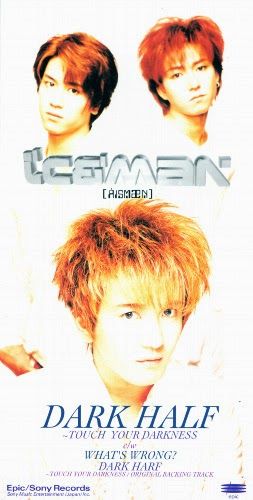
Iceman -- DARK HALF~TOUCH YOUR DARKNESS (1996)
(cover version)
Like
I said earlier, Daisuke’s early post-access career came down to recording a
solo album and producing a few artists here and there. In 1996, though,
planning to form a new band, he organised a number of auditions, which resulted
in the selection of vocalist Michihiro Kuroda (黒田倫弘)
and guitarist Kenichi Ito (伊藤賢一). Composed of these two guys, plus
Daisuke, Iceman was thus formed.
If
access already had that distinctive Arena rock feel in songs like “MOONSHINE
DANCE”, Iceman was even more devoted to noisy guitars, mostly because it had an
official guitarist on the band. Besides that, Daisuke’s synths were also a big
part of Iceman’s style, something that confuses me a lot when trying to
categorize them.
“DARK
HALF~TOUCH YOUR DARKNESS”, for example, showcases this constant battle between
guitars and synths in a very epic way with the exciting arrangement and rushing
beat. Although kind of heavy in the overall sound, the band manages to maintain
“DARK HALF~TOUCH YOUR DARKNESS” in a poppy vein with the catchy and powerful
chorus. I can’t even count how many times I caught myself humming its melody.
Apparently, the fangirls were also very fond of Iceman when they were at their
peak.
According
to generasia, the band stopped their activities in 2001, when vocalist
Michihiro Kuroda officially left the band to pursue a solo career as a rock
singer. Maybe Daisuke’s heavy electronic interferences were not well accepted
by him after a while.
“DARK
HALF~TOUCH YOUR DARKNESS” was Iceman’s debut single, which was released in July
1996, and reached #5 on the Oricon charts. Lyrics were written by Akio Inoue,
while music and arrangement were done by Daisuke.
04)
Daisuke Asakura expd. Takanori Nishikawa (T.M.Revolution) -- BLACK OR WHITE? (1995)
Probably
Daisuke’s most famous act, T.M.Revolution started working with him, still as
Takanori Nishikawa (西川貴教), during the “ELECTROMANCER” recording
sessions in 1995. The second single released prior to the album was “BLACK OR
WHITE?”, a song that was later remixed for Takanori’s debut album “MAKES
REVOLUTION”, re-released as a single in 1997, and also re-recorded and re-released
as a single in 2000 under the name of “BLACK OR WHITE? version 3”. Moreover,
Takanori still performs it sometimes.
“BLACK
OR WHITE?” is simply a great pop-rock song with Dai-chan’s catchy hyperactive
synths in the background. The “L.A. Mix” included in the “ELECTROMANCER” album,
and also presented above, is just even more exciting, because adds an entire
minute of pure repetitive instrumental near the end (I just love the synths in
this song). As for Takanori, I think he’s a great vocalist, even though I don’t
really like the majority of his songs.
“BLACK
OR WHITE?” marked the first time Daisuke and Takanori worked together. After
the release of “ELECTROMANCER”, the two would start their historic partnership
in 1996, which led to a big success during the later half of the 90s. Even
today, Daisuke is still involved in a good portion of T.M.R’s songs.
The
first version of the single reached #17 on the Oricon charts. The re-release in
1997 reached #51. As for “BLACK OR WHITE? version 3”, it reached #6. Lyrics
were written by Akio Inoue, while music and arrangement were done by Daisuke.
I
start my top three with an unnusual choice in Daisuke’s long history as a
producer, the “almost aidoru” male duo LAZY KNACK.
Comprised
of Sou Shimizu (清水聡) and Yuuna Katsuki (香月優奈),
LAZY KNACK’s early songs were created by Daisuke. Their first album, “FLASH” (January
1996), even included some access’s covers like “DRASTIC MERMAID” and an
acoustic version of “VIRGIN EMOTION”, but the one song from them that really
caught my attention was “NATIVE LOVE”, an infectious and catchy pop tune with
Dai’s well known happy and “not-very-subtle” synths (something I just love).
About
LAZY KNACK, I really like their lack of talent. Although it may be strange, I
do like how the boys sound strange at certain parts, almost struggling, like in
the lines before the choruses, for example. That said, it’s interesting how
Daisuke’s production can still shine with average vocalists like Sou and Yuuna.
With
no surprise, the duo ended a couple of years after their debut. As an “almost
aidoru” duo with lackluster sales, they couldn’t succeed in a scenario where
Johnny’s acts dominates the whole “boys” side of the coin. Nonetheless, with
all that in mind, I still like LAZY KNACK a lot. They have pretty good gems
like “NATIVE LOVE”, such as “CRYSTAL GAME” (1995), “SPARK” (1996), “DESTINY”
(1997) and “KNIFE” (1997), in their catalogue.
LAZY
KNACK’s “FLASH” album reached #16 on the Oricon charts. As for “NATIVE LOVE”,
it was written by LAZY KNACK and Akio Inoue, while music and arrangement were
done by Daisuke.
After
the “not-very-talented” male duo LAZY KNACK, we reach the “not-very-talented”gravure aidoru Akiko Hinagata (雛形あきこ) and “REMAKE IT!”, a song included in
her second album, “Hina Collection 2” (ヒナ・コレ2),
which was released in November 1996.
At
first, it was decided that the Akiko Hinagata song I would cover was going to
be “Yureru Koi Shoujo Iro”(揺れる恋乙女色), a brighter song that I listen to a lot more than “REMAKE
IT!”. However, after thinking a little bit, I changed my option and decided to introduce
the more subversive and chaotic “REMAKE IT!”, an electronic pop song full of
stormy synths that probably represents Akiko Hinagata’s most interesting moment.
Funny
thing about Akiko Hinagata is that she wanted to be produced by Tetsuya Komuro,
but, in the end, it was Daisuke who worked on her small singing career. In
fact, I consider he did magic with her, because she was probably even less
talented than LAZY KNACK, but, thanks to Dai-chan, had pretty interesting
electronic pop songs like the aforementioned “Yureru Koi Shoujo Iro” and other gems such as “Wonder Girl”, “DESTINATION” and “FUNKY GAME”, for
example.
“Hina Collection 2”
reached #73 on the Oricon charts. Lyrics for “REMAKE IT!” were written by Akio
Inoue, while music and arrangement were done by Daisuke.
I
couldn’t end my list without an old access song, but I have to say... this was
a pretty hard and unusual choice.
I
could talk about any of access’s early singles here, besides the gay themed “MermaidTrilogy” (“DRASTIC MERMAID”, “SCANDALOUS BLUE” and “TEAR’S LIBERATION”) and the
Arena rock inspired “MOONSHINE DANCE”, which I already covered before, but I
just decided to talk about a minor song in access’s discography. That said, I
will probably regret myself later, but whatever...
“REALTIME
LOVE” was not a single, but one of the highlights coming from access’s second
album, “ACCESS II”, which was released in September 1993.
About
the song, it’s one I always listen to while traveling to somewhere. I don’t
really know why, but the verses are sensual and mysterious, which makes me like
them more than the chorus itself. It’s probably the combination of Hiro’s
vocals with the cold synths. Other than that, it’s a song that reminds me of
80s Synthpop or New Wave bands, such as Duran Duran, for example. In fact, some
fans accuse access of ripping off Duran Duran’s “The Reflex” on “REALTIME LOVER”,
and I see where the comments are coming from, as the arrangements are very, very similar at certain parts.
What
else can I say? Daisuke took a little too much inspiration from “The Reflex”...
The “ACCESS II” album
reached #2 on the Oricon charts. “REALTIME LOVER” is credited under AXS (Hiro
and Dai).
Although
I could change some songs here and there, I’m pretty satisfied with the final product.
Also, I’m happy that I decided to talk about Daisuke’s work, because, with the
exception of access, I’ve never talked about any of the acts in this list here on
Kayo Kyoku Plus before.
As
I said in the Introduction, I spent most of 2014 covering new aidoru music for
the blog, so, consciously or not, I managed to ignore Daisuke’s productions.
However, they were a big part of my daily routine of traveling back and forth
from Resende, where I actually live, to Rio de Janeiro, where I study.
In
the end, it was great that I had the opportunity to talk about the overall
happy and fun pop music produced by Daisuke Asakura. I just hope you guys enjoy
some of the songs I chose to cover here.


.jpg)
.jpg)