I've been a fan of Japanese popular music for 40 years, and have managed to collect a lot of material during that time. So I decided I wanted to talk about Showa Era music with like-minded fans. My particular era is the 70s and 80s (thus the "kayo kyoku"). The plus part includes a number of songs and artists from the last 30 years and also the early kayo. So, let's talk about New Music, aidoru, City Pop and enka.
Credits
I would like to give credit where credit is due. Videos are from YouTube and other sources such as NicoNico while Oricon rankings and other information are translated from the Japanese Wikipedia unless noted.
I've been meaning to get a Rabi Nakayama(中山ラビ)song up here for some time but I never got around to it until today. And now, my first article on this Tokyo singer-songwriter has taken on some poignancy on finding out from her J-Wiki profile that Nakayama had passed away on July 4th this year.
Born Hitomi Miyamoto(宮本ひとみ)in 1948, some of her early musical experiences included going to see The Beatles in concert in Tokyo in 1966 and then hearing the songs of Bob Dylan in her high school English class. In 1968, she then became so inspired by new folk singer Nobuyoshi Okabayashi(岡林信康), who was called "the Bob Dylan of Japan", along with other artists of the genre that she decided to take up the guitar and perform live, eventually performing mainly in the Kansai region. During that time, she performed covers of Dylan's "Blowin' In The Wind", "The House of the Rising Sun" by The Animals, and Sachiko Nishida's(西田佐知子)"Coffee Rumba"(コーヒー・ルンバ). She would then make her major debut through Polydor in December 1972 with the album "Watashi'tte Konna"(私ってこんな...This is Who I Am).
Her live house performances of Bob Dylan songs which had been translated by poet Yo Nakayama(中山容) got Miyamoto to take on the stage name of Nakayama although I still don't know why she went with the first name of Rabi. Also, these performances ended up in having her being called "the female Bob Dylan".
Several albums and singles were released by October 1980 when Nakayama released the single "Komatta Onna" (Woman In Trouble) and the accompanying album "Aeba Saiko"(会えば最高...It'd Be Great If We Met). Now, when I first heard her songs via New J Channel and some of the videos posted on YouTube, I'd thought that she was always in the City Pop realm before realizing her folk roots, but I wasn't too surprised since I've known a number of Japanese folk singers who made the jump to the urban contemporary for at least a while.
With "Komatta Onna", though, I'm not so sure that this is so much City Pop than it is a New Music tune spiced a bit with some urban contemporary flakes. It is quite the catchy shuffle with the big drum beats and the electric piano dance following Nakayama's folksy and slightly growly vocals. Rabi sings her creation about a woman who realizes that she's wasting her life on man after man but can't shake the habit. There's also something with the vocoder-like instrument that hints at Billy Joel's"The Stranger".
Nakayama stopped performing and recording in 1987 but returned to the music business a decade later after the source of her music career, Yo Nakayama, passed away in March 1997. She continued to perform and record live albums until 2020 when she was diagnosed with cancer and then mycosis the following year after which she passed away at the age of 72. Her real name was only made public after her death.
I've almost finished the run of this summer's anime farce "Kanojo mo Kanojo"(カノジョも彼女...Girlfriend, Girlfriend) and have had a good time with it, so I'm hoping that it can get greenlit for a second season.
Among the YouTube comments I've read for excerpts from "Kanojo mo Kanojo", there have been references to another anime that I haven't seen called "Kanojo, Okarishimasu"(彼女、お借りします...Rent-A-Girlfriend) based on a June 2020manga that quickly got its anime adaptation up and running a month later. I've only seen a couple of scenes on the platform but I can see similarities and differences with "Kanojo mo Kanojo", although I think that "Kanojo, Okarishimasu" is probably a little more grounded.
The opening theme for the show is "Centimeter"by the rock band the peggies. When I first glanced at the katakana, I thought that it was titled "Sentimental" but luckily, just before I started typing here, I made the needed correction in my head and the music video made everything perfectly crystal. "Centimeter" is the peggies' 6th major single released in August 2020 which peaked at No. 34. It's a fun pop-rock song about a girl who is struggling to get over some major underconfidence to confess her feelings to a boy.
As for the peggies, they consist of guitarist Yuuho Kitazawa(北澤ゆうほ), who is not only the vocalist but also the main songwriter and arranger, bassist Makiko Ishiwata(石渡マキコ), and drummer Miku Ohnuki(大貫みく). In 2009, Kitazawa who was attending a junior high school associated with Japan Women's University when she invited Ishiwata and Ohnuki to form a cover band. But on entering high school a couple of years later, they decided to write their own original songs. They then started releasing music as an indies group from 2013 before releasing their first major single in May 2017, "Dreamy Journey"(ドリーミージャーニー), itself an anison for "BORUTO-ボルト- NARUTO NEXT GENERATIONS".
Looks like the anime version of "Kanojo, Okarishimasu" garnered its own group of fans which is awaiting a second season. No need to worry...one will be coming out next year.
First off, I saw the NHK live bulletin regarding the fairly sizable earthquake that jolted the Kanto region earlier today my time. I hope that everyone there is doing OK. From what I've been hearing from friends in the area, though, it looks like aside from the usual products falling from shelves and broken water mains, injuries have been minor so far.
Now, to our weekly Reminiscings of Youth feature for this week. Over the last few days, I've been catching this local commercial from our Toronto Transit Commission.
Then, I heard that the same nostalgic song was used for the Applebee's chain in the United States. In either case, it was a nice warm moment to show some promise of getting back to a near-normal life in the potential post-pandemic era.
It hits me and a lot of my generation even more since we all know that this is "Welcome Back" by John Sebastian, the former member of the band Lovin' Spoonful, and it was the theme song for the 1975-1979 US ABC sitcom, "Welcome Back, Kotter". The single itself wasn't released until March 1976, though.
I remember watching the show here and there in its first run and then in reruns. "Welcome Back, Kotter" struck me as being the comedic version of "To Sir, with Love". But instead of poised Sidney Poitier, the star was wisecracking actor/comedian Gabe Kaplan as Gabe Kotter, a former member of a group of high school malcontents known as the Sweathogs who comes back years later to teach at his alma mater, James Buchanan High School, and a new generation of Sweathogs.
Not sure if he was ever the official leader of the 1970s Sweathogs but Vinnie Barbarino certainly felt like the Grand Poobah of the guys which included Boom-Boom, Epstein and Arnold Horshack. Vinnie was played by a young John Travolta who had both cool charisma and dense goofiness in equal measure. I think that this was his breakthrough role that would later get him movie stardom in "Saturday Night Fever" (I believe that I did a ROY article on that movie's theme) and "Grease". Also in its heyday, there were some notable catchphrases that popped out into the pop culture realm such as "Up your nose with a rubber hose!", "Ooh, ooh, ooh!" and "Hi there!".
Perhaps the whole thing behind Sebastian's oh-so-comfy "Welcome Back" was that with the tension in some of these school-based movies with the teacher going up against the rowdy students, the producers probably wanted a song to let us viewers know that, yup, maybe these kids were Sweathogs but they were really lovable punks at heart who needed more love and nurturing. In any case, "Welcome Back, Kotter" became a quick hit for ABC and Sebastian soon found out that he therefore had a hit with the song, so having only meant to have "Welcome Back" as just that one-minute-and-change theme for the credits, he had to quickly add on some more music and lyrics to make it into a proper single. Indeed, the song hit the top spot on the Adult Contemporary charts in both the United States and Canada, and also did very well on the regular singles charts.
So, what did come out in March 1976 as singles, according to Showa Pops?
Unfortunately, I have to let readers know about another death in the Japanese music world today as composer Koichi Sugiyama(椙山浩一)passed away on September 30th due to sepsis at the age of 90. Commenter Kyle Andrew informed me earlier this morning and I had actually caught the news of his passing even earlier during the NHK News. I actually told Kyle that I would come up with an appropriate tribute sometime over the weekend but it seems as if my project manager today told me that there was nothing coming down the pipe for assignments, so now I have my opportunity to do a Creator article for Sugiyama.
His name has already been well represented within the pages of "Kayo Kyoku Plus" for years since he composed some very famous kayo hits including The Peanuts'(ザ・ピーナッツ)"Koi no Fuuga"(恋のフーガ), The Tigers'(ザ・タイガース)"Mona Lisa no Hohoemi"(モナリザの微笑)and a couple of folk band GARO's tunes "Gakusei Gai no Kissaten" (学生街の喫茶店)and "Kimi no Tanjoubi"(君の誕生日)in the 1960s and 1970s.
But in the NHK tribute to Sugiyama and for that matter, the Fuji-TV profile on him in the video at the top of this article, it wasn't just his Group Sounds contributions that were noted. He was also lauded within the reports as the man behind the soundtrack for the iconic "Dragon Quest" game that started its long run from 1986, something that I hadn't realized although even I, a non-gamer, could recognize that heroic theme. There were already some messages of condolences within the comments under the above video. Sugiyama himself noted in a past interview during the NHK report that he had wanted to base the game soundtrack on classical music rather than pop music.
In the J-Wiki article for him, his specialization in music was directed towards the genres ofkayo, anison and game music; his lists for the last two types in that article are quite long indeed. The Wikipedia profile on him mentioned that one day in the 1980s, Sugiyama, who was already very famous, had sent the Enix Corporation, which was behind "Dragon Quest", a fan letter for the music on a shogi game which sent the staffers there into a major swoon. They were also very impressed with his knowledge of games. I gather that this would be the equivalent of Alan Silvestri or John Williams sending a 👍 to an American game developer on letterhead. This would eventually lead to a collaboration between composer and company, and the rest is "Dragon Quest" history.
Sugiyama was born in what is now Taito Ward in Tokyo on April 11th 1931. Music was all around him during his upbringing which would explain his life's career, but J-Wiki also noted that he and both of his parents were also great lovers of games, decades before video games appeared, so that probably also explains the composer's interest in those.
He attended the University of Tokyo half-heartedly pursuing a science degree after getting disappointed on finding out that he couldn't get into a music college since he couldn't play the piano. On graduating, Sugiyama had a part-time job at a parts factory before getting a position at a radio station and Fuji-TV as a director in 1958. He left the network in 1965 and by 1968, he was fully focused on composing and orchestration.
However, even before then, he was already coming up with the melodies. In fact in October 1966, one of his earliest contributions to kayo kyoku came in the form of a single by The Peanuts, "Roma no Ame"(ローマの雨...The Rain in Rome). The 20th single by the duo, Jun Hashimoto(橋本淳)was the lyricist with Katsuhisa Hattori(服部克久)as the arranger for this relaxed hip-swiveler of a song characterized by the staccato blast of the horns in the intro and their smooth Bacharach-like feeling in the song itself. I also enjoy the haunting but enticing vocals by Emi and Yumi.
As has been stated, Sugiyama was also providing songs during the Group Sounds period of the late 1960s. In December 1966, he and Hashimoto once more created a song...this time for the GS band Jackey Yoshikawa and his Blue Comets(ジャッキー吉川とブルー・コメッツ)as a B-side for their 7th single, "Izuko e"(何処へ...Where To?). The brief "Sentimental City"(センチメンタル・シティ)is a pretty interesting song which seems to have a couple of rhythms spliced together: a laconic introspective melody with that electric organ and then a really skippy one as if there were two different settings for whoever the protagonist is. Above everything is a boozy saxophone.
Several months later, Hashimoto and Sugiyama would team up again to provide yet another one of the big Group Sounds bands, The Tigers(ザ・タイガーズ), with one of the biggest hits in their career, "Kimi Dake ni Ai wo"(君だけに愛を...Love Only For You). This was their 4th single from January 1968, and this time Sugiyama would also create the melody and arrange it for Kenji Sawada(沢田研二)and the guys. I think that there's even a bit more psychedelic rock in the proceedings. In comparison to The Peanuts' "Roma no Ame" with some of that twisting in any reflective dancing, maybe The Jerk might be the move here. Just guessing. Selling more than a million records, "Kimi Dake ni Ai wo" reached No. 2 on the new Oricon Singles chart.
If someone can identify the dance move in the video above while The Tigers are playing, that would be greatly appreciated. It's probably not The Jerk. Anyways, I wanted to put up this video since all of us can see how Sawada performed his moves. According to J-Wiki, at concerts when he beseeched his fans with "Kimi dake ni..." and flung out the "Golden Index Finger", a lot of them simply fainted away. You must learn the ways of the Force, Kenji.
The Group Sounds era faded away very early in the 1970s but Sugiyama continued to provide his music to the top stars of the day. Hideki Saijo(西城秀樹)was one of them, and for him, the composer created a couple of tracks for Saijo's June 1976 album"Ai to Jounetsu no Seishun"(愛と情熱の青春...Youth Filled With Love and Passion). One of them was "Itsumo Futari de"(いつも二人で...Always the Two of Us) which had Sugiyama pairing up with another prolific lyricist, Yu Aku(阿久悠). A prowling cat of a tune with a flutter of rock over a jazzy rhythm, the lanky aidoru was more than game for the arrangement. One would think that he may have been doing an old-fashioned soft-shoe in the recording booth.
Just one more example of Sugiyama's music that I will put up here also hit the public's ears in the same year as the Saijo album. This time, though, it came out in the form of aidoru trio Candies'(キャンディーズ)11th single,"Heart Dorobo"(ハート泥棒...Heart Thief). Released in September 1976, it's an especially dynamic tune for Ran, Sue and Miki as they sing about a young teenage girl, who may be a bit of a tsundere, quietly falling hard for a guy who has suddenly raised himself to the lass' demanding expectations, according to Haruo Hayashi's(林春生)lyrics. The song rose to No. 17 on Oricon and sold about 190,000 records.
For those who had only known Sugiyama for "Dragon Quest" and the other games that he provided music for, I thought this Creator article could give some more information on how he also contributed to kayo kyoku in general. But in finishing this off, let's get back to the beginning and realize that the "Dragon Quest" overture made it into this year's Olympic Opening Ceremonies. I'm hoping that Sugiyama did hear and appreciate its appearance. Certainly, many fans did from what I've read in the comments. All my condolences to him and his family and friends.
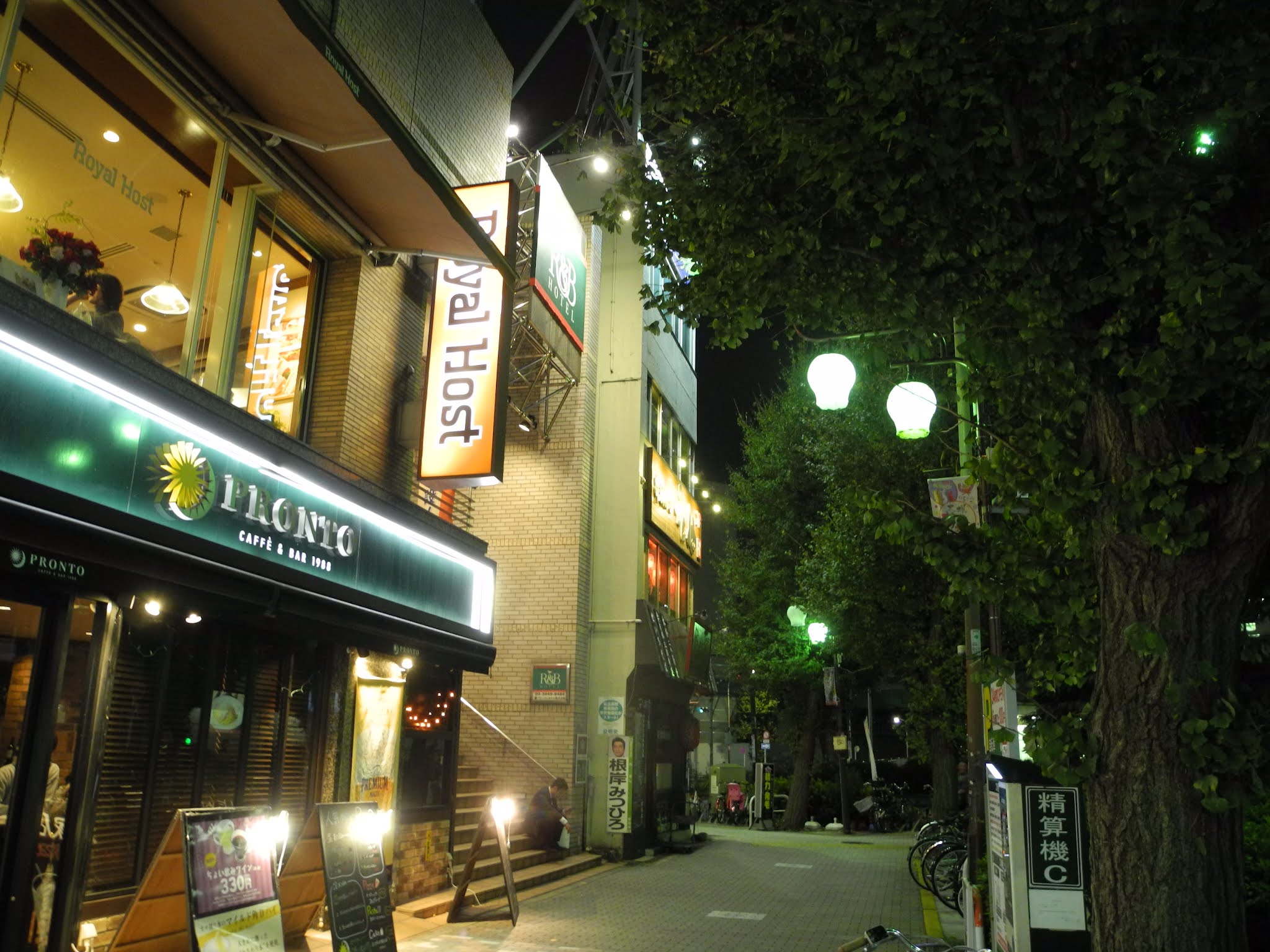
Just a pleasant night shot of the area outside of the R&B Hotel at Otsuka Station in Tokyo when I first got back to the big city in November 2017. Didn't patronize Pronto but I did visit Royal Host a few times during my two-week stay.
I found a track from Masahiko "Matchy" Kondo's(近藤真彦)5th studio album"Winning" (no idea if Charlie Sheen has anything to do with this) which came out on New Year's Day 1984. "Tokyo Night" has that City Pop beat in there and it's characterized by that loopy guitar from the intro which reminds me of Julio Iglesias' version of "Begin The Beguine". Written by Shigeru Sato(佐藤茂)and composed by Koji Makaino(馬飼野康二), the latter person took care of the arrangement for all of the tracks on "Winning", and looking at the very brief J-Wiki article on the album, it appears that a fair number of City Pop-familiar songwriters were contributing their wares such as Fujimal Yoshino(芳野藤丸), Kingo Hamada(濱田金吾)and Chinfa Kan(康珍化). There are some City Pop-sounding track titles as well.
Never thought I would say this but from looking at the contents of "Winning", I may be interested in getting it which would be the first time that I ever said this for a Matchy album.
When I was a kid, I had once thought that cartoons were supposed to be shown just in the mornings or afternoons, and that included "The Flintstones", not knowing at the time that the adventures of Fred and Barney and all the gang in Bedrock had actually started out as a prime-time evening show; in fact, it was the first prime-time animated program on television, according to Wikipedia.
But getting out of university going into the 1990s and hopping to Japan, a new animated sensation was taking over the airwaves at night: "The Simpsons" with its wacky characters, pop culture references and overall snarkiness. Also from Wikipedia, the show now has a few records as it "...is the longest-running American animated series, longest-running American sitcom, and the longest-running American scripted primetime television series, both in terms of seasons and number of episodes." If I can add some slight snark of my own, though, whether it still has its mojo after more than 30 years, I'll leave that judgement up to you.
However, I think with the success and obvious longevity of "The Simpsons", new cartoons with a subversive and irreverent streak began to pop up in the evening slots, and in some cases, the post-prime-time slots because some of the jokes were a little bluer than blue. Of course, there is another long-lived series "South Park" and then there were the truly out-there antics of "The Ren & Stimpy Show". I saw a number of those episodes during that interregnum between Japan stints, including the one that had "Happy Happy Joy Joy".
"The Ren & Stimpy Show" was the cartoon that came to mind when I first came across episodes of "OH! Super Milk-chan"(OH!スーパーミルクチャン)just within the last week. Director Hideyuki Tanaka(田中秀幸)helped bring out the first batch of 10-minute vignettes of this pint-sized toddler superhero with an indifferent attitude toward saving folks in 1998 on Fuji-TV's"Flyer TV" late-night variety block. But then, a couple of years later in 2000, the "OH! Super Milk-chan" half-hour episodes were broadcast on Space Shower TV, WOWOW and other satellite channels, before straight-to-dub and Americanized versions made it onto Cartoon Network in 2004. I'm naturally no expert on "OH! Super Milk-chan" but from what I've seen, though it doesn't have quite the existential shiv of "The Ren & Stimpy Show", it still seems to possess that certain similar weirdness thanks to the animation, the other off-kilter characters, and the babyish delivery from Milk herself, voiced by Haruka Nakamura(中村春香).
To add to the weirdness, the theme songs are covers of some ol' Showa kayo. For instance, there is the opening theme, "Ohkami nanka Kowakunai" (I'm Not Afraid of Anything Like A Wolf), which was originally by 70s aidoru Mako Ishino(石野真子)in 1978. Nakamura herself sings this in-character as the song takes on a carnival-like technopop arrangement. Meanwhile, the credits themselves are a parody parade of famous scenes of other anime.
Nakamura's website (no J-Wiki or Wiki profile) is somewhat sparse on the information although she identifies herself as a voice actress, narrator and singer. Though it's coy there about when and where she was born, another site has stated that Nakamura hails from Hiroshima Prefecture and she was born in 1988.
The ending theme is taken care by seiyuu, actor and calligraphy teacher Yuuichi Nagashima(長島雄一)and it's also a techno-ized version of the 1981 J-Rock anthem"Tsuppari High School Rock n' Roll"(Delinquent High School Rock n' Roll) by THE CRAZY RIDER Yokohama Ginbae ROLLING SPECIAL(THE CRAZY RIDER 横浜銀蝿 ROLLING SPECIAL) . Nagashima plays The President, Super Milk-chan's somewhat stoic boss who reminds me a bit of The Chief from "Get Smart".
Unlike his co-star, Nagashima, who was born Shigeru Nagashima(長島茂)in Saitama Prefecture in 1957 but now goes by the stage name Chō(チョー), has both a J-Wiki and a Wikipedia profile.
The American version of "OH! Super Milk-chan" has its own opening theme "Disco Milk" which first alerted me to the existence to the show, and to be honest, I actually like this theme better than the original theme. It's just so catchy with the vocal excerpts from the characters.
All that gets even more ramped up in the ending theme "Sushi Kuite!"(スシ食いてェ! ...I Wanna Eat Sushi!)with the added delight of hearing a sample from an old song that I've known for over 40 years. Unfortunately, I don't know who concocted these themes for the Adult Swim version of "OH! Super Milk-chan".
To be honest, I don't really follow current pop music in North America and haven't for a number of years now. It's just been the oldies for me, thus this blog. Well, I can make a very happy exception for "Uptown Funk" by Mark Ronson featuring Bruno Mars. However, Toronto media has made it a mission to crow far and wide about the local talent doing famously across borders such as Justin Bieber, Drake, and The Weeknd. And power to them!
A few years ago, I wrote up an article regarding the folk band Salty Sugar(ソルティー・シュガー)and their biggest hit, "Hashire Koutarou"(走れコウタロー...Run, Koutarou), the comically happy song poking fun at actual member Koutarou Yamamoto(山本厚太郎)since he was always literally running late for practice. Salty Sugar had their time between 1969 and 1971.
Some years later in 1974, guitarist Yamamoto joined up with Kazumi Mori(森一美)from the duo Kurosaki to Kazumi(黒崎とかずみ...Kurosaki and Kazumi) and Hideo Itagaki(板垣秀雄)formerly of the folk band Pipi & Kotto(ピピ&コット)to form the new folk trio Yamamoto Koutarou to Weekend(山本コウタローとウィークエンド...Koutarou Yamamoto and Weekend). It had a hit out of the gates with "Misaki Meguri"(岬めぐり...A Tour of the Capes) when it was released in June of that year.
Three more singles and a couple of albums were released until the band decided to shorten its name to just Weekend (ah, that's why I mentioned The Weeknd) in 1976 after which five more singles and three more albums came out up to 1978. The first of those singles under the short name was "Shiawase no Kane" (Happy Bells) hit the record shop shelves in March 1976, and it's far different from the supremely happy "Hashire Koutarou". In fact, suffice it to say, it's a downright depressing folk tune.
Written and composed by Yamamoto with arrangement by Ichizo Seo(瀬尾一三), "Shiawase no Kane" starts out happy enough as it describes a wedding scene from four years earlier only to have the love utterly dissipate within that time and the decision is made to divorce. The song is beautifully done by Seo, I have to say, though, and my compliments to who among Weekend is singing. As it is, this could only get onto one of those heartbreak song compilations that show up at places like Tower Records now and then.