Credits

I would like to give credit where credit is due. Videos are from YouTube and other sources such as NicoNico while Oricon rankings and other information are translated from the Japanese Wikipedia unless noted.

Thursday, December 28, 2017

The Works of Etsuko Yamakawa(山川恵津子)


Etsuko Yamakawa is a name that I have seen through various liner notes over the years but it wasn't until her lovely performance in the one-off duo Tohoku Shinkansen(東北新幹線)that I really got interested in what she had to say within her creations.


Yamakawa was born in 1956 in Kyoto. She attended Ferris University in Yokohama where she majored in the Faculty of Music. From her student days, she was involved with the Yamaha Music Foundation working with various musicians as a tour member starting with singer-songwriter Hiroko Taniyama(谷山浩子). If I remember from reading the liner notes for Tohoku Shinkansen's sole album "Thru Traffic", the foundation was also where she met her partner, Hiroshi Narumi(鳴海寛). Following graduation, she began her activities as a composer, arranger, music producer and a studio musician (keyboardist). Probably one of her earliest works was for Junko Yagami(八神純子), the lovely "Be My Best Friend" in 1980.


One of the things that I noticed while scrolling down Yamakawa's body of work on J-Wiki was that she participated in the creation of songs for those 1980s aidoru such as Kyoko Koizumi(小泉今日子). For Kyon-Kyon, she arranged her 18th single "Hyaku Percent Danjo Kyousai"(100%男女交際...100% Men And Women Dating)which was released in April 1986. The songwriters were Keiko Aso and Koji Makaino(麻生圭子・馬飼野康二), and the song went as high as No. 2, eventually becoming the 86th-ranked single of the year.

Although Koizumi was apparently not too thrilled with the final title, "Hyaku Percent Danjo Kyousai" won Yamakawa a Best Arrangement prize at the Japan Record Awards for that year. In fact, it was the first time that a woman won the award.


Marina Watanabe(渡辺満里奈)was another 80s aidoru for which Yamakawa had come up with several songs. One was her 2nd single, "White Rabbit kara no Message"(ホワイトラビットからのメッセージ...A Message From the White Rabbit) which was composed and arranged by Yamakawa and then released on New Year's Day 1987. Yasushi Akimoto(秋元康)was the lyricist. My impression so far is that Yamakawa provided quite a number of sprightly tunes for her young charges. It hit the top spot on Oricon and became the 37th-ranked single of the year. Apparently the animal of the title came about since 1987 was the Year of the Rabbit.


I mentioned Hiroko Taniyama at the top there so this is a song that she wrote and composed titled "Country Girl"(カントリーガール), her 8th single from March 1980. Yamakawa also arranged this one about a young man enthralled with the lass in the title. It got as high as No. 55 on the charts.


Before I discovered that Yamakawa was providing a lot of aidoru material, my impressions of her were that she took care of the mellower side of pop back in those days or she was into the City Pop side of things. "Tomete, Passio"(とめて、パシオ...Stop It, Passio), a track from Etsuko Sai's(彩恵津子)5th album, "PASSIO", from October 1986 is a Yamakawa composition that fulfills the latter impression. Chinfa Kan(康珍化), under his pseudonym of Shirusu Morita(森田記), provided the words to this mysterious song of the night. Yamakawa is even one of the backup singers here.


I did find a mellower song here in the form of "Aki no Jasmine Tea"(秋のジャスミン・ティー...Autumn Jasmine Tea) by veteran Yukari Ito(伊東ゆかり). Not sure whether Yamakawa composed, arranged or both but there is a nice touch of Latin with this one. Unfortunately, I couldn't find out who the lyricist was, but the song was originally part of Ito's 1984 album "fado".


For my last song, I've gone with Yuko Imai's(今井優子)cool "HOTEL TWILIGHT" from her 1988 album "VOYAGEUR". Yamakawa arranged this number written by the aforementioned Keiko Aso and composed by Hideya Nakazaki(中崎英也), and it rather gleams with that champagne-on-the-town sound that I often associated with some of the female pop singers at the end of the 1980s.

On one Mixi blog, one writer stated that he took a listen to "HOTEL TWILIGHT" and remarked that he had initially thought it was a Swingout Sister song with those strings and dramatic arrangement. The statement knocked me for a loop since I finally put two and two together. That champagne-on-the-town sound in that certain corner of J-Pop of the time might have been inspired by the British group. So, perhaps I can say that as much as the Doobie Brothers and Steely Dan probably inspired City Pop at the beginning of the 1980s, Swingout Sister may have influenced the urban contemporary tunes of Japan at the end of that decade.

To sum up, Yamakawa has created a wider palette of music than I had expected, ranging from sweet aidoru to cool urban. Of course, J-Wiki probably hasn't included every single work that she ever made so I will continue to look forward to any further discoveries.

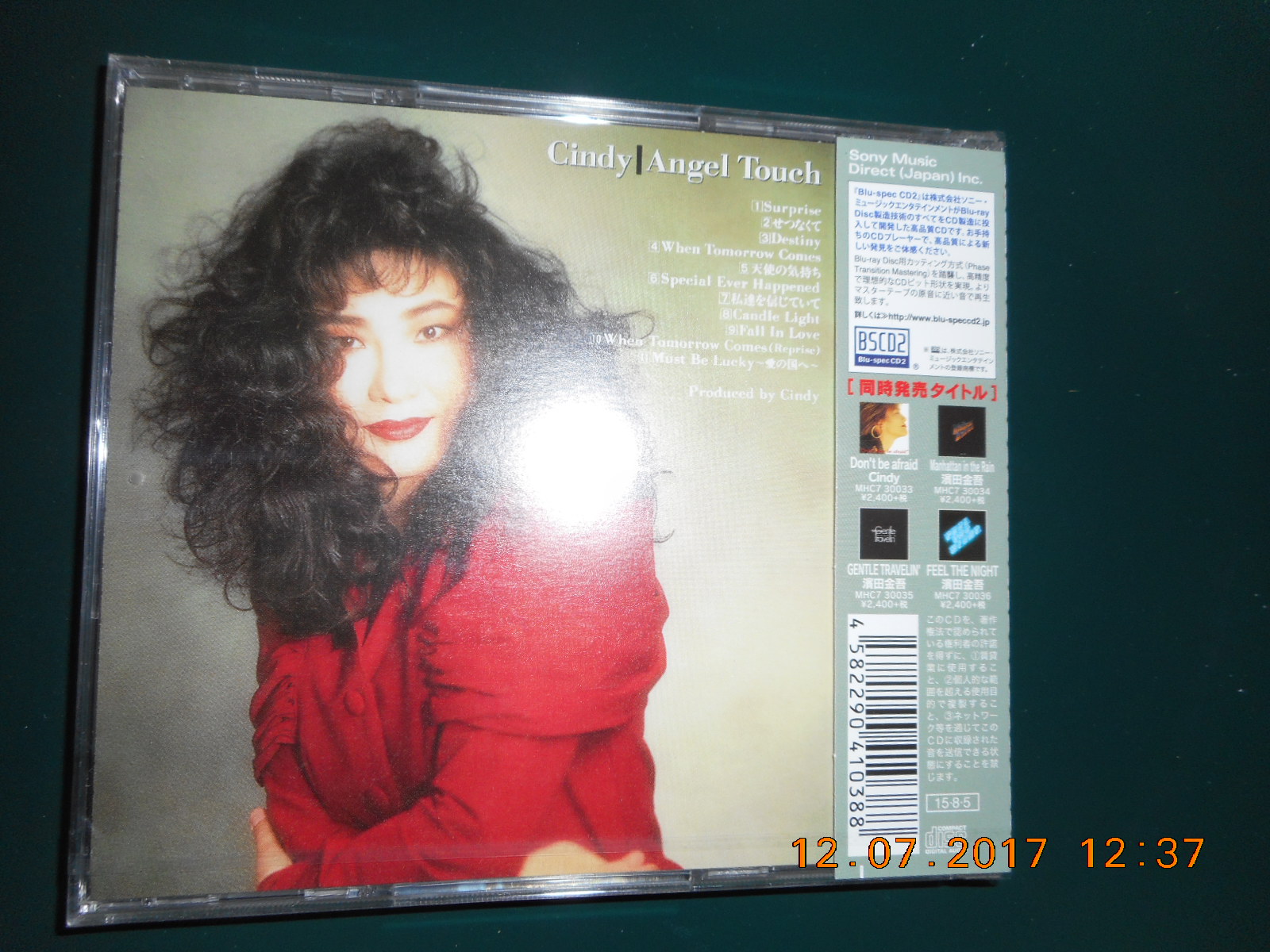
Cindy -- Angel Touch


About 18 months ago, I was first made aware of the lovely stylings of the late singer-songwriter Cindy. Never heard of her or saw her on TV any time during my two stints in Japan but then back in the summer of 2016, I discovered some of her material from her 2nd album "Angel Touch" which came out in June 1990.

The song that first drew me in was "Watashi Tachi wo Shinjiteite"(私達を信じていて), a mid-tempo R&B number that grabbed me by the short-n-curlies (sorry for that analogy) and has yet to let go. The arrangement was heavenly (the Future Funksters certainly agreed) but what made it all gel was Cindy's lovely voice.


From "Watashi Tachi wo Shinjiteite" and a hearty recommendation in the Comments section for the song, I decided that I had to get the album. And thanks to Tower Records, I was finally able to purchase "Angel Touch" earlier this month as part of my Xmas bonanza. I put it on the stereo earlier today and I am now thrilled that I got it. It is truly ambrosia for the ears.

For example, "Surprise" which starts the album off. That is one lovely intro with a hint of Latin as Cindy takes us on a mellow romantic ride. Chinfa Kan(康珍化), who also took care of another pop chanteuse in the previous decade, wrote the song with Cindy taking care of the melody. It also happened to be the coupling song for "Watashi Tachi wo Shinjiiteite" when it was released as a single.


I also like Track 2 "Setsunakute"(せつなくて...Heartrending)written by Masami Tozawa(戸沢暢美)with music and arrangement by Rod Antoon. Was able to hear a lot of the old R&B tropes from that turn of that particular decade which got the nostalgia going. After listening to this one, I just went "Wow! And this was almost a decade before the arrival of Misia".


The same duo behind the classic "Watashi Tachi wo Shinjiteite", Kan and songwriter/musician Hiroshi Narumi(鳴海寛), also wove this splendid ballad "Special Ever Happened" for Cindy which also turned out to be her 5th single from November 1990. Warm brandy for the soul. Miho Nakayama(中山美穂)would make a cover of the song in the following year for her album "De eaya".


"Candle Light" is some nice downtown funk with Cindy's great vocals and sax. Listening to this one, I just had to wonder if there had been any sort of duet between her and Sing Like Talking's Chikuzen Sato(佐藤竹善). Rui Serizawa(芹沢類)provided the lyrics with Cindy and Yuji Toriyama(鳥山雄司)coming up with the music.

Plenty of other tracks remain but I will leave those to future articles. In any case, as the commenter mentioned, I owed it to myself to get "Angel Touch", and happy to say that this could be one of those heavy rotation discs.


fairy w!ink -- Tenshi wa Doko ni Iru? (天使はどこにいる?)


I don’t really know why, and it probably don’t even have a reason, but Wink became somewhat trendy nowadays among aidoru acts paying tribute to the long gone 80s aidoru era. Initially, I was planning to write a bigger post about this, commenting every act who payed homage to them this year (well, three acts, but that’s already a good number), but one of them, which is Avex’s doll-like duo FEMM, just recorded an updated cover of “Samishii Nettaigyo” (淋しい熱帯魚), and the other, lovely and trashy aidoru duo Bed In (ベッド・イン), didn’t quite succeed in making a good impression on me with their Wink tribute, “CO.CO.RO Gradation” (COCORO グラデーション). Last but not least, there was fairy w!ink, an HKT48 subunit comprised of Misaki Aramaki (荒巻美咲) and Hirona Unjo (運上弘菜) that ended inspiring me to write about this subject in the first place.

When I was looking for some random stuff, I came across the cover of fairy w!ink’s single “Tenshi wa Doko ni Iru?” and thought I was hallucinating while seeing a Wink single I didn’t know in front of my eyes. Soon I realized it was a tribute done right, but I’d never expect it to come from the AKB48 factory. While I remember they’ve already done something similar with Seiko Matsuda before, I didn’t think Wink was quite as iconic as Seiko-chan. Now I see they are probably iconic enough, since three acts decided to pay tribute to them on the same year.

“Tenshi wa Doko ni Iru?”, which was released in December 2017, is a good mashup of Wink and AKB48, both in the visuals and the sonority. We can hear the melodrama that’s typical Wink, with the piano and all the classic European flourishes backed by dance beats, while childish vocals coming from the two HKT48 members just makes the whole thing more tender. As for the visuals, they emulate Wink’s seriousness and porcelain doll-like expressions, but with some cheesy and cheap outfits… which, I think, is something AKB48 and its sister groups could do better at this point (I do realize that they release a video for each song on their singles, but Wink was never that cheap-looking, even if they wore some plastic accessories and over-the-top outfits all the time).

Overall, I liked how the melody and arrangement were done in pure Wink fashion, while still sounding somewhat modern (at least for AKB48 and J-Pop’s overall standards nowadays). In the end, I kept thinking about some of Wink’s own songs, like “Kitto Atsui Kuchibiru ~Remain~” (きっと熱いくちびる ~リメイン~) for example – and that’s a great accomplishment since we’re talking about a tribute song –, but also meltia’s “Shirobana no Corsage” (白薔薇のコサージュ).

Lyrics were written by Yasushi Akimoto (秋元康), while music was composed by Daisuke Toyama (外山大輔). As for the arrangement, APAZZI was the responsible.

Source: generasia.com

Wednesday, December 27, 2017

Tatsuhiko Yamamoto -- Pacific Blue(パシフィックブルー)


Heck of a time to be writing about a summer song but, hey, if it warms up any of the Toronto readers here, I think I will have done my good deed for the day.


I had this video featuring Tatsuhiko Yamamoto's(山本達彦)"Pacific Blue" languishing in my bookmarks for the longest time, so I figured it was time to pull it out. A track on his 1982 album "Taiyo ga Ippai"(太陽がいっぱい...Le Plein Soleil), Yamamoto and lyricist Machiko Ryu(竜真知子)created this paean to lost loves everywhere. Apparently, the colour of heartbreak is a deep Pacific blue. The ballad almost sounds like music that Mayumi Itsuwa(五輪真弓)would perform....it has that certain ennui to it except for that underlying electric guitar rumbling away and then another guitar wearing its heart on its own sleeve at the end.

Miku Hatsune -- Saraba Siberia Tetsudo (さらばシベリア鉄道)


It's been a frigid week lying between Xmas and New Year's. The high temperature was no higher than -13 degrees Celsius and the wind chill factor made it feel like -30! Been a while since I felt it that cold.


However, I still made it out downtown to meet up with some friends for some Holiday lunch down at Kingyo, one of my favourite izakaya in Toronto. Boy, did that tonkatsu taste good especially with the cold out there.

One of my friends who is, like me, a fellow translator mentioned that he did take a peek at the blog and was impressed by the sheer volume (thank you by the way). He also stated that his kids really enjoyed the song stylings of one Miku Hatsune(初音ミク). They had even seen a Miku Hatsune concert out in Mississauga, the city just west of Toronto. I never got that opportunity although I had been interested in one that was held at The Sony Centre near Lake Ontario a couple of years ago. Unfortunately, some weeks or months beforehand, the tickets had already sold out just like that.

So on behalf of my friend, I will dedicate this article to the internationally famous Vocaloid. This time, I went with her singing an old kayo classic called "Saraba Siberia Tetsudo" which was originally performed by Hiromi Ohta(太田裕美)back in 1980. Considering today's weather, it really did feel like Siberia. To be honest, I don't know when the Hatsune cover came out so I will go with the original year.

Tuesday, December 26, 2017

Meiko Nakahara -- Ni-ji made no Cinderella -FRIDAY MAGIC-(2時までのシンデレラ-FRIDAY MAGIC-)


In another case of listening and writing about a few tracks from the specific album and then getting interested in the whole album, I finally got my copy of Meiko Nakahara's(中原めいこ)"Ni-ji made no Cinderella -FRIDAY MAGIC-" (Cinderella Til 2) from December 1982. Up to this point, I had already given my contributions to "Go Away", "Coconuts no Kataomoi"(ココナッツの片想い)and "Friday Magic".

Just like those tracks, "Ni-ji made no Cinderella" is basically a musical package of the party life in early 1980s Japan. There is that old saying about there being a million stories in the city. Well, judging from the above tracks and some of the others that I'm going to cover, they seem to represent a few of those urban stories during a night in Tokyo, perhaps Roppongi. All of the tracks were written and composed by Nakahara who, in a whimsical sense, could have been overlooking those stories while perched on that crescent moon as seen on the cover.


The partying starts off right from the first track "Fantasy", a story about tripping the light fantastic on a disco ball-glittered dance floor in some club such as the Lexington Queen. There's something pleasantly Earth Wind & Fire about Track 1 (aside from the fact that both artists share a number with the same title).


Track 2 is "Gigolo"(ジゴロ)about a woman who loves a man who loves her and a lot of other women, and the nail-biting insecurities that come with the knowledge. It's as disco as "Fantasy" but the arrangement also has that slip of melancholy in there.


"Pearl no Manicure"(パールのマニキュア...Pearl Nail Polish)has a bit more of a 50s pop ballad sound. Nakahara sings about lamenting over a lost love and whether she will ever put on that coat of that nail polish that her former beau liked so much.


"Koi no Yoin"(恋の余韻...Aftertaste of Love)takes things from raunchy Roppongi to classier Omotesando where a lady wants to take a breather from her lover so that she can savor/replay the wonderful time she has had with the lad. The music is still City Pop in my estimation (even has a bit of Doobie Bros. keyboard work) but without the disco ball. In fact, I would say that it even approaches EPO's breezy area of expertise.


The co-title track "Ni-ji made no Cinderella" finishes the album off as a mellow ballad celebrating a late-night dinner or drink in Prince Charming's apartment or even Cinderella's place. A nice way to bring Nakahara's 2nd release...and an evening...to a close.


Ryuko Mizuta -- Uwasa no Minato (噂の港)


Ever since Noelle Tham introduced Ryuko Mizuta (水田竜子) to this blog through her cover of Miyuki Utsumi’s “Yopparacchatta” (酔っぱらっちゃった), I became a somewhat distant fan, following her singles releases and even listening to her back catalogue in the attempt of knowing her better. Now, thanks to some nice shopping points I had accumulated on CDJapan, I decided to buy one of her yearly best selections and finally have “Yopparacchatta”, among other great songs from her catalogue I discovered, in my collection. The bad thing is, since I’ve bought the CD very recently, and it didn’t leave the warehouses yet, it’ll certainly take some time until it finally arrives in Brazil.

From what I’ve heard so far, Ryuko’s work can be separated into two categories: the first, with a more Kayo Kyoku flavor, covers her first years; and the second, in which her true enka tunes shines, is something she’s been into since the mid-00s. Personally, I enjoy the first category a lot more, but some of her enka tunes have gradually grown on me, which is the case of “Uwasa no Minato”, a single released back in February 2015.

When I started searching for Ryuko’s live performances on YouTube, the one song that constantly appeared to me was “Uwasa no Minato”, and that’s probably because it was one of her newest songs at the time. So, after watching a lot of different live performances of it, I ended liking it a lot more than other similar songs she’d released in the past. I don’t know, maybe the melodic shifts were interesting enough to my ears, or it was simply the result of repeatedly listening. It also helps that, besides the usual heavy singing, “Uwasa no Minato” isn’t overdramatic as some other songs in the genre.

Aside from the music… oh, boy, I do love Ryuko Mizuta’s figure. If her singing talent wasn’t enough, she’s so classy and sexy that I can watch her sing even the most boring enka songs and still be fascinated.

Lyrics were written by Mitsuo Ikeda (池田充男), while music was composed by Hideo Mizumori (水森英夫). As for the arrangement, Toshiaki Maeda (前田俊明) was the responsible.

Source: https://images-na.ssl-images-amazon.com/images/I/71W8Fdd5MTL._SL1261_.jpg