Credits

I would like to give credit where credit is due. Videos are from YouTube and other sources such as NicoNico while Oricon rankings and other information are translated from the Japanese Wikipedia unless noted.

Thursday, December 3, 2015

Tsuyoshi Nagabuchi -- Tonbo (とんぼ)


It looks like tonight will be my tribute to insect kayo after just completing "Kita no Hotaru"(北の螢). I have a bit more of a connection with Tsuyoshi Nagabuchi's(長渕剛)"Tonbo" (Dragonfly) since it was a song that I heard frequently at the Yorkville karaoke bar Kuri back in the late 1980s. At the time, I didn't know the details about the lyrics but I could sorta figure out that it was one of those tunes that guys sang to vent their frustrations.

Written and composed by Nagabuchi for release as his 20th single in October 1988, it was originally created as the theme song for the TBS drama "Tonbo", a show that starred the singer-songwriter himself as a yakuza member just out of prison only for him to face more trouble. I actually saw the very last scene of show through an afternoon rerun as his character of Eiji, looking like he went through a full 12 rounds with Mike Tyson, sullenly and defiantly bulled his way through the regular working crowd coming from the other direction as the strummy tones of the title song played in the background.

"Tonbo" may have started life as the theme song for an antisocial malcontent angry at the planet but I think it quickly became the anthem for anyone in the working world trying their best from not being worn down to a nub by overly long hours, too much work and dilettante bosses. I always thought it to be the equivalent of an especially astringent shot of shochu. It goes down good and rough and you want to spew out all that bad air. This would explain why it became a huge hit for Nagabuchi when it went all the way up to No. 1 and quickly became the 16th-ranked song of 1988. And it was enough of a powerful long seller that it even ended up the 3rd-ranked song of 1989. I was also a bit surprised to find out that "Tonbo" was the first single in 5 years since Takashi Hosokawa's(細川たかし)"Yagiri no Watashi"(矢切の渡し)to have become a million-seller.


I remember watching one of the morning shows on Japanese TV in my apartment several years ago. Apparently, it was the morning after the retirement of one of the big stars in baseball, Kazuhiro Kiyohara back in 2008. Immediately following his final game with the Orix Buffaloes, there was a ceremony right on the baseball field with Nagabuchi coming up and performing "Tonbo" in front of Kiyohara. The player tried to stayed stoic but didn't quite succeed.

As for the meaning of the dragonfly in the title, Nagabuchi apparently meant it to be the target of envy for all those corporate cogs as the insect in question just seems to enjoy a footloose and fancy-free life flitting about from place to place. I can say that it lives a very brief one as well, but hey, let's keep to the intention of the song here.


Shinichi Mori/Sayuri Ishikawa/Keiko Fuji -- Kita no Hotaru (北の螢)


There were a couple of kayo tropes I picked up from "Kita no Hotaru" (Fireflies of the North) when I heard it once again on the most recent episode of "Kayo Concert"(歌謡コンサート)the other day. One is that old-style Japanese songwriters do like their flying animals. There have been a multitude of titles featuring various birds (the more migratory the better) to represent the protagonist's wish to either escape his/her current fate or to send a message of love/regret to a former paramour. Insects are another example, and one of the better-loved ones have been fireflies. A summer fixture, the bio-luminescent firefly has been part and parcel of a family's memories or a catalyst for potential romance (especially when it comes to anime) in Japan. In my town of Tsukiyono back in my JET days, there was an annual firefly festival which took place around the local Bullet Train station.

"Kita no Hotaru" is once again one of those songs whose intro I can recognize immediately because of how the horns glide into original singer Shinichi Mori's(森進一)vocals. Released in August 1984 (perfect timing for fireflies), it was written by legendary Yu Aku(阿久悠)and composed by Takashi Miki(三木たかし), and speaking about vocals, this leads me into the second trope. I think all enka singers have had to show their fair share of anguish in their performances to reflect crushing regret/melancholy/defiance. Mori is one of the enka singers who I think is one of the aces of anguish. And with "Kita no Hotaru", I believe he is taking on the woman's role as he pleads with the insect of choice to relay feelings of regret over to an old flame. He may not have tears in his eyes but there's no doubt that he's singing from an unhappy place.

The ballad managed to peak at No. 22 on Oricon, but it also won a Gold Prize at the Japan Record Awards and a Grand Prize at the Japan Lyricist Awards. Sasuga, Aku-sensei!


Speaking about aces of anguish, Sayuri Ishikawa(石川さゆり)and the late Keiko Fuji(藤圭子)provided their own cover versions of "Kita no Hotaru". Both of their versions carry that albatross of regret but I could also detect a certain layer of "How dare you?!" anger/resentment in there.


Wednesday, December 2, 2015

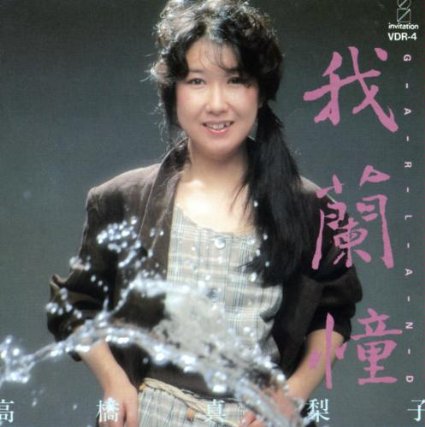
Mariko Takahashi -- Garland (我蘭憧)

http://www.amazon.co.jp/%E6%88%91%E8%98%AD%E6%86%A7-GARLAND-%E9%AB%98%E6%A9%8B%E7%9C%9F%E6%A2%A8%E5%AD%90/dp/B00005GX3I

Photo from Amazon.jp

I've got my fair share of Mariko Takahashi(高橋真梨子)albums and quite a few blog articles on the singer as you know, but there is one album of hers that I hadn't been able to cover until now. That would be her 8th album from October 1983, "Garland".

Now, I'm not saying that this is my absolute favourite release or the best album by the chanteuse. My personal favourite is "dear" from 1982, which for me doesn't have a single track that I don't like tremendously. When it comes to her albums, there is a mix of tracks that appeal and don't quite appeal to me, and "Garland" more or less falls in this category. However, there is one particular song, the first track that I had been hoping to feature via YouTube or NetEase pretty much since I started "Kayo Kyoku Plus", but none of the songs from the album have popped up on the former, and "Garland" was never placed on the latter (and NetEase is no longer functioning online for me). So, I'm doing the somewhat unusual thing of using the very brief samples via Amazon.jp to feature the three songs from this album tonight. Better than nothing.


(full version of "Nigai Rhapsody")

So, as for that first track...it is "Nigai Rhapsody"(にがいラプソディ...Bitter Rhapsody). Despite the bittersweet title, it is one of my very favourite Takahashi tunes. Written by Akira Ohtsu(大津あきら)and composed by Kenji Omura(大村憲司), it just sounds so cool to me...certainly with those opening notes by the keyboards and the percolating rhythms that flow in before the singer's sultry tones take centre stage. It might be about a love gone wrong but it comes across as one of those City Pop tunes that would be great listening to on the car radio. It's just too bad that we can only hear it for just 45 seconds online.


Track 2 is "Gokai"(誤解...Misunderstandings). When I first heard it, I just thought it was a rather weird arrangement of a bit of twangy electric guitar against a soft reggae beat; it took a while to get used to it but I was willing to give Koji Tamaki(玉置浩二)of Anzen Chitai, who not only composed "Gokai" but provided backup vocals, a chance. And over the years, I'm happy to say that the song has grown on me with its happy-go-lucky beat. Ohtsu also took care of the lyrics here.


However, what got me to buy "Garland" in the first place was the final 9th track "Twilight Cool"(トワイライト・クール)which I had first heard on an episode of "Sounds of Japan" on the radio way back when. Like "Gokai", it also has a happy-go-lucky beat but more through the filter of a 1950s/1960s teenybopper ballad. It sounds like something that Mariya Takeuchi(竹内まりや)would have sung early in her career but Takahashi definitely makes it her own here. And compared to the cool drama of that first track of "Nigai Rhapsody", "Twilight Cool" is a nice pleasant stroll down the residential street and a good way to end the album. Ken Sato(佐藤健)composed the song with Ohtsu on lyrics.

As I said at the top, "Garland" is not quite "dear" in my estimation as a Mariko Takahashi fan but even the rest of the songs have started touching a few of the nostalgia nerves.

https://itunes.apple.com/jp/album/%E6%88%91%E8%98%AD%E6%86%A7-garland/id155723390

Megumi Hayashibara -- Caravan ~Yuujou~ (キャラバン 友情)


Although I certainly know the majority of songs that were recorded by Megumi Hayashibara (林原めぐみ) over the years, sometimes I discover some rare and odd songs that were not “absorbed” by her official discography. One of the last times it happened was in early 2014 when I listened to “Caravan ~Yuujou~” for the first time, and, as I fan, almost fell out of my chair.

Apparently, “Caravan ~Yuujou~” is a song originally recorded by a singer called Satoko Shimizu (清水咲斗子), and it served as the second ending to the anime “Tenkuu Senki Shurato” (天空戦記 シュラト) in late 1989/early 1990. By that time, Hayashibara was still a new aidoru beginning her career as a successful seiyuu/singer, so her role in this anime was small, and she wasn’t chosen as the main singer for openings and endings (even though she performed some insert songs, like the already covered “Still Waiting”, for example). However, she recorded her own version of “Caravan ~Yuujou~” for one Shurato Drama CD in 1990, even though it was never included in her discography, which only officially started in 1991 with the release of “Half and, Half”. Honestly, I’m waiting it to be included in one future best of album, as she finally started packing old and lost songs from her 25 years old career... but let’s see if “Caravan ~Yuujou~” will be part of this project. Personally, I hope so. Let’s see why.

Surely, the Middle-Eastern arrangement in “Caravan ~Yuujou~” is quite impressive, and it constantly reminds of of Akina Nakamori’s (中森明菜) “SAND BEIGE -Sabaku e-(砂漠へ). Not that the songs are truly similar, but it’s almost impossible for me not to remember it while listening to “Caravan ~Yuujou~”... probably because of the mystic vibe shared by both songs.

Besides the arrangement, the main reason why I cherish this song is, of course, because of Megumi’s vocals. As she was new to the game, we can’t really expect an amazing rendition, but her haunting singing really combined well with “Caravan ~Yuujou~’s” overall mystic and dreamy sound. Her voice also seems a little bit uncontrolled if compared to a more restrained singing that experienced singers are able to provide. As a fan, I surely like this raw vocal performance, so it’s not a problem for me.

To finish, here’s Shurato’s ending with Satoko Shimizu’s original version of “Caravan ~Yuujou~”. Even though I prefer Megumi’s version for obvious reasons, the original singer is also very good. Well, trying to be a little more reasonable, I truly think Megumi’s haunting delivery was more suitable to “Caravan ~Yuujou~”, so that’s it... a somewhat objective reason.


As a side note, Shurato aired in Brazil when I was a little kid, but I don’t have any memories of it. In fact, I don’t know if I ever watched it.

Lyrics for “Caravan ~Yuujou~” were written by Takashi Kudo (工藤崇), while music and arrangement were composed by Hiroya Watanabe (渡辺博也).

...an edited image from Megumi's "Northern Lights" (2002) photoshoot

Jero -- Umi Yuki (海雪)


Upon entering the world of enka, besides your usual Itsuki, Hikawa and Sabu-Chan, I kept seeing word of Jero (ジェロ), also known as "The first African-American enka singer". That in itself was interesting - to know that enka has become so international - but what was really amusing was the fact that he's known for appearing on stage in more casual attire with cap askew and sneakers rather than a proper suit or kimono. Of course, his record company wasn't too thrilled on that idea initially and would rather him dressed more appropriately (by enka standards), but he managed to convince them that it (what you see now) fits his persona better. Seeing Jero like that in his hip-hop, ghetto-esque get-up makes one assume that he's a typical rapper, but his smooth and fruity vocals as he croons kayo classics puts him in the same league as a number of the more straight-laced enka balladeers.

Last night, Jero made an appearance on "Kayo Concert", this time dressed slightly more formally save for his trademark sneakers. The theme for this week was winter, so naturally he sang his debut hit, "Umi Yuki". I had heard it a while back, but it never fully registered in my mind until now, and boy is it one cool song with its funky beat and the roar of the electric guitar. It's not so much of enka as it is R&B, and in the MV above you get to see Jero with two other fellows doing a hip-hop dance routine to it. Not surprisingly, Ryudo Uzaki (宇崎竜童) was the one responsible for creating this rock-tinged fusion. The lyrics were done by Yasushi Akimoto (秋元康), and they are definitely on the enka side as they seem to talk about love lost.


Born as Jerome Charles White, Jr. in Pittsburgh, Pennsylvania, Jero had an interest in enka since he was young due to his grandmother's influence (she hailed from Japan) and studied Japanese while in high school and college. When he moved to Japan, he had been working as an English teacher and a computer engineer. It was only until he had promised his grandmother that he would perform on the Kohaku did he veer on to the path of becoming an enka singer. Eventually he was discovered after getting through on "Nodojiman" and winning a karaoke competition, and a few years later in 2008, he debuted with "Umi Yuki", which was very well received. It peaked at 4th place on the Oricon charts and had stayed at 1st place on the enka charts for 12 consecutive weeks, and it is a certified Platinum record. This allowed Jero to bag the "Best Newcomer" award at the 50th Japan Record Awards, and the song managed to be the overall winner at the 41st Japan Lyricist Awards. With that many accolades under his belt in just that one year, Jero earned a spot on the Kohaku, as he had promised grandma. Unfortunately, she wasn't able to catch his performance as she had passed away 3 years before. Quite sad, really, but I bet she would have been immensely proud.

amazon.co.jp

Tuesday, December 1, 2015

Eri Fukatsu -- Kamisama Onegai (神様お願い)


A lot of TV and movie watchers in Japan know about actress Eri Fukatsu(深津絵里). She's been doing commercials ever since she started in the business, including a famous one for Japan Railways featuring "Christmas Eve" by Tatsuro Yamashita(山下達郎).


And then there are all those TV dramas and movies she's performed in. For me, she'll always be the tough and acerbic police officer Sumire Onda in "Odoru Dai Sosasen"(踊る大走査線). A few years ago, she even won the Best Actress award at the Montreal World Film Festival.


However, I didn't find out until rather late into the 2000s that Ms. Fukatsu actually had an earlier life as a singer. I was browsing in an old-and-used CD shop in Nakano when I came across these rather weathered CD singles with her name on it. I had to rub my eyes a couple of times to make sure but those were indeed the same kanji characters and although the face was a bit chubbier back then, it was indeed the popular actress. I had seen her singing a little something in a TV ad some time before then but never thought she had actually been crooning behind a microphone. There was some curiosity in me to purchase one of the discs but decided that my yen was better spent elsewhere. And besides, her J-Wiki article made it abundantly clear that she was an actress first and foremost. There was little mention of her being a singer (started out as an aidoru in 1988 under a couple of stage names) and her short discography was buried deep in the bottom.

Last week, I came across one of her songs on YouTube. Titled "Kamisama Onegai" (Please, God), it was apparently a track on her 2nd album from 1992, "Sourire", and the song is fairly interesting for that slight reggae beat, and the fact that it sounded faintly like a Little River Band song. However, I was more interested in hearing how she sounded. Perhaps Fukatsu doesn't really regret leaving the singing part of her career behind, but her vocals weren't too too bad in "Kamisama Onegai". They were quite light and playful, and she did sound like an aidoru trying to spread her wings further afield. Obviously, though, she has done much better being a thespian.

Being a pretty obscure song, I couldn't track down who had written and composed the song.


Mayu Watanabe -- Hikaru Monotachi (ヒカルものたち)


I never truly liked Mayuyu (渡辺麻友) before, and always felt she was one of the most “plastic” and plain members of AKB48, but I’m having the opportunity to watch her latest drama, “Tatakau! Shoten Girl” (戦う!書店ガール), and acknowledge how she matured as a singer, actress and aidoru (in a more general way). Besides acting convincingly, the charismatic Mayu is really pushing herself singing live and in key on TV shows like “Music Fair” (something most of her colleagues from AKB48 are not able to do). She just needs to have a better repertoire, as I just remember one really good song from her discography: “Hikaru Monotachi”.

“Hikaru Monotachi” was Mayu Watanabe’s third single, released in November 2012. If I hadn’t watched it alongside the music video, I would easily consider it a Vocaloid song. Not that I’d be totally wrong, as the song was arranged by Hachiouji-P (八王子P), a famous Vocaloid producer, but we all know Mayu is a real girl (some “outsiders” in the comment section of the video that didn’t know Mayuyu before were really confused whether she was a human or a Vocaloid character).

The arrangement is pure happy Technopop, something we can always expect from Vocaloid songs, but the chorus, anchored by the way Mayu sings the line “hikaru monotachi”, is also pretty nice. Having listened to other Mayuyu songs before, I was really surprised to see how pleasant this song ended being. In the end, it conquered a spot in my personal “AKB48-related stuff” playlist.

As a side note, I read somewhere that Yasushi Akimoto (秋元康) considers Mayuyu to be something like the real, true, quintessential aidoru. Personally, I agree with the boss, although she always seemed a little bit forced. However, in one of the episodes of “Tatakau! Tensho Girl” I’ve watched so far, I can tell how truly captivated I was with Mayuyu’s smile... for the first time ever. She just earned my respect!!!

“Hikaru Monotachi” reached #1 on the Oricon charts, selling 122,381 copies. Lyrics were written by Yasushi Akimoto, while music was composed by Shintaro Tanabe (田辺晋太郎). As for the arrangement, Vocaloid producer Hachiouji-P was the responsible.

Source: generasia.com