I've been a fan of Japanese popular music for 40 years, and have managed to collect a lot of material during that time. So I decided I wanted to talk about Showa Era music with like-minded fans. My particular era is the 70s and 80s (thus the "kayo kyoku"). The plus part includes a number of songs and artists from the last 30 years and also the early kayo. So, let's talk about New Music, aidoru, City Pop and enka.
Credits
I would like to give credit where credit is due. Videos are from YouTube and other sources such as NicoNico while Oricon rankings and other information are translated from the Japanese Wikipedia unless noted.
The name Sakiko Ito(伊藤咲子)barely rings a bell but somehow I think I may have seen her through some variety shows in Japan. However, she did start her professional life as a 70s aidoru. Ito had a successful run on the audition show "Star Tanjo"(スター誕生!...A Star Is Born)when she was 15 back in 1973 and then made her debut the following year with "Himawari Musume"(ひまわり娘...Sunflower Girl).
Nearly a couple of years later, she had her 7th single, "Kimi Kawaii ne"(You're Cute) from March 1976 which became one of her bigger hits since it punched her ticket for her lone appearance on the Kohaku Utagassen that year.
Written by Yu Aku(阿久悠)and composed by Takashi Miki(三木たかし), the springtime release was an appropriate one since the song was all about falling in love and having things being all wonderful in the world. Watching her perform in the video of her Kohaku appearance, she almost sounds like the second coming of earlier 70saidoru Mari Amachi(天地真理)although Ito's vocals have a little less fragility.
That Kohaku performance was notable in that her backup singers were Hiromi Iwasaki(岩崎宏美), Hiromi Ota(太田裕美), Masako Mori(森昌子)and the Candies(キャンディーズ). Also, the other thing I noticed which was quite quaint was the fact that Iwasaki and the bunch were all wearing red jackets to signify their team in the NHK special. Yup, it was a different time back then.
"Kimi Kawaii ne" broke into the Top 10 with it peaking at No. 9. It also became the 56th-ranked song of 1976. Ito continued her career until her 22nd single in 1985 before calling it a day on the recording front, at least. However, she released a couple of additional singles in 2010 and 2014.
Well, NHK (and most likely all of the commercial TV networks) has been reporting that three of the five SMAP members will be leaving their Johnny's home for perhaps hookups with other talent agencies later this year. The trio consists of Goro Inagaki(稲垣吾郎), Shingo Katori(香取慎吾)and Tsuyoshi Kusanagi(草彅剛). Although SMAP officially disbanded at the end of 2016, the fandom has apparently been in quite the lather since the news broke.
Producers for the SMAP piece on "News Watch 9" decided to be a tad clever and used one of their songs to perhaps reflect the fans' feelings on the announcement. "STAY" first appeared as a track on the group's 17th original album"Pop Up! SMAP" from July 2006. The ballad by lyricist Keiko Sahara(佐原けいこ)and composer Genki Hibino(日比野元気)was a musical affirmation of love from one partner to another, and hearing it for the first time, I thought it was quite romantic and inspirational; a break in the clouds after some stormy times.
And maybe it could be used to pray for the guys at SMAP to not totally break apart. Since the official disbandment, the only member that I've heard from via TV Japan has been Kusanagi, and that has only been his voice for an NHK information variety program. It seems like his mellow vocals for speaking have also been in good demand. I've been aware that Takuya Kimura(木村拓哉)was in a recent drama but I haven't cottoned onto any J-Dramas in many years. And the other fellows have been missing from the screen for me.
Still, I can't really imagine SMAP staying scattered into the four (or should I say five?) winds for long. Not that I believe they will re-form on a permanent basis but I think the desire for the guys to get back together for some sort of special concert for charity or otherwise is just too strong. Even with Inagaki, Kusanagi and Katori signing up at other agencies, I'm pretty confident that an arrangement can be made for a future get-together.
As for "Pop Up! SMAP", naturally, it hit No. 1 on the Oricon weeklies and became the 30th-ranked album of the year.
I've found that over the decades, certain singers/musicians held sway over a certain number of years whether it be Seiko Matsuda(松田聖子)during the early 1980s, Tetsuro Komuro(小室哲哉)for much of the 90s and Hikaru Utada(宇多田ヒカル)for those years going into the 21st century. And I'm not saying that it was just those artists alone for those periods. Of course, Akina Nakamori(中森明菜), Namie Amuro(安室奈美恵)and Misia among others also held the media gaze during those times.
Then, there was Angela Aki(アンジェラ・アキ). Without looking it up, I couldn't remember when she first burst in on the J-Pop scene but for a time, she was a familiar figure on TV and probably one of the most down-to-earth-looking singers that I had ever seen. In her glasses, jeans and baggy T-shirt, she came off looking like the most comfortable college student that I could have witnessed sipping back a cuppa at a cafe in my university or cramming for an exam in one of the stacks.
One of her most famous songs was her debut single in September 2005, "Home". At the time, I wasn't quite sure what the J-Pop trend was; I think it was just before the alphabet aidoru groups started sprouting and perhaps the J-R&B boom from the turn of the century was beginning to wane somewhat. However, I think "Home" perhaps hit an endorphin-stuffed nerve in the country. From what I've read so far about the single was that it hadn't been part of any commercial tie-up so it was a fairly slow launch but the word-of-mouth started building about Aki's glorious vocals from her hometown area of Tokushima Prefecture.
Perhaps it had also been a while since a Japanese pop song with strong vocals and merely a piano made waves. With all of the production values and computer technology that were force-fed into a recording, something like "Home" made for a very refreshing revelation...again. And Aki had a number of influences ranging from Janis Ian, Coldplay and Fiona Apple to Ringo Shiina(椎名林檎), Sarah McLachlan and Joni Mitchell. With those last two artists being from my country, I would proudly like to shout "Oh, Canada"!
"Home" did have that feeling of home, thanks to Aki. Some of those artists that I mentioned in the previous paragraph were familiar figures on the radio back when I was a kid. And perhaps she has already done so, but I could imagine Aki covering Mitchell's"Help Me" (although one commenter for one YouTube video of the song remarked that perhaps only Mitchell could do it justice) or even Ian's "At Seventeen". In fact, the coupling song to "Home" happens to be Ian's "Will You Dance".
Eventually, Oricon took notice and "Home" peaked at No. 31, and perhaps even more importantly, Aki was invited onto the 2006 Kohaku Utagassen to perform that very song. The singer would have her consecutive string of appearances on the New Year's Eve special from 2006 to 2011.
I may have learned how to drink in Japan but that didn't mean I ever became a great lover of imbibing. Therefore, it's a bit of a wonder that I managed to survive the social circuit in my adopted nation all those years, but I'd like to put it to down to a very understanding group of colleagues and friends along with a palate that simply preferred sweets far over alcohol.
Thus, the bars of Ginza barely saw me darken their thresholds. In fact, I barely remember one place in the neighbourhood that I went to, and that was because some of our corporate students had wanted to take a few of us teachers for drinks after successfully completing a course. One of the peppier lads was interested in trying out a Western-style cocktail for the first time, and so one of us suggested a Grasshopper...basically a liquid chocolate mint. He ordered one, gulped it down and the drink basically took him for a spin for the next few hours. Luckily, he wasn't too heavy to carry.
If I'm not in error, this article is the 2nd Ginza-based writing in as many days. But today, I was watching NHK's "Nodo Jiman"(のど自慢)on which one fellow sang one of Saburo Kitajima's(北島三郎)earlier songs from 1963, "Ginza no Shousuke-san" (Shousuke-san of Ginza).
I thought it rather interesting since my whole impression of Sabu-chan was that he was the enka king of all music out in the rough wilderness or ocean. He was the earthy blue-collar guy throwing out nets or hewing wood in the forest. Never thought that the Hokkaido native would sing an enka about the tony district of Ginza, which I had always assumed would be the environment for all things Mood Kayo.
Still, to adapt an old phrase, you can take the guy out of the country but you can't take the country out of the guy. And Kitajima's "Ginza no Shousuke-san" might take place in a very ritzy spot in Tokyo but it sounds like this Shousuke-san still has this country bumpkin air as this interloper from the regions who has made it a habit to barhop all over the area. Not sure through the song how Shousuke has been treated: is he this hail-fellow-well-met or this barely tolerated barfly who spreads out the cash through his visits? But perhaps it is this uncertainty that is the point; it's about Shousuke and his oblivious fun and no one else as long as the flow of booze lasts.
I couldn't find any videos with Kitajima himself singing the song so perhaps the fans may not consider "Ginza no Shousuke-san" as one of his major legacies to enka but I did find the two videos here done by other folks through karaoke or cover versions. Tatsumi Miyake(三宅立美)wrote the lyrics while Shousuke Ichikawa(市川昭介)came up with the happy-go-lucky melody under the pseudonym of Yutaka Izumi(いづみゆたか). I'm not sure whether Ichikawa went with the fake name just to avoid folks having to wonder whether the Shousuke in the song was Shousuke the composer, although the kanji are completely different.
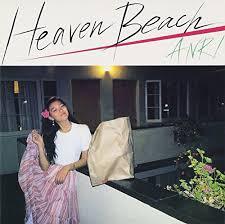
Y'know...I have my fair share of Anri(杏里)albums but I have yet to acquire "Heaven Beach"which was her 4th studio album from November 1982. Despite the autumn release, it must have been quite nice to hear the summer sounds from this one. Well, I assume considering the lady and the song of this article which is a track from the album, that it is a summery concoction.
"Last Summer Whisper" probably hasn't gotten onto any of Anri's many BEST compilations since the song is perhaps a little too mellow in a generic sense. However, I think it's one of those songs that Anri fans like me will come across for the first time and remark, "Gee, where have you been all my life?" It's really just a nice song of that time period representing City Pop and J-AOR. Not surprisingly, it's City Pop guru Toshiki Kadomatsu(角松敏生)who took care of words and music, and perhaps it was from this album that the Anri/Kadomatsu collaboration era began.
Of course, when I mention Kadomatsu these days, I start thinking about how all those Vaporwave and Japanese Future Funk fans may be kneeling in awe of him for providing so much material to mold. I've been hot and cold with some of those creations on YouTube. However, I have to admit that this one fellow, Boosted Bob (who's quite self-effacing in his description), did a pretty good job with his Vaporwave rendition of "Last Summer Whisper".
The music still sounds pleasing with a bit of spookiness while Anri's voice has been transmogrified to sound like either a supremely mellow Ken Hirai(平井堅)or Noriyuki Makihara(槇原敬之). Rather remarkable how that turned out.
Anyways, the original "Heaven Beach" only went as high as No. 89 on Oricon. I guess folks were too much into Christmas by that point. But no worries since Anri would go on an upswing as the 80s passed by. Plus, I still want to get the album.
Had a nice brief lunch with the anime buddy earlier today. We haven't done our usual biweekly Sunday routine for a number of weeks due to scheduling difficulties on both our ends so the outing at Olde York Fish N' Chips was quite good. Even got some of the good stuff for my parents since they also like the place.
It was quite summery this morning with a touch of humidity but we've been getting some fairly wet weather in the last several minutes. I'm sure folks out on the patios aren't too thrilled with the sudden change but having the humidity washed out for a little bit doesn't bother me.
Y'know, I don't quite remember all that much of a rainy Ginza when I was living in Japan. My memories of one of Tokyo's most expensive neighbourhoods have usually been quite sunny ones. Of course, Sundays have been the days when the main drag is closed down to vehicular traffic for about 6 hours so that the pedestrians can enjoy more walking and sitting space. Unlike old Akihabara which had a lot of the weird performance art and Akiba aidoru concerts, Ginza was pretty sedate with all of those tables and deck umbrellas covering them. However, I did remember seeing one Akiba-centric thingie with a cosplay girl playing dead on Chuo Avenue while her rabid partner as photographer was taking shots like a soldier on a machine gun. It's safe to say that the surrounding folks were mildly scandalized.
In any case, I did find this November 1967 Mood Kayo titled "Ame no Ginza" (Rainy Ginza) by Akira Kurosawa & Los Primos(黒沢明とロス・プリモス). This was their 5th single written by Masako Tokaki(冨樫政子)and composed by Hiroyuki Nakagawa(中川博之), and deals with a heartbroken woman standing on a Ginza corner in the rain, bereft of her man since the louse apparently found a replacement. I guess constant precipitation is also a good sign for the sad end of a romance along with falling leaves.
Now as for the lyricist 冨樫政子, I couldn't be completely sure of the reading of her name since I had never heard of her before and both her first and last names have different readings. So if Noelle or anyone well versed in her music can correct me, that would be greatly appreciated.
(empty karaoke version)
Ahhh...one of my old stomping grounds. I do hope that Yamano Music is still there when I visit the area next time.
Not sure how "Ame no Ginza" did on Oricon but the main vocalist here was Shoji Mori(森聖二)who became the 2nd leader of Los Primos after Kurosawa's departure in 1980. Kurosawa passed away in 2009 just before his 75th birthday (and again, this isn't the famous movie director Kurosawa) with Mori himself leaving this mortal coil a little more than 6 months later at the age of 70.
Again, it's not usually my custom to feature a singer or a band twice within a month but some time after I read commenter Karen's remark how much she liked ORESAMA's debut single after reading my article on their contribution of an anison to the show "Alice to Zouroku"(アリスと蔵六), I decided to take a look at the song.
Well, I gotta say that "Ohkami Heart" (Wolf's Heart) is quite the fun song and I think the video really helps! I guess I've always enjoyed those whimsical day-glo images that transports me back to the 80s. Don't know or can't quite remember who they were but there were some artists back then who came up with those images. In any case, whoever produced the video gets my compliments especially in their rendition of ORESAMA members Pon(ぽん)and Hideya Kojima(小島英也). As for the song itself, there is something old and new in the arrangement as if 80s technopop band PSY-S passed the baton to its next generation.
ORESAMA's debut came out in December 2014 as the ending theme song for the anime "Ōkami Shōjo to Kuro Ōji"(オオカミ少女と黒王子...Wolf Girl and Black Prince). My anime buddy never showed me this one despite the big-name seiyuu; I guess from what I've read of the plot, perhaps it was a little too sappy romantic for him. Vocalist Pon took care of the lyrics while Kojima composed the music.
I see that the band's other single, "Dramatic" has a video with a similar graphic design theme. Will have to look at that one, too.