Credits

I would like to give credit where credit is due. Videos are from YouTube and other sources such as NicoNico while Oricon rankings and other information are translated from the Japanese Wikipedia unless noted.

Friday, February 11, 2022

Hitomitoi -- Garasu no Summer Holiday(硝子のサマーホリデー)


I was actually saving this up for the arrival of the appropriate season several months down the line but I figure that being in February (aka the winter doldrums) and not having featured Neo-City Pop chanteuse Hitomitoi(一十三十一)in several months, perhaps it wouldn't hurt to have something summery today. Maybe it can bring in a bit of sun to part some of this seasonal drear.

"Garasu no Summer Holiday" (Glass Summer Holiday) is a track from Hitomitoi's December 2014 mini-album "Pacific High/Aleutian Low" (considering that release date, maybe the singer was also thinking the same thing about bringing in that bit of summer). Written and composed by her with a composer credit given as well to Tokyo DJ and music producer Grooveman Spot, it's got some crystalline keyboards, jangly guitar and even a soprano saxophone to keep the beat going. It sounds exactly how the photogenic Hitomitoi is basking on that lounge chair on the cover of the album. 

Anyways, I'm feeling quite toasty warm so I don't think that I'll quite need the cardigan now. Just hoping that the spring temperatures really do come soon.

Masahiro Taniguchi -- Wakakusa no Moeru koro(若草の萌える頃)


Welcome to another end of the business week. It's been balmy here in the Greater Toronto Area for the past few days and I don't think anyone is complaining although the streets are slightly slippery due to the thaw.

The other thing that's been slipping is my memory since the fellow that I am about to write about is someone that I'd thought was appearing on "Kayo Kyoku Plus" for the first time. However, I'm a tad embarrassed to admit that bassist/singer Masahiro Taniguchi(谷口雅洋)has had his debut on our humble blog since last August as a songwriter for MIO's "Mr. Monday Morning". In the article, I even made some reference to the song that is getting its just dues right here right now. Will need a Gibbs slap.

Anyways, this is "Wakakusa no Moeru koro" (When Young Grass Sprouts) which is an odd title for what I think is a very pure City Pop song. The third track from his 1980 debut album "Communication"(コミュニケーション), I don't know the botanical significance of the song but it is a classy hotel bar-friendly tune that was composed by Taniguchi, written by Keisuke Yamakawa(山川啓介)and arranged by Mitsuo Hagita(萩田光雄). Perhaps the botanicals are the herbs in his cocktail that he's sipping in the bar.

I love the Fender Rhodes, the silky strings, and Taniguchi's vocals which remind me of the voice of Junichi Inagaki(稲垣潤一), another City Pop veteran (for that matter, I also get shades of Hideaki Tokunaga). Just like that setting that I mentioned in the previous paragraph, there is something nice and downtown classy about Hagita's arrangement. And before I forget, I would love to know who's helping with the backup chorus.

Some final trivia about Taniguchi is that he not only hails from Kyoto but he's been going by a different name over the years: Mamoru Taniguchi(谷口守). Not sure if Mamoru is his real name or not but you can take a look at his website to check his credentials out. Also over the decades, along with MIO, he's provided tunes for Hiromi Go(郷ひろみ), Kaori Momoi(桃井かおり)and Mariko Nagai(永井真理子)among other singers.

Thursday, February 10, 2022

Lover Callots -- Lover Callots no Theme(ラバーキャロッツのテーマ)


Always keep searching in that underwater 90% of that J-Pop iceberg since you will come across some riches. 

I found one recently and it's called Lover Callots(ラバーキャロッツ), a band that was centered around the core of vocalist TAMAc and bassist GURI. They had their run between 2002 and 2005, and according to their J-Wiki profile, they specialize in pop and jazz. The band released four singles and two albums.

From their November 2003 debut album "Oshare Quest"(おしゃれクエスト...A Stylish Quest) is the first instrumental track "Lover Callots no Theme" (The Theme for Lover Callots), and it may be short at a little over three minutes, but it really does give a fine introduction to the guys. Everyone gets their time in the sun to shine with some of their jazz instrumental improvisation but I also can't help but get some of that Shibuya-kei feeling in there, too. In addition, the way that it's recorded with the brief horsing around in the first several seconds and the yell of "We are Lover Callots!", it also sounds like the band was actually performing a live gig somewhere in some stylish club in Daikanyama or Shimo-Kitazawa.

The Cherries -- Tobe Tobe(翔べ翔べ)


Man, you Takarazuka Revue fans ought to love this scene. In the first few minutes, Takarazuka veterans Rumiko Koyanagi(小柳ルミ子)and Jun Anna(安奈淳)dance up a storm to the Japanese version of "The Way We Were". And this is happening on an NHK broadcast of an old music series called "Hana no Stage"(花のステージ...Stage of Flowers) which I can assume was an ancestor for the current "Uta Con"(うたコン)that is televised on Tuesday nights on the national network. It had its run under that title between January 1978 and April 1980 with hosts ranging from the aforementioned Koyanagi to rocker and songwriter Ryudo Uzaki(宇崎竜童).

In addition, back in the day, "Hana no Stage" apparently had mascots in the form of a trio of young women: Yumi Suzuki(鈴木由美), Kaoru "Kako" Komata/Furumata(古俣かおる), and Misako "Misa" Watanabe(渡辺美佐子), according to "Idol.ne.jp". They were collectively known as The Cherries(ザ・チェリーズ)and they released a total of 7 singles which even went far beyond the time of "Hana no Stage" into late 1981

Their debut single from April 1979 was "Tobe Tobe" (Fly, Fly) and it had the cachet of being written by Yu Aku(阿久悠)and composed by Takashi Miki(三木たかし). With vocals reminiscent of those of popular 70s aidoru Candies(キャンディーズ), there is also quite a bit of polish with "Tobe Tobe". Along with that aidoru tempo, I also get some Fashion Music and even a mild dollop of progressive rock in there.

England Dan & John Ford Coley -- I'd Really Love to See You Tonight


I never thought that this particular song would make it into a film but according to its Wikipedia entry, it actually got into a few movies including the 2013 comedy "Anchorman 2". Never saw that one although I did catch the first movie.

This week's ROY article deals with "I'd Really Love to See You Tonight", a soft rock classic from May 1976 that I used to hear over and over on AM radio when I was a teen. It was just too bad that I always had a tough time remembering who sang it because I guess at the time, I wasn't accustomed to hearing a country's name being included in a person's name but indeed the duo is England Dan & John Ford Coley.

The duo had been together for a decade between 1970 and 1980 with their share of singles and albums under their belt, but "I'd Really Love to See You Tonight" is the only one that I remember by them as this calming ballad about giving love a second chance. It's that piano and the strings that make it for me. The song made it to the top of the Adult Contemporary charts in both America and Canada, and though I've heard that covers have been done by no less than Barry Manilow and Ian McShane among others, it'll always be the original by England Dan & John Ford Coley that I come home to. Strangely enough, I found out that an earlier song "Simone" from 1972 became a No. 1 hit in Japan.

According to Showa Pops, these kayo classics were released in May 1976 although at least for one of them, it was more like April.

Minako Yoshida -- Yume de Aetara (夢で逢えたら)


Hi-Fi Set -- Tsumetai Ame (冷たい雨)


Mieko Nishijima -- Ikegami Sen (池上線)

Wednesday, February 9, 2022

Ai Otsuka -- LUCKY☆STAR


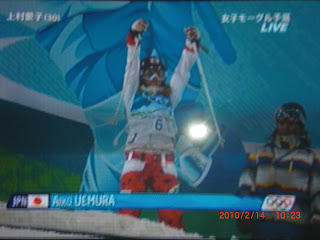
Now that the Beijing Olympics are in full swing currently, it's been nice to hear that both Canada and Japan have already been earning some medals of various colours. My mind then goes back a dozen years to the Vancouver Games in 2010...and doesn't remember very much at all. In fact, I had to go to some of those impromptu shots by my ancient Casio that I took of some of the televised footage, including the above photo showing off Aiko Uemura(上村愛子)on the moguls.

Singer-songwriter Ai Otsuka(大塚愛)is someone that I've known for her 21st-century bubblegum pop through songs such as "SMILY". I must have then focused solely on the NHK coverage of the Vancouver Olympics since I had no knowledge that the happy-go-lucky Osakan was also behind Fuji-TV's official theme for their Games broadcast in 2010. Indeed, she came up with "LUCKY☆STAR" which was a part of her 20th single "Zokkondition/LUCKY☆STAR"(ゾッ婚ディション/LUCKY☆STAR) as released in April of that year.

"LUCKY☆STAR" has got quite the mixture of spacey dance beats and jangly guitar and it doesn't really sound like the usual inspirational Olympic J-Pop song, but it is indeed catchy. I would have thought it was a tune created by Denki Groove(電気グルーヴ)but it's actually all by Otsuka. The official music video has a goodly dollop of computer graphics to the extent that I wondered if the Pet Shop Boys' 90s videos had been any inspiration. The entire single hit No. 6 on Oricon. "LUCKY☆STAR" would also be included in Otsuka's 6th original album "Love Fantastic" from July 2014. The video below has the instrumental version which is in itself pretty cool to listen to.


Azumi Inoue -- Yume Hiko(夢飛行)


Spoke to a couple of friends over the past few days, both of whom have plenty of Japan experience, and at least one of them is really itching to head over there again for vacation, perhaps later this fall. I really hope that his wish comes true although I really doubt that I'll be able to get there again anytime before 2023. By that time, it'll have been 6 years since my last flight out to my old stomping grounds.

Speaking of those long-awaited dream flights, I have one here with that very title in Japanese. "Yume Hiko" (Dream Flight) was the B-side to Azumi Inoue's(井上杏美)debut single "Star Storm" in April 1983. At first, that name didn't quite hit the recognition circuits, because she was going full kanji at the time, but when I noticed that she'd already had an entry on "Kayo Kyoku Plus", I realized that it was the Azumi Inoue(井上あずみ)who'd been responsible for singing the theme songs for the Hayao Miyazaki(宮崎駿)classic, "Tonari no Totoro"(となりのトトロ)in 1988. The Kanazawa native was actually born Midori Miyazaki(宮崎みどり)but took on her stage name based on a book written by a Kanazawa-born author Saisei Muro(室生犀星)titled "Anzukko"(杏っ子).

That jingly synthesizer which starts "Yume Hiko" is really quite nostalgic for me and it does remind me of those really cute aidoru tunes from the early 1980s, additionally enhanced by Inoue's high-and-clear vocals. I also can't forget that wailing electric guitar which finishes things off. Written by Rie Ohtani(大谷リエ), the melody was composed by Toshiaki Matsumoto(松本としあき), a pianist and composer who also later changed the transcription of his name(松本俊明)and has since become even more famous for a couple of Xmas tunes, Junichi Inagaki's(稲垣潤一)"Merry Xmas ga Ienai" (メリークリスマスが言えない)and Misia's "Everything".