Credits

I would like to give credit where credit is due. Videos are from YouTube and other sources such as NicoNico while Oricon rankings and other information are translated from the Japanese Wikipedia unless noted.

Monday, February 28, 2022

Tokyo Mokuyo Gakudan -- Mayonaka no Service Area(真夜中サービスエリア)


Unfortunately, I never got all that many opportunities to visit the famous roadside service areas of Japan (similar to those gas station/convenience store combinations here) since neither my friends and I got together in cars. My only chances were through the occasional bus tour that I got to go on including a trip to Yamanashi Prefecture one time with fellow teachers and students.

From what I've read and seen through translation assignments and variety shows like the above with popular tarento Matsuko Deluxe(マツコ・デラックス)raiding the Ebina Service Area after midnight for some of her beloved melon buns. Those facilities can be huge and I didn't even realize that they can be open past midnight, although the COVID situation may have changed opening times dramatically.

In recent days, I discovered this enigmatic band called Tokyo Mokuyo Gakudan(東京木曜楽団...Tokyo Thursday Band) which identifies itself as a multi-pop band. Not quite familiar with the term multi-pop but I can assume that they may take on genres such as indies pop, City Pop or pop/rock. There's barely any information about them anywhere although they have put out several singles and albums since the late 2010s, but there is a Twitter account for them that has been up since 2018. As for their name, apparently it's because they hail from West Tokyo and they meet every Thursday.

My first song by them is "Mayonaka no Service Area" (Midnight Service Area), a groovy and comfortable pop tune although I'm not sure whether I would put it in the genre of Neo-City Pop despite the use of a car in the music video. Mind you, they're not in the city per se as would be logical since the title refers to the rural service area along the highway. If I've got it right, the song came out in late 2019 and it has its moments of determined driving and dream-like rest stops with a rumbling piano and electric guitar that takes me and perhaps other listeners back to the 1970s, so "Mayonaka no Service Area" definitely has my attention.

Now, what would I get if I ever had the chance to stop at a service area past midnight? I'm OK for melon buns, but they wouldn't be in my Top 10. A nice hearty bento would be my best bet even though post-midnight indigestion would be a definite possibility.

Yuma Nakamura -- Dang Dang Ki ni Naru(Dang Dang 気になる)


As I've pointed out over the years, inside and outside of the blog, the Japanese are absolute foodies to join their brethren in places like America and the UK. One can throw a proverbial rock in the broadcast media zeitgeist and in all likelihood, it'll hit a cooking show or a program which is displaying a food-based segment. There are magazines that focus on a certain dish or drink such as ramen or coffee. And of course, there have been anime that have been based on food in general. For example, one such show that I've enjoyed is "Koufuku Graffiti" (幸腹グラフィティ...Gourmet Graffiti).


I never saw the anime but I have sometimes read the originating manga "Oishinbo"(美味しんぼ...The Gourmet) in a barber shop or two when I was living in Japan. The manga debuted in 1983 with the anime coming out in 1988, lasting for a few years. Premise-wise, it's all about the adventures of blasé but very knowledgeable culinary journalist Shiro Yamaoka and his partner, in work and then in life, Yuko Kurita, as they encounter all sorts of gourmet mayhem.


As I mentioned, I never caught the show but yesterday as I was continuing through the massive compilation album of Tetsuji Hayashi's(林哲司)works, thanks to JTM's generous gift, I did hear one of his compositions which was the second opening theme for "Oishinbo", "Dang Dang Ki ni Naru" (Bang Bang I'm Into You) by aidoru Yuma Nakamura(中村由真).

Released as her 9th single in June 1989, I was surprised that I had yet to have a Yuma Nakamura article on KKP. I guess that I assumed that she was on the blog because so many of her fellow "Sukeban Deka" 『スケバン刑事』sisters already had representation here. In any case, it's quite the sprightly theme song for a food anime with the synths in there. And if I'm not mistaken, those synths are giving out a slight House beat. I also have to give my compliments to the opening credits since they present a gorgeous vista of Tokyo, much like how "City Hunter" did while "City Hunter: Ai yo Kienai de" (愛よ消えないで)was playing.

Along with Hayashi's contributions, Masao Urino(売野政男)provided the lyrics while Motoki Funayama(船山基紀)arranged everything. It peaked at No. 17 on Oricon. From what I've read, Nakamura moved to live in Los Angeles in 2005 before making another move to Austin, Texas around 2020.

Sunday, February 27, 2022

Southern All Stars -- Hello My Love


Southern All Stars(サザンオールスターズ), true to their reputation as being one outrageously fun-time legendary band, has also come up with some very notable album covers over their career. One such cover was the one for their July 1981 release "Stereo Taiyo-Zoku"(ステレオ太陽族...Stereo Sun Tribe) with the junior high school girl wearing a very stylized mask. I've got no idea what the significance of it was, and when I read the J-Wiki article for "Stereo Taiyo-Zoku", leader and singer Keisuke Kuwata(桑田佳祐)himself in 2015 even said that the cover looks horrible. Well, it's a cover that I first remember seeing decades ago, so I think that it did its job.

Anyways, Rocket Brown introduced me to the first track on the album when we spoke last weekend, and it's quite the pleasant and slightly atypical Southern All Stars tune. "Hello My Love" begins with strings that almost had me thinking AOR then it evolves into a surprising Tatsuro Yamashita(山下達郎)arrangement, complete with those horns. But Kuwata's distinctive vocals reassured me that this was indeed an SAS tune as the song continues to change into its main form of cheerful Dixieland jazz although the Tats rhythm comes back now and then.

Kuwata took care of words and music. I remember from one KKP article about the band in which I mentioned that it has been standard operating procedure for Kuwata to inject some sex into the lyrics. I had thought that considering the old-timey nature of "Hello My Love", maybe an exception was made for this track, but when I took a look at the lyrics, it turned out that ol' Keisuke was still getting that knocking for knocking boots. And hey, the following second track is "My Foreplay Music".😮

Incidentally, "Stereo Taiyo-Zoku" was at the No. 1 position on Oricon for 6 straight weeks before finishing the year as the 13th-ranked album. I guess that it really stayed up.😜

Cherish -- Kasukabe Samba(春日部サンバ)


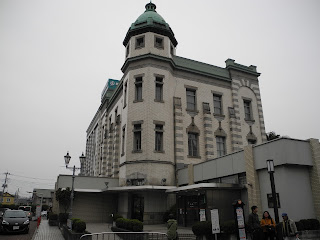
When I went to visit Japan again in 2017, my friend Hiro and I got to go to a section in Kawagoe City, Saitama Prefecture called Koedo(小江戸)which features a lot of historical architecture including the building in the above photo. It apparently was a bank back in the day. But aside from that municipality, the only other city that I've visited in Saitama was the capital, Saitama City.

Indeed, I've heard of Kasukabe City in Saitama but alas I never had the opportunity to visit it. Apparently, it's home to the famous anime character of Crayon Shin-chan(クレヨンしんちゃん)and his family. By the way, the video is by the channel Virtual Walk/All Over Japan.

Earlier tonight on the news, the anchor reported that Carnaval has started up once more in Rio which I'm happy about, and that one of the first things to get under way was some sort of samba festival. So I thought that I could find something samba-esque among the kayo

Well, I did find "Kasukabe Samba" but it really doesn't sound like a traditional Brazilian samba at all. Still, it's very pleasant listening although I was surprised that this was actually a single provided by the folk duo Cherish(チェリッシュ)in 1990 as a promotion for the city of Kasukabe. The reason that I was surprised was that in spite of the release year, it certainly sounds more like something that came from the 1970s, around the same time that the duo's arguably most famous hit, "Tento Mushi no Samba" (てんとう虫のサンバ)was released. This was written by Akira Ito(伊藤アキラ)and composed by Shunichi Makaino(馬飼野俊一).

Ringo Shiina -- Yami ni Furu Ame (闇に降る雨)


When I first heard about the initially terrifying and terrifyingly talented singer-songwriter Ringo Shiina(椎名林檎)just around the turn of the century via friends, my impression of her at the time was that she wasn't one to cross...ever. Shiina seemed to have this thousand-kilometre glare in her performances back then that said "Hi! My hobby is vivisection!". But then, I discovered this YouTube video and realized that she can goof about like the rest of us.


But heck...back in those years, she certainly made an impression from her music, singing and visuals via those music videos. And so is the case with "Yami ni Furu Ame" (A Driving Rain in Darkness) which was a track on her March 2000 2nd album "Shoso Strip"(勝訴ストリップ...Winning Strip)

Looking at the translation of her lyrics at Anime Lyrics, I gather that she has been seduced by a darker entity of the real rather than the falseness of the light and happy. Fair enough, but dang, I love the music. With the strings in there enhanced by the music video images in that huge mansion (a treat for both Ringo fans and psychoanalysts), I can imagine this as being Shiina's rock version of Fashion Music, kayo kyoku's take on baroque pop...with some Beatles-like psychedelia with what sounds like a sitar.

And yet, I was surprised to read in the blurb for "Yami ni Furu Ame" on J-Wiki that Shiina stated that this was the song where she gathered all of the classic enka tropes for it! In fact, when she listened to the complete product, she declared that this was so Masako Mori(森昌子). I guess that I'm going to have to listen to this some more. In any case, the originating album hit No. 1 for three weeks in a row and ended up as the 3rd-ranked album of the year. 

Yukari Ito -- Sasurai(さすらい)


Personally speaking, I can't say that I am a particularly good traveler. I never developed the wanderlust or the smarts or the financial supply to head on out to a different country to explore, so I do have the admiration for those (and they include some of my friends) who have taken that jet, ship or car to take the risk to go around that unknown country, meet new people and learn new things.

Kayo kyoku has plenty of examples where such folks have gone onto new pastures within and outside of Japan, but usually not on a mission of learning but one of forgetting, namely that romance that has dried up like autumn leaves in late November. The one example that comes immediately to mind is enka veteran Sayuri Ishikawa's(石川さゆり)trademark "Tsugaru Kaikyo Fuyu Geshiki" (津軽海峡・冬景色).

I found another example, and this time, it's a sad straight kayo titled "Sasurai" elegantly sung by Yukari Ito(伊東ゆかり). According to Jisho.org, the term means "wandering alone in a strange country", and the lyrics by Ou Yoshida(吉田旺)clearly illustrates this as the protagonist walks around in a new town with no people she knows as she searches for someone to unload her story to. Perhaps that town might be located way out on the other side of Japan, but the melancholy melody by Shosuke Ichikawa(市川昭介)under his pseudonym of Akira Nishi(西あきら)indicates that the man or woman may have gone as far afield as France or Spain (mind you, the last minute of the song gets overlaid with some boppy 70s kayo percussion). 

"Sasurai" was released as Ito's 21st single in October 1970...perfect timing in kayo terms since that is when the romance falls as much as those autumn leaves. In a way, although I think that Ito delivers this wonderfully, this is also a song that could fit the discographies of either Hiromi Iwasaki(岩崎宏美)or Akina Nakamori(中森明菜)in her diva period.

Saturday, February 26, 2022

Ryo Fukui -- It Could Happen to You


All right, I'll have to confess. I do play the lottery once a month here in Toronto through things like Lotto Max and Lotto 649 although I have a very Vulcan attitude toward the whole concept since there is a certain illogic of thinking that one could win a lottery despite the millions to one odds. Yet, in a Captain Kirk moment, people still do win the millions of dollars. 

The recent commercials for Lotto 649 have had a smooth-sounding announcer enticing folks to get their numbers since as he says "Somebody will win. It could be you", or something along those lines. Well, enjoying my snark like all cynics and based on what a University of Toronto statistician once chortled, I can add "Somebody will win. It WON'T be you".

But all that preamble ramble about my lottery experiences...and no, the most that I've won is $20...is because the title of this song is "It Could Happen to You" as performed by the late jazz pianist Ryo Fukui(福居良). This was a track from his debut album "Scenery" from July 1976 and it's a winning number (no pun intended considering that ramble) because of that expression of bounciness and joy from his performance. When I first heard Fukui's version of "It Could Happen to You", I rather felt like Snoopy when he was dancing around while Schroeder was jamming away on the piano in "A Charlie Brown Christmas". Yup, any contemporary of Vince Guaraldi will be a contemporary of mine.

My previous article was on Saburo Kitajima's(北島三郎)"Kita no Daichi"(北の大地)and that was all about the wonder of Hokkaido nature. Well, Fukui hailed from Japan's northernmost prefecture and his career was based there, frequently playing at a club in Sapporo until his untimely passing in 2016. In addition to "Scenery", he put out three more albums up to 2015 and a couple of live releases. Below is Fukui's performance of the song at that club, Slowboat.


Composer Jimmy Van Heusen and lyricist Johnny Burke first created "It Could Happen to You" in 1943 and actress/singer Dorothy Lamour first sang it in the musical comedy "And the Angels Sing" in the following year.

The Wikipedia article behind the song shows a paragraph several lines deep of other singers and bands who have covered it over the decades, so it has definitely become a beloved jazz standard. One of those artists is Miles Davis who took it on in his 1958 "Relaxin' with the Miles Davis Quintet".