I've been a fan of Japanese popular music for 40 years, and have managed to collect a lot of material during that time. So I decided I wanted to talk about Showa Era music with like-minded fans. My particular era is the 70s and 80s (thus the "kayo kyoku"). The plus part includes a number of songs and artists from the last 30 years and also the early kayo. So, let's talk about New Music, aidoru, City Pop and enka.
Credits
I would like to give credit where credit is due. Videos are from YouTube and other sources such as NicoNico while Oricon rankings and other information are translated from the Japanese Wikipedia unless noted.
Love Kahoru Kohiruimaki(小比類巻かほる)during this time period. I mean, I liked her pop/rock repertoire in the late 80s as well, but when she started going into R&B from the 90s, I think she made some pretty fun stuff.
"Mirage Mirror" was one of her memorable tunes from the early 90s. It was the first track from her 8th album, "Silent" released in September 1991. The original album version started off with a lead-up synth rumbling before launching into a Seinfeld-esque bass guitar riff (anyone who has seen "Seinfeld", the old US sitcom will know what I mean) and then into the main happy funk. The lyrics were by Kohhy herself and the melody by Yoshiaki Ohuchi(大内義昭).
Kuniko Yamada(山田邦子), a homely but hilariously cheeky comedienne, first found fame on the Fuji-TV Saturday night comedy-variety show, "Oretachi Hyokinzoku"(オレたちひょうきん族...We Are The Funny Guys) which pretty much ran for the entire decade of the 1980s. Her specialty was impersonating singers, but I recall seeing her in a segment in which she drew some surprisingly racy stuff in front of the kids. But with her own star rising, Yamada eventually got her own variety show on the same network from October 1989 titled "Kuni-chan no Yamada Katsutenai Terebi"(やまだかつてないテレビ....Kuni's Yamada Unprecedented TV) every Wednesday night. It was part of my weekly viewing routine during my years in Gunma. The comedienne was her usual hammy self in various skits and segments with other regulars, but a number of musicians also achieved a form of semi-regular status on the show.
So, in March 1991, a double-CD pack which resembled one of those cubic watermelons that Japanese scientists had concocted some years back was released titled "Yamada Katsutenai CD"(やまだかつてないCD....Yamada Unprecedented CD). Being a fan of the show, of course, I just had to purchase my own copy. CD 1 has all of the original songs while CD 2 contains the karaoke versions of those songs. Almost half of them have already been profiled: Kan -- "Ai wa Katsu", Mariko Nagai -- "ZUTTO" and the late Kaori Kawamura -- "Tsubasa wo Kudasai".
Kawamura also had another contribution to the show in the form of "Kamisama ga Oritekuru Yoru"(神様が降りてくる夜...The Night The Gods Come Down), a pop-rock tune which was used as the theme for one of the recurring segments: a parodic feature on medieval Japanese court life. The song was created by Ken Takahashi(高橋研).
During the turn of this decade, the singing duo Wink had become one of the big acts in show business. Of course, Kuniko Yamada, whose talent lay in impersonating singers, just couldn't resist and decided that she needed to impersonate them. So, she incorporated another segment in 1990 titled "Nihon Zenkoku Sachiko Sagase"(日本全国早智子探せ.... Find A Sachiko All Over Japan) in which her Shoko Aida would find the right Sachiko Suzuki. She found her.... Chie Yokoyama(横山知枝), a high school student from Hiroshima Prefecture. Together they formed the unit, Yamadakatsutenai Wink(やまだかつてないWink), and their first single was "T-Intersection -- Anata ni Modorenai"(T-Intersection -- あなたに戻れない...I Can't Return to You), an uptempo Eurobeat piece whose lyrics were written by Yamada herself and composed by saxophonist MALTA.
In the following year, the ersatz Wink came up with a ballad titled "Sayonara dakedo Sayonara janai"(さよならだけどさよならじゃない...It is and It Isn't Goodbye), which was also written by Yamada and composed by regular guest KAN. It was created partially as a tribute to Yokoyama who was on her way to graduating from high school and onto college. However, it's become a graduation song for just about everyone. It did become a hit, peaking at No. 2 and ending up as the 49th-ranked song of 1991. The entire disc set itself was able to hit the top spot on Oricon as well.
There is also a Xmas song by the duo on the CD, but let's save that for a more appropriate time.
Yamada Katsutenai CD
Discs to help me remember the late 80s and early 90s
I only found out about this song barely a couple of hours ago on a tape-delay broadcast of NHK's "Kayo Concert". Sayuri Ishikawa(石川さゆり)did her rendition of this song so I decided to do a bit of digging, and found out that it was first released in 1955. Eto Kunieda(エト邦枝)was the first to sing it. A native of Asakusa, Tokyo, she had been studying at the Imperial Music Academy and working at the Ministry of Finance. Once she graduated from the academy, she went from recording company to recording company until she was picked up by Teichiku in 1954.
"Casbah no Onna"(Casbah Woman), written by Hisao Ohtaka(大高ひさを)and composed by Akira Kugayama(久我山明), was a sad tune of one woman's plight, doomed to work in a bar while dreaming about what life would be like in the more exotic cities of the world like Tunis or Paris. At the time, the song didn't become a huge hit but cover versions done in the 60s during a boom in the oldies brought some redemption. I think it's one of those songs that makes one contemplate one's role on this hill of beans.
Not sure when the Naomi Chiaki(ちあきなおみ)version came out but it's still a wonderful rendition nevertheless. Enjoy it with that tumbler of whiskey.
As for Kunieda, she retired from music to become a trainer for bus guides, and she even opened up her own karaoke school in her home. But with the re-discovery of "Casbah no Onna", she was welcomed back with open arms onto the stage, including this one for the program "Omoide no Melody"(思い出のメロディ....Melodies of Memories) in 1976. And there was perhaps one more appearance at a kayo festival in 1986 sponsored by the Japan Singers' Association, a year before she passed away.
This is an Osaka-based band that I found out purely by accident one night while I was couch-potatoing in front of my TV set on one of the Japanese music channels. I had been just drinking down my coffee when I almost got my head blasted off by vocalist Yoshie Nakano's scream of "FEEEEEEEEEEEEEEEEVERRRRRRRRRRRRRRR!!!"
What followed was this raucous anarchic mash of rockabilly and jazz (with some added post-punk) led by Nakano's sonic growly chewing of her own lyrics. I wish I could translate them but after looking at them, I would need to speak to Freud himself (very well-titled song, by the way).
Ego-Wrappin'was formed in 1996 with Yoshie Nakano and Masaki Mori(中納良恵・森雅樹)as the guitarist and co-songwriter of the duo. "Psychoanalysis" was not released as a single but was one of the tracks on their 2nd album, "Michishio no Romance"(満ち汐のロマンス....Tide Flow Romance), released in 2001.
I was definitely interested by Ego-Wrappin' just from this song alone so I bought the album. Nakano can go really deep and trashy with the voice or elegantly jazzy in the album's first track, "Katsute"(かつて....Never Before). Their star was definitely rising in the early 2000s....a few more albums came out afterwards with regular frequency. They definitely appeared to have street cred just from how they looked; the video looks like it was shot in one of the many cramped live houses in the entertainment districts of either Tokyo or Osaka and the band had that look of unproduced bohemian NOSTALGIA! (inside joke there) In fact, I would say that Nakano in the video appeared like a don't-mess-with-me mama-san of a tiny watering hole in Shinjuku. (hey, she's from Osaka...she's tough).
Definitely one of the more original musical units I've come across.
Anri's(杏里)14th single is considered up there with "Olivia wo Kikinagara"(オリビアを聴きながら....While Listening to Olivia) and "Cat's Eye" as her most representative hits. In fact, "Kanashimi ga Tomaranai" was released in November 1983, just a few months after "Cat's Eye" had come out.
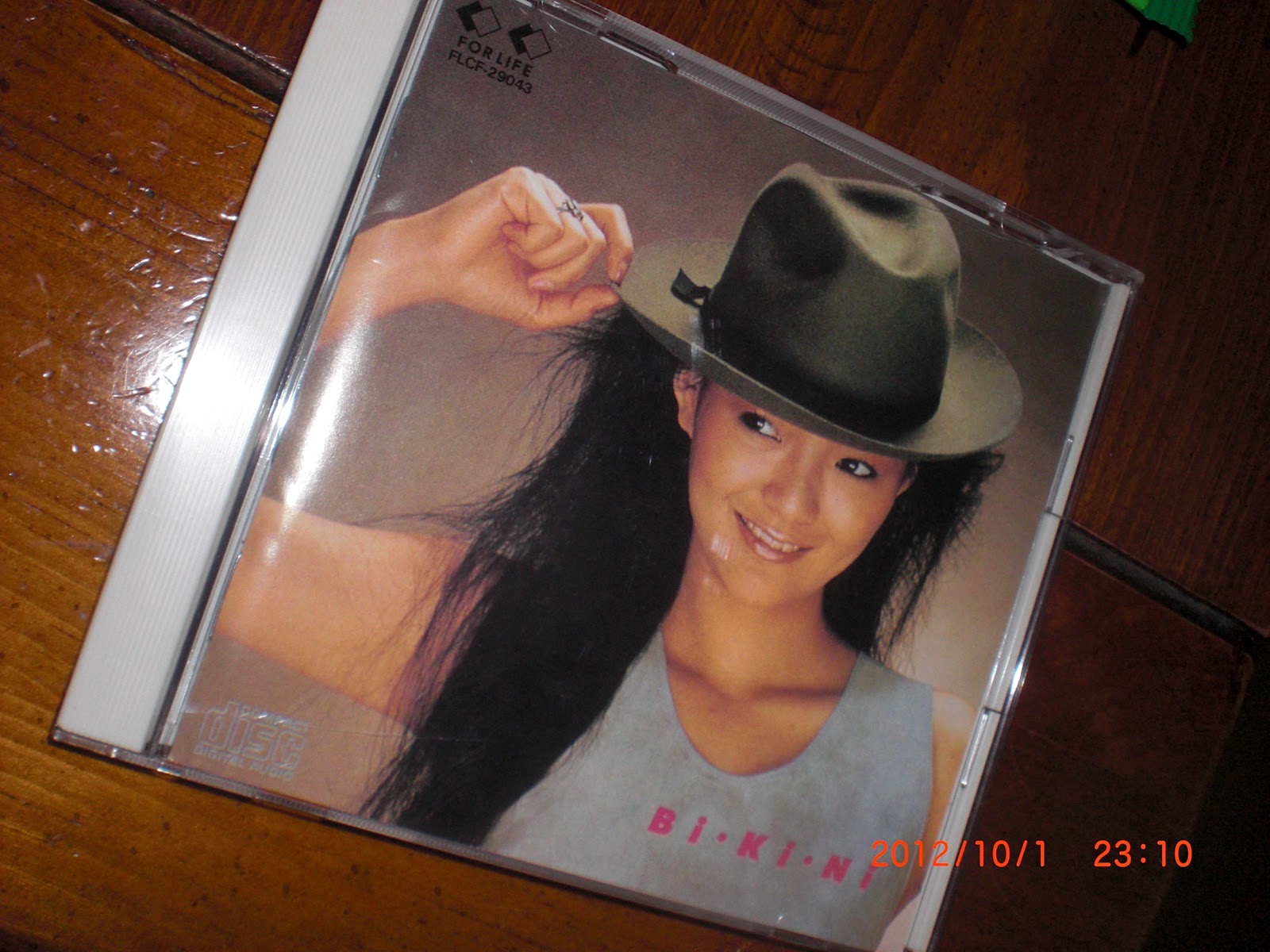
Chinfa Kan and Tetsuji Hayashi(康珍化・林哲司)were the creators behind the tune, but it was Hayashi and Toshiki Kadomatsu(門松敏生)who did the arranging. I mention this because it was from this year that Kadomatsu had a pretty strong influence on Anri's repertoire through writing, composing and arranging a number of her songs through three albums starting with 1983's "Bi-Ki-Ni" and "Timely!!", and "Coool"(1984). He put a bit more boogie into the beat, a little more dazzle into the dance.
"Kanashimi ga Tomaranai" was part of "Timely!!", and it's notable for the opening lyric which is basically the direct translation of the title, "I can't stop the loneliness", and the 70s disco feel to the proceedings. It's also an interesting song melodically since there is this juxtaposition of the disco chorus with a sweet, almost-aidoru like approach to the verses although the lyrics talk of the usual lost opportunity at love.
This song along with "Olivia wo Kikinagara" were the Anri choices for heavy rotation singing at my old haunt of Kuri.
Here are Anri and Kadomatsu with their joint take on the song. "Kanashimi ga Tomaranai" got as high as No. 4 on Oricon, and it was the 19th-ranked song of 1984. BTW, I just love the trumpet solo....so Maynard Ferguson.
Anri -- Bi-Ki-Ni (1983)
Maybe THE iconic picture of the lass.
Kentaro Shimizu(清水健太郎) started out as an actor and tarento when he got his big musical break with "Shitsuren Resutoran"(Heartbreak Restaurant). Written and composed by R&B singer Hiro Tsunoda(つのだ☆ひろ) (he was the deep voice at the very beginning of Akemi Ishii's 1986 hit "Cha-Cha-Cha"), the song is a kayo kyokufunk classic with all of the Fender Rhodes piano and guitar and horns....just has that cool urban sound that I enjoyed in 70s Japanese pop.
Released in November 1976, Shimizu's debut single was a monster hit which spent a month at the top of the Oricon charts in 1977, and became the 9th-ranking song of that year. He also won the Newcomer's Award at the Japan Record Awards and an invitation to perform at that year's Kohaku Utagassen.
It was just one of those chance meetings when I stepped into a CD store one day and I heard this pretty little song on the speakers. Yumi Tanimura(谷村有美)had released her second BEST album, titled "With II", so the store was dutifully pushing that. I guess I have a soft spot for Burt Bacharach-inspired horns in a ballad. "Tomodachi" (Friends) is one of those soft pop ballads that deserves a listen over a cup of tea. It was released in November 1990 as her 6th single.
(instrumental version)
The period going from the 80s into the 90s was notable for a number of trends in music. One of them consisted of these female singer-songwriters who were into the more softer areas of pop music. Tanimura was one of them, along with Reimy(麗美)and Mariko Nagai(永井真理子).