I've been a fan of Japanese popular music for 40 years, and have managed to collect a lot of material during that time. So I decided I wanted to talk about Showa Era music with like-minded fans. My particular era is the 70s and 80s (thus the "kayo kyoku"). The plus part includes a number of songs and artists from the last 30 years and also the early kayo. So, let's talk about New Music, aidoru, City Pop and enka.
Credits
I would like to give credit where credit is due. Videos are from YouTube and other sources such as NicoNico while Oricon rankings and other information are translated from the Japanese Wikipedia unless noted.
I had plans to put up someone else tonight but when I came across this video by Yui Murase(村瀬由衣), I had to put her on priority. Not that I think her "To Each His Own" is the most amazing ballad that I had ever laid my ears upon and it's not even the best track on her debut album, "Suiyoubi no Asa, Mado wo Akeru"(水曜日の朝、窓を開ける...Open Your Windows on Wednesday Morning) from April 1992. It is just that I had been looking for any signs of proof of life on the Net for a Murase song, especially from this album.
"Suiyoubi no Asa, Mado wo Akeru" was an album that I got through the "Eye-Ai" CD service over 20 years ago. It was obviously purely on sight alone and there was something attractive about the lady with the pale complexion peeking behind the screen.... just something that drew my eye and had me part with my money. Murase is one of those obscure singers who would get blank looks from about a hundred folks in Japan if I asked them about her before I finally found someone who had some inkling about who she is. From what I remember reading about her on the blurb on the menu list in that issue of "Eye-Ai" was that she started out working as a backup singer for a number of other artists before striking it out on her own behind the mike.
Murase has her own website and according to her biography there, she moved up to Tokyo when she was only 15 to become a singer. In her music club at Meiji University, she became a vocalist for a band with a West Coast rock sound before passing an audition to perform jazz in concert houses and hotel lounges from 1984.
As I said the English-language "To Each His Own" is a track on her debut album, and it's representative of the mellow AOR sound for her release. At the time, as much as female singers and bands were finding their rock growl, there were artists such as Murase, Miki Imai(今井美樹)and Midori Karashima(辛島美登里)who were going the other way with a more relaxed and delicate approach from the late 80s into the early 90s following the champagne synths-spiced City Pop during the Bubble Era. This particular ballad was written by Rumiko Varnes and composed by Daisuke Inoue(井上大輔). Hopefully, there will be more tracks from "Suiyoubi no Asa" posted somewhere.
Little did I know until a few minutes ago just when I was about to finish the article that Murase's song was actually a cover version of the original by Inoue himself. It sounds even more laid back and was a track on his 1989 album"Sapphire Blue".
Another Monday...back on the commute to the salt mines, as it were. Mind you, here in Toronto, when you have the Toronto Transit Commission breaking down here and there way too often...well, the trip to and from work can feel like a trip down a flight of stairs. In my case, I don't have to commute anymore and today, I seem to have that rare day off. Plus, I have another Monday to look forward to.
In this case, it's Monday Michiru(Monday満ちる). A singer-songwriter who is currently based in New York City, she's the daughter of famed jazz pianist Toshiko Akiyoshi(穐吉敏子)and the late alto saxophonist Charlie Mariano. I've heard about her for years and in terms of her music genre, I've placed her with R&B singers such as Misia and Harumi Tsuyuzaki(露崎春女). I have a couple of compilation albums which have tracks by her and I even purchased one of her albums from Recomints in Nakano Broadway. However, those songs never quite hooked me at first listening.
Then, today I encountered her YouTube videos with her 3rd single, "You Make Me" from July 1998. Incidentally, the song is on that one album by her that I did purchase "Selections '97-'00". Over the years, I've learned that I love an R&B tune which has good groove, great horns and wonderfully soulful vocals. Congratulations, Monday...you made my Monday! "You Make Me" is one of those songs that completes my R&B trifecta. Darn catchy and something that can be heard over the earbuds to make that commute a little more pleasant. I'm not sure if it did anything on Oricon, but who cares? It makes me happy.
Just a small observation from me, but Monday looks like a big sister to Chloe Bennett, aka Agent Daisy Johnson from "Agents of SHIELD". Yeah, geek on! But moving on, I will have to dig up that Monday Michiru album and give it another go.
"You're my sunshine" was the Namie Amuro(安室奈美恵)song that I liked the least out of all of the hits that were generated by the Okinawan dancer-singer during her first big boom from the mid-1990s. I'm not sure what it was but my impression was that it was a Jekyll-&-Hyde thing trying to fight over whether it was a pop song or a full-on dance tune. As I recall, it was one of the few Amuro songs that I couldn't remember in its entirety aside from the singer yelling either "I'm your sunshine!" or "You're my sunshine!" with a whole bunch of dance moves in between. Even trying to categorize it tonight, I couldn't decide whether this was R&B or techno or pop so I just went with the great equalizer and put down Pop.
Still, Amuro's 6th single from June 1996 was another one of her humongous hits, and the single and its commercials were all over the airwaves like butter on popcorn. Of course, Tetsuya Komuro(小室哲哉)was behind its creation. It was at No. 1 for two straight weeks (it was the 3rd-straight Amuro single to debut at the very top of the charts) and became the 13th-ranked song for the year, selling a total of over 1.3 million copies. "You're my sunshine" was also part of her first official album, "Sweet 19 Blues" which was released in July of that year and repeated the single's success by staying at No. 1 for two weeks. The album had even more success by attaining the No. 2 ranking for 1996 and becoming the 13th-ranked album in the history of Oricon, cracking through the 3-million sales ceiling.
One small piece of trivia that I gleaned from the article of the song on J-Wiki is that Tomomi Kahala(華原朋美)was part of the backup singing group.
The expression harusame can mean spring rain or those glass noodles used in dishes such as sukiyaki. I do like my sukiyaki in the late fall and winter but frankly speaking my next statement will probably have the Sukiyaki Friendship Society not being so friendly toward me, but I have to say that raw egg is a deal breaker for me. Not that having some of that customary raw egg as a dipping sauce for the sukiyaki goodies destroyed my intestines in my past but as I grew up, I learned to dislike anything slimy when it comes to food. So, stuff like natto, shiokara and tororo is stuff I stay far away from. Raw egg has assaulted me once but that was my fault and it didn't involve sukiyaki.
Perhaps not the smoothest segue to the topic of this entry but here I am writing about Kozo Murashita's(村下孝蔵)"Harusame", and yep, I am assuming that the singer-songwriter was crooning more about the meteorological event than the ingredient for sukiyaki.
Actually, I got to this point to writing about Murashita's 2nd single from January 1981 due to a talk that I had with JTM last night. A day earlier, he was kind enough to send me an excerpt of a Shizuoka radio program titled "Tetsuji Hayashi & Kento Handa: Showa Ongakudo"(林哲司&半田健人 昭和音楽堂...Showa Music Hall) which is a weekly half-hour show starring songwriter Hayashi and actor Handa as they focus on a certain singer from the 1970s-1990s and his/her works. The focus on the particular broadcast that JTM sent me was Kozo Murashita and so I got to re-hear "Harusame" once more. I believe I may have actually heard it once before on another old radio program of my youth "Sounds of Japan".
In any case, "Harusame" is another wonderful...and early...Murashita concoction with the singer's wonderfully resonant pipes and his gentle flowing music. His lyrics are actually about the slow disintegration of a once-happy relationship but, man, Murashita the songwriter can even make heartbreak sound lovely!
"Harusame" only got as high as No. 58 on Oricon and was a track on his 2nd album from April 1981, "Izuko e"(何処へ...To Where). Perhaps it was a modest result for Murashita but as JTM and I were discussing last night, it went to show that the late singer was or had been underrated. He didn't look anything like a Johnny's aidoru of that time or a hip artist in flashy clothing. From his concerts, he appeared very down-to-earth as if he had to rush back home after a performance to get dinner ready for his kids. But his somewhat roly-poly appearance belied some wonderful vocal ability and a calming figure as he sat on a stool and strummed his guitar on the stage. He passed away several years ago he is still missed.
Yep, time to put up my City Pop-friendly photo from the small community of Ito since I'm putting up an Author's Pick for some tunes from my favourite genre in the wide world of kayo kyoku. I was inspired by Marcos V'sarticle on his own selection of his beloved songs. However, my article has a bit of a lemon twist on it which I will now explain.
My eyes decided to wake up before the rest of me did early this Sunday morning. Therefore, just on a whim, I decided to pull out my bible on the genre, "Japanese City Pop", and took an umpteenth look through it for the next hour in bed. On Page 58, there was an article by one of the contributors to the book, Tsutomu Mori(森勉), who is a manager of a record store somewhere in Japan (at least at the writing of the book), and he listed his selection of his 10 City Pop singles, titled originally as "Single de Kiku Japanese City Pop 10-sen"(シングルで聴くジャパニーズ・シティ・ポップ10 選).In fact, I will provide a translation of his opening paragraph (to be accurate, though, it seems like he may have just asked people around him [such as customers and colleagues] to come up with their favourite City Pop tunes and he simply collated them for the article):
I had songs selected just for the reason that they were well-loved and much-listened for many years. For space considerations, there are many songs that were omitted, but when it comes down to it, the feel of a single record is wonderful, isn't it? So from the oldest songs onward...
Now, I haven't asked Mr. Mori's permission to put up his list here but I am hoping that if he or any of his friends or contemporaries ever come across my interpretation of this list that he has contributed to "Japanese City Pop" that he can appreciate that I am simply interested in letting other people know of a professional's favourite list of City Pop. Unfortunately, for the most part, aside from some technical details, Mori doesn't provide a whole lot of personal insight about his choices for this particular list.
I'm providing the first five entries today with the second half a few days later. The comments for each of the songs are my own but if I find something interesting in Mori's original comments, I will paraphrase them in. Also, although the first two entries are new ones for me, the following three already have their own entries on the blog. In the end, I'm writing the article so I can get to hear some new City Pop fare and revisit the ones I've already talked about just to see if I have gleaned some additional insights of my own.
1. Chiemi Eri -- Tabitatsu Asa (1971)
With that certain sound of strings and those fat drumbeats (provided by legendary drummer Hal Blaine), that nostalgic 70s sound comes in loud and clear. I've written about the late Chiemi Eri(江利チエミ)before in "Kayo Kyoku Plus" for a song that she released later in 1974 called "Sakaba nite"(酒場にて)about having that rather melancholy night at the bar, but her earlier "Tabitatsu Asa"(旅立つ朝...The Morning of the Trip), her 84th single from May 1971 has a more hopeful air. It was composed by Kunihiko Murai(村井邦彦)and written by Kougo Hotomi(保富康午); the lyrics are actually about a woman's upcoming trip back to her hometown but my impression is that the lady is waking up in her small apartment in the big city. Plus, the arrangement really feels urban.
I don't know about you folks out there but when I was living in my bedroom town of Ichikawa east of Tokyo, I always found that there was something unique about the sun rising over a still-sleepy urban area.
2. Tonpei Hidari -- Tonpei no Hey You Blues (1973)
Someone brought in the atmosphere of New York City from "The French Connection" for this soul strut of a song. Tonpei Hidari(左とん平)is an actor who was born as Michihiro Hidaki(肥田木通弘)in Tokyo in 1937 and his nom de guerre came about with his last name making a slight sound shift from his birth name and the first name of Tonpei coming from the name of an izakaya he used to know.
Composer Goro Gou(郷伍郎)created "Tonpei no Hey You Blues"(とん平のヘイ・ユウ・ブルース...Tonpei's Hey You Blues)with lyrics by Yoshimichi Mochizuki(望月良道)for release in November 1973. I'm not sure whether Tonpei's character in the song was a gangster or a hard-bitten private detective but from the melody, I could feel that he was quite the worldly and world-weary type. And in terms of the lyrics, Tonpei was possibly wasted and wailing skyward about why he seemed to have become a human wad of gum under the crushing soles of society. The song managed to reach as high as No. 73 on the Oricon charts. Tonpei could have certainly used a sympathetic ear from Popeye Doyle (go watch "The French Connection"). Mori mentioned that although the music and vocals may have sounded somewhat mismatched at first, he gradually discovered that the overall sound worked out.
I've already written about this song as a part of the article for Tabo's(大貫妙子)album of "Sunshower" from July 1977. That article was something I typed in all the way back in February 2012 so since then I've gotten a lot more listening in to that particular album as well as her other later albums. And considering that period in the early 80s when Ohnuki embraced that appealing and quirky mix of technopop and French pop, hearing something as urban kayo and sunny as "Summer Connection" also makes for a nice refreshing reminder that the singer-songwriter had been involved in genres such as City Pop and New Music.
"Boekifu ni Sarasarete", a mellow mid-tempo song that fits nicely into the sub-genre of Resort Pop within the bubble of City Pop, is also a tune that has already been covered. Listening to this one again, I feel that I gotta get that debut album "Indian Summer" by the female trio of Mother Goose. I'm just afraid though that every month that passes, this release will get pushed further deeper into the rarest of the rare. However, I've pulled off a few miracles before.
Probably one of my favourite Japanese songs...period. If there is a reason to turn off the lights, open the window and simply watch the stars during a night of enjoying a drink, it can be heard here. Minako Yoshida's(吉田美奈子)rhythm section and horns are absolutely splendid.
In any case, I will plow ahead with Part 2 later this week.
I've been watching an anime series that had its run in early 2014. It's called "Nobunagun" (ノブナガン) and it's a show that my anime buddy said was done on the cheap, based on the manga of the same name. But as both my friend and I know, even if the budget isn't too high, the show can still be fun and satisfying to watch. And I've been enjoying this particular series with the way-out premise of people becoming superheroes due to them possessing an E-gene which grants them abilities that make them a mix between Ironman and the X-Men. To add another gimmick, their E-genes have been passed down over the centuries from some of the most famous figures in history. The main character of Sio Ogura, for example, has the E-gene of powerful daimyo Nobunaga Oda.
As for the opening theme by alt-rock/metal band, Pay money To my Pain, "Respect for the deadman", I'm about as alien to a heavy metal concert as Barack Obama buying dojinshi at Tokyo Big Sight. However, I actually like "Respect for the deadman" since it not only fits the way-out nature of "Nobunagun" but it has that howling delivery by guest artists Ken and Teru from the band Crossfaith especially when they shoot out the lyric "PRAY TO SEE" and those grinding guitars which sound like they actually energize some of the characters' power suits.
"Respect for the deadman" was originally written by vocalist K and Ken, and composed by the band. It was not only an anison but also a track on the band's 4th album"gene" which was released in November 2013. The song was also a posthumous release from K who had passed away from acute heart failure at the age of 31 late the year before. The album peaked at No. 7 on Oricon.
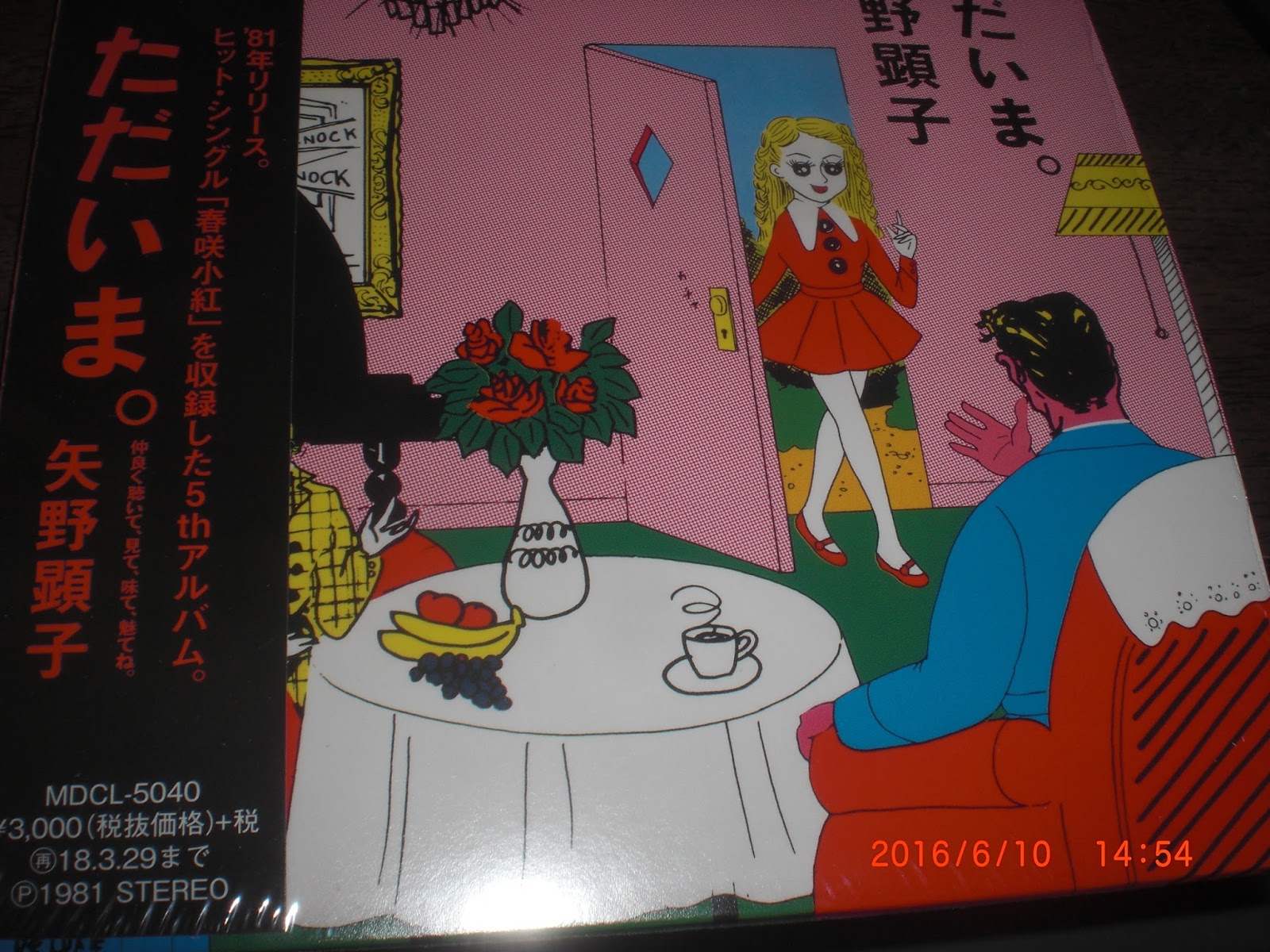
Out of my purchasing blitzkrieg a couple of weeks ago, the one album that has gotten the biggest pleasure out of me is Akiko Yano's(矢野顕子)"Tadaima"(I'm Home). Originally released in May 1981 as Yano's 5th studio album, it came out just a couple of months before my fateful high school trip to Japan. If I had known about it, I probably would have grabbed the audiotape or even the LP since my then-embryonic interest in Japanese pop music at the time was Yellow Magic Orchestra. Anything that had a synthesized pulse would have been in my radar range at the time.
I've already written about a couple of the album's tracks, "Itsuka Oji ga" (いつか王子様が...which finally triggered me to get the album) and one of her biggest hits, the super-catchy "Harusaki Kobeni"(春咲小紅)which I couldn't resist from bringing back here. And although I realize that Yano's albums have had a whole assortment of album covers, I think the one for "Tadaima" just strikes me as being so Yano-esque for the lack of a better term. It's kinda weird and adorable at the same time...somewhat like me in front of my niece.
But I will officially start off with the first and title track "Tadaima" which continues her technopop phase that began with her previous album "Gohan ga Dekita yo"(ごはんができたよ). Written by Shigesato Itoi(糸井重里)and composed by Yano, it has the spacy but warm Ryuichi Sakamoto(坂本龍一)synths and the singer's vocal whoops and onomatopoeia...this time emulating cats and dogs for some reason. In the song, she's pining to have her home filled with loved ones to greet her when she comes in instead of merely the empty darkness of being a single resident. Still, instead of it being a sad ballad, it's got that zippy energy that also infuses "Harusaki Kobeni". Yano might feel a little lonely but she can happily hang on for a while before that family comes in.
"VET" is Yano going way off on a New Wave tangent with spacy synths that really had me reminiscing about those British songs from the early 80s. I could have imagined her and her band all dressed up in tin foil and performing all Devo-like to this song about fighting the good fight against animal diseases. The interesting thing is that I can barely hear her rapid-firing those English lyrics.
"I Sing" is another all-English song written by Yano and composed by her then-beau YMO's Ryuichi Sakamoto which seems to be her giving advice to a less experienced singer on how to handle fame. Even with all of the electronics in there, I think this is a very sunny and gentle pop song.
My final song is indeed the final track "Rose Garden". Now with a title like that and the fact that it was placed as the last tune had me assuming that it would be a typically slow ballad to bring "Tadaima" to a nice close. But instead, it's a Yano-made technopop earworm with the singer rapping out her lyrics to a galloping melody that could be identified as a new synthesizer accompaniment to a traditional dance at the summer O-Bon festival. I would love to see any ambitious choreographers hammering a dance out from this one. And just some minutes ago, I was commenting on Marcos V's article on a Kyary Pamyu Pamyu song; I wonder what she could do with it as a cover.
As I stated in the "Itsuka Oji ga" article, I had read that "Tadaima" was even more well-regarded than "Gohan ga Dekita yo" although at this point, I'm not quite sure whether I would agree with that assessment just yet. There are some really hook-friendly songs on that previous album but "Tadaima" is still a fun release to finally get. Still, I'm now quite interested in hearing her even earlier material from the mid-1970s before Yano found her techno-muse.