I've been a fan of Japanese popular music for 40 years, and have managed to collect a lot of material during that time. So I decided I wanted to talk about Showa Era music with like-minded fans. My particular era is the 70s and 80s (thus the "kayo kyoku"). The plus part includes a number of songs and artists from the last 30 years and also the early kayo. So, let's talk about New Music, aidoru, City Pop and enka.
Credits
I would like to give credit where credit is due. Videos are from YouTube and other sources such as NicoNico while Oricon rankings and other information are translated from the Japanese Wikipedia unless noted.
Since the beginning of this blog, the J-Xmas songs that I've put up here have either had themes of just having plain old party fun or just the opposite: being horribly lonely on Xmas Eve. But perhaps folks from other countries who experience their first Christmas in Japan alone may commiserate due to the latter to a certain extent since December 25th isn't a statutory holiday but just a regular work day despite all of the illumination and music around. When I was working at my first English school of NOVA, in fact, I had heard rumours that some other young teachers were absolutely distraught on finding out that they had to work their regular 8-hour shift on Christmas.
Well, it's the lonely theme for this article on EPO's"Juu-ni Gatsu no April Fool" (December April Fool). It's a bit ironic since I've always seen Ms. Eiko Miyagawa(宮川榮子)nee Sato(佐藤永子)as being the singer with the super uptempo touch. Still, I think she's in counseling and encouraging mode here as she sings about a lady who feels as low as can be after going through her first Xmas without her now ex-beau.
Her 10th single from November 1985 and a track from her 8th album"Pump! Pump!" released in June 1986, words and music are by EPO, and I think that she got some inspiration from some 1970s soul for the melody. I can't help but hear some of that Minnie Ripperton and Roberta Flack when it comes to "Juu-ni Gatsu no April Fool".
Hello, folks. J-Canuck here to let you know that a few months ago, I wrote about the Japan Top 10 podcast. Well, over those past few months, JTop 10 music director Recca and I have kept in contact and we've decided to do some collaborative work. As she will explain below, some of us here at "Kayo Kyoku Plus" will be contributing some of our favourites to a future podcast while she and William will be contributing some articles on the blog. In any case, enough of me...I will now let Recca take over with her first article on Momoe Yamaguchi.
Hey there everyone, Recca from the Japan Top 10podcasthere. We’re collaborating with Kayo Kyoku Plus on some posts here and a future episode of Japan Top 10. I’m the music director and a sometimes-host of J Top 10, so I’m popping in to write a guest article.
I like things that “push the limits” of popular media. TV shows that get as avant-garde as you can while still being commercial. Children’s movies that go really dark but are somehow still for kids. Pop songs that go high-concept and weird but are still pop songs. So, I often boil down my taste in music to “weird pop.”
No one will dispute that Momoe Yamaguchi 山口百恵 is a pop idol. Who made pop music. But she had her fair share of strange concept albums during her latter years, right before her all-too-early retirement. Today’s track, Koi no Hotline(恋のホットライン; Hotline of Love), comes to us from one of those—1980’sMöbius’s Game(メビウス・ゲーム). The album’s tag line boils down to something like “Momoe’s infinite wonder world.” And what a wonderful world it is.
The album features some straight-up retro rock n’ roll, including the album’s only single, Rock n’ Roll Widow (ロックンロール・ウィドウ), and the 1950s pop pathos of Aishuu no Coney Island (哀愁のコニーアイランド; Sorrowful Coney Island).
But the album’s high-concept “wonder world” really kicks in with Track 5, Apocalypse Love (アポカリプス・ラブ), and its dark and Biblical apocalyptic imagery. Momoe is the queen of Babylon, watching over her crumbling desert empire, wailing plaintively 「泣かないで」(Don’t cry) as she illustrates the end of days.
That song bleeds directly into the next, Techno Paradise(テクノ・パラダイス), speeding up into the frenetic disco climax that is my featured song today, Koi no Hotline. I can’t say enough about this song. That driving disco bass line punctuating the gaps between lines of the verses gets my blood pumping. It’s got a hint of the retro rock n’ roll from the first few tracks of the album in the backing vocals, but there’s no question, we’ve definitely entered Momoe’s high-concept disco wonder world by this point. This song is a sexy tune about desire and Momoe knows what she wants.
The song ends all-too-suddenly, slowing down and bleeding into the next track, the electronic-infused funky One Step Beyond(ワン・ステップ・ビヨンド). Then it’s onto E=MC2, likening love to an equation in another example of the album’s electronic future visions transposed to a pop soundtrack. We end with the mournful string-driven Violet Rhapsody (ヴァイオレット・ラプソディー), Momoe breathy and wistful after our trip through time and space.
The Momoe on display for most of this album is my favorite Momoe. It’s the same no-nonsense badass lady speeding down the highway in Playback Part 2 and showing up unannounced to turn a love triangle into a Mexican standoff in Zettai Zetsumei. These have often been referred to as Momoe’s “punk” songs. The kind of songs that get yells of “kakkoii!” (“So cool!”) at karaoke, if you can do a half-decent job of channeling your inner Momoe.
While nothing on this album approaches the technopop that would come into full bloom in the years surrounding its release, it’s a fun dash of electronic instruments, disco, and apocalyptic future visions in the career of “Momoe-chan.” What a transition from her 1970s teenage idol tunes to this mature, sexy, and transcendent figure.
I didn’t discuss every track on this amazing album, so I highly recommend checking it out for yourself. I picked up my CD copy in Japan, but it’s easily available online as well. And, of course, please keep an eye on Japan Top 10’s feed for our future collaboration episode with Kayo Kyoku Plus! If you enjoyed my commentary here, you might want to check out some of the past Japan Top 10 specials I’ve hosted, covering themes like ‘80s J-pop, the best-selling J-pop songs of all time, J-pop songs from pro wrestling, and many others.
Lately, I've been racking my brain as to what Christmas song I should write for this festive season. But the thing is, I'm not a fan of Christmas songs and enka and kayo aren't the most Christmas-y genres out there. So I changed my train of thought to that of snow-related songs because in my mind, Christmas = Winter = Snow. (Those in the southern hemisphere, I apologize for my simple mind.) However, I realised I'd already talked about snow songs I like - e.g. "Yuki no Wataridori" (雪の渡り鳥) and "Yuki Ressha" (雪列車). It then occurred to me that Singapore doesn't snow (artificial snow or shaved ice "snow" from Snow City does not count) at this time of the year, but rains. In fact, it has been raining almost everyday since December began. With rain in mind, I had just the song.
Hiroshi Uchiyamada and The Cool Five (内山田洋とクール・ファイブ) does have the quintessential rainy number that is "Nagasaki wa Kyo mo Ame datta" (長崎は今日も雨だった), though that feels very area specific. "Ame", from their 1978 10th Anniversary album, on the other hand, isn't. Responsible for the words to "Ame" was Chiko Murofushi (むろふしチコ) and the music, Kaoru Kuramitsu (倉光薫).
I came across "Ame" by chance while rummaging through this YouTube channel specializing in all things Cool Five, and I took to it right off the bat. The lightly tinkling percussions at the start reminiscent of light falling rain and the following smooth strings set a very comfortable tone for this mood kayo; it feels like you're watching the world go by from behind a rain-streaked window inside a warm and cozy abode. The muted electric guitar throughout also gives the melody a nice edge.
Now, this is a Cool Five song, or simply just a song with Kiyoshi Maekawa (前川清) at the helm in the way of vocals, after all, so this tune doesn't stay all that quiet for long. As we progress to the chorus, Mae-Kiyo's gentle crooning swells to an almost resentful and whiny yell as he laments the loss of the one he loves, of whom he is reminded of on rainy days, before falling into a soft and hopeless sigh as he knows that there is no chance of reuniting with her. This is definitely my favourite part of "Ame". Having been surrounded by Hachi's mellowness and Haru-san's jolliness so much these days, it feels good to have the angst dial cranked up from a 2 or 3 to a 10 by Mae-Kiyo.
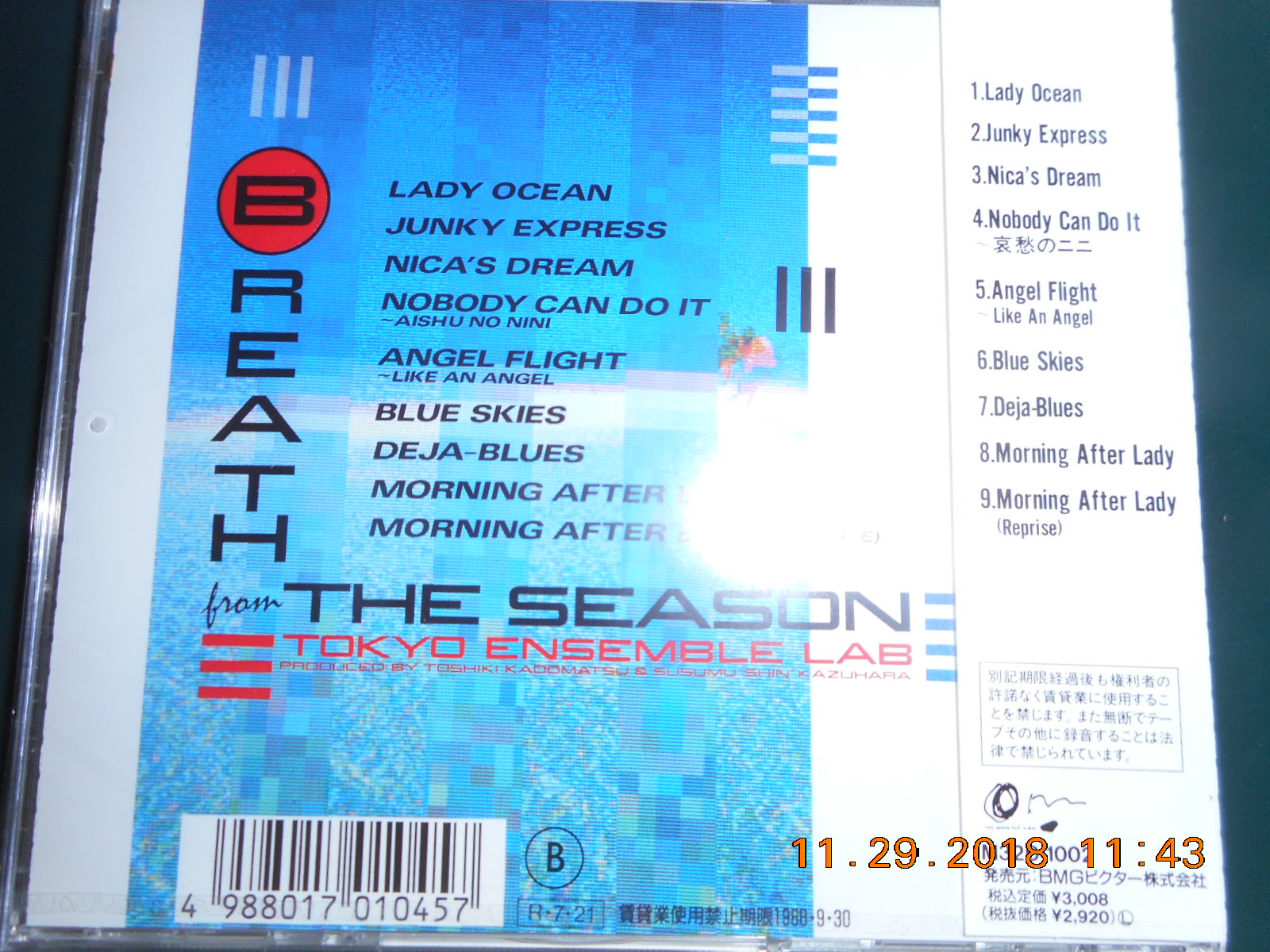
It all seems so poignant now when I first wrote about this spectacular band called Tokyo Ensemble Lab on the first day of summer several months ago, specifically for the fusion festival that is "Lady Ocean". My final statement for the article was that I may be doing some shopping around for the originating album "Breath From The Season".
Guess what? It's almost the first day of winter and I finally got "Breath From The Season", the 1988 inaugural album by Tokyo Ensemble Lab. Produced by Toshiki Kadomatsu(角松敏生)and band leader/trumpeter Shin Kazuhara(数原晋), the album does fulfill the predictions that I had for it...that it would be a container of music holding the swing jazz of "Nica's Dream" and the fabulous fusion of "Lady Ocean".
Track 2 is "Junky Express ~ Geraleen". Before I go on though, I should inform you that Tokyo Ensemble Lab apparently adopted the Kadomatsu tradition of adding female monikers to each track. "Lady Ocean" was tagged with "Yuko" while "Nica's Dream" was given the name of "Mako". It almost figures like the Secret Service giving members of the President's family their code names.
Anyways, "Junky Express" is a fun Latin jazz jam with a soupcon of synthpop added. I hear it as a prototype for the whole Electro Swing thing that popped up earlier this decade. Also, being a fan of these guys, I got reminded of some of the Manhattan Transfer's forays into Latin jazz.
"Nobody Can Do It ~ Aishuu no Nini"(哀愁のニニ...Grief-Stricken at 22[?])has been tagged with "Kaoru". By the sounds of it, Kaoru must be a statuesque, beautiful, and most likely, a lonely lady in the big city. Kazuhara composed the track and is the lead trumpeter. The song weaves between that noble high-in-the-sky trumpet solo and some downtown action in what must be some dramatic story for the lass.
Then, there is "Blue Skies ~ Kana". Yep, it is indeed the Irving Berlin classic but it's book-ended by the Lab's own big band riffs. However, the familiar melody of "Blue Skies" does fly in on the trombones though mixed in with a bit of "In The Mood", and the whole thing again has that Electro Swing feeling and even some Matt Bianco. It's basically one fun jam session for Kazuhara and the guys.
My last song for this article is "Morning After Lady ~ Shizuyo", a soulful number written by James B. Pentaudi with Kadomatsu coming up with the music. It's a power ballad performed by LeMel Humes that has me reminiscing about my radio and university days. Nice to hear this arrangement again after so long, and it is a fine tune to wake up to...but perhaps the volume can be lowered a bit if you want to do so. :)
A little over two weeks away from Christmas, and I think that there are probably quite a few folks in my neck of the woods that are already clamoring for spring to haul ass to arrive here. It seems that the wintry weather has come by in full force although I'm fairly confident knowing how unpredictable the temperatures are in Toronto that there will be a fair share of balmy days ahead even in the winter.
Then, perhaps it might be a good time to present "Ashita, Haru ga Kitara" (Tomorrow, When Spring Comes) by actress-singer Takako Matsu(松たか子). It's about time that I introduced her to the annals of "Kayo Kyoku Plus" because at that point in the late 1990s, she became quite popular for her music as much as for her performances as a thespian.
"Ashita, Haru ga Kitara" was her debut single right on the first day of spring in 1997, and according to the write-up for the song on Wikipedia, it sounds as if one of the directors for the popular drama "Long Vacation" lightly suggested that she try her voice behind the mike. The Wikipedia article is quite the love letter about Matsu's first foray at singing so I will let that article speak for itself. What I can add is that I remember "Ashita, Haru ga Kitara" coming out with me previously wondering how she would sound since I've heard other actors going behind the recording mike and not being all that successful.
But, y'know...Matsu came across like a breath of fresh spring air. No, I mean she didn't sound like an epic soul diva but there was something very calming and down-to-earth about her singing as if she were your good buddy with a better-than-average set of vocal cords. With all of the Komuro Boom that was steamrollering across pop music at the time, it was quite refreshing to hear Matsu.
Yuji Sakamoto(坂元裕二)took care of the lyrics while Daisuke Hinata(日向大介)composed the music. "Ashita" reached No. 8 on Oricon, and ultimately sold about half a million copies. In the previous year, Matsu had been a co-host on the Kohaku Utagassen but with the hit of her first single, she became a participant herself in the New Year's Eve special.
(Sorry, but the video has been taken down.)
I could imagine "Ashita" being popular among the karaoke crowd, and even on the old celeb karaoke show "Yoru mo Hippare"(夜もヒッパレ)on NTV, Namie Amuro(安室奈美恵)had her chance to cover it as well.
Another regular NHKkayo-based program that has made its way onto TV Japan is "Gogo Uta"(ごごウタ...Afternoon Music) which is co-hosted by veteran funny man Kazuki Kosakai(小堺一機). Compared to the other shows including "Uta Con"(うたコン), "Gogo Uta", with its Friday afternoon time slot, is a program which seems to be a bit more relaxing for the guests (well, as relaxed as one could be in front of a large studio audience). I'm not sure whether the producers had meant it as such, but I take it as if the Green Room atmosphere were brought out into the open (although, of course, no sordid secrets get out here). One of my parents has often complained that everyone just talks too much on this show, but I think that has always been the point for "Gogo Uta"...more pleasant chit-chat and then some of theenka/Mood Kayo stuff.
I think another purpose for "Gogo Uta" is to provide a nationwide platform which may be less intimidating than "Uta Con" for up-and-coming singers or singers who need that extra promotional boost. One such guest today was enka singer Naoki Sanada(真田ナオキ)from Saitama Prefecture. He's been performing since 2016, and today he performed his third single from September this year (2018), "Yoi no Blues" (Drunken Blues).
As has been the case for his previous two singles, "Yoi no Blues" has been created for Sanada by enka master Ikuzo Yoshi(吉幾三), and why I'm writing about it is because aside from the fact that I like it, it also doesn't really come across as an enka tune to my ears although the theme of being at the end of one's rope or at the bottom of the barrel is a typical one for an enka or Mood Kayo song. But come to think of it, there is some of that oomph in Yoshi's melody that would indicate a warrior's call to battle.
Yoshi's lyrics talk about a fellow, perhaps someone who is associated with the underworld, who has just had enough of his life and is drunkenly desperate for a fresh chance to go in a better direction. Perhaps the guy is confessing his sins to the nomiya's proprietor or just blasting himself alone somewhere on the pier while knocking back a One Cup Ozeki (I like sake sometimes but I will never ever go near that stuff again) which kinda strikes me as being Mood Kayo. I've also noticed some of that muscular rock feeling through the guitar. Basically, I wonder if Yoshi has created the 21st-century version of a Nyc Nyusa(ニック・ニューサ)New Adult Music song. New Adult Music is a genre that I actually found out about for the first time earlier this year through his hit single "Sachiko"(サチコ).
One other thing that I've noticed about Sanada himself is that his movements kinda hinted at a young Hiroshi Itsuki(五木ひろし)and that delivery in "Yoi no Blues" also made me wonder whether he was even incorporating a bit of bluesy Akiko Wada(和田アキ子). Pretty interesting fellow and song, and I hope either with "Yoi no Blues" or any future song that he gets that breakthrough hit.
Last thing...in the lyrics, Sanada sings that he just can't seem to get drunk no matter how much he knocks back. Considering the "Woe is me" tone of "Yoi no Blues", I kinda wonder whether this would be the ideal kayo for Captain America currently after I had caught the trailer for "Avengers: Endgame".😁
Well, I got together with some fellow translators today at the Touhenboku Ramen branch at Yonge & Eglinton to see this humongous lineup. At first, I internally remarked "Look, I know it's cold today (-6 degrees C) but I didn't expect this many folks for ramen on a Friday!" But then, as I approached, I realized that the queue wasn't for Touhenboku but for the new Fuwa Fuwa Japanese pancake shop just a few shops down. Apparently, it had opened today! I can only guess that the owner of the ramen place was looking outside wistfully and saying "Ahh...yes, I remember when we were like that". But Touhenboku was still doing good regular business.
Anyways, enough about my lunch. At this late hour, I have to make some amends for completely forgetting the fact that despite I had written about Yumi Arai's(荒井由実)"Chuo Freeway", one of the veteran singer-songwriter's many kayo standards, all the way back in 2012, I have neglected to write about Hi-Fi Set's(ハイ・ファイ・セット)cover version since their take has become as much of a trademark tune for the chorus group as it has for Yuming(ユーミン)herself.
One other surprise is that Hi-Fi Set's"Chuo Freeway" was never released in a single (neither A nor B side) but was the final track on their third original album from February 1977, "Love Collection". Now, recollecting my original article for Yuming's "The 14th Moon" album where I wrote about the original "Chuo Freeway", the smooth tribute to her own experience of getting that luxurious drive home from work on the titular highway after midnight, I came to see her version as a fairly dreamy and happy nighttime experience.
However, after listening to Hi-Fi Set's cover of the song, I think just from the vocals and the key change, their "Chuo Freeway" befits a more daytime atmosphere or at least sometime earlier in the evening. The protagonist isn't in the back seat of the car semi-sleepily admiring the view but perhaps is in full control of the car and enjoying a nice afternoon drive. I think both versions are just splendid.
I found this video of Junko Yamamoto(山本潤子), formerly of Hi-Fi Set, singing "Chuo Freeway" in 2012.
Although I may have mentioned that I have never driven a car in my life and probably never will since I know that I will most likely weaponize a Corolla if I ever get behind the wheel and would automatically enter the Hall of Fame (Shame) on "Canada's Worst Drivers" if I ever get onto the program, there are times after I hear drive-based songs such as "Chuo Freeway" that I wonder about actually enjoying a night drive. I've been side-saddle or in the back getting driven home and the view of the Toronto cityscape from the Gardiner Expressway or while bombing northwards on the Don Valley Parkway is pretty fine. Music like the one generated by Yuming while driving would make a fine companion.