I've been a fan of Japanese popular music for 40 years, and have managed to collect a lot of material during that time. So I decided I wanted to talk about Showa Era music with like-minded fans. My particular era is the 70s and 80s (thus the "kayo kyoku"). The plus part includes a number of songs and artists from the last 30 years and also the early kayo. So, let's talk about New Music, aidoru, City Pop and enka.
Credits
I would like to give credit where credit is due. Videos are from YouTube and other sources such as NicoNico while Oricon rankings and other information are translated from the Japanese Wikipedia unless noted.
I think that there's a saying about really getting to know your own hometown only when you're separated from it for a length of time.
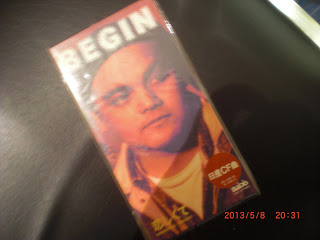
Perhaps that is the thrust behind Okinawan folk-blues bandBEGIN's"Kono Machi Hanarete" (Leaving This Town), a happy-sad tune that talks of a young fellow who's leaving his own home willingly to go on a search for himself, and maybe to realize how good his birthplace has been to him all these years.
I don't know very much about Okinawan music, but what I do know has been wrapped around the native three-stringed lute known as the sanshin, and with "Kono Machi Hanarete", there's something more foreign. This seems to be more planted in the terra firma of America with a zydeco accordion and a twangy blues guitar that sounds as if someone from Ego-Wrappin' decided to drop in for a spell.
BEGIN was responsible for words and music, and it probably made its first appearance in the band's first BEST compilation, "FAN -- Little Pieces" released in March 1995. But it has also appeared in their third BEST album "Ballads" in March 1999.
Nice to have gotten some bagels and English muffins last week from the supermarket. I always appreciate the variety. Did the same thing this morning and got the same items to tide us over until next week.
An intriguing one to start off the City Pop stuff for this Friday as we also begin the month of May. I found this one by genre songbird Haruko Kuwana(桑名晴子), and as I've always noticed, she's a most photogenic lady! 💝However in 1980, she and the band decided to go with the moniker Baker's Shop with Haruko when "Hot Line"(ホット・ライン)was released that year, and evidently from what I see in the video thumbnail above, a single did come out of it as well titled "Furimukuna"(Don't Look Back).
From the JASRAC database, it was written and composed by Kuwana (although the name that was given there was Harukoo) with Toshiro Masuda(トシロウ・マスダ)co-writing the lyrics. And why I selected it will be evident from the first few notes of "Furimukuna"; it's just scintillating City Pop with Kuwana's splendidly smoky vocals as that intro did it for me.
Rocket Brown and I have talked about some of the musical tropes in City Pop including what he has identified as the Sparkle Riff, that tinkly keyboard riff that we've all heard in many a song of the genre such as Takako Mamiya's(間宮貴子)"Love Trip" (at about 8 seconds in). I also like to call it the Perrier Pour. Well, that might be an 80s City Pop thing to me. With the Japanese urban contemporary material in the 1970s, the musical trope that I've heard in a number of songs there has been another keyboard phenomenon that I've dubbed the Haze, and that pops up almost immediately in "Furimukuna". It just sounds like haze rising from the hot ground, although I did say that this particular Kuwana delight was made in 1980, but of course, there was no temporal Iron Curtain in that year stating that the Haze had to end and the Sparkle Riff had to begin.
In any event, "Furimukuna" ironically makes me want to look back to the good ol' days in Tokyo when I hear it.
Well, the second Japan-based pop song that influenced Toshiki Kadomatsu(角松敏生)when he was a high school lad along with "Kyou wa Nandaka"(今日はなんだか)by Sugar Babe(シュガーベイブ)is Shigeru Suzuki's(鈴木茂)"Suna no Onna"(The Woman in the Dunes) from his solo debut 1975 album"Band Wagon".
As was the case with "Kyou wa Nandaka", when I wrote up "Who Influenced Toshiki Kadomatsu? (Pre-Debut)" yesterday afternoon, I found out that the three songs that had been made by Japanese artists were too good just to reference in one Creator article. Each of them deserved its own article, so "Suna no Onna" gets its due here.
Kadomatsu, having listened to the music of Suzuki's old band, Happy End(はっぴいえんど), mentioned that hearing "Suna no Onna" threw him for a bit of a loop since this and presumably all of the other tracks didn't sound anything like the Happy End stuff. Although I'm still at the exploration stage for that band, my impression of Happy End is that it dabbled in folk-rock and perhaps the beginnings of City Pop. It was pretty heavy stuff...not in a bad way, of course, but it just seemed like a quartet of musicians who really wanted to get across their sound in a serious way.
But with this first track from Suzuki's first solo effort, "Suna no Onna" feels like the guitarist-songwriter swapping out the leather jacket for an Aloha shirt, waving bye-bye to most of his former bandmates and immediately jumping into that red convertible for a sunny beachside destination. Ah, however, bandmate Takashi Matsumoto(松本隆)has joined him in the passenger seat to provide the lyrics for this early Resort Pop which really does pop in a cool way. It's the guys having fun on a road trip to Shonan along the lines of Tod and Buz on the old US series "Route 66".
And it really was a road trip of international proportions. "Band Wagon" was produced and recorded in two different studios in San Francisco and Hollywood with Doug Rauch, David Garibaldi and Don Grusin backing Suzuki as the band, according to the J-Wiki and Wikipedia articles for the album. By the way, Suzuki and Matsumoto took care of all of the songs in terms of words and music.
When I first looked up "Suna no Onna" through Yahoo.jp, I got a lot of references to the 1962 mystery novel by Kobo Abe which was made into a 1964 movie. Indeed, the Suzuki song was named after them.
Continuing on from Part 1 that is "Who Influenced Toshiki Kadomatsu (Pre-Debut)", I bring you Part 2 with the singers and songs that helped in shaping this man's sound following his official start in 1981 as an entertainer. Again, as mentioned in that article, this is based on a section of Kadomatsu's(角松敏生)J-Wiki biography which has listed these pre-debut and post-debut influences. Unlike yesterday's pre-debut batch in which the majority of the songs have been well-known to me since my childhood, most of the post-debut entries coming up were fresh at the time.
(February 11 2023: That whole section on Kadomatsu's pre-debut and post-debut influences has been excised from the J-Wiki article, possibly since it was never sourced. Still, I don't think the person who put up all of these songs was simply picking names or titles out of a hat so at the very least, these choices can still provide a topic of discussion.)
Hiroshi Sato and Wendy Matthews -- You're My Baby (1982)
I mentioned this in the KKP article for Hiroshi Sato's(佐藤博)classic "Awakening" in which Kadomatsu gave his stamp of approval to this 1982 album, a release by the keyboardist and singer that is perfect as a cool-down AOR project. According to that section on his post-debut influences, Kadomatsu did listen to "Awakening" after his own debut and found it so polished that he felt that he could never match that level of goodness. He even said that as a fellow just barely into his 20s at the time, he didn't have the vocabulary to respond or express for the chords and melody, and didn't have any hope in replicating them. Geez! I can only assume that Sato gave him a pep talk to buck up.
My take on what I just read there is one of surprise considering that Kadomatsu had already released a few albums such as "Weekend Fly to the Sun" before "Awakening" came out in June 1982. I personally found "Weekend Fly to the Sun" a great album, so I can only assume that Kadomatsu was totally in awe of "Awakening". I wonder whether he had been searching for a certain leavening agent to help take his music into more dreamier and introspective circumstances.
Steely Dan -- Aja (1977)
This influence on Kadomatsu made me go "Ah...naruhodo". Considering how much Steely Dan's riffs have been incorporated into many a Japanese City Pop/J-AOR song, I guess that I wouldn't be surprised that Kadomatsu would see "Aja", one of Donald Fagen and Walter Becker's greatest creations, as a factor in how he developed his own sound. He said that he underwent a major learning experience from "Aja" which amassed all of the important things in music including musical sophistication, composition, freshness and the challenge itself.
Kadomatsu may have found out about "Aja" a bit late into the party, but he was much better than me because I only...finally...purchased the album only a couple of years ago, much later than Fagen's splendid solo work "The Nightfly". However, I have known about "Peg" and "Josie" for decades since that got regular airplay on the radio, and I've totally fallen in love with "Deacon Blues" and "Black Cow".
Once again, another blessed song from my youth and it's up there in my love for EW&F tunes alongside "September". I actually first heard "After The Love Has Gone" on an episode on an old American sitcom "WKRP in Cincinnati" during a more contemplative scene, and that is perhaps the perfect scene in real life to hear this one by David Foster, Jay Graydon and Bill Champlin. For Kadomatsu, this was the first Foster song that he had ever heard, and found it had this amazingly sharp and sophisticated mood. He's even stated that "After The Love Has Gone" evokes the best emotion while hearing it during a summer evening. Works for me, too! And you know, I can now get the influence of this ballad upon some of his slower songs.
Christopher Cross -- Sailing (1980)
And perhaps that is also the case with Christopher Cross'"Sailing" when it comes to influencing Kadomatsu's mellower efforts. According to Kadomatsu, apparently when Cross' self-titled album carrying "Sailing" was released in Japan, it sold like hotcakes upon hotcakes, and when he, who at the time was listening to his fair share of disco, heard this number, he felt that AOR had also finally landed in his country.
Luther Vandross -- Sugar and Spice: I Found Me A Girl (1981)
This is the one song that I had never heard before today, and yeah, I'm Gibbs-slapping myself. But better late than never, and don't we live in a wonderful time (COVID-19 excepted) when we have access to decades of great music that we can discover via sites such as YouTube?
Kadomatsu was truly knocked out by the upbeat and funky "Sugar and Spice" when he first heard it, and once again, along with his experience with Yoshitaka Minami's(南佳孝)"Poolside" from the pre-debut entries, he felt that Vandross expressed a world that was far away...a world that he himself wanted to experience. The Shibuya-born musician-producer really desired to know that vibe in New York City where he felt that Vandross was bringing out that world view of his, and sure enough, Kadomatsu got his wish a few years later in 1984 when he went to live in The Big Apple (not sure if he still resides there, though).
With the pre-debut and post-debut influences on Kadomatsu over the past couple of days, I kinda/sorta have a handle on how his music developed, but there is so much there that it will probably take quite a bit longer to absorb and understand it all. Hopefully, your brains will be able to sift through all of it better than I can.
One definite benefit from doing these articles is that when I was exploring Vandross' wonderful song, I also discovered "Street Life"(1979) by The Crusaders, formerly The Jazz Crusaders. It's the type of tune that I've always loved.
Well, I'm keeping part of my promise to cover individually some of those songs that influenced one of City Pop's greatest figures when he was a kid via the first part of the two-article series of "Who Influenced Toshiki Kadomatsu?"
The first one is "Kyou wa Nandaka"(Today, Somehow) by New Music band Sugar Babe(シュガーベイブ)which had members who would become stars on their own: Tatsuro Yamashita(山下達郎), Taeko Ohnuki(大貫妙子)and Ginji Ito(伊藤銀次) among others. One of the tracks on their lone 1975 album"SONGS", "Kyou wa Nandaka" is as joyful to hear as it is to read. The lyrics by Yamashita and Ito read off a very happy man's realization that love is about to come around; it's only a matter of time.
May I also add that Tats' music is sublime with that clarion call piano in the intro and the end along with the free jazz at the end as well? "Kyou wa Nandaka" is the melodic equivalent of a fun and rollicking car ride with the top down anywhere in the big city, and there is that riffing guitar that pops up a few times in the song that reminds me of a motor revving up. Plus, there are those sweet and warm horns accompanying Yamashita's vocals. The music seems to be enjoying life as much as the protagonist is and may even be illustrating the vibrancy of the metropolis itself.
Enjoy aiko's own sunny cover of "Kyou wa Nandaka".
Today has perhaps ended up as being one of the more positive days for me so far during this COVID-19 nightmare. Toronto's rate of new infections dropped to around the low 300s and on a more personal level for our family, TV Japan just announced that their regular broadcasting schedule will be returning this Saturday after almost a month of the NHK World Premium schedule. Not that we had any complaints about the current regimen; most of the regular TV Japan shows are 85% NHK anyways. It turned out that TV Japan based in New York had a number of its staffers come down with the coronavirus which somehow led to the change, but the really good news is that everyone has recovered there. Generally, it's still too early to say that happy days are truly back again, but taking things day by day, perhaps the light at the end of the tunnel is getting a little bigger.
One of those NHK shows that has continued to be a staple on both regular TV Japan and NHK World Premium has been the morning serial "Yell"(エール), and I just wrote about the theme song by GReeeeN, "Hoshikage no Yell"(星影のエール)some days ago. One of the characters is Mitsuko Sekiuchi, the mother of Oto, the young lady who has suddenly agreed to give her hand in matrimony to the congenial-if-jittery genius songwriter Yuuichi Koyama. Mitsuko is not too pleased with the announcement, especially since she had told her fierce-hearted daughter to break off the relationship with Yuuichi. However, despite telling her imminent son-in-law to his face that he's frankly a dolt, she can also see the good in him and the love that Oto has for him, so she has...reluctantly...allowed the wedding to go through.
Mitsuko is played by actress-singer Hiroko Yakushimaru(薬師丸ひろ子), and it really shows how much time has passed when she's playing a middle-aged mother who's mostly sweet but can unleash her inner dragon persuasively. She's the Taisho Era version of Mrs. Cunningham from "Happy Days". After all these years, I still see Yakushimaru as that wide-eyed teen ingenue in the sailor-suit uniform sporting a machine gun on posters.
And I still remember her as that 80s singer with the soft and resonant voice. Case in point, I found this final track from her 2nd album"Yume Juuwa"(夢十話)from August 1985. Titled "Bamboo Boat", it's been a while since I've listened to Yakushimaru's material, but this particular song is reflective of what my memories relate of her music: personal, whimsical and mellow with plenty of strings.
Written by Minako Yoshida(吉田美奈子)and composed by Takao Kisugi(来生たかお), the partnership between Kisugi and Yakushimaru is back again after their collaboration on "Sailor Fuku to Kikanjuu"(セーラー服と機関銃)in 1981. Hiroko-chan is singing about a South Seas romance that has since faded into bittersweet memory, but bittersweet chocolate is pretty tasty so the past affair is probably not too hard to take either. It's a nice way to finish up "Yume Juuwa".
So, when I think of singer/musician/songwriter/producer Toshiki Kadomatsu(角松敏生), the following phrases and images come to mind:
Summery music. Moony-eyed romantic. Urban funkadelia. What can I tell ya? 80s workout studio-friendliness. Soulful balladeer of yesteryear.
I think that we can all agree that there are probably a few more descriptors that we can add here, but let's stick with this bunch. As for that first phrase of "Summery music", I can distinguish Kadomatsu from Tatsuro Yamashita(山下達郎)in that (fully realizing that both Tosh and Tats have provided a wealth of both uptempo songs and slow love songs) whereas the latter is someone that I can see entertain a small group of good buddies inside the beach house, Kadomatsu is that fellow that I've imagined having fun with the masses at some large venue outside by the shore while he's manning some DJ's turntables. He lives life large, my friend.
Whether it's on his own albums such as "After 5 Clash" including "Step Into The Light" or whether he's providing music for other singers such as the eternally summery Anri(杏里)in "Timely!!", Kadomatsu has come up with that certain sound that brings to my ears and heart anything from Motown to LA of a certain decade to any sort of Resort Pop reminiscent of either Shonan or Venice Beach. He loves his tight horns, crashing synthesizers, boppy bass and angelic chorus.
So, then, what makes Toshiki Kadomatsu tick? More specifically, how did his sound evolve into the grand discovery for all those City Pop fans in the last few years? Well, Rocket Brown of Come Along Radio and I had a conversation the other day, and we found out that the both of us came across a section that exists only in Kadomatsu's J-Wiki article that dealt with how he had been influenced by certain songs and artists before and after his debut in 1981.
The Kadomatsu J-Wiki article has its share of footnotes, but this section on pre-debut and post-debut influences doesn't have them, and when I tried to look up Kadomatsu influences on the rest of the Net, I couldn't find any particular outside article that the section could have been sourced to. Therefore, anyone close to him or even the master himself could have plunked this interesting information down onto J-Wiki. Anyways, what I'm going to do is first provide the pre-debut influences here (with the post-debut influences next day) and a best-possible translated paraphrasing of what I found (although let me know if I did something wrong). Feel free to pour yourself a highball glass of Perrier to get into the mood.
(February 11 2023: That whole section on Kadomatsu's pre-debut and post-debut influences has been excised from the J-Wiki article, possibly since it was never sourced. Still, I don't think the person who put up all of these songs was simply picking names or titles out of a hat so at the very least, these choices can still provide a topic of discussion.)
B.J. Thomas -- Raindrops Keep Fallin' On My Head (1969)
Kadomatsu's first encounter with Western music was in kindergarten in the 1960s, but the first Western song that he fell in love with was "Raindrops Keep Fallin' On My Head". Burt Bacharach and Hal David were behind this Oscar-winning song recorded by B.J. Thomas for the movie "Doc Hudson and SHIELD Official Pierce"...sorry, I should say "Butch Cassidy and the Sundance Kid" back in 1969. According to the J-Wiki entry for this particular influence on Kadomatsu, he wanted to create original music with a foundation in R&B along with jazz, and also take into consideration chord development and modulation with an inclusion of a Bacharach approach. Maybe that explains his love of some of the mellow horns and those ballads.
"Raindrops Keep Fallin' On My Head" was also a song that I remember hearing a lot on AM radio for years and years, but didn't know about the connection with "Butch Cassidy and the Sundance Kid" until I was almost in junior high school. The horns and the strings get me into a very sentimental mood.
The Beatles -- Hey Jude (1968)
One of the most famous tunes by The Fab Four was released in 1968, but Kadomatsu first heard this when he was in Grade 4 so perhaps just a little after he'd discovered "Raindrops Keep Fallin' On My Head". Strangely enough, though, it wasn't the original version that he first heard but an orchestral version that was used as the theme song for a TV drama, and getting really interested in "Hey Jude", his older brother told him about The Beatles and he managed to buy the single. The following year, Kadomatsu took up the guitar and really got into playing their tunes. So, taking up the instrument and playing in front of an audience was all thanks to John, Paul, George and Ringo.
I mentioned about my observation that Kadomatsu was someone who loved to play to a crowd and made his songs to fit that want to whip up the masses. Wouldn't "Hey Jude" be the ideal template?
The J-Wiki article here says that Kadomatsu played Sugar Babe's(シュガーベイブ)lone 1975 album"SONGS" so often that he probably wore out the record. Although this particular track by Tats and band isn't directly referenced in the explanation, I assume that it is this song for which Kadomatsu had a dickens of a time trying to match the chord tensions that Sugar Babe came up with, although by his high school years, he had mastered three-chord progressions for rock music. But he got there eventually and it was often "Kyou wa Nandaka"(今日はなんだか...Today, Somehow)that he played.
Reading the paragraph in the original article, it looks like Kadomatsu had also listened to a fair bit of Happy End(はっぴいえんど), the legendary band with Shigeru Suzuki(鈴木茂), Haruomi Hosono(細野晴臣), Takashi Matsumoto(松本隆)and Eiichi Ohtaki(大滝詠一). So, once the band broke up and Suzuki went solo with his debut album"Band Wagon" in 1975, Kadomatsu decided to give that LP a spin, and was fairly floored by how different the album, including this first track "Suna no Onna"(砂の女...The Woman in the Dunes), sounded compared to the Happy End tunes. In fact, high school kid Kadomatsu, despite his initial good impressions toward "Band Wagon", seemed to have been mystified enough about how good it was that he asked his buddies who loved playing Deep Purple and Yonin Bayashi(四人囃子)at the time whether it was indeed cool. They reassured him that it was.
A track from Minami's(南佳孝)3rd album"South of the Border", Kadomatsu as that teenager had assumed that the world depicted in the lyrics of "Poolside" was some exotic Valhalla for the grownups that he himself could never access. But he also stated that the world view of the lyrics and music helped him grow up to become an adult a whole lot more quickly. Perhaps it kickstarted Kadomatsu into that wonderful summery haven of City Pop/AOR that had been reflected by the overseas cities of New York and Los Angeles. Those earlier songs above may have assisted in the nitty-gritty of making music, but it seems as if "South of the Border" provided the ideal arena in which to create that music.
I definitely have to say that those three last songs in the pre-debut list are all worthy of getting their own articles soon enough on "Kayo Kyoku Plus".