I've been a fan of Japanese popular music for 40 years, and have managed to collect a lot of material during that time. So I decided I wanted to talk about Showa Era music with like-minded fans. My particular era is the 70s and 80s (thus the "kayo kyoku"). The plus part includes a number of songs and artists from the last 30 years and also the early kayo. So, let's talk about New Music, aidoru, City Pop and enka.
Credits
I would like to give credit where credit is due. Videos are from YouTube and other sources such as NicoNico while Oricon rankings and other information are translated from the Japanese Wikipedia unless noted.
I once again plopped in Kirinji's(キリンジ)masterful "Ai wo aru dake, Subete"(愛をあるだけ、すべて)2018 album into the player last night and enjoyed another 40 minutes of melodic bliss. Then I enjoyed it so much that I listened to the power middle-order lineup on the album once more. For me, that would be "AI no Touhikou"(AIの逃避行), "Hi Zero Wa Game"(比ゼロ和ゲーム)and "Jikan ga nai"(時間がない).
At the time that I wrote up the article for the album, those three songs were the only ones represented on YouTube (very much thankfully, though). However, recently I was able to find a new video showing off one of the other tracks on "Ai wo aru dake, Subete", "Shinryoku no Kyojin" (Titans of the New Leaves).
I would like to stress that although the three songs that make up my personal power lineup as mentioned above are truly splendid, the entirety of the album is great overall. "Shinryoku no Kyojin" is a more mid-tempo and introspective synthpop track written and composed by Takaki Horigome(堀込高樹), and through the words and music, it seems to be his illustration of the Japanese tradition of shinrin-yoku(森林浴)or forest bathing.
Now, shinrin-yoku has nothing to do with plunking a bathtub in the middle of the woods and enjoying some Calgon time. It's actually taking a walk through the forest as a form of nature therapy to destress and feel better. I came across the term frequently when I was translating a whole bunch of those Japanese tourism articles a couple of years ago, and during this pandemic, for anyone who may be living next to the woods, perhaps this has been just the huge green tonic to endure this medical crisis.
Horigome's melody for "Shinryoku no Kyojin" might be a little too "loud" as a musical accompaniment for forest bathing, but the intent is there, and after all the partying especially through the power lineup, it's nice to get a breather. Still, I would be happy if a video pops up showing off one other track from the album, "Akumu wo Miru Cheese"(悪夢を見るチーズ).
For the last entry tonight, I have another rare number from the New Wave group Portable Rock which was fronted by future Pizzicato Five vocalist Maki Nomiya(野宮真貴).
My first entry for this eclectic unit was "Haru Shite, Koi Shite, Mitsumete, Kiss Shite"(春して、恋して、見つめて、キスして)which was originally recorded in 1986 and had all that synthy goodness of a bubbly Seiko Matsuda(松田聖子)tune created by one of the guys at Yellow Magic Orchestra. Yes, indeed it was The Divine Miss M singing this song.
Well, from their 2nd full album"Dance Volunteer" which came out in 1987 is the first track "Yuutsu no Hold Me"(Depression's Hold Me). And this time while keeping the New Wave intact, the arrangement has more of a harder PSY-S feeling to it as I enjoy those thumping synths. It sounds rather British, although at the same time, I'm reminded somehow of the US synthpop band Information Society and their hit "What's On Your Mind?". Man, those were good days on the dance floor.
"Yuutsu no Hold Me" was written by Seira Asakura(あさくらせいら)and composed by Portable Rock bassist Nobuo Nakahara(中原信雄).
Ahhh...I finally get to taking a look at the third of those pre-debut influence songs for Toshiki Kadomatsu(角松敏生)that I had written about the other day in that special Creator article. So, as a reminder, those three Japanese tunes were "Kyou wa Nandaka"(今日はなんだか)by Sugar Babe(シュガーベイブ), "Suna no Onna"(砂の女)by Shigeru Suzuki(鈴木茂), and "Poolside" by Yoshitaka Minami(南佳孝).
In that article for the musician/producer, I mentioned for Minami's"Poolside", which was a track on his September 1978 album"South of the Border", according to the original section on his pre-debut influences in J-Wiki, that it had represented a then-unattainable dreamland of sorts for the teenaged Kadomatsu. However, I think it then presented itself as a dare and a challenge for him to reach for that Valhalla, a place that he finally reached when he decided to head for The Big Apple in the mid-1980s.
"Poolside" was composed by Minami and written by Etsuko Kisugi(来生えつこ). For me, after listening to it a few times now, I feel that it was an interesting song for Kadomatsu to fall for since from Minami's music, this isn't really depicting a high-class resort on the level of "Fantasy Island". That particular keyboard is nothing that I had ever heard before in an AOR tune, and it reminds me more of Minami as some seen-it-all heard-it-all journeyman entertainer doing the circuit of sparsely populated Holiday Inn in-hotel dining rooms across America playing well on a well-used instrument ("Thanks all for coming! Try the beef!"). There are Christmas lights strung haphazardly on the walls and plastic palm trees here and there, with the bartender making overly sweet and strong Mai Tais. Meanwhile, Kisugi's lyrics show a world which is shrunk all the way down to the immediate area around the Holiday Inn pool as a fellow falls for a lady, probably in a most appealing bikini nonchalantly enjoying her life in and out of the bright blue chlorinated water. The fellow could even be the entertainer a few hours before showtime.
Well, I have depicted what might be considered to be a fairly skeevy setting, but in twisting around a Shakespearean quote for my own usage: I have come here to praise Minami, not to bury him."Poolside" works for me because it shows off a scene that perhaps a lot of young dream-filled Kadomatsus back in the 1970s in Japan could have swooned for: staying and enjoying the life in a typical Holiday Inn in the USA. Back then, when taking an overseas trip was perhaps still a fantasy for many Japanese, especially high school kids without a job or tons of income in a land which was on the way to become the second-biggest economy on Earth at that time, even that so-called mundane business trip may have seemed like a journey of wonder.
As a Canadian kid, I remember spending some vacations in the cheap motels and actively lobbying my Dad and Mom (much to their short-tempered chagrin) to hole up in a Holiday Inn or a Motel 6 for the night during a fishing trip. It was exciting! The last time I had a similar-enough experience was over a decade ago, when my Air Canada flight back to Japan from Toronto's Pearson Airport had been scrapped due to a snowstorm and I ended up staying at a hotel across the street. I had a perfectly serviceable room and a buffet all to my own (heaven for me back then) in the first-floor dining room. No pool and no entertainment, though.
Really, the only way for me to find out for sure what Kadomatsu was thinking back then on hearing "Poolside" is to ask him directly. But since that's pretty much out of the question, I can only guess that listening to the entirety of "South of the Border" must have generated that world that he sorely wanted to see and experience and then build through his music. Incidentally, I've put up one other track from Minami's album, "Hizuke Henkosen"(日付変更線).
Can't consider myself a prolific baker but once in a while, I like to whip up some old-fashion Pineapple Upside-Down Cake for the family. Haven't done it since COVID-19 darkened our shores, but perhaps I can do it again in the near future.
A few weeks ago, I was given a recommendation by Rocket Brown from Come Along Radio, and it was a surprising one. From 1978-1979, the late Hiroshi "Monsieur" Kamayatsu(かまやつひろし)provided 4 albums for Trio Records, and half of them were releases based on the AOR genre.
All this time, I had seen the congenial Kamayatsu on TV for years and knew him as an ever-grinning tarento and a musician from the Group Sounds period via The Spiders and then as someone who embraced folk and rock (maybe one of the New Music pioneers) going into the 1970s. However, I'd had no idea that he also headed into Margaritaville later that decade. Indeed he did, though, with "Walk Again" in 1978, and then this album the following year,"Pineapple no Yukue e"(Up In The Pineapple).
I was only going to talk about the first track, "Do You Wanna Ride" but then ended up listening to the next three tracks since I got rather entranced by them. As for "Do You Wanna Ride", which was composed by Monsieur and written by Yutaka Hoshi(星豊), it's indeed him singing in both English and Japanese, and I swear that he could be singing about that front cover showing the beach and the palm trees as he invites the listener to come along with him in his wonderful world. That cover is so AOR-friendly (including the lettering) that I had a huge craving to buy a hammock from Canadian Tire (curbside pickup, of course).
Batting second at 3:28 is "No No Boy" which is a song that had originally been recorded by him and the rest of The Spiders back in the 1960s. This cover version takes on a more upbeat but just-as-gentle feeling when compared to what I think is a more melancholy original. At 6:13, "No No Boy" gets quickly shuffled off for Track 3, "Gentle Wind", a brief instrumental composed by Ken Morimura(森村献). that begins with that 1970s City Pop/AOR trope of the Haze riff, but I think the melody has got a bit more of a funky breeze kicking about in there with a little wacka-wacka for good measure.
Finally at 8:05 is "Summer Love Again" which seems to contain a hint of Neil Sedaka and Akira Terao(寺尾聡). This is another short-and-sweet track with perhaps a little City Pop in the arrangement which will have the libations flowing under the beachfront umbrellas. Takeshi Shima(島武実)this time provided the lyrics for Kamayatsu's mellow melody.
Indeed this is some fine Resort Pop for folks who want to listen to something summery and relaxing. Referring back to my second paragraph about showing some surprise that Kamayatsu did embrace his inner AOR, I think that surprise should be curbed somewhat because of course he wasn't the only one to do so. People who were involved in 1970s folk such as Iruka(イルカ)and bassist Kingo Hamada(濱田金吾)from Craft(クラフト)also took their 1980s plunge into City Pop/AOR through "Follow Me" and "midnight cruisin'" respectively.
It's been a couple of years since greeting the lovely singer-songwriter Toko Furuuchi(古内東子)once more on the blog, and I'm happy to do so on this Friday evening.
Often has been the time that I've thought that Toko Furuuchi's blend of light soul and pop is so calming that it's nearly therapeutic on whatever stresses listeners may be suffering from. This first track from her October 2008 13th album"In Love Again" is another dose of her medicine.
"Hohaba" (Pace) seems to be about a couple of people who used to be romantically linked but have switched over to friendship although one of the pair may still harbor those stronger feelings. The two people are apparently far from each other now but have maintained some form of contact, and the man or woman who secretly still holds a torch for the other has vowed to maintain support in any shape or form. It's bittersweet and yet it's more palatable than the usual pill to swallow. The ballad can provide for any bad day, though, in my estimation.
As for the album, "In Love Again" managed to reach No. 15 on Oricon. I may have to take out those Furuuchi releases again to peruse.
I think that there's a saying about really getting to know your own hometown only when you're separated from it for a length of time.
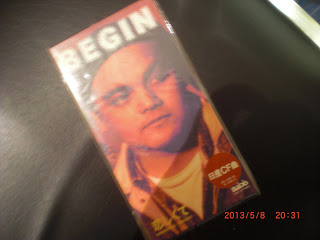
Perhaps that is the thrust behind Okinawan folk-blues bandBEGIN's"Kono Machi Hanarete" (Leaving This Town), a happy-sad tune that talks of a young fellow who's leaving his own home willingly to go on a search for himself, and maybe to realize how good his birthplace has been to him all these years.
I don't know very much about Okinawan music, but what I do know has been wrapped around the native three-stringed lute known as the sanshin, and with "Kono Machi Hanarete", there's something more foreign. This seems to be more planted in the terra firma of America with a zydeco accordion and a twangy blues guitar that sounds as if someone from Ego-Wrappin' decided to drop in for a spell.
BEGIN was responsible for words and music, and it probably made its first appearance in the band's first BEST compilation, "FAN -- Little Pieces" released in March 1995. But it has also appeared in their third BEST album "Ballads" in March 1999.
Nice to have gotten some bagels and English muffins last week from the supermarket. I always appreciate the variety. Did the same thing this morning and got the same items to tide us over until next week.
An intriguing one to start off the City Pop stuff for this Friday as we also begin the month of May. I found this one by genre songbird Haruko Kuwana(桑名晴子), and as I've always noticed, she's a most photogenic lady! 💝However in 1980, she and the band decided to go with the moniker Baker's Shop with Haruko when "Hot Line"(ホット・ライン)was released that year, and evidently from what I see in the video thumbnail above, a single did come out of it as well titled "Furimukuna"(Don't Look Back).
From the JASRAC database, it was written and composed by Kuwana (although the name that was given there was Harukoo) with Toshiro Masuda(トシロウ・マスダ)co-writing the lyrics. And why I selected it will be evident from the first few notes of "Furimukuna"; it's just scintillating City Pop with Kuwana's splendidly smoky vocals as that intro did it for me.
Rocket Brown and I have talked about some of the musical tropes in City Pop including what he has identified as the Sparkle Riff, that tinkly keyboard riff that we've all heard in many a song of the genre such as Takako Mamiya's(間宮貴子)"Love Trip" (at about 8 seconds in). I also like to call it the Perrier Pour. Well, that might be an 80s City Pop thing to me. With the Japanese urban contemporary material in the 1970s, the musical trope that I've heard in a number of songs there has been another keyboard phenomenon that I've dubbed the Haze, and that pops up almost immediately in "Furimukuna". It just sounds like haze rising from the hot ground, although I did say that this particular Kuwana delight was made in 1980, but of course, there was no temporal Iron Curtain in that year stating that the Haze had to end and the Sparkle Riff had to begin.
In any event, "Furimukuna" ironically makes me want to look back to the good ol' days in Tokyo when I hear it.