I've been a fan of Japanese popular music for 40 years, and have managed to collect a lot of material during that time. So I decided I wanted to talk about Showa Era music with like-minded fans. My particular era is the 70s and 80s (thus the "kayo kyoku"). The plus part includes a number of songs and artists from the last 30 years and also the early kayo. So, let's talk about New Music, aidoru, City Pop and enka.
Credits
I would like to give credit where credit is due. Videos are from YouTube and other sources such as NicoNico while Oricon rankings and other information are translated from the Japanese Wikipedia unless noted.
Well, it's been quite a few years since Tokyo Joshi Ryuu(東京女子流), aka TOKYO GIRLS' STYLE, was up here on "Kayo Kyoku Plus". I think the last article up was Marcos V.'s own special selection back in the spring of 2018. And I have to thank Marcos for introducing me to TGS in the first place through his article for "Partition Love" which came out in 2014, and since that was the year that I did my first visit back to Tokyo since coming home for good, I was more than happy to get my own copy of the single.
Now, I come across this even earlier single by TOKYO GIRLS' STYLE that was released in May 2011. It was not only the group's 6th single, it was also a double A-side single titled "Kodou no Himitsu/Sayonara, Arigato"(鼓動の秘密/サヨナラ、ありがとう。...Secret of the Beat/Farewell, Thank You.). I'd like to talk about that first song "Kodou no Himitsu" which was written by c. close, otherwise known as Chihiro Kurosu(黒須チヒロ), and composed by Sho Watanabe(渡辺翔).
It's very appealingly quirky and blippity-bloppity but at the same time, I also treated it as something very old-fashioned, and I'd been knocking it around in my head wondering why I would think that latter opinion. Finally, I figured it out. There's something very Taeko Ohnuki and Ryuichi Sakamoto(大貫妙子・坂本龍一)circa early 1980s about the arrangement which was handled by Hiroshi Matsui(松井寛)in terms of the synthesizers.
Some of that quirkiness apparently filtered into the official music video, I see. I especially like some of that jittery choreography for "Kodou no Himitsu" which relates the story of someone falling head-over-heels but not knowing how to approach the target of their dreams. Oh, that kataomoi again. In any case, the single peaked at No. 24 on Oricon, and the song became part of TGS' first album"Kodou no Himitsu" which hit the shelves in May 2011 a couple of weeks before the single. The album reached No. 25 on the charts.
For me, the genre of Mood Kayo with its Latin, Hawaiian or bluesy influences sends me images of swanky bars or nightclubs, hidden or overtly famous with the backup choruses intoning their "wa-wa-wa-wa". Enka is even more traditional with the themes of love and challenges in the countryside. However, there is that certain corner of enka which does take place in the city usually with that guitar-toting balladeer poking into the more modest and smaller drinking establishments within the older quarters of Tokyo and then playing a sweet love song.
That's how I think of "Shinjuku Jouwa"(Shinjuku Love Story) which was written by Ryo Inomata(猪又良)and composed by the late and great Toru Funamura(船村徹). Inomata created a story of a barfly in a tiny watering hole in Shinjuku...perhaps somewhere on the famous bar street known as Golden Gai...when he sees a woman crying softly along the bar. He knows her as Hiroko and apparently she's had another heartbreak or some bad fate befall her for which he offers her a shoulder to cry upon and perhaps his rickety apartment to sleep it off at. He may be a comrade-at-arms just helping a buddy out or he may have some deeper feelings for her which is why the really cynical part of me wants to say "Watch out, Hiroko!".
Scrolling down Funamura's long list of creations for singers in his J-Wiki file, it seems that "Shinjuku Jouwa" was first recorded by baritone/bass-voiced Moody Matsushima(ムーディー松島)in 1968. With a name like that, Matsushima probably has done Mood Kayo but here, it's more of that mournful enka. His real name is Takashi Matsushima(松島孝)and hailing from Tochigi Prefecture, he started his singing career in 1967 and "Shinjuku Jouwa" was his 3rd single. According to the Showa Pop Encyclopedia, he released at least four singles in the late 1960s and then perhaps two singles in the 1980s but his discography is a tad sporadic.
Judging from seeing some of the videos on YouTube, "Shinjuku Jouwa" has been covered a lot, and it's no surprise since the ballad is definitely one to let out the emotions through a genre that is supposed to allow for a lot of emotional release. Unfortunately, I couldn't find out which year singer Naomi Chiaki(ちあきなおみ)had recorded her version of the song although it's available on her 1994 "Chiaki Naomi Vol. 3 ~ Shinjuku Jouwa", a couple of years after she had retired from the geinokai.
The arrangement for Chiaki's cover is not all that much different from the original by Matsushima, but there are the additions of a crying violin and some form of accordion to enhance the melancholy qualities of "Shinjuku Jouwa". Of course, the Latin guitar of the balladeer has to be there, too.
Here is another enka singer that I hadn't heard of but he also gives a wonderful take on "Shinjuku Jouwa", although his vocals are more in the tenor range. Eiji Miyoshi(三善英史)released his take on the song back in 1979 through his album "Enka"(演歌), his final original album, although he has continued to release singles up to 2017 according to his own J-Wiki article. His version of "Shinjuku Jouwa" has a slightly more languid tempo and he has a bigger string unit backing him up.
Miyoshi hails from Tokyo's Shibuya Ward and made his debut in 1972. He's even appeared on the Kohaku Utagassen a total of three times between 1973 and 1975.
I couldn't finish this article without having the master Funamura himself perform "Shinjuku Jouwa". Again, I haven't been able to track down when he covered the song but according to Tsutaya, it's not on the album portrayed in the thumbnail above, "Kitai no Mei Kashu ~ Funamura Toru"(希代の名歌手 船村徹...The Extraordinary Singer: Toru Funamura). Funamura gives an especially heartrending version since his vocals feel as if he's looking at poor Hiroko as his own daughter or granddaughter.
I literally waited several months to put this song up onto the blog and the day has finally come. Patience, be thanked!
"Hachi-gatsu, Saisho no Suiyoubi" (August, The First Wednesday) is the first track on aidoru Marina Watanabe's(渡辺満里奈)5th album"Sunny Side" from July 1988. And indeed today is the first Wednesday for August 2021 so it's rather nice to have this summery tune on board. For an aidoru tune, it's got some nice refinement in the arrangement. I couldn't find out who arranged the song but I wouldn't be surprised if it had been anyone behind the songs for Miki Imai(今井美樹)or Stardust Revue who were known for some very fine songs in the late 1980s.
As it is, MAYUMI(堀川まゆみ)was behind the melody, and she's been known to have created a few songs for Imai back then as well. Meanwhile, Keiko Aso(麻生圭子)provided the lyrics about a young lady trying to kick her boyfriend or husband off the couch and off the game controller (I'm wondering whether Aso had the power of prescience when she was writing up the words) so that they can enjoy some fresh air at the beach. The song is indeed nice but I think that opening synthesizer is a bit too tinny for something this smooth.
I've mentioned this before and I'll mention this again but summers are one of the very few things that I don't miss about the Tokyo area because of the oppressive heat and humidity. One place I do miss though is the electronics district of Akihabara although in recent years, people have wondered whether it's solely a place for the gadget geeks anymore and now just one of the many entertainment areas in the megalopolis. Whatever the opinion is, I remember relying on Akihabara during those hot summers for air-conditioned solace in any of the electronics shops such as Ishimaru, Laox or Yodobashi, especially when I could get a free massage in those souped-up massage chairs. Even outside, there have been plenty of vending machines to slake a very dry thirst although in the height of the summer, a lot of juices and milks were sold out.
Anyways, I am here tonight to present "Akihabara" by Mitsuyoshi Azuma(吾妻光良)& The Swinging Boppers. I never would have imagined that a blues song would ever be made for this particular neighbourhood. Ginza, Asakusa and Ueno have probably had their blues songs but Akihabara?
Yet, here one is and "Akihabara" is so bluesy that I just had to put in the Blues label for the first time on KKP (and so I'll have to hunt down any other kayo in the past that can fit the category). This song was created and performed by Azuma and his band as a track for their third album"Stompin' & Bouncin' ~ The Great Victor Masters 1990-1991" which was released in October 1991. There are some fine horns dancing about in the performance and Azuma himself has a nice mix of rasp and gloss in his vocals, and from what I can understand from the sung lyrics, he's describing what Akihabara was like back in those days: a huge square of electronic parts and appliance shops for the appropriate geeks to delight in.
Starting out in Shinjuku in 1979, Mitsuyoshi Azuma & The Swinging Boppers specialize in jump blues and swing jazz according to J-Wiki. When Azuma was a part of a music circle called Rock Climbing at Waseda University, he and his friend who had been involved in jazz music decided to hold a Big Band performance as a graduation memento event which led to the eventual formation of The Swinging Boppers. Their first album, "Swing Back With The Swinging' Boppers", came out in 1983, and it was only a couple of years ago that they released their most recent album "Scheduled by the Budget", and there has even been a single which came out last year in November, "Big Bug Boogie".
Among all the photos that I could dig through so far, this box of goodies was the only one where I could even spot a literal sliver of lemon.
Indeed it's the stylized version of the famed citrus fruit that is the topic and title of this article. "le:mon" is a track from this October 2017 full release, "INSHOW-HA wa Kimi ni Toikakeru"(印象派は君に問いかける...INSHOW-HA Would Like To Ask You a Question) by the musical duo INSHOW-HA(印象派). Their name translates into "The Impressionists", and certainly they do leave quite the impression. INSHOW-HA reminds me of that other female duo, the techno-rap unit Charisma.com, in that the two ladies there, MC Itsuka and DJ Gonchi, started out as company employees who decided to get their stress out by becoming performers. Osaka-based MICA and miu also jumped from the corporate ladder to the world of music in 2009 and have come to bring their form of loopy techno-rock to the masses.
Supposedly, the duo's music videos have also garnered a lot of attention, and "le:mon" is no exception as MICA and miu (the latter having provided words and music) play very stoic and leggy figures doing their weirdly best around various tourist sites in Japan. I'd say that the video for this one would have gotten onto our local unusual music video show here in Toronto, "City Limits", without a problem. miu's melody fairly floods all around you with the beats and the guitar growls while the ladies' vocals alternately fly up whimsically and head down to flat ground.
The above is a photo of my breakfast at the R&B Hotel in Otsuka, Tokyo when I had my last trip to Japan in 2017. It's a business hotel judging from the clientele and I really appreciated their washer-and-dryer facilities. Also, breakfast was fine, too, although sometimes just to jiggle up the variety, I enjoyed brekkie at the Royal Host next door.
Sorry but the video was taken down but you can listen to
Speaking on that morning theme along with the fact that I'm typing this on a Monday, I have "Mr. Monday Morning" by jazzy singer MIO (although she has been known as MIQ for the past twenty years). Mind you, I'm typing this well into the afternoon...generally, I don't blog in the mornings. Anyways, this was the title track from her December 1985 album and although it starts off sounding a bit like a technopop tune, those horns and the synth-bass reassure listeners of the genre that it's a good and funky City Pop number.
"Mr. Monday Morning" was written by the prolific Machiko Ryu(竜真知子)and composed by Masahiro Taniguchi(谷口雅洋), and I really like it when MIO throws out that "Tell me why!" in the refrain for this song which sounds as if love might actually be coming to a couple. From that title, though, it might be about an amiable friends-with-benefits situation (although the term probably didn't exist back in the mid-1980s), so that love thing may not be as smooth as assumed.
I'd never heard of singer-songwriter Taniguchi but apparently he released an album "Communication" in 1980 which is considered to be one of the more hidden City Pop delicacies. According to this page, it got its CD release just last year. Judging from what I've heard of this particular song, I'm going to have to pay some attention to his works very soon. Also, I did write about another MIO tune with a morning theme earlier this year.
It's Simcoe Day in Toronto so a good chunk of the population if not everyone is having a day off, and I'm just relaxing from my usual translation duties. The Tokyo Olympics are now a little over half way done with both Japan and Canada enjoying a nice variety of medals despite the typically hellfire that is summer in the city and COVID.
Speaking of the Olympics, I'd thought that Mari Hamada's(浜田麻里)"Heart and Soul" was the first time that a Japanese pop song was used as a theme for an Olympic TV broadcast, and indeed it was NHK's inaugural Olympic song for the 1988 Seoul Games. Apparently, it shares that distinction with Hound Dog's"Only Love" which was adopted by NTV for its Olympic broadcast that year. I found this out through a webpage put up by Entamedata which lists the various Olympic themes used by the Japanese TV networks over the decades.
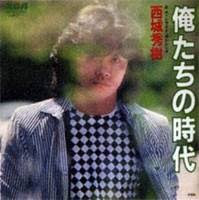
Well, I was a tad surprised to find out from that particular list that yet another kayo from several years in the past before "Heart and Soul" had been given the attempt to become an Olympic theme, and it was recorded by none other than Hideki Saijo(西城秀樹). The song was "Ore-tachi no Jidai" (Our Times), Saijo's 33rd single.
Released in June 1980, the original cover of "Ore-tachi no Jidai" had Saijo on the track ready to fly through the 100-metre dash as the song, written by Takashi Taka(たかたかし)based on the original lyrics by Masato or Masahito Kumano(熊野昌人), composed by Kimio Mizutani(水谷公生)and arranged by Jun Sato(佐藤準), begins with a rock riff followed by an upbeat funky and marching melody led by a beefy bass, tinkly synthesizers and a horn section and then ends with a strangely jazzy twist. Incidentally, this is just my theory, but I'm wondering whether the use of that synthesizer heralded what a lot of sports show themes would sound like in the years to come on Japanese TV. When I listen to Saijo singing "Ore-tachi no Jidai", I really feel like that he's putting some extra Saijo in his vocals for some reason.
As I said off the top, this was to have been an official Olympic song and according to that Entamedata list and J-Wiki, it was used by TV Asahi for one particular Olympic-themed special, but the real client was the Japanese Olympic Committee itself which was going to use "Ore-tachi no Jidai" as a cheer song for the 1980 Olympics in Moscow. Unfortunately, due to an international crisis looming over Afghanistan at the time which had the United States and the Soviet Union enter another one of their global fights in the Cold War, America and its allies, which included Canada and Japan, boycotted the Moscow Games. As a result, according to the J-Wiki article for "Ore-tachi no Jidai", that meant changing the cover for the single mid-sale to something more sober as you can see at the bottom.
Still, the single did pretty well by breaking into the Top 10 at No. 6 and finishing 1980 as the 99th-ranked single. I like the B-side "Moonlight Dancing"(ムーンライト・ダンシング)even more and you can read my personal recollection of that song there.