I've been a fan of Japanese popular music for 40 years, and have managed to collect a lot of material during that time. So I decided I wanted to talk about Showa Era music with like-minded fans. My particular era is the 70s and 80s (thus the "kayo kyoku"). The plus part includes a number of songs and artists from the last 30 years and also the early kayo. So, let's talk about New Music, aidoru, City Pop and enka.
Credits
I would like to give credit where credit is due. Videos are from YouTube and other sources such as NicoNico while Oricon rankings and other information are translated from the Japanese Wikipedia unless noted.
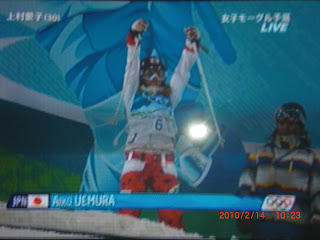
Now that the Beijing Olympics are in full swing currently, it's been nice to hear that both Canada and Japan have already been earning some medals of various colours. My mind then goes back a dozen years to the Vancouver Games in 2010...and doesn't remember very much at all. In fact, I had to go to some of those impromptu shots by my ancient Casio that I took of some of the televised footage, including the above photo showing off Aiko Uemura(上村愛子)on the moguls.
Singer-songwriter Ai Otsuka(大塚愛)is someone that I've known for her 21st-century bubblegum pop through songs such as "SMILY". I must have then focused solely on the NHK coverage of the Vancouver Olympics since I had no knowledge that the happy-go-lucky Osakan was also behind Fuji-TV's official theme for their Games broadcast in 2010. Indeed, she came up with "LUCKY☆STAR" which was a part of her 20th single"Zokkondition/LUCKY☆STAR"(ゾッ婚ディション/LUCKY☆STAR) as released in April of that year.
"LUCKY☆STAR" has got quite the mixture of spacey dance beats and jangly guitar and it doesn't really sound like the usual inspirational Olympic J-Pop song, but it is indeed catchy. I would have thought it was a tune created by Denki Groove(電気グルーヴ)but it's actually all by Otsuka. The official music video has a goodly dollop of computer graphics to the extent that I wondered if the Pet Shop Boys' 90s videos had been any inspiration. The entire single hit No. 6 on Oricon. "LUCKY☆STAR" would also be included in Otsuka's 6th original album"Love Fantastic" from July 2014. The video below has the instrumental version which is in itself pretty cool to listen to.
Spoke to a couple of friends over the past few days, both of whom have plenty of Japan experience, and at least one of them is really itching to head over there again for vacation, perhaps later this fall. I really hope that his wish comes true although I really doubt that I'll be able to get there again anytime before 2023. By that time, it'll have been 6 years since my last flight out to my old stomping grounds.
Speaking of those long-awaited dream flights, I have one here with that very title in Japanese. "Yume Hiko"(Dream Flight) was the B-side to Azumi Inoue's(井上杏美)debut single"Star Storm" in April 1983. At first, that name didn't quite hit the recognition circuits, because she was going full kanji at the time, but when I noticed that she'd already had an entry on "Kayo Kyoku Plus", I realized that it was the Azumi Inoue(井上あずみ)who'd been responsible for singing the theme songs for the Hayao Miyazaki(宮崎駿)classic, "Tonari no Totoro"(となりのトトロ)in 1988. The Kanazawa native was actually born Midori Miyazaki(宮崎みどり)but took on her stage name based on a book written by a Kanazawa-born author Saisei Muro(室生犀星)titled "Anzukko"(杏っ子).
That jingly synthesizer which starts "Yume Hiko" is really quite nostalgic for me and it does remind me of those really cute aidoru tunes from the early 1980s, additionally enhanced by Inoue's high-and-clear vocals. I also can't forget that wailing electric guitar which finishes things off. Written by Rie Ohtani(大谷リエ), the melody was composed by Toshiaki Matsumoto(松本としあき), a pianist and composer who also later changed the transcription of his name(松本俊明)and has since become even more famous for a couple of Xmas tunes, Junichi Inagaki's(稲垣潤一)"Merry Xmas ga Ienai"(メリークリスマスが言えない)and Misia's "Everything".
That's a pretty lithe Masahiko "Matchy" Kondo(近藤真彦)there doing his waiter thing with those dishes. Working in a restaurant part-time as a teenager is definitely paying one's dues.
Back in the heat of August last year, I wrote about Matchy's "One More Time", a B-side that has the cachet of being a redux of Tatsuro Yamashita's(山下達郎)alternate take on "Ride On Time". It definitely made quite the story when I first heard about this.
Well, the flip side for that B-side is "Eien ni Himitsu sa" (Forever A Secret), the boy wonder's 15th single released in September 1984. It may have gotten out onto the record shelves closer to fall, but there's no denying the summery feeling from this one, and that is due to the melody and arrangement by Tats himself again with Takashi Matsumoto(松本隆)providing the lyrics about a couple very much in love taking that stroll along the beach, perhaps keeping the affair as sub-rosa as possible. Especially with that background chorus in there, it definitely feels like a Tatsuro tune.
"Eien ni Himitsu sa" was another No. 1 hit for Kondo and it ended up becoming the 49th-ranked single for 1984, selling close to 240,000 records.
I've been catching up on some of the anime from Fall 2021, one being "Senpai ga Uzai Kohai no Hanashi"(先輩がうざい後輩の話...My Senpai is Annoying), the rom-com set in a corporation. Almost reaching the halfway point, it's been a calm and enjoyable watch as I witness the two main couples: Harumi and Futaba along with Touko and Souta; the latter couple having the more normal evolution into a relationship.
Just around the time that the anime was getting started, I'd already put up the article for the opening theme, the rambunctious "Annoying! San San Week!"(アノーイング!さんさんウィーク!)as sung by four of the cast members. I also noticed that veteran seiyuu Yui Horie(堀江由衣)was in the cast although she isn't involved in the opener but I didn't initially figure out who she was playing. I still remember her as the relative straight-person in the gag-filled "Danberu Nan-Kiro Moteru?"(ダンベル何キロ持てる?...How Heavy Are the Dumbbells You Lift?)and going way back, she was the innocent and stoic title character in "Miss Monochrome"(ミス・モノクローム). Eventually, I realized that she had the role of Touko's little brother, Yuuto.
Horie also has the role of singer for the ending theme of "Senpai ga Uzai Kohai no Hanashi" which fits the usual mold of the relatively more introspective and mellow song at the end of an episode compared to the uptempo opener in an anime. "Niji ga Kakaru made no Hanashi"(The Story Until the Rainbow is Built) sounds like it's reflecting more of the hopeful romance among the characters as much as "Annoying! San San Week!" is about the crazy antics at the office. Yoshifumi Kanamaru(金丸佳史)was behind the lyrics while Ryota Nakano(中野領太)took care of composition and arrangement.
I don't know whether "Senpai ga Uzai" will get a second season or if it will be just a one-and-done show, but I'm hoping that the ending will have something hopeful between Harumi and Futaba, even if it seems like the latter always wants to conk the former on the head in frustration.
There have been a couple of articles featuring the late actor and singer Hiroshi Moriya(守屋浩)who had passed away in September 2020, including "Boku wa Naichicchi"(僕は泣いちっち), an enka ballad by songwriter Kuranosuke Hamaguchi(浜口庫之助)which may have been the first of his songs to get recorded.
However, I have neglected to provide some background information on Moriya who was born in Chiba Prefecture in 1938 as Kunihiko Moriya(守屋邦彦). In his late teens, he got his first taste of showbiz when he joined the rockabilly band Swing West(スイングウェスト)as a roadie in 1957 and then got involved with the Nichigeki Western Carnival(日劇ウエスタンカーニバル)the following year at the Nihon Gekijo Theatre in Tokyo.
At around the same time, Takeo Hori(堀威夫), the founder of Hori Productions, later to become the talent agency Horipro tacked on the stage name of Hiroshi Moriya to young Kunihiko so that he could be promoted along a couple of other Hiroshi-tagged actor/singers, Hiroshi Inoue(井上ひろし)and Hiroshi Mizuhara(水原弘)to become known as Sannin Hiroshi(三人ひろし), aka The Three Hiroshis, during the late 1950s going into the early 1960s. With the rockabilly boom in full swing (no pun intended), Moriya began to grow his fame.
Still, the song that I have here by Moriya tonight doesn't sound anything like a rockabilly tune. In fact, I'd say that "Arigata ya Bushi" (The Thank You Tune),his hit single from November 1960 is definitely in the traditional Japanese vein, although with a mix of festival-loving minyo, a bit of Latin even, and an arrangement that also feels like it could easily be played by an old-fashioned chindon'ya band. The interesting thing, though, is that the composer is unknown, although according to the J-Wiki article for "Arigata ya Bushi", it may have originated from a song devoted to the Buddha on the island of Shikoku, although it's been also said that it had been sung as a folk tune all the way over in Nagoya.
Whatever the origin legend may say, "Arigata ya Bushi" was written by the aforementioned Hamaguchi basically as someone's somewhat snarky theory of life (yeah, yeah, thank ya, thank ya, whatever!) as unnecessary hustle and bustle while the fellow himself is more than happy to go or lay about at his own sweet pace. Considering the times, the famed lyricist even installs a note about a woman he likes spending her time attending university demonstrations. "Arigata ya Bushi" may have been about the joy of fecklessness, but it really hustled in the sales department, selling around 140,000 records a few months after its November debut.
(I'm sorry but the video has been taken down.)
The J-Wiki article also mentions that "Arigata ya Bushi" had its cover versions including one by Yujiro Ishihara(石原裕次郎)via one of his movies in 1963. Speaking of that, the success of the song also led to a movie based on it, "Arigata ya Bushi Aah Arigata ya Arigata ya"(有難や節 あゝ有難や有難や...Doing What I Please) that was released in May 1961 with one of the stars being Moriya himself. In the above video, lyricist Hamaguchi himself gives his own song a go.
Another rollicking cover was provided by reggae singer KAJA as the ending theme song for the fourth season of the TV Asahi assassin series "The Hangman"(ザ・ハングマン)in 1984. Incidentally, KAJA shouldn't be confused with the obscure band Kaja that I'd already written about a couple of years ago. As such, I'll keep the reggae singer listed in Labels with "(reggae)" next to it. The pronunciation is also different in that the band Kaja sounds like "ka-ya".
There was a time during my long stay in Japan in which I was attending my fair share of weddings. It seemed as if I were heading to the ceremonies and receptions every few months. Naturally, they were very happy affairs although I was worried about the amount of money that I had to hand over in those special envelopes as part of the traditions. However, I definitely enjoyed the lion's share of food at those receptions, and if anyone is lucky enough to be invited to a wedding in Nagoya or the larger area of Aichi Prefecture, accept it! Those folks especially really go all out for the party atmosphere and the cuisine.
I've been out of the wedding-attending zone for about two decades now. At my age, most likely the next wedding that I will attend will be the one for my niece and that probably won't be for many years to come. So, listening to Ai Furihata's(降幡愛)"Secret Sugar" and watching the adorable video above, I got some of those old memories of seeing friends getting hitched, although in a couple of cases unfortunately, they ended up in divorce.
When it comes to Furihata's contributions on the blog so far, I've been accustomed to hearing her provide her form of Neo-City Pop and 80s-style synthpop such as the first song that I'd ever heard from her, "City". "Secret Sugar" is a totally different animal altogether although it was created by the same duo behind those urban contemporary tunes, Furihata herself on lyrics and Akimitsu Honma(本間昭光)on melody. "Secret Sugar" is a song that was provided on her September 2021 single"Honeymoon"(ハネムーン)and it's very much in the happy and folksy pop vein, almost along the same lines of an old Carpenters song and maybe some of those 60s Brill Building tunes. The two even incorporate a grand version of "The Wedding March" in the instrumental bridge. The single, by the way, peaked at No. 29 on Oricon.
J-Canuck recently wrote about 365 Nichi no Kami Hikouki (365日の紙飛行機) and that inspired me to write this article.
Speaking of AKB48, I first came to know them through a classmate in my Beginning Japanese class in Foothill College California back in 2010. He was watching some YouTube video and I asked him what it was. He replied that it's AKB48. I was surprised at the thought that there's an Aidoru group with 48 girls and wanted to ask him further. He didn't care to explain and I ended up Googling myself. Turned out that I was not entirely wrong about the 48 people part, but this "AKB48 Corp." is much more complicated than any Aidoru group I've ever known!
First, a big disclaimer: I'm not an AKB48 fan. Fans out there, please keep me honest if I say something stupid.
Some background info for people who may not know much about AKB48. Since there're so many people in the group, not every one gets the chance to participate in every single album. They have to go through a selection process (選抜会). This process also decides who gets to play center, or the prominent dancer for the single album.
I haven't done enough research about this selection process. I think fans' ballot counts. I definitely think Akimoto Yasushi (秋元康) has so much power that he can overrule anything. There's also something called Janken Taikai (じゃんけん大会), or Scissor Paper RockTournament, where members play scissor paper rock against each other. The last 16 people remaining are eligible to participate in the single album, whereas the final winner plays center.
I think whoever coined the idea is a genius!
Ue kara Mariko was the result of such Janken Taikai, with Shinoda Mariko (篠田麻里子) being the scissor paper rock champion, Fujie Reina (藤江れいな) as the 1st runner-up, and Minegishi Minami (峯岸みなみ) and Kobayashi Marina (小林茉里奈) losing to Shinoda and Fujie respectively in the round of final four. That's why both Fujie, Minegishi, and Kobayashi got quite a lot of air time in the official MV above. Since anything can happen in scissor paper rock, this selection process is purely based on luck (unless the whole thing is a fake). Consequently, big fan favorites like Maeda Atsuko (前田敦子), Ooshima Yuuko (大島優子), and Itano Tomomi (板野友美) were not in the song. In fact, Maeda was out as soon as the 2nd round (she lost to Akimoto Sayaka 秋元才加).
Music-wise, Ue kara Mariko has a light and cheerful tone and rhythm. Like any pop song, it has some easy-to-remember melodies throughout the song. It's quite a typical AKB48 song in my opinion. The lyrics is what I think is interesting. It's telling a story from a male perspective. A boy was going out with a girl older than him. In Japanese terms, he's dating his senpai. Moreover, this senpai he's dating was unpredictable and regularly "tested" him. For instance, she would suddenly close her eyes, expecting our boy to kiss her. If he showed the slightest hesitation, she'd call him a wimp! The boy called her sadistic (サディスティックな奴め), but clearly he found this kind of flirting cute and exciting!
Akimoto Yasushi seemed to have written the lyrics tailored for Shinoda Mariko. Even her name was there in the song title. Furthermore, Shinoda Mariko was the oldest in the group and it fit the song's story (i.e. a boy was dating someone older). Apparently, she’s also the tallest.
Finally, I want to talk about the story in the MV, especially for AKB48 fans who don't know Japanese. Besides enjoying the music, the dance, and the cute little girls, I think it's a bonus if you also understand what the story was about.
The story took place in what seems to be an all-girl high school. Shinoda Mariko (篠田麻里子) played the biology teacher. Akimoto Sayaka (秋元才加) played the physical education teacher. The rest of the cast were students.
In the first scene, Minegishi Minami (峯岸みなみ), Fujie Reina (藤江れいな) & Kobayashi Marina (小林茉里奈) were meeting on campus. The school's Student Body president was up for grabs, but nobody wanted it and there's no candidate. As a result, each class would hold a lottery, and the 8 people who "won" would be forced to become candidates. Furthermore, the presidency would subsequently be decided by scissor paper rock.
Minegishi was complaining why she "won" the lottery, even though there're more than 30 people in her class. She didn't want to become president because it's a job that only attracts criticism but no appreciation. She turned to Kobayashi and asked her to come forward as a candidate. After Kobayashi refused, she turned to her "best friend", Fujie, and begged her to become a candidate. Before Fujie had a chance to respond, Kobayashi said no for her. She whispered to Fujie that she didn't need to be so mellow even though Minegishi was her senior (senpai).
Minegishi spotted Shinoda Mariko (篠田麻里子), their biology teacher. She's talking to a foreigner in fluent English. Minegishi commented that Shinoda looked so cool (apparently, fluent English is a cool factor in Japan😁).
In the second scene, Fujie was in Shinoda's biology class. It had already ended but they remained in the classroom. Fujie commented that Shinoda was the chosen one. Shinoda paused, and told Fujie that she thought they're alike. Fujie didn't think so. Shinoda then suggested that Fujie should try to dress up a bit, and a hair ornament might be the perfect item for her. Shinoda then took a faraway look, and said she had chosen instead of being chosen.
Back on campus, Fujie, Minegishi and Kobayashi were together again. They're looking at a web site featuring some photos of Shinoda. Kobayashi made a comment that Shinoda felt like a celebrity. Fujie said Shinoda sang rock when she's young. Even now, some of her photos could be found on auction sites. Minegishi then made a comment that Shinoda didn't look like a typical biology teacher at all. Fujie followed by saying that Shinoda had to be born under a lucky star. Minegishi, highly frustrated, complained why the presidency would be decided by scissor paper rock.
The 4th scene happened inside a library with Ooya Shizuka (大家志津香), Maeda Ami (前田亜美), and Satou Sumire (佐藤すみれ). Ooya said the Student Body presidency appeared to be decided by scissor paper rock once in the past. Maeda said she also heard about it. Satou found out that indeed it happened 8 years ago. They then found the photo of the first ever paper scissor rock president, but they didn't recognize that it's Shinoda, their current biology teacher. Satou commented that just by looking at the face of that person in the photo, there's an unlucky aura all around her.
Finally, it's time for the scissor paper rock tournament. Shinoda came in and sat behind the crowd. Akimoto Sayaka (秋元才加), the physical education teacher, noticed her and told the students that Shinoda was the first ever scissor paper rock president. Everybody was shocked. Ooya made a comment that it's unbelievable that Shinoda was the loser that became president. Akimoto corrected her and pointed out that 8 years ago, because there're too many candidates, they decided to play scissor paper rock to settle the presidency (why not hold a simple election is beyond my grasp 😂). In other words, Akimoto explained, Shinoda won the presidency and was no loser. She further commented that ever since that time Shinoda really started to shine. "This is a SUPER upgrade!" Minegishi bursted out, to which Shinoda replied, "Responsibilities make women grow! I’m telling you."
In the last scene, Shinoda and Fujie met in the corridor. Fujie wanted to return the hair ornament, which Shinoda lent her as a lucky charm. Shinoda said she could keep it, and walked away. Fujie called her and made a peace sign (=scissor). Shinoda, continued walking and without turning back, returned with a fist (=rock), showing that Shinoda would always be the queen of scissor paper rock.