I've been a fan of Japanese popular music for 40 years, and have managed to collect a lot of material during that time. So I decided I wanted to talk about Showa Era music with like-minded fans. My particular era is the 70s and 80s (thus the "kayo kyoku"). The plus part includes a number of songs and artists from the last 30 years and also the early kayo. So, let's talk about New Music, aidoru, City Pop and enka.
Credits
I would like to give credit where credit is due. Videos are from YouTube and other sources such as NicoNico while Oricon rankings and other information are translated from the Japanese Wikipedia unless noted.
Earlier today, I received a pen-and-paper letter from an old friend who lives in Okinawa. We haven't seen each other in almost 30 years but we've been able to keep in touch annually through Xmas and stuff. He and his family had lived briefly here in Toronto where we first met. I think that the last time that we met was during the early years of my second stay in Japan when we and some other mutual friends met up at a ramen joint just across the street from my NOVA school in Asakusa.
I'll have to send a reply as soon as possible, but reading the letter this afternoon had me thinking of this song by the late singer-songwriter Johnny Yoshinaga(ジョニー吉長), "Zero Comma Zero". Honestly, I don't know what the title is all about although I start thinking about geographical coordinates, but there is Yoshinaga's lyric "Time goes fast, time goes on" which is kinda my internal observation on my relationships with friends as I approach my sixties.
A track from his 1983 album"Love Child", this was his own creation which has its ingredients of mellow funk, light rock and perhaps some blues rolling around in there. Plus I think that the genres are all hiding under a thin veil of City Pop because of the arrangement. It does make for the ideal song of contemplation about life and all that happens within it while nursing that drink at a bar.
I have to confess sheepishly that I would never have imagined a title like "Okorinbo no Ningyo" (Short-Tempered Mermaid). For one thing, I had never heard of the cutesy word okorinbo before (usually, my term for short-tempered has been tanki), and for another, I had never even considered the concept of a crabby mermaid. Up to now, my impression of the half-humanoid/half-fish had been that mermaids and mermen were pretty serene types.
Well, the more you know, right? Anyways, "Okorinbo no Ningyo" was the June 1987 debut single for Chiba-born aidoru Yuko Nito(仁藤優子). Graduating from the famous Horikoshi High School in Tokyo, she opted to sing Akina Nakamori's(中森明菜)hit "Shojo A"(少女A)in the Horipro Talent Scout Caravan in 1986, won a prize and entered show business.
I do like "Okorinbo no Ningyo" for the AOR-like intro, the sparkly aidoru melody by Ken Sato(佐藤健)with lyrics by Jun Natsume(夏目純), and Nito's clear-as-a-bell vocals which remind me of those by a young Naoko Kawai(河合奈保子)back in the early 1980s. It's got that winning summery vibe as this mermaid-human male romance plays out. Her first single peaked at No. 13 on Oricon.
According to J-Wiki, up to 1990, Nito released five singles along with one original album. However, ongoing issues with her throat led to her eventually slowing the pace in the music part of her career to its end, so for a while, she focused on becoming a baradol(バラドル...variety show aidoru) along with another up-and-comer Miyuki Imori(井森美幸)and then went along the acting route.
Sad way to start off this week on "Kayo Kyoku Plus", but unfortunately another one of the bright lights in the kayo kyoku era has flickered out. Singer and actor Teruhiko Saigo(西郷輝彦), one of the original Gosanke(御三家...The Big Three) of the 1960s alongside Yukio Hashi(橋幸夫)and Kazuo Funaki(舟木一夫), passed away yesterday at the age of 75 in Tokyo from prostate cancer. My fellow KKP contributor Noelle Tham was the first to write about Saigo through what is arguably his most famous song "Hoshi no Flamenco" (星のフラメンコ) from 1966 which got him to perform it at NHK's Kohaku Utagassen in the same year as well as in the 1973 edition. The above video features that latter appearance which turned out to be his final of 10 appearances on the New Year's Eve special (although he would show up on the 1987 edition to help cheer on his buddy, Yuzo Kayama).
Saigo was born as Seiki Imagawa(今川盛揮)in Kagoshima Prefecture in 1947. After dropping out of high school in 1962, he hitchhiked his way to Osaka where he worked part-time and eventually became employed with the country and rockabilly band Gary Ishiguro & Sons of the West(ゲーリー石黒とサンズ・オブ・ウエスト)which usually toured around the Kansai region of the nation. It was there that he was able to enter a talent agency.
His debut single was "Kimi dake wo"(Just For You) from February 1964, just a couple of weeks after his 17th birthday. Written by Tetsu Mizushima(水島哲)and composed by Jun Kitahara(北原じゅん), Saigo's first foray into recording coincided with the recent establishment of Crown Records in late 1963 so he was seen as one of the new crop of fresh young singers for the company. With that jaunty innocent arrangement and Saigo's rich and velvety vocals, "Kimi dake wo" was a hit off the bat for the singer and it managed to sell 600,000 records. Along with another hit from his 4th single in August that same year, "Juu-nana Sai no Kono Mune ni"(十七才のこの胸に...Seventeen in My Heart) , Saigo would also win Best New Artist honours at the Japan Record Awards at the end of the year, and even make his first appearance on the Kohaku to sing "Juu-nana Sai no Kono Mune ni".
Saigo had been married to actress/singer Mari Henmi(辺見マリ)and they had a daughter Emiri Henmi(辺見えみり)along with musician Noritaka(辺見鑑孝). His second marriage begat another daughter, actress/illustrator Uchuu Imagawa(今川宇宙). My condolences to Saigo's family, friends and fans.
Rocket Brown and I were having a very cordial conversation earlier today regarding Yokohama-based kayo since one of my recent purchases was the January 2004 2-CD set known as "Yokohama Fantasy"(横浜幻想)which is chock-filled with those very songs. Strangely enough, neither disc has "Yokohama Tasogare"(よこはま・たそがれ)by Hiroshi Itsuki(五木ひろし)or even the original version of the classic "Blue Light Yokohama" by Ayumi Ishida(いしだあゆみ), both of which I had covered in a KKP article of a decade ago. I guess maybe they were seen as being too obvious although "Blue Light Yokohama" is at least covered by singer-songwriter Tomoko Tane(種ともこ)on Disc 2, albeit in a heavily rearranged version.
If "Yokohama Fantasy" had held off on its release by several months, it could have included another cover of the evergreen "Blue Light Yokohama" as ably recorded by Takako Uehara(上原多香子), former member of the 90s girl group SPEED. This version of the Jun Hashimoto and Kyohei Tsutsumi-penned(橋本淳・筒美京平)classic kayo was Uehara's 9th single released in February 2004 and it's a comforting and straight-ahead cover with the arrangement amped by synthesizers and a touch of soul.
This cover peaked at No. 33 on Oricon. Hopefully, I'll be able to take a look into "Yokohama Fantasy" in the coming days since there are tracks by some pretty familiar faces that I hadn't know about, although there are also some famous representatives, too. I'd actually written about her previous single, "Make-up Shadow", itself a cover of a Yosui Inoue(井上陽水)tune.
Up to now, the only time that I've written about singer-songwriter Rie Eto(衛藤利恵)was for her vocal contributions to a Denki Groove(電気グルーヴ)song, the punchy "N.O.", and that took advantage of her very fluent German.
I found her debut single from November 1994, "Tenshi no Hohoemi" (Angel Smile), an elegant if mysterious pop tune written by Sayaka/Yuka Hirota(広田結花)and composed by Hitoshi Haba(羽場仁志). In fact, I think that it so much of that elegance and mystery, I think that it would have been an ideal ending theme for those Tuesday night suspense dramas on Japanese TV, but the song was actually used as an insert tune for the televised adaptation of the manga "Shizukanaru Don"(静かなるドン...The Quiet Don).
Up to 2000, Eto has released 8 singles and 6 albums with her most recent single and album coming under her stage name of amber. As I mentioned in the article on "N.O.", she had also participated as the narrator for the entertainment show "Showbiz Countdown" (where I first heard her) and a number of commercials.
I've had Marcos V. and Joana kindly introduce me to the wonders of the aidoru group Dance for philosophy(フィロソフィーのダンス), and I even wrote my own article featuring them because of their fun rockabilly jazz tune "Dance or Dance" (ダンス・オア・ダンス).
But that's definitely not the genre on display here for Dance for philosophy's 3rd major single from August 2021, "Double Standard". There's some gorgeous Neo Disco action going on here that had my mind wandering back to some of Mondo Grosso's stuff from the early 2000s, and the music video appears to have the group going into action spy mode. With words by SHOW and music & arrangement by Yoji Noi(野井洋児), "Double Standard" also became the ending theme for a spinoff anime titled "Mahōka Kōkō no Yūtōsei"(魔法科高校の優等生...The Honor Student at Magic High School) which had its run between July and September 2021.
Happy Saturday! Another cold start to the weekend and a few more centimetres of snow on the ground, but at least it's sunny out there. Still, I'm happy to be here inside working on the blog as usual.
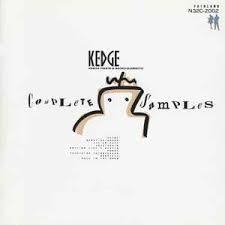
From Discogs
Almost four years ago, I was surprised to encounter this album titled "Complete Samples" which got its release in 1988. First off, the tracks that I was exposed to were darn catchy in the synthpop sense, and secondly, the duo behind the music, KEDGE, had a very young Tomita Lab(冨田ラボ), aka Keiichi Tomita(冨田恵一), as one of the two members while lyricist-singer Naoko Sugimoto(杉本直子)was the other one. It was most definitely quite the revelation since I'd been accustomed to the smooth groove and soul of Tomita Lab's subsequent works many years later as compared to the techno perkiness of the KEDGE tracks on "Complete Samples".
I just had to include the photo of the younger Tomita and Sugimoto via Fondsound since I'd never seen KEDGE in the flesh before. Of course, as a disclaimer, if Fondsound comes across this article and doesn't appreciate the inclusion of the photo, they can let me know so that I can take it down.
(4:40)
Now with that first article on "Complete Samples" which, I assume, had all of its tracks composed by Tomita and written by Sugimoto, I put up only three of the tracks so it was actually an incomplete sample of "Complete Samples". So for today, I hope to take care of the remaining six tracks on this most distinct album. We can start off with Track 2, "Merry-Go-Round"(メリーゴーランド), a very Taeko Ohnuki(大貫妙子)French song of elegance with the synthesizers and piano that mellows things right down after the supremely poppy opener of "Chime". I thought at one point that "Merry-Go-Round" could have made for a nice contemplative ballad in a musical.
(refer to 8:30 in the above video)
I recall the Art of Noise making a similar song with this propulsive dance beat and the callout chorus. This is Track 3 "It's So Easy". Mind you, I'm not sure whether Tomita had meant it to be a dance tune, and there are some rather fascinating tangents coming off the melody with perhaps some influences as varied as Hiroshi Sato(佐藤博)and Howard Jones, both of whom I've compared to each other in the similarities of their voices. The other fascinating thing about "It's So Easy" comes from the credits on Discogs since one of the backup singers was identified as Sachiko Suzuki(鈴木早智子), and when I pressed on her link, it led me to the Sachiko Suzuki of Wink.
Judging from the thumbnail above, I gather that "Rolling Like A Heaven" was released as a KEDGE single with the lovely "Sosutenuto"(ソステヌート)as the B-side. It's a somewhat more pensive technopop tune approaching the YMO home world with that shimmering synthesizer aural wall sounding like it could have been concocted by The Professor himself. At one point, Sugimoto even goes into a Blondie-like rap although I'm fairly sure that she isn't talking about eating cars.
"Rondo"(ロンド)has listeners join KEDGE on a strange and slightly trippy waltz. Not being a classical music expert, I discovered that the most famous example of a rondo is Beethoven's "Fur Elise". "Rondo" by KEDGE though feels slightly like going through Dr. Strange's first trip through the multiverse thanks to The Ancient One in a playful and somewhat mean-spirited mood. However, the pace is considerably more genteel and reminiscent of PSY-S.
"Fushigi na Shinnyusha"(不思議な侵入者...Mysterious Intruder) is one of the more upbeat tunes and the closest to straight summertime pop on "Complete Samples". Not sure what the connection is between that ominous title and what is a very bubbly happy-go-lucky song, but the remarkable thing about Sugimoto here as she sings this one is how her vocals alternate between the aforementioned Ohnuki and any 80s aidoru. Another interesting point is how Tomita ends "Fushigi na Shinnyusha" with repeated phrasings of the refrain as if it were the end of an old American variety program or game show. I can hear the announcer saying "Thanks for joining us tonight! We'll see you again next week!".
The final track, "Gate to the Mood", is neither a ballad nor an uplifting song but is a mid-tempo instrumental being set in a techno tropical paradise. Again, I'm drawn to Tomita's arrangement because of the key shifts as if he's trying to bring in some story of intrigue along the lines of a Hollywood adventure of the 1940s or 1950s. But yes, I'm trying to keep aware that this is a synthpop finale to a fascinating and rare (and probably very expensive) album.
I mentioned Fondsound earlier and the site has its own article on "Complete Samples" which you should also take a gander at.