I've been a fan of Japanese popular music for 40 years, and have managed to collect a lot of material during that time. So I decided I wanted to talk about Showa Era music with like-minded fans. My particular era is the 70s and 80s (thus the "kayo kyoku"). The plus part includes a number of songs and artists from the last 30 years and also the early kayo. So, let's talk about New Music, aidoru, City Pop and enka.
Credits
I would like to give credit where credit is due. Videos are from YouTube and other sources such as NicoNico while Oricon rankings and other information are translated from the Japanese Wikipedia unless noted.
Back in April 2017, I wrote up an article about an anison that caught my ears from the show "Kido Senkan Nadesico"(機動戦艦ナデシコ...Martian Successor Nadesico), sung by seiyuu Houko Kuwashima(桑島法子), that had the same effect as strawberries and cream in June.
For whatever insane reason, I never wrote down about who had created "Watashirashiku" in the original article. Allow me to rectify that omission, then, by stating that it was singer-songwriter Yuki Matsuura(松浦有希)who came up with this very pleasant song. Composer and producer Kiyoshi Yoshida(吉田潔)also helped out in the creation and arrangement of the music.
Matsuura provided a self-cover of "Watashirashiku" on her 3rd album"Stella Bambina" from August 1997. Dang, the intro for both versions is still splendid and I do like the harmonica in Matsuura's cover. It's a nice way to finish the work week.
The above is a pretty spectacular shot from the condo of my good friend in the Musashi-Kosugi neighbourhood. Unlike my aging area here in Toronto, Musashi-Kosugi is one of the young and growing areas west of Tokyo and I had the privilege of staying with my friend and his family for a few nights. There are a lot of good restaurants and shops and I think it's only 20 minutes away from Yokohama on the train.
Anyways, I wanted to start off my contributions for the final day of November 2018 by paying tribute to the evening in Musashi-Kosugi via Kingo Hamada's(濱田金吾)"Run Thru The Night" from his 1981 album, "Feel The Night". I've always liked the iconography for the album cover since I first glimpsed it in "Japanese City Pop"; it's a bit like LEGO after imbibing a few drinks.
"Run Thru The Night" will probably not be my favourite song by this City Pop/AOR veteran, but it's still a nice slice of urban contemporary with some sprinkling of funk and perhaps even a cameo of Steely Dan sensibilities. Hamada came up with the music but according to the Yamaha Music Holdings Entertainmentsite, it was a fellow by the name of John Helmes who came up with the words. I couldn't track this Helmes down on the search engines so I'm wondering if this is actually a Hamada pen name. In any case, "Run Thru The Night" has that nocturnal vibe of painting Tokyo red in the high-flying times of Japan.
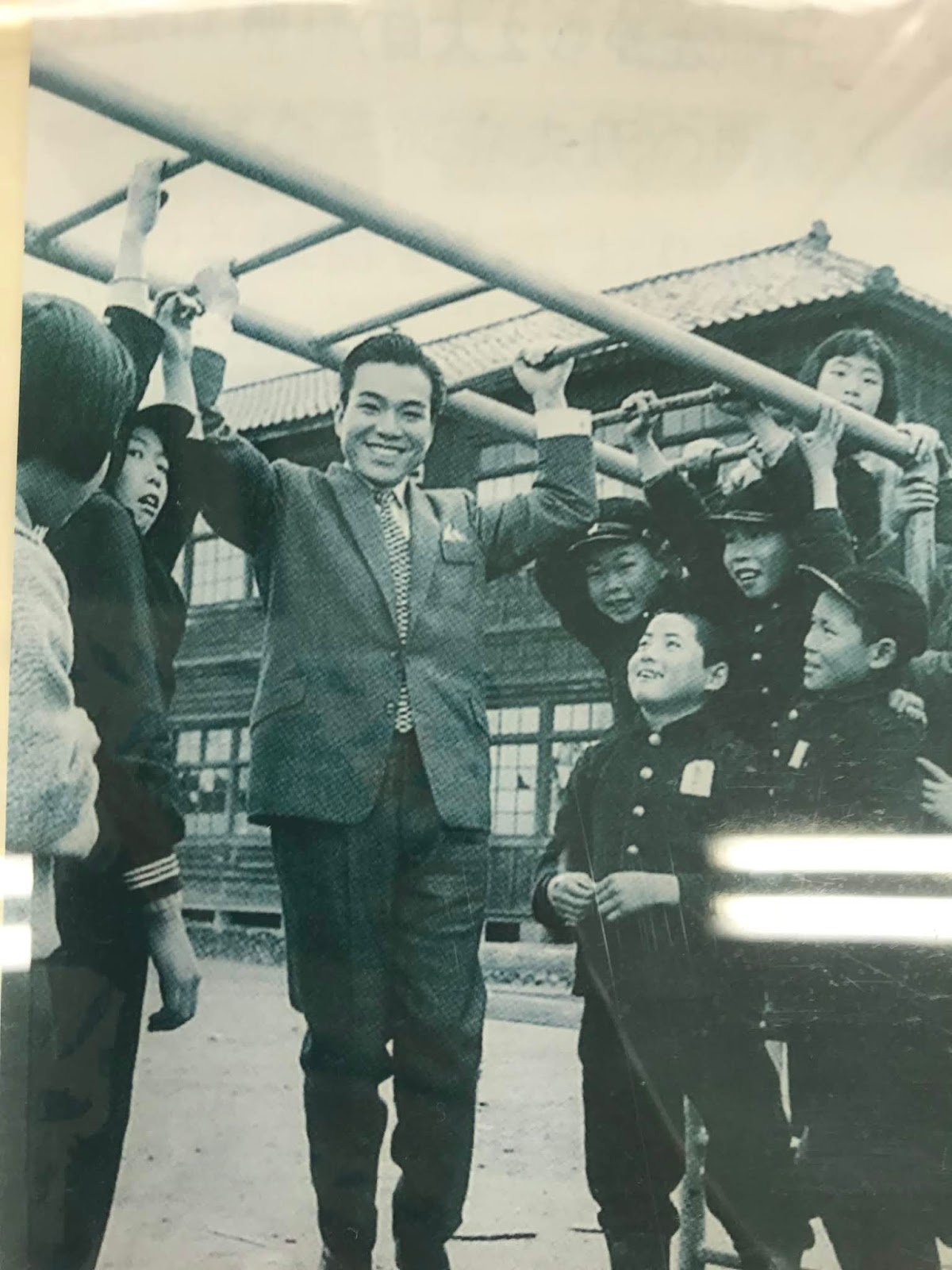
Yes, folks, the merry fellow you see hanging from the monkey bars was, indeed, Haruo Minami (三波春夫). He truly had a winning smile.
By the way, from now I will start referring to Minami as Haru-san from time to time as well. It's a fitting nickname I'd heard in a clip before, and I think it'd be more interesting to call him that alternatively than simply just Minami in my writings.
En route to Nagaoka
I had known about Minami's statue park from the time I discovered him, but visiting him wasn't really a concrete item on my list of things to do during my trip. It might seem odd considering what you all know about me by now, but I wasn't completely sure how frequent train service was on the Shin'etsu line running from Nagaoka to his hometown of Tsukayama.
But, of course, I eventually decided that I might as well give it a go as I don't think I'd have many other opportunities to visit Niigata otherwise (Minami or no Minami), so on one of the days in Tokyo, Mom and I took the shinkansen up to Nagaoka to check out Niigata and what of the Shin'etsu line. As it turned out, this local line does stop at Tsukayama moderately frequently - it was meant to be! ...This taught me to not be overly reliant on Wikipedia's train line information - there weren't many English sites with lesser known railway schedules like this, okay?
Anyways, having gone to Aizubange (Hachiro Kasuga's (春日八郎) hometown in Fukushima) and being impressed by being not so rustic as I thought it'd be, I suppose that gave me the not-so-realistic impression that Tsukayama may be more or less the same. Well, when we got there, it turned out to be what I had previously expected of Aizubange. It was very quiet and the facades of buildings had seen better days. However, it looked exactly like the villages featured on Channel News Asia's "Japan Hour" railway episodes, and it felt kind of strange (in a good way, of course) to actually be seeing it for myself.
And with it being Niigata, there were fields upon fields of rice with some plots being dotted by elderly farmers planting their crop. Up to that point, I had never seen how this Asian carb staple was farmed, so it was another first for this city kid. On the flip side, the farmers must be wondering what these two out-of-town folk were doing in a place like that. On another note, Tsukayama seems to be one of the hubs for the sports equipment company, Yonex. The juxtaposition of the occasional large factory blocks in the midst of old houses and rice fields was quite amusing.
Compared to the insane 45 minute hike it took to get to Hachi's museum,the 20 minute or so walk to this park was a breeze. But I would say my reaction upon seeing the one dubbed the National Singer standing on the pedestal was similar to seeing The First Enka Singer: Absolutely surreal.
It was the most realistic statue of a singer I had ever seen; his dimensions, that beaming and welcoming expression, the kimono. It felt incredibly bizarre looking up at it. It looked so real, it almost seemed like if I stared any longer, Minami would look down and say, "Hello"... That said, one of my perennial fears is for statues to animate and come after me, but this is one statue I wish would come to life.
Lyrics and melody of "Chanchiki Okesa" engraved in stone. Beside
is the music player.
Moving on, I have to say that this park was well put together. Besides the life-like statue and a little cherry blossom tree against the mountainous backdrop which forms a picturesque view, there are also a personal history plaque and some music plaques, at which you can play excerpts of 5 of his representative hits: "Chanchiki Okesa" (チャンチキおけさ), "Yuki no Wataridori" (雪の渡り鳥), "Tokyo Gorin Ondo" (東京五輪音頭), "Echiro Bon Uta" (越路盆唄), and "Sekai no Kuni Kara Konnichiwa" (世界の国からこんにちは). I believe the first I played was "Chanchiki Okesa", Haru-san's debut, to mark the occasion. Then I went on to play my favourite, "Yuki no Wataridori", and the rest of what was offered. As the music reverberated in this valley, I did look up at the statue a few times. Sadly, nothing happened.
Going on a tangent for a little bit: This was the first video I heard "Chanchiki Okesa" from. I don't know how but I didn't take notice of that first shot of him in his younger days at the very start of the video. Took me long enough (through the Marubell bromides) to realise how hot - I mean cute - I mean... nice... he looked back then.
KONNICHIWA, KONNICHIWA, NISHI NO - ARRGH!!
Coming back, as for my mother, she has come a long way since hating Minami. I remember she used to want to throw him into the dumpster - mind you, she didn't like Murata either, but dear Muchi only got the trash can. But she did eventually see merit in him through his versatility and crazy song fusions. Now she has done a complete 180. She even has a favourite song by him which she jumped at the chance to play at the park: "Sekai no Kuni Kara Konnichiwa". According to her, there was no better time than then to play this as we, being foreign fans from far off lands, have come to his hometown so it's fitting that he welcome us with none other than this apt ditty... ... Y'know, I like Minami a lot, and I agree with Mom, and this song is so him with how jolly it is, but I can't stand this song of his. It's just so infectiously annoying with the multitude of "Konnichiwas".
Okay, before the "Konnichiwas" burn a hole through my brain, let's continue. We had ekibens and juice bought at Nagaoka station for lunch at a strategically placed gazebo in the park. It was quite a comfortable place to take a break. But just be sure you have no trash to throw besides cans as there is no trash bin. We had to learn the hard way. Nearest proper bin was back at the station 20 minutes away.
Beside the park sat this firefly education center of sorts, which to my surprise, also had a little room that served as a museum space for this Tsukayama-bred talent. It wasn't particularly fancy, which was understandable as the main attraction is the statue park, and I was happy that there was at least a good number of Haru-san's artifacts on display, as well as pictures what seemed to be his entire discography. So I admired stuff like his calligraphy, movie posters (yes, he acted in stuff too), and old photos, all while lugging along a bag of trash.
And looking at his discography, Minami seemed to have sung an Ondo about essentially anything under the sun, from traffic safety to space to dinosaurs. Also, that pose for the cover on the left though... hmm.😕
What got the ball rolling. Also, how did I NOT notice it from this cover??? I must've been blind.
As for how Minami's typical style came about and how he became the first mainstream male singer to perform in a kimono, it happened that Mrs Yuki Kitazume (Mrs Minami) was the one who had encouraged him to do so. Y'know, one thing I noticed, as far as Haru-san and Hachi are concerned, their wives had a significant role in shaping their musical career. In that sense, I suppose the saying, "Behind every great man is a great woman" comes into play here.
Since he sang the theme to the Osaka World Expo in 1970, there was even a set of commemorative stamps with Minami on them!
I believe this was a gift he received on one of his anniversaries
in showbiz.
At the end of my round around the room, there was a section which featured the thoughts of school kids from that area on Minami, as well as a little trivia quiz to see how much one knows about him. I scored full marks... ... I... uh... don't know if that's good or bad.
That's a nice sketch!
At the end of it all, I was glad to have gone to Tsukayama. There weren't any trinkets I could get, but I did get a stamp in my notebook that included the statue. I also left my mark on the guest book. As we left, admittedly, I couldn't help but look back at the statue one last time.
To round this up, here is "Yuki no Wataridori". This song would be perfect if it were snowing. But then again, Niigata gets a tonne of snow and I don't fancy the idea of trudging through snow drifts for nearly half an hour.
Somehow, Minami, in spite of his refined mannerisms, could pull off a convincing ronin.
Well, that's 2 down, 2 more to go. The remaining ones are literally at opposite ends of the country though. I think the painted pikachu scream meme would fit in this situation.
Almost three years ago, I wrote about the band METAFIVE, this supergroup of some of the more eclectic performers in Japan such as former Yellow Magic Orchestra drummer Yukihiro Takahashi(高橋幸宏)and DJ Towa Tei. I was quite taken with their electro-funk song and music video "Don't Move" along with the groovy "Luv U Tokio", both on "META", their inaugural album from January 2016.
Speaking of YMO, as you have probably figured out, I've been a huge fan of Takahashi, Haruomi Hosono(細野晴臣)andRyuichi Sakamoto(坂本龍一)for many years as masters of technopop. Having said that, in the relatively few instances that they've actually had to act out in music videos...well, let's say that the results were quite cringeworthy, and one example is their performance in front of a camera for "Kageki na Shukujo"(過激な淑女). I think Leo Imai's(LEO今井) brief head twitches and dead-eye stare at the beginning of the music video for "Don't Move" were far more effective.
Well, perhaps Takahashi may have learned his lesson with the video for the track "Musical Chairs" from METAFIVE's 2nd smaller album"METAHALF" (November 2016) that what he couldn't pull off in a video through choreography, he could do with the power of....geography!
Good heavens! Google Mapscan be cool. "Musical Chairs" isn't too bad as another brand of electro-funk although the funk part is a little more subdued when compared to "Don't Move", but having that mesmerizing bird's-eye view of various sites keeps things even more stimulating. It's to the point that if I ever buy "METAHALF" and listen to "Musical Chairs" just on its own, I'm gonna be thinking aerial photographs forever. Yoshinori Sunahara(砂原良徳)and Leo Imai wrote and composed this song which is vaguely about some pushback in a conflict, presumably romantic in nature. One more thing that I have to mention is that I like Tomohiko Gondo's(ゴンドウトモヒコ)warm and noble horn calmly sounding in the midst of all of the musical technology.
The last time that I saw "Uta Kon"(うたコン), I noticed the folk group Kaientai(海援隊)led by veteran actor/singer Tetsuya Takeda(武田鉄矢)on stage at NHK. My natural assumption was that the band would perform "Okuru Kotoba"(贈る言葉), since it is basically the song that Takeda and guitarists Kazuomi Chiba and Toshio Nakamuta(千葉和臣・中牟田俊男)are known for.
But I was given a pleasant surprise (not that I've gotten tired of "Okuru Kotoba" as one of the premier graduation kayo) when Kaientai performed something different. This turned out to be their 18th single, "Hito toshite" (As A Person) which was released in November 1980 and was also the theme song for the second season of "3-Nen B-Gumi, Kinpachi Sensei"(3年B組み金八先生...Mr. Kinpachi of Class 3B), one of the most famous school-based dramas on Japanese TV, starring Takeda.
"Hito toshite" was a Kaientai creation with Takeda writing the lyrics while Chiba and Nakamuta composed the music. Sounding similar to the good-time folk of "Okuru Kotoba", which might explain why it didn't rise nearly as high as the earlier song on Oricon (peaked at No. 25), Takeda's lyrics relate some advice about people in general. Folks are reliably flawed but they're the only folks we have on the planet so love them all the same.
And since I didn't mention it in "Okuru Kotoba" (I wrote the article back in early 2012 when I had yet to get into the habit of also putting down the songwriters), I should say that it was Takeda who also provided the words there while Chiba took care of the music.
Nope...the song of note here isn't on "Moonlight Island" by Haruko Kuwana(桑名晴子), but "Akogare no Sundown" is on her 1978 debut album"Million Stars".
Sharing space with the song from the last Haruko Kuwana article that I wrote about in early 2017 "You're Young", the first track "Akogare no Sundown"(Desired Sundown) is a cool and cooling City Pop tune. After hearing it a few times, I went down to the YouTube comments, a few of which were marveling at the interesting sound, and this was after I had internally remarked on the keyboards myself. There's definitely a 70s city vibe because of that, and Kuwana's swooping vocals hint at those sunset breezes coming off the ocean. It truly feels like a sunset song worthy of a glass of wine.
Like "You're Young", I couldn't find out who wrote and composed "Akogare no Sundown" unfortunately, but that's all the more incentive for me to track down and purchase "Million Stars". It is apparently available at Tower Records in Japan. Checking my Xmas wish list.
I'm figuratively and happily eating some crow for dinner tonight (literally, it was fish n' chips) since that package from Tower Records that I had been waiting for actually did arrive earlier this morning. The Canada Post rotating strikes were included in my last article that I wrote on this band NOVO, but they are now over (for now) and the CDs arrived, and one of them was indeed as you can see above the June 2013 release of "Love Is There ~ NOVO Complete Works".
What I found out, though, was that this 2013 release by this band that has been called according to one happy Amazon customer Japan's answer to Sergio Mendes & Brazil 66 is basically a reconfiguration of an earlier NOVO album from 2003 called "novo complete"aside from a couple of additions. One addition happens to be the subject of the first NOVO song that I discovered, the lovely "Ai wo Sodateru"(愛を育てる)in its 2012 form.
Having one go-round with "NOVO Complete Works" earlier this afternoon, I did get that impression of mellow tropicality in the band's music, including the one other 1973 single that NOVO had released, "Shiroi Mori"(白い森...White Woods). Written by Toshiyuki Nishimori(西森利行)and composed by vocalist and keyboardist Yutaka Yokokura(横倉裕), the song is a happy-go-lucky bossa nova delight sung by Yokokura and Aoi Fujikawa(藤川あおい)that is pretty darn Sergio Mendes to me. Not quite sure what those white woods are from the lyrics (maybe the white-capped ocean?...couldn't imagine it to be Aspen, Colorado in the winter), though the couple there make a content pair. At the same time as that Mendes influence, I couldn't help but also feel a bit of 60s group The 5th Dimension.
There is also an updated album version of "Shiroi Mori", this time sung slightly more delicately by vocalist Diane Silverson (who is co-vocalist on most of the tracks) and with some more jazz in the arrangement. But hey, there is no doubt about the bossa nova of it all here.
If I've read the liner notes in the album correctly, "Kono Hoshi no Ue de"(この星の上で...On This Star), this love song was the B-side to "Shiroi Mori". Written and composed by Yokokura, it seems like there's a bit more oomph into his keyboards so I got reminded somewhat of the music of The Carpenters and even Vince Guaraldi.
(Sorry but the video has been taken down.)
The one more song that I will introduce here from "NOVO Complete Works" is the other addition to the 2003 album, "Guanabara Bay" which is titled after the second-largest bay in Brazil according to Wikipedia. Along with the other songs from the album that I've already written about, "Ai wo Sodateru" and "Mado ni Akari ga Tomoru Toki"(窓に明りがともる時), "Guanabara Bay" has quickly become another favourite of mine with its mix of Latin and AOR.
This time, Yokokura is teamed up with Leeza Miller, and all I can say is that it's amazing about that Sergio Mendes connection, since Miller was one-half of the duet on the 1983 hit "Never Gonna Let You Go" which was a track on Mendes' self-titled album (I remember hearing that song all throughout my junior year in high school). Yokokura was once again responsible for the smooth melody while a person credited as T. Mann took care of the lyrics. Strangely enough, Barry Mann composed "Never Gonna Let You Go", so I'm not sure whether there is a familial connection there.
"Love Is There ~ NOVO Complete Works" is another nice addition to the collection. Surprisingly, despite the 14 songs, the album only takes about 48 minutes of your time...so each song is short and sweet. Since I first heard about Yokokura earlier this year, I've been getting very interested in his back catalog and this album has just kept the interest stoked.